


Competency-based medical education (CBME) emphasizes learner-centered, interactive strategies to enhance engagement and knowledge retention. Gamification can transform passive lectures into active learning experiences. This study evaluated the effectiveness of a Bingo-based quiz in improving student engagement, performance and long-term retention.
MethodsA prospective study was conducted among 250 first-year MBBS students. The students were divided into a lecture-only group and a Bingo group. A 15-item validated multiple-choice question test mapped to Bloom's taxonomy was administered post-session and again after six months. The quantitative data were analyzed via t-tests, whereas the qualitative perceptions via a validated questionnaire and thematic analysis.
ResultsA total of 192 students completed the short-term post-test. The Bingo group achieved higher mean (14.08 vs. 13.79) and median scores (15.0 vs. 14.0) than did the Lecture group, with a greater proportion achieving perfect scores (54.2% vs. 42.3%) and ≥90% (84.4% vs. 75.7%), although these differences were not statistically significant (p = 0.209). Among 134 students who completed both assessments, the Bingo group showed small but significant long-term gains (13.59 ± 2.06–14.16 ± 1.33, p = 0.0066), whereas the Lecture group showed a smaller, nonsignificant improvement (+0.40, p = 0.105). Student perceptions were strongly positive, with high Likert-scale ratings (mean 4.23–4.70) and thematic analysis highlighting engagement, improved retention, confidence, and preference for similar activities.
ConclusionIntegrating Bingo-based gamification into physiology lectures supports a trend toward improved engagement and significant long-term gains. Such strategies represent a low-barrier, effective complement to traditional teaching, aligning with the CBME goals of active, student-centered learning.
La educación médica basada en competencias (EMBC) enfatiza estrategias centradas en el estudiante e interactivas para mejorar la participación y la retención del conocimiento. La gamificación puede transformar clases expositivas pasivas en experiencias de aprendizaje activo. Este estudio evaluó la efectividad de un cuestionario gamificado tipo Bingo en la mejora del compromiso estudiantil, el rendimiento y la retención a largo plazo.
MétodosSe realizó un estudio prospectivo con 250 estudiantes de primer año de medicina. Los participantes se dividieron en un grupo con clase magistral y otro con Bingo, ambos sobre el tema de la hemostasia. Se aplicó una prueba validada de 15 preguntas de opción múltiple, mapeadas a la taxonomía de Bloom, inmediatamente después de la sesión y nuevamente a los seis meses. Los datos cuantitativos se analizaron mediante pruebas t y las percepciones cualitativas se exploraron con un cuestionario validado y análisis temático.
ResultadosUn total de 192 estudiantes completaron la evaluación a corto plazo. El grupo Bingo obtuvo medias y medianas ligeramente superiores (14,08 y 15,0) en comparación con el grupo Clase (13,79 y 14,0), con mayor proporción de calificaciones perfectas (54,2% vs. 42,3%) y ≥90% (84,4% vs. 75,7%), sin diferencias significativas (p = 0,209). Entre los 134 estudiantes que completaron ambas evaluaciones, el grupo Bingo mostró una ganancia significativa a largo plazo (13,59 ± 2,06 a 14,16 ± 1,33; p = 0,0066), mientras que el grupo Clase presentó una mejoría menor y no significativa. Las percepciones estudiantiles fueron muy positivas, destacando mayor motivación, retención, confianza y preferencia por actividades similares.
ConclusionesLa integración de la gamificación basada en Bingo en las clases de fisiología favorece la participación y genera beneficios significativos en la retención a largo plazo. Esta estrategia, de bajo costo e implementación sencilla, constituye un complemento eficaz de la enseñanza tradicional y se alinea con los objetivos de la EMBC orientados al aprendizaje activo y centrado en el estudiante.
Competency-based medical education (CBME) emphasizes the use of interactive and student-centered teaching methods to enhance engagement, facilitate deeper learning and ensure the attainment of desired competencies.1 Gamification, an innovative approach that incorporates game-like elements such as points, rewards, and challenges into the learning process, has emerged as a powerful tool to stimulate interest, motivation and active participation among learners.2–4 While traditional lectures remain effective at disseminating information, they often fall short in fostering a deep understanding and long-term retention of complex medical concepts.5 In the post-COVID-19 era, medical learners have become more digitally adept but exhibit shorter attention spans.6 When incorporated into medical education, gamification has been shown to promote a participatory approach, foster collaboration, encourage timely completion of assignments, enhance student creativity and retention, and better prepare learners for assessments.7 Gamification in medical education is supported by self-determination theory, which highlights the importance of intrinsic motivation, autonomy, and a sense of achievement, all of which are fostered by game-based elements.5 Bingo is a game-based learning activity where participants match answers or concepts to prompts on a game card, aiming to complete a row, column, or diagonal to win. In medical education, Bingo can be used as an active learning strategy by incorporating clinical terms, symptoms, or diagnoses on cards and encouraging learners to recall, recognize, and apply knowledge in a fun and engaging way.8 Bingo-like games encourage the application of foundational knowledge to clinical scenarios, promoting a deeper understanding and integration of basic science concepts with clinical medicine.9 Bingo-like games have been tested during clinical training years to facilitate assignments aimed at developing the skills of asking and answering questions; thus, build competencies for practicing evidence-based medicine.10 They have also been used in tutorial sessions for second-year undergraduate medical students to promote the clinical application of basic science knowledge.8 In a recent study, integrating Bingo cards into regular didactic lectures for third-year medical students resulted in a substantial improvement in baseline scores in the immunology course.9
Physiology, being inherently conceptual, demands a high level of recall, analysis, and application, particularly in topics such as hemostasis and coagulation disorders in hematology. The incorporation of game-based activities into such topics can foster student ownership and enhance engagement during lectures.11 Our goal was to introduce a game-like activity in the form of Bingo that would be fun, engaging, and promoting active learning during didactic lectures. The purpose of this initiative is threefold: first, to describe the implementation of the Bingo game in our undergraduate medical education curriculum; second, to capture students' perceptions of their experience with game-based learning activities, including its impact on longer-term learning; and last, to assess long-term knowledge retention (6 months) in medical students after completing the Bingo activity.
MethodsStudy design and settingThis prospective single-center study was conducted at the Department of Physiology at Kasturba Medical College, Manipal.
Study participants and samplingAll 250 first-year undergraduate (UG) medical students enrolled in the 2024–2025 academic year for the course of the MBBS were qualified as participants. The academic training period of MBBS students is divided into three professional phases.12 The inclusion of first-year students in the study was dependent upon their consent. Students who did not complete all the activity components or who did not attend the bingo session were excluded from the study.
Sample sizeA total of 250 first-year medical students in the 2024–2025 batch (based on complete enumeration data).
Study settingRegular didactic lectures were used to cover hemostasis topics for all 250 students. The 250 students were divided into two batches of 125 each. One batch of 125 students received two regular lectures (one regular and one active teaching learning lecture) on hemostasis (Lecture-only group), while another batch of 125 students attended a regular lecture followed by a Bingo-based activity to reinforce the concept in place of the second lecture (Bingo group). A sample ready-to-use Bingo card is shown in Supplementary File 1.
The participants were divided into groups of 10 in the classroom, and each group received a Bingo card in print that had a 5 × 5 grid with an option to choose one word for each box. A total of 13 groups were formed. The word sequence for the Bingo activity was randomized such that the students themselves put in the words for each box in the card. Each word (answer) in the box has a hint or inquiry that was told to the full class verbally. A list of 29 answers was displayed to the students to put in the Bingo card, and the students filled in a total of 24 answers randomly in any of the boxes. After discussing the question with their group members and the facilitators, the students were asked to strike out the right answer in the grid box where they had written the specific answer. Every question had a one-minute time limit. The game continued until all the questions had been addressed. Prizes such as chocolates were given to teams that completed any row, column, or diagonal first to inspire the students. Before the start of the activity, two facilitators (subject experts) were given instructions and trained in all aspects of the gamified approach used in Bingo-based gamification learning. The role of the facilitators was to distribute the Bingo cards, recognize all the questions and answers called out, smoothly conduct the activities and clear any disputes regarding the answers to any of the questions. The questions and answers of the Bingo session were prepared by two experts in physiology, and trials were performed on postgraduate students in the Physiology Department before they were administered to the undergraduate students. The questions, topics and their respective answers are shown in Supplementary File 1.
Assessment and feedbackTo compare the students' knowledge from the didactic lectures and the Bingo-based activity, a test comprising 15 multiple-choice questions (MCQs) pertaining to Bingo topics (hemostasis) was given to all students from both batches online via Microsoft Forms after the session. The MCQs were analyzed and mapped to various cognitive levels of Bloom's Taxonomy,13 as illustrated in Supplementary File 1. Subject matter experts created and validated the questions for dependability.
Of the 15 questions, 53% assessed lower-order cognitive skills (remembering and understanding), whereas 47% targeted higher-order cognitive processes (application, analysis, and evaluation). After completing all the components of the classroom activity, the students were then asked to offer their opinions on the session. Then, a peer-validated questionnaire for the feedback assessment was given to the students. The questionnaire was shown on the screen as a QR code at the end of Bingo-based exercise. The questionnaire was divided into two subsets of questions, open-ended questions and Likert scale questions, which had five possible answers: strongly agree, agree, neutral, disagree and strongly disagree. Reviewers in the field of physiology validated this questionnaire and made any required changes. The feedback/questionnaire question list is presented in Supplementary file 2. After a period of six months, the students were given the MCQ test again without prior announcement and this test consisted of the 15 MCQs provided earlier. Once the students responded, the results were compiled and analyzed.
Ethical considerationThe study received ethical approval from the Institutional Ethics Committee of Kasturba Medical College, Manipal and Kasturba Hospital, with approval number IEC1: 57/2025. The work was carried out in accordance with the World Medical Association (Declaration of Helsinki 2013).
Statistical analysisUsing paired t tests, the students' immediate and long-term test (6-month) results were assessed via standardized answer keys, and the results were compared for statistical significance (p value <0.05) with a power of 80%. Following Braun and Clarke's reflexive thematic analysis approach,14 themes were actively constructed through interpretive engagement with the data. After repeated reading for familiarization, line-by-line inductive coding was conducted to capture both semantic and latent features. Codes were compared, refined, and clustered into broader categories, which were developed into candidate themes. Theme construction was iterative and reflexive, involving team discussions and constant reference to the dataset to ensure analytic coherence and that themes reflected participants' perspectives. Given the possibility of nonresponse bias, steps were taken to increase participation. All the responses were collected, entered (Microsoft Excel sheet) and then analyzed via R software version 4.5.1. 0.
ResultsDescriptive statisticsA total of 192 first-year medical students (88) in the lecture-only group and (104) in the Bingo group participated in the Bingo-based quiz on hemostasis immediately after the test, which was the short-term post-test. The mean scores were 13.79 (±1.84) for the lecture-only group and 14.08 (±1.47) for the Bingo group. The Bingo group had a slightly greater percentage of students achieving a perfect score (54.17% vs. 42.34%) and scoring ≥90% (84.38% vs. 75.68%). The distribution of scores showed slightly greater variability in the lecture-only group, with a wider range of scores (minimum score: 2 vs. 8), as shown in Fig. 1.
Comparison between groups
An independent samples t-test was conducted to compare the performance between the two groups. The results indicated no statistically significant difference in the mean scores between the groups (t = −1.26, p = 0.209). While the Bingo group had a marginally higher mean score and a lower standard deviation, the differences were not significant, suggesting that any variation in performance could be attributed to chance, as shown in Table 1.
Descriptive statistics, mean scores and retention scores in the two groups.
| Metric | Lecture group | Bingo group |
|---|---|---|
| Age (years)# | 18.9 ± 0.7 | 19.1 ± 0.6 |
| Sex (Male: Female)# | 36:52 | 53:51 |
| Mean short-term score (Initial)# | 13.79 ± 1.84 | 14.08 ± 1.47 |
| Mean short-term score (for comparison)⁎ | 14.00 ± 1.53 | 13.59 ± 2.06 |
| Mean long-term score | 14.40 ± 1.17 | 14.16 ± 1.33 |
| Mean score difference | +0.40 ± 1.68 | +0.57 ± 1.93 |
| Mean retention (%) | 104.07% ± 14.37 | 110.86% ± 60.31 |
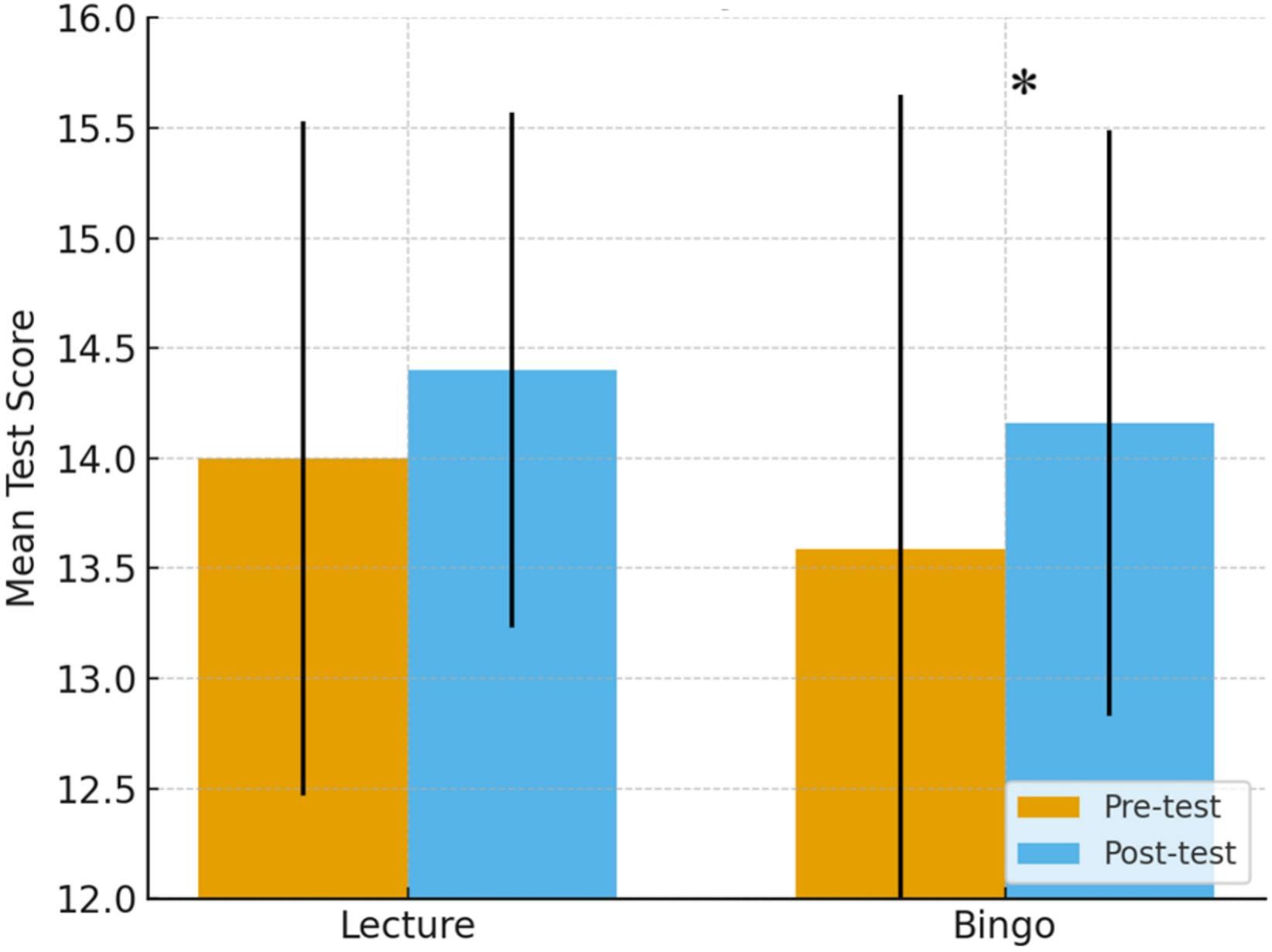
Among the students who completed both the short-term post-test assessment and the long-term follow-up test after six months, individual performance significantly improved over time, with n = 47 in the lecture-only group and n = 87 in the Bingo session group. Both the lecture-only and Bingo groups showed modest improvements in their test scores. While the Lecture group presented a slight mean score increase of +0.40 points (from 14.00 ± 1.53 to 14.40 ± 1.17) and p = 0.105, the Bingo group had a greater mean gain of +0.57 points (from 13.59 ± 2.06 to 14.16 ± 1.33) p = 0.0066. The students in the Bingo group retained more than 110% of their initial performance in the long-term post-test, meaning that they had better mean scores than did those in the short-term post-test, as shown in Table 1. Visual inspection of the bar charts further confirmed these trends (Fig. 2), revealing positive score differences for most students in the Bingo group.
Student perceptions of the Bingo quiz
The Likert-scale responses assessing student perceptions of the Bingo-based quiz demonstrated high levels of engagement and perceived effectiveness. The mean scores across all the items ranged from 4.23 to 4.70, indicating a positive reception. The aspect of engagement and enjoyment of the quiz format had 89% positive reviews, followed closely by the perceived appropriateness of the quiz difficulty, which was 86% positive, and students' interest in similar gamified activities for other topics, which was 88% positive reviews. A summary of all the responses to each question is shown in Table 2. A Likert scale as a percentage of students' perceptions is also shown in Fig. 3. When a reliability indicator, Cronbach's alpha, was performed for the Likert scale items, it was found to be 0.923, indicating excellent internal consistency and reliability of the questionnaire.
The percentage values to each question as found on the Likert scale.
| S. no. | Question | Strongly disagree/disagree (%) | Neutral (%) | Agree/strongly agree (%) |
|---|---|---|---|---|
| 1 | The supporting lectures on hemostasis helped me understand the topic | 7% | 10% | 83% |
| 2 | The PowerPoint lecture on hemostasis uploaded on the LMS was useful | 5% | 8% | 87% |
| 3 | The interactive digital learning quiz on the learning management system (LMS) helped reinforce my learning | 10% | 15% | 75% |
| 4 | The Bingo quiz enhanced my understanding of the topic | 8% | 12% | 80% |
| 5 | The Bingo quiz format was engaging and enjoyable | 4% | 7% | 89% |
| 6 | The difficulty level of the Bingo quiz questions was appropriate | 5% | 9% | 86% |
| 7 | The activities (lecture, LMS resources, and quiz) complemented each other well | 7% | 11% | 82% |
| 8 | The Bingo quiz helped me identify areas in hemostasis where I need improvement | 5% | 10% | 85% |
| 9 | I feel more confident about the topic of hemostasis after participating in these activities | 8% | 13% | 79% |
| 10 | I would like similar activities (lecture, LMS resources, and quiz) in other topics | 4% | 8% | 88% |
LMS: learning management system.

Five major themes were identified following the Braun and Clarke method for thematic analysis14:
- 1.
Engagement & Enjoyment: Students described the Bingo quiz as “fun,” “interactive,” and “engaging,” emphasizing that it sustained their interest and made learning more enjoyable.
- 2.
Enhanced Understanding & Retention: Many students noted that the quiz helped them reinforce key concepts and “improved long-term retention through active recall”.
- 3.
Confidence in Knowledge: Students reported increased confidence in their understanding of hemostasis, stating that the “quiz helped clarify doubts” and “highlighted areas requiring further review”.
- 4.
Suggestions for improvement: Some students suggested minor modifications, such as allowing “more discussion time after the quiz” and “incorporating a wider range of question difficulty levels”.
- 5.
Preference for Similar Learning Activities: Many participants expressed interest in incorporating similar gamified learning approaches for other complex topics in the curriculum.
This study introduced gamification through a Bingo quiz during physiology lectures for first-year medical students to promote interactivity and engagement, while also assessing their knowledge retention. For this, we compared one group that received two lectures with another group that received a lecture supplemented by the Bingo quiz.
Enhancement of academic performanceShort-term retentionAmong the 192 participants in the short-term post-test, the Bingo group had slightly higher scores than the lecture-only group did (mean 14.08 vs. 13.79; median 15 vs. 14), with more students achieving perfect scores (54.2% vs. 42.3%) and scores ≥90% (84.4% vs. 75.7%), although the differences were not statistically significant (p = 0.209). Score variability was lower in the Bingo group, indicating more consistent performance. As the topic of hemostasis was covered the first six months of the Physiology course, its integration with a gamified approach aligned well with our study objective of making complex physiological concepts more engaging and clinically relevant, and we had sufficient time to assess the students for knowledge retention While the lack of a statistically significant difference in scores between groups may be attributed to the single-session nature of the intervention, the trends favoring the Bingo group align with previous studies exploring gamification in medical and allied health education.15 For example, a study by Sannathimmappa et al.9 exploring the use of Bingo-based games in immunology courses with 145 medical students in their 3rd year of college revealed that Bingo games enhanced student engagement and learning outcomes. Immediate feedback, a key feature of the Bingo-based activity, enhances learning by supporting knowledge retention and error correction.16,17 Real-time clarification also reduces misconceptions, a common issue in delayed-feedback models.18
Long-term retentionAmong the 134 students who completed both assessments, the Bingo group showed significant long-term gains (13.59 ± 2.06 to 14.16 ± 1.33, p = 0.0066), with a retention of 110% (increase in the mean score from the short-term post-test session), unlike the lecture-only group, which showed a smaller, nonsignificant gain (+0.40, p = 0.105). The marginal score improvement and more consistent performance among the Bingo group suggest that, over repeated sessions, more robust significant differences might emerge.19 Furthermore, brief exposure to gamification sessions may not have been sufficient to manifest long-term cognitive gains, indicating the need for repeated, longitudinal implementation to assess sustained educational impact.20 In our study, the Bingo group showed a statistically significant improvement in long-term performance, likely due to enhanced engagement, repeated reinforcement, and active learning. Although the lecture group had a slightly higher short-term post-test average, they did not demonstrate significant retention gains, suggesting that better initial performance did not translate into long-term retention. These findings align with prior educational research, which suggests that active learning techniques and spaced reinforcement of both elements present in Bingo can support long-term memory consolidation.21,22 This aligns with cognitive learning theories that emphasize the importance of active engagement, spaced repetition, and retrieval practice in promoting durable learning.23 The improvement in long-term performance may reflect the impact of deeper cognitive processing during the initial session, where learners actively constructed meaning and contextualized new information. Additionally, the delay between assessments and pattern recognition likely encouraged both knowledge preservation and delayed consolidation, allowing for the retrieval of core concepts rather than rote memorization, thereby enriching student learning within a student-centered medical education framework.
Student perceptionsThe students' perceptions were strongly positive, with high Likert ratings (4.23–4.70) and 89% endorsing Bingo as engaging and effective. The thematic analysis revealed key themes of enhanced engagement, improved understanding and retention, increased confidence, constructive suggestions, and a strong preference for gamified methods, further supporting the educational value of this active learning approach in both immediate and sustained learning contexts. In this study, the interactive nature of the Bingo session emerged as a critical factor in its effectiveness. The students reported feeling more involved and alert during the session, in contrast to traditional formats, which often result in the passive absorption of content. This finding aligns with a growing body of literature that supports interactive learning models, particularly when interactivity is emphasized.24 In our context, interactivity allows students to apply theoretical knowledge in real time, promoting deeper learning and reinforcing connections between concepts.25 The greater variability in the Bingo group's retention (SD = 60.3%) indicates that while the approach benefited most students, individual responses varied, which is typical of active learning interventions where personal engagement plays a pivotal role. An important aspect of Bingo-based learning was the promotion of peer learning and group dynamics. The collaborative dimension of the game also contributed to increased student confidence, as evidenced by the qualitative feedback, where the students reported feeling more assured in their responses and more motivated to participate. The psychological safety fostered by group-based activity likely empowered quieter or less confident students to engage more actively in the activity.
Insights into the implementation of BingoBingo, which is typically known as a recreational game of chance, has been restructured as an interactive learning tool to reinforce key physiological concepts8,9,26 and nonphysiological concepts.27,28 This approach aligns with broader efforts to incorporate engaging and participatory teaching methods that foster a deeper understanding of subject matter.
By focusing on individual improvement rather than group-level comparisons, the data highlight the importance of designing instructional strategies that effectively support each learner's cognitive engagement and retention. This finding reinforces the value of incorporating pedagogical elements that enhance comprehension during the learning phase while laying a strong foundation for future recall. Educational theories such as constructivism and self-determination theory provide a solid framework for understanding the benefits of gamification.29 These models propose that learning is most effective when students are actively involved in the construction of knowledge, motivated by autonomy, competence, and relatedness. Unlike more complex or competitive gamified tools such as escape rooms or leaderboards, Bingo-based gamification emphasizes recognition and recall in a relatively low-stress environment while being competitive.30
Limitations and future prospectsThe primary source of data for evaluating the effectiveness of Bingo-based lectures was student self-reported feedback. While this provides valuable insights into student perceptions, it may also be subject to response bias. Taken together, the findings reveal the educational value of integrating low-barrier, high-engagement gamification strategies such as Bingo into medical curricula, as shown by several previous studies.8,9,26,28 Despite the limitations posed by a single session format, the study highlights how gamified learning can enhance engagement, promote interactive knowledge application, foster peer collaboration, and increase student confidence, which are all critical components in the formation of effective medical professionals. Another limitation of the present study is the absence of a sex- and gender-based analysis, which may influence the generalizability and interpretation of the findings across diverse populations. Also, in this study, not all students attended the initial sessions, and a proportion did not complete the long-term post-test despite multiple reminders. These exclusions were primarily due to logistical factors such as absenteeism and scheduling constraints, rather than differences in academic performance or prior knowledge. Future studies involving multiple sessions across diverse topics and student cohorts would help build a more comprehensive understanding of the long-term academic and attitudinal impacts of gamification in medical education.
ConclusionBingo-based gamification in medical physiology lectures demonstrates significant potential for enhancing engagement and supporting long-term retention. Positive student feedback and measurable score improvements after six months, particularly in the Bingo group, highlight its effectiveness. Sustained gains suggest that gamified sessions can reinforce key concepts and promote deeper cognitive consolidation beyond the classroom. While not a substitute for traditional lectures, Bingo offers an enjoyable, structured complement, especially beneficial for early learners. Its visual format encourages spaced repetition and pattern recognition, facilitating both knowledge preservation and delayed consolidation, thereby enriching student learning within a student-centered medical education framework.
Supplementary File 1
Supplementary File 2