

The COVID-19 pandemic significantly transformed higher education, accelerating the adoption of hybrid learning models. These models combine face-to-face and virtual instruction, posing both opportunities and challenges for teaching and assessment. In the context of optometry education, this study explored how formative assessment strategies are perceived and implemented within a hybrid modality in the “Binocular Vision Anomalies” Learning Unit at the National Polytechnic Institute.
Material and methodsA non-experimental, descriptive-correlational study was conducted with 73 optometry students enrolled in the evening shift. A Likert-type questionnaire, adapted and validated from a prior study, was administered through Google Forms. The instrument included 14 closed items and 2 open-ended questions. Descriptive statistics and Spearman's Rho correlation coefficient were used to analyze the relationship between students' perceptions of hybrid education and formative assessment.
ResultsThe analysis revealed a moderate positive correlation (Spearman's Rho = +0.65) between the hybrid modality and the perceived effectiveness of formative assessment. Students reported favorable views of hybrid learning, particularly in terms of curricular planning and use of technological resources. Clinical case analysis was identified as the most effective assessment strategy, while alignment with learning styles and teaching methodology were key factors in students' preferences.
ConclusionThe findings suggest that hybrid education facilitates effective formative assessment, supporting active learning and personalized feedback. However, the moderate correlation also indicates the influence of additional variables. These results underscore the need to optimize formative assessment strategies tailored to hybrid contexts, integrating digital tools while maintaining coherence with pedagogical objectives.
La pandemia de COVID-19 transformó significativamente la educación superior, acelerando la adopción de modelos de aprendizaje híbrido. Estos modelos combinan la instrucción presencial y virtual, lo que representa tanto oportunidades como desafíos para la enseñanza y la evaluación. En el contexto de la educación en optometría, este estudio exploró cómo se perciben e implementan las estrategias de evaluación formativa dentro de una modalidad híbrida en la Unidad de Aprendizaje “Anomalías de la Visión Binocular” del Instituto Politécnico Nacional.
Material y métodosSe realizó un estudio no experimental, de tipo descriptivo-correlacional, con 73 estudiantes de la carrera de Optometría inscritos en el turno vespertino. Se aplicó un cuestionario tipo Likert, adaptado y validado a partir de un estudio previo, a través de Google Forms. El instrumento incluyó 14 ítems cerrados y 2 preguntas abiertas. Se utilizaron estadísticas descriptivas y el coeficiente de correlación Rho de Spearman para analizar la relación entre las percepciones de los estudiantes sobre la educación híbrida y la evaluación formativa.
ResultadosEl análisis reveló una correlación positiva moderada (Rho de Spearman = +0.65) entre la modalidad híbrida y la efectividad percibida de la evaluación formativa. Los estudiantes manifestaron opiniones favorables hacia el aprendizaje híbrido, particularmente en lo referente a la planeación curricular y el uso de recursos tecnológicos. El análisis de casos clínicos fue identificado como la estrategia de evaluación más eficaz, mientras que la alineación con los estilos de aprendizaje y la metodología docente fueron factores clave en las preferencias estudiantiles.
ConclusiónLos hallazgos sugieren que la educación híbrida facilita una evaluación formativa efectiva, al apoyar el aprendizaje activo y la retroalimentación personalizada. Sin embargo, la correlación moderada también indica la influencia de variables adicionales. Estos resultados subrayan la necesidad de optimizar las estrategias de evaluación formativa adaptadas a contextos híbridos, integrando herramientas digitales sin perder coherencia con los objetivos pedagógicos.
With technological advancements, digital media and resources have undergone significant transformations, affecting not only the social sphere but also education. Academic institutions face the need to adapt to these changes and implement strategies that respond to the growing demand for digitalized teaching. This context presents challenges for both students and teachers, who must ensure a meaningful and effective teaching-learning process.1
Pre-existing challenges in higher education in MexicoBefore the pandemic, higher education in Mexico already faced challenges related to accessibility and teaching quality. According to the Government of Mexico City (2021), these challenges included the lack of access to education for disadvantaged minorities, the need to measure the impact of learning on graduates' employability, universities' commitment to sustainable development, the integration of competency-based education, and the promotion of comprehensive health for teachers and students.2
Impact of the pandemic on higher educationThe COVID-19 pandemic had a massive impact on education worldwide. According to UNESCO,3 91% of students worldwide were affected by university closures. In Latin America, 156 million students faced educational interruptions, while in Mexico, 37,589,611 students were affected, of whom 4,561,792 were enrolled in higher education.4
This scenario highlighted the importance of information and communication technologies (ICTs) in higher education. Mexico ranks 82nd worldwide in terms of internet access in schools, highlighting the need to improve educational technological infrastructure.4
The hybrid modality as a response to the educational crisisSince the pandemic, both public and private institutions have implemented virtual activities to replace face-to-face classes. This transition was particularly significant at the upper-secondary level, revealing challenges in digital infrastructure and the experience of teachers and students with technological tools. Platforms such as Google Meet, Zoom, and WebEx were used, prompting the analysis of hybrid teaching models.5
The hybrid model combines face-to-face and virtual teaching, allowing for greater flexibility in teaching and assessment without compromising educational objectives.6 Additionally, it facilitates more collaborative and personalized assessment by integrating structured and unstructured learning. It also provides teachers with the opportunity to use multimedia content and digital resources, enriching teaching.5
Formative assessment in a hybrid environmentFormative assessment in hybrid environments plays a key role by enabling continuous monitoring of student learning across both face-to-face and virtual environments. It is defined as a set of practices aimed at collecting evidence of student performance during the teaching-learning process to provide feedback and inform instructional adjustments.7 In hybrid settings, it can be implemented through digital tools such as interactive quizzes, online rubrics, discussion forums, and participation tracking on virtual platforms, complemented by in-person observations and self-assessment. Compared to traditional learning environments, the hybrid modality offers students more frequent, personalized, and multimodal feedback, allowing them to reflect more effectively on their own learning processes and outcomes. The combination of synchronous and asynchronous interactions promotes metacognitive awareness and gives learners greater autonomy to identify both strengths and areas needing improvement, at their own pace and with varied learning resources.8 The effectiveness of formative assessment in this model can be evaluated through indicators such as progressive improvement in student performance, active use of feedback, and pedagogical adaptations based on data gathered throughout the course. When implemented coherently, it enhances self-regulated learning and more responsive teaching, ultimately strengthening educational quality in hybrid environments. In the hybrid modality, formative assessment presents both opportunities and challenges. It allows students to identify their strengths and weaknesses and gives teachers the ability to adjust their teaching methods in real time, promoting active participation between both parties. For formative assessment to be effective, teachers must establish clear evaluation criteria, involve students in self-assessment and self-reflection, and provide continuous and individualized feedback.
In the academic context, the combined use of skills, strategies, and technologies has enabled more effective formative assessment, mediated by digital tools.9 This transition has resulted in a hybrid model where learning is flexible and accessible, benefiting both teachers and students.6
Challenges of formative assessment in hybrid environmentsDespite its advantages, using a blended learning environment poses challenges in terms of student experience. Although the use of technologies in education has been promoted, little is known about how students perceive these environments and what they consider effective.4 This underscores the importance of investigating students' experiences in hybrid environments to improve the quality of teaching and assessment.
Contextualization of the problemWithin the optometry degree, subjects are referred to as Learning Units (LU). One of these is Binocular Vision Anomalies, offered during the fourth semester of the degree. This LU is characterized as a theoretical-practical course and is generally taught by three to four teachers per group due to the number of students enrolled in that semester.
Before the pandemic, the Binocular Vision Anomalies LU was taught face-to-face, using some digital resources. However, the transition to online education forced teachers to adapt to digital platforms to teach classes and assess student performance. Although the LU has returned to face-to-face instruction, a hybrid teaching model has been adopted. The problem lies in the fact that formative assessment strategies used in face-to-face settings have been transferred to the hybrid environment without specific adaptation. This raises the need to analyze their effectiveness and determine whether modifications are required to align with the hybrid modality. Therefore, this study addresses the need to evaluate the effectiveness of formative assessment strategies within the Binocular Vision Anomalies LU in a hybrid education context. Specifically, it seeks to answer the following research questions: How effective are formative assessment strategies in the hybrid modality? What adjustments or modifications are necessary to enhance student learning? How does active student participation in formative assessment influence their learning outcomes and teaching practices? Additionally, which digital tools can be employed to strengthen formative assessment without increasing the instructor's workload? By investigating these questions, the study aims to provide evidence-based insights to optimize formative assessment practices tailored to hybrid learning environments.
Material and methodsResearch contextThis research was conducted at the Interdisciplinary Center for Health Sciences, Santo Tomás Unit (CICS UST), part of the National Polytechnic Institute (IPN). This educational center is located in downtown Mexico City and offers a Bachelor's Degree in Optometry in a school-based format for both morning and evening shifts. Within the fourth semester of this program, the Binocular Vision Anomalies LU is taught, which served as the specific context for this research.
Participants and sampleThe sample consisted of 73 students who met the following selection criteria:
- (a)
Being enrolled at the IPN
- (b)
Being registered in the evening shift of the Bachelor's Degree in Optometry
- (c)
Have taken the Binocular Vision Anomalies LU during the February to June 2024 semester.
No restrictions were established regarding the participants' socioeconomic status, age, or geographical background, allowing for greater variability and representativeness of the sample.10
Research designThe research design was non-experimental, descriptive-correlational, as the variables were not directly manipulated, and their behavior was observed in a natural context.10 This approach allows for describing and analyzing the relationship between the hybrid modality and formative assessment without establishing causality.11
A Likert-type scale was used, recognized for its reliability and validity in measuring perceptions and attitudes in educational contexts.12,13
InstrumentA polytomous questionnaire with Likert-type response options was used, which included:
- (a)
14 Likert scale items (disagree, agree, and strongly agree).
- (b)
2 open-ended questions aimed at exploring students' qualitative perceptions.
The questionnaire was adapted from the instrument used in the study “Hybrid Education and Formative Assessment in Students from a Public University in Lima, 2022,” which had previously been validated through a pilot test. The instrument's validity was established by experts in the field who evaluated its relevance, coherence, and pertinence. Subsequently, reliability was determined using Cronbach's alpha coefficient,14 obtaining a value of 0.71 for the hybrid education variable and 0.734 for the formative assessment variable.
The items were grouped into the following dimensions:
- •
Curricular Planning: 5 questions.
- •
Use of Resources: 5 questions.
- •
Process-Oriented Learning Planning: 4 questions.
- •
Process-Oriented Learning Assessment: 2 open-ended questions.
The questionnaire was administered at the CICS UST, IPN, in coordination with the Optometry Department to obtain the necessary permissions. Google Forms was used as the platform to facilitate anonymous and confidential data collection.15 Prior to responding, participants were presented with an informed consent form detailing the study's characteristics, ensuring professionalism, ethical standards, and confidentiality in data handling.16 The study was assessed and determined not to require formal ethical approval because it involved voluntary, anonymous survey data collection without any intervention or risk to participants. All procedures adhered to institutional guidelines for educational research involving minimal risk, and the research complied with ethical principles of informed consent, confidentiality, and voluntary participation. Therefore, no formal ethics review process was necessary, consistent with the regulations established by the National Polytechnic Institute for non-invasive educational studies.
Data analysisFor statistical analysis, Microsoft Excel from the Microsoft 360 package was used, applying descriptive statistics to characterize the participants and to describe the variables, and Spearman's Rho correlation coefficient to analyze the relationship between the hybrid modality and formative assessment, given the ordinal nature of the data.17 This analysis allowed for identifying the direction and strength of the relationship between the variables without assuming normality in the data.18
ResultsSpearman correlation analysisTo examine the relationship between students' perceptions of the hybrid modality and their perceptions of formative assessment in the Binocular Vision Anomalies learning unit, Spearman's Rho correlation coefficient was used. This test was selected due to its non-parametric nature and suitability for ordinal variables, such as those obtained through a Likert scale.18,19 Since Likert scale responses are ordinal, Spearman's Rho is appropriate for assessing the strength and direction of the relationship between the variables without assuming data normality.16 The analysis yielded a Spearman's Rho value of +0.65, indicating a moderate positive correlation between students' positive perceptions of the hybrid modality and their positive perceptions of formative assessment.20 This result suggests that students who perceive the hybrid modality more favorably also tend to report more positive perceptions of formative assessment and its outcomes.
Descriptive statistics of the variables and their dimensionsDistribution of the hybrid education variable and its dimensionsTable 1 presents the frequency distribution for the hybrid education variable and its dimensión, curricular planning and use of resources.
Distribution of the hybrid education variable and its dimensions.
| Levels | Hybrid education | Curricular planning | Use of resources | |||
|---|---|---|---|---|---|---|
| f | % | f | % | f | % | |
| Desagree | 22 | 33.01 | 12 | 3.29 | 20 | 5.48 |
| Agree | 172 | 23.56 | 62 | 16.99 | 110 | 30.14 |
| Totaly agree | 526 | 71.23 | 291 | 79.72 | 235 | 64.38 |
| Total | 730 | 100 | 365 | 100 | 365 | 100 |
f = absolute frequency.
The distribution indicates that the majority of students agreed or strongly agreed with the statements related to curricular planning and use of resources, suggesting a generally positive perception of the hybrid modality in these areas.
The results show that 71.23% of the students were totally in agreement with the hybrid modality, while only 33.01% expressed disagreement. Similarly, the dimensions of curricular planning and use of resources also registered high acceptance rates, with 79.72% and 64.38%, respectively, in the totally in agreement category.
These findings suggest a generally positive perception of the hybrid modality, particularly in terms of curricular planning and resource utilization.
Distribution of the formative assessment variable and its dimensionsTable 2 presents the frequency distribution for the formative assessment variable and its dimensión, planning oriented to learning processes.
The results reveal thath 76.38% of the students totally agreed that the formative assessment applied was relevant and effective.
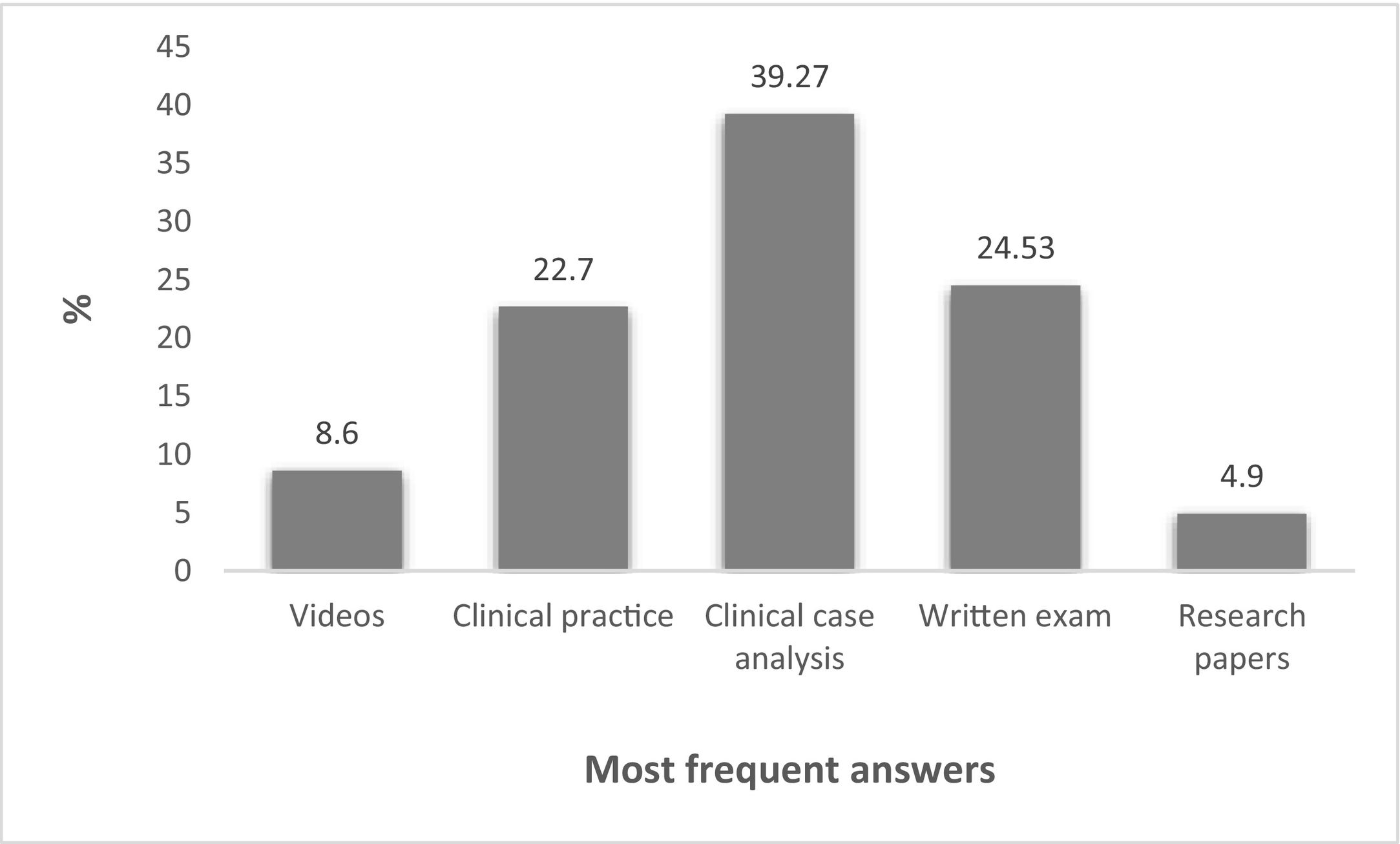
Qualitative analysis of open-ended questionsAssessment oriented to learning processesThe item asked: “Mention 5 forms of assessment that you consider should be applied by the instructor for a Good development of the academic program.”
The most effective form of assessment indicated was clinical case analysis, mentioned by 39.27% of the students. In contrast, research papers were considered the least effective strategy (4.90%) (Fig. 1).
Report of most commonly found responses
The item explored “What did you base your selection of the assessment forms on?”
64.38% of the participants indicated they selected the strategies because they aligned with their learning style. 16.43% mentioned an increase in their grades. 19.18% reported more practice in the learning process (Fig. 2).

According to the most frequent responses, clinical case análisis was identified as the most effective form of assessment, mentioned by 39.27% of the participants. In contrast, research papers were considered the least effective strategy with only 4.90% preference, although some students appreciated their contribution to academic development.
A total of 64.38% of participants chose the strategies because they felt aligned with their learning style. Additionally, they noted that these assessment forms maintained methodological coherence with the teaching approach used by the instructor in the learning unit. Participants also indicated that these strategies contributed to better academic outcomes, with 16.43% reporting a perceived increase in grades and 19.18% noting greater engagement in the learning process. It is important to clarify that these data reflect students' perceptions and self-reported experiences, rather than objective measures of academic performance.
DiscussionIn this study, a moderate correlation (Spearman's Rho = +0.65) was observed between students' perceptions of formative assessment and their perceptions of the hybrid learning modality, indicating a positive relationship. This suggests that students who reported more positive perceptions of hybrid learning modalities were also more likely to report more positive perceptions of formative assessment outcomes. However, despite the significant relationship between the variables, the moderate correlation indicates that other factors might influence the effectiveness and perception of formative assessment in hybrid environments.
The descriptive analysis showed a high absolute frequency of positive responses for both variables, indicating a favorable perception and widespread acceptance of both formative assessment strategies and the hybrid learning modality among students. These results suggest that students generally viewed hybrid education as a viable and supportive context for the implementation of formative assessment. However, it is important to note that these findings reflect self-reported perceptions rather than objective measures of effectiveness.
These findings are consistent with those reported by Aguilar,21 who emphasized that the hybrid modality provides greater flexibility in teaching and learning processes, which optimizes the implementation of formative assessment practices. Additionally, Fernández et al.22 noted that the proper integration of digital tools in the hybrid modality promotes continuous and timely feedback, which is crucial for formative assessment, aligning with the positive perception observed in this study.
On the other hand, Anaya et al.23 found that the hybrid modality encourages participatory and autonomous learning, which aligns with the results of this research, where participants perceived a match between the hybrid modality and their learning style. Similarly, Hernández et al.24 highlighted the importance of both synchronous and asynchronous interaction in the hybrid modality to strengthen formative assessment, a factor that also emerged in this research as key to the effectiveness of formative assessment.
Finally, Herrera25 argued that the hybrid modality offers an adaptive and dynamic learning environment, which facilitates the implementation of formative assessment practices aligned with students' needs. This finding is reflected in the results of this research, where the high frequency of positive perception of formative assessment strategies suggests that students perceive coherence between formative assessment and the methodology applied in the hybrid modality.
In conclusion, the results of this study not only provide empirical evidence of the moderate relationship between formative assessment and the hybrid modality but also corroborate trends identified in previous research. These findings highlight the need to continue exploring how to optimize the integration of both practices to maximize academic performance and enhance student learning.
According to the findings obtained in this research, the following recommendations and suggestions are proposed for future research and educational practices:
- (a)
It is suggested that the instrument used in this study be adapted and applied to teaching staff, in order to contrast perceptions of formative assessment from both the teacher's and the student's perspectives. This will allow for an exploration of how formative assessment is planned and implemented in teaching practice, potentially providing new findings and complementary perspectives.
- (b)
Future research should delve deeper into the dimensions covered in this study (such as curricular planning, resource utilization, and assessment oriented toward learning processes), with the goal of exploring the relationship between formative assessment and the hybrid educational modality in more detail. This would contribute to a more comprehensive analysis and a deeper understanding of learning dynamics in hybrid environments.
- (c)
It is recommended that educational institutions ensure the effective implementation of Information and Communication Technologies (ICT) as key tools to optimize formative assessment. This will support the holistic development of students, preparing them to face future challenges in an increasingly digitalized and changing environment.
- (d)
It is suggested that educational institution administrators take into account the findings of this research when hiring teachers. This will ensure the selection of profiles that promote and foster effective formative assessment practices aligned with the hybrid modality, aiming to maximize academic benefits and personal growth for students.
In summary, these recommendations not only provide valuable guidelines for future research but also offer actionable strategies for educational contexts seeking to enhance the quality of teaching and optimize learning in hybrid modalities.
Use of generative AI and AI-assisted technologiesDuring the preparation of this work, the authors declare that they used Jenni AI to improve the readability, spellcheck and grammar check of the translation since the manuscript was initially written in Spanish. After using this tool, the authors reviewed and edited the content as needed and took full responsibility for the content of the published article.
Ethical approvalNot applicable. This study did not involve human participants, animals, or sensitive data requiring ethical approval.
FundingThis research did not receive any specific grant from funding agencies in the public, commercial, or not-for-profit sectors.
Supplementary material: Original instrument provided.