
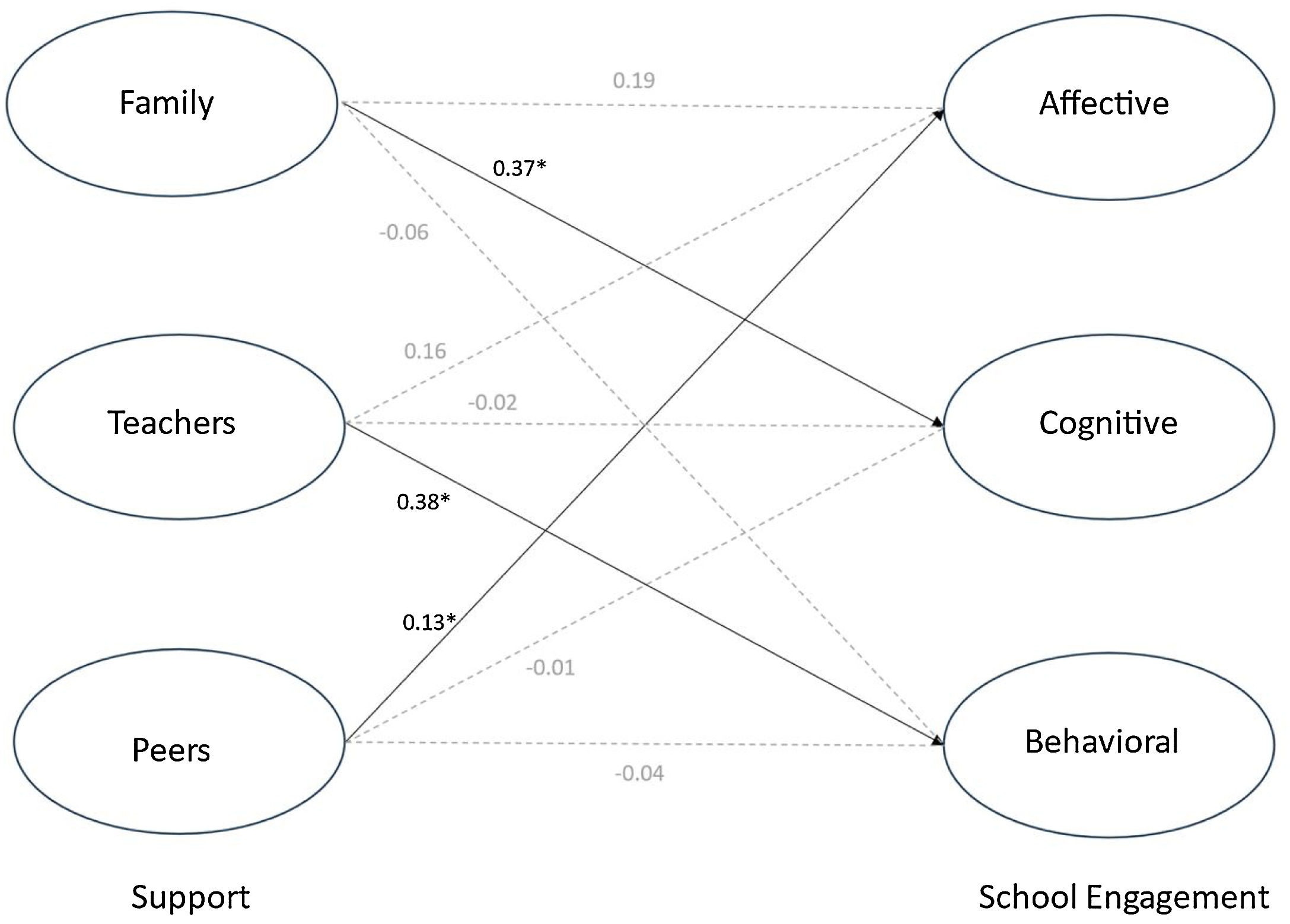
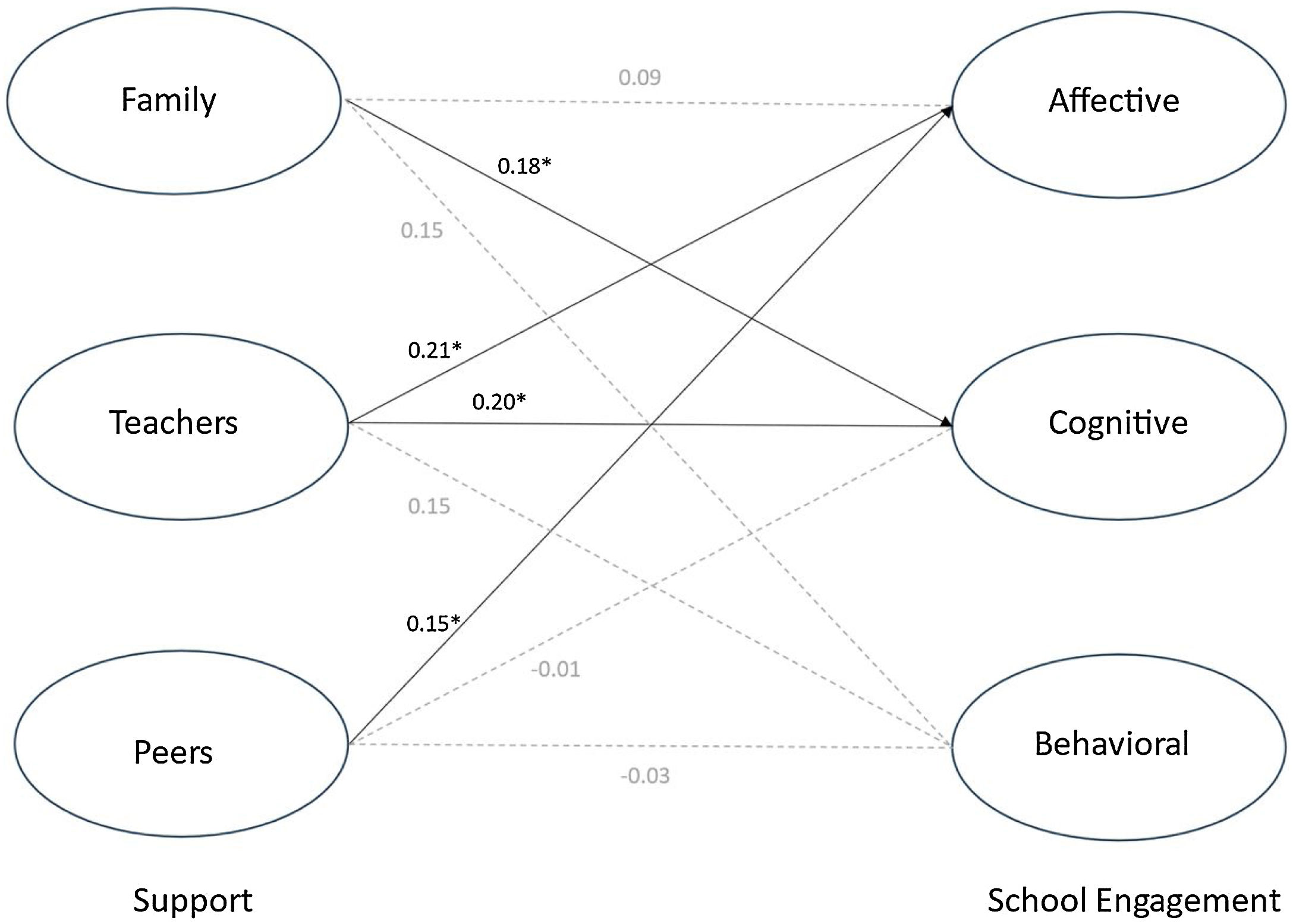

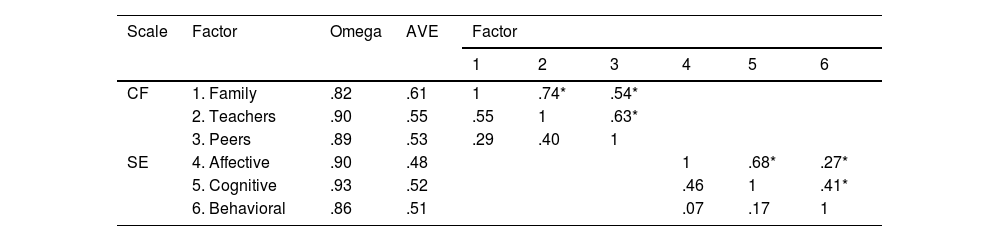
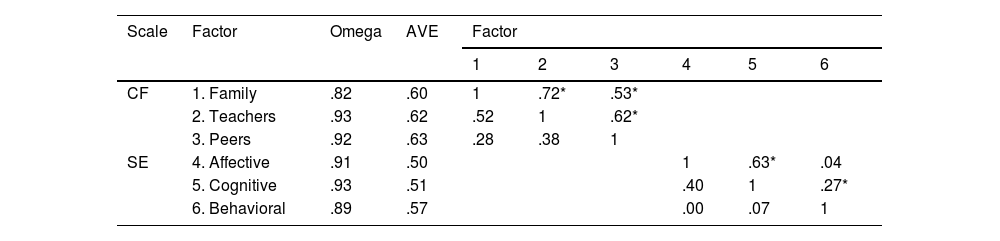


School engagement has been proven to be a crucial factor in the development of a successful educational trajectory. It is a multidimensional concept encompassing affective, cognitive, and behavioral aspects, all of which are influenced by the social support students receive from the contexts in which they grow, with the most significant being family, teachers, and peers. The primary objective of this study is to analyze the impact of family, teacher, and peer support on students' levels of affective, cognitive, and behavioral school engagement in the subsequent year while also examining variations between primary and secondary school students. This study involved 927 elementary and secondary school students who were assessed over two consecutive years. The results of the multigroup structural equation analysis revealed that family, teacher, and peer support levels had distinct predictive capabilities on different components of school engagement at both educational levels. Specifically, family support predicted levels of cognitive engagement, while peer support predicted levels of affective engagement. Furthermore, for elementary school students, teacher support emerged as a predictor of behavioral engagement, while for secondary students, it was identified as a predictor of cognitive and affective engagement. This study highlights how important family, teacher, and peer support are for shaping different aspects of school engagement. By understanding these distinct influences, educators and families can work together to create supportive environments that help students thrive academically and emotionally.
El compromiso escolar ha demostrado ser un factor crucial para el desarrollo de trayectorias educativas exitosas. Se trata de un constructo multidimensional que incluye aspectos afectivos, cognitivos y conductuales, que se ve influenciado por los contextos en los que los y las estudiantes se desarrollan, siendo los más relevantes la familia, el profesorado y los pares. El objetivo principal de este trabajo es analizar la influencia del apoyo de la familia, el profesorado y los pares que los y las estudiantes tienen sobre los niveles de compromiso escolar afectivo, cognitivo y conductual que presentan al siguiente curso, así como las variaciones entre el alumnado de educación primaria y secundaria. En este estudio participaron 927 estudiantes de educación primaria y secundaria, evaluados en dos cursos consecutivos. Los resultados de los análisis de ecuaciones estructurales multigrupo mostraron que el apoyo recibido de la familia, el profesorado y los pares poseen capacidad predictiva diferenciada sobre los componentes del compromiso escolar en ambos niveles educativos. Concretamente, la familia predijo los niveles de compromiso cognitivo y los pares los niveles de compromiso emocional. Además, en el caso de los y las estudiantes de educación primaria, el apoyo recibido por el profesorado predijo el compromiso conductual y en el caso de los y las estudiantes de secundaria el compromiso afectivo y cognitivo. Este estudio destaca la importancia del apoyo de familia, profesorado y pares para moldear diferentes aspectos del compromiso escolar. Al comprender estas influencias distintas, educadores y familias pueden trabajar juntos para crear entornos de apoyo que ayuden a los y las estudiantes a prosperar académica y emocionalmente.