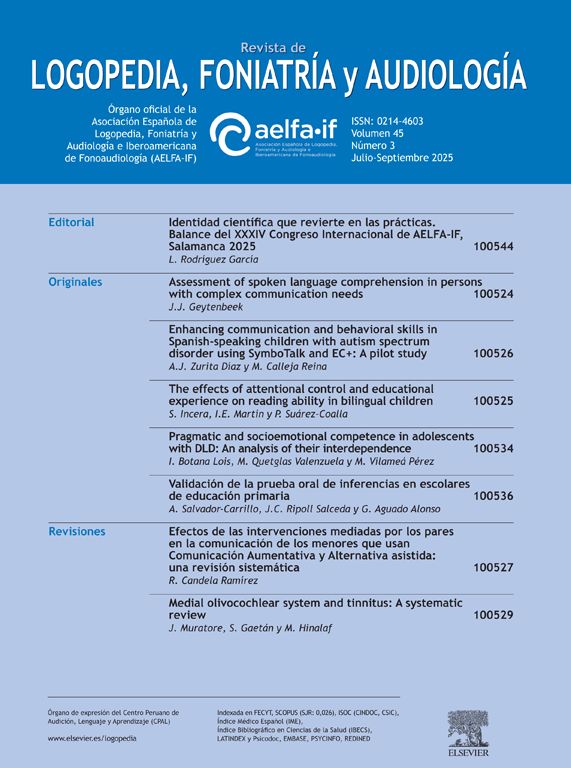
metricas
Revista de Logopedia, Foniatría y Audiología Pragmatic and socioemotional competence in adolescents with DLD: An analysis of ...
Información de la revista
Vol. 45. Núm. 3.
(Julio - Septiembre 2025)
Cita
Cita
Compartir
Descargar PDF
Más opciones de artículo
Visitas
832
Vol. 45. Núm. 3.
(Julio - Septiembre 2025)
Original article

Pragmatic and socioemotional competence in adolescents with DLD: An analysis of their interdependence

Competencia pragmática y socioemocional en adolescentes con TDL: análisis de su interdependencia
Visitas
832
Iria Botana Lois, Mónica Quetglas Valenzuela
Autor para correspondencia
monica.quetglas@udc.es

Corresponding author.
, Mónica Vilameá Pérez
Department of Psychology, Elviña Campus, 15701 A Coruña, Spain
Este artículo ha recibido
Información del artículo
Resumen
Texto completo
Bibliografía
Descargar PDF
Estadísticas
Abstract
Introduction and objectives

Adolescence is a complex period of development, as it involves crucial challenges and changes at the cognitive, linguistic, and socio-emotional levels. In the context of Developmental Language Disorder (DLD), it is common for difficulties to increase in the face of new demands and challenges. The aim of this study is to determine the extent to which DLD typical linguistic limitations are associated with impairments in pragmatic and socio-emotional competence in adolescence, and whether one influences the other.

Materials and methods

Based on the work of Andrés-Roqueta and Conti-Ramsden and colleagues, the CCC-2 and SDQ parent versions were administered to a sample of 18 adolescents aged 10 and 18 years old, 9 of them with DLD and the other 9 with typical development.

Results

Significant differences were identified between the two groups, both in pragmatic and socio-emotional difficulties, while no differences were found in prosociality.

Conclusions

It was verified that deficits in pragmatics in adolescents with DLD are related to difficulties at a social and emotional level by hindering the development and maintenance of social relationships and by negatively affecting the expectation of self-efficacy and socio-emotional welfare. Consequently, it is concluded that speech therapy intervention for language and communication disorders must include the functional use of language in various contexts from an early age, as it will allow the development of satisfactory relationships and protection against exclusion, which will improve well-being in adolescence and long term.

Keywords:
Language
DLD
Adolescents
Pragmatics
Socio-emotional
Resumen
Antecedentes y objetivo

La adolescencia es un período de desarrollo complejo que implica desafíos y cambios cruciales a nivel cognitivo, lingüístico y socioemocional. En el contexto del trastorno del desarrollo del lenguaje (TDL), es común que las dificultades aumenten ante nuevas demandas y retos. El objetivo de este estudio es analizar en qué medida las alteraciones lingüísticas propias del TDL en la adolescencia implican alteraciones en las competencias pragmática y socioemocional, y cómo unas actúan sobre las otras.

Materiales y métodos

Partiendo de los trabajos de Andrés-Roqueta y Conti-Ramsden et al., se administraron las versiones para padres de los cuestionarios CCC-2 y SDQ a una muestra de 18 adolescentes de entre 10 y 18 años: 9 con TDL y 9 con desarrollo típico.

Resultados

Se identificaron diferencias significativas entre ambos grupos en la competencia pragmática y en la socioemocional, mientras que en prosocialidad no se observaron diferencias significativas.

Conclusiones

Se confirma que los déficits en el uso del lenguaje en adolescentes con TDL están relacionados con dificultades a nivel social y emocional, ya que dificultan el desarrollo y el mantenimiento de relaciones sociales, y afectan negativamente a la expectativa de autoeficacia y al bienestar. En consecuencia, se concluye que la intervención logopédica en los trastornos del lenguaje y la comunicación debe incluir el uso funcional del lenguaje en diversos contextos desde edades tempranas, ya que esto favorecerá el desarrollo de relaciones satisfactorias y la protección contra la exclusión, mejorando así el bienestar durante la adolescencia y a largo plazo.


Palabras clave:
Lenguaje
TDL
Adolescentes
Pragmática
Socioemocional

Artículo

Opciones para acceder a los textos completos de la publicación Revista de Logopedia, Foniatría y Audiología
Suscriptor
Suscriptor de la revista

Si ya tiene sus datos de acceso, clique aquí.

Si olvidó su clave de acceso puede recuperarla clicando aquí y seleccionando la opción "He olvidado mi contraseña".
Comprar
Comprar acceso al artículo

Comprando el artículo el PDF del mismo podrá ser descargado

Comprar ahora
Contactar
Teléfono para suscripciones e incidencias
De lunes a viernes de 9h a 18h (GMT+1) excepto los meses de julio y agosto que será de 9 a 15h
Llamadas desde España
932 415 960
Llamadas desde fuera de España
+34 932 415 960
E-mail
References
[Andrés Roqueta and Estevan, 2010]
C. Andrés Roqueta, R.A.C. Estevan.
Dificultades pragmáticas en el trastorno específico del lenguaje. El papel de las tareas mentalistas.
Psicothema, 22 (2010), pp. 677-683
[Andrés Roqueta et al., 2012]
C. Andrés Roqueta, R.A.C. Estevan, R.F. Buils.
Cognición social y competencia pragmática. El caso de los niños y niñas con trastorno específico del lenguaje.
International Journal of Psychological Research (Medellin), 5 (2012), pp. 59-69
[Andrés-Roqueta et al., 2021]
C. Andrés-Roqueta, I. Garcia-Molina, R. Flores-Buils.
Association between CCC-2 and structural language, pragmatics, social cognition, and executive functions in children with developmental language disorder.
[Andreu et al., 2021]
L. Andreu, N. Ahufinger, A. Igualada, M. Sanz-Torrent.
Descripción del cambio del TEL al DLD en contexto angloparlante.
Revista de Investigación en Logopedia, 11 (2021), pp. 9-20
[Bishop, 2003]
D.V.M. Bishop.
The Children's Communication Checklist. Second Edition (CCC-2) manual.
Harcourt Assessment, (2003),
[Bishop, 2010]
D.V.M. Bishop.
Which neurodevelopmental disorders get researched and why?.
[Bishop et al., 2016]
D.V.M. Bishop, M.J. Snowling, P.A. Thompson, T. Greenhalgh, C. Consortium.
CATALISE: A multinational and multidisciplinary Delphi consensus study. identifying language impairments in children.
PLoS ONE, 11 (2016), pp. e0158753
[Bishop et al., 2017]
D.V.M. Bishop, M.J. Snowling, P.A. Thompson, T. Greenhalgh.
Phase 2 of CATALISE: A multinational and multidisciplinary Delphi consensus study of problems with language development: Terminology.
Journal of Child Psychology and Psychiatry, 58 (2017), pp. 1068-1080
[Conti-Ramsden and Botting, 2004]
G. Conti-Ramsden, N. Botting.
Social difficulties and victimization in children with SLI at 11 years of age.
Journal of Speech, Language, and Hearing Research, 47 (2004), pp. 145-161
[Conti-Ramsden et al., 2013]
G. Conti-Ramsden, P.L.H. Mok, A. Pickles, K. Durkin.
Adolescents with a history of specific language impairment (SLI): Strengths and difficulties in social, emotional and behavioral functioning.
Research in Developmental Disabilities, 34 (2013), pp. 4161-4169
[Corder and Foreman, 2009]
G.W. Corder, D.I. Foreman.
Nonparametric statistics for non-statisticians: A step-by-step approach, 2nd ed..
[De Barbieri et al., 1999]
Z. De Barbieri, M. Maggiolo, S. Alfaro.
Trastornos de la comunicacion oral en niños que asisten a control de salud en un consultorio de atencion primaria.
Revista Chilena de Pediatria, (1999),
[Durkin and Conti-Ramsden, 2007]
K. Durkin, G. Conti-Ramsden.
Language, social behavior, and the quality of friendships in adolescents with and without a history of specific language impairment.
Child Development, 78 (2007), pp. 1441-1457
[Fujiki et al., 2002]
M. Fujiki, B. Brinton, D. Clarke.
Emotion regulation in children with specific language impairment.
Language, Speech, and Hearing Services in Schools, 33 (2002), pp. 102-111
[Goodman et al., 1998]
R. Goodman, H. Meltzer, V. Bailey.
The strengths and difficulties questionnaire: A pilot study on the validity of the self-report version.
European Child and Adolescent Psychiatry, 7 (1998), pp. 125-130
[Harris, 2013]
J.C. Harris.
New terminology for mental retardation in DSM-5 and ICD-11.
Current Opinion in Psychiatry, 26 (2013), pp. 260-262
[Ibáñez-Rodríguez et al., 2021]
A. Ibáñez-Rodríguez, N. Ahufinger, L. Ferinu, J. García-Arch, L. Andreu, M. Sanz-Torrent.
Dificultades sociales, emocionales y victimización específica por el lenguaje en el trastorno del desarrollo del lenguaje.
Revista de Logopedia, Foniatría y Audiología, 41 (2021), pp. 40-48
[McGregor, 2020]
K.K. McGregor.
How we fail children with developmental language disorder.
Language, Speech & Hearing Services in Schools (Online), 51 (2020), pp. 981-992
[Mendoza Lara, 2016]
E. Mendoza Lara.
Trastorno específico del lenguaje (TEL): Avances en el estudio de un trastorno invisible.
Pirámide, (2016),
[Monfort et al., 2004]
M. Monfort, A. Juárez Sánchez, I. Monfort Juárez.
Niños con trastornos pragmáticos del lenguaje y de la comunicación descripción e intervención.
Entha, (2004),
[Prieto et al., 2021]
C. Prieto, C. Sepúlveda, G. Soto.
Instrumentos de evaluación pragmática y comunicativa en español.
Logos: Revista de Lingüística, Filosofía y Literatura, 31 (2021), pp. 3-25
[Raven et al., 1996]
J.C. Raven, J.H. Court, J. Raven.
Test de matrices progresivas. Escalas coloreada, general y avanzada. Manual.
TEA Ediciones, (1996),
[Sanz-Torrent and Andreu, 2023]
M. Sanz-Torrent, L. Andreu.
El trastorno del desarrollo del lenguaje (DLD): Una mirada desde la investigación hacia la práctica.
Pirámide, (2023),
[St Clair et al., 2011]
M.C. St Clair, A. Pickles, K. Durkin, G. Conti-Ramsden.
A longitudinal study of behavioral, emotional and social difficulties in individuals with a history of specific language impairment (SLI).
Journal of Communication Disorders, 44 (2011), pp. 186-199
[Toseeb et al., 2017]
U. Toseeb, A. Pickles, K. Durkin, N. Botting, G. Conti-Ramsden.
Prosociality from early adolescence to young adulthood: A longitudinal study of individuals with a history of language impairment.
Research in Developmental Disabilities, 62 (2017), pp. 148-159
[Verzeletti et al., 2016]
C. Verzeletti, V.L. Zammuner, C. Galli, S. Agnoli.
Emotion regulation strategies and psychosocial well-being in adolescence.
[Villanueva et al., 2008]
P. Villanueva, Z. de Barbieri, H.M. Palomino, H. Palomino.
Alta prevalencia de trastorno específico de lenguaje en isla Robinson Crusoe y probable efecto fundador.
Revista Medica de Chile, 136 (2008), pp. 186-192
[Villegas Lirola, 2022]
F. Villegas Lirola.
Trastorno específico del lenguaje en Andalucía, España: Prevalencia en función del subtipo y del género.
Revista de Logopedia, Foniatría y Audiología, 42 (2022), pp. 147-157
[Wechsler et al., 2001]
D. Wechsler, M.V. de la Cruz López, A. Cordero Pando.
WISC-R: Escala de inteligencia de Wechsler para niños-revisada, 9th ed..
TEA, (2001),
[Wiig et al., 2018]
E.H. Wiig, E.M. Semel, W.A. Secord.
CELF-5. Evaluación clínica de los fundamentos del lenguaje – Quinta edición, 5th ed..
Pearson Clinical & Talent Assessment, (2018),
[Wilson and Carston, 2007]
D. Wilson, R. Carston.
A unitary approach to lexical pragmatics: Relevance, inference and ad hoc concepts.
[World Health Organization, n.a.]
World Health Organization, n.a. Adolescent health [WWW Document]. Retrieved January 22, 2025 from https://www.who.int/es/health-topics/adolescent-health#tab=tab_1.
[Yew and O’Kearney, 2013]
S.G.K. Yew, R. O’Kearney.
Emotional and behavioural outcomes later in childhood and adolescence for children with specific language impairments: Meta-analyses of controlled prospective studies.
Journal of Child Psychology and Psychiatry, 54 (2013), pp. 516-524
[Zubrick et al., 2015]
S.R. Zubrick, C.L. Taylor, D. Christensen.
Patterns and predictors of language and literacy abilities 4–10 years in the longitudinal study of Australian children.
asdasdasd
Opciones de artículo
Herramientas