




Valorar el rendimiento de las herramientas de cribado (Epworth, Berlín y STOP-Bang) para diagnosticar apnea obstructiva del sueño (AOS) (IAH≥5/h) y detectar casos moderados-graves (IAH≥15/h). Determinar su utilidad en atención primaria (AP) al combinarlas con estudio mediante Apnealink™ (AL), en colaboración con la unidad de sueño hospitalaria (USH).
Material y métodosParticiparon sujetos con sospecha de AOS y STOP-Bang≥3 (18-80años). Valorados por AP con AL y posteriormente por la USH. Se recogieron datos antropométricos, antecedentes personales, características clínicas relacionadas con AOS, resultados obtenidos con herramientas de cribado, estudio AL y poligrafía (PGR); también las decisiones diagnósticas y terapéuticas del MAP y confirmatorias de USH. Se estudió la muestra de manera global y por sexos. Además, se analizó la capacidad discriminativa de las herramientas de cribado mediante curvas ROC.
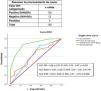
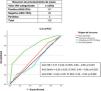
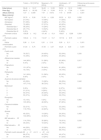
ResultadosSe incluyeron 150 pacientes (97H, 53M) de edad media 56±12,37años. Se detectó relación significativa entre sexo masculino y mayor peso, altura, IMC≥35, perímetro de cuello, perímetro de cintura, índice de cintura/cadera, perímetro de cuello patológico (43H, 41M), STOP-Bang≥5, consumo de tabaco y alcohol. Se estudiaron 144 con AL: 133 tenían IAH≥5/h, y 98, IAH≥15/h. La concordancia diagnóstica con USH fue elevada (K=0,88; p<0,001). El rendimiento de STOP-Bang para IAH≥5/h fue muy bueno (AUC=0,88; p<0,001), y moderado para Berlín (AUC=0,63) y ESE (AUC=0,63). Para IAH≥15/h, STOP-Bang muestra buen rendimiento (AUC=0,77), al contrario que Berlín (AUC=0,55) o ESE (AUC=0,49).
ConclusionesSTOP-Bang demostró mejor rendimiento. La utilización de herramientas de cribado para el abordaje de AOS en AP en colaboración con USH, complementada con métodos diagnósticos sencillos, es posible y rentable en nuestro medio.
To assess the usefulness of the Epworth (ESS), Berlin, and STOP-Bang (SB) screening tools, combined with the Apnealink™ device (AL), in collaboration with the USH, in diagnosing OSA with AHI≥5/h or moderate-to-severe OSA (IAH≥15/h).
Material and methodsThe study included patients aged 18 to 80years with suspected OSA and a SB score ≥3. Patients were initially assessed by a primary care physician (PCP) using the AL device and subsequently evaluated by the USH. Collected data included anthropometric measurements, personal medical history, clinical characteristics related to OSA, screening tool scores, AL study results, PGR findings, diagnostic and therapeutic decisions made by the PCP, and confirmatory assessments by the USH. All data were entered into a computerized system for statistical analysis. The study analyzed both the overall sample and gender-specific subgroups. The effectiveness of the screening tools was assessed through ROC curve analysis.
ResultsThe study included 150 patients (97men, 53women) with a mean age of 56±12.37years. Significant gender differences were observed: men had higher values for weight, height, BMI≥35, neck circumference, waist circumference, waist-to-hip ratio, elevated neck circumference (>43cm in men, >41cm in women), high SB score (≥5), and higher tobacco and alcohol consumption.
A total of 144 patients underwent AL testing, with 133 patients having an AHI>5/h and 98 patients an AHI≥15/h. The agreement with the USH was 89%, with a K=0.88±0.036 (95%CI: 0.8-0.94, P<.001).
According to the screening tools, the probability of having OSA with AHI≥5/h was: SB-AUC=0.63±0.08 (95%CI: 0.047-0.78, P=.098). For AHI≥15/h: SB-AUC=0.77±0.04 (95%CI: 0.048-0.92, P=0.080), Berlin-AUC=0.55±0.05 (95%CI: 0.45-0.66, P=.305), ESS-AUC=0.49±0.05 (95%CI: 0.039-0.59, P=.889).
ConclusionsThe SB tool demonstrated the best performance. The use of screening tools combined with simple diagnostic methods in primary care, in collaboration with USH, is both feasible and cost-effective for managing OSA in our setting.
Artículo
Diríjase al área privada de socios de la web de la SEMERGEN, (https://www.semergen.es/index.php?seccion=biblioteca&subSeccion=revistaSEMERGEN ) y autentifíquese.

