
Patients’ perception of their cleansing quality can guide strategies to improve cleansing during colonoscopy. There are no studies assessing the agreement between the quality of cleansing perceived by patients and cleansing quality assessed during colonoscopy using validated bowel preparation scales. The main aim of this study was to compare the cleansing quality reported by patients with the quality during colonoscopy using the Boston Bowel Preparation Scale (BBPS).
Patients and methodsConsecutive patients referred to an outpatient colonoscopy were included. Four drawings representing different degrees of cleansing were designed. Patients chose the drawing that most resembled the last stool. The predictive ability of the patient's perception and agreement between the patient's perception and the BBPS were calculated. A BBPS score of <2 points in any segment was considered inadequate.
ResultsSix hundred and thirty-three patients were included (age: 62.8±13.7 years, male: 53.4%). Overall, 107 patients (16.9%) had inadequate cleansing during colonoscopy, and in 12.2% of cases, the patient's perception was poor. The patient's perception compared to the quality of cleanliness during colonoscopy presented a positive and negative predictive value of 54.6% and 88.3%, respectively. The agreement between patient perception and the BBPS was significant (P<0.001), although fair (k=0.37). The results were similar in a validation cohort of 378 patients (k=0.41).
ConclusionsThe cleanliness perceived by the patient and the quality of cleanliness using a validated scale were correlated, although fair. However, this measure satisfactorily identified patients with adequate preparation. Cleansing rescue strategies may target patients who self-report improper cleaning.
Registration number of the trial: NCT03830489.
La percepción de los pacientes sobre su calidad de limpieza previa a la colonoscopia puede guiar estrategias de rescate para mejorar la limpieza durante la colonoscopia. El objetivo fue evaluar la concordancia entre la calidad de limpieza percibida por los pacientes con la calidad durante la colonoscopia utilizando la escala de preparación colónica de Boston (BBPS).
Pacientes y métodosSe incluyeron pacientes consecutivos remitidos a una colonoscopia ambulatoria. Se diseñó un set de 4 imágenes representativas de diferentes grados de limpieza. Los pacientes elegían la imagen que se asemejaba más a la última deposición. Se calculó la concordancia entre la percepción del paciente y la BBPS. Una puntuación de la BBPS<2 puntos en cualquier segmento se consideró una limpieza inadecuada.
ResultadosSe incluyeron 633 pacientes. Globalmente, 107 pacientes (16,9%) presentaron una limpieza inadecuada durante la colonoscopia, y en el 12,2% de los casos, la percepción del paciente fue de limpieza inadecuada. La percepción del paciente presentó un valor predictivo positivo y negativo de 54,6 y 88,3%, respectivamente, para predecir la calidad de limpieza mediante la BBPS. La concordancia entre la percepción del paciente y la BBPS fue significativa (p<0,001), aunque aceptable (k=0,37). Los resultados fueron similares en una cohorte de validación de 378 pacientes (k=0,41).
ConclusionesExiste concordancia entre la limpieza percibida por el paciente y la calidad de la limpieza mediante una escala validada, aunque esta fue aceptable. Estos resultados sustentan el uso de estrategias de rescate en los pacientes con percepción de una limpieza colónica inadecuada.

Colonoscopy is the gold standard for the detection of colorectal neoplastic lesions and is the cornerstone examination for colorectal cancer (CRC) screening.1,2
Poor bowel cleansing has a negative impact on the efficiency of colonoscopy, increasing costs due to the need for repeated examinations, delays in diagnosis, decreasing detection rates for premalignant and malignant lesions, increasing procedural times, and probably risks.3
This situation is of utmost importance in the current situation, whereby a high proportion of elective procedures have been delayed due to the COVID-19 pandemic.
Although current recommendations state a rate of 10%–15% of colonoscopies with inadequate bowel preparation as admissible,4,5 the rate of poor bowel preparation across studies range between 6.8% and 33%.6,7
The patient's perception of colon cleansing prior to performing a colonoscopy has been scarcely studied as a predictor of colon cleansing quality.8,9 Theoretically, if the correlation between the patient's perception of colon cleansing while ingesting the cleansing solution and the quality during colonoscopy were optimal, it would allow identifying those patients with poor preparation in time to perform rescue interventions on the same day of the examination. A few studies have suggested that the correlation between the patient's perception and the colonoscopic assessment of bowel cleansing is weak.8,9 However, no study has used a validated cleansing scale during colonoscopy, and the populations included have not been representative of the general population.
The main aim of this study was to assess the correlation between the effluent characteristics of the last bowel movement self-reported by the patient and a validated colonoscopy cleansing scale. Afterward, we validated the results in a second cohort of patients.
Material and methodsDesign and settingThis was an observational prospective study conducted at the Open Access Endoscopy Unit of the Hospital Universitario de Canarias between February 2021 and May 2021. This is a tertiary referral hospital that provides health care to approximately 400,000 inhabitants of the northern part of Tenerife Island. The endoscopy unit has an annual output of approximately 6000 outpatient colonoscopies, 3000 of which are performed during morning sessions.
The Ethics Committee approved the study protocol in May 2020. The study was included at Clinicaltrials.gov (NCT04702646) in January 2021. All authors had access to the study data and reviewed and approved the final manuscript.
PatientsPatients older than 18 years undergoing outpatient colonoscopy in the morning shift were considered for inclusion. Patients with the following characteristics were excluded: contraindication for colonoscopy, dementia with difficulty in preparation, previous inclusion, incomplete colonoscopy for reasons other than poor preparation, and total or subtotal colectomy. Two cohorts of patients were included in the study: in the first cohort, a correlation between the patient's perception of bowel cleansing, staff's assessment of the pictures provided by the patients and the quality rated during the colonoscopy was assessed.
The results of the correlation between patient perception and the Boston Bowel Preparation Scale (BBPS)10 were validated in a second cohort of consecutively included patients. Only demographics and health history data, patient perception of the last bowel movement and BBPS were registered in the validation cohort.
Procedures before colonoscopyAll patients received a telephone call 2 weeks prior to the colonoscopy. Information about the examination was provided, resolving doubts about how the cleansing preparation should be carried out, as is routinely done in our digestive endoscopy unit.
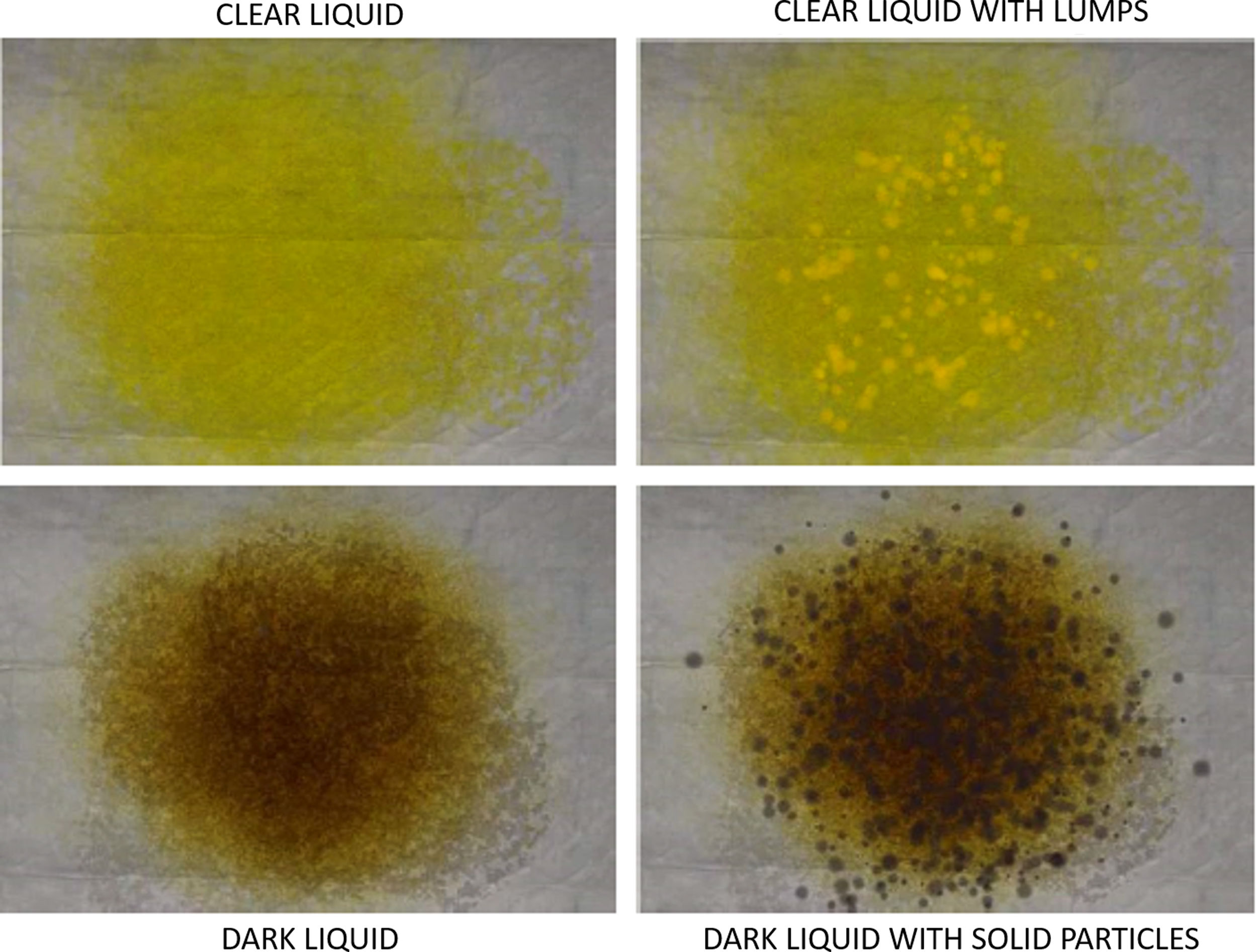
Two nurses involved in the study explained to the patients the purpose of the study, administered the informed consent form and provided them with a questionnaire about their medical history and data related to the cleansing preparation. In addition, the patients were asked to provide a picture of their last bowel movement from the toilet bowl, with adequate lighting conditions, over a light background (preferably white). On the day of the colonoscopy, patients were asked what their last bowel movement looked like. Three sets of 4 pictures each resembling different effluent qualities (clear liquid, clear liquid with lumps, dark liquid, or dark liquid with solid particles) were designed by members of our staff, and the selection of the more realistic one was chosen by consensus among investigators, in such a way that 12 agreed in choosing one of them (Appendix A). This manner of grading cleansing quality was used in a previous study.8 The patient was provided with this set and was requested to point out which of the pictures most resembled the last stool.
The pictures provided by the patients were rated by two nurses at the entrance of the endoscopy unit according to the same scale.
Procedures during colonoscopyColonoscopies were performed by seven experienced endoscopists. The whole endoscopy team was blinded to the patient's perception of the cleansing quality. BBPS was registered in the colonoscopy report together with the colonoscopy findings (number, size, and morphological characteristics of any polyp). The endoscopists had extensive experience rating the colonoscopy cleansing quality according to the BBPS, and they passed the Educational Program by obtaining a score ≥3.11
Collected variablesPatient variablesThe collected variables included demographic details; indication for colonoscopy; educational level (higher or lower than high school); personal history of colonic polyps or colorectal cancer; comorbidities (diabetic patients under pharmacological treatment; cirrhosis diagnosed by clinical, imaging or analytical criteria; stroke; or chronic kidney disease defined as a renal glomerular filtration rate <60mL/min); Eastern Cooperative Oncology Group (ECOG); history of abdominal or pelvic surgery; constipation (<3 bowel movements/week and at least one of the following: straining, hard stools defined as Bristol scale 1 or 2, and incomplete evacuation)12; and medication (treatment with tricyclic antidepressants, opioids or calcium antagonists).
Variables collected on the day of colonoscopyThe following variables were collected: the elapsed time between the last intake of solution and the beginning of the colonoscopy and the elapsed time between the last bowel movement and the beginning of the colonoscopy; willingness to follow the same preparation protocol in the future13; any difficulty following bowel prep instructions; level of satisfaction14; volume intake categorized as ≥75% or <75% of the bowel preparation; BBPS score (global and by colonic segment); cecal intubation rate; complications related to the colonoscopy (perforation or postpolypectomy bleeding requiring hospitalization); patient and staff perception of quality of bowel cleansing. The withdrawal time from the cecum was recorded using a stopwatch; the watch was stopped when any biopsy or therapeutic technique was required and then resumed after the completion of these procedures. The amount of water used for lavage during each examination was also quantified by counting the number of 50-mL water syringes used. When a water pump was used the aspirated water during the examination was quantified. The number of polyps and their sizes and locations were also recorded.
OutcomesPrimary outcomeThe primary outcome was the correlation between the patient's perception of the bowel preparation and the bowel cleansing quality rated by the BBPS.10 This validated scale ranges from 0 to 3 points per segment (proximal, transverse and distal colon). Bowel cleansing was adequate when each of the colon segments were scored ≥2 points. Bowel cleansing was inadequate when the score in at least one of the segments was <2 points. In incomplete colonoscopies because of poor bowel preparation, the bowel cleansing was considered inadequate when a segment was not assessed.
Secondary outcomesThe secondary outcomes were as follows:
- -
The correlation between the cleaning quality reported by the patient and the cleaning quality rated by the endoscopy staff.
- -
The correlation between the cleaning quality rated by the endoscopy staff and the BBPS.
- -
Predictive factors of poor bowel cleansing.
The agreement between the patient's perception of the last bowel movement and the BBPS assessed by the endoscopist was calculated by Cohen's kappa coefficient.15 All four categories reported by the patients were compared first with the BBPS categorized as adequate preparation (BBPS score ≥2 per segment) or inadequate preparation (BBPS score <2 per segment). A second analysis was carried out categorizing the patient's perception into adequate (Pictures 1 or 2) and inadequate (Pictures 3 or 4) preparation and were compared with the BBPS categorized in the same manner. Agreements were also performed between patient perception and staff assessment of the last patient bowel movement as well as between staff assessment and BBPS. Statistical performances (sensitivity, specificity, positive and negative predicted values) were calculated. In addition, the positive and negative likelihood ratios were assessed. The ratio of cases in the positive and negative groups reflects the prevalence of the disease.
A simple logistic regression analysis was performed comparing each of the possible predictor variables with the BBPS. Subsequently, a multiple logistic regression analysis was carried out to evaluate the predictors of adequate quality evaluated by the BBPS, including those with a significance ≤0.05. The selection of variables significantly associated in the multiple logistic regression analysis was performed following a forward likelihood ratio.
In our unit, the percentage of colonoscopies with poor preparation in an unselected population is approximately 15% of patients undergoing an outpatient colonoscopy. Since for the multiple logistic regression model, it is necessary to include 9 patients with poor preparation for each independent variable, hypothesizing that we would include 10 variables, it was necessary to include a total of 600 patients.
Data were analyzed with the Statistical Package for Social Sciences v. 25.0 (Armonk, NY: IBM Corp).
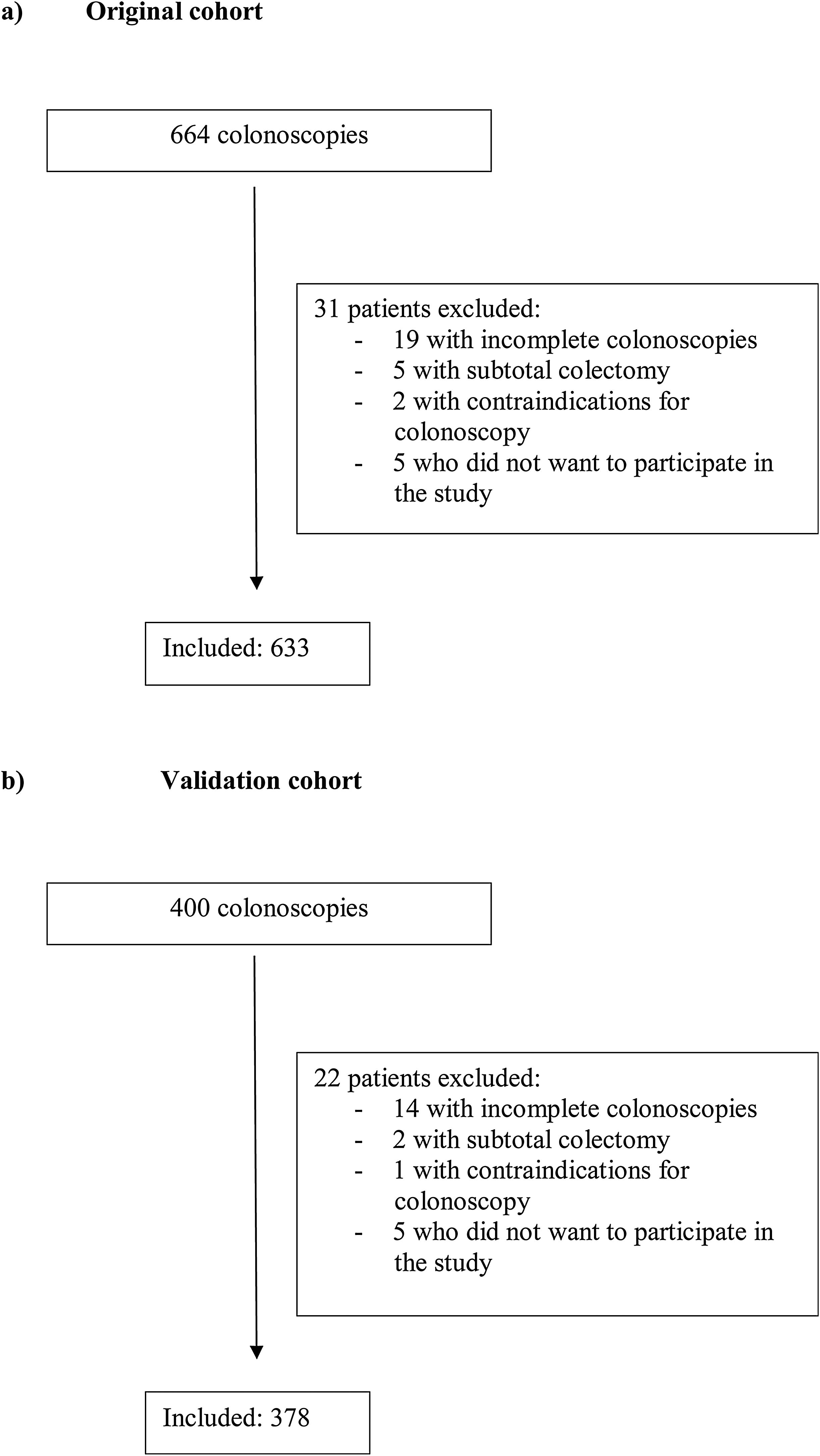
ResultsA total of 664 patients were recruited in the original cohort, and 400 patients were recruited in the validation cohort. Of these, 53 were excluded because of incomplete colonoscopy (N=33), unwillingness to participate in the study (N=10), total or subtotal colectomy (N=7) and contraindication for colonoscopy (N=3) (Fig. 1).
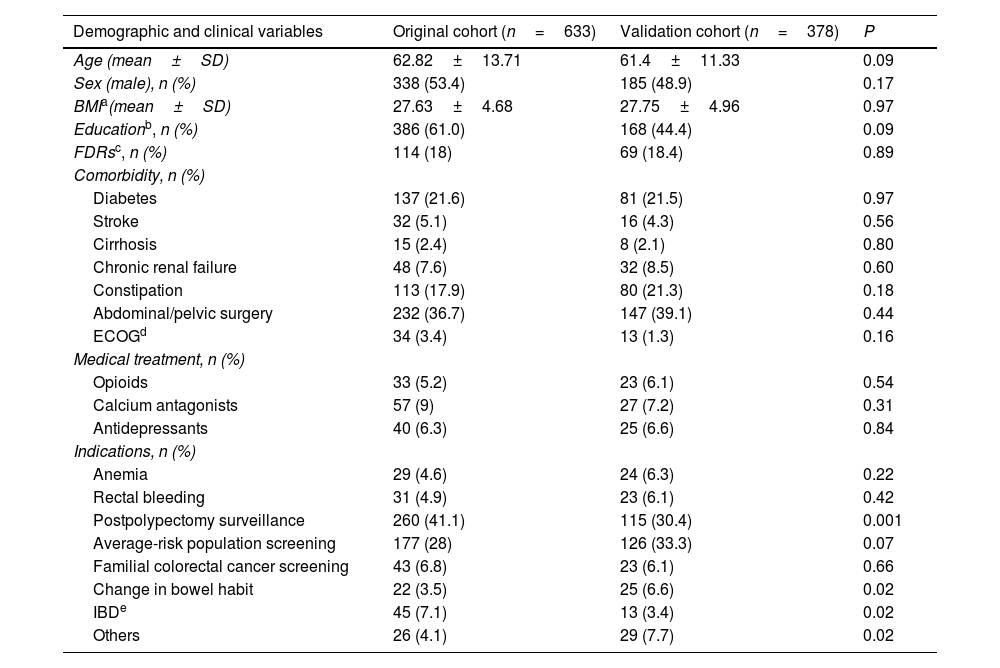
Results of the original cohortOverall, 633 patients were included in the original cohort (age 62.8±13.7 years; 53.4% males). Demographics, comorbidities, type of bowel preparation used, compliance with diet and bowel preparation and instructions adherence, indication of the examination and time elapsed between the last bowel movement and the beginning of the examination are shown in Table 1.
Baseline characteristics of the patients.
| Demographic and clinical variables | Original cohort (n=633) | Validation cohort (n=378) | P |
|---|---|---|---|
| Age (mean±SD) | 62.82±13.71 | 61.4±11.33 | 0.09 |
| Sex (male), n (%) | 338 (53.4) | 185 (48.9) | 0.17 |
| BMIa(mean±SD) | 27.63±4.68 | 27.75±4.96 | 0.97 |
| Educationb, n (%) | 386 (61.0) | 168 (44.4) | 0.09 |
| FDRsc, n (%) | 114 (18) | 69 (18.4) | 0.89 |
| Comorbidity, n (%) | |||
| Diabetes | 137 (21.6) | 81 (21.5) | 0.97 |
| Stroke | 32 (5.1) | 16 (4.3) | 0.56 |
| Cirrhosis | 15 (2.4) | 8 (2.1) | 0.80 |
| Chronic renal failure | 48 (7.6) | 32 (8.5) | 0.60 |
| Constipation | 113 (17.9) | 80 (21.3) | 0.18 |
| Abdominal/pelvic surgery | 232 (36.7) | 147 (39.1) | 0.44 |
| ECOGd | 34 (3.4) | 13 (1.3) | 0.16 |
| Medical treatment, n (%) | |||
| Opioids | 33 (5.2) | 23 (6.1) | 0.54 |
| Calcium antagonists | 57 (9) | 27 (7.2) | 0.31 |
| Antidepressants | 40 (6.3) | 25 (6.6) | 0.84 |
| Indications, n (%) | |||
| Anemia | 29 (4.6) | 24 (6.3) | 0.22 |
| Rectal bleeding | 31 (4.9) | 23 (6.1) | 0.42 |
| Postpolypectomy surveillance | 260 (41.1) | 115 (30.4) | 0.001 |
| Average-risk population screening | 177 (28) | 126 (33.3) | 0.07 |
| Familial colorectal cancer screening | 43 (6.8) | 23 (6.1) | 0.66 |
| Change in bowel habit | 22 (3.5) | 25 (6.6) | 0.02 |
| IBDe | 45 (7.1) | 13 (3.4) | 0.02 |
| Others | 26 (4.1) | 29 (7.7) | 0.02 |
In the original cohort, the last bowel movement was described by the patients as follows: 411 (64.9%) reported clear liquid (adequate cleansing); 145 (22.9%), clear liquid with lumps (adequate cleansing); 64 (10.1%) dark liquid (inadequate cleansing); and 13 (2.1%), solid particles with/without dark liquid (inadequate cleansing). Therefore, 87.8% would be reported as adequate, and 12.2% inadequate. Overall, 526 patients (83.1%) were rated as adequate following the BBPS, and 104 patients (16.9%) were rated as inadequate.
The agreement between the patient's description and the BBPS was fair (k=0.368; P<0.001) when all 4 categories of patient perception were considered and when they were categorized into 2 categories (adequate/inadequate) (k=0.374; P<0.001).
A total of 266 participants (42%) brought a picture of the last effluent that was assessed by the staff. The agreements between the picture of the last effluent and the BBPS were also fair when the 4 categories were considered (k=0.41; P<0.001) and when the cleansing quality was stratified into 2 categories (k=0.43; P<0.001). There was a good agreement between the quality assessment reported by the patient and by the staff before the colonoscopy (k=0.78; P<0.001).
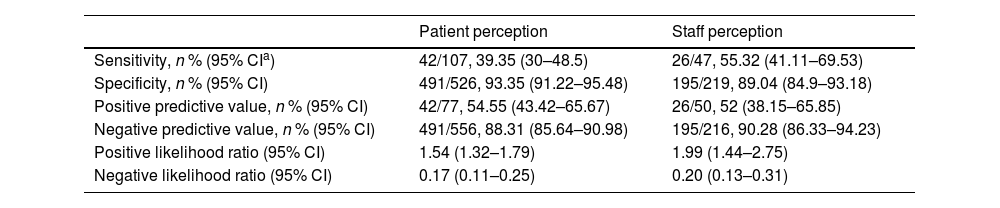
When the patients reported that the last stool was a clear liquid or clear liquid with lumps, 88.3% of the cases were rated by the endoscopist as adequate bowel preparation. However, when the patient reported the last stool as being a brown liquid only or with a solid component, it was rated as inadequate by the endoscopist in 54.6% of the cases. The sensitivity, specificity, positive predictive value and negative predictive value of the patient and staff perceptions compared with the BBPS are shown in Table 2.
Statistical performance of the patient and staff perceptions of the last bowel movement in the original cohort.
| Patient perception | Staff perception | |
|---|---|---|
| Sensitivity, n % (95% CIa) | 42/107, 39.35 (30–48.5) | 26/47, 55.32 (41.11–69.53) |
| Specificity, n % (95% CI) | 491/526, 93.35 (91.22–95.48) | 195/219, 89.04 (84.9–93.18) |
| Positive predictive value, n % (95% CI) | 42/77, 54.55 (43.42–65.67) | 26/50, 52 (38.15–65.85) |
| Negative predictive value, n % (95% CI) | 491/556, 88.31 (85.64–90.98) | 195/216, 90.28 (86.33–94.23) |
| Positive likelihood ratio (95% CI) | 1.54 (1.32–1.79) | 1.99 (1.44–2.75) |
| Negative likelihood ratio (95% CI) | 0.17 (0.11–0.25) | 0.20 (0.13–0.31) |
When the area under the curve (AUC) of the patient and staff bowel cleansing prediction where compared there was not significant differences (AUC 0.69, 95% CI 0.63–0.75 vs. AUC 0.72, 95% CI 0.66–0.78; P=0.24).
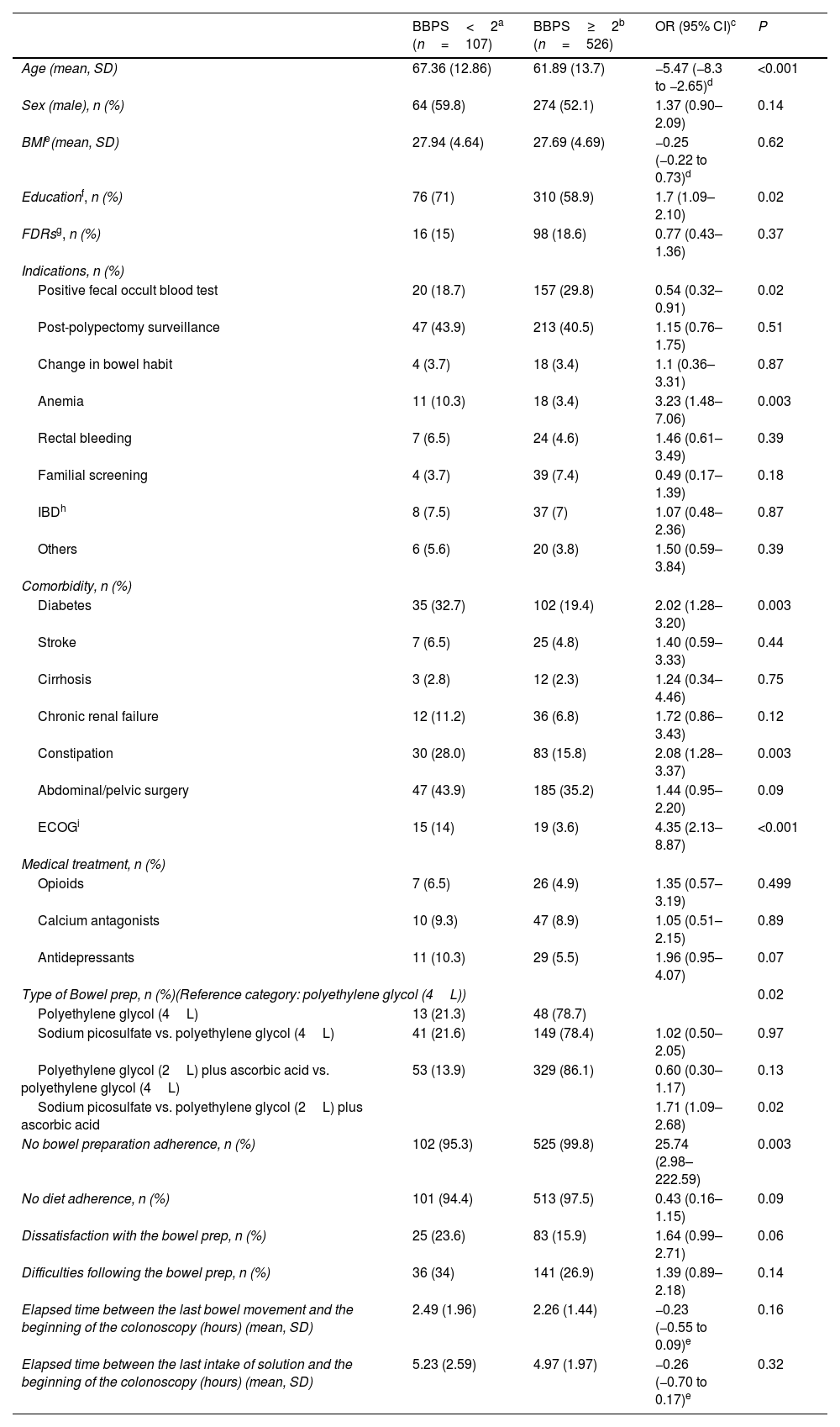
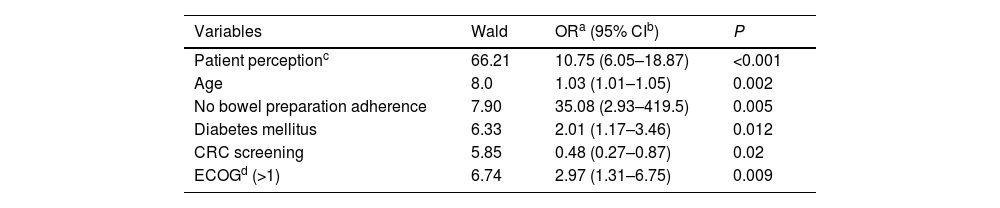
Predictors of poor bowel cleansingIn the simple logistic regression analysis (Table 3), elderly age, education, the indication for CRC screening and anemia, diabetes mellitus, constipation, ECOG performance status, type of bowel preparation, and adherence to the bowel preparation were significantly associated with poor bowel cleansing following the BBPS. Age, CRC screening, diabetes mellitus, ECOG performance status, adherence to bowel preparation and patient perception of the last bowel movement were the variables independently associated with poor bowel cleansing (Table 4).
Simple logistic regression analysis. Variables associated with poor bowel cleansing.
| BBPS<2a (n=107) | BBPS≥2b (n=526) | OR (95% CI)c | P | |
|---|---|---|---|---|
| Age (mean, SD) | 67.36 (12.86) | 61.89 (13.7) | −5.47 (−8.3 to −2.65)d | <0.001 |
| Sex (male), n (%) | 64 (59.8) | 274 (52.1) | 1.37 (0.90–2.09) | 0.14 |
| BMIe(mean, SD) | 27.94 (4.64) | 27.69 (4.69) | −0.25 (−0.22 to 0.73)d | 0.62 |
| Educationf, n (%) | 76 (71) | 310 (58.9) | 1.7 (1.09–2.10) | 0.02 |
| FDRsg, n (%) | 16 (15) | 98 (18.6) | 0.77 (0.43–1.36) | 0.37 |
| Indications, n (%) | ||||
| Positive fecal occult blood test | 20 (18.7) | 157 (29.8) | 0.54 (0.32–0.91) | 0.02 |
| Post-polypectomy surveillance | 47 (43.9) | 213 (40.5) | 1.15 (0.76–1.75) | 0.51 |
| Change in bowel habit | 4 (3.7) | 18 (3.4) | 1.1 (0.36–3.31) | 0.87 |
| Anemia | 11 (10.3) | 18 (3.4) | 3.23 (1.48–7.06) | 0.003 |
| Rectal bleeding | 7 (6.5) | 24 (4.6) | 1.46 (0.61–3.49) | 0.39 |
| Familial screening | 4 (3.7) | 39 (7.4) | 0.49 (0.17–1.39) | 0.18 |
| IBDh | 8 (7.5) | 37 (7) | 1.07 (0.48–2.36) | 0.87 |
| Others | 6 (5.6) | 20 (3.8) | 1.50 (0.59–3.84) | 0.39 |
| Comorbidity, n (%) | ||||
| Diabetes | 35 (32.7) | 102 (19.4) | 2.02 (1.28–3.20) | 0.003 |
| Stroke | 7 (6.5) | 25 (4.8) | 1.40 (0.59–3.33) | 0.44 |
| Cirrhosis | 3 (2.8) | 12 (2.3) | 1.24 (0.34–4.46) | 0.75 |
| Chronic renal failure | 12 (11.2) | 36 (6.8) | 1.72 (0.86–3.43) | 0.12 |
| Constipation | 30 (28.0) | 83 (15.8) | 2.08 (1.28–3.37) | 0.003 |
| Abdominal/pelvic surgery | 47 (43.9) | 185 (35.2) | 1.44 (0.95–2.20) | 0.09 |
| ECOGi | 15 (14) | 19 (3.6) | 4.35 (2.13–8.87) | <0.001 |
| Medical treatment, n (%) | ||||
| Opioids | 7 (6.5) | 26 (4.9) | 1.35 (0.57–3.19) | 0.499 |
| Calcium antagonists | 10 (9.3) | 47 (8.9) | 1.05 (0.51–2.15) | 0.89 |
| Antidepressants | 11 (10.3) | 29 (5.5) | 1.96 (0.95–4.07) | 0.07 |
| Type of Bowel prep, n (%)(Reference category: polyethylene glycol (4L)) | 0.02 | |||
| Polyethylene glycol (4L) | 13 (21.3) | 48 (78.7) | ||
| Sodium picosulfate vs. polyethylene glycol (4L) | 41 (21.6) | 149 (78.4) | 1.02 (0.50–2.05) | 0.97 |
| Polyethylene glycol (2L) plus ascorbic acid vs. polyethylene glycol (4L) | 53 (13.9) | 329 (86.1) | 0.60 (0.30–1.17) | 0.13 |
| Sodium picosulfate vs. polyethylene glycol (2L) plus ascorbic acid | 1.71 (1.09–2.68) | 0.02 | ||
| No bowel preparation adherence, n (%) | 102 (95.3) | 525 (99.8) | 25.74 (2.98–222.59) | 0.003 |
| No diet adherence, n (%) | 101 (94.4) | 513 (97.5) | 0.43 (0.16–1.15) | 0.09 |
| Dissatisfaction with the bowel prep, n (%) | 25 (23.6) | 83 (15.9) | 1.64 (0.99–2.71) | 0.06 |
| Difficulties following the bowel prep, n (%) | 36 (34) | 141 (26.9) | 1.39 (0.89–2.18) | 0.14 |
| Elapsed time between the last bowel movement and the beginning of the colonoscopy (hours) (mean, SD) | 2.49 (1.96) | 2.26 (1.44) | −0.23 (−0.55 to 0.09)e | 0.16 |
| Elapsed time between the last intake of solution and the beginning of the colonoscopy (hours) (mean, SD) | 5.23 (2.59) | 4.97 (1.97) | −0.26 (−0.70 to 0.17)e | 0.32 |
Multiple logistic regression analysis. Variables associated with poor bowel cleansing.
| Variables | Wald | ORa (95% CIb) | P |
|---|---|---|---|
| Patient perceptionc | 66.21 | 10.75 (6.05–18.87) | <0.001 |
| Age | 8.0 | 1.03 (1.01–1.05) | 0.002 |
| No bowel preparation adherence | 7.90 | 35.08 (2.93–419.5) | 0.005 |
| Diabetes mellitus | 6.33 | 2.01 (1.17–3.46) | 0.012 |
| CRC screening | 5.85 | 0.48 (0.27–0.87) | 0.02 |
| ECOGd (>1) | 6.74 | 2.97 (1.31–6.75) | 0.009 |
Additionally, independent predictors of poor bowel cleansing during the colonoscopy among those patients reporting inadequate preparation were assessed. Calcium antagonists intake (OR 6.75, 95% CI [1.24–36.91]), a bad taste of the preparation solution (OR 7.65, 95% CI [1.29–45.34]) and an education lower than high school (OR 4.31, 95% CI [1.48–12.56]) were associated to a poor bowel cleansing according to the BBPS. Independent predictors of adequate bowel preparation during the colonoscopy among those patients reporting adequate bowel cleansing were also assessed. CRC screening (OR 2.92, 95% CI [1.62–5.26]), not suffering from diabetes mellitus (OR 1.68, 95% CI [1.04–2.69]), not suffering from constipation (1.70, 95% CI [1.03–2.81]) and a good ECOG performance status (2.63, 95% CI [1.20–5.75]) were associated to an adequate bowel cleansing according to the BBPS.
Results of the validation cohortA total of 400 consecutive patients were recruited for the validation cohort, and 378 were finally included (Fig. 2b). Comparisons of baseline characteristics between the two cohorts are shown in Table 1. Statistical performances were similar between the two cohorts (Supplementary Table 1). In the validation cohort, the agreement between the patient's perception of the last bowel movement and the BBPS was also fair when the 4 pictures were considered (k=0.40) as well as when they were grouped into 2 categories (k=0.41).
DiscussionDespite the current recommendations of scientific societies stating ≥85%–90% as the minimum standard for adequate bowel preparation, the cleansing quality achieved in endoscopic units is variable.4,5 Different cleansing strategies have been suggested in difficult-to-prepare patients, and it is important to inquire about the exact reason for poor bowel preparation.3,16 Although rescue cleansing strategies such as the administration of additional bowel preparation before the examination have been proposed as a potential strategy,3,17,18 ideally, a correlation between the patient's perception or staff assessment of the last effluent should be proven. The available evidence of the correlation between the patient's perception of the quality of colonic cleaning and cleaning at the time of colonoscopy is scarce. To our knowledge, this is the first study to compare patients’ perception of the last bowel movement with a validated colon cleansing scale. The present study found a fair/moderate agreement between the patients’ perception of the last effluent quality or the staff evaluation and the endoscopists’ assessment following the BBPS. A high negative predictive value that reassured the patients of a good cleansing score during the colonoscopy was found.
There are currently two prospective studies that aimed to investigate this issue.8,9 In a single-center study, 474 outpatients were asked about their cleansing quality, and subsequently, they underwent an outpatient colonoscopy.9 The patients were prepared the day before the examination with 4L of polyethylene glycol (PEG) or sodium phosphate (35%). In this study, 99.6% of the participants referred to their preparation as good or excellent; however, the preparation was optimal during the colonoscopy in only 74.9% of the patients, and the correlation between both assessments was weak (r=0.08). Age under 61 years was the only factor associated with the quality of preparation perceived by the patient and during the colonoscopy. In a more recent multicenter study, Fatima et al.8 had the same aim in a total of 429 outpatients from 3 hospitals. In this study, the agreement between the patients’ perception and cleansing quality during the colonoscopy was also weak (Cohen kappa=0.07–0.17). However, these two studies have several flaws. First, the predictive capacity of the patient's perception should be compared with a robust gold standard. However, none of the aforementioned studies used a validated cleansing scale as recommended by scientific societies, and a calibration exercise to improve consensus or interobserver variability was not performed either.3,15 Second, the participants may not have been representative of the general population. Specifically, in the study by Fatima et al.,8 the 3 participating hospitals provided medical care to private, indigent and veteran patients. Third, in the study by Harewood et al.,9 the last bowel movement may not have been representative of the actual colon cleansing because patients were prepared the day before the colonoscopy. The present study overcomes these limitations since we used a validated cleansing scale, the endoscopists had extensive experience using the scale, and they passed the BBPS educational program. In addition, the Spanish health system is universal and largely exceeds private insurance care. In addition, the Canary Islands population is similar to the population of other Spanish regions regarding race, gender and education. Finally, as recommended, a split-dose regimen was used for bowel preparation. We believe that these factors make our correlation results more reliable.
Despite the correlation found in this study being far from optimal, we believe that our results have immediate practical applications. The study suggests that in more than half of patients reporting poor bowel quality, it is confirmed to be inadequate during colonoscopy. Conversely, almost 90% of patients who report good bowel quality will have adequate cleansing. These data suggest that we can rely on the self-report of the patients when they say that they are clean; however, we cannot trust a negative patient prediction. We believe that our low PPV of patient prediction is undermined by the particularities of the BBPS. Since the BBPS must be scored after adequate bowel lavage and suction during withdrawal, we hypothesized that this maneuver would successfully rescue a significant proportion of patients who otherwise would have had inadequate bowel preparation. Since the percentage of our patients reporting poor quality is quite low (approximately 12–14%), rescue cleansing strategies could be implemented in this group without major logistical issues. We believe that this percentage of patients would be manageable with the launching of this strategy in clinical practice. Since bowel preparation intake is the most cumbersome part of the colonoscopy for many patients, in this study we tried to predict what patients might benefit most from additional bowel preparation. In that way, we found that calcium antagonists intake, poor flavor of the bowel solution and low education level were associated with poor bowel cleansing during the colonoscopy in patients with a perception of an inadequate preparation based on their last rectal effluent. Rescue interventions after the endoscopic procedure, including the application of high-volume enemas or the addition of a larger quantity of cleaning solution in patients with poor bowel preparation, have been described.17,18 In both cases, these interventions seem to achieve acceptable cleansing rates. In a recent multicenter randomized study, high-volume polyethylene glycol (PEG) enemas were compared with an additional 2L of oral PEG solution in 131 patients with a BBPS score of <2 points in any colon segment.18 Greater efficacy was observed with the addition of PEG oral solution. It should be noted that this study required an initial colonoscopy to assess the quality of cleaning; therefore, the implementation of this intervention may lead to logistical problems. Testing rescue cleansing strategies before the colonoscopy is warranted, and using our 4-cleansing quality picture set to quantify the efficacy of any intervention may be helpful.
Concerning variables associated with poor bowel cleansing, interestingly, the patient's perception of the last effluent was the most powerful independent factor of poor bowel cleansing at the colonoscopy.
Our study has some strengths. First, to our knowledge, this is the first study to assess the correlation between patients’ perception of the last effluent and a validated bowel cleansing scale in a large cohort of nonselected patients. Second, similar to Fatima et al.,8 only 12% of the participants reported inadequate cleansing, making an intervention based on giving additional preparation to these patients a feasible strategy in real clinical practice (approximately 1 out of 10 patients) without major logistical problems.
We are also aware of the limitations of this study. First, it is a single-center study; therefore, our results should be replicated by other groups. Second, the correlation between patient perception and the BBPS is fair; however, as mentioned before, we believe that our results have important clinical applications.
In conclusion, the correlation between the patient's perception of the last effluent and a universally accepted validated scale of colonic cleansing quality is statistically significant, although it is fair. However, it seems useful to guide the implementation of rescue strategies the same day of the colonoscopy appointment and avoid the repetition of colonoscopies.
Ethical considerationsThe authors declare that all the participants signed an informed consent. The protocol was approved by the local ethics committee of Hospital Universitario de Canarias CHUC_2020_32 (CALPER).
Authors’ contributionsConception and design: Antonio Zebenzuy Gimeno García. David Nicolás Pérez.
Performed procedures: Anjara Hernández, Antonio Zebenzuy Gimeno García, David Nicolás Pérez, Onofre Alarcón, Goretti Hernández, Vanessa Felipe.
Data collection: Federica Benítez-Zafra, Domingo Hernández Negrín, Jorge Mon, Yaiza Cedrés, José Luis Baute, Rocío del Castillo, Rafael Romero, Noemi Segura.
Data analysis and interpretation: Alejandro Jiménez, Antonio Zebenzuy Gimeno-García, Marco Navarro Dávila.
Drafting of the manuscript: Antonio Zebenzuy Gimeno-García, Manuel Hernández Guerra, David Nicolás Pérez.
Critical revision: Eduardo Rodríguez, Manuel Hernández Guerra, Federica Benítez-Zafra.
Final approval of the article: Antonio Zebenzuy Gimeno García.
FundingThis study was supported by a grant from Fundación Canaria Instituto de Investigación Sanitaria de Canarias (FIISC) (PIFIISC20/04). This foundation was not involved in any phase of this research.
Conflicts of interestDr. AZ Gimeno García has received a research grant from Fundación Canaria Instituto de Investigación Sanitaria de Canarias (FIISC). The other authors do not have conflicts of interest.
We would like to acknowledge Fundación Canaria Instituto de Investigación Sanitaria de Canarias (FIISC) for the support (PIFIISC20/04). We would also like to acknowledge Rosa Delgado, Gloria Lorenzo, Melissa Piñero, Alvaro Peralta, Ana Romero and Eduardo Quintana for their support.