

Effective teaching practices are crucial for student success and the quality of education. One such practice that has recently gained attention is the use of engaging teacher messages, which have shown promising results. This study investigates the reciprocal relationship between teacher engaging messages and student motivation using a random intercept cross-lagged panel model. Participants were 1048 (Mean age = 16.33, SD = 1.25) high school students from 16 different secondary schools, 949 of whom participated in at least one measurement wave and were accounted for in the analyses participated in the study. Rooted in self-determination theory, the study found that messages highlighting the benefits of studying had a positive impact on changes in student motivation to learn, and that teacher engaging messages were not impacted by changes in student motivation. These findings suggest that effective teacher engaging messages, such as gain-framed autonomous messages, are partly independent from students’ motivation and can therefore be promoted to enhance student outcomes and the overall quality of education.
Las prácticas docentes eficaces son cruciales para el éxito de los estudiantes y la calidad de la educación. Una de estas prácticas, que ha atraído recientemente la atención, es el uso de mensajes por parte de los docentes para fomentar el compromiso en los estudiantes, los cuales han mostrado resultados prometedores. Este estudio investiga la relación recíproca entre los mensajes de los docentes y la motivación de los estudiantes mediante un modelo de panel cruzado con interceptos aleatorios. Participaron en el estudio 1,048 estudiantes de secundaria (M = 16,33 años; DT = 1,25) de 16 institutos diferentes, de los cuales 949 han participado en al menos una serie de mediciones y han sido tenidos en cuenta en los análisis. El estudio, basado en la teoría de la autodeterminación, ha demostrado que los mensajes que destacaban los beneficios de estudiar tienen un impacto positivo en los cambios en la motivación de los estudiantes, mientras que los mensajes de los docentes no se han visto afectados por los cambios en la motivación de los estudiantes. Estos resultados sugieren que los mensajes eficaces de compromiso del docente, como los mensajes autónomos enmarcados en los beneficios, son en parte independientes de la motivación de los estudiantes y, por tanto, pueden promoverse para mejorar los resultados de los estudiantes y la calidad general de la educación.
Despite the wealth of research available on effective teaching practices (Institute of Educational Sciences, 2023), one of the major challenges in education today continues to be the lack of integration of scientific research into real life practice. Accordingly, teachers are still lacking support on how to translate scientific evidence into day-to-day teaching and thus rely instead on traditional or improvised practices that may not be supported by evidence (Slavin, 2019). For instance, although theories concur that need-supportive environments enhance student learning and engagement at school (Pitzer & Skinner, 2017; Ryan & Deci, 2020), little evidence exists on how teachers can easily translate such motivational support in their relationship with students (Slavin, 2019). To overcome this problem, Smith et al. (2022) recommended making theories more concrete and specific, providing clear guidelines, practical examples, and tools for teachers to integrate research into their daily practice. One potential approach that has proven to address such issues is the use of engaging messages by teachers (Santana-Monagas, Putwain et al., 2022; Santana-Monagas & Núñez, 2022). These are messages explicitly communicated to students with the purpose of encouraging them to take an action in relation to their school tasks. Such messages have already been shown to relate with many student outcomes (Falcon et al., 2023; Santana-Monagas et al., 2023; Santana-Monagas, Núñez et al., 2022) proving their relevance for student engagement and motivation to learn (Santana-Monagas, Putwain et al., 2022). Nonetheless, to date, studies have followed cross-sectional designs that do not capture whether such messages cause changes in students’ motivation overtime (Falcon, Alonso et al., 2023; Santana-Monagas, Putwain et al., 2022). Hence, to properly understand the directionality between such variables, longitudinal studies are necessary. Besides, the use of engaging messages by teachers and students’ motivation are not static in time nor within a person but rather expected to change over time and within individuals (Alamer & Alrabai, 2023; Marsh et al., 2022; Núñez-Regueiro et al., 2022). For such reasons, the present research goes beyond by exploring the relations among teachers’ engaging messages and students’ motivation to study following a three-wave panel design that accounts the variability expected to be observed within students and across a school year.
The impact of teacher messages on student motivationConsistently throughout research, teachers’ behavior has been found to be a major catalyst of students’ behavior (Jang et al., 2010). Among these behaviors, teachers’ messages, especially those guiding behavior during challenges, have been highlighted as an important verbal behavior influencing students’ theories on intelligence and learning (Barger, 2019) or performance (Putwain & Remedios, 2014). Over the past decade, a large body of research, based on the Message Framing Theory, has addressed the impact of loss-framed messages, emphasizing the downsides of failure, on student outcomes. As so, these messages have proven to negatively affect students’ feelings, behaviors, and performance (Putwain et al., 2021; Santana-Monagas et al., 2024). Contrastingly, gain-framed messages, emphasizing favorable outcomes of an action, enhance learning and motivation (Santana-Monagas et al., 2024). Over and above the kind of framing used (gain vs. loss), messages can also appeal to different student motivations. The Self-Determination Theory (SDT) classifies these motivations as either autonomous (highlighting task value or pleasure) or controlled (focused on rewards, punishments, or seeking approval; Ryan & Deci, 2017; Santana-Monagas & Núñez, 2022). Research regarding these forms of regulations has shown that autonomously motivated students perform better, while those motivated in a controlled manner often struggle (Behzadnia et al., 2018; Liu et al., 2017).
Preliminary research has combined both theories (i.e., message-framing and SDT) to build an integrative framework regarding teachers’ engaging messages (Santana-Monagas, Putwain et al., 2022). As aforementioned, these are teacher messages aimed at advising and encouraging students’ what actions could be taken to achieve (or avoid) certain outcomes. Within this perspective, some messages are expected to be more effective than others in creating a positive learning environment. For instance, using a cross-sectional design, Santana-Monagas, Putwain et al. (2022) showed that gain-framed messages appealing to autonomous forms of motivation positively predicted academic performance via autonomous motivation to learn. When comparing both frames, results showed stronger relations with student motivation for gain-framed messages. In addition, Santana-Monagas, Núñez et al. (2022) found that students who perceived their teachers rely on autonomous gain-framed messages informed of a better teacher-student relatedness and student vitality, whereas loss-framed autonomous messages were less beneficial. Altogether, these findings suggest that when a student receives (from the teacher) engaging messages appealing to his or her autonomous motivation by pointing out the gains of studying (vs. losses of not studying), a more positive and engaging environment for learning can be created, hence modeling the quality of motivation.
The impact of student motivation on teacher messagesAlthough teachers can play a role in modeling student motivation, this modeling does not occur in a “vacuum” and may depend on the context of learning afforded by the group of students in the classroom, such as their motivation, academic performance, or behavior (Ahn et al., 2021; Lo, 2024). Even in the earliest grades, students show large differences in their learning and socializing behavior at school, which results in distinct trajectories of behavioral adjustment (Pingault et al., 2011), student engagement (Archambault & Dupéré, 2017), academic self-concept (Nagy et al., 2010), and learning (Pfost et al., 2014). As a result, teachers may adapt their practices to the specific kinds of students encountered within the class or between classes. This phenomenon, where student’s characteristics activate teachers’ behavior response, has been denominated as students’ “evocative-effect” (Nurmi, 2012). This mutual dependence between teacher and students positions teaching as a context-sensitive process, wherein behaviours of both students and teachers are intricately interlinked (Nurmi & Kiuru, 2015). As so, such teacher-student interactions, possess the potential to way the messages selected by teachers who might find themselves adjusting, refining, or entirely transforming their messages in response to individual students, and thus, exhibiting varying types of messages with them. This is the case proven in analyses of erosion of teacher resources and enthusiasm in situations of poor disciplinary class climate (Dicke et al., 2014; LeCompte & Dworkin, 1991; Rumberger & Palardy, 2005; Van Houtte et al., 2013).
In this line, Fauth et al. (2020) also showed that common indicators of teaching quality (e.g., classroom management, clarity of instruction, emotional support) are largely associated with indicators of prior student motivation (i.e., prior interest and effort in class), suggesting that teaching quality is a by-product of both teacher behavior (modeling approach) and student behavior (adaptive approach). Regarding engaging messages research, findings have shown how teachers adapt their messages to the educational level of students being taught (Santana-Monagas et al., 2023) and how students’ performance also shapes the probability of teachers’ using messages and the number of messages used (Falcon et al., 2023). Hence, proving some evidence on the context-sensitivity of teachers’ engaging messages. It might be logic to assume teachers’ engaging messages would also respond to students’ motivation. Yet, research has rather focus on teachers’ views related to students’ academic performance (e.g., Murdock-Perriera & Sedlacek, 2018; Ready & Wright, 2011). However, when teachers reflect on their students, their considerations may extend beyond students’ performance on the last exam. For instance, they may assess factors such as enthusiasm for learning, attentiveness in class, diligence, effort or in other words, there motivation. Given that the focus on achievement alone might not comprehensively capture teachers’ efforts to engage students, it is reasonable to assume that teacher engaging messages might be influenced by student motivation, leading to possible bidirectional causalities between these two processes, to which we turn to next.
Reciprocal relations between messages and motivation: RI-CLPMGiven the many chances teachers have every day to engage in interactions that motivate students, guaranteeing what behaviors are effective is key. Particularly in secondary education, this becomes even more relevant as it has been observed a consistent decline in students’ motivation and academic interest during these years (Lazarides et al., 2019; Scherrer & Preckel, 2019). Moreover, this decline tends to be stable throughout adolescence as the stability of interindividual differences increases (Gottfried et al., 2001). Still, motivation is a malleable construct that changes as a function of the environment (Trautwein et al., 2015). Similarly, teachers’ messages have also proven to have a stable component, such as teachers’ overall tendency to rely on one or another type of message (Santana-Monagas, Núñez et al., 2022), but teachers also adapt these to students’ characteristics (Santana-Monagas et al., 2023). Therefore, the present research focused on understanding the dynamic changes in students’ motivation as a function of teachers’ engaging messages attending the stability and fluctuation of individual differences. As so, two main challenges persist in the existing literature. First, most studies are cross-sectional, lacking the temporal data needed to establish longitudinal relation between teacher behavior and student motivation. Second, even the longitudinal studies that do exist fail to adequately control individual differences, often producing unreliable results that do not distinguish between changes within individuals and differences between individuals (as detailed hereafter). These limitations not only impede theory development but also hamper the knowledge to properly design interventions.
To address this issue, we will use a random intercept cross-lagged panel model (RI-CLPM; Hamaker et al., 2015; Mulder & Hamaker, 2021). Unlike the conventional CLPM, the RI-CLPM differentiates between within-person and between-person processes of change by incorporating random intercepts, which reflect baseline levels of motivation and engaging messages estimated across the entire observation period (e.g., from T1 to T3). These intercepts are termed “random” because they vary for each individual, meaning that each student has a unique estimated baseline level of achievement and motivation. This approach formally accounts for stable interindividual differences in change, known as trait factors. The remaining variance in the model represents temporary within-person fluctuations in dynamic constructs, referred to as state factors, which are captured through autoregressive and cross-lagged effects. As Hamaker et al. (2015) highlighted, estimates in the standard CLPM can mistakenly merge between-person and within-person processes of change. As a result, prior research has found that such models may produce misleading estimates of reciprocal relationships when stable individual differences are not properly accounted for (Ehm et al., 2019; Liu et al., 2023; Núñez-Regueiro et al., 2022). By addressing individual variability in longitudinal data, the RI-CLPM is regarded as the most suitable model for our data and research objectives.
One limitation of the RI-CLPM is that teacher engaging messages —but also, possibly, student motivation—may incorporate two sources of variation, one specific to the student receiving the message (reflecting student-level variation), and one general to the whole class (reflecting class-level variation). For instance, a student’s level of motivation may be sensitive to the average level of motivation in the class. Not accounting for these sources of variation might affect the estimation of within-person effects (at the student level), by introducing class-level “noise” in the within-person parameters (Burić et al., 2024; Núñez-Regueiro et al., 2022). The second step of the present strategy is therefore to extend the RI-CLPM to a multilevel structure that formally disaggregates trait factors into a within-class component (i.e., student level) and a between-class component (i.e., class level). This will be done in the present study by allowing trait factors to incorporate systematic variation at the class level to remove between-person variations.
The present studyThe aim of the present study is to investigate the relation between teacher engaging messages and student motivation in a school setting. The nature of this relation is poorly understood but it is strategically important to translate theories on student motivation into real-life teaching practices, and to extend our understanding of needs-supportive learning environments. Shedding light on such processes can indeed reveal which teacher engaging messages are effective in supporting student motivation over the school year. Three research questions will be addressed:
RQ1. Do motivational appeals (autonomous, controlled) in teacher engaging messages contribute to facilitate the corresponding motivation among students’ receiving the message?
RQ2. Does the effect size of teachers’ engaging messages on student motivation depend on the way messages are framed (gain-framed vs. loss-framed)?
RQ3. In turn, does a student’s motivation impact the kind of message they recall receiving from the teacher?
According to SDT (Ryan & Deci, 2017), we expected that teacher messages underlining autonomous motivational appeals would increase students’ autonomous motivation levels, and that messages oriented towards controlled motivational appeals would increase students’ controlled motivation levels (Hypothesis 1). We also expected that the framing of messages, notably in terms of the losses versus gains associated with school tasks (Rothman & Salovey, 1997), would change the effect size of engaging messages (Santana-Monagas, Putwain et al., 2022). More precisely, we expected a higher effect size for gain-framed messages than for loss-framed messages (Hypothesis 2). Thirdly, it was expected from theories of differentiation-polarization and teacher stress (Bowles & Gintis, 2011; LeCompte & Dworkin, 1991) that the quality of engagement of a student would influence the kind of messages he or she received from the teacher, by inducing an adaptation of engaging messages to the nature of student motivation (i.e., autonomous vs. controlled student motivation; Hypothesis 3). However, no hypotheses were made about the influence of student motivation on the framing of messages, due to a lack of prior evidence on this issue.
MethodParticipantsA total of 1048 (460 females; Mean age = 16.33, SD = 1.25) students from 58 classes, 949 of whom participated in at least one measurement wave and were accounted for in the analyses participated in the study (see data analysis). Participants were from 16 different secondary schools in urban and rural areas of Gran Canaria, Tenerife, and Santander in Spain. Students came mostly from middle-class families and presented no potential ethnic differences. To minimize potential bias, the survey questions were tailored to a single subject, mathematics. Thus, all participants in the study were taking the same subject and were exposed to the same amount of instruction time per week.
MeasuresInstrumentsTeacher Engaging Messages. Engaging messages received by each student were measured using the Teacher Engaging Messages scale (Santana-Monagas, Putwain et al., 2022). Items were preceded by the stem “My teacher tells me that” and were rated on a 7-point Likert scale, ranging from 1 = not true at all to 7 = completely true. Four kinds of teacher engaging messages were measured, by crossing the frameworks of self-determined motivation (controlled vs. autonomous) and message framing (gain vs. loss).
Student Motivation to Learn. Motivation to learn was measured using four subscales of the Spanish version of the Échelle de Motivation en Éducation (Núñez et al., 2005). Each subscale was composed of 4 items preceded by the stem “Why do you study?” and was rated on the same 7-point Likert scale used for teacher engaging messages (1 = not true at all to 7 = completely true). Aligning with self-determination theory, autonomous motivation was measured based on items for intrinsic and identified motives (sample item = “[I study] Because I experience pleasure and satisfaction while learning new things”), whereas controlled motivation was based on items for introjected and external motives (sample item = “[I study] In order to have a better salary in the future”).
Covariates. Background covariates were accounted for in the modelling strategy for both levels of analyses. At the student level, covariates included age, sex (0 = “female adolescent”, 1 = “male adolescent”), and grade point average during the first trimester (GPA, 11-point scale). At the class level, they included teacher’s age (Mage = 45.5 ± 7.8) and sex (0 = “female”, 1 = “male”), the grade level (0 = “middle school”, 1 = “high school”; 32% high school students), and the curricular track (0 = “academic”, 1 = “vocational”; 16% vocational students).
ProcedureParticipants were informed of the aims of the study and assured that their participation was voluntary and kept confidential. To ensure anonymity and protect participants’ privacy, only minimal personal data was recorded such as date of birth, sex, and class. This allowed us to link data collected across trimesters while maintaining the confidentiality of the participants. Data collection took place during a regular class period by a member of the research team. Close to the end of each trimester of the school year, students rated their motivation as well as the engaging messages they received from the same teacher. The study was conducted in accordance with the ethical guidelines of the Declaration of Helsinki and was approved by the University Human Research Ethics Committee.
Data analysisFirst, descriptive statistics and reliability coefficients were estimated. Because students were nested in classes, ICC values were estimated to account for the variability attributable to the class level. Values above .10 inform about the need to conduct multilevel analysis (Lüdtke et al., 2009; Marsh et al., 2008). Second, as recommended for models of dynamic constructs (Mulder & Hamaker, 2021; Núñez-Regueiro et al., 2022), preliminary psychometric analyses were conducted to test longitudinal measurement invariance. Psychometric analyses confirmed that the measurement models for both teacher engaging messages and student motivation scales showed good to excellent fit across time, meeting the criteria for longitudinal invariance (see supplementary material).
Next, to examine the research questions several RI-CLPM (Hamaker et al., 2015) were tested, extended to a multilevel specification that accounted for the nature of the data, that is, with students nested within classes (Núñez-Regueiro & Leroy, 2023). Teacher engaging messages were modelled with the matching motivation to learn yielding four combinations (two frames of teacher message*two student motivations). For each combination, the following identification strategy was used. First, a multilevel RI-CLPM was specified (Model 1), in which trait factors were specified and allowed to covary and to vary as a function of classes, thus differentiating within-class (student level) and between-class (class level) variation in traits. The model included autoregressive and cross-lagged effects between the residuals of each construct (i.e., student motivation and teacher engaging messages), while allowing these parameters to be freely estimated. To assess the temporal stability of the residual structure, nested models were compared to an unconstrained solution, first by constraining auto-regressive effects to be invariant across occasions (i.e., from T1 to T2 and from T2 to T3), and then by adding time-invariance constraint on cross-lagged parameters. Temporal stability was obtained when such constraints resulted in minor decrements in model fit (ΔCFI ≥ −.01), which occurred for all lagged effects but one (i.e., auto-regressive effects of controlled motivation in relation with gain-framed controlled message, ΔCFI = −.015). At this stage, nonsignificant covariances between random effects (p < .05) were removed for parsimony without loss of generality (ΔCFI ≥ −.01). Second, to test the robustness of the obtained models, covariates were included by regressing trait factors on student characteristics (student level) and class or teacher characteristics (class level).
Following Orth et al. (2024), we considered the size of cross-lagged effects as small (ß = .03), medium (ß = .07) and large (ß = .12) based on their standardized coefficients. However, while standardized coefficients provide useful information on effect sizes, they do not account for the percentage of variance explained by these effects. Therefore, we computed explained variance following Lenhard and Lenhard (2022) approach, which allows converting standardized β coefficients into correlation coefficients when β values range between −0.5 and 0.5. Finally, missing data (18% to 35% on each wave) was handled using full information maximum likelihood estimates, which enabled recovering information from 100% of the sample.
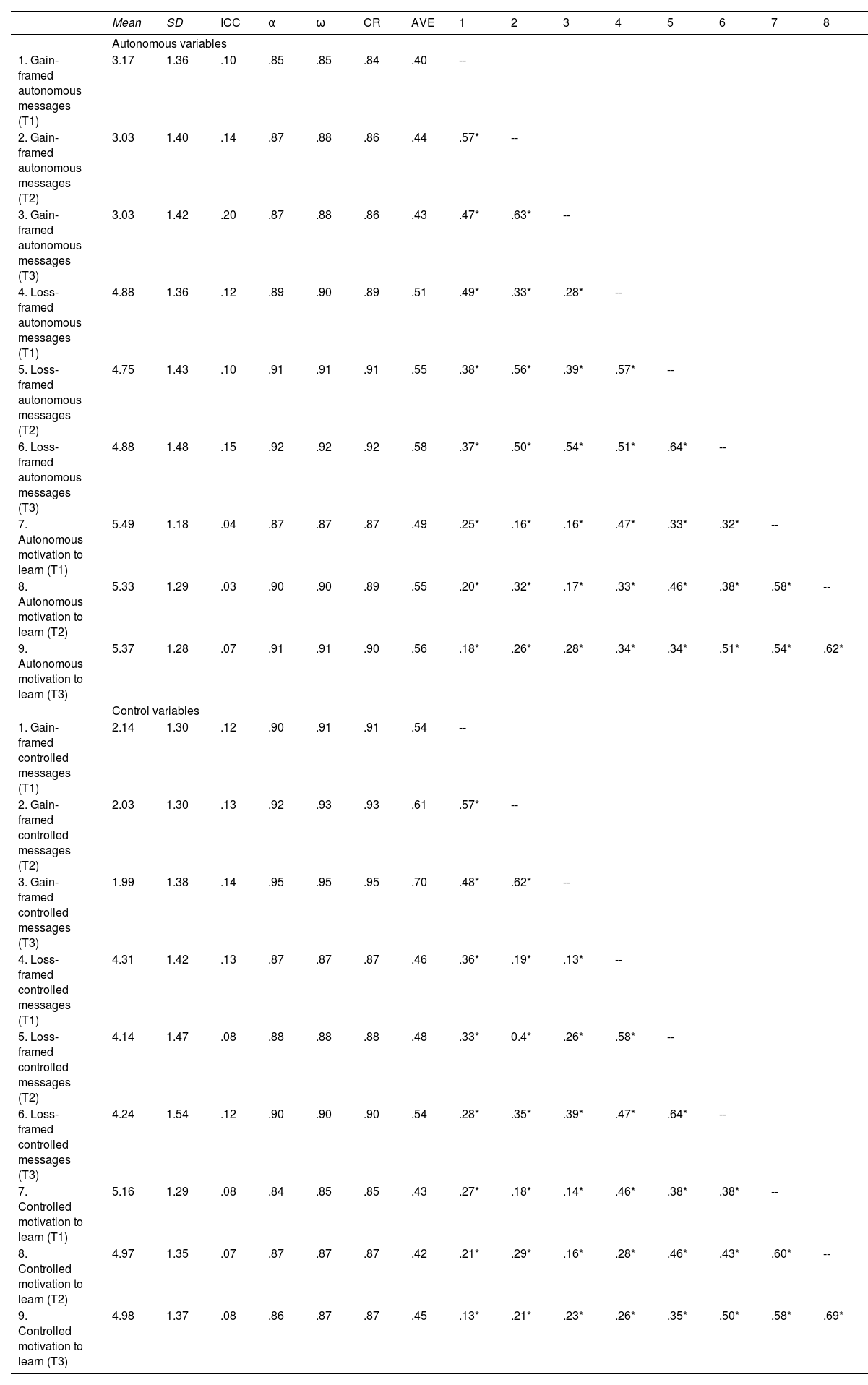
ResultsDescriptive statisticsStatistics for teacher engaging messages and student motivation across measurement waves are displayed in Table 1. Scores showed great stability over time, both in terms of means and standard deviations. Intraclass correlation coefficients (ICC) also showed that scores varied substantively as a function of classes, this level accounting for 8% to 20% of the variance in engaging messages, and 3% to 8% of the variance in student motivation (Table 1). Such values indicated that a part of the variance observed among students’ answers was driven by differences at the class level (Marsh et al., 2012) which might introduce noise in estimates of individual differences and require specifying a multilevel structure in processes of change (as explored hereafter).
Means, standard deviations, intraclass correlation, and correlations among autonomy and control variables
| Mean | SD | ICC | α | ω | CR | AVE | 1 | 2 | 3 | 4 | 5 | 6 | 7 | 8 | |
|---|---|---|---|---|---|---|---|---|---|---|---|---|---|---|---|
| Autonomous variables | |||||||||||||||
| 1. Gain-framed autonomous messages (T1) | 3.17 | 1.36 | .10 | .85 | .85 | .84 | .40 | -- | |||||||
| 2. Gain-framed autonomous messages (T2) | 3.03 | 1.40 | .14 | .87 | .88 | .86 | .44 | .57* | -- | ||||||
| 3. Gain-framed autonomous messages (T3) | 3.03 | 1.42 | .20 | .87 | .88 | .86 | .43 | .47* | .63* | -- | |||||
| 4. Loss-framed autonomous messages (T1) | 4.88 | 1.36 | .12 | .89 | .90 | .89 | .51 | .49* | .33* | .28* | -- | ||||
| 5. Loss-framed autonomous messages (T2) | 4.75 | 1.43 | .10 | .91 | .91 | .91 | .55 | .38* | .56* | .39* | .57* | -- | |||
| 6. Loss-framed autonomous messages (T3) | 4.88 | 1.48 | .15 | .92 | .92 | .92 | .58 | .37* | .50* | .54* | .51* | .64* | -- | ||
| 7. Autonomous motivation to learn (T1) | 5.49 | 1.18 | .04 | .87 | .87 | .87 | .49 | .25* | .16* | .16* | .47* | .33* | .32* | -- | |
| 8. Autonomous motivation to learn (T2) | 5.33 | 1.29 | .03 | .90 | .90 | .89 | .55 | .20* | .32* | .17* | .33* | .46* | .38* | .58* | -- |
| 9. Autonomous motivation to learn (T3) | 5.37 | 1.28 | .07 | .91 | .91 | .90 | .56 | .18* | .26* | .28* | .34* | .34* | .51* | .54* | .62* |
| Control variables | |||||||||||||||
| 1. Gain-framed controlled messages (T1) | 2.14 | 1.30 | .12 | .90 | .91 | .91 | .54 | -- | |||||||
| 2. Gain-framed controlled messages (T2) | 2.03 | 1.30 | .13 | .92 | .93 | .93 | .61 | .57* | -- | ||||||
| 3. Gain-framed controlled messages (T3) | 1.99 | 1.38 | .14 | .95 | .95 | .95 | .70 | .48* | .62* | -- | |||||
| 4. Loss-framed controlled messages (T1) | 4.31 | 1.42 | .13 | .87 | .87 | .87 | .46 | .36* | .19* | .13* | -- | ||||
| 5. Loss-framed controlled messages (T2) | 4.14 | 1.47 | .08 | .88 | .88 | .88 | .48 | .33* | 0.4* | .26* | .58* | -- | |||
| 6. Loss-framed controlled messages (T3) | 4.24 | 1.54 | .12 | .90 | .90 | .90 | .54 | .28* | .35* | .39* | .47* | .64* | -- | ||
| 7. Controlled motivation to learn (T1) | 5.16 | 1.29 | .08 | .84 | .85 | .85 | .43 | .27* | .18* | .14* | .46* | .38* | .38* | -- | |
| 8. Controlled motivation to learn (T2) | 4.97 | 1.35 | .07 | .87 | .87 | .87 | .42 | .21* | .29* | .16* | .28* | .46* | .43* | .60* | -- |
| 9. Controlled motivation to learn (T3) | 4.98 | 1.37 | .08 | .86 | .87 | .87 | .45 | .13* | .21* | .23* | .26* | .35* | .50* | .58* | .69* |
Note. N = 949 students. *p < .05. Abbreviations: SD = Standard deviation; ICC = Intraclass correlation; α = Cronbachs’ Alpha; ω = McDonald’s Omega; AVE = Average Variance Extracted; CR = Composite Reliability.
Multilevel structure of variance-covariance. For all combinations of teacher engaging messages and student motivation, the multilevel RI-CLPM showed good to excellent fit to the data (CFI = [.940, .965], RMSEA = [.039, .056; see Model 1, Table S2). Furthermore, in these models, the trait factors for both constructs always presented significant variance on both levels of analysis (student level, class level), both in terms of means and variances (see SM-B). At student level, trait factors for teacher engaging messages were weakly or moderately related with student motivation for gain-framed messages (ψwithin = [.148, .295]), but were strongly related to student motivation for loss-framed messages (ψwithin = [.594, .656]), thus indicating—in line with descriptive statistics above—that students’ baseline levels were more strongly related to the loss-framed messages they personally received from their teacher. At the class level, autonomous engaging messages were not significantly related to student’s autonomous motivation (p < .10) and their covariance was fixed to zero for parsimony. On the contrary, controlled messages were strongly related to students’ controlled motivation (ψbetween = [.675, .701]). In other words, classes with students reporting high average levels of controlled motivation during the school year also tended to be classes whose teacher used more often controlled engaging messages towards them.
Relations among autonomous variables. Autoregressive effects were large and significant at 1% for teacher gain-framed autonomous messages (β1 = [.323, .334]; R2 = [.139, .147]), loss-framed autonomous messages (β1 = [.293, .338]; R2 = [.118, .151]), and student autonomous motivation for the gain-framed model (β4 = [.195, .250]; (R2 = [.060, .090]) and the loss-framed model (β4 = [.232, .298]; R2 = [.080, .121]; Figure 1a). Thus, within-student processes of change in teacher engaging messages and student motivation had an endogenous nature, being related to past states, even after accounting for stable interindividual differences via the inclusion of trait factors. Concerning cross-lagged effects, results showed stable positive large effects of teachers’ gain-framed autonomous messages on student’s autonomous motivation from T1 to T2 (β2 = .123, p = .033; R2 = .030), as well as from T2 to T3 (β2 = .129, p = .033; R2 = .032). For loss-framed autonomous messages, these relations were small and did not reach statistical significance (β2 = [-.015, .018], p < .10).

Multilevel RI-CLPM Models of Relations Between Teacher Engaging Messages and Student Motivation.
Note. N = 949 students. a) Relations between autonomous teacher engaging messages (line 1 = gain-framed, line 2 = loss-framed) and student autonomous motivation; b) Relations between controlled teacher engaging messages (line 1 = gain-framed, line 2 = loss-framed) and student controlled motivation. †p < .10. *p < .05. **p < .01. ***p < .001.
Abbreviations: TeacherEngMsg, tem = Teacher engaging messages; StudentMotiv, smot = student motivation.
Relations among controlled variables. With a single exception (i.e., non-significant autoregressive effects of controlled motivation from T1 to T2, β4 = .122, p = .321), all controlled variables showed large and significant auto-regressive effects ([β1, -β4 ] = [.291, .399], p < .05, R2 = [.116, .202]) indicating the presence of strong, endogenous processes of change in dynamic states (Figure 1b). Alike autonomous variables, the cross-lagged effects of teacher messages on student motivation appeared to be significant for gain-framed messages (β2 = [.108, .107], p = .05, [R2 = .025, .025]), but not significant for loss-framed messages (β2 = [.025, .030], p =.704). Unlike autonomous variables, one large and significant cross-lagged effect from student motivation to loss-framed teacher engaging messages was found (β3 = [.126, .143], p =.036, [R2 = .031, .037]), indicating that students who reported higher (lower) states of controlled motivation systematically received, on a later occasion, more (less) engaging messages underlining the losses associated with not getting rewards or risking punishments.
Robustness to covariates. Previous multilevel RI-CLPMs were expanded by the inclusion of significant covariates. Results from multilevel RI-CLPMs remained unchanged and were robust to the inclusion of multiple covariates on both levels of variance in trait factors (for details, see Figure S1 and Tables S3 to S7 in supplemental material).
DiscussionFollowing a longitudinal design, the present study aimed to examine the reciprocal relations between teachers’ engaging messages and students’ motivation to learn. Substantively, it sought to explore whether teachers’ engaging messages impact students’ motivation (RQ1) and whether the framing of messages mattered in this relation (RQ2), while attending the stability and variability of individual differences to obtain reliable estimates of reciprocal relations. Finally, it also aimed to explore whether changes in student’s motivation led to subsequent changes in teacher messages recalled (RQ3). Overall, findings expand previous knowledge on the proposed relation among both variables by suggesting that the dynamics are not entirely longitudinal, but rather oriented from teacher engaging messages towards student motivation (but see limitations); and by identifying specific teacher messages which are effective in supporting the development of autonomous motivation in students. Accordingly, the present findings reinforce existing evidence on the link between teacher behavior and student motivation, while also informing the methodology for analyses of longitudinal reciprocal relations.
Effects of teacher engaging messages on student motivationThe current study found that the kind of engaging messages that students receive from the teacher has an impact on their future motivation to learn (either autonomous or controlled; validation of H1; RQ1). This impact was found to be moderate to strong in terms of effect size, and was invariant throughout the school year (i.e., across trimesters). Whereas prior studies had reached the conclusion that teacher engaging messages were indeed positively related to student motivation, the evidence was limited by two things. First, studies using a correlational design precluded inferring on the direction of effects (i.e., from engaging message to motivation, or conversely; Santana-Monagas, Putwain et al., 2022). Second, studies using a longitudinal design used a methodology that conflated heterogeneous sources of change (state vs. trait factors; Jang et al., 2016), thus obtaining parameters exposed a high risk of statistical artifacts and spurious findings (Hamaker et al., 2015; Núñez-Regueiro et al., 2022). By employing an analytical strategy that overcame both issues (i.e., random intercept cross-lagged panel model), this study obtained more reliable findings and showed that the longitudinal relation among both constructs appears to be driven by teacher engaging messages, although student motivation might also affect the kind of messages the teacher will privilege (as discussed hereafter).
Moreover, a noteworthy finding (RQ2) was that such prospective effects were only found when teacher messages were framed positively (i.e., gain-framed messages highlighting the benefits of working hard) but were not apparent when they were framed negatively (i.e., loss-framed messages highlighting the losses associated with not working hard at school). In other words, the positive framing of messages was essential, perhaps necessary, in inducing significant changes in student motivation (both autonomous and controlled; validation of Hypothesis 2). The latter difference in effect sizes aligned well with previous findings (Bartholomew et al., 2018; Codina et al., 2018; Liu et al., 2017; Santana-Monagas et al., 2023). This result may be explained by the fact that focusing on positive events has a higher effect on well-being and self-confidence to that of negative events (Martínez-Zelaya et al., 2022) and that positive words are appraised better and remembered for longer (Unkelbach et al., 2008). Thus, it could be that gain-framed autonomous messages, repeatedly used throughout the course of a year, are maintained in the memory of students, and contribute to reinforce their motivation to learn each time they are recalled. These findings, once again, highlight the importance of teaching practices to induce changes in student outcomes (Ahn et al., 2021; Belcher et al., 2022) and, more specifically, they help us understand which kind of teacher messages can model motivational changes over time (Santana-Monagas, Putwain et al., 2022).
The analysis of associations between stable levels of loss-framed messages and student motivation (i.e., correlations between trait factors) nevertheless showed that both processes do correlate positively, even though their occasion-specific changes over time are not related. Thus, it could be stated that both variables share a common source of variance, possibly an unobserved confounding factor, but are not related in their dynamics of change. To the extent that loss-framed messages have been found in previous research to relate positively to various negative outcomes (e.g., anxiety, worse performance, or distress; Belcher et al., 2022; Putwain & Best, 2011; Putwain & Remedios, 2014), bel it might be beneficial to advise teachers not to use these kinds of messages, although it remains unknown which intermediate or correlated process might intervene in inducing negative outcomes.
Effects of student motivation on teacher engaging messagesConcerning the reciprocal relation (RQ3), the present findings suggest that changes in a student’ motivation to learn can lead to subsequent changes in the kind of message students’ recall receiving from the teacher, but only for specific processes (validation of H3). More precisely, it was found that when a student presents temporary increases in controlled motivation (on occasion T), his or her teacher will tend to use more loss-framed controlled message on a later occasion as recalled by students (on occasion T + 1). However, this effect was not observed for variations in autonomous student motivation or for gain-framed messages. These findings therefore align with and complement previous research highlighting how teachers adapt to their students (Fauth et al., 2020; Jang et al., 2016; Kaplan et al., 1997; Nurmi & Kiuru, 2015) and show that teacher adaptation may occur for a subset of students who respond to rewards or punishment in their learning activities (control), but who do not necessarily have a genuine interest in these (autonomy).
As argued in the introduction, previous evidence on teacher engaging messages have found that, when student performance is high, teachers tend to use more often controlled messages, independently from the frame (Falcon et al., 2023). When students are already engaged, teachers might not feel the need to rely on gain-framed autonomous messages (Lee, 2014). However, when students are motivated in a controlled manner, it may prompt teachers to lean on these motivations. This reliance on controlled motivation may occur because messages promoting autonomous motivation, such as “If you work hard, you will find the subject enjoyable” might seem disconnected from students’ motivational regulation and therefore may not been seen as an effective approach. Teachers might also decide to rely on loss-framed messages as a threat strategy seeking students to follow their advice (Putwain et al., 2021; Putwain & Remedios, 2014) or as a response to students’ misbehaviour in class. In this case, loss-framed controlled messages might be used as a classroom management strategy (e.g., “If you don’t pay attention, you will get into trouble”). Overall, the fact that teacher adaptation occurred for one combination (i.e., from controlled motivation to loss-framed teacher engaging messages) for which the reciprocal relation was not observed (i.e., no significant teacher modeling effect on student motivation) could also indicate a situation whereby the longitudinal relation of teacher- student relationships is reversed in the class.
Limitations and future perspectivesAlthough the findings from the present study make some important contributions to the field, some limitations should be addressed. First, the collected data relied on self-report measures, which has some limitations (Paulhus & Vazire, 2007). For instance, measuring teachers’ engaging messages through students’ self-reports could lead to some perceptual biases and not exactly reflect teachers’ actual behaviour in the classroom. At the same time, student reports have the advantage of more accurately measuring the effectiveness of teaching behaviour (Fauth et al., 2014; Göllner et al., 2021; Wagner et al., 2016), as it is their own perception of teacher messages that drives their motivation to learn, which is the ultimate goal of the teacher in the first place. All in all, one might therefore conclude that teacher engaging messages can be deemed “effective” insofar as they are perceived for what they are meant to be by the student, and they induce actual improvements in student motivation. Notwithstanding this conclusion, future research could also collect more objective data on teacher messages by audio-recording teachers’ speech or direct classroom observations, to verify that student perceptions match actual behaviour by the teacher (Falcon & Leon, 2024; Falcon et al., 2024). It would also be interesting to include teacher reports as it is possible that teacher behaviour does not co-vary with student behaviour because teachers may not be aware of the motivation experienced by students. Second, the present findings are circumscribed to student-level and hence, for RQ3 findings, the changes observed could reflect either an evolution in teachers’ engaging messages or a shift in the students’ attention to teachers’ engaging messages received. To discern among both possibilities, RI-CLPM should be conducted at the class-room level as well. Nonetheless, there is currently no analytic strategy capable of simultaneously modeling state-like variances at both the group and individual levels. Third, the present findings are circumscribed to secondary education and to a Spanish sample. It could be that teachers in other educational levels and cultures rely on different kinds of messages, or that the motivational impact of such messages differs in other contexts. Thus, future research could reproduce the present study in another educational level and culture to observe whether the present trends replicate. Besides, a few covariates have been examined, but future research should control for others such as socioeconomic status, previous grades, or teachers’ year experiences. Fourth, the present research used a three-wave data approach. If we wanted to further control for unstable differences between individual trajectories of growth and estimate a random curve cross-lagged panel model (Curran et al., 2014; Núñez-Regueiro et al., 2022), future research should incorporate another wave of data. Fifth, the present research examined messages with their matching motivation to learn, nonetheless if interested in the unique contribution of each kind of motivation on messages or vice versa, future research could test one single model.
Practical implicationsFuture research could expand the present findings and apply its practical implications in several ways. For instance, given that teachers might not be aware of students’ motivational experiences, future research could further investigate whether providing teachers with some actual feedback from students’ motivational experiences could help them adapt their messages to their classroom realities and suit students’ needs (Göllner et al., 2021). Moreover, given the positive relation found between gain-framed messages and students’ motivations, future research should conduct interventions that instruct teachers with this new knowledge. Teachers could be endeavored to tailor their messages in favor of those with a gain-frame and, for increased impact on student learning and development, those that highlight autonomous motivation (i.e., messages underlining the pleasure and value of learning at school). Since most teachers are not self-conscious of the kinds of messages they are relying on (Putwain & Remedios, 2014) providing feedback about their messages could be a good starting point. Finally, the knowledge gathered could also serve to empower teachers. As previous research has proven, teacher’s self-efficacy, that is, their beliefs on their capability to generate desirable educational outcomes (Schwarzer & Hallum, 2008), has a positive impact on students’ learning experiences (Daumiller et al., 2021). Accordingly, acknowledging teachers on the fact that they have an impact on student’s motivation via their messages could enhance their self-efficacy beliefs and empower their teaching.
ConclusionThese findings are the first to demonstrate reciprocal relations between both variables and can be of great usefulness for the empowerment of teachers and their practices. They are also among the first to show the importance of accounting for differences between classes in the investigation of reciprocal relations. This new knowledge attenuates the gap among theory and practice by providing a clear framework to design interventions for day-to-day practice, while also informing the methodology for analysing reciprocal relations among dynamic constructs. By monitoring their messages in a conscious way, it is likely that teachers can induce changes in their student’s motivation and, by implication, in their learning (Bieg et al., 2022; Daumiller et al., 2021; Schwarzer & Hallum, 2008). Not only is this relevant to inform effective teaching practices, but it also could have a positive effect on teachers’ professional well-being, by enhancing teachers’ self-efficacy beliefs and the quality of their teaching. In a profession where most individuals tend to experience occupational distress and burnout (Mérida-López & Extremera, 2017; Núñez-Regueiro et al., 2023; Núñez-Regueiro & Leroy, 2023), nurturing teachers’ capability to impact on students’ outcomes should be a concern among educational professionals.
CRediT authorship contribution statementJaime León: conceptualization, data curation, formal analysis, funding acquisition, project administration, writing—original draft, writing—review and editing, investigation, supervision· Fernando Núñez-Regueiro: conceptualization, formal analysis, methodology, writing—review and editing· Elisa Santana-Monagas: investigation, visualization, writing—original draft, writing—review and editing.
FundingThe Ministry of Science Innovation and Universities of Spain supported this work with grant TED2021-129268B-I00/AEI/10.13039/501100011033 to Jaime León.
The following are Supplementary data to this article:
Author Note: The Ministry of Science Innovation and Universities of Spain supported this work with grant TED2021-129268B-I00/AEI/10.13039/501100011033 to Jaime León and by a grant to Elisa Santana-Monagas of the Ministry of Economy, Industry, Trade and Knowledge and the co-financing of the European Social Fund through the consecution of the predoctoral training program for research staff in the Canary Islands. Data is available under request. This study was not preregistered.