

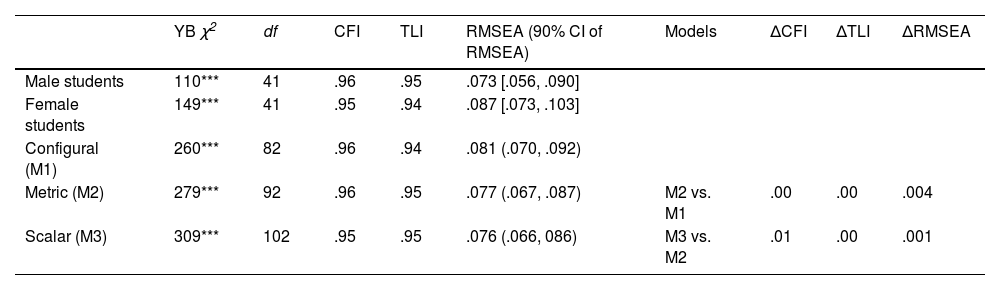
The aim of the present investigation was to analyze the psychometric properties of the Spanish version of the Teacher Emotionally Intelligent Behavior Scale (TEIBS-S) in two independent studies with secondary students. In Study 1, a cross-sectional design was used and 1850 secondary students (52.3% girls; Mage = 14.2 years) completed the TEIBS-S and other self-report measures of theoretically relevant constructs, including life satisfaction, negative emotional states, the quality of teacher-student relationships, and support in the classroom. In Study 2, a prospective design was used in which 409 secondary school students (60% girls; Mage = 13.4 years) completed the TEIBS-S at time 1 and different self-report measures of academic engagement, satisfaction with life, positive and negative emotional states, anxiety and depression symptomatology, and somatic symptoms over on average five-month prospective interval. The results revealed preliminary evidence of adequate internal consistency. Also, the factor analyses supported a one–factor solution as original English version and was invariant across gender and expected significant relationships with the well-being and academic variables analyzed. Finally, Study 2 indicated that the TEIBS-S was positively related to academic engagement dimensions, positive affect and life satisfaction and negatively linked to somatic symptoms five months later. Our findings provide preliminary evidence that the TEIBS-S is a useful and valid instrument to assess teacher emotional intelligence-related behaviors that are linked to students’ affective and academic outcomes. Finally, practical recommendations and future lines of research using the TEIBS-S in school context are suggested.
El objetivo de esta investigación es analizar las propiedades psicométricas de la versión española de la Escala de Comportamientos Emocionalmente Inteligentes del Docente (TEIBS-S) en dos estudios independientes con estudiantes de secundaria. En el Estudio 1, se ha utilizado un diseño transversal con 1850 estudiantes de secundaria (52.3% chicas; Medad = 14.2 años) que han completado la TEIBS-S y otras medidas que evalúan satisfacción vital, estados emocionales negativos, calidad de las relaciones profesorado-alumnado y apoyo en el aula. En el Estudio 2, se ha utilizado un diseño prospectivo donde 409 estudiantes de secundaria (60% chicas; Medad = 13.4 años) han completado la TEIBS-S en tiempo 1 y, tras unos cinco meses de media, han cumplimentado diferentes medidas de engagement académico, satisfacción vital, estados emocionales positivos y negativos, sintomatología ansiosa y depresiva y quejas somáticas. Los resultados han revelado una consistencia interna adecuada. Además, los análisis factoriales han apoyado una solución de un factor similar a la versión en inglés e invariante a través del género, así como relaciones significativas esperadas con las variables de bienestar y académicas analizadas. Por último, el Estudio 2 ha indicado que la TEIBS-S se ha relacionado positivamente con el compromiso académico, el afecto positivo y la satisfacción con la vida y negativamente con los síntomas somáticos del alumnado unos cinco meses como media después. Nuestros hallazgos proporcionan evidencias preliminares de que la TEIBS-S es un instrumento útil y válido para evaluar comportamientos docentes emocionalmente inteligentes y que se relacionan con resultados afectivos y académicos significativos de sus estudiantes. Finalmente, se sugieren algunas recomendaciones prácticas y futuras líneas del uso de la TEIBS-S en el contexto escolar.