





El dolor crónico no oncológico (DCNO) comporta muchas consultas en atención primaria, afecta la salud física y mental, y es causa frecuente de discapacidad. Los tratamientos habituales son farmacológicos y se utilizan poco estrategias de educación y ejercicio recomendadas por las guías clínicas.
ObjetivoEvaluar una intervención grupal basada en educación, intervención psicológica y ejercicio físico para el abordaje del DCNO y/o fibromialgia.
Material y métodosEstudio piloto, antes-después sin grupo control, realizado en atención primaria. Evaluamos 3 grupos, con un total de 42 adultos con DCNO y/o fibromialgia. Intervención: educación en neurociencias (1 sesión), grupos psicoeducativos (5 sesiones) y ejercicio físico (5 sesiones). Se analizó el cambio del dolor percibido medido con escala visual analógica (EVA), calidad de vida con el cuestionario SF-36 versión 2 y número de analgésicos, usando la t de Student para datos apareados y significación estadística p<0,05.
ResultadosEl dolor percibido disminuyó de media 0,59 (DE: 1,59) (p=0,057), el número de analgésicos utilizados 0,32 (DE: 0,72) (p=0,008) y la puntuación del SF-36 aumentó 3,83 (DE: 8,89) (p=0,031). Las dimensiones del cuestionario SF-36 que mejoraron fueron el dolor corporal, con una variación media de 7,25 (DE: 13,90) (p=0,01), función social 7,58 (DE: 16,43) (p=0,021), salud mental 9,46 (16,57) (p=0,005) y vitalidad 7,59 (DE: 18,66) (p=0,041).
ConclusionesUna intervención grupal con estrategias de afrontamiento activo basadas en educación, intervención psicológica y ejercicio físico fue útil para reducir el dolor y uso de analgésicos y mejorar la calidad de vida de pacientes con DCNO.
Chronic non-oncological pain (CNOP) is a common cause of primary care consultation. It affects physical and mental health, and is frequently associated with disability. The usual treatments are pharmacological, while education and exercise strategies recommended by clinical guidelines are rarely used.
ObjectiveTo evaluate a group intervention based on education, psychological intervention and physical exercise to manage CNOP and/or fibromyalgia.
Materials and methodsPilot study, without control group, conducted in Primary Care. We evaluated three groups, with a total of 42 adults with CNOP and/or fibromyalgia. Intervention: neuroscience education (1 session), psycho-educative groups (5 sessions) and physical exercise (5 sessions). We measured the change in perceived pain with the visual analogue scale (VAS), quality of life with the SF-36 version 2 questionnaire and number of chronic analgesics used, and we analyzed the data with the paired sample Student's t test (statistical significance: p<0.05).
ResultsPerceived pain decreased on average by 0.59 (SD: 1.59) (p=0.057), the number of analgesics used by 0.32 (SD: 0.72) (p=0.008) and the SF-36 score increased 3.83 (SD: 8.89) (p=0.031). The dimensions of the SF-36 questionnaire that improved were bodily pain, with a mean variation of 7.25 (SD: 13.90) (p=0.01), social function 7.58 (SD: 16.43) (p=0.021), mental health 9.46 (16.57) (p=0.005) and vitality 7.59 (SD: 18.66) (p=0.041).
ConclusionsA group intervention with active strategies based on neurosciences education, psychological intervention, and physical exercise was useful to reduce pain and chronical use of analgesics and improve the quality of life of patients with CNOP.
El dolor crónico no oncológico es muy frecuente en nuestro entorno y supone uno de los principales motivos de consulta a la atención primaria. Se estima que la prevalencia del dolor crónico en España es del 16,8% (IC 95%: 8,16-31,47%)1. En un estudio nacional con participación de 623 médicos de atención primaria se vio que el 30,7% de las visitas tenían relación con el dolor crónico2. Algunos de los pacientes con dolor crónico presentan fibromialgia. La fibromialgia es un trastorno caracterizado por dolor crónico musculoesquelético generalizado y persistente que se suele acompañar de otros síntomas, y tiene una prevalencia estimada entre el 2 y el 4% en la población general3.
Las guías clínicas recomiendan un abordaje del dolor interdisciplinario y multimodal, y debería incluir de forma inicial medidas no farmacológicas4. Una revisión sistemática sugiere que la actividad física presenta escasos efectos adversos y podría mejorar el dolor y la funcionalidad física en pacientes adultos con dolor crónico5. Una intervención combinada de ejercicio físico y psicoterapia podría mejorar el umbral e intensidad del dolor6,7. Hay evidencia para recomendar este abordaje para el dolor músculo-esquelético en atención primaria, mientras que la farmacoterapia solo ofrece beneficios a corto plazo8. Sin embargo, existen discrepancias entre lo que indican las guías y la práctica asistencial con un uso limitado de los tratamientos recomendados y un uso excesivo del reposo, pruebas de diagnóstico por la imagen y prescripción de analgésicos, incluyendo opioides9.
La reciente incorporación de nuevos perfiles profesionales en los centros de atención primaria, como psicólogos y fisioterapeutas, ofrece la oportunidad de incorporarlos para abordar el dolor crónico. En nuestro centro iniciamos una intervención grupal a pequeña escala en una fase piloto, con los medios actualmente disponibles, que contó con educación en neurociencias del dolor, intervención psicológica y ejercicio físico en pacientes con dolor crónico no oncológico y/o fibromialgia. El objetivo fue evaluar la efectividad de un abordaje multidisciplinar y grupal que incluía educación sobre el dolor, psicoterapia y actividad física en la mejora del dolor percibido, la calidad de vida y sobre el uso crónico de analgésicos.
Material y métodosEn 2023-2024 realizamos un estudio piloto antes-después, sin grupo control en un centro de atención primaria. Es un centro urbano, con población envejecida y nivel socioeconómico medio (índice MEDEA: −0,20). Incluimos adultos entre 18 y 80 años de edad con dolor crónico persistente no oncológico y/o fibromialgia. Excluimos pacientes con deterioro cognitivo, patología psiquiátrica que impidiera una correcta conciencia del dolor, presencia de un evento vital traumático en los 6 meses previos, y pacientes incluidos en atención domiciliaria.
Variables de estudioRecogimos variables demográficas (edad, sexo), diagnóstico (dolor crónico no oncológico, fibromialgia o ambos). La variable de resultado principal fue el dolor medido a través de la escala visual analógica (EVA). La EVA consiste en una línea horizontal de 10cm, en cuyos extremos se encuentran las expresiones extremas de un síntoma. En la izquierda se ubica la ausencia o menor intensidad y en la derecha la mayor intensidad. Así clasificamos el dolor en leve (EVA<3), moderado (EVA 4-6) y severo (EVA>7). Las variables de resultado secundarias fueron el número de analgésicos crónicos consumidos y la calidad de vida. Medimos la calidad de vida con el Cuestionario de Salud SF-36 versión 210. Está formado por 36 preguntas que valoran los estados tanto positivos como negativos de la salud. El cuestionario cubre 8 escalas: función física, rol físico, dolor corporal, salud general, vitalidad, función social, rol emocional y salud mental. Para cada dimensión, codificamos los ítems que lo componen, los agregamos y transformamos en una escala de 0 (peor estado de salud para esa dimensión) a 100 (mejor estado de salud). Estandarizamos cada una de las escalas del SF-36 usando las medias y desviaciones estándar de la población española y agregamos las escalas usando los pesos españoles para calcular los índices sumarios físico y mental11. También recogimos la asistencia a las sesiones de intervención grupal (número de sesiones realizadas) y la satisfacción de los pacientes con la misma.
Reclutamiento de los pacientesCalculamos un tamaño de muestra necesario de 41 pacientes (aceptando un riesgo alfa de 0,05 y un riesgo beta inferior a 0,2, para detectar una diferencia de 7 unidades, asumiendo una desviación estándar de 15 y una tasa de pérdidas del 10%).
En una primera estimación por diagnóstico identificamos a 213 pacientes con diagnóstico de dolor crónico/persistente y 184 pacientes con diagnóstico de fibromialgia. Usamos un procedimiento de muestreo aleatorio simple y formamos 3 grupos de 18 pacientes cada uno. De los 54 pacientes contactados, 42 aceptaron participar. Citamos individualmente a los pacientes para informar detalladamente sobre el estudio y obtener el consentimiento informado. En la misma visita individual, realizamos una anamnesis orientada al dolor crónico y a recoger información sobre las variables de estudio mencionadas: número de analgésicos crónicos utilizados previamente a la intervención, valoración EVA y cuestionario SF-36 versión 2.
Descripción de la intervenciónLa intervención grupal consistió en una sesión semanal, de 2h de duración, excepto la primera, que fue de 1h, durante 6 semanas. La intervención fue idéntica para los 3 grupos de pacientes.
En la 1.a sesión se realizó educación en neurociencias del dolor durante 1h. Esta sesión fue guiada por médicos de familia. Consistía en una sesión teórica de 1h, donde explicamos los mecanismos por los que se cronifica el dolor y los diferentes aspectos que influyen en la perpetuación de este. Explicamos en qué consiste la sensibilización central, y con qué estrategias podemos revertir estos cambios a nivel central, y clarificamos dudas de los pacientes.
En la 2.a a 5.a sesión se realizó una intervención psicológica (1h de duración) y actividad física (durante 1h).
La intervención psicológica estaba guiada por el gestor emocional del centro. Abordamos el manejo del dolor en los distintos ámbitos de la vida diaria, así como las emociones asociadas, mostrando estrategias para romper los círculos viciosos que colaboran en la perpetuación del dolor.
La actividad física leve-moderada estaba dirigida por la fisioterapeuta del centro. Los pacientes desarrollaron diferentes actividades físicas, muchas en forma de juegos, a fin de ayudar a perder el miedo, y a ver que el ejercicio físico no es un componente que empeore su dolor, sino una herramienta para combatirlo. También explicamos diferentes rutinas para poder realizar en el domicilio.
Al finalizar la intervención realizamos una última sesión grupal de 1h para volver a pasar los cuestionarios (EVA y SF-36) y recogimos información sobre el número de fármacos analgésicos utilizados después de la intervención. También evaluamos la satisfacción de los pacientes mediante la cumplimentación de una encuesta.
Análisis de datosResumimos las variables cualitativas con el recuento y el porcentaje asociado, y las variables cuantitativas con la media y desviación estándar. Evaluamos la efectividad de la intervención valorando el cambio en la variable principal de resultados, la escala EVA de dolor. También analizamos los cambios en la calidad de vida con el cuestionario SF-36 versión 2, tanto de la puntuación global como de las diferentes dimensiones e índices resumen de salud física y mental, y evaluamos la reducción en el número de fármacos analgésicos crónicos usados después de la intervención. Utilizamos el test t de Student para datos apareados con el programa IBM SPSS versión 26, y consideramos significación estadística para valores de p inferiores a 0,05. Realizamos los análisis con los pacientes que completaron el protocolo de estudio.
Aspectos éticosEl Comité Ético aprobó el estudio (PR194/23, CSI 23/49). Lo realizamos de acuerdo a los estándares establecidos en la Declaración de Helsinki de 1964 y sus enmiendas posteriores. Obtuvimos el consentimiento informado de los pacientes para participar en el estudio. Seguimos la ley de protección de datos y la garantía de derechos digitales (Ley Orgánica 3/2018, de 5 de diciembre), y el Reglamento del Parlamento Europeo y del Consejo de protección de las personas (UE 2016/679 de 27 de abril).
ResultadosDurante los meses de octubre y noviembre de 2023 reclutamos a los 42 pacientes que participaron en los 3 grupos de intervención. El 97,6% fueron mujeres, siendo la media de edad de 63,48 años (DE: 8,32). Un 21,4% tenía el diagnóstico de dolor crónico registrado en la historia clínica informatizada, un 57,2% el de fibromialgia, y un 21,4% tenía ambos diagnósticos.
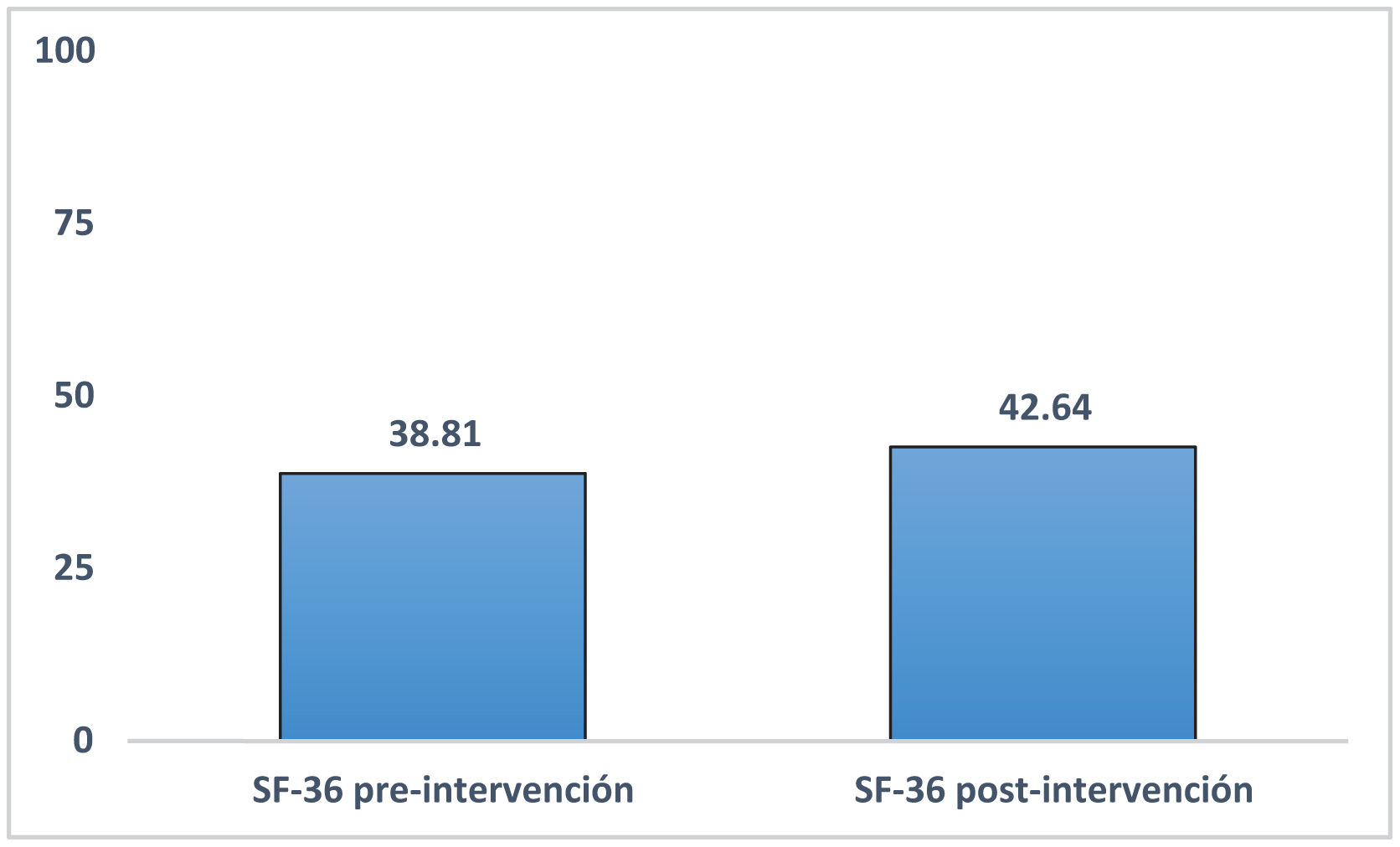
Los resultados de la variable principal, dolor medido a través de la escala EVA, así como los resultados de las variables secundarias, calidad de vida y reducción en el número de fármacos analgésicos después de la intervención, pueden verse en las figuras 1-3, respectivamente. La diferencia en el dolor percibido antes y después de la intervención estaba en el límite de significación estadística (p=0,057). En lo que respecta a la calidad de vida encontramos una mejora estadísticamente significativa, pasando de una puntuación total en el cuestionario SF-36 versión 2 preintervención de 38,81 (DE 20,59) a 42,64 (DE 20,40) después de la intervención (p=0,031).


Al desglosar las diferentes dimensiones del cuestionario (tabla 1) encontramos una diferencia estadísticamente significativa en la mejora en las dimensiones que se refieren al dolor corporal, función social, salud mental y vitalidad. También encontramos una diferencia significativa en la puntuación sumaria del componente mental, aunque no en el índice sumario físico.
Dimensiones e índices sumarios del cuestionario de calidad de vida SF-36
| Dimensiones SF-36 | Diferencia post-preintervención media (DE) | p |
|---|---|---|
| Salud general | −2,1 (15,3) | 0,479 |
| Función física | −0,5 (16,2) | 0,862 |
| Dolor corporal | 7,3 (13,9) | 0,010* |
| Vitalidad | 7,6 (18,7) | 0,041* |
| Función social | 7,6 (16,4) | 0,021* |
| Salud mental | 9,5 (16,6) | 0,005* |
| Rol emocional | 3,6 (28,1) | 0,507 |
| Rol físico | 0,2 (19,0) | 0,951 |
| Índice sumario físico | −0,5 (6,0) | 0,682 |
| Índice sumario mental | 4,5 (10,2) | 0,027* |
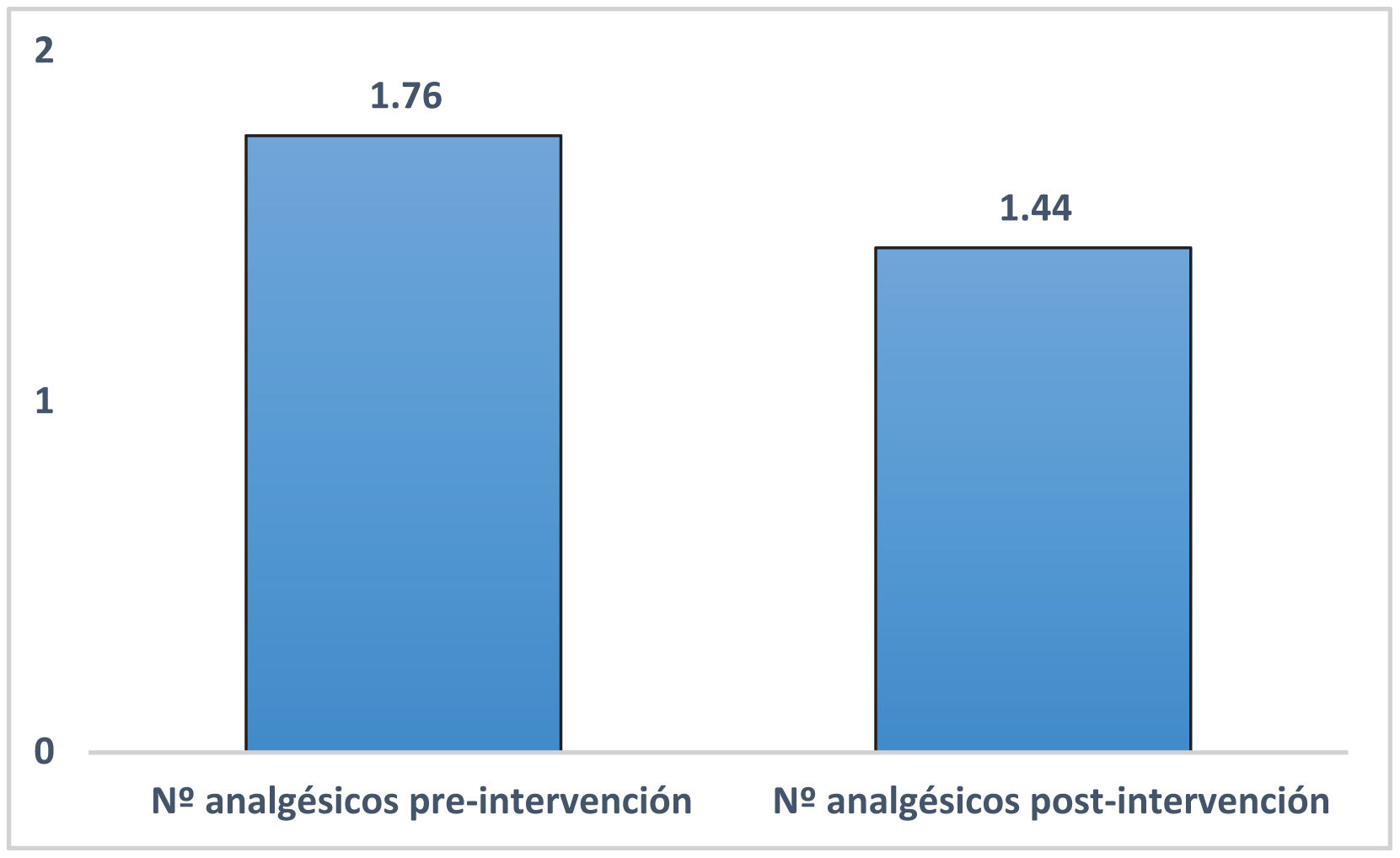
Por otra parte, en relación con la variable farmacológica, detectamos una diferencia estadísticamente significativa en la reducción del uso crónico de analgésicos (p=0,008), pasando de una media de 1,76 (DE 0,767) a una media de 1,44 (DE 0,950) postintervención.
Tuvimos una tasa de pérdidas de seguimiento del 30,95% durante las 7 semanas que duró la intervención. En cuanto a la adherencia a las sesiones grupales, el 59,52% de los pacientes completaron más del 70% de las sesiones, el 45,24% de los pacientes completaron más del 80% de las sesiones, y el 26,19% de los pacientes asistieron a todas las sesiones.
En el cuestionario de satisfacción evidenciamos que el 79,3% de los pacientes estaban muy satisfechos con la intervención grupal, el 17,2% bastante satisfechos y solo el 3,2% se mostraron poco satisfechos en relación con esta.
DiscusiónEn este estudio preliminar valoramos una intervención grupal destinada a adultos con dolor crónico no oncológico y/o fibromialgia en la que intervinieron diversos perfiles profesionales presentes en nuestro centro. Analizamos la utilidad potencial de esta intervención en mejorar el dolor percibido, la calidad de vida y el uso de analgésicos de estos pacientes. Los resultados evidenciaron que tras la intervención mejoró la calidad de vida, y disminuyó el número de fármacos analgésicos utilizados. En cuanto al dolor, aunque la disminución de la puntuación en la EVA estaba en el límite de significación estadística, posiblemente por el reducido número de pacientes, la reducción observada en el número de analgésicos sugería una menor intensidad del dolor tras el programa grupal.
El cuestionario SF-36 evalúa 8 dimensiones: función física, rol físico, dolor corporal, salud general, vitalidad, función social, rol emocional y salud mental. De estas, función física, rol físico, dolor corporal y salud general se correlacionan más con el índice sumario físico; mientras que rol emocional y salud mental se correlacionan más con el índice sumario mental. Las dimensiones vitalidad y función social tienen una influencia similar en los índices sumarios físico y mental10,11.
En nuestro estudio, con la intervención grupal mejoraron las dimensiones: dolor corporal, función social, salud mental y vitalidad; así como el índice sumario mental. Para las dimensiones función física, salud general, rol emocional, rol físico y el índice sumario físico no encontramos diferencias estadísticamente significativas. En los grupos pudimos apreciar cómo se establecía un vínculo entre los pacientes y a medida que avanzaban las sesiones estos venían más animados y con mayor predisposición (a aprender, reunirse, establecer rutinas saludables, cambiar creencias y hábitos), lo cual se pudo reflejar en la mejora observada de la función social, vitalidad y salud mental del SF-36 versión 2. Muchos de ellos al finalizar las sesiones grupales incorporaron la actividad física en sus rutinas.
En la primera sesión de nuestra intervención ofrecimos educación en neurociencias. Es necesario abordar falsas creencias que los pacientes pueden tener en relación con el dolor, como que se debe a una lesión localizada en la zona dolorosa o la necesidad de reposo para la recuperación12. Se ha sugerido también que los propios profesionales deberían a veces corregir sus propios conceptos erróneos sobre el dolor para poder mejorar su práctica asistencial12. Un ensayo clínico controlado en pacientes con dolor cervical crónico inespecífico evidenció que al añadir educación en neurociencias a los ejercicios terapéuticos mejoraba la discapacidad asociada al dolor y las creencias de evitación13. Una intervención grupal de educación en neurociencias del dolor en pacientes con fibromialgia realizada en atención primaria demostró una mejor capacidad funcional al compararlo con los cuidados habituales14. Una revisión sistemática concluyó que la educación en neurociencias es eficaz para mejorar el dolor y la discapacidad en la lumbalgia crónica y en la fibromialgia15.
En un estudio controlado con un total de 156 pacientes se evaluó el efecto de una intervención realizada en atención primaria, que consistió en educación en neurociencias (6 sesiones con un total de 10h) y ejercicio físico grupal (18 sesiones en 6 semanas, con un total de 18h)16. Encontraron una mejora, tanto al finalizar la intervención como a los 6 meses, en la calidad de vida SF-36 versión 2 en todas sus dimensiones e índices sumarios, pero más marcadas en el componente físico y dolor corporal, mientras que en la salud mental y salud emocional la mejora fue más moderada. Nuestra intervención fue más sencilla (5 sesiones con un total de 11h), y por tanto más fácil de incorporar en la práctica asistencial.
Otros estudios nacionales de intervención grupal han obtenido resultados positivos. Un estudio antes-después evaluó un programa grupal interdisciplinario con medidas no farmacológicas en un total de 143 pacientes con dolor crónico no oncológico. Al finalizar el programa disminuyó el dolor, ansiedad, depresión y uso de fármacos, y mejoró la calidad de vida, autopercepción del estado de salud, autoestima y bienestar de los pacientes17. Una intervención grupal que utilizó educación en neurociencias del dolor asociada a ejercicio en mujeres con fibromialgia obtuvo mejores resultados que el tratamiento habitual en la capacidad funcional, intensidad del dolor, catastrofismo, ansiedad y depresión18.
La principal limitación de nuestro estudio es la ausencia de grupo control, y el número limitado de pacientes, aunque los resultados nos apuntan a la utilidad de la intervención grupal y a que es factible realizarla en nuestro centro con la estructura actual y recursos disponibles.
Por otra parte, casi la totalidad de pacientes eran mujeres y por tanto nuestros resultados no podrían extrapolarse a la población masculina. Finalmente, la asistencia a las sesiones fue limitada y las pérdidas de seguimiento fueron superiores a las estimadas, a pesar de que la intervención se llevó a cabo en el propio centro de atención primaria. Solo el 26,19% de los pacientes asistieron a todas las sesiones, si bien el 59,52% completó más del 70% de las sesiones.
Una de las principales dificultades que tuvimos fue acomodar esta terapia grupal dentro de la actividad asistencial del centro, así como la coordinación de los diferentes profesionales y espacios disponibles. Por este motivo, la intervención fue de una sesión semanal de 1h de ejercicio físico durante 5 semanas. En estudios, con mayor intensidad en el ejercicio físico como el de Galan et al., se observó mayor efecto de mejora en la dimensión física16. De hecho, al preguntar a nuestros pacientes sobre aspectos a mejorar en cuanto a la intervención, algunos señalaron que sería conveniente ampliar el número y frecuencia de las sesiones para consolidar los cambios obtenidos.
En futuros estudios debería incorporarse grupo control y ampliar el número de pacientes participantes, así como la cantidad y frecuencia de sesiones de ejercicio físico para facilitar la mejora en la capacidad física y adquisición de rutinas con cambios en el estilo de vida que se puedan mantener una vez finalizada la intervención. También sería necesario incorporar estrategias para mejorar la captación y adhesión de los pacientes al programa.
ConclusionesEs imprescindible cambiar de diana terapéutica y centrarse en tratamientos encaminados a revertir los cambios neuroplásticos que presentan los pacientes con dolor crónico no oncológico. Para ello es imprescindible modificar las creencias erróneas relacionadas con la experiencia dolorosa tanto en profesionales como en pacientes y poner en práctica las actuales recomendaciones que aconsejan estrategias de afrontamiento activo basadas en educación y ejercicio en el primer nivel asistencial. Con nuestro estudio hemos visto que es posible este abordaje con los recursos y profesionales disponibles en el centro de atención primaria, pudiendo mejorar la calidad de vida de los pacientes, y disminuir el número de fármacos analgésicos utilizados.
Consideraciones éticasEl estudio se aprobó por el Comité Ético (PR194/23, CSI 23/49) y se realizó de acuerdo con los estándares establecidos en la Declaración de Helsinki de 1964 y modificaciones posteriores. Se obtuvo el consentimiento informado de los pacientes para participar en el estudio. Se siguió la ley de protección de datos y la garantía de los derechos digitales (Ley Orgánica 3/2018, de 5 de diciembre), y el Reglamento del Parlamento Europeo y del Consejo de protección de las personas (UE 2016/679 de 27 de abril).
Declaración sobre el uso de la IA generativa y de las tecnologías asistidas por la IA en el proceso de redacciónNo se ha utilizado inteligencia artificial (IA) generativa y tecnologías asistidas por IA en el proceso de redacción.
FinanciaciónNo hemos recibido apoyo financiero para la realización de la investigación y/o preparación del artículo.
Conflicto de interesesLos autores declaran no tener ningún conflicto de interés.
A la Unidad docente UDACEBA.

