




Knowing and understanding cultural heritage is essential for proper value-attribution, since without historical, social, political, economic or artistic contexts, we cannot attribute value to it. Knowledge, which is the first phase of the Heritage Learning Sequence (HLS), enables us to identify the causes and justifications that explain its nature and state, and provides a sound grounding for heritage valuation. The dimensions knowing and understanding, as measured by the Q-Herilearn scale (Fontal, Ibañez-Etxeberria, et al., 2024b) in digital environments have been analysed according to the answers given by a sample of 2362 participants aged 18 to 70. Comparative analyses between groups (frequentist and Bayesian) have been carried out, the validity of both the measurement models and the structural model (MIMIC) has been determined, and the analyses were complemented by means of network analysis. Both the measurement model and the final structural model (MIMIC with DIF) have provided sufficient guarantees in terms of validity and reliability, and results have been endorsed by network analysis. The dimensions analysed (knowledge and understanding of heritage) are strongly interconnected, so that the understanding of heritage depends largely on the degree of prior knowledge. However, we have found no evidence (or very weak, given the small effect size) of the influence of socio-demographic variables on either the dimensions or the indicators that measure them. We believe that the most relevant contribution of this research is the combination of structural equation-based models with network analysis-based models to study the knowledge and understanding of cultural heritage in digital contexts.
Conocer y comprender el patrimonio cultural es fundamental para la adecuada atribución de valor ya que, sin un contexto histórico, social, político, económico o artístico, no es posible asignarle un significado adecuado. El conocimiento, que constituye la primera fase de la Secuencia de Aprendizaje Patrimonial (HLS, por sus siglas en inglés), permite identificar las causas y justificaciones que explican su naturaleza y estado, proporcionando así una base sólida para la valoración del patrimonio. Las dimensiones conocer y comprender, medidas mediante la escala Q-Herilearn (Fontal, Ibañez-Etxeberria et al., 2024b), en entornos digitales han sido analizadas según las respuestas proporcionadas por una muestra de 2.362 participantes de 18 a 70 años. Se han realizado análisis comparativos entre grupos (frecuentistas y bayesianos), se ha determinado la validez tanto de los modelos de medición como del modelo estructural (MIMIC), y los análisis se han complementado mediante análisis de redes. Tanto el modelo de medición como el modelo estructural final (MIMIC con DIF) han proporcionado garantías suficientes en términos de validez y fiabilidad, y los resultados han sido respaldados por el análisis de redes. Las dimensiones analizadas (conocimiento y comprensión del patrimonio) están fuertemente interconectadas, de modo que la comprensión del patrimonio depende en gran medida del grado de conocimiento previo. Sin embargo, no hemos encontrado evidencia (o muy débil, dado el pequeño tamaño del efecto) de la influencia de las variables sociodemográficas tanto en las dimensiones como en los indicadores que las miden. Consideramos que la contribución más relevante de esta investigación es la combinación de modelos basados en ecuaciones estructurales (MIMIC) con modelos basados en análisis de redes para estudiar el conocimiento y la comprensión del patrimonio cultural en contextos digitales.
Knowing and understanding cultural heritage is fundamental in order to have arguments and criteria leading to its proper valuation (Mazzanti, 2002). Indeed, it is not possible to value cultural property that lacks justification or meaning (Pétursdóttir, 2020) in relation to a historical, social, political, economic or artistic context (Rowlands, 2020). If we are unable to identify the causes, reasons or arguments that account for the qualities, nature and/or current state of cultural heritage, we will not be able to attribute any value to such heritage —we will not know why it is valuable— (Taher Tolou Del et al., 2020) or else we will directly believe, that it has no value (DeSilvey & Harrison, 2020). Therefore, knowing is the first phase and therefore the first verb in the Heritage Learning Sequence (henceforth HLS) (Fontal, 2022; Fontal et al., 2024).
Heritage knowledge varies as a function of (a) the type of preferred or dominant cognitive operations for acquiring, processing, storing and using information (e.g., perception, attention, memory, reasoning, problem solving, etc.) (Röll & Meyer, 2020); (b) the procedure whereby we acquire that knowledge (e.g., reception, interaction, experimentation, discovery, etc.) (Petersson et al., 2020); and (c) the extent to which that knowledge fits previously existing knowledge (e.g., inclusion, adequacy, extension, denial, association, comparison, etc.) (Wang et al., 2024). According to the HLS, knowledge of heritage determines (i.e., has a direct influence on) its understanding, insofar as it shapes (a) the way of accessing knowledge (cognitive operations), (b) the knowledge-acquisition procedure and (c) its relation to other learnings. Therefore, how we understand certain cultural goods will be a direct consequence of how we have got to know them (Chen & Wan, 2023; Yan & Li, 2023).
Understanding heritage requires finding answers to the questions that cultural property raises among the general public, either spontaneously or in a directed way, within the framework of some kind of communication, interpretation, mediation or educational process (Boniotti, 2023). If a cultural asset does not make sense (e.g., we consider it absurd, it is decontextualised, it does not respond to any aesthetic criterion, it has no historical coherence, it is not linked to a socio-cultural context, it does not possess aesthetic qualities, etc.), we can hardly find reasons for its valuation (Spennemann, 2023b), beyond the inherited inertias of valuation itself (Cucco et al., 2023). Following the HLS, understanding has a direct influence on the attribution of value to heritage (Fontal, Ibañez-Etxeberria et al., 2024b). The understanding of heritage involves mental operations that lead to constructing meaning, explaining causes or recognising qualities (e.g., analysis, interpretation, synthesis, reflection, memory, creativity or problem solving, among others) (Schuster & Grainger, 2021).
Digital technologies have reshaped how cultural heritage is preserved, accessed and communicated. Three-dimensional modelling and virtual reality enable precise documentation and creative reinterpretation of heritage assets, offering designers immersive environments to engage with spatial and semantic aspects of cultural forms (Banfi & Oreni, 2025). Likewise, augmented reality fosters emotional and educational connections in cultural settings by enhancing perceptual experiences, particularly within arts education (Papanastasiou et al., 2019). However, challenges remain in ensuring that digital representations reflect the cultural values they intend to preserve. This requires balancing technical accuracy with openness and usability, allowing for broader access, engagement, and reinterpretation across audiences (Rahaman, 2018). Participatory and co-creative design approaches further support this goal, encouraging inclusive and context-aware digital heritage practices (Hodgson et al., 2024).
Currently, digital environments are the preferred settings for the processes of knowledge and understanding of heritage (Ch’ng et al., 2020). In addition to the traditional communicative processes, they provide the site for other interactive processes between peers and between the latter and institutions and organisations entrusted with the custody of heritage (e.g., museums, administrations, foundations, cultural centres, associations, etc.) (Agostino et al., 2021) and even nurture the formation of generative heritage communities, in which the management, participation in and promotion of heritage result from self-organised projects (Viola, 2022), in line with the Framework Convention on the Value of Cultural Heritage for Society (Council of Europe, 2005).
Heritage education has evolved from a preservation-focused approach to a holistic paradigm that emphasises the relationships between people and heritage (Smith, 2006). Therefore, researching the learning process is particularly relevant. Research on heritage education and digital environments ranges from its impact on transformed heritage experiences through virtual and augmented reality applications (Ibañez-Etxeberria et al., 2020), facilitating new forms of engagement that drive traffic to cultural institutions and enhance visitor experiences (Fernández-Lores et al., 2022). Recent research has also highlighted the emergence of on-line heritage paradigms focused on cyber communities and digital educommunication, which are reshaping how people interact with cultural assets in virtual spaces (Rivero et al., 2024). Measuring heritage knowledge in digital environments addresses cognitive-conceptual (Zort et al., 2023), relational (Molho, 2023) and experiential (Ch’ng et al., 2020) dimensions. The instruments that have been generated to understand cultural heritage through digital environments focus on highly specific domains or situations, (e.g., Li et al., 2023, in connection with disaster cycles), specific technologies (e.g., Innocente et al., 2023, for XR Technologies; Kara, 2022, for video games) or specific types of heritage (e.g., Usui & Funck, 2023). Similarly, instruments that measure the understanding of cultural heritage are limited to analyses for specific apps (e.g., De Paolis et al., 2023) and particular learning contexts (e.g., Race et al., 2023, for museums) or refer to highly specific technology (e.g., Vacca, 2023). New tools have been developed to specifically analyse museum educommunication on social media (Aso et al., 2024), and innovative approaches have been implemented in Spanish house museums to engage visitors through various web technologies (Pérez, 2021). All of which confronts us with a scene marked by the absence of instruments targeted at including and relating both dimensions: a shortcoming that we attempt to overcome with the present study.
The present studyThe objectives of this study are: (1) to relate the forms of heritage knowledge and understanding to the users’ habits when employing technology; (2) to establish models in the forms of approaching heritage knowledge and understanding; (3) to quantify the relationship between the two factors; (4) to identify the forms of heritage knowledge and understanding in terms of the users’ socio-demographic background; (5) to determine the degree of influence of several socio-demographic variables (age, gender, number of countries visited, country of residence, area of residence, frequency of internet connection, preferred social media, education level) on both dimensions and, where appropriate, on individual items; (6) to check to what extent the items within each of the two dimensions analysed (knowing and understanding) are interrelated.
This paper follows the methodology of cross-sectional survey designs, the purpose of which is to describe the opinions of participants, as expressed through responses to structured questionnaires (Creswell & Creswell, 2023; Fowler, 2014). The exploratory study is based on the Heritage Learning Sequence (Fontal, Ibañez-Etxeberria et al., 2024b), which identifies the seven main verbs in heritage learning which, in turn, constitute the seven dimensions of the Heritage Process Model (HPM, Fontal, 2022). Each of the latent variables is assessed by seven indicators. Based on the previously stated objectives, the following hypotheses have been formulated: (1) The measurement model for the heritage dimensions Knowing (hencefoth kno) and Understanding (henceforth und) will reach sufficient validity and reliability values, with a positive relationship between the two factors; (2) The structural model will reproduce the original variance-covariance matrix with sufficient accuracy; (3) The socio-demographic characteristics (independent exogenous covariates) will significantly influence both the two dimensions and the items that measure them; (4) The kno dimension will have a positive and significant influence on the und dimension of heritage; (5) The relationships between the observable indicators measuring the kno and und dimensions will be positive and statistically significant; (6) Indicators measuring each of the dimensions will show stronger relationships with each other than those shown with items belonging to the other dimension; (7) The structure of the indicator network will achieve a sufficient degree of replicability, i.e., the structure in two random sub-samples drawn from the original sample will be invariant; (8) The proportion of variance of each node explained by nodes belonging to its theoretical dimension will be larger than that explained by the rest of the nodes in the network; and (9) The structure shall achieve sufficient levels of sensitivity.
Figure 1 schematically represents the relationship between objectives, hypotheses, data analysis techniques, and results.
MethodParticipants
The initial number of participants was 3589. In a first screening, we removed those who left blank responses to any of the socio-demographic variables (N = 1160). Thus, we started with a total of 2429 responses with complete socio-demographic data. After a second cleaning of the data (which will be explained later, in the Procedure section), the final sample consisted of N=2362 participants aged 18 to 70 years (M=26.06, SD=8.74). The defining characteristics of the participants (age, gender, country of residence, number of countries visited, area of residence, mother tongue, education level, frequency of internet connection and preferred social media) are summarised in Table 1 (Supplementary Materials, henceforth SM). Participants were predominantly under 30 years old (88.4%), female (70.0%) and residents in Spain (75.3%), living in urban areas (77.2%), with Spanish as their mother tongue (80.0%), a higher education background (83.1%), a frequency of internet use of more than once a day (93.1%) and a preference for Instagram as their favourite social media (49.7%).
We used two methods to estimate a sample size that would guarantee sufficient power to reject the null hypothesis φ12=0 (i.e. the hypothesis of zero covariance between the two factors in the CFA model) and significantly detect a hypothesis of factorial covariance φ12=.30: (a) the procedure proposed by Satorra and Saris (Satorra & Saris, 1985) and (b) a Monte Carlo simulation (Muthén & Muthén, 2002). MIn both methods the hypothetical starting CFA model included two factors ξ1 (kno) and ξ2 (und), each of which is measured by seven indicators y1-y7 for ξ1 and y8-y14 for ξ2). We hypothesised that all indicators have a mean μ=0 and a variance σ2 = 1.00. All factor loadings were specified as λ=.75, which equates to an item reliability of ρ=.563. For the purpose of factor scale definition, factor variances were specified as σ2 = 1.00. Therefore, all error variances were θ=.438. The covariance between the two factors was set at φ12=.30. All parameter values specified in the application of the Satorra-Saris and Monte Carlo methods are hypothetical values of the population parameters based on the best theoretical estimate.
Satorra-Saris procedureWe applied the Satorra-Saris method with different theoretical sample sizes, from N=50 to the empirical sample size (N=2362) used in the study. In each of the analyses we tested the significance of the covariance between the factors (φ12). The χ2 value obtained in each analysis was taken as an approximate non-centrality parameter λ. With a sample of N=50, the χ2 value is 3.798, which corresponds to an approximate power of .496; with a sample of N=75, the χ2 value is 5.697, which corresponds to an approximate power of .690, and so on (vid. Fig. 1 SM). The analysis was carried out with Mplus, v. 8.10 (Muthén & Muthén, 2023).
Monte Carlo analysisThe Monte Carlo analysis was also performed with Mplus, v. 8.10 with 10000 replicates. As in the previous case, we analysed the same sample sizes and took as power estimate the significance level of the covariance φ12. Thus, for N=50 we obtain a p-value=.543; for N=75, p=.666, and so on. Both methods produced very similar results (Figure 1 SM). Convergence was achieved in 100% of replicates. The parameters estimated by the model were very similar to the population parameters, with no bias in the estimation or in the standard error. The Mean Squared Error (MSE) values were almost zero, confirming the absence of bias. Between 94.7% and 95.6% of replicates contained a population value at a 95% confidence interval. The test reached maximum power (1.000) for population parameters greater than zero. In conclusion, the Monte Carlo analysis indicated accurate estimates of the model parameters, with high power and low probability of type I error (see Table 2 SM). Consequently, the three criteria required to determine whether a sample size is sufficient were met: i.e., the parameter and standard error biases should not exceed 10% for any parameter in the model; the parameter and standard error biases for the focused parameter should not be larger than 5%; and the coverage should range from .91 to .98 (Muthén & Muthén, 2002).
InstrumentsData were collected using Q-Herilearn (Fontal et al., 2024; Fontal, Ibañez-Etxeberria et al., 2024a, 2024b), a probabilistic summated rating scale that measures different aspects of the learning process in Heritage Education. It consists of 77 questions: eight collect socio-demographic information, 20 identify habits of use in digital environments and 49 correspond to the items that measure the seven factors (i.e., knowing, understanding, respecting, valuing, caring, enjoying and transmitting). Each dimension is measured by seven indicators scored on a 4-point frequency response scale (1=Never or almost never; 2=Sometimes; 3=Quite often; 4=Always or almost always). The metric properties of the scores obtained with this instrument (evidence of content validity, convergent and discriminant validity, internal consistency) were fully satisfactory (Fontal, Ibañez-Etxeberria et al., 2024b). Tables 3 and 4 (SM) include the wording of the items.
ProcedureAfter being informed of the purpose of the research, ensuring confidentiality of information and providing informed consent, participants completed an online survey between May 9 2022 and November 23, 2023, in accordance with the UPV-EHU Ethics Committee (CEISH, Cod: M10_2021_31). All fields were voluntary. We performed a second cleaning of the data by using two strategies: outlier filtering and multivariate outlier detection. Straight lining cases (N=12), outliers (N=24) from the left tail of the distribution lpz (≤ −3; Drasgow et al., 1985; Niessen et al., 2016) and multivariate outliers (N=31) were removed, so that the useful empirical sample consisted of N=2362 participants.
Data analysisAnalysis proceduresWe used five types of analysis: (a) preparatory data analyses (e.g., polychoric and Spearman correlations, item distribution with measures of central tendency and dispersion); (b) descriptive statistics of the scores obtained for kno and und, and comparison between groups according to the different socio-demographic variables defining the sample (objective 1); (c) different confirmatory factor analysis models for the evaluation of the measurement model (objectives 2, 3), (d) Multiple Indicators Multiple Causes MIMIC structural model to estimate the relationships between various socio-demographic variables, factors and observable indicators (objectives 4, 5), and (e) network analysis to test the nature, strength, sensitivity, stability, predictability and replicability of the relationships between items (objective 6).
MPlus, v. 8.10 (Muthén & Muthén, 2023), SAS, v. 9.4 (SAS Institute Inc., 2013) and R, v. 4.3.3 (R Core Team, 2023) software packages were used in the several analyses conducted. The code used for the analyses (e.g., SAS, R, Mplus) is available upon reasonable request from the corresponding author. The kno and und dimensions were used, each consisting of seven indicators. No data transformation (e.g., collapsing of variables or categories, binarisation of variables, imputation of missing data) was necessary. Mardia coefficients indicated the absence of multivariate normality, both in the kno subscale (b2p=70.39 κ=16.00, p≤ 0) and in the und subscale (b2p=73.89, κ=23.57, p≤ 0) as well as in the total scale (b2p=261.43, κ=42.98, p≤ 0). Even so, the data presented acceptable levels of skewness and kurtosis (Table 5 SM; Figure 2, Figure 3 SM). To address the problem of skewed ordinal data, we calculated polychoric correlations between items. There were no noticeable differences with Spearman’s ordinal correlations (mean difference M=.063, SD=.011) and we found no cells with few observations generating spurious connections. Correlation matrices and other related graphs are presented in Tables 6 and 7 (SM) and Figures 2 and 3 (SM). Only one of the 91 correlations exceeded .60, so it was not necessary to combine items. The mean (M=.416) and dispersion (SD=.080) of the correlations were adequate for the purpose of the study.
Item distributionThe range of item means was 2.011 (kno10) to 2.721 (kno4). Therefore, none of them showed excessively high or low values (i.e., very close to 4 and 1, respectively) that could present very high or very low partial correlations with the rest of the items. This indicates that no floor or ceiling effects were found in the distribution of the variables. Of the 14 items, none presented relatively high values for negative skewness, and two did so for positive skewness (kno9, Skp=.548; kno10, Skp = .560). The minimum and maximum values for skewness were −.096 (kno4) and .560 (kno10). The minimum kurtosis value was −.970 (und24) and the maximum was −.196 (kno10). Since the skewness and kurtosis values are not extreme, we did not consider it necessary to perform any transformation (e.g., paranormal transformation) or to use other options such as dichotomising the data and running an Ising Model in the further analysis of the network of relationships between the indicators (Table 5 SM).
Analysis of relationships between itemsTo assess reliability and construct validity, we used the following coefficients: Cronbach’s α, composite reliability (ρ), and McDonald’s ω, as well as φ12 (the correlation between both factors) and AVE (average variance extracted). In order to test hypotheses 5–10, we carried out a network analysis on the items measuring the two dimensions assessed. A summary of the analyses is presented below.
Estimation method. A network is a complex system composed of nodes (14 items, in this study) connected by edges representing conditional dependency relationships between nodes. We used GGM (Gaussian Graphical Model, EBICglasso) and regularisation as estimation method on the polychoric correlation matrix. The tuning-parameter gamma was set to γ=.5.
Network precision. In order to analyse the precision of the network parameters and the stability of the centrality indices we use non-parametric bootstrapping methods based on 1000 samples. We follow three strategies: (a) calculation of bootstrapped confidence intervals to estimate the accuracy of edge weights; (b) analysis of the stability of centrality indices after removing successive portions of the data; and (c) application of bootstrapped difference tests to both edge weights and centrality indices.
Statistical packages. Network estimation was performed with the bootnet package, version 1.5.3 (Epskamp & Fried, 2023). Network visualization was performed with the qgraph package, version 1.9.5 (Epskamp et al., 2023). To determine clustering and the optimal number of dimensions, we used parallel analysis (Horn, 1965), VSS (Revelle & Rocklin, 1979) and MAP (Velicer, 1976). These analyses were complemented by Exploratory Graph Analysis EGA (EGAnet, v. 2.0.5, Golino & Christensen, 2024).
Comparison between groups. We conducted a comparison between two subsamples (N1=1181; N2=1181) randomly drawn from the original sample. The groups were compared by means of the Network Comparison Test NCT, v. 2.2.2 (van Borkulo et al., 2023) using 1000 iterations.
Centrality indices. We calculate three centrality indices: strength, closeness and betweenness. Strength focuses on the overall influence or importance of a node resulting from the weight of its connections: i.e., it quantifies the influence of a node based on the strength of its connections. Closeness emphasises the accessibility of a node within the network resulting from its ability to reach other nodes in the network. Betweenness highlights the role of a node in connecting other nodes within the network, often influencing the flow of interactions or information. In this study we have paid special attention to strength as a measure of centrality.
Differences between edges within the network. We calculate the differences between the edges of the network by means of a bootstrap difference test using the difference Test function of the bootnet package.
ResultsTo estimate the relationships between the knowledge and understanding factors as a function of participants’ technology use habits (objective 1), we conducted group comparisons using both frequentist and Bayesian statistics. The most relevant results are presented below. Tables 8–15 (SM) show the descriptive statistics of the total scores achieved for kno and und according to the eight socio-demographic variables analysed. This information is complemented by comparisons between groups using both frequentist (Welch’s t and F) and Bayesian (logeBF10) statistics. The numerical results are shown in Tables 16 and 17 (SM), and the graphs are in Figures 4 to 19 (SM). From these results we were able to draw the following conclusions:
- 1.
In general, we have not found significant differences in kno and und scores between the groups formed by the different socio-demographic variables, since most of the frequentist analyses have resulted in p-values higher than .05, and Bayesian analyses have delivered evidence (anecdotal, moderate, strong or very strong) of the likelihood of H0.
- 2.
In some analyses, significant differences between groups were found (influence of age, country of residence, number of countries visited and preferred social media on kno; age and country of residence on und). For example, in the case of age on kno, the following results were obtained in the frequentist analysis: FWelch(2, 703.34)=16.63, p= .000; ω2=.04 [95% IC=.07; 1.00]. The Bayesian analysis, on the other hand, produced the following results: log(BF10)=11.596, error%=.027; R2=.014 [95% IC=.007; .023], with decisive evidence in favour of H1. Participants older than 30 (N=276, μmean=18.13) obtained higher scores on kno by comparison with both participants between ages 21 and 30 (N=1414, μmean=16.20, pHolm-adj=4.98e-08) and participants in the youngest group (N=672, μmean=15.11, pHolm-adj=.000).
- 3.
Notwithstanding the above results, the effect sizes (γHedges for two groups and ω2 for more than two groups in frequentist analyses; δmedian for two groups and R2 for more than two groups in Bayesian analyses) have either been very small (Cohen, 1988; Sawilowsky, 2009), or include the value zero in the confidence interval. Thus, in frequentist analyses the range of ω2 goes from .002 to .13; the range of γHedges goes from −.076 to .148. In Bayesian analyses, R2 ranges from .000 to .039; the range of δmedian goes from −.076 to .146.
- 4.
Consequently, preliminary bivariate analyses that compare groups on the basis of socio-demographic variables have not provided sufficient evidence to support hypothesis 3.
In order to explain the knowledge and understanding factors of heritage (objective 2), we employed various measurement CFA models, which are summarized in the following paragraphs. The analysis of construct validity is essential to assess whether the instrument genuinely measures the two proposed theoretical dimensions. In this case, it is crucial to examine different Confirmatory Factor Analysis (CFA) models to evaluate the latent structure of the data. Thus, several models have been tested: (a) A baseline model to determine whether the items can be grouped into a single general factor (unidimensional model); (b) A two-factor correlated model, assessing whether the items are organized into two distinct yet related dimensions; (c) A bifactor CFA model to explore whether, in addition to the two specific factors, there exists a common general factor; (d) A bifactor ESEM orthogonal model, which examines whether allowing cross-loadings can reduce the bias inherent in traditional CFA; and (e) An ESEM model with oblique TARGET rotation, designed to assess whether significant cross-loadings exist between factors without imposing strict independence among items. This comprehensive approach allows for a more precise understanding of the factorial structure of the instrument and ensures that the theoretical model aligns with the empirical data.
In addition to χ2 and its corresponding significance level, we used several goodness-of-fit indices and information criteria commonly employed in SEM research: RMSEA (Steiger, 1990) with its 95% confidence interval and p-close value, Comparative Fit Index CFI (Bentler, 1990), Tucker-Lewis Index TLI (Tucker & Lewis, 1973), Standardized Root Mean Squared Residual SRMR (Pavlov et al., 2021), Akaike Information Criterion AIC (Akaike, 1987), Bayesian Information Criterion BIC (Schwarz, 1978) and Sample-Size Adjusted BIC ABIC (Sclove, 1987). According to the most common interpretation suggestions (e.g., Browne & Cudeck, 1993; Hu & Bentler, 1999; Marsh et al., 2004), RMSEA values below .06 and .08 are considered excellent and acceptable, respectively; values above .90 and .95 in CFI and TLI are considered good and excellent; finally, SRMR values below .06 are regarded as acceptable. These results, together with those obtained for the rest of the measurement models, can be found in Table 18 (SM). The model that achieved the best fit (two correlated factors) demonstrated acceptable construct validity and composite reliability values (i.e., α, ρ and ω values above .707 and AVE above .50), as summarised in Table 1. These results support hypothesis 1.
To address objective 3, the relationship between the two factors (knowledge and understanding) was quantified using the MIMIC model, the results of which are described below. Once we achieved a satisfactory fit for the CFA model, we implemented a Multiple Indicators Multiple Causes (MIMIC) model in order to assess the invariance of scores across the two factors and eight socio-demographic variables. Three models were tested whose conceptual representation is shown in Figure 2. The first model (M1) includes eight exogenous covariates (x1 - x8) and one factor (η1) measured by 14 indicators. The second model (M2) includes two orthogonal factors (η1 y η2), each measured by seven indicators. The third model (M3) included a regression coefficient β from η1 a η2, three γ DIF coefficients (x1 → y5; x2 → y7; x3 → y13) to analyse the direct path of covariates on specific indicators, and five error covariances θε between pairs of items with semantic similarity.

The covariates were age (with less than 20 as the reference group), gender (with female as the reference group), number of countries visited (none), country of residence (Spain), area (rural), internet connection frequency (more than once a day), preferred social media and educational level (vocational education or lower). In addition to the eight covariates, we estimated additional models by introducing an interaction term between each pair of covariates as an exogenous variable. None of the interactions was statistically significant in predicting the endogenous variables η1 y η2.
The additional free parameters reported in Figure 3 correspond to the estimation of five correlations between the residuals of pairs of items that, showing clear semantic similarity, obtained MI (Modification Index) and SEPC (Standardized Expected Parameter Change) substantially greater than 10 and .3, respectively. This semantic similarity can be specifically seen in the fact that the items refer to the visual perception of heritage (kno4-kno6); they allude to search processes aimed at expanding knowledge (kno6-kno9); they share the reference to operations in social media (kno9-kno10); they allude to the understanding of heritage based on sensory perception, i.e., visual and auditory (und17-und20); or they refer to different resources of augmentative technology, i.e., virtual reality, augmented reality, 3D recreation, in order to enhance the understanding of heritage (und23-und20). As shown in Table 2, the fit of model M3 was far superior to that achieved by models M1 and M2. This result supports hypothesis 2.

MIMIC model with DIF.
Note. c_visit=Countries visited; c_resi=Residence country; r_area=Residence area; int_frq=Internet connection frequency; prefer=Preferred social network; educ=Educational level. In blue: standardised regression coefficients between covariates and kno factor; in red: standardised regression coefficients between covariates and und factor; in green: standardised paths between covariates and items (DIF).
MIMIC models fit
| M1 | M2 | M3 | |
|---|---|---|---|
| FP | 50 | 59 | 67 |
| χ2 | 2307.404 | 1563.103 | 896.292 |
| DF | 181 | 172 | 164 |
| P | .000 | .000 | .000 |
| RMSEA | .071 | .059 | .043 |
| [95% CI] | [.068;.073] | [.056;.061] | [.041;.046] |
| p-close | .000 | .000 | 1.000 |
| CFI | .842 | .897 | .946 |
| TLI | .823 | .878 | .933 |
| SRMR | .047 | .038 | .030 |
| AIC | 70733 | 69939 | 69223 |
| BIC | 71021 | 70280 | 69609 |
| ABIC | 70862 | 70092 | 69396 |
Note. FP=Number of free parameters; DF=Degrees of freedom; RMSEA=Root Mean Square Error of Approximation; 95% CI=95% Confidence Interval; p-close=Probability that RMSEA≤.05; CFI=Comparative Fit Index; TLI=Tucker-Lewis Index; SRMR=Standardized Root Mean Square Residual; AIC=Akaike Information Criterion; BIC=Bayesian Information Criterion; ABIC=Sample-size-adjusted BIC.
The influence of sociodemographic variables on the Knowledge and Understanding factors of heritage (objectives 4 and 5) was analysed using the MIMIC model. The main results obtained are presented in the following paragraphs. mBy exploring sociodemographic differences using the MIMIC (M3) model with DIF on the kno and und subscales, we analysed the extent to which covariates could influence both overall scores on kno and und and responses to specific items. Examination of Figure 3 leads us to draw the following conclusions:
- 1.
The standardised path from kno to und was positive and significant (β=.855, p= .000). It can therefore be stated that heritage knowledge has a decisive influence on its understanding and appreciation. This result lends support to hypothesis 4.
- 2.
All λ values were positive and significant (p< .001), which implies that the measurement model is adequate to measure the constructs of knowledge and understanding of heritage, a result that supports hypothesis 5.
- 3.
However, most of the paths between the covariates and the factors were found to be non-significant (p> .05). This indicates that gender, number of countries visited, area of residence, frequency of internet connection, preferred social media and level of education have no significant direct effect on either knowledge or understanding of heritage. The only significant influences were found between age and level of knowledge (γ = .177, p = .000), country of residence and level of knowledge (γ=.111, p= .000), age and level of understanding (γ = −.043, p= .010), and gender and level of understanding (γ = −.059, p= .001).
These results support those presented above, in which we related each of the predictors to the two dependent variables kno and und. However, we estimate that the detection of such significant influences is essentially due to the large sample size, since the effect sizes were very small in all cases. Thus, path age → kno resulted in f2=.020; path c_resi → kno resulted in f2=.002; path age → und resulted in f2=.011; and path gender → und resulted in f2=.001 (Table 19 SM). This suggests that the scores achieved on the kno and und factors are not really influenced by the sociodemographic variables considered in the study.
- 4.
The DIF analysis (i.e., paths that had reached higher levels of significance in the influence of the covariates on the indicators) has resulted in some significant standardised coefficients: age → kno10 (γ=.127, p= .000, f2=.072); gender → kno14 (γ = −.053, p= .001, f2=.094); c_visit → und23 (γ = −.082, p= .000, f2=.053). However, we estimate that again the detection of such effects is due rather to the size of the sample used than to the existence of substantive influences, as evidenced by the small effect sizes achieved. The direct effects of the covariates age on kno10 (I read online news about heritage), gender on kno14 (Viewing the publications of other users allows me to expand my knowledge about heritage) and number of countries visited on und23 (Virtual reality and augmented reality are means that help me better understand cultural heritage) cannot therefore be considered to differ as a function of the value of the covariate, while holding the factor constant. Taking these results together, we conclude that we have found no empirical evidence to support hypothesis 3.
The interrelationships among the items within the two analysed dimensions (knowledge and understanding), as specified in objective 6, were explored through network analysis, the results of which are reported below. We have largely followed the general and particular specifications proposed by Burger and co-writers (Burger et al., 2023). In the following paragraphs we refer to the results of the main analyses of the relationships between items (network inference, accuracy and stability checks, stability of centrality indices, network visualization, network density and average absolute edge values, standardized centrality indices). We will conclude the section with the results achieved on predictability, replicability, sensitivity, and clustering.
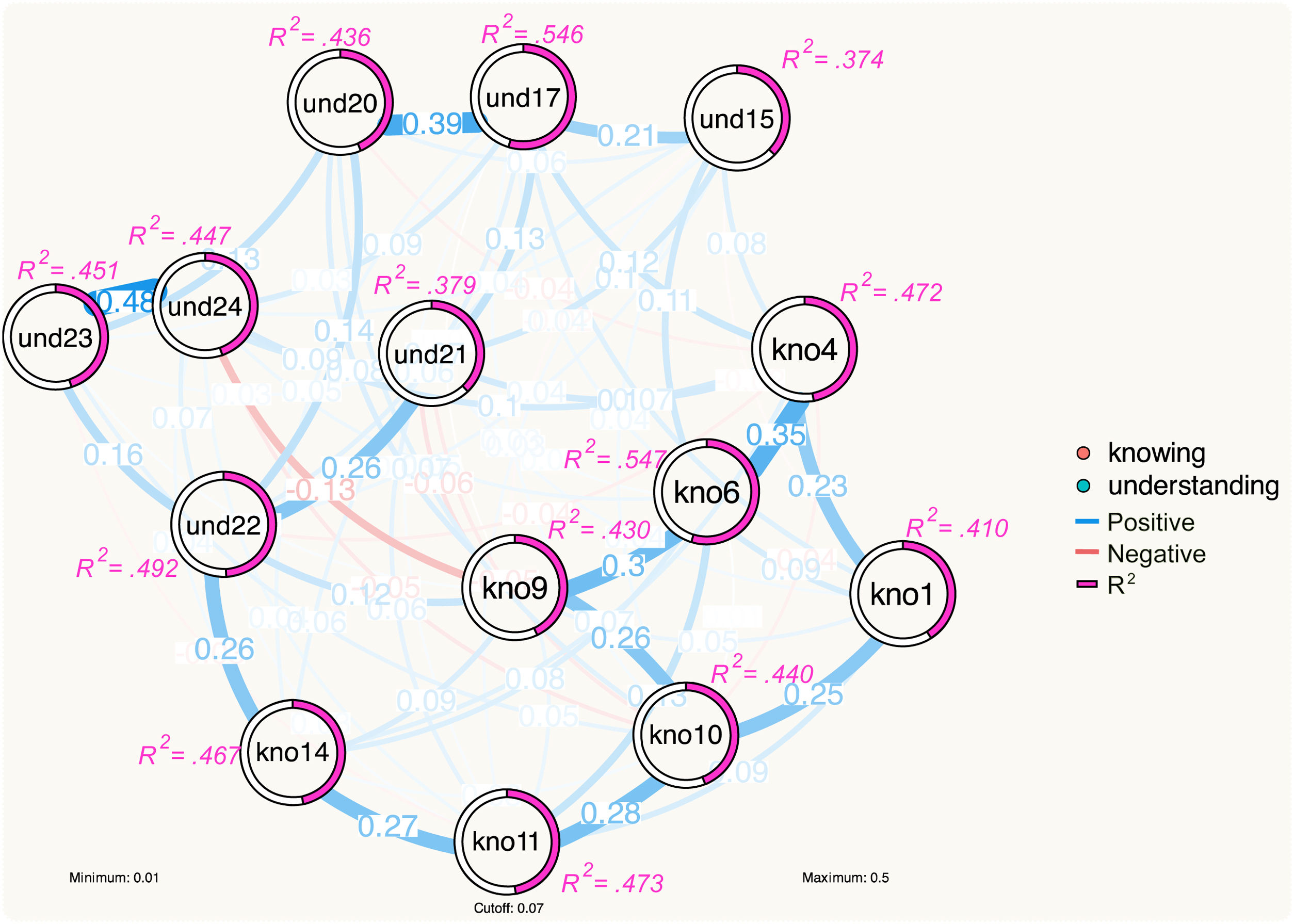
Network inferenceThe nodes with the highest strength centrality were kno6 (What I see in a digital environment encourages me to keep looking for other heritages) and und17 (The images of the digital environment help me understand heritage). As expected, strength was strongly related to predictability, reaching correlations of r=.796 (kno), r=.845 (und) and r=.829 (complete network).
Accuracy and stability checksWe used the bootnet package to determine the uncertainty associated with the estimates of the edge weights, calculating 1000 bootstraps to estimate the confidence intervals (95%) of the weights of the items. These intervals are shown in Figure 4. The y-axis contains the 91 edges (labels have been removed for readability) and the x-axis contains the scale of measurement of the weights.

The red circles are the estimates of the sample edges, while the blue circles indicate the bootstrap mean values, and the horizontal lines shaping the grey area equal the 95% confidence interval across 1000 bootstraps. The edges are sorted according to weight value. Thus, the edge with the highest weight was und23-und24 (w=.405), and the edge with the lowest weight was kno9-und24 (w = −.080). As expected, we found that most of the edges were positive (w > 0): N=73, 80.22%. Only four (4.40%) were negative (w < 0), while in 14 of the edges (15.38%) the mean weight was w=0, which lends support to hypothesis 5. Finally, we note that the intervals show generally small ranges, while the empirical sample values fall within the intervals, indicating that accurate estimates have been made. The numerical values corresponding to the graph in Figure 4, as well as the estimates of non-zero values, can be found in Table 24 and Figure 20 (SM), respectively. In accordance with hypothesis 6, we found that intra-factor edge weights (i.e., kno-kno or und-und connections) were systematically stronger than inter-factor weights (i.e., kno-und connections), as will be detailed later (see Network visualisation section).
Stability of centrality indicesWe analysed the stability of the centrality indices by comparing their average correlations with bootstrapped samples (N=1000) at successive intervals where one part of the initial sample was excluded (Figure 5). To this purpose, we calculated the correlation-stability coefficient (CS-Coefficient; Epskamp et al., 2023). This statistic represents the mean percentage of the sample that can be removed to maintain a correlation of r ≥ .7. As we eliminate larger portions of the sample, the value of r decreases. What is relevant is that in the last interval the value of r is not less than .25. If it is greater than .5, we can conclude that there is a significant correlation between the centrality indices of the empirical sample and the indices of the bootstrapped samples. This is the case for Betweenness (CS (r=.70) ≈ .612), Closeness (CS (r=.70) ≈ .645) and Strength (CS (r=.70) ≈ .726). In the latter case, within the interval corresponding to 50%, a value r ≈ .854 was reached. Consequently, we can state that the centrality indices were sufficiently stable in all cases.

In the graph in Figure 5 the lines indicate the means, and the areas indicate the range between quantiles 2.5 and 97.5. The numbers inscribed in the rectangles indicate the correlations achieved in successive intervals.
Network visualizationThe estimated network is presented in Figure 6. The nodes correspond to the 14 items of the kno and und subscales, and the edges represent regularised partial correlations (γ=.5) between the nodes. Blue lines represent positive relationships and red lines negative relationships. The strength of the associations is proportional to the thickness and saturation of the edges.

The coloured segments at each node represent the amount of variance of the node that is explained by the rest of the nodes which it is connected to. The values of both the variance explained at each node (R2) and the edge weights are also included. For the purpose of graphical representation, we used the Fruchterman-Reingold algorithm (Fruchterman & Reingold, 1991). Figure 6 clearly shows the existence of two distinct and yet connected dimensions. Visual examination alone indicates that the intra-dimension node relationships (e.g., kno4-kno6, ko6-kno9; und23-und24, und17-und20) are stronger than the inter-dimension relationships. Thus, connections kno-kno (M=.126, SD=.088, min=.003, max=.280) and und-und (M=.117, SD=.099, min=.002, max=.406) were manifestly superior to kno-und connections (M=.040, SD=.050, min=.-.080, max=.216). As discussed above, this result supports hypothesis 6. The strongest inter-factor connection corresponded to kno14-und22, w=.216. The connection between these two items (kno14: Viewing the publications of other users allows me to expand my knowledge about heritage; und22: The review of experiences published in the heritage social networks helps me to understand heritage) seems to lie in their focus on leveraging social networks and user-generated content to enhance knowledge and understanding of heritage. They highlight the importance of collaborative learning, information sharing, and social interactions within the context of heritage appreciation and education.
Network density and average absolute edge valuesTable 3 summarises the main characteristics of the network.
Characteristics of the estimated network structure
| Characteristic | Value | Characteristic | Value |
|---|---|---|---|
| Number of nodes | 14 | Mean weight (all) | 0.069 |
| Mean weight (intra) kno | 0.126 | Mean weight (intra) und | 0.117 |
| Mean weight (inter kno-und) | 0.04 | Min weight (kno9-und24) | −0.08 |
| Max weight (und23-und24) | 0.406 | Number of non-zero edges | 77 |
| Number of possible edges | 91 | Number of zero edges | 14 |
| Density | 0.846 | Sparsity | 0.154 |
| Number of clusters | 2 | Average absolute edge weights | 0.088 |
| Transitivity (Clustering Coefficient CC) | 0.81 | Transitivity-random | 0.745 |
| APL | 1.198 | APL-random | 1.379 |
| Mean Strength | 0.944 | Strength-max (und17) | 1.143 |
| Strength-min (und15) | 0.768 | S-W | 1.253 |
| Minimum value | 0.01 | Maximum value | 0.5 |
| Cutoff | 0.07 | Smallworldness sw | 0.997 |
Note. APL=Average Shortest Path Length; S-W=Small-World Index.
The network consists of 14 nodes and 91 edges with an overall mean weight of .069. The mean weights of the items within each factor were considerably higher (M=.126 for the kno factor and M=.117 for the und factor). Considering the whole network, weights ranged from −.080 (kno9-und24) to .406 (und23-und24). Since only 14 of the 91 possible edges have had a weight=0, we can say that the net is highly dense, indicating strong connectivity among nodes (density=.846, sparsity=.154), and few missing connections or gaps in the network structure. This interpretation suggests that the nodes in the network are closely connected, and most potential relationships or interactions among them have been realized, leading to a densely connected network structure.
The values achieved for transitivity (Transitivity=.810; Transitivity-random=.745) indicate that the clustering of the network is higher than would be expected in a random network with a similar degree distribution. This suggests a non-random, structured clustering pattern in the network. The value APL=1.198 indicates that, on average, any two nodes in the network can be reached in approximately 1.198 steps. This suggests that the average distance between nodes is relatively short. Since APL-random=1.379, the APL of the network is lower than the random APL, indicating that it has a more efficient structure in terms of connectivity between nodes.
Taken together, the values obtained for the small-world index (S-W=1.253) and the smallworldness (sw=0.997) show that the network exhibits small-world characteristics, even though such characteristics are not very strong. The network shows a balance between a high degree of clustering and short paths, which is common in small-world networks. But the fact that both values are at the lower end of what is considered a small-world network indicates that these properties are not particularly strong. In summary, the network has small-world features, with tight-knit communities and relatively short average path lengths between nodes. It also exhibits a high level of clustering (transitivity). Moreover, the network structure indicates an organised, non-random topology, probably driven by specific network processes or mechanisms, and is more efficient in terms of connectivity than a similar random network. Node und17 (The images of the digital environment help me understand heritage) displayed the highest strength value (1.143, R2=.546) among all nodes in the network. Therefore, this node has the strongest overall influence or connectivity based on the weights of its connections. At the opposite pole is node und15 (The digital environment allows me to understand heritage using maps) with a strength=.768, R2=.374, which indicates that this node has the weakest overall influence or connectivity based on the weights of its connections.
Centrality indicesFigure 7 shows the standardised values of the centrality indices. Considering the Strength values, the items with the highest values were kno6 (What I see in a digital environment encourages me to keep looking for other heritages) in the kno factor and und17 (The images of the digital environment help me understand heritage) in the und factor. In any case, we should note that the differences between the nodes have turned out to be small, as illustrated in Figures 20, 21 and 22 (SM). We see, for example, that the node with the highest strength value in the kno subscale (kno6, raw strength=1.116, std. strength=1.490) shows significant differences with eight of the nodes, and the node with the highest strength in und (und17, raw strength=1.143, std. strength=1.719) shows significant differences with 10 of the nodes in the network. As expected, the items with the largest number of cells with non-significant differences in strength are generally those located around the mean ± 1 SD (M=.944, SD=.116), equivalent to a range of raw strength scores between 0.828 and 1.059. All centrality index values can be found in Table 20 (SM).
Predictability
We used R2 as a measure of the predictability of the nodes. The R2 values can be found in Table 21 (SM), and their graphical representation can be seen in Figure 5. The variance explained at each node by the rest of the nodes was generally high. The mean of the kno factor nodes was .463 and that of the und factor nodes .447 (the mean of the 14 nodes amounted to .455). The range went from R2=.375 (und15) to R2=.547 (kno6). This means that, on average, 45.46% of the variance of each node was explained by the rest of the nodes in the network. The nodes with the highest R2 values were kno6 (R2=.547), und17 (R2=.546), und22 (R2=.492), kno11 (R2=.473). These nodes are therefore strongly influenced by the rest of the nodes in the network, while those with lower values, e.g., und21 (R2=.379), or und15 (R2=.375) show a higher degree of independence within the network. On the other hand, as can be seen in Table 21 and Figure 23 (SM), the amount of variance in each node explained by the nodes of its own network was much higher than that explained by the nodes of the other network, which is reflected in the discriminant validity of the measures used. Thus, for example, the overall variance explained by the kno9 node amounted to .430; the variance explained by the nodes of the kno sub-network amounted to .407, with only .023 corresponding to the variance explained by the und sub-network. These results lend support to hypothesis 8.
ReplicabilityThe ability to replicate the findings of a study using similar data and analysis is an essential component of research. To the extent that results can be replicated, we reduce the effects of randomness and the impact of particular circumstances. In addition, we will help establish the validity, robustness and consistency of the results, which will in turn further strengthen the original theory. In order to estimate replicability, we split the original sample into two random subsamples, each with N=1181 participants. On these new samples we estimate the networks, centrality indices and R2 values. Figure 8 presents the estimated networks. As in the network estimated on the whole sample (Figure 5), the blue lines represent positive relationships and the red lines negative relationships. The strength of the associations is proportional to the thickness and saturation of the edges. For each node, the coloured segment represents the amount of variance of the node explained by the rest of the nodes it IS connected to. Both networks presented a similar structure, reaching a correlation of r=.846. Correlations between centrality indices were also very high: strength: r=.915; closeness: r=.659; betweenness: r=.840; expected influence: r=.922. The correlations between R2 values (Table 22 SM) were very high: r=.988 (kno) and r=.825 (und). The biggest difference between edges was .057. The strength difference between both networks amounted to .001. The invariance analysis resulted in M=.057 (p= 1.000). Finally, the global strength invariance test was S=.001 (p= .998), with a value of global strength = 6.346 for subsample 1 and 6.347 for subsample 2. Consequently, both networks are comparable, and no significant differences were found between them, so that replicability has been sufficiently established, which supports hypothesis 7.
Sensitivity
Following the procedure proposed by Fried et al. (2019), we compared the results of the unregularised model (γ=0, M1) with two regularised models, respectively with γ=.25 (M2) and γ=.5 (M3). All comparisons showed that the three networks are equivalent. The correlation coefficients between the adjacency matrices were very high: r(M1-M2)=1.000; r(M1-M3)=.999; r(M2-M3)=.999. As expected, the density was somewhat lower with higher γ values: μM1=.824; μM2=.824; μM3=.802. These results suggest that no spurious relationships were found between the nodes that might misrepresent the relationships between them, which supports hypothesis 9.
ClusteringWe conducted three kinds of analysis so as to determine the optimal number of dimensions present in the data: Very Simple Structure VSS (Revelle & Rocklin, 1979), Parallel Analysis (Horn, 1965) and Minimum Average Partial (Velicer, 1976). All three methods agreed that the most appropriate solution is two-dimensional. These results are shown in Figures 24, 25 and 26 (SM). The model fit is supported by χ2(64)=521.9, BIC=58; EBIC = −177; RMSEA=.071; SRMR=.033. The above analyses were complemented with an EGA approach (Exploratory Graph Analysis EGA; Golino & Christensen, 2024). We analysed two factor structures: a model with two correlated factors (M1) and a DSL (Direct Schmid-Leiman) bifactor model with one general factor and two orthogonal factors (M2). Results concerning goodness of fit are summarised in Table 23 (SM). Both models showed a good fit. The M1 model [χ2(76)=276.414, p= .000, RMSEA = .044, CFI = .990, TLI = .988, SRMR = .047] had a worse fit than the M2 model [χ2(63)=105.718, p= .001, RMSEA = .022, CFI = .998, TLI = .997, SRMR = .029]. The results of the scaled chi-square of Satorra and Bentler (Satorra & Bentler, 2001) [Δχ2=265.29, ΔDF=13, p< .001] showed that the difference between the two was significant. This result leads us to the conclusion that the clustering of the items in two dimensions is plausible, although it is worth considering the existence of a unifying construct that explains shared variance among all indicators, independent of specific domain factors.
DiscussionThe sequence that orders heritage learning includes seven dimensions (i.e., knowing, understanding, respecting, valuing, caring, enjoying and transmitting) that have been validated in previous studies, both in terms of the theoretical model that relates them (Fontal et al., 2024) and in terms of the Q-Herilearn scale, designed and calibrated for its measurement (Fontal, Ibañez-Etxeberria et al., 2024a, 2024b). In the present study we have focused on the two initial dimensions, which are the most relevant for the acquisition of the conceptual knowledge of heritage (i.e., knowing-understanding) and on which the rest of the sequence depends. Regarding the relationship between the forms of heritage knowledge and understanding and users’ habits when employing technology (objective 1), preliminary bivariate analyses did not reveal consistent significant differences in knowledge (kno) and understanding (und) scores across groups defined by socio-demographic variables. Although some isolated differences were observed (for instance, in relation to age or country of residence), effect sizes were small and of limited practical significance. These findings suggest that individual differences in digital heritage learning are not primarily shaped by socio-demographic factors, but rather by users’ technological habits and patterns of engagement within digital environments. This reinforces the inclusive and democratising potential of digital heritage education, as it appears to reduce disparities associated with user profiles (De Paolis et al., 2023).
The analysis of construct validity using various Confirmatory Factor Analysis (CFA) models confirmed the suitability of the proposed two-dimensional structure—knowledge (kno) and understanding (und) (objective 2). The best-fitting model was the two-factor correlated solution, supporting the theoretical distinction and interdependence between both dimensions, as proposed in the Heritage Learning Sequence (Fontal et al., 2024). This structure aligns with the idea that heritage learning follows a sequenced progression, where knowing precedes and facilitates understanding. The use of a comprehensive modelling strategy—including bifactor and ESEM approaches—enabled a deeper examination of the instrument’s latent structure and ensured alignment between the theoretical model and empirical evidence. These findings provide a sound basis for evaluating the early stages of heritage learning in digital contexts.
The combined methodology of cross-group comparative analysis (frequentist and Bayesian), structural equation modelling (MIMIC) and network analysis has allowed us to confirm that heritage understanding is directly dependent on heritage knowledge. It was found that knowledge has a positive and significant influence on the understanding of heritage (objective 3). It should be recalled that knowledge and understanding of heritage are two of the most frequent verbs in heritage-related educational legislation (Messina Dahlberg & Gross, 2024). They are also present in much of the international legislation emanating from UNESCO in response to the demands of the Fribourg Declaration on Cultural Rights (UNESCO, 2007) and, at the European level, they are in line with the Council of Europe‘s Framework Convention on the Value of Cultural Heritage for Society (Council of Europe, 2005). It is therefore an international priority in which most countries of the world are involved.
Digital environments have become the preferred contexts in which, with increasing frequency and intensity, the teaching and learning of heritage takes place (Shim et al., 2024). Thus, demonstrating that knowledge of heritage leads to understanding of heritage and, by the same token, that the degree and extent of our understanding of heritage is conditioned by our knowledge of heritage is highly relevant to the proper sequencing of teaching-learning processes in digital environments. The validation of this relationship (and precisely in this order: knowledge first, then understanding) is key to initiating the sequences that underpin heritage education programmes and, in turn, provides a solid structure for measuring the learning outcomes derived from their implementation. If we take into account that respect for and appreciation of heritage are the next phases in the Heritage Learning Sequence (HLS), and if we assume that they are directly dependent on understanding (Fontal, Ibañez-Etxeberria et al., 2024a), we will be able to gauge the scope of the results of this study; the latter provide us with a set of ordered indicators that in turn sequence educational designs targeted at two of the most heritage-related objectives that are most demanded by the agents responsible for programme management: the respect for and appreciation of heritage itself (Azzopardi et al., 2023).
Contrary to what was initially hypothesised, socio-demographic characteristics (independent exogenous covariates) have no significant bearing on either the two dimensions or the items used to measure them (objectives 4 and 5). In this sense, the absence of evidence that would have enabled us to identify differences linked to socio-demographic variables for heritage knowledge and understanding in digital environments confirms the democratising potential of heritage education developed in digital environments (Taylor & Gibson, 2017) compared to previous evidence that points to these differences in formal and non-formal settings (Ch’ng et al., 2020; Arteaga et al., 2021). This reinforces the potential of digital settings in terms of educational inclusion and positions such settings as a preferential educational context in order to comply with the right of every person to take part in cultural life as espoused by the International Covenant on Economic, Social and Cultural Rights (UN, 2009).
This has likewise demonstrated that the relationships between the observable indicators measuring both dimensions are positive and statistically significant, and that the indicators measuring each of the dimensions show stronger relationships with each other than those shown with the items belonging to the other dimension (Objective 6). The network analysis has made it possible to study in depth and breadth the two dimensions with their corresponding 14 items, which has in turn revealed that the structure of the network of indicators has reached a sufficient degree of replicability, that the proportion of the variance of each node explained by the nodes belonging to its theoretical dimension is greater than that explained by the rest of the nodes in the network and that the structure presents sufficient levels of sensitivity. The above analysis has led to the identification of those items with the strongest relationships within each dimension and between both dimensions. Thus, within the kno dimension, the strongest associations occur between items kno4 (The digital environment allows knowing about heritage through images) and kno6 (What I see in a digital environment encourages me to keep looking for other heritages), highlighting the relevance and predominance of the visual dimension in the reception of heritage information (as compared to auditory or written dimensions). This insight, in turn, provides essential guidance for structuring heritage teaching and learning processes. Item kno6 also shows a strong relationship with item kno9 (I look for social media that help me to learn more about heritage), which incorporates the relational dimension as a stimulator of heritage learning, in common with humanistic and humanised visions of heritage that currently dominate the international scene (Brulon, 2024).
Within the und dimension, the strongest relationship is between items und23 (Virtual reality and augmented reality are means that help me better understand cultural heritage) and und24 (3D recreation allows understanding the dimensions of an ancient settlement/village and what its streets and buildings were like). This strong relationship points to three technological variants that are currently relevant for the understanding of heritage and take up a large part of the studies on heritage teaching and interpretation (Achille & Fiorillo, 2022); also items und17 (The images of the digital environment help me to understand heritage) and und20 (The audios in the digital environment help me to understand the heritage they deal with) present a very strong relationship between the visual and auditory dimensions which, unlike what happened with knowledge, places the audiovisual as a key factor to the understanding of heritage.
Interdimensionally, we found two items with a significantly stronger relationship than the rest of the items, i.e., kno14 (Viewing the publications of other users allows me to expand my knowledge about heritage) and und22 (The review of experiences published in the heritage social media helps me to understand heritage), which again highlights the importance of interactivity in promoting (in this case, in a continuous fashion) the understanding of cultural heritage itself. Undoubtedly, this result reinforces the potential of interactive digital environments as key contexts for heritage education.
LimitationsThis study exhibits certain limitations primarily related to (a) the characteristics of the participants and (b) the data collection instrument employed. The use of a convenience sample significantly restricts the generalizability of the findings. To address this limitation, a large sample size was employed, and statistical power and precision were enhanced through the application of procedures proposed by Satorra and Saris, as well as Monte Carlo-based analyses, as detailed in the relevant section. The reliance on self-reported data acknowledges the inherent susceptibility to biases (e.g., social desirability, inconsistent responses). To minimize these potential biases, a rigorous procedure was implemented. This involved the evaluation of items by independent external raters, analysis of inter-rater agreement, and thorough assessments of the psychometric properties of the responses (content validity, convergent and discriminant validity, internal consistency). Multivariate outliers, as well as respondents displaying inconsistent or unexpected responses, were excluded from the analyses.
Future avenues for researchThe lack of influence of socio-demographic variables on heritage knowledge and understanding should be analysed for the other dimensions of the HLS to confirm whether digital environments are indeed inclusive in all dimensions affecting the heritage teaching-learning process. Furthermore, this absence of relevant differences should be further explored by including new contexts and larger samples of each of the socio-demographic variables, with particular attention to age and geopolitical context. In particular, differences linked to the area of residence will be the focus of a subsequent study as part of a research project focusing on the valuation, conservation and transmission of intangible cultural heritage in heritage communities situated in rural settings (Ref: PID2023-147913OB-I00) funded by Spain’s State Research Agency (Agencia Estatal de Investigación). On the other hand, the fact that we have not found significant differences in the forms of knowledge and understanding of heritage according to the socio-demographic characteristics of the participants in these digital environments requires a differential, specific study capable of estimating whether this globalisation is caused by the media where It takes place or by the learning outcomes it refers to. In other words, whether the main forms, mechanisms and actions of heritage learning constitute a universal tendency, or whether this absence of differences derives from the globalising nature of digital environments, or even whether it is an aggregate of both causes. This would require hypothesising a specific model in order to analyse the evidence obtained in the present study. On the other hand, Artificial Intelligence currently provides an emerging field of research, also in the area of heritage education; and, just as research has been conducted on how a generative AI language model interprets cultural heritage values (Spennemann, 2023a), it would be interesting to explore its contributions in relation to the individual knowing-understanding sub-sequence and also to build on the trends observed among the different items provided by network analysis.
CRediT authorship contribution statementConceptualization: Olaia Fontal - Alex Ibañez-Etxeberria; methodology: Benito Arias; formal analysis: Olaia Fontal - Benito Arias; writing – preparation of the original manuscript: Olaia Fontal - Alex Ibañez-Etxeberria - Benito Arias - Víctor E. Gil-Biraud; writing – revision and edition: Olaia Fontal - Víctor E. Gil-Biraud - Benito Arias; financing management: Olaia Fontal - Alex Ibañez-Etxeberria; resources: Olaia Fontal - Alex Ibañez-Etxeberria; supervision: Olaia Fontal - Alex Ibañez-Etxeberria - Víctor E. Gil-Biraud - Benito Arias.
FundingThis research has been funded by Spain’s Ministry of Science and Innovation, State Research Agency, within the framework of project PID2019-106539RB-I00, Learning Models In Digital Environments On Heritage Education. Principal Investigators: Olaia Fontal Merillas and Alex Ibañez Etxeberria; as well as by Spain’s Ministry of Science and Innovation Next Generation EU (Recovery, Transformation and Resilience Fund), within the framework of project PDC2022-133460-I00, Heritage Education in Spain facing the 2030 Agenda: Heritage Literacy Plan on Digital Environments. Principal Investigators: Olaia Fontal Merillas and Alex Ibañez Etxeberria.
Data availability and access to supplementary materialsThe Open Science Framework (OSF) repository contains both the data generated and analysed during the present study and the supplementary materials (Additional tables and figures). The code used in this research (R, Mplus, SAS) is available upon reasonable request to the corresponding author.
The following are Supplementary data to this article: