



To evaluate the utility of the sentinel lymph node biopsy (SLNB) in patients with operable breast cancer and positive axillary nodes at initial diagnosis treated with neoadjuvant chemotherapy (NAC).
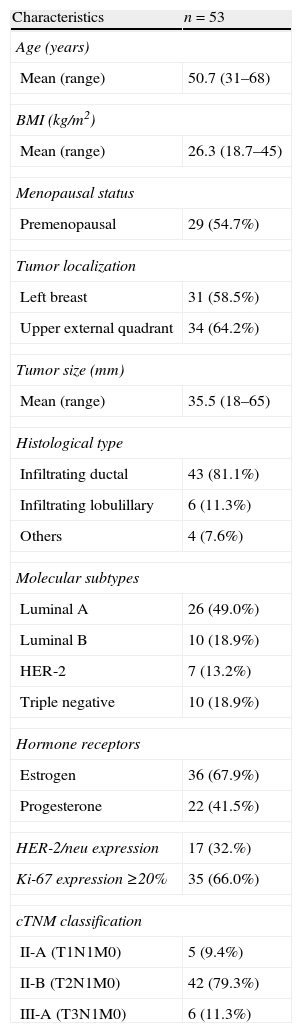
Material and methodsA prospective study was performed from January 2008 to December 2012 on 52 women, mean age 50.7 years, with infiltrating breast carcinoma T1-3, N1, M0 (1 bilateral, 7 multifocal) treated with epirubicin/cyclophosphamide, docetaxel and trastuzumab in HER-2/neu-positive patients. Axillary evaluation included physical examination, axillary ultrasound, with ultrasound-guided core needle biopsy of any suspicious lymph node. The day before surgery, 74–111MBq of 99mTc-albumin nanocolloid was injected periareolarly. All patients underwent breast surgery, with SLNB and complete axillary lymph node dissection (ALND). The SLNs were examined by frozen sections, hematoxylin–eosin staining, immunohistochemical analysis or one-step nucleic acid amplification assay (OSNA).
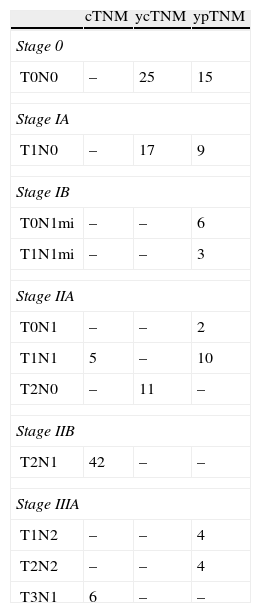
ResultsMean tumor size: 3.5cm. Histologic type: 81.1% invasive ductal carcinoma. Complete response of primary tumor was clinical 43.4%, pathological 41.5%. All patients were clinically node-negative after NAC. Pathological complete response of axillary node was 42.2%.
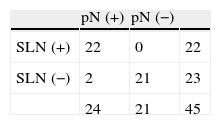
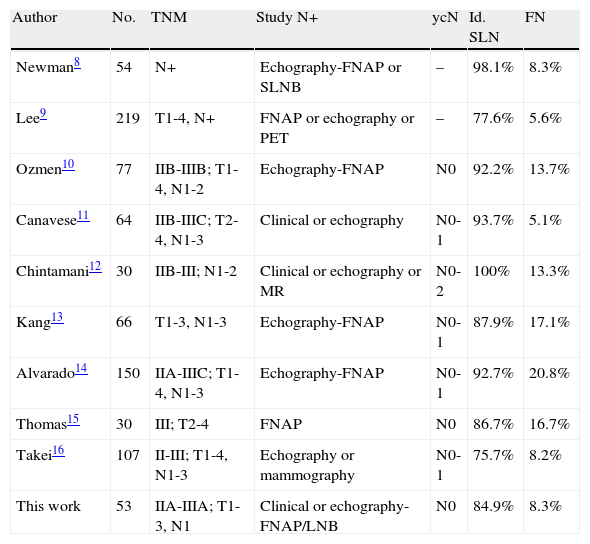
SLN identification rate was 84.9%. Axilla was positive in the pathology study in 6 of 8 patients without migration. SLN accurately represented the axillary status in 95.5%. False negative rate was 8.3%. SLN was the only positive node in 68.2% of patients. Mean number of SLN removed was 1.9 and of nodes resected from the ALND 13.2.
ConclusionSLN biopsy after NAC is a feasible and accurate tool in patients with operable breast cancer T1-3, N1 and clinically node-negative after therapy.
Valorar la utilidad de la biopsia selectiva del ganglio centinela (BGC) después de la quimioterapia neoadyuvante (QTN) en pacientes con cáncer de mama operable y axila positiva al diagnóstico.
Material y métodosEstudio prospectivo entre enero de 2008 y diciembre de 2012 en 52 pacientes, con una edad media de 50,7 años y con cáncer de mama infiltrante T1-3, N1, M0 (uno bilateral, 7 multifocales), tratadas con epirrubicina/ciclofosfamida, docetaxel y trastuzumab en HER-2/neu positivas. El estatus axilar se estableció por la exploración física, la ecografía axilar y la punción ecoguiada de ganglios sospechosos. El día antes de la cirugía se inyectó periareolarmente 74-111MBq de 99mTc-nanocoloide de albúmina. En todas se realizó una cirugía mamaria, una BGC y una linfadenectomía axilar. El GC se analizó por cortes de congelación, hematoxilina-eosina, inmunohistoquímica u OSNA.
ResultadosTamaño medio del tumor: 3,5cm. Tipo histológico: 81,1% carcinoma ductal infiltrante. Respuesta completa al tumor primario: clínica 43,4%, patológica 41,5%. Ninguna de las pacientes presentó adenopatías axilares palpables después del tratamiento. Respuesta completa patológica axilar: 42,2%.
El porcentaje de identificación del GC fue de 84,9%. En 6 de las 8 pacientes sin migración la axila resultó positiva en el estudio anatomopatológico. En el 95,5% de los casos el GC determinó correctamente el estatus axilar. La tasa de falsos negativos fue de 8,3%. En el 68,2% de los casos el GC fue el único afectado de la axila. El número medio de GC identificados fue de 1,9 y el de ganglios axilares extirpados fue de 13,2.
ConclusiónLa BGC post-QTN es una técnica segura y factible en pacientes con cáncer de mama operable T1-3, N1 y axila clínicamente negativa después del tratamiento.
Article
If you experience access problems, you can contact the SEMNIM Technical Secretariat by email at secretaria.tecnica@semnim.es or by phone at +34 619 594 780.
Revista Española de Medicina Nuclear e Imagen Molecular (English Edition)

