



Nursing homes are becoming increasingly important as end-of-life care facilities. However, many older adults want to stay in their homes as they age.
ObjectiveTo assess the feasibility of a deinstitutionalization process on selected institutionalized older adults who are willing to initiate the process.
MethodsThis study, divided into two phases, will be carried out over 15 months on 241 residents living in two nursing homes in Navarra (Spain). The first phase has a cross-sectional design. We will identify the factors and covariates associated with feasibility and willingness to participate in a deinstitutionalization process by bivariate analysis, essential resources for the process and residents to participate in the process. The second phase has a complex interventional design to implement a deinstitutionalization process. An exploratory descriptive and comparative analysis will be carried out to characterize the participants, prescribed services and the impact deinstitutionalization intervention will have over time (quality of life will be the main outcome; secondary variables will be health, psychosocial, and resource use variables). This study will be accompanied by a pseudo-qualitative and emergent sub-study to identify barriers and facilitators concerning the implementation of this process and understand how intervention components and context influence the outcomes of the main study. Intervention components and the way the intervention is implemented will be of great relevance in the analysis.
DiscussionAlternatives to institutionalization with adapted accommodation and community support can allow people who wish to return to the community.
Trial registrationNCT05605392.
Las residencias de personas mayores cobran cada vez más importancia como centros de atención al final de la vida. Sin embargo, muchos adultos mayores desean permanecer en sus casas mientras envejecen.
ObjetivoSe pretende evaluar la viabilidad de un proceso de desinstitucionalización en adultos mayores seleccionados que viven en las residencias y que expresen la voluntad para iniciar el proceso.
MétodosEste estudio, dividido en dos fases, se llevará a cabo durante 15 meses en 241 sujetos que viven en dos residencias de personas mayores en Navarra (España). La primera fase tiene un diseño transversal en donde se identificarán los factores y covariables asociadas a la viabilidad y voluntad para participar en un proceso de desinstitucionalización a través de un análisis bivariante, los recursos imprescindibles para el proceso y los residentes que quieran participar en él. La segunda fase tiene un diseño de intervención compleja en la que se implementa un proceso de desinstitucionalización. Se realizará un análisis exploratorio descriptivo y comparativo para caracterizar a los participantes, los servicios prescritos y el efecto de la intervención de desinstitucionalización a lo largo del tiempo (la calidad de vida será la variable principal; las secundarias serán las referentes a la salud, las psicosociales y de uso de recursos). Este estudio irá acompañado de un subestudio pseudocualitativo y emergente para identificar las barreras y los elementos facilitadores relativos a la implementación de este proceso y comprender cómo los componentes de la intervención y el contexto influyen en los resultados del estudio principal. Los componentes de la intervención y su ejecución serán de gran relevancia en el análisis.
DiscusiónLas alternativas a la institucionalización con viviendas adaptadas y apoyos comunitarios pueden permitir a las personas que así lo desean el retorno a la comunidad.
Registro del estudioNCT05605392.

Most countries in the world are experiencing growth in the number and proportion of older adults requiring a greater need for care.1 In Spain, as in other developed countries, nursing homes (NHs) are becoming increasingly important as end-of-life care facilities where most older adults live and are cared for until the end. Public policies have been oriented towards promoting residential environments primarily intended for 24-h care supervision. However, this contradicts the preferences for end-of-life care shown in studies: most people desire to remain in their own homes and be supported to live and die in the community.2,3
In the Spanish context, residential preferences vary depending on expected health conditions. Remaining in one's own home is preferred when older people foresee a healthy old age, whilst co-residence at a relative's home turns into the favoured solution if older people have to face some physical or cognitive limitation.4 For the frailest cases, where the need for complex care requires continuous nursing and medical care, NH institutionalization may be the appropriate care resource. However, evidence shows that admissions are often conditioned by a fragile support network rather than by the individual's clinical condition or dependency level.2 In other cases, admission to a NH is due to the consideration of an irreversible dependency situation without considering the possibilities of recovery. Different studies assert that there is a significant shift in the demographic and health profile of individuals residing in nursing homes, with an increase in persons who are in their last year of life.5,6 This underscores the importance of considering these factors in the process of deinstitutionalization. On top of that, persistent problems around the cost and quality of accommodation with a lack of sufficient adapted housing and sheltered housing, and inequalities in the distribution of social resources often limit the consolidation of personalized care and support planning.7–9 In Spain, both weak home care and the scarce existence of alternatives in accommodation to NHs are important encouragements for older people's permanent institutionalization.
In many cases, home care services would compare favourably with institutionalized forms of care in terms of cost-effectiveness but organizing a network of services could be more challenging than running facilities such as NHs.10 Promoting personalized care support at a chosen place could be a challenge to enhance a sense of self-control, empowerment and quality of life.11,12 On the other hand, not all people experience a constant decline in abilities after entering an institution. For some residents who experience an improvement in their abilities and greater independence, a transition from residential care to the community may be an option with the necessary support.13,14 Under this pretext, and if many people prefer to live at home rather than in an institution, the present study aims to assess the feasibility and willingness for a deinstitutionalization process on selected institutionalized older adults from two public NHs in Navarra (Spain). This completely innovative study aims to provide data to help future studies addressed in this field.
MethodsStudy design and settingA two-phase study will be carried out over 15 months with residents from two NHs in Navarra (Spain). Both NHs are publicly managed and have 161 and 80 residential places respectively. They are located in the capital of the Chartered Community of Navarra and a nearby municipality of approximately 14,000 inhabitants. The majority of the rooms are individual and they offer services and programmes of comprehensive person-centred care in different situations of dependency. These include permanent care, personal care, feeding, podiatry, hairdressing, health care and nursing, social work, psychology, hygiene, action in emergencies, physiotherapy, occupational therapy, leisure activities and social care, among others. Recognized II (severe) or III (high) degree of dependency and/or social dependency are the admission criteria in terms of dependency.15
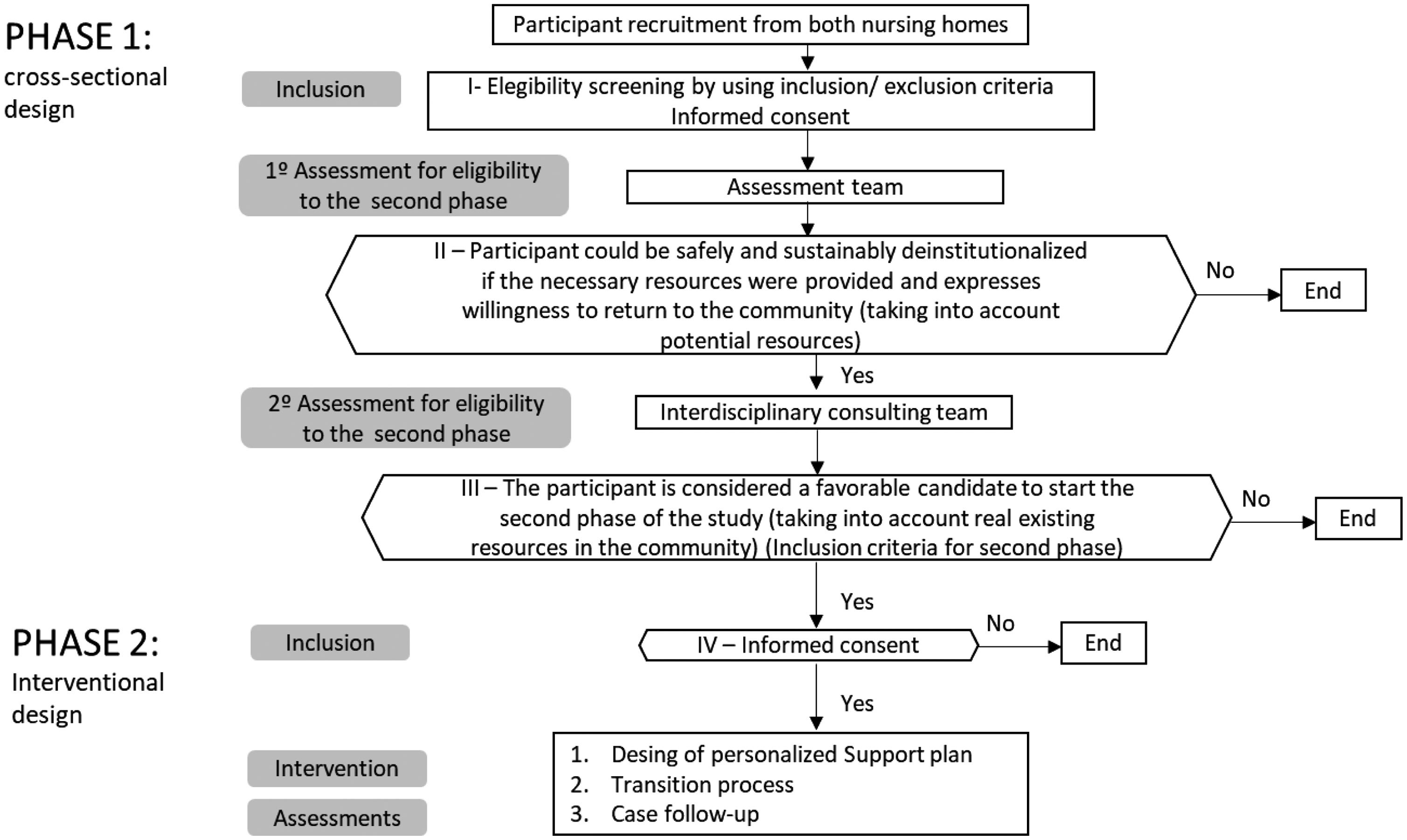
The first phase of the study has a cross-sectional design with the double aim of identifying residents who are willing to participate in a deinstitutionalization process and studying prognostic and determining factors for a resident to be a candidate for a feasible and safe deinstitutionalization. The second phase has a complex interventional design to implement a deinstitutionalization process conducted on an individual basis on participants identified in the first phase (Fig. 1). This phase will be aimed at studying the impact that the intervention may have on the participants attempting the process. The protocol of the study is registered in Clinical Trials (NCT05605392) and written following the guidelines for interventional trials (SPIRIT).16
Phase 1 and Phase 2 of the main study will be accompanied by a pseudo-qualitative and emergent sub-study. A multi-case analysis of several cases in extreme situations in the context of the object of study is chosen to allow for flexibility in extending or modifying the topic guide questions given participants’ responses. Semi-structured interviews and personal video diaries will be analyzed. A guide has been developed to facilitate data collection based on literature research,17,18 experts’ backgrounds, and three initial interviews. It will support a description and analysis of older adults’ attitudes towards deinstitutionalization, their beliefs, and perceived barriers and facilitators to answer the research question and to emerge the factors associated with being supported to come back home. Furthermore, they will contribute to the co-building of a wider and deeper understanding of their motivations, desires, and will.
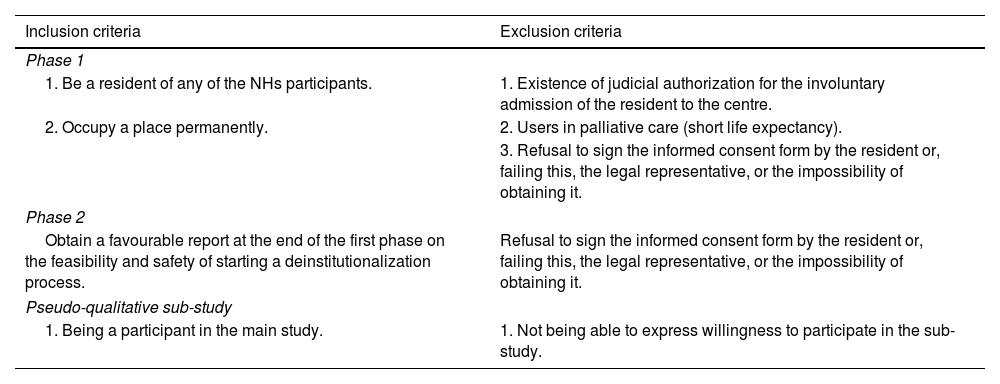
Sample size, recruitment, and participantsThe eligibility criteria for study participation are detailed in Table 1.
Eligibility criteria for study participation.
| Inclusion criteria | Exclusion criteria |
|---|---|
| Phase 1 | |
| 1. Be a resident of any of the NHs participants. | 1. Existence of judicial authorization for the involuntary admission of the resident to the centre. |
| 2. Occupy a place permanently. | 2. Users in palliative care (short life expectancy). |
| 3. Refusal to sign the informed consent form by the resident or, failing this, the legal representative, or the impossibility of obtaining it. | |
| Phase 2 | |
| Obtain a favourable report at the end of the first phase on the feasibility and safety of starting a deinstitutionalization process. | Refusal to sign the informed consent form by the resident or, failing this, the legal representative, or the impossibility of obtaining it. |
| Pseudo-qualitative sub-study | |
| 1. Being a participant in the main study. | 1. Not being able to express willingness to participate in the sub-study. |
An invitation letter to participate in the study will be sent to all residents who meet the eligibility criteria (241 candidates for participation). Evaluators will explain the project to those residents who attend the appointment and will invite them to sign the informed consent. Participants may withdraw from the study at any time. Those who give their consent but leave the NH before starting their participation in the study will be able to be replaced by another new resident. Participants who withdraw after starting their participation in the study will not be replaced.
Phase 2The same process of information and consent to participate as for Phase 1 will be followed. Based on the assessments made in the first phase (needs, economic circumstances, geographical location, available resources, etc.) and their willingness to live in the community, a convenience sample of candidates for the second phase of the study will be drawn.
Pseudo-qualitative sub-studyA minimum of 12 and a maximum of 18 residents will be recruited for this longitudinal qualitative study. The sample will include residents from three different groups: individuals who dropped out in the first phase, individuals potentially able but ultimately unwilling to participate in the second phase, and individuals who start the second phase regardless of whether they complete the intervention. Participants will be selected using purposive sampling according to a criterion of convenience and representativeness of the above-mentioned groups and based on their potential to provide rich, diverse, and relevant data that aligns with our research objectives.19 Although the samples are much smaller compared to the standards used in quantitative research,20 the objective is to achieve a certain representativeness of profiles in the existing universe, although the aim is not to generalize results about the population as a whole. We will conduct multiple interviews with each participant over time to capture changes in their experiences or perspectives.21
ProcedureThe project is designed to provide two types of resources to candidates to enable deinstitutionalization: accommodation as an alternative to the NH (adaptation of own housing or rental of new housing) and a multidisciplinary professional intervention to provide support in the transition process and the reintegration into the community.
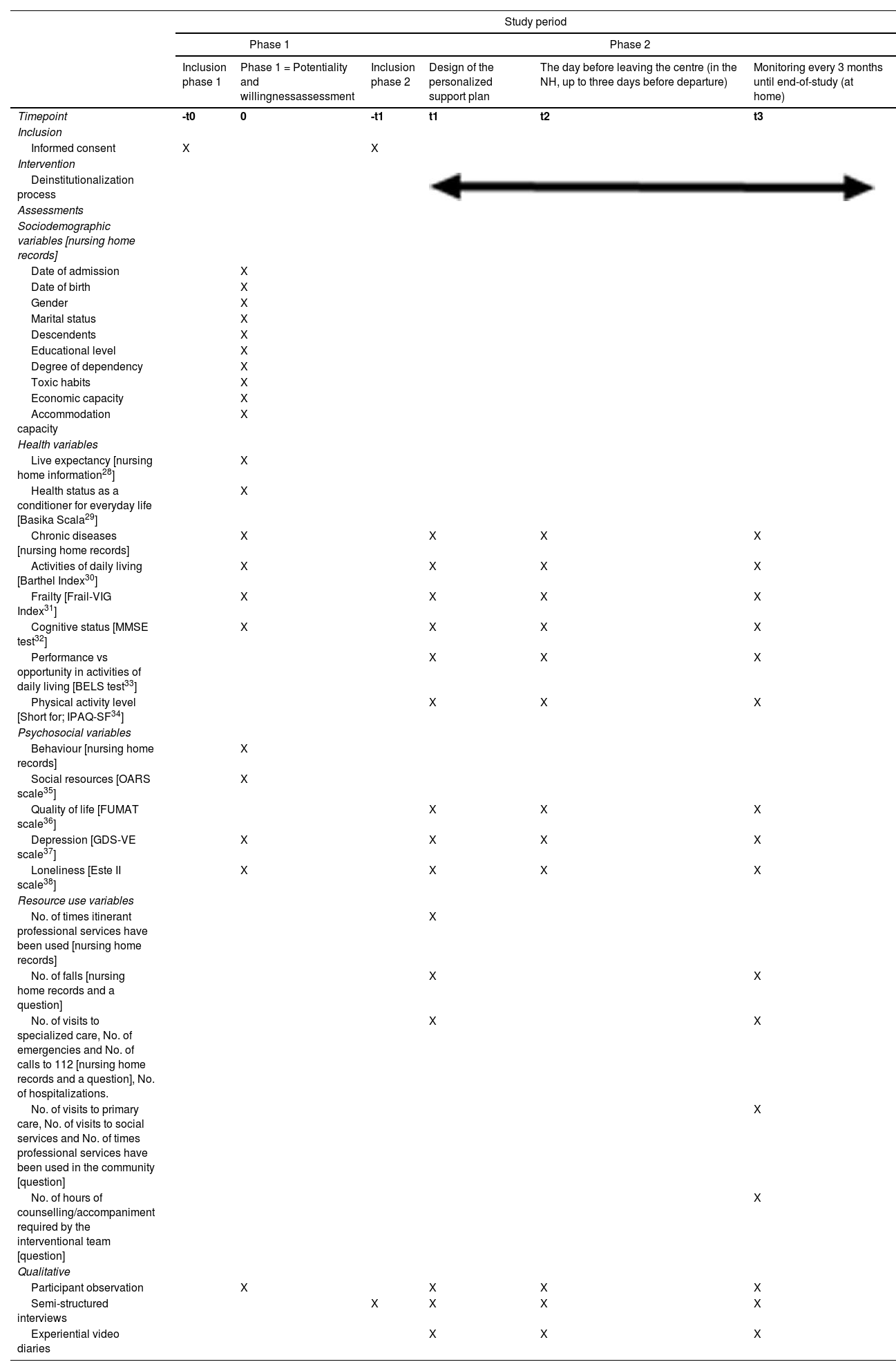
Phase 1Two trained evaluators (an interviewer and an observer) will carry out a comprehensive geriatric assessment through a structured interview. They will collect case-by-case information (detailed in Table 2) and participant's willingness to initiate a deinstitutionalization process. Areas of personal needs will be identified, in terms of accommodation (need and accessibility), basic and instrumental activities of daily living (BADL and IADL) (frequency distribution and quantity), socialization and financial support.
The schedule of inclusion, intervention, and assessments (SPIRIT figure).
| Study period | ||||||
|---|---|---|---|---|---|---|
| Phase 1 | Phase 2 | |||||
| Inclusion phase 1 | Phase 1 = Potentiality and willingnessassessment | Inclusion phase 2 | Design of the personalized support plan | The day before leaving the centre (in the NH, up to three days before departure) | Monitoring every 3 months until end-of-study (at home) | |
| Timepoint | -t0 | 0 | -t1 | t1 | t2 | t3 |
| Inclusion | ||||||
| Informed consent | X | X | ||||
| Intervention | ||||||
| Deinstitutionalization process | ||||||
| Assessments | ||||||
| Sociodemographic variables [nursing home records] | ||||||
| Date of admission | X | |||||
| Date of birth | X | |||||
| Gender | X | |||||
| Marital status | X | |||||
| Descendents | X | |||||
| Educational level | X | |||||
| Degree of dependency | X | |||||
| Toxic habits | X | |||||
| Economic capacity | X | |||||
| Accommodation capacity | X | |||||
| Health variables | ||||||
| Live expectancy [nursing home information28] | X | |||||
| Health status as a conditioner for everyday life [Basika Scala29] | X | |||||
| Chronic diseases [nursing home records] | X | X | X | X | ||
| Activities of daily living [Barthel Index30] | X | X | X | X | ||
| Frailty [Frail-VIG Index31] | X | X | X | X | ||
| Cognitive status [MMSE test32] | X | X | X | X | ||
| Performance vs opportunity in activities of daily living [BELS test33] | X | X | X | |||
| Physical activity level [Short for; IPAQ-SF34] | X | X | X | |||
| Psychosocial variables | ||||||
| Behaviour [nursing home records] | X | |||||
| Social resources [OARS scale35] | X | |||||
| Quality of life [FUMAT scale36] | X | X | X | |||
| Depression [GDS-VE scale37] | X | X | X | X | ||
| Loneliness [Este II scale38] | X | X | X | X | ||
| Resource use variables | ||||||
| No. of times itinerant professional services have been used [nursing home records] | X | |||||
| No. of falls [nursing home records and a question] | X | X | ||||
| No. of visits to specialized care, No. of emergencies and No. of calls to 112 [nursing home records and a question], No. of hospitalizations. | X | X | ||||
| No. of visits to primary care, No. of visits to social services and No. of times professional services have been used in the community [question] | X | |||||
| No. of hours of counselling/accompaniment required by the interventional team [question] | X | |||||
| Qualitative | ||||||
| Participant observation | X | X | X | X | ||
| Semi-structured interviews | X | X | X | X | ||
| Experiential video diaries | X | X | X | |||
Community resources22 utility will be identified according to each personal need. Some examples of resources are telecare, meal service outside and/or inside the home, medication aids, cognitive stimulation and functional rehabilitation services, home maintenance and day-to-day aids (cleaning, laundry, shopping, etc.), supervision and others. This information will be determinant in detecting indispensable resources for a safe and sustainable process, for both those participants who are willing and will initiate the second phase and those who cannot participate as the process is not feasible or unsafe. Evaluators will determine the minimum support that each participant needs in both scenarios: with and without taking into account available informal support. This classification together with the above information will allow for determining the feasibility of the deinstitutionalization process for each candidate. Observer's notes will be analyzed through qualitative research.
Participants who express willingness and can potentially be provided indispensable resources for their return (according to their resources, those from the community and those offered by the project) will proceed to a second assessment with an external socio-health consulting team consisting of medical and social staff from primary care, NHs staff, and professionals from central services related to the area of ageing and health and social care systems. This discussion group will be specifically constituted for this project and be led by the project case manager. A case-by-case discussion will be held to assess the feasibility and safety of deinstitutionalization according to the real availability of support in each geographical area (service saturation, eligibility, and accessibility of each resource needed).
Phase 2The second phase will be presented to selected first-phase candidates. The description of the intervention will be made following the Criteria for Reporting the Development and Evaluation of Complex Interventions in Healthcare (CReDECI2).23
The case manager will conduct an open interview with each participant to design a long-term care-tailored plan according to the participant's preferences, values and needs (reflecting differences in their health and functional status). These factors, in combination with economic circumstances and geographical location, will shape both the options and the resources available to participants needing long-term care and how they understand and evaluate their choices.24
Then, a package of services that includes aspects of prevention, promotion, treatment, rehabilitation, palliation, assistive care and social support to varying degrees depending on the needs of the individual, will be prescribed. For each service prescribed, the following will be specified: prescriber professional, resource provider, a place to be provided (home, centre, etc.), and the estimated date of review and/or completion. In case the resource will be provided totally or partially by non-professional support, it will be specified.
Assistive care components of long-term care may be short-term services that can optimize functional ability in situations in which function could potentially be restored, or may be provided long-term for those experiencing impaired functional ability that is less amenable to rehabilitation.24 Therefore, each prescribed service will be re-evaluated as needed and will be subject to change. Temporary assistance provided by the project team during the transit phase will also be prescribed, either BADL and/or IADLs support to ensure that external services fully meet participants’ needs, IADL re-education, socialization, etc. In the event of not achieving a feasible and agreed plan or not being able to provide a resource determined as indispensable, the deinstitutionalization process will not be able to be initiated and the participant will finish their study participation.
Once the plan is designed and agreed by both parties (participant and case manager), its implementation will be conducted. For this purpose, the case manager will coordinate the actions to be carried out by the intervention team in collaboration with professionals from both the NH and the community (primary care, social services teams, neighbourhood networks, and volunteers where appropriate, etc.), following the established plan. The intervention team, which will include social workers, occupational therapists, social integration and nursing and will be led by the case manager, will work with the participant to improve the performance of the activities and areas of improvement. The support in the residence will be progressively withdrawn at the same time as new supports will be implemented at home in the community. The intervention and prescribed support may be modulated in case of any variation of the assessed participant's needs. The case manager will ensure compliance with the plan following the intervention progress until the end of the study. Once it is considered that the necessary links have been created between the participant and the community to reside on a stable basis and safely without the support of the project in the community, gradual disengagement of the project team and resources will be initiated to promote the participant's autonomy and safety life in the community.
Ethical considerationsThe Navarra Ethics Committee approved the protocol of this clinical trial with registration number PI_2022/100. All participants will be verbally and written informed during the process of inclusion in the study. Participants’ identities will be coded and pseudo-anonymized. Only authorized individuals will have access to identifiable personal details if data verification procedures require inspection. Obtained data will be in an electronic database stored in a secure server, with password-protected access restricted to research team authorized members. The recordings will be destroyed 5 years after the end of the study.
The case manager will provide process security, and integration of health and social care solutions and will be responsible for adapting the intervention to new temporary or permanent changes in the candidate's clinical or social situation or to new preferences that may arise during the process.25 In case of detection of potential risks or if the participant wishes to return to the NH and finalize the study, return to the NH will be possible at any required time during the study. The necessity for a return will stem from the early identification of problems, such as changes in physical or mental health, difficulties in performing daily activities, signs of social isolation, or issues with managing daily life such as unpaid bills or unprocessed important documents. Upon identification of these problems, the care plan will be reviewed to make appropriate adjustments, increasing the level of support provided and psychoeducation with the person to try to resolve the identified problems and mitigate risks. If the adjustments made do not guarantee the solution to these problems and they become potential risks for the person, and if it is decided that the person should return to the residence, this return process will be carried out through coordination with the residential staff to ensure a safe transition, taking into account that the person will have a guaranteed residential place available for this return at the time they decide or it is necessary due to the aforementioned issues.
Assessments and outcomesAssessments for both phases will be carried out by evaluators of the research team experts in research methods with experience in the field of geriatrics and gerontology. They will be calibrated with each other to minimize bias, gathering information from NH records and through participants’ interviews in which validated tests or pre-determined questions are asked (specified in the table). A combination of qualitative and quantitative methods will be used for the interpretation of the outcomes.
Quantitative analysis (phases 1 and 2)Different variables will be collected either according to phase and time point (Table 2). The main outcome will be quality of life, while secondary outcomes will be differentiated between sociodemographic, health, psychosocial, and resource use variables (Table 2). In addition to these, we will conduct quantitative analyses to determine the influence of various factors on the willingness and ability of older adults to return to the community. These factors include, but are not limited to, the level of dependency, life expectancy, loneliness, depression, and the number of falls. By examining these variables, we aim to gain a more comprehensive understanding of the factors that may facilitate or hinder the process of deinstitutionalization. We will also analyze the resources identified as indispensable for the process and whether the non-existence, insufficiency, saturation or unavailability of these resources will be a limiting factor for a deinstitutionalization process.
Pseudo-qualitative analysis (phases 1 and 2)Qualitative data will be gathered through participant observation (first phase), and semi-structured interviews and experiential video diaries (second phase) by the research team evaluators. Process evaluation will examine participants’ views and perceptions, and intervention implementation intervention components, and investigate contextual factors that affect the intervention.26
Our data analysis will involve rigorous qualitative techniques such as thematic analysis, with transparency in how themes are derived from the data.27 We will also use triangulation by incorporating multiple data sources and theoretical perspectives to validate our findings. Throughout the research process, we will engage in reflexivity by documenting our own biases, assumptions, and actions to enhance the credibility of our study (Table 2).
Data managementThe research evaluators will be in charge of collecting the pseudo-anonymized data and entering them in coded form in an electronic database (repository) created by the monitoring unit of the Foundation for Health and Ageing of the Autonomous University of Barcelona, an external foundation subcontracted to provide monitoring and evaluation services. Recordings that may be made in the framework of the study will be stored on secure devices, as they cannot be anonymized. Transcripts of the recordings will be anonymized so participants cannot be identified. A study monitoring and evaluation plan will be developed following the project objectives and the protocol, combining internal and external evaluation criteria and actions for the different monitoring phases.
Statistical analysisQuantitative analysisIn phase 1, a descriptive analysis will be undertaken to characterize the participants. Categorical variables will be described by absolute and relative frequencies, while quantitative variables will be described by mean and SD, or medians and interquartile ranges, if appropriate. We will conduct a bivariate analysis to identify the factors and covariates associated with the status of potential deinstitutionalization and willingness to participate in a deinstitutionalization process. Likewise, the characteristics of the candidate population that has refused to participate in the deinstitutionalization process and the reasons that led them to make this decision will be analyzed. The bivariate analyses will be conducted by applying the χ2 test (or Fisher's test) and the linear χ2 test in case of dichotomous or ordinal variables, as well as the Student's t-test for quantitative variables, or its non-parametric equivalent.
In phase 2, exploratory descriptive and comparative analysis will be conducted to characterize the deinstitutionalized participants and the effects of the deinstitutionalization intervention over time, concerning quality of life as the main outcome, and other secondary outcomes. As a small sample size is expected, non-parametric tests will be considered.
Pseudo-qualitative analysisA case study approach will be chosen which will accompany the quantitative results and will provide triangulation. The analytical approach will be primarily deductive, applying frameworks to aggregate data from multiple sources.39 After initial contact with the text or video, the textual corpus based on the transcriptions of both the interviews and the discussion groups will be analyzed with the help of the Atlas ti analysis software. The factors identified, as well as reflective notes on the transition process itself, will be thematized and analyzed with the analysis software and organized according to different levels of needs (skills and competencies, etc.) and individual (health status, the complexity of care, etc.), institutional and community characteristics. Thus, the pattern of responses and behaviours will be described and significant points of juxtaposition will be identified to explain the variability of the data.40 Our primary aim in this phase is to explore and understand the experiences and perspectives of the participants. This approach aligns with the qualitative nature of our study, where the focus is on gaining insights into participants’ experiences and perceptions rather than quantifying data and testing hypotheses. We believe this approach will provide a rich, in-depth understanding of the impact of deinstitutionalization on older adults.
DiscussionOlder adults prefer to continue living at home rather than move to a residential facility, with a generally higher quality of life for those living in the community than those in residential facilities.41,42 For people to be able to live at home, an adequate support network in the community must be developed. Through this project, our team aims to offer an opportunity for change, offering alternatives to institutionalization with housing support and case management.
Long-term care should be person-centred, address the health, personal care, and social needs of individuals, and be aligned with the person's values and preferences.24 In Navarre, as in other territories, the government tries through various services and financial aid to guarantee that the old people can remain at home (promotion of personal autonomy and prevention of dependency service, municipal home care service, day/night care services, financial benefit for a personal assistant, adapted and assisted transport service, etc.). However, studies show a need to extend and reinforce the network of resources for older people to be able to remain at home, with a clear objective: to develop and maintain personal capacity to control, cope and make decisions about how to live according to one's own rules and preferences and to facilitate the performance of basic and instrumental activities of daily living.43 Through the first phase of this study, we will assess the overall situation of each resident and quantify, from the total sample, the proportion of institutionalized people who could potentially live in the community if they had an adequate personalized support plan with the necessary resources to meet their needs. The extent to which community resources are useful in the deinstitutionalization process will be analyzed and these results could be extrapolated to other areas. Additionally, it will allow us to highlight the proportion of residents for whom perhaps a NH is not the optimal resource,44 but who, with other intermediate resources such as adapted housing or support at certain times of the day, could remain in their community. The willingness and influential factors that conditionate the process will be also analyzed.
With regard to the accessibility of housing, there is a growing recognition that better integration between health, social and housing care also plays an important role in addressing the challenge of long-term care. In Navarre, the number of people living alone is increasing, often in houses that are not adapted to their needs and which will require refurbishment, as well as the existence of an ageing housing stock. For the old people, the existence of architectural barriers often means that it is impossible for them to leave their homes independently. Although it is true that progress has been made in this area in recent years, it is necessary to continue with this work in order to guarantee universal accessibility for all people. This is why this study will support this resource through the rental of housing and the refurbishment of own housing. If affordable housing is not available, quality of life and health could seriously suffer due to lack of access to services and lack of money for other essential needs.7–9 This study will allow us to know which supports and resources (services and/or accommodation) are specifically lacking in our community and which hinder deinstitutionalization.
On the other hand, through the second phase, the impact that the process has on the people who attempt the process will be analyzed. The designed plan will have the aim of empowering and enabling participants to do as much as possible themselves, rather than replace their existing or potential ability with a social service that may ultimately decrease their function and increase care dependency.24
When talking about proposals for improvement in long-term care, the need to improve coordination and contact between people working in the field of care is highlighted. Hence the need to create skilled teams that also share experiences and knowledge with other teams, which is one of the hallmarks identified as an element of quality in the public sphere. This approach is in line with the SAAD Evaluation Report of the Ministry of Social Rights and Agenda 203045 and the Green Paper on Ageing46 who claim that the integration of care through close cooperation and exchange of information between professionals, patients and their carers (including non-professional carers) has the potential to contain the rising costs of health and social care and contribute to the independence of older people. The case manager introduced in this study will be a key factor in ensuring team coordination between professionals and participants.
Integrating qualitative research into quantitative outcomes will allow an understanding of explanatory elements (the “black box” of a complex intervention) that may influence the outcomes.39 Qualitative methods will help to generate new theories and a better understanding of the attitudes, beliefs, motivations, and behaviours of a given population that would be impossible to explore through quantitative techniques.47 Conversely, quantitative data would allow testing hypotheses generated by qualitative data. Empirical case studies can enable a dynamic understanding of complex challenges, help strengthen causal inferences (particularly when pathways between intervention and effects are non-linear) and provide evidence about the necessary conditions for intervention implementation and effects.39 The pseudo-qualitative approach is due to the interest in applying the advantages of the qualitative research method but adapting it to the limitations derived from the characteristics of the sample and the temporality of the sub-study.
Regarding the limitations, the present study is innovative in nature, so no scientific literature has been found to define the intervention process and evaluation. Given the lack of data, we have based the intervention design on similar transition processes of older people, such as discharge from hospitalization, and the deinstitutionalization of other groups or people with other conditions.48 The shift in the process of deinstitutionalization of individuals with severe mental disorders has led to the development of numerous community-based mental health care programmes and services.49 These include community mental health teams, psychoeducational programmes, intensive case management, assisted living facilities, and interventions for acute psychiatric episodes, among others.50 Despite these advancements, research suggests that deinstitutionalization has not had a real impact on older individuals with severe and disabling mental disorders.48 This underscores the need for a deeper analysis of the changes that have occurred in the process of deinstitutionalization of older individuals with severe mental disorders, especially with regard to the development of community services, and the identification of barriers and facilitators for the effective implementation of these services.
Despite these limitations, this study will help to provide a rationale not described in the literature so far on which future studies in this innovative area can be based.
Rather than creating new systems, we would like to contribute to transforming the existing models of care that are disease-focused to include a wider narrative that takes into consideration aspects of functional ability and is centred around a person's needs,24 contributing to redirecting and enhancing long-term care for older people. We have to promote models that provide services and support in the community so older adults can remain in their homes as long as they want,51 following the strategy of countries such as Denmark, where the rate of geriatric residents over 65 is decreasing year by year.52
FundingThis work was supported by the Next Generation European Union funding.
Conflicts of interestThe authors state that they have no conflicts of interest.


