





Las enfermedades reumáticas (ER) son causa frecuente de discapacidad, deterioro de la calidad de vida y altos costos en salud.
ObjetivoEstimar la prevalencia de dichas enfermedades usando la metodología Community Oriented Program for Control of Rheumatic Diseases (COPCORD) en el pueblo indígena misak del resguardo Guambia (Cauca), mayor de 18 años.
Materiales y métodosSe realizó un estudio transversal de base comunitario utilizando un muestreo aleatorio sistemático, en tres etapas: 1) selección de participantes casa por casa siguiendo la vía rural principal de cada vereda del resguardo de Guambia; 2) aplicación del cuestionario COPCORD, versión en español o versión adaptada y validada a la lengua wam del pueblo misak), por entrevistadores bilingües estandarizados, y 3) confirmación del diagnóstico por reumatólogos con acceso a toda la información. Se realizó estadística descriptiva.
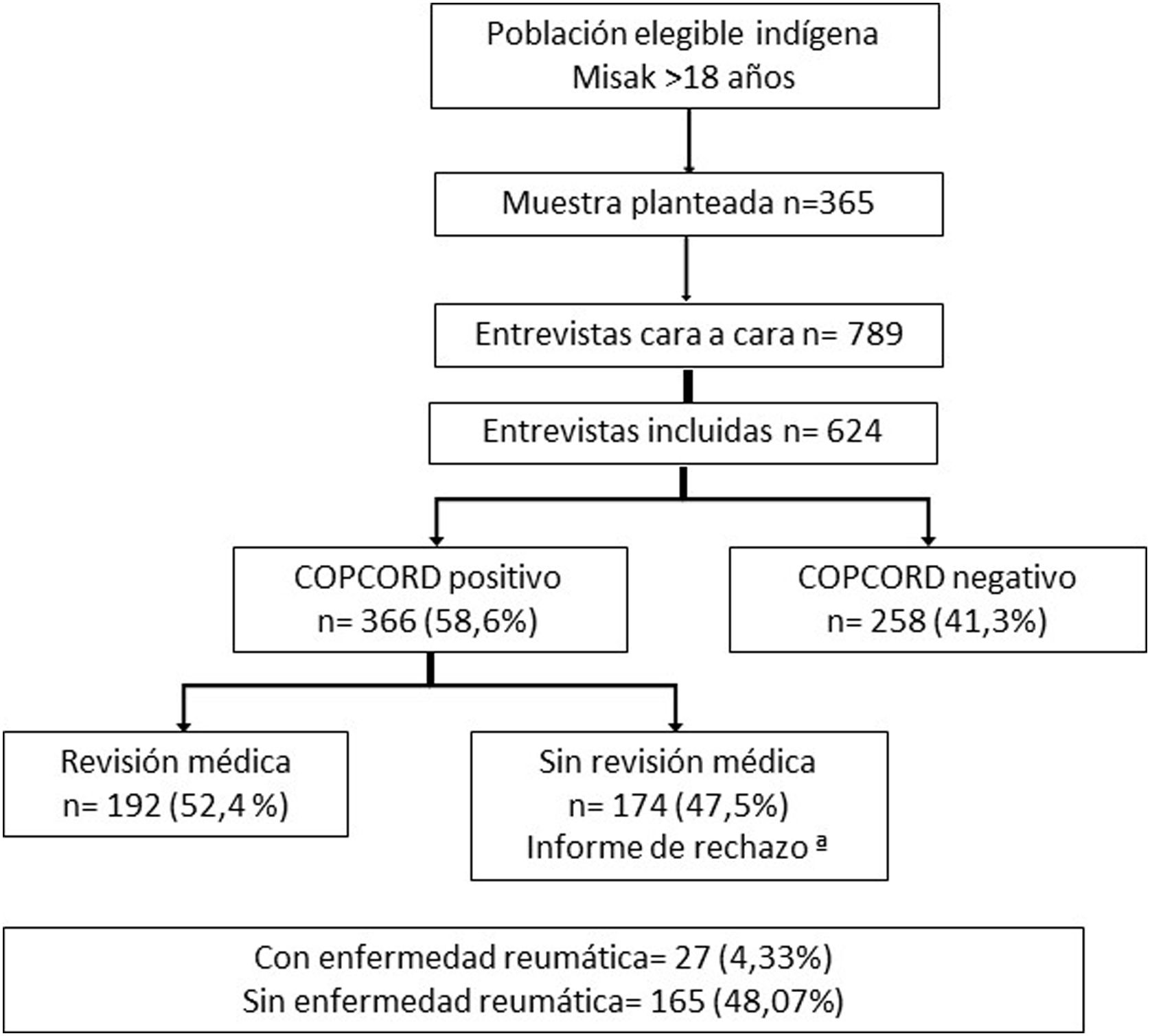
ResultadosDe un total de 624 personas encuestadas, el 67% fueron mujeres, la media de edad fue 44 años, el 49,2% tenía educación básica primaria y el 79,4% hablaba español. El dolor en los últimos siete días y/o histórico fue reportado en 366 encuestados (58,6%). Recibieron valoración médica 192 pacientes, de los cuales 27 (4,33%) tuvieron diagnóstico de enfermedad reumática y 21 (3,36%) de artritis reumatoide (AR).
ConclusiónLa prevalencia de ER fue menor a lo reportado, sin embargo, la prevalencia de AR (3,36%) fue mayor a la reportada en el resto del país y en otras comunidades indígenas de Latinoamérica. Las ER representan un problema de salud pública y la información particular en grupos indígenas es necesaria para el diseño de intervenciones específicas.
Rheumatic diseases are a frequent cause of disability, deterioration in quality of life, and high health costs.
ObjectiveThe objective of the study was to estimate the prevalence of rheumatic diseases using COPCORD methodology in the indigenous misak people of the Guambia - Cauca reservation, over 18 years of age.
Materials and methodsA community-based cross-sectional study was carried out using systematic random sampling, in 3 stages: 1. selection of participants house by house following the main rural road of each village of the Guambia reservation. 2. Application of the COPCORD questionnaire, Spanish version or version adapted and validated to Wam, misak language), by standardized bilingual interviewers. 3. Confirmation of the diagnosis was made by rheumatologists with access to all the information. Descriptive statistics were performed.
ResultsOf a total of 624 people surveyed, 67% were women, the average age was 44 years, 49.2% had basic primary education, and 79.4% spoke Spanish. Pain in the last 7 days and/or history was reported in 366 respondents (58.6%). One hundred and ninety-two patients received medical evaluation, of which 27 (4.33%) had a diagnosis of rheumatic disease and particularly 21 (3.36%) of rheumatoid arthritis.
ConclusionThe prevalence of rheumatic diseases was lower than reported, however the prevalence of rheumatoid arthritis (3.36%) was higher than that reported in the rest of the country and in other Indigenous communities in Latin America. Rheumatic diseases represent a public health problem and specific information on Indigenous groups is necessary for the design of specific interventions.

