




Artificial Intelligence (AI) is revolutionizing rehabilitation by enabling data-driven, personalized, and effective patient care. AI systems analyze patterns, predict outcomes, and adapt treatments to individual needs, empowering clinicians to deliver more targeted and responsive interventions. This review explores AI's role in rehabilitation, focusing on its applications in personalized care, outcome prediction, and real-time patient monitoring. Evidence from current literature highlights how AI improves patient satisfaction, engagement, and clinical outcomes by fostering a stronger therapeutic alliance and promoting adherence to treatment plans. However, significant challenges remain, including data privacy concerns, clinician training gaps, and disparities in technology access. Addressing these barriers is essential to optimize AI adoption and fully realize its potential to enhance patient-centered care. By integrating AI into daily practice, rehabilitation professionals can deliver more efficient, individualized, and high-quality care, paving the way for transformative advancements in the field.
La inteligencia artificial (IA) está revolucionando la rehabilitación, permitiendo el cuidado al paciente impulsado por datos, personalizado y efectivo. Los sistemas de IA analizan patrones, predicen resultados y adaptan tratamientos a las necesidades individuales, empoderando a los clínicos a realizar intervenciones más focalizadas y receptivas. Esta revisión explora el rol de la IA en la rehabilitación, centrándose en sus aplicaciones en el cuidado personalizado, la predicción de los resultados y la monitorización a tiempo real. La evidencia procedente de la literatura actual destaca el modo en que la IA mejora la satisfacción, el compromiso y los resultados clínicos del paciente, fomentando una alianza terapéutica más fuerte y promoviendo la adherencia a los plantes terapéuticos. Sin embargo, persisten dificultades significativas, incluyendo las cuestiones sobre privacidad de los datos, las brechas formativas de los clínicos y las disparidades en cuanto al acceso a la tecnología. Abordar estas barreras es esencial para optimizar la adopción de la IA y comprender plenamente su potencial para mejorar la atención centrada en el paciente. Integrando la IA en la práctica diaria, los profesionales rehabilitadores pueden prestar una atención más eficiente, individualizada y de alta calidad, preparando el camino a los avances transformativos en este campo.
Artificial Intelligence (AI) refers to a broad field of computer science focused on creating systems capable of performing tasks that typically require human intelligence, such as decision-making, problem-solving, and pattern recognition. Machine Learning (ML) is a subset of AI that focuses specifically on developing algorithms that enable computers to learn from data and improve their performance over time without explicit programming. This distinction is crucial in understanding how AI technologies, including Machine Learning, are transforming various fields, particularly in healthcare and rehabilitation.
Artificial Intelligence (AI) including Machine learning has rapidly become integral to healthcare, with rehabilitation emerging as a field that stands to benefit significantly from its data-driven capabilities. By utilizing algorithms capable of analyzing extensive datasets, AI enables clinicians to identify patterns in patient progress, predict treatment outcomes, and personalize interventions to suit individual needs. This approach aligns well with the shift toward patient-centered care in modern healthcare, where AI acts as a key tool in creating precise, adaptive, and responsive treatment plans.1
Research consistently demonstrates that AI's ability to process vast amounts of data enhances the accuracy and personalization of rehabilitation.2 For instance, literature on AI in physical therapy and rehabilitation report improvements in patient adherence to treatment and recovery timelines due to tailored, data-informed intervention plans.3
AI's role in real-time monitoring is also highlighted in recent studies, which indicate that wearable devices and sensor technologies allow for continuous tracking of patient activity, providing rehabilitation professionals with insights that help optimize therapy plans dynamically.4 A systematic review on wearable AI devices in healthcare shows the effectiveness of these tools in capturing essential patient metrics, allowing adjustments to be made in response to real-time data.5
Furthermore, predictive analytics—another key application of AI in rehabilitation—enables clinicians to anticipate potential treatment outcomes and adjust interventions preemptively, reducing the likelihood of setbacks. Systematic reviews emphasize that AI's predictive capabilities are especially beneficial in managing chronic conditions and complex rehabilitation cases, as it empowers therapists to refine approaches based on individual risk factors and likely responses.6
AI are also instrumental in addressing gaps in rehabilitation services, such as limited access in rural or underserved areas. Tele-rehabilitation platforms powered by AI can facilitate remote monitoring and continuous care, making rehabilitation more accessible.7
Moreover, AI applications in rehabilitation extend beyond physical recovery; cognitive and emotional rehabilitation can be enhanced through tools such as virtual reality (VR) and AI-driven cognitive training systems.8 The intersection of AI, rehabilitation, and patient-centered care is poised to revolutionize the field, offering a more dynamic, efficient, and patient-tailored approach to rehabilitation.
In this review, we will explore the core applications of AI in rehabilitation, highlighting their potential benefits, challenges, and future directions. This exploration aims to provide a comprehensive understanding of how AI is reshaping rehabilitation practices and to encourage further research into the transformative possibilities these technologies offer.
MethodologyThis manuscript is a narrative review that aims to synthesize existing evidence on the role of Artificial Intelligence (AI) in rehabilitation and its implications for patient care. A narrative review approach was selected to provide a comprehensive and descriptive overview of current knowledge in this evolving field.
Databases and search strategyThe literature search was conducted across the following databases:
- •
PubMed
- •
Scopus
- •
Web of Science
- •
Google Scholar
- •
IEEE Xplore
Search terms included combinations of:
- •
“Artificial Intelligence (AI)”
- •
“Machine Learning (ML)”
- •
“Rehabilitation”
- •
“Patient care outcomes”
- •
“Healthcare technology”
- •
“Robotic therapy”
- •
“Ethical considerations in AI”
Boolean operators (AND, OR) were used to refine the search queries. For example: (“Artificial Intelligence” OR “Machine Learning”) AND (“Rehabilitation” OR “Patient care”) AND (“Robotic therapy” OR “Ethical challenges”).
Inclusion and exclusion criteria- •
Inclusion criteria:
- ∘
Peer-reviewed articles published in English.
- ∘
Studies focusing on AI applications in rehabilitation.
- ∘
Articles published between 2019 and 2024 to capture recent advancements.
- ∘
Narrative, systematic, or scoping reviews, as well as original research articles.
- •
Exclusion criteria:
- ∘
Non-English publications.
- ∘
Studies not related to healthcare or rehabilitation.
- ∘
Articles lacking sufficient focus on AI technologies.
The literature search was conducted between January 2019 and December 2024, focusing on studies published in the past five years to capture the latest advancements in AI and rehabilitation technologies
Data extraction and synthesisData from the selected studies were extracted and summarized. Key points from each study, including objectives, methodologies, findings, and limitations, were synthesized to provide a holistic overview of the field.
Rationale for a narrative reviewThis narrative review methodology was chosen due to the diversity and heterogeneity of the available literature on AI in rehabilitation. A narrative approach enables an integrative discussion, emphasizing thematic insights and practical applications rather than a rigid systematic analysis.
The role of AI and machine learning in rehabilitation: key applications- 1.
Personalized treatment plans:
AI algorithms are revolutionizing the personalization of rehabilitation programs. By analyzing patient-specific data, such as medical history, real-time performance metrics, and recovery progress, AI can tailor treatment plans that cater to individual needs. For instance, machine learning models can assess how a patient is responding to therapy and recommend adjustments to their exercises, intensity, or duration to optimize recovery. Studies indicate that AI-based treatment personalization improves patient engagement and accelerates recovery.3 AI can predict the likely progression of rehabilitation for different types of patients, including those with chronic conditions or neurological impairments, enabling therapists to make informed, data-driven decisions. A review highlighted that machine learning models can enhance patient outcomes by adapting rehabilitation plans to specific patient profiles.3,9
- 2.
Predictive analytics
Predictive analytics is transforming rehabilitation by enabling practitioners to make more accurate forecasts regarding a patient's recovery journey and potential complications. Through machine learning algorithms, predictive models analyze patient-specific data (such as demographics, health history, and prior recovery outcomes) alongside vast datasets from previous cases to make personalized predictions. This information helps therapists to anticipate recovery milestones, adjust treatment plans proactively, and even identify risks of complications, leading to a more effective, customized care approach.10
Research highlights that AI-driven predictive analytics enhance care by allowing early detection of risks, enabling interventions that can prevent complications and improve recovery outcomes. In orthopedics, for example, these predictive tools have been shown to support more precise planning for patient recovery by identifying risk factors in real time and helping tailor therapeutic interventions accordingly. Overall, predictive analytics contributes to a customized, data-informed approach to rehabilitation that maximizes patient engagement and optimizes outcomes, reinforcing its role as a transformative tool in modern healthcare.11
- 3.
Remote monitoring
In neurorehabilitation, AI including machine learning (ML) techniques are increasingly employed to support personalized interventions and remote patient tracking, especially for conditions like stroke and spinal cord injuries. These technologies enable continuous monitoring of motor recovery, and their predictive analytics capabilities allow clinicians to tailor treatments to each patient's specific progress and needs. AI-driven models also enhance the accuracy of diagnosing neurological conditions and tracking functional improvements through devices that measure biometrics like movement and heart rate, which are central to rehabilitation outcomes.12
For cardiac rehabilitation, wearable devices combined with interpretable ML models allow for the tracking of functional capacity over time, using multi-parameter sensors such as ECG and accelerometers. Studies have shown that these devices, when integrated with ML algorithms, can predict outcomes like walking distance—a key indicator of functional improvement in cardiac rehab—by analyzing various data points such as chronotropic response. These advancements make it feasible to monitor patients remotely, supporting home-based rehabilitation and increasing accessibility for patients who may otherwise face barriers to traditional rehab programs.13
- 4.
Rehabilitation robotics
Rehabilitation robotics has emerged as a transformative approach in Rehabilitation, particularly for patients with mobility impairments due to neurological conditions, such as stroke or spinal cord injury. These robotic devices support task-specific, repetitive movement training—key elements for motor skill recovery in neurorehabilitation. While robotic therapy offers promising advancements, evidence suggests it performs comparably to conventional therapy in certain areas Rehabilitation robots range from devices assisting limb movements to wearable exoskeletons, enhancing patient participation and optimizing rehabilitation outcomes through consistent practice. Research indicates that robotic-assisted therapies improve motor function and patient engagement compared to conventional approaches.14 For example, upper-limb robotic devices, designed to facilitate arm and shoulder movements, allow patients to practice fine motor tasks with greater accuracy.15
Rehabilitation robots are classified into various types, each designed to support different aspects of movement recovery. Exoskeletons are wearable devices that provide structural support, enabling patients with conditions like lower-limb paralysis to perform actions such as walking and arm movements. These devices adapt to the user's movement patterns, offering customized support and aiding significantly in gait training. End-effector robots are particularly useful in gait rehabilitation, as they support specific limb segments, such as the hand or foot, allowing for isolated movement exercises. Notable examples include the Lokomat, which assists with gait training, and the ArmeoSpring, used for arm rehabilitation. Lastly, wearable robotics—such as smart braces and gloves—are compact, sensor-driven devices that monitor movements and provide resistance for tasks like strengthening muscles and improving flexibility. Evidence suggests that different rehabilitation robot types, especially exoskeletons and end-effectors, play a crucial role in enhancing motor function and engagement in stroke and spinal cord injury recovery, making them valuable tools in personalized rehabilitation plans.14,16
Benefits of AI and machine learning in rehabilitationAI and ML are revolutionizing rehabilitation medicine by significantly enhancing motor recovery.17 Their ability to assess, personalize, monitor, and optimize treatment plans underscores their growing importance and transformative potential in this field. By incorporating AI which includes wearable sensors, virtual and augmented reality, and robotic devices, these technologies enable accurate movement analysis and adaptive neurorehabilitation methods. Incorporating AI and ML into motor recovery can significantly boost rehabilitation results, increase patient involvement, and make better use of resources.9
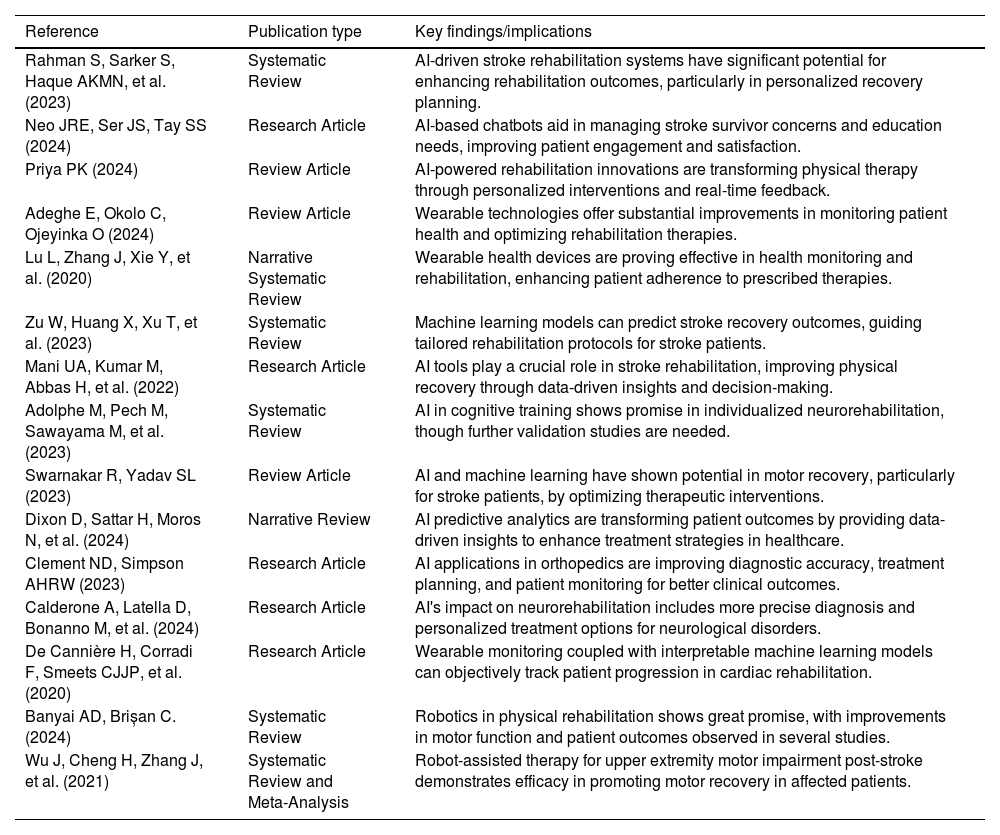
AI is making significant strides in neurologic physical therapy. Narrow AI is being developed for use in robotic-assisted therapy,18,19 and to evaluate motor function, gait, functional status, upper extremity recovery, and movement.20 AI holds significant potential in analyzing functional task movements21 and prescribing personalized interventions. It can predict outcomes and create tailored care plans for individuals with neurological disorders.22,23 Neurologic physical therapy professionals should collaborate with engineers, data scientists, and computer scientists to create AI tools that enhance clinical decision-making and provide patient-centered care.24Table 1 summarizes key studies and their implications for AI applications in rehabilitation and healthcare.
key studies and their implications for AI applications in rehabilitation and healthcare.
| Reference | Publication type | Key findings/implications |
|---|---|---|
| Rahman S, Sarker S, Haque AKMN, et al. (2023) | Systematic Review | AI-driven stroke rehabilitation systems have significant potential for enhancing rehabilitation outcomes, particularly in personalized recovery planning. |
| Neo JRE, Ser JS, Tay SS (2024) | Research Article | AI-based chatbots aid in managing stroke survivor concerns and education needs, improving patient engagement and satisfaction. |
| Priya PK (2024) | Review Article | AI-powered rehabilitation innovations are transforming physical therapy through personalized interventions and real-time feedback. |
| Adeghe E, Okolo C, Ojeyinka O (2024) | Review Article | Wearable technologies offer substantial improvements in monitoring patient health and optimizing rehabilitation therapies. |
| Lu L, Zhang J, Xie Y, et al. (2020) | Narrative Systematic Review | Wearable health devices are proving effective in health monitoring and rehabilitation, enhancing patient adherence to prescribed therapies. |
| Zu W, Huang X, Xu T, et al. (2023) | Systematic Review | Machine learning models can predict stroke recovery outcomes, guiding tailored rehabilitation protocols for stroke patients. |
| Mani UA, Kumar M, Abbas H, et al. (2022) | Research Article | AI tools play a crucial role in stroke rehabilitation, improving physical recovery through data-driven insights and decision-making. |
| Adolphe M, Pech M, Sawayama M, et al. (2023) | Systematic Review | AI in cognitive training shows promise in individualized neurorehabilitation, though further validation studies are needed. |
| Swarnakar R, Yadav SL (2023) | Review Article | AI and machine learning have shown potential in motor recovery, particularly for stroke patients, by optimizing therapeutic interventions. |
| Dixon D, Sattar H, Moros N, et al. (2024) | Narrative Review | AI predictive analytics are transforming patient outcomes by providing data-driven insights to enhance treatment strategies in healthcare. |
| Clement ND, Simpson AHRW (2023) | Research Article | AI applications in orthopedics are improving diagnostic accuracy, treatment planning, and patient monitoring for better clinical outcomes. |
| Calderone A, Latella D, Bonanno M, et al. (2024) | Research Article | AI's impact on neurorehabilitation includes more precise diagnosis and personalized treatment options for neurological disorders. |
| De Cannière H, Corradi F, Smeets CJJP, et al. (2020) | Research Article | Wearable monitoring coupled with interpretable machine learning models can objectively track patient progression in cardiac rehabilitation. |
| Banyai AD, Brișan C. (2024) | Systematic Review | Robotics in physical rehabilitation shows great promise, with improvements in motor function and patient outcomes observed in several studies. |
| Wu J, Cheng H, Zhang J, et al. (2021) | Systematic Review and Meta-Analysis | Robot-assisted therapy for upper extremity motor impairment post-stroke demonstrates efficacy in promoting motor recovery in affected patients. |
The integration of Artificial Intelligence (AI) in rehabilitation offers vast potential to improve patient care and outcomes. However, it also presents several challenges and ethical considerations that must be addressed to ensure its responsible application.
Accuracy and safety: A major concern is ensuring the accuracy and safety of AI-driven systems. Technologies such as robotic exoskeletons and AI-powered sensors require highly reliable algorithms to assess a patient's condition and adjust treatments accordingly. Any malfunction or failure to interpret patient data accurately could result in ineffective therapy or even harm. Ensuring the integrity of these systems is crucial for patient safety and therapeutic efficacy.25
High costs and accessibility: The implementation of AI technologies in rehabilitation can be expensive, which may limit their accessibility to certain populations. High upfront costs for equipment, along with the need for specialized infrastructure, may restrict access to these innovations, particularly in low-resource settings or rural areas. Additionally, maintenance costs and the need for regular updates to AI systems can pose financial challenges for healthcare providers. These factors could exacerbate existing disparities in healthcare access and create inequities in patient outcomes.
Training and workforce readiness: AI integration into healthcare requires that medical professionals are adequately trained to use these technologies effectively. However, there is currently a shortage of healthcare workers with the necessary expertise in AI and machine learning. To fully harness the potential of AI in rehabilitation, ongoing training and education programs for healthcare providers are essential. This will ensure that they can operate and interpret AI-driven systems accurately, minimizing the risk of errors or misuse.
Trustworthiness and ethical issues: Despite the promise of AI and machine learning (ML) in creating personalized rehabilitation therapies, these technologies face significant ethical challenges. One of the primary issues is ensuring that these AI systems are trustworthy. They must function as intended without introducing bias, violating patient privacy, or ignoring legal responsibilities. Ethical considerations around fairness, transparency, and accountability must be addressed to minimize the risk of unintended consequences in clinical practice. As AI continues to evolve in rehabilitation, developing strategies to mitigate risks, promote patient well-being, and safeguard against bias are crucial for the ethical application of AI in healthcare.26
Future directions and innovations in AI rehabilitationThe integration of Artificial Intelligence (AI) in rehabilitation is rapidly evolving, with tremendous potential to transform patient care, rehabilitation outcomes, and access to services. As AI technologies continue to mature, several key areas show promise for future innovation, focusing on enhancing personalized care, improving patient outcomes, and overcoming existing barriers to implementation.27
Future AI innovations are expected to lead to more comprehensive, multi-modal rehabilitation approaches that combine physical, cognitive, and emotional recovery into a unified system. AI can integrate data from various sources such as wearable devices, brain-computer interfaces (BCIs), virtual reality (VR), and augmented reality (AR) platforms to provide a holistic approach to patient care. Multi-modal AI systems could enable dynamic adjustments to rehabilitation protocols based on real-time patient data, improving the precision and personalization of treatments,28 For instance, AI-driven platforms could tailor interventions not only to physical recovery but also to cognitive and emotional rehabilitation, leading to more effective overall outcomes.
AI has significant potential in predictive analytics, particularly in forecasting recovery trajectories and identifying risks early in rehabilitation. By analyzing real-time data, such as sensor input, medical history, and genetic profiles, AI systems can predict recovery patterns and potential setbacks, enabling clinicians to intervene proactively.
AI-powered virtual therapy assistants represent another promising innovation in rehabilitation. Using machine learning algorithms and natural language processing, these virtual assistants could provide on-demand, interactive therapy sessions, delivering personalized feedback, reminders, and support during rehabilitation exercises.27
AI's integration with tele-rehabilitation is expected to revolutionize remote healthcare delivery. AI-enabled tele-rehabilitation platforms could allow clinicians to monitor patient progress and make real-time adjustments to treatment plans without in-person visits. Data from wearable devices, motion sensors, and other technologies could be analyzed by AI to assess recovery and provide clinicians with insights into a patient's functional status, improving the precision of remote care. This combination of AI and tele-rehabilitation could make rehabilitation services more accessible, particularly for patients living in rural or underserved areas.29
Cognitive rehabilitation, especially for individuals with neurological disorders, stands to benefit from AI's capabilities in tailoring cognitive training programs. AI applications, such as virtual reality (VR) and brain-computer interfaces (BCIs), could be integrated into cognitive rehabilitation therapies to enhance brain plasticity and recovery following traumatic brain injuries or strokes.30
Future AI systems in rehabilitation will provide enhanced decision support to clinicians. These AI tools will integrate large datasets, clinical guidelines, and real-time patient information to recommend personalized treatments and interventions. AI-powered decision support systems could assist healthcare providers in identifying the most effective rehabilitation strategies, thus improving the efficiency and accuracy of clinical decision-making.31
ConclusionThe integration of Artificial Intelligence (AI) in rehabilitation represents a transformative leap in healthcare, offering personalized, data-driven solutions that enhance patient outcomes and the overall therapeutic experience. AI's ability to analyze large datasets, predict treatment trajectories, and tailor interventions based on individual needs has the potential to revolutionize rehabilitation practices. From real-time monitoring and personalized treatment plans to the use of robotic systems and predictive analytics, AI facilitates more efficient, responsive, and targeted care, ultimately improving clinical outcomes and patient engagement.
However, challenges remain, particularly concerning data privacy, clinician training, and the accessibility of technology, which may hinder the widespread adoption of AI in rehabilitation settings. Ethical considerations around fairness, transparency, and the safety of AI-driven systems must also be addressed to ensure the responsible integration of these technologies in clinical practice. Efforts to mitigate risks, ensure patient safety, and promote the ethical use of AI will be critical as these technologies continue to evolve.
Looking forward, AI holds immense promise for the future of rehabilitation. Innovations such as multi-modal rehabilitation approaches, AI-powered virtual therapy assistants, and enhanced predictive analytics are poised to enhance the precision of care and improve the accessibility of services, particularly in underserved regions. By continuing to explore and overcome existing barriers, AI can unlock new frontiers in rehabilitation, leading to more effective, patient-centered interventions and improved long-term outcomes.
In conclusion, embracing AI in rehabilitation has the potential to redefine the landscape of patient care. With careful consideration of challenges and ethical implications, AI can play a pivotal role in advancing rehabilitation practices, ensuring that patients receive the best possible care tailored to their unique needs.
Ethical disclosuresEthical approval was not required for this study.
Informed consentInformed consent was not required as the study did not involve direct patient interaction.
FundingNo funding was received for this study.
Conflict of interestThe authors declare no conflict of interest.

