

metricas

Radiología

Sugerencias
Radiología Quimioembolización transarterial con microesferas radiopacas cargadas de doxorr...
Información de la revista
Vol. 67. Núm. 4.
(Julio - Agosto 2025)
Cita
Cita
Compartir
Descargar PDF
Más opciones de artículo
Visitas
1231
Vol. 67. Núm. 4.
(Julio - Agosto 2025)
Original

Quimioembolización transarterial con microesferas radiopacas cargadas de doxorrubicina para el carcinoma hepatocelular: seguridad, eficacia y distribución

Transarterial chemoembolization with doxorubicin-loaded radiopaque beads for hepatocellular carcinoma: Safety, efficacy, and distribution
Visitas
1231
A. Páez-Carpioa,b, P. Bermúdeza,b, M. Sanduzzi Zamparellia,c,d, M. Barrufeta,b, O. Arrabale, A. Fornera,c,d, A. Darnella,f, J. Bruixa,c,d, F. Torrese, M. Reiga,c,d,1,
Autor para correspondencia
mreig1@clinic.cat

Autor para correspondencia.
, M. Burrela,b,1,
Autor para correspondencia
mburrel@clinic.cat

Autor para correspondencia.
a Grupo Barcelona Clinic Liver Cancer (BCLC), Institut d’Investigacions Biomèdiques August Pi i Sunyer (IDIBAPS), Barcelona, España
b Unidad de Oncología Hepática, Departamento de Angiorradiología, Hospital Clínic de Barcelona, Barcelona, España
c Unidad de Oncología Hepática, Unidad Hepática, Hospital Clínic de Barcelona, Barcelona, España
e Unidad de Bioestadística, Facultad de Medicina, Universitat Autònoma de Barcelona, Barcelona, España
f Unidad de Oncología Hepática, Departamento de Radiología Abdominal, Hospital Clínic de Barcelona, Barcelona, España
d Centro de Investigación Biomédica en Red en Enfermedades Hepáticas y Digestivas (CIBEREHD), Madrid, España
Este artículo ha recibido
Información del artículo
Resumen
Texto completo
Bibliografía
Descargar PDF
Estadísticas
Resumen
Objetivo

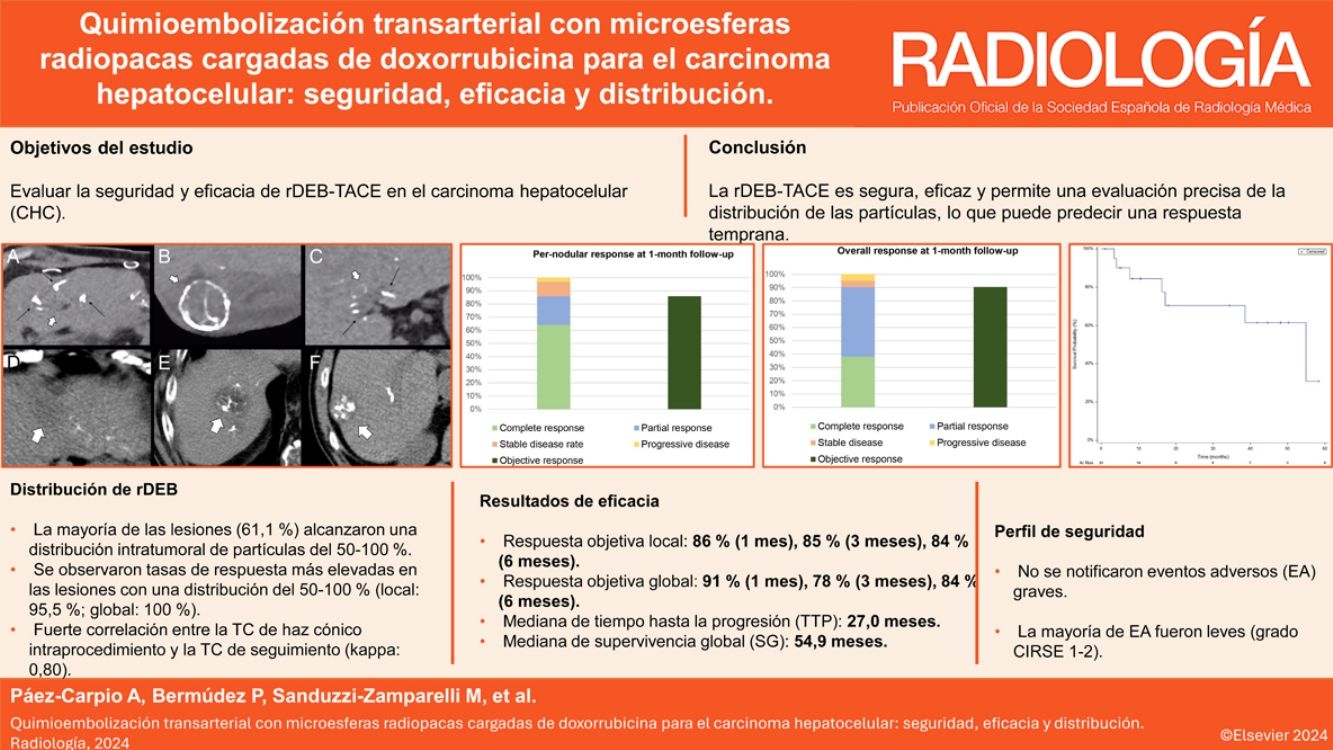
Evaluar la seguridad y eficacia de la quimioembolización transarterial con microesferas radiopacas cargadas con doxorrubicina (rDEB-TACE) en pacientes con carcinoma hepatocelular (CHC).

Materiales y métodos

Este estudio observacional retrospectivo de un solo centro incluyó a todos los pacientes mayores de 18 años diagnosticados con CHC y tratados con rDEB-TACE entre 2017 y 2020 en nuestra institución. La eficacia de rDEB-TACE se evaluó mediante la respuesta al tratamiento a los 1, 3 y 6 meses, el tiempo hasta la progresión (TTP) y la supervivencia global (OS). La seguridad se evaluó según la ocurrencia de eventos adversos (EA). La distribución de rDEB se clasificó en distribución general: tipo 1 (intratumoral), tipo 2 (intratumoral-arteria nutricia) y tipo 3 (arteria nutricia); y por distribución intratumoral (0-50% y 50-100%).

Resultados

Se incluyeron 21 pacientes con 36 lesiones tratadas con rDEB-TACE. El tiempo medio de seguimiento fue de 17 meses (RQI: 6,0-45,5). La respuesta objetiva local y global a los 1, 3 y 6 meses fue del 86%, 85%, 84%, y 91%, 78% y 84%, respectivamente. La mediana de TTP fue de 27,0 meses (IC 95%: 8,9-28,1) y la mediana de OS fue de 54,9 meses (IC 95%: 16,3-no estimable). No se reportaron eventos adversos mayores. El tipo de distribución de partículas más común fue el tipo 2 (69,4%). La concordancia entre la distribución de partículas en el cone beam TC intraprocedimiento y el TC de seguimiento fue alta (kappa=0,80). La mayoría de las lesiones tratadas mostraron una distribución intratumoral de partículas del 50-100%, con una mayor tasa de respuesta objetiva local (95,5% vs. 71,4%) y global (100% vs. 71,4%) en este grupo en comparación con el grupo de 0-50%.

Conclusión

La rDEB-TACE es un tratamiento seguro y eficaz para el CHC. La distribución de rDEB puede evaluarse con precisión y predecir la respuesta radiológica temprana.

Palabras clave:
Carcinoma hepatocelular
Quimioembolización
Terapéutica
TC de haz cónico
Microesferas
Doxorrubicina
Abstract
Aim

To evaluate the safety and efficacy of transarterial chemoembolization with radiopaque doxorubicin-loaded microspheres (rDEB-TACE) in patients with hepatocellular carcinoma (HCC).

Materials and Methods

This single-center, retrospective, observational study included all patients 18 years and older diagnosed with HCC and treated with rDEB-TACE from 2017 to 2020 at our institution. rDEB-TACE efficacy was evaluated by type of response after treatment at 1-, 3- and 6-month, time to progression (TTP), and overall survival (OS). Safety of the technique was assessed based on the occurrence of adverse events (AEs). rDEB distribution was classified by overall distribution as type 1: intratumoral, type 2: intratumoral-feeding artery, and type 3: feeding artery and by intratumoral distribution in 0-50% and 50-100%.

Results

Twenty-one patients with 36 lesions treated with rDEB-TACE were included. Median follow-up time was 17 months (IQR: 6.0-45.5). Local and overall objective response at 1, 3 and 6 months was 86%, 85%, 84% and 91%, 78% and 84%, respectively. Median TTP was 27.0 months (95%CI: 8.9-28.1) and median OS was 54.9 months (95%CI: 16.3-NE). No major AEs were reported. The most common particle distribution was type 2 (69.4%). Concordance of particle distribution between intraprocedural cone beam CT and follow-up CT was high (kappa=0.80). Most lesions treated showed a 50-100% intratumoral particle distribution, with higher rates of local (95.5% vs 71.4%) and overall objective response in this group (100% vs 71.4%) compared with the 0-50% group.

Conclusion

rDEB-TACE is a safe and effective treatment for patients with HCC. Distribution of rDEB can be accurately assessed during and after the procedure and may predict early response.

.
Keywords:
Carcinoma hepatocellular
Chemoembolization
Therapeutic
Cone-beam CT
Microspheres
Doxorubicin
Resumen gráfico

Artículo

Opciones para acceder a los textos completos de la publicación Radiología
Suscriptor
Suscriptor de la revista

Si ya tiene sus datos de acceso, clique aquí.

Si olvidó su clave de acceso puede recuperarla clicando aquí y seleccionando la opción "He olvidado mi contraseña".
Comprar
Comprar acceso al artículo

Comprando el artículo el PDF del mismo podrá ser descargado

Comprar ahora
Contactar
Teléfono para suscripciones e incidencias
De lunes a viernes de 9h a 18h (GMT+1) excepto los meses de julio y agosto que será de 9 a 15h
Llamadas desde España
932 415 960
Llamadas desde fuera de España
+34 932 415 960
E-mail
Bibliografía
[1]
M. Reig, A. Forner, J. Rimola, J. Ferrer-Fábrega, M. Burrel, Á. García-Criado, et al.
BCLC strategy for prognosis prediction and treatment recommendation: The 2022 update.
J Hepatol, 76 (2022), pp. 681-693
[2]
J.M. Llovet, M.I. Real, X. Montaña, R. Planas, S. Coll, J. Aponte, et al.
Arterial embolization or chemoembolisation versus symptomatic treatment in patients with unresectable hepatocellular carcinoma: a randomised controlled trial.
Lancet, 359 (2002), pp. 1734-1739
[3]
P.R. Galle, A. Forner, J.M. Llovet, V. Mazzaferro, F. Piscaglia, J.L. Raoul, et al.
EASL Clinical Practice Guidelines: Management of hepatocellular carcinoma.
J Hepatol, 69 (2018), pp. 182-236
[4]
M. Varela, M.I. Real, M. Burrel, A. Forner, M. Sala, M. Brunet, et al.
Chemoembolization of hepatocellular carcinoma with drug eluting beads: efficacy and doxorubicin pharmacokinetics.
J Hepatol, 46 (2007), pp. 474-481
[5]
J. Lammer, K. Malagari, T. Vogl, F. Pilleul, A. Denys, A. Watkinson, et al.
Prospective randomized study of doxorubicin-eluting-bead embolization in the treatment of hepatocellular carcinoma: results of the PRECISION V study.
Cardiovasc Intervent Radiol, 33 (2010), pp. 41-52
[6]
A. Basile, G. Carrafiello, A.M. Ierardi, D. Tsetis, E. Brountzos.
Quality-improvement guidelines for hepatic transarterial chemoembolization.
Cardiovasc Intervent Radiol., 35 (2012), pp. 765-774
[7]
M. Reig, A. Forner, M.A. Ávila, M. Burrel, C.R. de Lope, M.E. Reig, et al.
Diagnóstico y tratamiento del carcinoma hepatocelular. Actualización del documento de consenso de la AEEH, AEC, SEOM, SERAM, SERVEI y SETH.
Med Clin (Barc), 156 (2021), pp. 463
[8]
J. Bruix, G.J. Gores, V. Mazzaferro.
Hepatocellular carcinoma: clinical frontiers and perspectives.
[9]
K. Malagari, M. Pomoni, T.N. Spyridopoulos, H. Moschouris, A. Kelekis, S. Dourakis, et al.
Safety profile of sequential transcatheter chemoembolization with DC Bead™: results of 237 hepatocellular carcinoma (HCC) patients.
Cardiovasc Intervent Radiol, 34 (2011), pp. 774-785
[10]
J.H. Zou, L. Zhang, Z.G. Ren, R.P. Guo, Q.L. Wu.
Efficacy and safety of cTACE versus DEB-TACE in patients with hepatocellular carcinoma: a meta-analysis.
J Dig Dis, 17 (2016), pp. 510-517
[11]
R. Duran, K. Sharma, M.R. Dreher, K. Ashrafi, S. Mirpour, J. Chapiro, et al.
A Novel Inherently Radiopaque Bead for Transarterial Embolization to Treat Liver Cancer - A Pre-clinical Study.
Theranostics, 6 (2016), pp. 28-39
[12]
F. Pan, D. Schneider, E. Ryschich, J. Werner, A. Mehrabi, P. Schemmer, et al.
In Vitro Characterization of a Novel Type of Radiopaque Doxorubicin-Loaded Microsphere.
Cardiovasc Intervent Radiol, 43 (2020), pp. 636-647
[13]
A.H. Negussie, M.R. Dreher, C.G. Johnson, K. Ashrafi, C.T. Burke, B.J. Wood.
Synthesis and characterization of image-able polyvinyl alcohol microspheres for image-guided chemoembolization.
J Mater Sci Mater Med, 26 (2015), pp. 198
[14]
K.V. Sharma, M.R. Dreher, Y. Tang, W.F. Pritchard, O.A. Chiesa, K. Ashrafi, et al.
Development of “imageable” beads for transcatheter embolotherapy.
J Vasc Interv Radiol, 21 (2010), pp. 865-876
[15]
R. Syha, G. Grözinger, U. Grosse, M. Horger, K. Nikolaou, D. Ketelsen, et al.
Parenchymal Blood Volume Assessed by C-Arm-Based Computed Tomography in Immediate Posttreatment Evaluation of Drug-Eluting Bead Transarterial Chemoembolization in Hepatocellular Carcinoma.
Invest Radiol, 51 (2016), pp. 121-126
[16]
K.V. Sharma, Z. Bascal, H. Kilpatrick, M.R. Dreher, B.J. Wood.
Long-term biocompatibility, imaging appearance and tissue effects associated with delivery of a novel radiopaque embolization bead for image-guided therapy.
Biomaterials, 103 (2016), pp. 293-304
[17]
K. Malagari, T. Kiakidis, H. Moschouris, T.N. Spyridopoulos, E. Alexopoulou, A. Kelekis, et al.
Safety, Efficacy and Distribution of Doxorubicin Loaded Radiopaque Beads in Chemoembolization in Intermediate Stage Hepatocellular Carcinoma (HCC) with Correlation with Local Response.
Cardiovasc Intervent Radiol, 46 (2023), pp. 337-349
[18]
J. Reicher, S. Mafeld, G. Priona, K. Ashrafi, B.J. Wood.
Early Experience of Trans-arterial Chemo-Embolisation for Hepatocellular Carcinoma with a Novel Radiopaque Bead.
Cardiovasc Intervent Radiol, 42 (2019), pp. 1563-1570
[19]
J. Lakhoo, R. Adams, A. Dave, L. Luo, C.J. Vargo, A.J. Isaacson, et al.
Radiopaque beads loaded with doxorubicin in the treatment of patients with hepatocellular carcinoma: A retrospective, multi-center study.
Cancer Treat Res Commun, 25 (2020), pp. 100208
[20]
J.G. Thompson, W. van der Sterren, I. Bakhutashvili, I.M. van der Bom, A.G. Radaelli, J.W. Karanian, et al.
Distribution and Detection of Radiopaque Beads after Hepatic Transarterial Embolization in Swine: Cone-Beam CT versus MicroCT.
J Vasc Interv Radiol, 29 (2018), pp. 568-574
[21]
J. Bruix, M. Sherman, J.M. Llovet, M. Beaugrand, R. Lencioni, A.K. Burroughs, et al.
Clinical management of hepatocellular carcinoma. Conclusions of the Barcelona-2000 EASL conference. European Association for the Study of the Liver.
J Hepatol, 35 (2001), pp. 421-430
[22]
K. Malagari, A. Denys, M. Burrel, M. Reig, M. Brunet, R. Duran, et al.
Polyethylene Glycol Drug-Eluting Embolic Microspheres Loaded with Doxorubicin for the Treatment of Hepatocellular Carcinoma: Feasibility, Safety, and Pharmacokinetic Study.
J Vasc Interv Radiol, 33 (2022), pp. 752-761
[23]
R. Lencioni, J.M. Llovet.
Modified RECIST (mRECIST) assessment for hepatocellular carcinoma.
Semin Liver Dis, 30 (2010), pp. 52-60
[24]
D.K. Filippiadis, C. Binkert, O. Pellerin, R.T. Hoffmann, A. Krajina, P.L. Pereira.
Cirse Quality Assurance Document and Standards for Classification of Complications: The Cirse Classification System.
Cardiovasc Intervent Radiol, 40 (2017), pp. 1141-1146
[25]
C. Ruff, C. Artzner, R. Syha, U. Grosse, R. Hoffmann, M. Bitzer, et al.
Transarterial Chemoembolization of Hepatocellular Carcinoma Using Radiopaque Drug-Eluting Embolics: Impact of Embolic Density and Residual Tumor Perfusion on Tumor Recurrence and Survival.
Cardiovasc Intervent Radiol, 44 (2021), pp. 1403-1413
[26]
C. Ruff, G. Grözinger, R. Syha, S. Elser, S. Partovi, M. Bitzer, et al.
Transarterial Chemoembolization of Hepatocellular Carcinoma Using Radiopaque Drug-Eluting Embolics: How to Pursue Periprocedural Cross-Sectional Imaging.
J Vasc Interv Radiol, 30 (2019), pp. 380-389
[27]
A.S. Mikhail, W.F. Pritchard, A.H. Negussie, H. Kilpatrick, B.J. Wood.
Cone-Beam Computed Tomography-Based Spatial Prediction of Drug Dose After Transarterial Chemoembolization Using Radiopaque Drug-Eluting Beads in Woodchuck Hepatocellular Carcinoma.
Invest Radiol, 57 (2022), pp. 495-501
[28]
M. Burrel, M. Reig, A. Forner, M. Barrufet, C.R. de Lope, S. Tremosini, et al.
Survival of patients with hepatocellular carcinoma treated by transarterial chemoembolisation (TACE) using Drug Eluting Beads. Implications for clinical practice and trial design.
J Hepatol, 56 (2012), pp. 1330-1335
[29]
C. Georgiades, J.F. Geschwind, N. Harrison, A. Hines-Peralta, E. Liapi, K. Hong, et al.
Lack of response after initial chemoembolization for hepatocellular carcinoma: does it predict failure of subsequent treatment.
Radiology, 265 (2012), pp. 115-123
[30]
R. Lencioni, T. de Baere, M. Burrel, J.G. Caridi, J. Lammer, K. Malagari, et al.
Transcatheter treatment of hepatocellular carcinoma with Doxorubicin-loaded DC Bead (DEBDOX): technical recommendations.
Cardiovasc Intervent Radiol, 35 (2012), pp. 980-985
[31]
K. Malagari, M. Pomoni, H. Moschouris, E. Bouma, J. Koskinas, A. Stefaniotou, et al.
Chemoembolization with doxorubicin-eluting beads for unresectable hepatocellular carcinoma: five-year survival analysis.
Cardiovasc Intervent Radiol, 35 (2012), pp. 1119-1128
[32]
K. Malagari, M. Pomoni, A. Kelekis, A. Pomoni, S. Dourakis, T. Spyridopoulos, et al.
Prospective randomized comparison of chemoembolization with doxorubicin-eluting beads and bland embolization with BeadBlock for hepatocellular carcinoma.
Cardiovasc Intervent Radiol, 33 (2010), pp. 541-551
[33]
K. Malagari, K. Chatzimichael, E. Alexopoulou, A. Kelekis, B. Hall, S. Dourakis, et al.
Transarterial chemoembolization of unresectable hepatocellular carcinoma with drug eluting beads: results of an open-label study of 62 patients.
Cardiovasc Intervent Radiol, 31 (2008), pp. 269-280
[34]
C. Spreafico, T. Cascella, A. Facciorusso, C. Sposito, L. Rodolfo, C. Morosi, et al.
Transarterial chemoembolization for hepatocellular carcinoma with a new generation of beads: clinical-radiological outcomes and safety profile.
Cardiovasc Intervent Radiol, 38 (2015), pp. 129-134
[35]
R. Salem, A.C. Gordon, S. Mouli, R. Hickey, J. Kallini, A. Gabr, et al.
Y90 Radioembolization Significantly Prolongs Time to Progression Compared With Chemoembolization in Patients With Hepatocellular Carcinoma.
Gastroenterology, 151 (2016), pp. 1155-1163
[36]
R. Salem, G.E. Johnson, E. Kim, J.W. Choi, A. Gabr, R. Hickey, et al.
Yttrium-90 Radioembolization for the Treatment of Solitary, Unresectable HCC: The LEGACY Study.
Hepatology, 74 (2021), pp. 2342-2352
[37]
P. Lucatelli, M. Burrel, B. Guiu, L. Tselikas, L. Marchetti, G. de Rubeis, et al.
CIRSE Standards of Practice on Hepatic Transarterial Chemoembolisation.
Cardiovasc Intervent Radiol, 44 (2021), pp. 1851-1867
[38]
R. Kloeckner, G. Otto, S. Biesterfeld, C. Düber, C. Dueber.
MDCT versus MRI assessment of tumor response after transarterial chemoembolization for the treatment of hepatocellular carcinoma.
Cardiovasc Intervent Radiol, 33 (2010), pp. 532-540
asdasdasd
Opciones de artículo
Herramientas


