
The aim of our study was to investigate the influence of G-308 promoter variant of the tumor necrosis factor (TNF) alpha gene on metabolic changes and weight loss secondary to a high monounsaturated fat vs a high polyunsaturated fat hypocaloric diet in obese subjects.
Patients and methodA sample of 261 obese subjects were enrolled in a consecutive prospective way, from May 2011 to July 2012 in a tertiary hospital. In the basal visit, patients were randomly allocated during 3 months to Diet M (high monounsaturated fat hypocaloric diet) and Diet P (high polyunsaturated fat hypocaloric diet).
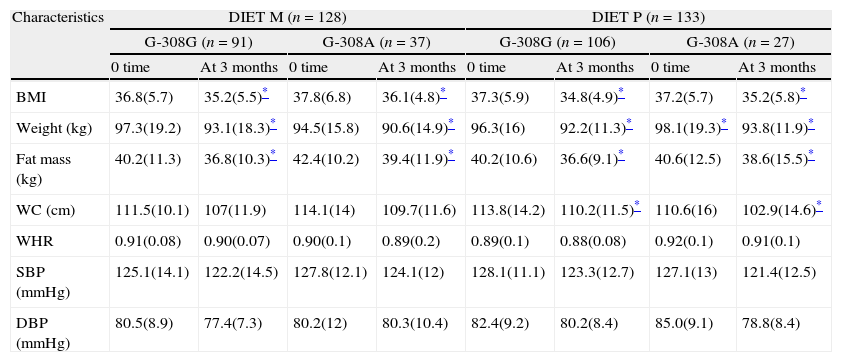
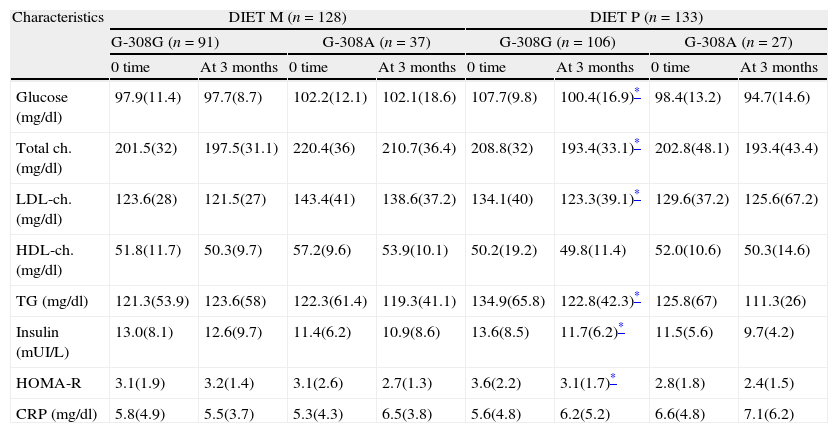
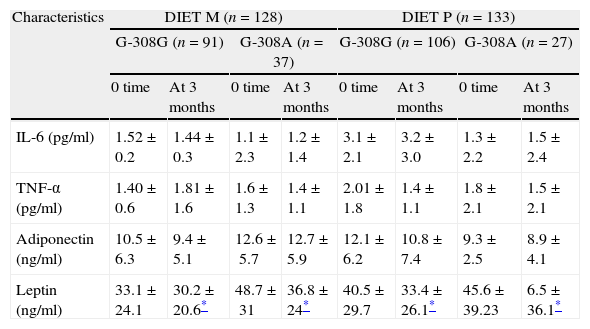
ResultsOne hundred and ninety seven patients (73.2%) had the genotype G-308G and 64 (26.8%) patients had the genotype G-308A. There were no significant differences between the effects (on weight, body mass index (BMI), waist circumference, fat mass) in either genotype group with both diets. With the diet type P and in genotype G-308G, glucose levels (−6.7(22.1)mg/dl vs −3.7(2.2)mg/dl: p=0.02), HOMA-R (−0.6(2.1)units vs −0.26(3.1)units: p=0.01), insulin levels (−1.7(6.6)UI/L vs −0.6(7.1)UI/L: p=0.009), total cholesterol levels (−15.3(31.1)mg/dl vs −8.4(22.1)mg/dl: p=0.01), LDL cholesterol levels (−10.7(28.1)mg/dl vs −3.8(21.1)mg/dl: p=0.008) and triglycerides (−12.1(52.1)mg/dl vs −6.6(43.1)mg/dl: p=0.02) decreased.
ConclusionCarriers of the G-308G promoter variant of TNF alpha gene have a better metabolic response than A-308 obese with a high polyunsaturated fat hypocaloric diet.
El objetivo de este estudio es investigar la influencia de la variante G-308 del promotor del gen TNF-α sobre los cambios metabólicos y pérdida de peso secundaria a una dieta hipocalórica rica en grasas monoinsaturadas frente a una dieta rica en grasas poliinsaturadas.
Pacientes y métodoUna muestra de 261 obesos fue reclutada de una manera prospectiva consecutiva, desde mayo de 2011 a julio de 2012 en un hospital terciario. En la visita basal fueron aleatorizados a recibir las siguientes dietas durante al menos 3 meses: dieta M (rica en grasa monoinsaturada) y dieta P (rica en grasa poliinsaturada).
ResultadosCiento noventa y siete (73,2%) obesos presentaron el genotipo G-308G, y 64 (26,8%), el genotipo G-308A. No hubo diferencias significativas en la mejoría de peso, IMC, circunferencia de la cintura y masa grasa con ambas dietas y en ambos genotipos. Tras la dieta P y con el genotipo G-308G, los niveles de glucosa (−6,7 [22,1] vs. −3,7 [2,2] mg/dl; p=0,02), HOMA-R (−0,6 [2,1] vs. −0,26 [3,1] unidades; p=0,01), insulina (−1,7 [6,6] vs. −0,6 [7,1] UI/l; p=0,009), colesterol total (−15,3 [31,1] vs. −8,4 [22,1] mg/dl; p=0,01), colesterol LDL (−10,7 [28,1] vs. −3,8 [21,1] mg/dl; p=0,008) y triglicéridos (−12,1 [52,1] mg/dl vs. −6,6 [43,1] mg/dl; p=0,02) disminuyeron.
ConclusiónLos portadores del genotipo G-308G presentan mayores beneficios metabólicos tras la pérdida de peso generada por la dieta rica en grasas poliinsaturadas.