



The calculation of body height in the intensive care unit is essential for obtaining the ideal body weight, which is used to program the tidal volume and establish objective and effective pulmonary ventilation. The objective of the study was to determine the interrater reliability of a tool for measuring body height in adult patients in an intensive care unit (ICU) in southwestern Colombia.
MethodsThis cross-sectional observational study was conducted between January and May 2021, following the recommendations of the COSMIN protocol. Two physiotherapists in the roles of observer/evaluator measured the heights of 106 patients upon admission to the ICU with a previously designed. The sample size was calculated based on Pearson's correlation coefficient. For interrater reliability, the intraclass correlation coefficient (ICC) was used, and Bland–Altman analysis was used to assess concordance. The 95% confidence interval was established, and a P value <0.05 indicated statistical significance.
ResultsA total of 106 individuals with a mean age of 59.3 years were included; the mean body height was 158.5 cm for women. The interrater reliability of the measurement of height was excellent (global ICC of 0.99, P = 0.000), and an almost perfect positive correlation was obtained between the raters for both women and men (R = 0.99).
ConclusionsExcellent interrater/interobserver reliability was obtained for the measurement of body height in the ICU. This research highlights the importance of protocolizing the measurement of height in critical patients with valid and reliable instruments.
El cálculo de la estatura corporal en la Unidad de Cuidado Intensivo es imprescindible para obtener el peso corporal ideal, usado para programar el volumen corriente y establecer una ventilación pulmonar objetiva y efectiva. El objetivo del estudio fue determinar la confiabilidad inter evaluador de una herramienta para medición de la estatura corporal en pacientes adultos en una unidad de cuidado intensivo en el suroccidente colombiano.
MétodosEstudio observacional de corte transversal, entre enero y mayo del 2021, siguiendo las recomendaciones del protocolo COSMIN. Dos fisioterapeutas con el rol observador/evaluador realizaron la medición de la estatura con un protocolo diseñado, en 106 pacientes al ingreso a UCI. El cálculo de muestra se realizó a partir del coeficiente de correlación de Pearson. Para la confiabilidad inter evaluador se usó el Coeficiente de Correlación Intraclase (ICC) y para la concordancia análisis de Blant-Altman. Se estableció intervalo de confianza del 95% y valor de P < 0.05.
ResultadosFueron incluidas 106 personas con edad media de 59.3 años; la media de estatura corporal fue 158.5 cm para mujeres. La confiabilidad inter evaluador de la medición de la estatura fue excelente (ICC global de 0.99, P = 0.000) y se obtuvo una correlación positiva casi perfecta tanto para mujeres como para hombres (R = 0.99).
ConclusionesSe obtuvo excelente confiabilidad inter evaluador (evaluador/observador) de la medición de la estatura corporal en UCI. Esta investigación resalta la importancia de protocolizar la medición de la estatura en el paciente crítico con instrumentos válidos y confiables.
Obtaining body height in the intensive care unit is essential to calculate ideal body weight; and this, in turn, to calculate the tidal volume of the mechanical ventilator. At present, protocols to accurately obtain this measurement are not described in the literature.
What is the contribution of this?A new protocol for obtaining body height in intensive care, using accessible and portable tools; which will contribute to standardizing this measurement, minimizing errors and improving the clinical practice of professionals who work in this field.
Implications of the study
Accurately obtain body height and therefore, ideal body weight; which will allow the tidal volume to be adjusted to the physiological requirements of each patient, constituting a safe clinical practice.
IntroductionThe ideal weight has wide applicability that extends from the nutritional and sports medical fields to clinical contexts in areas of pharmacology, clinical nutrition and intensive care.1 Various equations2 have been used for decades to calculate the ideal weight, taking into account measurements such as height, actual body weight, ulnar length and even body mass index.3
The proposed equations were designed and established based on characteristics of the population in which they were created and have been adopted as a standard measure in Spanish-speaking countries in the clinical and nutritional fields to objectively estimate ventilatory, pharmacological and nutritional strategies.1 Specifically, in the context of the intensive care unit (ICU), the guidelines of the Acute Respiratory Distress Syndrome Network (ARDS Network) proposed an equation based on the measurement of body height for calculating the ideal weight of patients on mechanical ventilation derived from anthropometric measurements in the US population.4 According to some authors, it continues to be the gold standard for calculating the ideal weight in ICUs worldwide.5,6
Payan et al.6 conducted a literature review to identify the evidence related to the use of equations for calculating the ideal weight in adult patients connected to mechanical ventilation in ICUs in Latin America, and the results showed that in 89% of the articles, the authors used the ARDS Network equation to calculate the ideal weight. Additionally, it was found that in many of these ICUs, there are no tools for obtaining body weight and height, such as hanging scales, beds with built-in scales and portable stadiometers, possibly due to their costs, and so visual and subjective estimates are used instead.6
Maskin et al.7 published the results of a prospective study that determined the magnitude of errors in the visual estimation of weight and height of critically ill patients and concluded that weight estimation by ICU staff often is inaccurate, highlighting the need for objective measurements with calibrated instruments to achieve precision.
Alternatives to using equations to calculate the ideal weight require the measurement of height, which if it is not remembered by the patient cannot be obtained in any way other than by measurement or estimation; therefore, objective measurement body height with valid and reliable instruments is necessary. However, there is little literature on the design of measurement protocols for this anthropometric variable in critically ill patients.
Measurement is a fundamental component of good clinical practice, and the use of valid and reliable tests and measures is vital for making clinical decisions, maintaining quality of care, and determining clinical efficacy and patient safety. In this context, some authors agree that two of the properties needed for any measurement are reliability and validity.8,9 A reliable instrument measures a phenomenon consistently and systematically obtains the same results without variability.
The foregoing highlights the importance of protocolizing the measurement of height in critical patients for calculating the ideal weight objectively with the use of valid protocols and simple and inexpensive tools and evaluation of the most relevant psychometric properties. Therefore, the objective of this study was to determine the interrater reliability of a tool for measuring body height in adult patients in an ICU in southwestern Colombia.
Materials and methodsThis observational cross-sectional study was approved by the Health Research Ethics Committee of a university (Cod: 070-020) and the health institution. The study complies with the Declaration of Helsinki. Informed consent was signed by the patient if the clinical condition allowed it or by the closest family member if the patient was not conscious or in a condition to consent, and the confidentiality and anonymity of the participants were ensured. This study followed the recommendations of Strengthening the Reporting of Observational Studies in Epidemiology (STROBE).10
Interrater reliabilityThis study was carried out between January and May 2021. Two physiotherapists were trained in the application of the designed protocol, and a pilot test was carried out with a convenience sample of 30 patients. The approximate time for the application of the protocol was less than two minutes.
The interrater reliability study was conducted in a 40-bed multipurpose adult ICU in a third-level complexity clinic. The sample size was calculated using Pearson's correlation, based on a main objective of comparing 2 quantitative measurements to define their linear relationship. The calculated sample size was 106 patients, 53 men and 53 women, and taking into account the COSMIN checklist, it was considered an ideal sample size for calculating the interrater reliability.9
The inclusion criteria were age older than 18 years and admission to the ICU regardless of the need for mechanical ventilation. Patients with musculoskeletal alterations that limited measuring height, those in whom the clinical condition restricted the adoption of the supine position with horizontalization of the bed and those under isolation due to infections by multidrug-resistant microorganisms or COVID-19 were excluded.
To measure body height, the authors designed a protocol (appendix) based on the reference manual for anthropometric standardization by Lohman,11 recommended by the World Health Organization (WHO). The protocol incorporated the use of Wilchow boards, a tool designed by Wilches et al. (pending industrial property in Colombia) to simulate a stadiometer that would facilitate a more objective measurement of body height and minimize errors in the measurement.
These boards are portable, lightweight, easy to disinfect, and made of firm and resistant wood in the shape of an “L” with a calibrated 90° bend. The boards are positioned with the patient horizontally, at the level of the cranial vertex and on the soles of both feet, leaving both ankles dorsiflexed at a 90° angle. Additionally, a standard rigid 5-m tape measure (30–497; Stanley, New Britain, USA) with a precision of 0.1 mm was used to take measurements with millimetre precision, as suggested by some authors.12,13
Regarding the use of the boards, the endorsement of the institution's infection committee was obtained, and the recommendations for disinfection with quaternary ammonium (0.5%) were followed after each use.
Preparation of evaluators and pilot studyThe 2 physiotherapists responsible for the measurements underwent training in the application of the protocol, and each professional assessed each patient and recorded the duration, execution, comments and questions generated during the process. The patients evaluated in this pilot test had characteristics similar to those in the sample. The pilot test allowed us to apply the protocol in less than two minutes, and the evaluators agreed that the measurement was easy to perform and did not report difficulties or adverse events such as disconnection of equipment or haemodynamic instability during the measurement.
To calculate reliability, the two physiotherapists (evaluator 1 and evaluator 2) with more than 3 years of experience in the care of critical patients performed the measurements independently on the same patient once each-, with an interval of three minutes between each measurement, following the standardized protocol. Before the measurement, the haemodynamic, psychic and motor stability of the patient were evaluated, and the measurements were performed with continuous heart rate, arterial oxygen saturation (SaO2), and blood pressure monitoring and electrocardiographic tracing.
The information collection forms were completed separately, without communication between the evaluators. Once the measurements were completed, each evaluator placed the collection form in an envelope identified as evaluator 1 or evaluator 2, which was sealed and stored in a box that could only be accessed by the principal investigator.
The two physiotherapists and the ICU work team were masked, and once a patient was included in the study, they were unaware of the height measurement reported by the ICU health care team.
To ensure the quality of the data collected, the principal investigator reviewed the information in each record form once a week. After verifying the information in the data collection forms, data entry was carried out in a database prepared in Excel version 2016 (Microsoft, United States), and quality control was carried out in the data entry by an external person who did not participate in the collection.
Statistical analysisStatistical analyses were conducted in SPSS 25.0 (IBM, United States). Categorical variables are expressed as frequencies and percentages, and continuous variables are expressed as the mean and standard deviation (SD).
The interrater reliability between rater 1 and 2 was calculated from the intraclass correlation coefficient (ICC), which ranges between 0 and 1, where 0 indicates the greatest disagreement and 1 indicates perfect agreement.14
Once the reliability value was obtained, the measurements for men and women were compared with the independent samples Student's t for variables that behaved according to a normal distribution (Shapiro–Wilk test) and with homogeneity of variance (Levene’s test). Concordance was assessed with Bland–Altman analysis, and the correlation was measured by means of the Pearson test. Statistical significance was established according to the 95% confidence interval (95% CI) and a significance level of p < 0.05. For the interpretation of the ICC values, the classification of Landis and Koch15 was employed (0: poor; 0.01−0.20: mild; 0.21−0.40: regular; 0.41−0.60: moderate; 0.61−0.80: substantial; 0.81−1.00: almost perfect). To check the agreement between the evaluators, the kappa index was used, which takes on values from 0 to 1, where 0 indicates the greatest disagreement and 1 indicates perfect agreement. Qualitatively, values greater than 0.8 were considered excellent, values greater than 0.7 were considered strong, and values greater than 0.6 were considered good.
ResultsDuring the data collection period, 106 patients were included. Fig. 1 shows the recruitment flow chart for the participants. Over the 5 months of the study period, 1479 patients were admitted to the ICU. Of these, 616 were not evaluated because their stay in the ICU was less than 72 h; 561 were excluded due to viral pneumonia related to COVID-19, and 90 patients were excluded due to infection by multidrug-resistant microorganisms.

Fifty percent of the sample were male, and 50% were female. The mean age was 59.3 years for women (SD: 16.71) and 56.8 years for men (SD: 17.6).
Regarding the presence of ventilatory support during the measurement, 40 women and 41 men were connected to mechanical ventilation.
The average body height was 170.5 (±7.0) cm for men and 158,5 (±7.5) cm for women.
The results indicated excellent interrater reliability for the body height measurement between Rater 1 and Rater 2 (ICC = 0.996; P = 0.000), as shown in Table 1.
Intraclass Correlation Coefficient between Evaluator 1 and Evaluator 2.
| Intraclass correlation coefficient | |||||||
|---|---|---|---|---|---|---|---|
| ICC | 95% CI | F test (true value = 0) | |||||
| Lower limit | Upper limit | F value | gl 1 | gl 2 | P value | ||
| Individual measurements | 0.996 | 0.994 | 0.997 | 509.6 | 105 | 105 | 0.000 |
| Average measurements | 0.998 | 0.997 | 0.999 | 509.6 | 105 | 105 | 0.000 |
When comparing the measurement of body height in men and women between the two evaluators (Student's t-test), no statistically significant differences were identified for either sex (men, P = 0.940; women, P = 0.952).
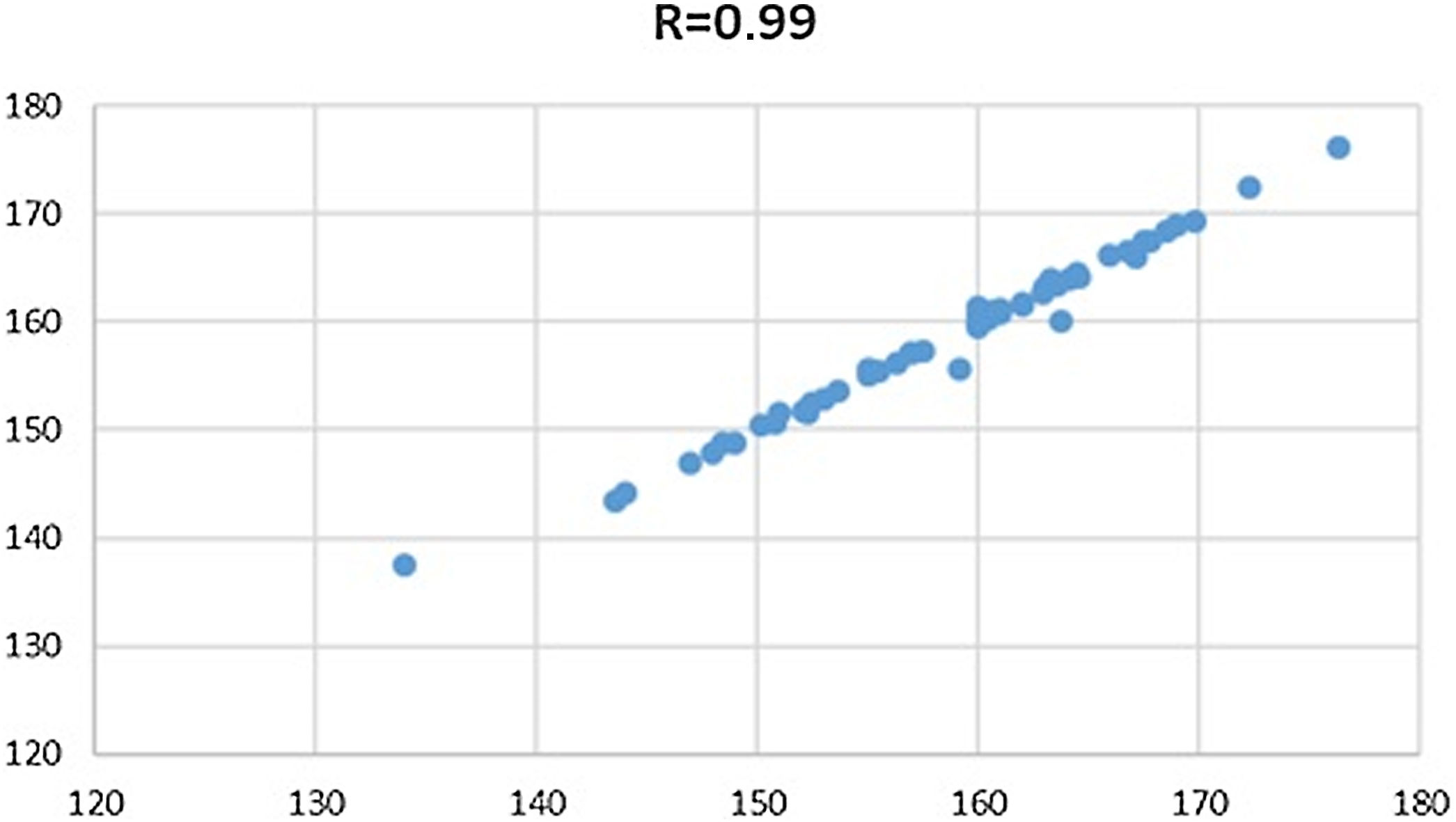
The kappa index was greater than 0.95 for both scales. The results of the Bland‒Altman analysis showed that the behaviour of the differences around zero was uniform; in addition, there was very good agreement in the measurements of body height in men (average = 0.11, SD: 0.75) and women (average = 0.092, SD = 0.96) (Figs. 2 and 3). An excellent statistical correlation was also obtained in the measurement of body height for both men and women (R = 0.99 for both), as shown in Figs. 4 and 5.
Discussion


The objective of this study was to determine the interrater reliability of the measurement of body height in critically ill patients, and the results showed excellent interrater reliability. The authors consider that standardization, precision and training guaranteed this reliability and that the designed protocol can be a useful tool to guide the calculation of the ideal weight in the context of intensive care.
In this study, 50% of the patients evaluated were men, with an average body height of 170.5 cm, while that in women was 158.5 cm. The sample size (n = 106) reached was that suggested by the COSMIN checklist for reliability studies,9 and 76% of the patients were on mechanical ventilation at the time of measurement. The authors consider that this reflects the real context of the ICU and avoided selection biases that could interfere with the results.
Regarding the design of the protocol for measuring body height in critically ill patients, a literature review identified publications focused on anthropometric measurements in the ICU, but no standardized protocols were described. In the present study, the protocol included the use of a standardized 5 m tape measure and the Wilchow boards, based on the results reported by O'Brien D et al.,16 who reported that the measurement of body height in the ICU may be influenced by errors associated with body folds and suggested the use of measuring tapes with a length greater than 2 m. In this research, the use of the Wilchow boards avoided contact with body folds, which could influence the results between one professional and another, and the authors consider that this favoured a reduction in biases related to the measurements.
García del Moral et al.,17 in a prospective cohort study in 28 ICU patients, compared the measurements of real weight and body height with their visual estimates and found a poor concordance for the two parameters. These authors consider that although weight and body height are important measurements in the ICU, little attention is given to them, and there is substantial subjectivity, for which they suggest that in the context of the ICU, validated and reliable tools that reduce the margin of error in the measurement should be employed.
Given the need to standardize the measurement of height in critically ill patients, the designed protocol is supported by scientific evidence related to the subject; the guidelines and recommendations of the Lohman criteria11 were adopted and adapted to the context of the critical patient by using low-cost and easily available instruments. The authors of the study consider that a standardized protocol reduces the variability between evaluators and that it is necessary to standardize the processes of patient care, which implies a change in culture, both organizational and professional, allowing homogenization of the knowledge of the health care staff and an understanding of the benefits of the use of these instruments.
For the authors of the present study, the designed protocol may be appropriate as a useful tool for facilitating the measurement of height for subsequently calculating the ideal weight in critically ill patients, favouring decision-making, helping to maintain the quality of care and decreasing the subjectivity in the measurement.
In this study, excellent interrater reliability was observed in the measurement of height, and differences between rater 1 and rater 2 were not significant. This could be related to their training, adequate learning and clinical experience. Singh et al.18 determined the interrater reliability in measuring body height in the supine position from a measurement of ulnar length and tibial length with a 1.5 m tape measure in 100 patients connected to mechanical ventilation, and the results showed ICCs of 0.88, 0.95 and 0.97, respectively. In the present study, patients on mechanical ventilation were also measured, but the reliability of the measurement was only evaluated with a tape measure while the patient was in the supine position. The resulting ICC was 0.99, but unlike in Singh et al.,18 a standardized protocol was used, which included the use of Wilchow boards. The authors of this research consider that given inability to use beds with scales, the Wilchow boards that resemble stadiometers allow the measurement of height in maximum extension, ensuring the Frankfort plane, which could have favoured reliability in the results obtained.
Finch et al.19 conducted an investigation in 24 healthy adult volunteers simulating positions taken by patients with muscle contractures, seeking to evaluate the precision and interrater reliability in the measurement of body height in bed with a new method, following a protocol that uses 150 cm nonstretchable tubes, standard tape measures and markers. Four evaluators (3 dietitians and 1 physiotherapist) performed the measurements with the patients in 3 different positions and obtained an interevaluator reliability of 0.94 and the corresponding 95% confidence interval using the ICC, similar to the results of the present investigation, indicating excellent reliability when measuring height when following a measurement protocol.
The measurement of body height in critically ill patients can be very important, since in some situations, the calculation of weight is not easily obtained by direct methods, such as for hospitalized patients, in which conditions such as mechanical ventilation or compromised consciousness limit mobility or the ability to stand.17,20 Therefore, some researchers21–23 have developed and proposed equations for the calculation of ideal weight that include anthropometric variables such as height, weight or the measurements of a body segment.
The methodological strengths of the study include the use of a standardized measurement protocol that incorporates simple, easily accessible instruments (Wilchow boards and tape measures), the implementation of measurement training protocols for the raters, the use of strategies for reducing the possibility of information and selection biases, and the control of confounding factors, such as the masking of the measurement results and the quality control carried out to the information collection and analysis processes.
Future multicentre studies are recommended that compare the measurements obtained with the designed protocol, the standard method (stadiometer) and other variables, such as ulnar length, leg length and arm/mid-arm length.
The present study should be considered a referential framework in our environment, as it provides a protocol for measuring body height in critically ill patients and could standardize this measurement and favour decision-making not only by physiotherapists but also by other professionals, to improve clinical practice and offer safe and quality care. In addition, the importance of anthropometric measurements (weight and height) in the context of intensive care is evidenced by its implication in clinical decision-making. However, there are no guidelines defined in existing clinical practice guidelines for obtaining these measurements in the context of the ICU.
LimitationsThe limitations of the study are related to the scarcity of literature related to the interevaluator reliability of the measurement of body height in the ICU, which facilitated the discussion of the results obtained, and to the failure to take into account other professionals of the ICU team who could also use the protocol.
ConclusionExcellent interrater reliability (global ICC of 0.99, p < 0.000) in the measurement of body height was observed between the two raters with the use of a protocol that incorporates Wilchow boards and a tape measure.
Conflict of interest statementThe authors declare no conflict of interest.
Sources of fundingThis research has not received specific support from public sector agencies, the commercial sector or non-profit entities.
The authors thank all the patients who agreed to participate in this research, as well as the logistical support provided by the institution where it was carried out.
To measure body height, the following steps were followed:
- •
Verification of the haemodynamic condition of the patient.
- •
Positioning the patient in the supine position with the bed at zero degrees and without pillows.
- •
Verification of the absence of hyperextension or flexion of the neck.
- •
Verification of positioning of the legs fully extended and of the fibulotalar joint at a 90° angle.
- •
Positioning of the Wilchow boards at the levels of the cranial vertex and the soles of the feet (right and left).
- •
Extension of the tape measure from the upper edge of the Wilchow board at the cranial vertex to the table at the feet.
- •
Verification of the full extent of the tape measure before recording the measurement value in centimetres.
- •
Recording of the value of body height
Measurement protocol that includes Wilchow boards and measure tape.