



To explore the prevalence of hopelessness in patients diagnosed with endometriosis and how it may influence their relationships.
Material and methodsProspective–descriptive study among patients with a clinical and/or anatomopathological diagnosis of endometriosis. Demographic data (age, religion, educational level, marital status, occupation, etc.) and pain data have been processed. Pain associated with endometriosis has been evaluated with an analogue scale of pain. The Beck Hopelessness Scale (BHS) was used to determine the level of hopelessness. The results have been classified into 0–3 normal; 4–8 mild; 9–14 moderate and 15–20 severe. SPSS Statistics 26 has been used and the statistical significance has been stipulated at p<0.05.
ResultsOne hundred and ten patients have been recruited with an average age of 39.8±7.09 years. The average on the Beck Hopelessness Scale is 5.08 with a SD 3.14. In our sample, we obtained that 38.2% of women experienced some level of hopelessness at the time the questionnaire was completed (mild=28.2%, moderate=9.1%, severe=0.9%). We found a significant relation between hopelessness and low income but not with regard to education, employment status or marital status.
Regarding the pain experienced and its relation with hopelessness, we found that it was significantly connected to pain during urination and dyspareunia and not to chronic pelvic pain dysmenorrhea and dyschezia.
ConclusionFour out of ten patients with endometriosis experience hopelessness, mostly mildly. This hopelessness is influenced by demographic factors such as income level and also pain, specifically pain during intercourse and during urination.
El objetivo es analizar la prevalencia de desesperanza en pacientes con endometriosis y cuáles pueden ser los factores relacionados con la misma.
Material y métodoSe ha desarrollado un estudio prospectivo descriptivo entre mujeres con diagnóstico clínico y/o anatomopatológico de endometriosis. Se recogieron datos demográficos junto al grado de dolor evaluado por la escala visual analógica. Para el estudio de la desesperanza se ha empleado la Escala de Desesperanza de Beck (BHS). Los resultados fueron clasificados en 0-3 normal; 4-8 leve; 9-14 moderado y de 15-20 como severa. El programa estadístico empleado fue Statistical Package for the Social Sciences (SPSS) 26 (IBM Corp, Armonk, NY, USA) y se estipuló la significancia estadística en p<0,05.
ResultadosUn total de 110 pacientes fueron encuestadas con una edad media 39,8±7,09 años. La media obtenida en la escala es de 5,08 con una desviación estándar (DE) de 3,14. En nuestro estudio 38,2% de las participantes experimentaban desesperanza en algún grado (leve=28,2%, moderado=9,1%, severa=0,9%). Se ha encontrado una relación significativa entre la experimentación de desesperanza con usuarias con recursos económicos más bajos, pero no con la educación, situación laboral o estado civil. Con respecto al malestar experimentado, hemos observado una asociación con el provocado durante la micción o las relaciones sexuales, pero no con la disquecia, dismenorrea o el dolor pélvico crónico.
ConclusiónCuatro de cada 10 pacientes con endometriosis experimentan un grado de desesperanza, principalmente leve. Se relaciona con dispareunia y dolor en la micción, así como en mujeres con bajos recursos económicos.

Endometriosis is a condition defined as a benign and proliferative disorder characterized by the ectopic presence and growth of functional endometrial tissue, glands and stroma, outside the uterine cavity.1 It is a chronic inflammatory disease and it is considered as one of the most common gynaecological issues. According to epidemiological data, the incidence of endometriosis in general population varies between 4 and 15% depending on the source.2 As in some cases endometriosis may have subclinical course, the real prevalence seems to be underestimated. Nevertheless, it was reported in up to 50% of women suffering from infertility.1
The clinical manifestations of endometriosis are variable and unpredictable in both presentation and course. Affected women usually present pain and infertility during their reproductive years.3 Pain linked to endometriosis can appear as dysmenorrhea, dyspareunia and chronic pelvic pain, but none of these symptoms are specific of the endometriosis disease.
The correlation of endometriosis with other diseases is the subject of numerous investigations. It has been linked to ovarian cancer, autoimmune disorders as well as psychiatric disorders such as depression and anxiety. This last relation is significantly characterized by the presence of pain or infertility. In a systematic review studying the association between psychiatric disorders and endometriosis, Pope et al.4 showed that all the eighteen analyzed studies concluded that chronic pelvic pain is associated with the relationship between endometriosis and depression or anxiety, although there are other factors such as infertility or social isolation.
Hope is the most valuable resource for the individual to cope with difficult and stressful situations. It is a motivating power that allows the individual to achieve many goals when necessary.5 Hope is a positive motivational state based on a sense of goal-orientated determination described as agency, followed by pathways, planning to meet goals.6 Hope and hopelessness symbolize opposing expectations.3 Hopelessness, according to Beck's cognitive theory, refers to a negative belief about the future, whenever problems are perceived that are unsolvable.7 Therefore, hopelessness can be defined as a negative expectation about future situations or events that may involve oneself or others.5 People who have these negative expectations think they cannot solve their problems, they never reach their goals, and that there will be more negative than positive times in their future. Beck considers hopelessness as the third component of his cognitive negative triad of depression which already involves the self and the world/environment.8
Health-related Quality of Life (HRQoL) is defined by WHO as “the perception that an individual has of his or her own health and well-being aspects related to his or her health conditions”.9 The quality of life associated with health is affected by diseases, including chronic diseases.9 Endometriosis is a chronic inflammatory disease that can sometimes be disabling. In this sense, the QoL in endometriosis has been widely studied and these patients shown worse rates than healthy population.10
Breast cancer survivors11 with a better quality of life have lower levels of hopelessness than patients with a poorer quality of life. These studies proving that quality of life is negatively correlated with hopelessness in some chronic disease.
We believe that patients with endometriosis, whose quality of life is affected, will present a higher level of hopelessness. Thus, the main goal of our work is to study the prevalence of hopelessness level in women with endometriosis in our area and if it could be associated to a certain physical symptom of endometriosis (dysmenorrhea, dyspareunia, dysuria, chronic pelvic pain, dyschezia – difficult or painful defecation), and whether the level of hopelessness experienced by patients depends on some social and demographic factors.
Materials and methodsThis is a prospective and descriptive study developed in the Endometriosis Unit of the University Hospital Virgen de la Arrixaca (Murcia, Spain) from January 1, 2020 to June 30, 2020 in adult patients with clinical diagnosis of endometriosis using imaging (ultrasound and/or MRI) or anatomopathological tests.
The Beck Hopelessness Scale (BHS) is a 20-items self-report inventory that was designed to measure three major aspects of hopelessness: feelings about the future, loss of motivation, and expectations. The test is designed for adults age 17–80. It measures the extent of the respondent's negative attitudes, or pessimism, about the future.5
It consists of twenty true/false questions examining the respondent's attitude for the past week. Higher scores indicate higher levels of hopelessness.12 As a result of the completed questionnaire, the level of hopelessness is divided in: 0–3 normal; 4–8 mild; 9–14 moderate and 15–20 severe.
Pain quantification has been performed in the main forms of pain associated with endometriosis: dyspareunia, dyschezia, dysuria, dysmenorrhea and chronic pelvic pain. The analogue pain scale has been stratified into 0 no pain, 1–3 mild, 4–6 moderate, and 7–10 severe pain.13
The demographic variables analyzed were age, marital status, educational level, religion, work activity, employment status, coexistence status, as well as smoking habits. Data such as depression or other illnesses has been collected as a dichotomous nominal variable based on the medical diagnosis recorded in the patient's medical history.
To carry out a statistical study, descriptive studies with percentage, frequency, mean and standard deviation, contingency tables with Pearson's χ2 analysis and Spearman's correlation have been performed. A p<0.05 was considered significant. Calculations were performed with IBM-SPSS version 26.0 (IBM Corp, Armonk, NY, USA).
This study was conducted in respect to the Declaration of Helsinki and it has been approved by the ethics committee of the University Hospital of Virgen de la Arrixaca (Murcia).
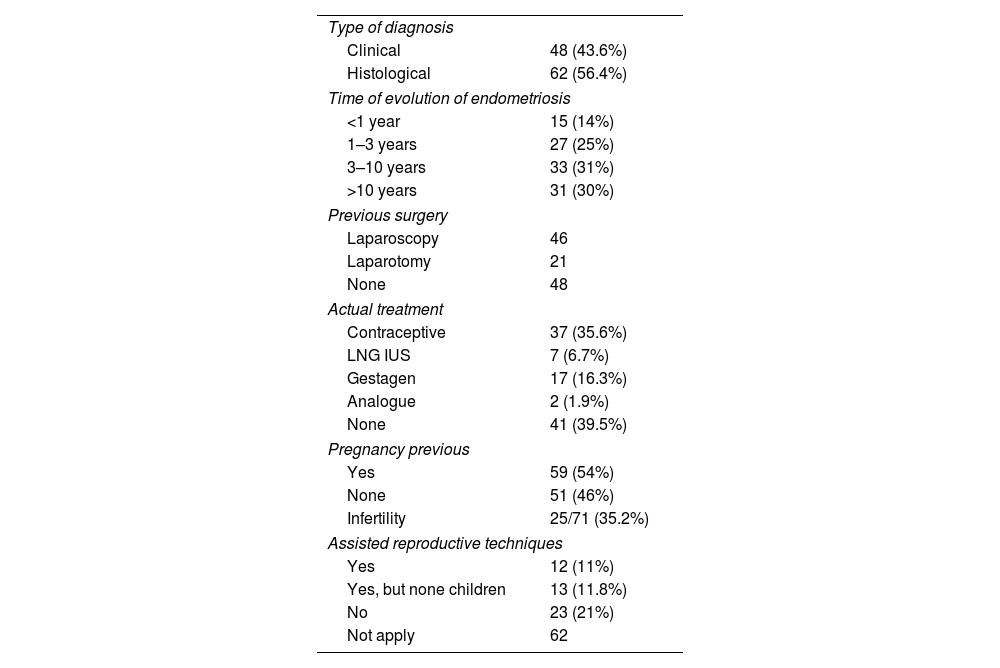
ResultsOne hundred and ten participants have been included in the study. The mean age of our patients was 39.8±7.1 years. 80.9% have a partner or are married, and almost half of them have completed university studies. Basically, they declared Catholics (88%) and most currently working (69.2%). Almost 3 out of 4 are non-smokers (74.5%). Socio-demographic data are reflected in Table 1. Thirty eight percent have diagnosed with ovarian endometriosis (OE) compared to 62% who have been diagnosed deep infiltrating endometriosis (DIE). More than half of the patients have had endometriosis for more than 3 years and 35% are infertile. Other clinical data are exposed in Table 2.
Demographic characteristics.
| Marital status | |
| Single | 16 (14.5%) |
| Married | 89 (80.9%) |
| Widowed | 0 (0%) |
| Divorced/separated | 5 (5.4%) |
| Educational level | |
| Without education | 3 (2%) |
| Primary education | 13 (11.8%) |
| Secondary or vocational courses | 40 (36.4%) |
| University studies | 54 (49.1%) |
| NA | 0 (0%) |
| Professional activity | |
| Housewife | 6 (5.45%) |
| Unemployed | 17 (15.45%) |
| Active | 76 (69.2%) |
| On sick leave | 8 (7.3%) |
| Retired | 1 (0.9%) |
| NA | 2 (1.8%) |
| Coexistence | |
| Alone | 7 (6.4%) |
| With a partner | 101 (91.8%) |
| NA | 2 (1.8%) |
| Smoking habits | |
| Non-smoker | 82 (74.5%) |
| 5–10cig/day | 15 (13.6%) |
| 10–20cig/day | 13 (11.9%) |
| Average income (€) | |
| ≤600/monthly | 18 (16.4%) |
| 600–1200/monthly | 46 (41.8%) |
| 1200–3600/monthly | 40 (36.4%) |
| >3600 | 0 (0%) |
| NA | 8 (7.3%) |
| Religion | |
| Catholic | 88 (80%) |
| Muslim | 1 (0.9%) |
| Non-religious | 14 (12,.8%) |
| Practicing Catholic | 4 (3,6%) |
| Practicing Muslim | 3 (2.7%) |
| Employment status | |
| Salaried employee | 71 (64.5%) |
| Businesswoman/Freelance | 10 (9,1) |
| Receives family support | 4 (3.6%) |
| Receives benefits or subsidy | 18 (16.4%) |
| NA | 7 (6.4%) |
| People living in the home place | |
| 1 | 7 (6.4%) |
| 2 | 40 (36.4%) |
| 3 | 27 (24.5%) |
| 4 | 22 (20%) |
| 5 | 2 (1.8%) |
| NA | 12 (10.9%) |
NA: no answer.
Clinical data.
| Type of diagnosis | |
| Clinical | 48 (43.6%) |
| Histological | 62 (56.4%) |
| Time of evolution of endometriosis | |
| <1 year | 15 (14%) |
| 1–3 years | 27 (25%) |
| 3–10 years | 33 (31%) |
| >10 years | 31 (30%) |
| Previous surgery | |
| Laparoscopy | 46 |
| Laparotomy | 21 |
| None | 48 |
| Actual treatment | |
| Contraceptive | 37 (35.6%) |
| LNG IUS | 7 (6.7%) |
| Gestagen | 17 (16.3%) |
| Analogue | 2 (1.9%) |
| None | 41 (39.5%) |
| Pregnancy previous | |
| Yes | 59 (54%) |
| None | 51 (46%) |
| Infertility | 25/71 (35.2%) |
| Assisted reproductive techniques | |
| Yes | 12 (11%) |
| Yes, but none children | 13 (11.8%) |
| No | 23 (21%) |
| Not apply | 62 |
With regard to the impact of the disease, 43.7% of the patients reported that on some occasion they had missed class due to it and 39.1% required sick leave.
The mean level of hopelessness obtained on our scale was 5.08±3.14. We obtained that 38.2% of women in our sample experienced some level of hopelessness at the time the questionnaire was completed (mild level=28.2%, moderate=9.1%, severe=0.9%) while a 65.4% of women experienced a normal level of hopelessness.
Regarding the questions about other diseases, the depression/anxiety spectrum is the most suffered at some point in their life, representing 45.5% of our patients and at the present time 23.6%. Analysing the relationship between depression and hopelessness, a significant association is observed (χ2=5.424, p<0.020). The other two most frequent diseases have been asthmatic disease 15/110 (13.6%) and hypothyroidism 11/110 (10%).
In relation to the symptoms associated with this disease, 80% of the patients present dysmenorrhea; 57% of them suffer from it with severe intensity. After this symptom, the second most frequent is chronic pelvic pain, in 72.7% and pain during intercourse in 63.7%. Less frequent are dysquezia in 43.6% and pain during urination in 27.2%.
In the analysis of the relation between age and the type of pain associated with endometriosis and hopelessness, we found that dyspareunia and dysuria together with depression are significantly related to hopelessness (p=0.02; p=0.01; p=0.02; respectively). We did not find a connexion between hopelessness and educational level, professional activity or marital status. On the other hand, we found significant differences with regards to the income level of the patient (p=0.028) (Table 3).
Correlations between variables and hopelessness.
| Statistical | p value | |
|---|---|---|
| Age | −1.308 | 0.19 |
| CPP | 0.160 | 0.35 |
| Depression | 5.424 | 0.20* |
| DM | 0.225 | 0.15 |
| DQ | 0.146 | 0.52 |
| Dyspareunia | 0.419 | 0.02* |
| Dysuria | 0.596 | 0.01* |
| Education | 4.380 | 0.22 |
| Income | −0.328 | 0.02* |
| Marital status | 1.220 | 0.54 |
| Professional activity | 6.185 | 0.28 |
CPP: chronic pelvic pain; DM: dysmenorrhea; DQ: dyschezia.
Hopelessness experienced by our patients was higher than observed in general population comparing to the study published by Kovalevent et al.14 in a population of 1500 people. They established a mean level on the BHS scales of 4,23±3,50 for women between 18 and 86 years old. Another study15 validating the survey in 2013 postmenopausal women, with a mean age of 68.9 years, presented a mean on the BHS of 4.81±4.49. Furthermore, in another Finnish population study16 of 1722 people, 987 of which were women, they found a population mean of 3.9±3.6, well below our obtained mean. These data confirm that patients with endometriosis experience a degree of hopelessness, since our results have been 5.08±3.13.,
In relation to the stratification of the degree of hopelessness, in the Finnish population study,16 23% of women between 25 and 45 years old reported mild, 6% moderate and 3% severe hopelessness (total 32%). Compared to our results, women with endometriosis experience present not only a higher mean level of hopelessness but probably a higher percentage of patients have a degree of hopelessness (mild level=28.2%, moderate=9.1%, severe=0.9%; total; 38,2%).
Regarding patients with gynaecological problems, a study was carried out in 50 women who suffered from infertility5 and the mean obtained was 9.74±1.66 prior to the extraction of eggs in the process of assisted reproduction, higher than in our study. The fact that, infertility is related to the feeling of hopelessness adds a possible contribution to our results, since one third of patients with endometriosis present infertility.17
Having analyzed other literature, we found that polycystic ovary syndrome is another gynaecological pathology associated with hopelessness. In the study by Özdemir et al.18 they published that patients with a diagnosis of polycystic ovary syndrome had a hopelessness level of 6.17±5.02 compared to the control group of 4.38±3.01.
Regarding age, although some authors14–16 found that hopelessness was associated with increasing age, in our case, we found no differences. It can be justified because our sample does not have a great dispersion in the age of our patients (see the deviation of 7 years with a mean of 39 years). The studies are based on people over 60. Specifically, in the study by Kocalevent,14 the peak of highest hopelessness is found at age of 61.
As others authors have published,12 in our study, another factor associated with the degree of hopelessness is low income. Similarly, depression have been linked to hopelessness, since for some authors, hopelessness appears during depression and it is relieved when recovering from it; although depressed patients feel hopelessness differently.7 Our study, in agreement with others, shows a correlation between both variables, perhaps because hopelessness has been considered either a proxy measure of depression or an increased risk factor of suicide or a moderator of some risk factors towards depression.8
Pain associated with endometriosis presents various clinical forms. In our study it is related to dyspareunia and dysuria. The fact that dysmenorrhea does not have an influence on the level of hopelessness could be due to the cultural normalization that we have of this type of pain, even though it affects 80% of our patients, and more than 50% suffers it with severe intensity. Regarding our results that relate hopelessness with pain during urination, we can see in a recent Dutch article that pain, discomfort, pressure or other unpleasant sensations around the bladder can cause hopelessness.19
In this sense, bladder pain syndrome/interstitial cystitis has been associated with hopelessness,20 although the endometriosis and interstitial cystitis are different nosological entities, they have symptoms in common such as the chronic pelvic pain associated to the bladder, with urgency and/or frequency.
In contrast, in a recent systematic review,3 the authors concluded, that hope had a positive impact on patients with chronic pain. Hope had a relevance role in patients experiencing chronic pain. Patients with higher hope values might articulate alternative ways of dealing with pain and be less pain catastrophizing.
To our knowledge, this is the first study that analyses the hopelessness experienced in patients with endometriosis. We believe that it should be considered in the comprehensive handling of our patients in order to improve the personalized care of each of them. Future research programmes should emphasize the study of fertility problems associated with endometriosis.
In conclusion, four out of ten patients with endometriosis experience hopelessness, mostly mildly. This hopelessness is influenced by demographic factors such as income level and also pain, specifically pain during intercourse and during urination.
Ethical responsibilitiesProtection of people and animalsThe authors declare that no experiments have been carried out on humans or animals for this research.
Data confidentialityThe authors declare that they have followed their workplace's protocols regarding the publication of patient data.
Right to privacy and informed consentThe authors declare that no patient data appear in this article.
Patient consentAll patients have given their consent to participate in the study presented following the recommendations of the ethics committee of our hospital.
Authors’ contributionsI confirm that all the authors fulfil the conditions requires for authorship; they have all made substantial contributions and have approved the final version of the manuscript.
FundingNone declared.
Conflict of interestThe authors have no conflict of interest.


