


metricas
Clínica e Investigación en Ginecología y Obstetricia Fertility preservation in endometriosis: Review of current evidence and best pra...
Información de la revista
Vol. 51. Núm. 2.
(Abril - Junio 2024)
Cita
Cita
Compartir
Descargar PDF
Más opciones de artículo
Visitas
1594
Vol. 51. Núm. 2.
(Abril - Junio 2024)
Review article
Acceso a texto completo

Fertility preservation in endometriosis: Review of current evidence and best practices

Preservación de la fertilidad en la endometriosis: revisión de la evidencia actual
Visitas
1594
M. Carbonell
Autor para correspondencia
, M.A. Perelló, J. Herrero
Hospital Universitario Vall d’Hebron, Barcelona, Spain
Este artículo ha recibido
Información del artículo
Resumen
Texto completo
Bibliografía
Descargar PDF
Estadísticas
Tablas (2)
Table 1. Characteristics of included studies.
Tablas
Table 2. Available recommendations on fertility preservation for endometriosis.
Tablas
Suplemento especial
Este artículo forma parte de:
Preservación de la fertilidad / Fertility Preservation

Editado por: Dolors Manau - Assisted Human Reproduction Unit Institute of Gynecology, Spain
César Díaz García - IVIRMA London, UK

Última actualización: Enero 2025

Más datos
Abstract

In recent decades, the field of female fertility preservation has experienced substantial growth. Reliable techniques such as cryopreservation of oocytes and ovarian tissue have emerged, along with more established methods such as embryo freezing. Among the group of patients who can benefit from these new techniques are patients with endometriosis, a common disease capable of compromising ovarian reserve and fertility prospects. Unfortunately, comprehensive recommendations for fertility preservation in patients with endometriosis are still lacking.

This narrative review comprehensively explores fertility preservation in patients with endometriosis, using a range of relevant literature, including available national and international guidelines. Additionally, it explains the weight of several factors that contribute to the decision-making process for fertility preservation, including age, severity of endometriosis, ovarian reserve, and previous or future surgery.

This manuscript summarizes available recommendations that provide guidance for this vital but challenging aspect of reproductive medicine. Underlines the need for personalized care for patients with an early diagnosis of endometriosis and initial medical treatment to try to reduce the deterioration of ovarian reserve and emphasizes the importance of research to refine fertility preservation strategies in people with endometriosis.

Keywords:
Endometriosis
Fertility preservation
Cryopreservation
Endometrioma
Resumen

En las últimas décadas, el campo de la preservación de la fertilidad femenina ha experimentado un crecimiento sustancial. Han surgido técnicas fiables, como la criopreservación de ovocitos y tejido ovárico, junto con algunas más establecidas como la congelación de embriones. Entre el grupo de pacientes que se pueden beneficiar de estos nuevos métodos, están aquellas con endometriosis, una enfermedad frecuente y capaz de comprometer la reserva ovárica y las perspectivas de fertilidad. Desafortunadamente, todavía faltan recomendaciones integrales para la preservación de esta en pacientes con endometriosis.

Esta revisión narrativa explora exhaustivamente la conservación de la fertilidad en pacientes con endometriosis, utilizando una variedad de literatura pertinente, incluidas las pautas nacionales e internacionales disponibles. Además, explica el peso de varios factores que contribuyen al proceso de toma de decisiones para conservar la fertilidad, incluida la edad, la gravedad de la endometriosis, la reserva ovárica y la cirugía previa o futura.

Este manuscrito, resume las recomendaciones disponibles que brindan orientación para este aspecto vital pero desafiante de la medicina reproductiva. Subraya la necesidad de una atención personalizada a la paciente con un diagnóstico de endometriosis precoz y un tratamiento inicial médico para intentar disminuir el deterioro de la reserva ovárica y enfatiza la importancia de la investigación para refinar las estrategias de preservación de la fertilidad en las personas que presentan endometriosis.


Palabras clave:
Endometriosis
Preservación de la fertilidad
Criopreservación
Endometrioma
Texto completo
Introduction

Endometriosis, a chronic gynecological condition marked by endometrial-like tissue growth outside the uterus, predominantly affects the pelvic area. It impacts roughly 10% of women of reproductive age and is frequently linked with pelvic pain, menstrual disturbances, and infertility.1 The causes of infertility in endometriosis are complex and can be attributed to anatomical distortions, inflammatory changes, hormonal imbalances, and compromised oocyte quality.2,3 There are frequently misdiagnoses and significant delays in the diagnosis of endometriosis, which can cause a worsening of reproductive capacity. Therefore, it is essential to raise awareness among professionals to detect those patients who may have endometriosis through a clinical interview, physical examination and transvaginal ultrasound.

The childbearing aspirations of women with endometriosis can be significantly impaired by the evolution of the disease and its treatments. Surgical interventions, commonly used for the treatment of endometriosis, can lead to the removal of ovarian tissue or compromise ovarian function, resulting in a decreased ovarian reserve.4–6 For this reason, improving the detection and diagnosis of endometriosis and offering initial medical treatment should be prioritized. Medical treatment can reduce the recurrence and progression of endometriosis and does not affect ovarian stimulation to preserve fertility.7–9

This review examines the evidence available for fertility preservation in patients with endometriosis. Furthermore, it offers an inclusive evaluation of the indications, outcomes, and limitations of different fertility preservation methods in the context of endometriosis by synthesizing the current available literature. Additionally, it provides a comprehensive evaluation of contemporary recommendations and treatment algorithms as detailed in existing guidelines.

Methods

We conducted a search of all published studies from January 2012 to June 2023, which included randomized controlled trials, cohort studies, case–control studies, case series, cross-sectional studies, and literature reviews containing original data. We also included guidelines from national and international societies related to fertility preservation in patients with endometriosis. We did not impose any language restrictions, and we collaborated with a search methodologist during this process. Initially, an attempt was made to carry out a systematic review, but due to the variability of the clinical guidelines, it was decided to carry out a narrative review. Because this is a narrative review it was not recorded in Prospero; PRISMA guidelines for systematic reviews were followed where possible.

We excluded all articles related to experimental studies conducted on in vitro or animal models. Any literature focusing solely on surgical interventions, such as fertility-sparing surgery was also omitted. Moreover, studies on fertility preservation in clinical situations other than endometriosis that did not present a distinct analysis for patients with endometriosis, were not considered. Studies emphasizing laboratory-specific technical issues or in vitro maturation were disregarded as well. Additionally, we did not include studies related to IVF outcomes in endometriosis patients, as it was considered that the data could not be directly extrapolated to fertility preservation indications. However, relevant data from these studies were incorporated into the discussions when applicable.

Our research was conducted by consulting the following electronic databases: MEDLINE, EMBASE, Web of Science, Scopus, ClinicalTrials.gov, OVID, the Cochrane Library, and Google Scholar. In addition, we utilized Scite, Elicit.org, Inciteful.xyz, and Evidence Hunt, which are AI-powered tools designed to aid in identifying pertinent and interrelated studies in existing databases. To identify relevant studies a mesh combination of the following keywords was used: (cryopreservation OR oocyte-embryo freezing OR ovarian tissue cryopreservation OR oocyte cryopreservation OR embryo cryopreservation OR oocyte freezing OR fertility preservation OR IVF OR fertility treatment) AND (endometriosis OR endometrioma).

After a primary screen of all titles and abstracts retrieved (by MC), the full texts of all potentially eligible studies were retrieved. Three review authors (MC, JH, MPL) independently examined these articles for compliance with the inclusion criteria and selected the studies that were eligible for inclusion in the review. Disagreements were resolved by consensus with the fourth and fifth reviewer (MPB, AT). All references of the retrieved studies were also reviewed to avoid missing relevant publications.

Results

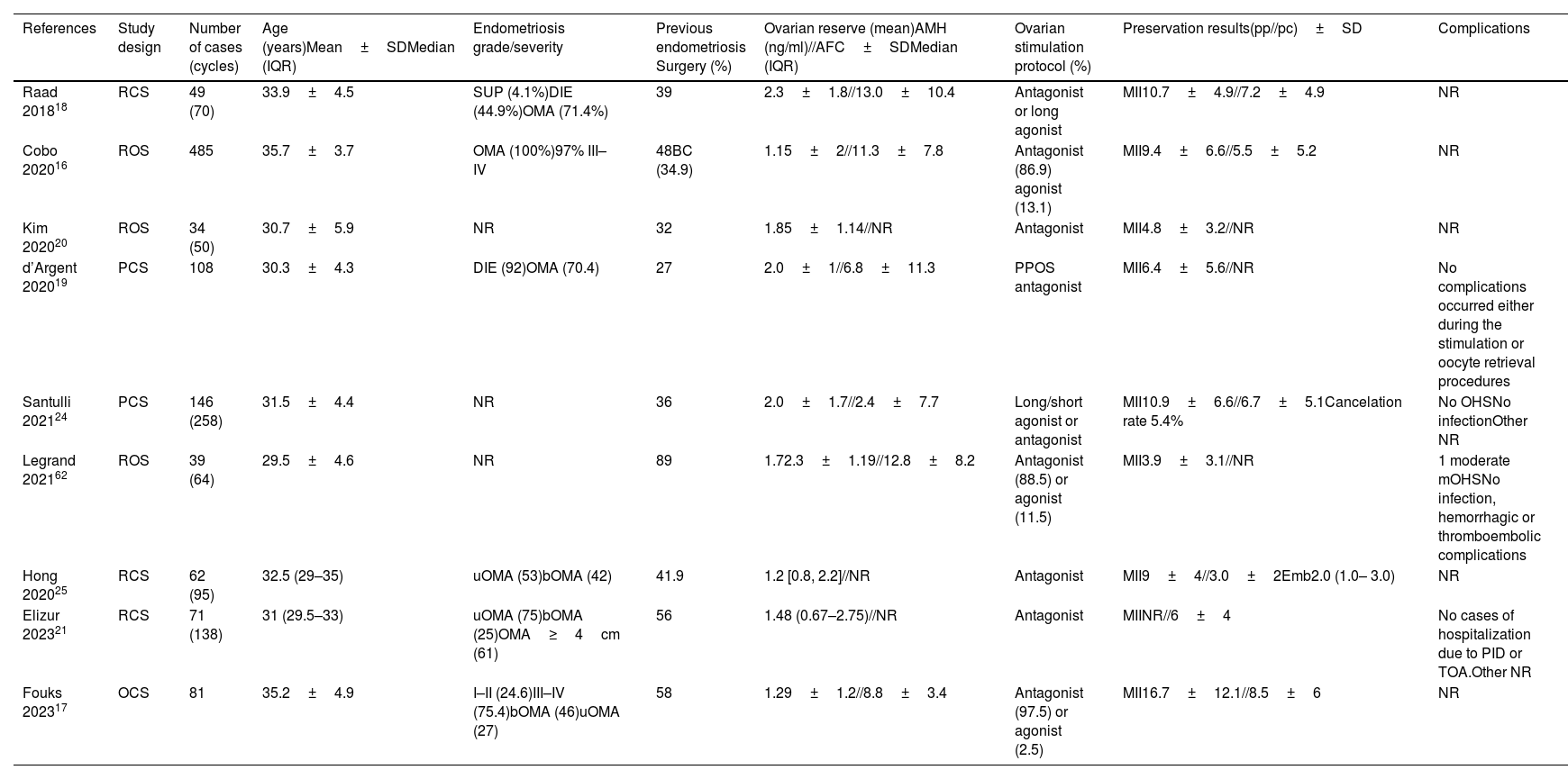
In total, 603 studies were identified in the initial search. After exclusions and further investigation of additional relevant publications, nine eligible articles were identified. These included three Retrospective Cohort Studies (RCS), three Retrospective Observational Studies (ROS), two Prospective Cohort Studies (PCS), and one Observational Cross-sectional Study (OCS) (Table 1).

Table 1.

Characteristics of included studies.

References  Study design  Number of cases (cycles)  Age (years)Mean±SDMedian (IQR)  Endometriosis grade/severity  Previous endometriosis Surgery (%)  Ovarian reserve (mean)AMH (ng/ml)//AFC±SDMedian (IQR)  Ovarian stimulation protocol (%)  Preservation results(pp//pc)±SD  Complications 
Raad 201818  RCS  49 (70)  33.9±4.5  SUP (4.1%)DIE (44.9%)OMA (71.4%)  39  2.3±1.8//13.0±10.4  Antagonist or long agonist  MII10.7±4.9//7.2±4.9  NR 
Cobo 202016  ROS  485  35.7±3.7  OMA (100%)97% III–IV  48BC (34.9)  1.15±2//11.3±7.8  Antagonist (86.9) agonist (13.1)  MII9.4±6.6//5.5±5.2  NR 
Kim 202020  ROS  34 (50)  30.7±5.9  NR  32  1.85±1.14//NR  Antagonist  MII4.8±3.2//NR  NR 
d’Argent 202019  PCS  108  30.3±4.3  DIE (92)OMA (70.4)  27  2.0±1//6.8±11.3  PPOS antagonist  MII6.4±5.6//NR  No complications occurred either during the stimulation or oocyte retrieval procedures 
Santulli 202124  PCS  146 (258)  31.5±4.4  NR  36  2.0±1.7//2.4±7.7  Long/short agonist or antagonist  MII10.9±6.6//6.7±5.1Cancelation rate 5.4%  No OHSNo infectionOther NR 
Legrand 202162  ROS  39 (64)  29.5±4.6  NR  89  1.72.3±1.19//12.8±8.2  Antagonist (88.5) or agonist (11.5)  MII3.9±3.1//NR  1 moderate mOHSNo infection, hemorrhagic or thromboembolic complications 
Hong 202025  RCS  62 (95)  32.5 (29–35)  uOMA (53)bOMA (42)  41.9  1.2 [0.8, 2.2]//NR  Antagonist  MII9±4//3.0±2Emb2.0 (1.0– 3.0)  NR 
Elizur 202321  RCS  71 (138)  31 (29.5–33)  uOMA (75)bOMA (25)OMA4cm (61)  56  1.48 (0.67–2.75)//NR  Antagonist  MIINR//6±No cases of hospitalization due to PID or TOA.Other NR 
Fouks 202317  OCS  81  35.2±4.9  I–II (24.6)III–IV (75.4)bOMA (46)uOMA (27)  58  1.29±1.2//8.8±3.4  Antagonist (97.5) or agonist (2.5)  MII16.7±12.1//8.5±NR 

SD: standard deviation; IQR: interquartile range; AMH: anti-Müllerian Hormone; AFC: antral follicle count; pp: per patient=accumulated; pc: per cycle; RCS: retrospective cohort study; ROS: retrospective observational study; PCS: prospective cohort study; OCS: observational cross-sectional study; SUP: superficial endometriosis; DIE: deep infiltrating endometriosis; OMA: endometrioma (uOma: unilateral/bOMA: bilateral); MII: metaphase II oocytes; NR: not reported; PPOS: progestin primed ovarian stimulation; I–II–III–IV: rASRM endometriosis classification; PID: pelvic inflammatory disease; TOA: tubo-ovarian abscess.

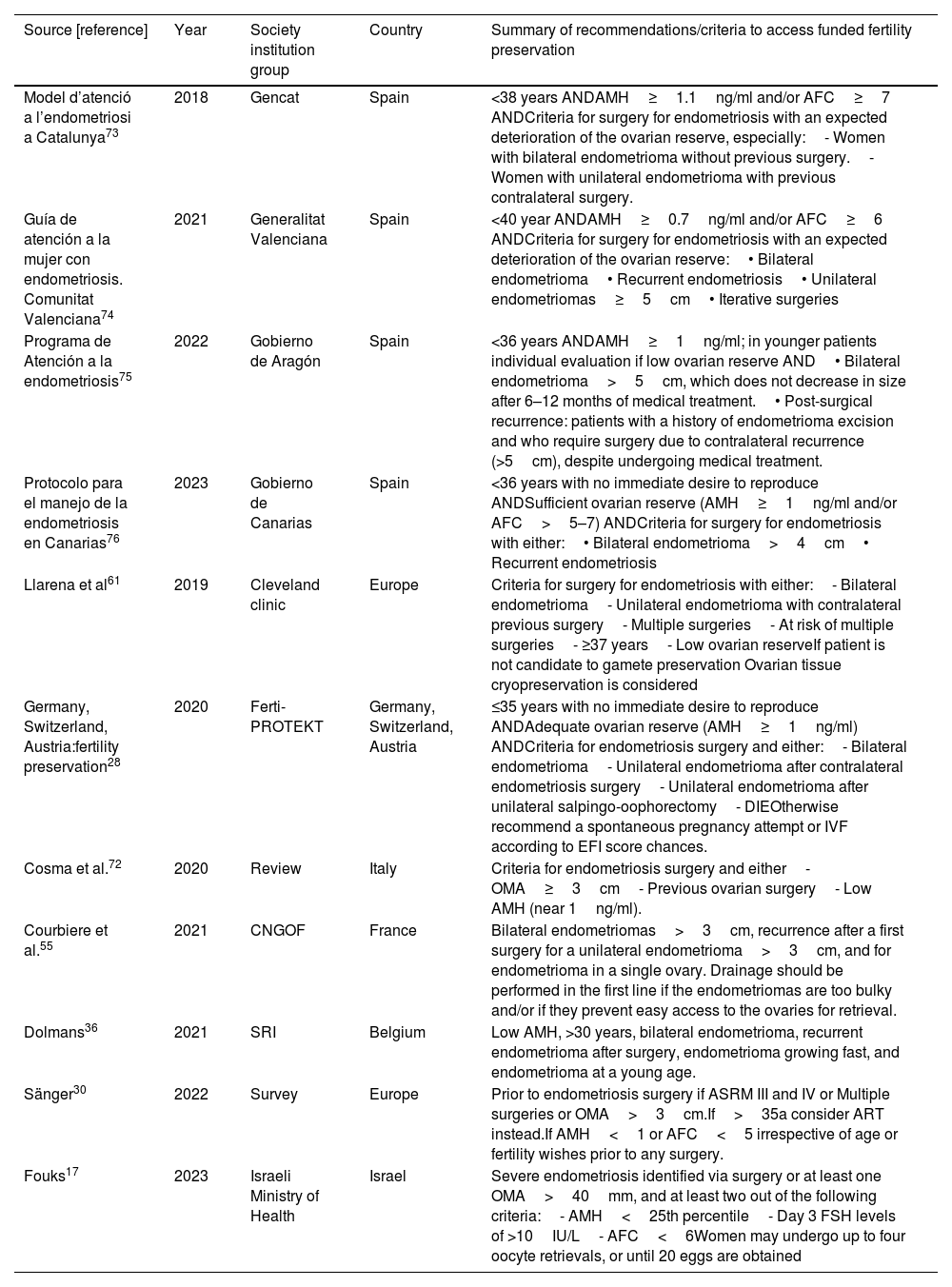
Additionally, the review of potential national and international guidelines resulted in the identification of 11 proposed algorithms for fertility preservation and endometriosis (Table 2).

Table 2.

Available recommendations on fertility preservation for endometriosis.

Source [reference]  Year  Society institution group  Country  Summary of recommendations/criteria to access funded fertility preservation 
Model d’atenció a l’endometriosi a Catalunya73  2018  Gencat  Spain  <38 years ANDAMH1.1ng/ml and/or AFC7 ANDCriteria for surgery for endometriosis with an expected deterioration of the ovarian reserve, especially:- Women with bilateral endometrioma without previous surgery.- Women with unilateral endometrioma with previous contralateral surgery. 
Guía de atención a la mujer con endometriosis. Comunitat Valenciana74  2021  Generalitat Valenciana  Spain  <40 year ANDAMH0.7ng/ml and/or AFC6 ANDCriteria for surgery for endometriosis with an expected deterioration of the ovarian reserve:• Bilateral endometrioma• Recurrent endometriosis• Unilateral endometriomas5cm• Iterative surgeries 
Programa de Atención a la endometriosis75  2022  Gobierno de Aragón  Spain  <36 years ANDAMH1ng/ml; in younger patients individual evaluation if low ovarian reserve AND• Bilateral endometrioma>5cm, which does not decrease in size after 6–12 months of medical treatment.• Post-surgical recurrence: patients with a history of endometrioma excision and who require surgery due to contralateral recurrence (>5cm), despite undergoing medical treatment. 
Protocolo para el manejo de la endometriosis en Canarias76  2023  Gobierno de Canarias  Spain  <36 years with no immediate desire to reproduce ANDSufficient ovarian reserve (AMH1ng/ml and/or AFC>5–7) ANDCriteria for surgery for endometriosis with either:• Bilateral endometrioma>4cm• Recurrent endometriosis 
Llarena et al61  2019  Cleveland clinic  Europe  Criteria for surgery for endometriosis with either:- Bilateral endometrioma- Unilateral endometrioma with contralateral previous surgery- Multiple surgeries- At risk of multiple surgeries- ≥37 years- Low ovarian reserveIf patient is not candidate to gamete preservation Ovarian tissue cryopreservation is considered 
Germany, Switzerland, Austria:fertility preservation28  2020  Ferti-PROTEKT  Germany, Switzerland, Austria  ≤35 years with no immediate desire to reproduce ANDAdequate ovarian reserve (AMH1ng/ml) ANDCriteria for endometriosis surgery and either:- Bilateral endometrioma- Unilateral endometrioma after contralateral endometriosis surgery- Unilateral endometrioma after unilateral salpingo-oophorectomy- DIEOtherwise recommend a spontaneous pregnancy attempt or IVF according to EFI score chances. 
Cosma et al.72  2020  Review  Italy  Criteria for endometriosis surgery and either- OMA3cm- Previous ovarian surgery- Low AMH (near 1ng/ml). 
Courbiere et al.55  2021  CNGOF  France  Bilateral endometriomas>3cm, recurrence after a first surgery for a unilateral endometrioma>3cm, and for endometrioma in a single ovary. Drainage should be performed in the first line if the endometriomas are too bulky and/or if they prevent easy access to the ovaries for retrieval. 
Dolmans36  2021  SRI  Belgium  Low AMH, >30 years, bilateral endometrioma, recurrent endometrioma after surgery, endometrioma growing fast, and endometrioma at a young age. 
Sänger30  2022  Survey  Europe  Prior to endometriosis surgery if ASRM III and IV or Multiple surgeries or OMA>3cm.If>35a consider ART instead.If AMH<1 or AFC<5 irrespective of age or fertility wishes prior to any surgery. 
Fouks17  2023  Israeli Ministry of Health  Israel  Severe endometriosis identified via surgery or at least one OMA>40mm, and at least two out of the following criteria:- AMH<25th percentile- Day 3 FSH levels of >10IU/L- AFC<6Women may undergo up to four oocyte retrievals, or until 20 eggs are obtained 

AFC: antral follicle count, AMH: anti-Müllerian hormone, ART: assisted reproductive technology, ASRM: American Society for Reproductive Medicine, CNGOF: Collège National des Gynécologues et Obstétriciens Français, EFI: endometriosis fertility index, FSH: follicle-stimulating hormone, OMA: ovarian endometriosis, SRI: Societe de Recherche pour l’Infertilité.

Based on the available literature, the decision to implement fertility preservation in a patient with endometriosis primarily depends on her age, disease severity or phenotype, ovarian reserve, surgical indication, and surgical history related to endometriosis, as well as future fertility desires. However, as illustrated in Tables 1 and 2, the criteria vary significantly across different studies and available guidelines.

Endometriosis severity

A crucial factor in deciding the course of endometriosis treatment and thus the need for fertility preservation is the evaluation of endometriosis severity. The systematic review and meta-analysis by Horton et al. indicated that endometriosis negatively impacts various IVF parameters, such as reducing the number of mature oocytes, particularly in more severe subtypes and those affected by endometrioma.10 However, data on fertility preservation in endometriosis patients is less plentiful. Numerous classification systems, like the Revised American Society for Reproductive Medicine (rASRM),11 Endometriosis Fertility Index (EFI),12 and #Enzian,13 each have their unique advantages. However, only EFI has shown a significant correlation with post-surgical pregnancy outcomes in endometriosis patients. Still, the accuracy of EFI in predicting pregnancy after Assisted Reproductive Technology (ART) is unclear.14,15

Only two of the studies included in this review define endometriosis severity using one of the three recognized classifications, specifically the rASRM, in both instances. In Cobo's 2020 study, a variety of parameters, such as oocyte retrieval and vitrification counts, embryo quality, survival rate, pregnancy rate, and cumulative live birth rates (CLBR), did not demonstrate statistically significant differences based on the stage of endometriosis (stages I–II vs. III–IV).16 Additionally, the recent cross-sectional study by Fouks is noteworthy as the only study to include clinical symptoms in conjunction with rASRM staging as a measure of disease severity. This study highlights a strong correlation between the severity of symptoms and diminished results in fertility preservation.17 However, the remaining publications merely discuss the presence, size, and laterality of endometriomas or Deep Infiltrating Endometriosis (DIE) without considering other clinical staging factors (Table 1).

The 2018 study by Raad et al. found no significant differences in Controlled Ovarian Stimulation (COS) outcomes based on the phenotype of endometriosis or characteristics of ovarian endometrioma.18 Similarly, the prospective cohort study by d’Argent et al. concluded that the presence, location, or size of endometriomas had no significant impact on oocyte retrieval.19 Conversely, Kim et al. reported a lower number of oocytes retrieved in patients with endometrioma compared to infertile patients without endometrioma.20

Surgery

Prior surgery before an ovarian stimulation cycle can significantly decrease ovarian reserve and oocyte yield, with bilateral cyst removal causing a more profound impact.5,6,16,21–23 In 2018, Raad noted that patients with previous surgical excision of ovarian endometriomas had considerably lower counts of retrieved oocytes (6.8 vs. 11.2) and mature oocytes (5.3 vs. 8.3).18 This observation was later reinforced by the study conducted by Cobo et al., where they discovered that the quantity of oocytes retrieved and the number of MII oocytes subsequently vitrified – calculated both per cycle and per patient – was greater in women who had not undergone ovarian surgery prior to fertility preservation. This trend held true irrespective of whether patients had unilateral or bilateral surgery. Studies by Santulli et al.24 and Hong et al.25 further explored the role of ovarian stimulation for fertility preservation finding also that history of surgery for ovarian endometriosis significantly reduced the number of retrieved oocytes and increased the risk of cycle cancelation, once again highlighting the detrimental effect of surgery. This finding aligns also with the results reported by Elizur et al. in their retrospective cohort study, which noted that preceding ovarian endometrioma surgery significantly reduced ovarian reserves and yielded fewer MII oocytes.21 It's worth noting that second-line conservative surgery for recurrent endometriosis could further negatively impact IVF outcomes.26

In a recently published review the Number Needed to Treat (NNT) was 16 for patients under 35, indicating that one in 16 patients who underwent oocyte cryopreservation before endometriosis surgery could conceive later, an achievement not possible without cryopreservation. Information for older patients was not assessed due to data limitations.27

If controlled ovarian stimulation for oocyte retrieval is recommended prior to surgery, endometriosis surgery should take place at least two weeks after follicular aspiration in order to reduce the risk of bleeding.28

Age

Research studies have repeatedly demonstrated that age significantly impacts Assisted reproductive technology (ART) outcomes in endometriosis patients.16,24,29,30 However, it's noteworthy that none of the studies evaluated in the current review had an average cryopreservation age exceeding 35 years. The 2020 study by Cobo et al. had the highest mean age at 35.7 years. In the previously mentioned study, a noticeable decline was observed in age-specific analysis. Patients aged 35 years or younger exhibited an 85.1% survival rate of oocytes, while this rate dropped to 80.8% in those older than 35 years (p<0.05). Age not only adversely affected the survival rate of oocytes but also the quantity of oocytes harvested and vitrified, the quality of embryos, and clinical outcomes. Moreover, the theoretical advantage of cryopreservation before endometriosis surgery observed in patients under 35 seems to disappear in older individuals. This suggests that fertility preservation might yield significantly less effective results in women over 35, irrespective of their surgical history. This observation can be attributed to the already low prognosis of older patients even before surgery.31

Ovarian reserve

The assessment of ovarian reserve is pivotal to fertility preservation in endometriosis patients. The combination of Anti-Mullerian Hormone (AMH) and Antral Follicle Count (AFC) is typically deemed the most accurate predictor of ovarian response to stimulation, particularly in the broader population seeking fertility treatments.32 However, according to various studies, the optimal biomarker for evaluating ovarian reserve in endometriosis patients before fertility preservation interventions remains uncertain.33

Certain researchers have proposed that the Antral Follicle Count (AFC) could be underestimated in patients with endometriosis due to the mass effect of endometriomas on the ovarian parenchyma.34 On the contrary, other studies indicate that despite similar AMH levels, women with endometrioma retrieve significantly fewer oocytes compared to control groups.35

Conversely, a recent cross-sectional study by Fouks found AMH values to have the highest correlation with treatment success in endometriosis patients undergoing fertility preservation (+0.472, p=0.006).17 In the articles included in this review, ovarian reserve was assessed using either Anti-Mullerian hormone, Antral follicle count (AFC), or both, and a wide range was observed (Table 1). Interestingly, none of the reviewed articles reported a mean AMH level below 1ng/ml for the study population. The ovarian reserve markers only fell below this threshold in specific subgroups, particularly those who underwent surgery prior to fertility preservation.

Choice of fertility preservation technique

There are two primary strategies for fertility preservation: the extraction and subsequent cryopreservation of fertility, either as oocytes or embryos, or the cryopreservation of ovarian tissue.36

Oocyte cryopreservation is recognized as an effective method for fertility preservation.37 Studies show that cryopreserved oocytes have comparable fertilization, embryo development, and pregnancy rates to fresh oocytes.30,38 The versatility and ethical advantages of cryopreserved oocytes, coupled with the advancements in vitrification techniques, have made it the preferred choice for fertility preservation.30

Embryo cryopreservation, in contrast, offers further diagnostic possibilities such as Preimplantation Genetic Diagnosis (PGD), as well as a more precise estimate of the reproductive potential of the preserved material. This strategy is notably beneficial when immediate pregnancy is anticipated, and fertility preservation is perceived as an ‘adjuvant’ option, particularly when surgery is the primary therapeutic option.24 However, this approach presents clear ethical and functional limitations when the objective is long-term preservation or in patients without a partner at the time of preservation.27

The cryopreservation of ovarian tissue as a viable fertility preservation option, while relatively new, is gaining prevalence, especially in oncological cases.36 The American Society for Reproductive Medicine and the European Society of Human Reproduction and Embryology have acknowledged it as a legitimate fertility preservation methodology.38,39 However, its application in endometriosis cases has been limited due to a lack of corroborating data and practical experience.30,36

Controlled Ovarian Stimulation (COS) protocol

Controlled Ovarian Stimulation (COS) for endometriosis patients, whether they’re undergoing oocyte preservation or in vitro fertilization (IVF), lacks a universally accepted optimal approach. Both GnRH antagonist and agonist protocols have demonstrated comparable pregnancy and live birth rates, allowing for either to be selected based on the preferences of the patients and their physicians.40 While the long or ultra-long agonist protocol has traditionally been the most commonly adopted ovarian stimulation method for clinically challenging endometriosis cases in the past, the antagonist protocol has swiftly gained popularity due to its greater flexibility, convenience, and significantly reduced incidence of OHSS (Table 1).30,41 For women with low ovarian reserve, double stimulation may be an option to increase the yield of available oocytes.42 There is less information available regarding other promising alternatives for ovarian stimulation in this patient group, such as Progestin-Primed Ovarian Stimulation (PPOS).19,43

Letrozole, a selective aromatase inhibitor, has been extensively used for fertility preservation in patients with hormone-dependent cancers, yielding promising results. It has also been suggested to enhance fertility outcomes in individuals with low ovarian reserve and endometriosis-related pelvic pain.44 However, there is limited data concerning its efficacy in COS cycles for fertility preservation or IVF in endometriosis patients. Regardless, studies have shown that combining letrozole with gonadotropin therapy significantly reduces estrogen peaks, maintains comparable gonadotropin doses, and yields similar oocyte and embryo numbers to treatments not involving letrozole.45,46 Future research should explore the effects of letrozole on pain-related scores and endometriosis progression linked to ovarian stimulation.

COS adjuvancy

Since the 1980s, it was posited that Gonadotropin-Releasing Hormone Agonists (GnRH-a) could suppress pituitary function, leading to a low estrogen state that may improve reproductive outcomes in women with endometriosis due to a reduction in pelvic inflammation. This recommendation was further supported by the 2014 ESHRE guidelines, which advocated for an ultra-long GnRH-a protocol before IVF.47,48

However, based on more recent data,49 the European Association of Human Reproduction and Embryology reversed this recommendation in their most recent guidelines.40 A study in 2023 also reported that the ultra-long protocol does not improve IVF/ICSI outcomes and may even negatively impact live birth and fertilization rates.50 The ultra long protocol's effects on fertility preservation are even less clear, due to the lack of specific studies.

While combined oral contraceptive pills (COCP) are commonly prescribed to manage pain and halt disease progression in patients with endometriosis, it has been reported that their prolonged use may decrease the oocyte yield following stimulation.8,51,52 In a similar fashion, pre-treatment with Dienogest (DNG), has been found to be comparable to GnRH-a in managing endometriosis symptoms and does not improve the number of mature oocytes, clinical pregnancies, or live births.53

Resveratrol, a natural compound with anti-angiogenic, anti-carcinogenic, proapoptotic, anti-oxidative, and anti-inflammatory properties, in conjunction with antioxidants like melatonin, vitamins E and C, could be considered as new therapeutic possibilities for endometriosis treatment.26 However, more evidence is needed to recommend specific indications for these supplements in fertility preservation for endometriosis patients.

Complications

Oocyte retrieval in ART treatments presents risks such as pelvic hemorrhage, infections, OHSS, thrombosis, and specific concerns for endometriosis patients, including undetected malignancies and disease progression.38,54 Earlier, a >4cm endometrioma size mandated surgical intervention before ART,8,55,56 but this has been recently revised.40 Recent studies indicate that fertility preservation before surgery may lead to more cryopreserved oocytes without increased complications, particularly for women with larger or bilateral endometriomas.21 However, recent European survey found that 50% of centers still preferred interventions for endometriomas4cm before ovarian stimulation.30

Severe pelvic inflammatory disease (PID) post-ART has been a particular concern in endometriosis patients.57 However, the risk of severe PID post-oocyte retrieval in women with ovarian endometriomas has been estimated to be less than 1%.58

Despite potential exacerbation of endometriosis symptoms with ovarian stimulation, recent research shows no significant link between stimulation and disease progression or recurrence.42

The rate of venous thromboembolism in women undergoing Assisted Reproductive Technology (ART) is 0.6%, significantly increasing in women on estrogen–progestogen contraception, a common circumstance among endometriosis patients.42 However, no increase in this complication has been reported in endometriosis patients thus far. The incidence of Ovarian Hyperstimulation Syndrome (OHSS), a rather rare complication with the introduction of antagonist cycles, is expected to be even lower in endometriosis patients due to their typically lower ovarian reserve. Finally, anesthesia-related complications during oocyte retrieval are rare and nonspecific.54

In 2019, the ESHRE Working Group on Ultrasound in ART issued recommendations about oocyte pick-up (OPU), which included guidelines for patients with endometriosis.59 During the OPU procedure, it's critical to avoid aspirating or puncturing ovarian endometriomas (OMAs) to prevent contamination of the follicular fluid and to minimize the risk of intra-abdominal infections. To further reduce these risks, they recommend disinfecting the vaginal area with povidone–iodine, using sterile isotonic saline solution, and administering antibiotics during the procedure.58 Nevertheless, there may be instances where puncturing the OMA is necessary to prevent significant loss of oocytes. In such cases, comprehensive preoperative counseling and informed consent from patients are paramount. If an OMA is accidentally punctured, the guidelines advise immediate withdrawal of the needle, flushing with suitable media, and replacing the collecting tube.27

Number of oocytes to freeze and pregnancy outcomes

Determining the quantity of oocytes for cryopreservation is complex and depends on factors like patient age, desired child count, and necessary stimulations to secure enough mature oocytes.52 Age-related success rates reveal that live birth rate per warmed vitrified oocyte varies based on age – from 5% in women aged 38 and above, to 7.4% in those under 30 during COS.42,60 Consequently, it's suggested that women under 38 should cryopreserve 15–20 oocytes, and those aged 38–40 should store 25–30 oocytes for reasonable success, and in endometriosis patients the number may be higher due to potential oocyte quality issues.31,42,52,61 Additionally, endometriosis patients often show lower ovarian reserve and fewer oocyte yields from COS, thus needing multiple stimulation cycles.16,18,25,45,62 However, it's unclear how many stimulation cycles are optimal, and whether they should be consecutive or include an hormonal therapy phase. These questions should be individually addressed, considering the number of oocytes obtained, endometriosis-related pain, patient preferences, and associated costs.28

Very little data exists regarding the usage of cryopreserved gametes in endometriosis patients. The most comprehensive description to date is offered by Cobo in 2020, who reported a return rate of 46.5% in their vitrification program: 485 out of 1044 patients with endometriosis who had their oocytes vitrified returned to use them in an attempt to achieve pregnancy. In total, 225 babies were born, resulting in a cumulative live birth rate (CLBR) per patient of 46.4%. The results were significantly better in a subgroup of patients who were 35 years of age or younger and had not undergone surgery before preservation, with a success rate of 72.5%.16

Conclusion

The existing literature unequivocally suggests that patients with severe endometriosis, especially those with bilateral endometriomas, are at an elevated risk of premature ovarian insufficiency (POI) and decreased AMH levels. Additionally, most authors conclude that surgical treatment can further undermine ovarian reserve and AMH levels, thereby impairing the outcomes of ART. Therefore, it is very important that the initial treatment is based on medical treatment since hormonal treatment has shown clinical and ultrasound improvement in patients who have endometriomas, adenomyosis and deep infiltrating endometriosis.63–71

When surgery is necessary, fertility preservation could be performed prior to surgical intervention. Although fertility preservation appears to be a reasonably safe procedure, complications may arise due to the presence of sizable endometriomas during oocyte retrieval. Nevertheless, there lacks a clear consensus regarding an established cutoff to recommend surgery prior to ovarian stimulation. And above all, there is a lack of consensus in the group of patients who have low ovarian reserve (AMH<1ng/ml) before surgery, which are not represented in the majority of guidelines and clinical studies and constitutes a very important part of patients with endometriosis of childbearing age.

The current evidence emphasizes the potential efficacy of fertility preservation strategies, especially oocyte cryopreservation, in managing fertility concerns in patients with endometriosis. Paradoxically, those patients who stand to benefit most from oocyte cryopreservation – young patients with high ovarian reserves and minimal endometriosis – are also the most likely to achieve spontaneous pregnancy without requiring assisted reproductive treatments. A notable challenge lies in the fact that none of the existing staging systems have proven to be reliable predictors of fertility preservation outcomes. This restricts their utility as tools for determining the indications for fertility preservation. Additionally, age appears to be a key factor in predicting the expected outcomes of fertility preservation, and the utility of the procedure in patients above 35 years of age remains a subject of ongoing debate.

Given this intricate matrix of influencing factors, coupled with limitations in current research, an international consensus algorithm could prove pivotal. This algorithm should identify patients at risk, and provide early access to fertility preservation based on factors such as age, ovarian reserve, and the severity of endometriosis. Such an approach could dramatically improve patient management. Looking forward, it is essential to continue research to not only refine these strategies but also to develop a comprehensive, individualized algorithm that accommodates each patient's unique circumstances. Despite recent advancements, our understanding of the cost-effectiveness of these strategies remains limited, a factor of crucial importance for their wider application. Consequently, the future of this crucial area of reproductive medicine requires an intensified focus on effectiveness and economic evaluations to ensure the most favorable outcomes for our patients.

Declaration of generative AI and AI-assisted technologies in the writing process

During the preparation of this paper, the authors used ChatGPT to correct grammatical and structural errors. After using said tool/service, the author(s) reviewed and edited the content as necessary, taking full responsibility for the content of the publication.

Ethical disclosuresProtection of human and animal subjects

The authors declare that no experiments were performed on humans or animals for this study.

Confidentiality of data

The authors declare that no patient data appear in this article.

Right to privacy and informed consent

The authors declare that no patient data appear in this article.

Ethical considerations

This study does not involve experimentation with human or animal subjects.

Funding

This research has not received specific support from public sector agencies, the commercial sector or non-profit entities.

Conflict of interests

None.

References
[1]
K.T. Zondervan, C.M. Becker, S.A. Missmer.
Endometriosis.
N Engl J Med, 382 (2020), pp. 1244-1256
[2]
C. Tomassetti, T. D’Hooghe.
Endometriosis and infertility: insights into the causal link and management strategies.
Best Pract Res Clin Obstet Gynaecol, 51 (2018), pp. 25-33
[3]
Z. Tan, X. Gong, Y. Li, S.W. Hung, J. Huang, C.C. Wang, et al.
Impacts of endometrioma on ovarian aging from basic science to clinical management.
Front Endocrinol (Lausanne)., 13 (2023 Jan 4), pp. 1073261
[4]
C.P. Biacchiardi, L.D. Piane, M. Camanni, et al.
Laparoscopic stripping of endometriomas negatively affects ovarian follicular reserve even if performed by experienced surgeons.
Reprod Biomed Online, 23 (2011), pp. 740-746
[5]
J.A. Moreno, C. Romeral, G. Niño, A.P. Benavente.
The effect of laparoscopic endometrioma surgery on anti-Müllerian hormone: a systematic review of the literature and meta-analysis.
JBRA Assist Reprod, 26 (2022),
[6]
M. Pineda Mateo, M. Arnáez de la Cruz.
Manejo quirúrgico del endometrioma en pacientes con deseo genésico.
Clínica E Investig En Ginecol Obstet, 50 (2023), pp. 100851
[7]
I. Chen, V.B. Veth, A.J. Choudhry, et al.
Pre- and postsurgical medical therapy for endometriosis surgery.
Cochrane Database Syst Rev, 2020 (2020),
[8]
D. de Ziegler, V. Gayet, F.X. Aubriot, et al.
Use of oral contraceptives in women with endometriosis before assisted reproduction treatment improves outcomes.
Fertil Steril, 94 (2010), pp. 2796-2799
[9]
P. Santulli, C. Blockeel, M. Bourdon, et al.
Fertility preservation in women with benign gynaecological conditions.
Hum Reprod Open, 2023 (2023),
[10]
J. Horton, M. Sterrenburg, S. Lane, A. Maheshwari, T.C. Li, Y. Cheong.
Reproductive, obstetric, and perinatal outcomes of women with adenomyosis and endometriosis: a systematic review and meta-analysis.
Hum Reprod Update, 25 (2019), pp. 593-633
[11]
American Society for Reproductive Medicine. Revised American Society for Reproductive Medicine classification of endometriosis: 1996. Fertil Steril. 1997;67:817–21. doi:10.1016/S0015-0282(97)81391-X.
[12]
G.D. Adamson, D.J. Pasta.
Endometriosis fertility index: the new, validated endometriosis staging system.
Fertil Steril, 94 (2010), pp. 1609-1615
[13]
J. Keckstein, E. Saridogan, U.A. Ulrich, et al.
The #Enzian classification: a comprehensive non-invasive and surgical description system for endometriosis.
Acta Obstet Gynecol Scand, 100 (2021), pp. 1165-1175
[14]
A. Fruscalzo, A. Dayer, A.P. Londero, et al.
Endometriosis and infertility: prognostic value of #Enzian classification compared to rASRM and EFI score.
[15]
G. Hudelist, L. Valentin, E. Saridogan, et al.
What to choose and why to use – a critical review on the clinical relevance of Rasrm, EFI and Enzian classifications of endometriosis.
Facts Views Vis ObGyn, 13 (2021), pp. 331-338
[16]
A. Cobo, J. Giles, S. Paolelli, A. Pellicer, J. Remohí, J.A. García-Velasco.
Oocyte vitrification for fertility preservation in women with endometriosis: an observational study.
Fertil Steril, 113 (2020), pp. 836-844
[17]
Fouks Y, Goaz S, Ryley D, et al. Fertility preservation in endometriosis: does patient symptomatology affect the extent of the ovarian response? Reprod Sci. Published online 2023. doi:10.1007/s43032-023-01180-5.
[18]
J. Raad, C. Sonigo, C. Tran, C. Sifer, I.C. Durnerin, M. Grynberg.
Oocyte vitrification for preserving fertility in patients with endometriosis: first observational cohort study… and many unresolved questions.
Eur J Obstet Gynecol Reprod Biol, 220 (2018), pp. 140-141
[19]
E. Mathieu D’Argent, C. Ferrier, C. Zacharopoulou, et al.
Outcomes of fertility preservation in women with endometriosis: comparison of progestin-primed ovarian stimulation versus antagonist protocols.
[20]
S.J. Kim, S.K. Kim, J.R. Lee, C.S. Suh, S.H. Kim.
Oocyte cryopreservation for fertility preservation in women with ovarian endometriosis.
Reprod Biomed Online, 40 (2020), pp. 827-834
[21]
S.E. Elizur, A. Aizer, M. Yonish, et al.
Fertility preservation for women with ovarian endometriosis: results from a retrospective cohort study.
Reprod Biomed Online, 46 (2023), pp. 332-337
[22]
M. Nickkho-Amiry, R. Savant, K. Majumder, E. Edi-O'sagie, M. Akhtar.
The effect of surgical management of endometrioma on the IVF/ICSI outcomes when compared with no treatment? A systematic review and meta-analysis.
Arch Gynecol Obstet, 297 (2018), pp. 1043-1057
[23]
J.S. Younis, N. Shapso, I. Izhaki.
Is ovarian reserve reduction following endometriotic cystectomy predicted? The implication for fertility preservation counseling.
Front Endocrinol, (2022), pp. 13
[24]
P. Santulli, M. Bourdon, S. Koutchinsky, et al.
Fertility preservation for patients affected by endometriosis should ideally be carried out before surgery.
Reprod Biomed Online, 43 (2021), pp. 853-863
[25]
Y.H. Hong, H.K. Lee, S.K. Kim, J.R. Lee, C.S. Suh.
The significance of planned fertility preservation for women with endometrioma before an expected ovarian cystectomy.
Front Endocrinol, (2021), pp. 12
[26]
L. Filip, F. Duică, A. Prădatu, et al.
Endometriosis associated infertility: a critical review and analysis on etiopathogenesis and therapeutic approaches.
Med Lith, 56 (2020), pp. 1-23
[27]
L. Henry, J. Vervier, A. Boucher, et al.
Oocyte cryopreservation in patients with endometriosis: current knowledge and number needed to treat.
[28]
Von Woll M, Nawroth F. In: von Wolff M, Nawroth F, eds. Fertility preservation in oncological and non-oncological diseases. Springer International Publishing; 2020. doi:10.1007/978-3-030-47568-0.
[29]
A. Cobo, A. Coello, M.J. de los Santos, et al.
Number needed to freeze: cumulative live birth rate after fertility preservation in women with endometriosis.
Reprod Biomed Online, 42 (2021), pp. 725-732
[30]
N. Sänger, M. Menabrito, A. Di Spiezo Sardo, J. Estadella, J. Verguts.
Fertility preservation counselling for women with endometriosis: a European online survey.
Arch Gynecol Obstet, 307 (2023), pp. 73-85
[31]
A. Cobo, J. García-Velasco, J. Domingo, A. Pellicer, J. Remohí.
Elective and onco-fertility preservation: factors related to IVF outcomes.
Hum Reprod, 33 (2018), pp. 2222-2231
[32]
R. Tal, D.B. Seifer.
Ovarian reserve testing: a user's guide.
Am J Obstet Gynecol, 217 (2017), pp. 129-140
[33]
E. Garavaglia, C. Sala, G. Taccagni, et al.
Fertility preservation in endometriosis patients: anti-Müllerian hormone is a reliable marker of the ovarian follicle density.
[34]
M.L. Lima, W.P. Martins, M.A. Coelho Neto, C.O. Nastri, R.A. Ferriani, P.A. Navarro.
Assessment of ovarian reserve by antral follicle count in ovaries with endometrioma.
Ultrasound Obstet Gynecol, 46 (2015), pp. 239-242
[35]
Z.O. Inal, Y. Engin Ustun, N. Yilmaz, A. Aktulay, Y. Bardakci, C. Gulerman.
Does the anti-Müllerian hormone truly reflect ovarian response in women with endometrioma?.
J Obstet Gynaecol, 39 (2019), pp. 516-521
[36]
M.M. Dolmans, J. Donnez.
Fertility preservation in women for medical and social reasons: oocytes vs ovarian tissue.
Best Pract Res Clin Obstet Gynaecol, 70 (2021), pp. 63-80
[37]
D. Lantsberg, S. Fernando, Y. Cohen, L. Rombauts.
The role of fertility preservation in women with endometriosis: a systematic review.
J Minim Invasive Gynecol, 27 (2020), pp. 362-372
[38]
R.A. Anderson, F. Amant, D. Braat, et al.
ESHRE guideline: female fertility preservation.
Hum Reprod Open, 2020 (2020),
[39]
Fertility preservation in patients undergoing gonadotoxic therapy or gonadectomy: a committee opinion. Fertil Steril. 2019;112:1022–33. doi:10.1016/j.fertnstert.2019.09.013.
[40]
C.M. Becker, A. Bokor, O. Heikinheimo, et al.
ESHRE guideline: endometriosis.
Hum Reprod Open, 2022 (2022),
[41]
Q. Chen, S. Du, Y. Lin, B. Zheng.
Controlled ovarian stimulation for endometriosis patients with ultra-long GnRH-agonist or GnRH-antagonist protocols: a retrospective study by propensity score matching.
J Obstet Gynaecol Res, 49 (2023), pp. 1366-1374
[42]
M.E. Coccia, L. Nardone, F. Rizzello.
Endometriosis and infertility: a long-life approach to preserve reproductive integrity.
Int J Environ Res Public Health, 19 (2022),
[43]
N. Iwami, M. Kawamata, N. Ozawa, et al.
New treatment strategy for endometriosis using progestin-primed ovarian stimulation with dienogest: a prospective cohort study, comparison of dienogest versus dydrogesterone.
Reprod Biol, 21 (2020), pp. 100470
[44]
N.S. Bülow, M. Dreyer Holt, S.O. Skouby, et al.
Co-treatment with letrozole during ovarian stimulation for IVF/ICSI: a systematic review and meta-analysis.
Reprod Biomed Online, 44 (2022), pp. 717-736
[45]
S.J. Kim, C.W. Choo, S.K. Kim, et al.
The effects of letrozole on women with endometriosis undergoing ovarian stimulation for in vitro fertilization.
Gynecol Endocrinol, 36 (2020), pp. 257-260
[46]
M. Ebrahimi, F.A. Asbagh, F.D. Tanha, H. Pakniat, E. Feizabad, Y. Rasouli.
Co-treatment of gonadotropin and letrozole in infertile women with endometriosis: a double-blind randomized clinical trial.
Int J Reprod Biomed, 20 (2022), pp. 483-490
[47]
H.N. Sallam, J.A. Garcia-Velasco, S. Dias, A. Arici, A.M. Abou-Setta, S.H. Jaafar.
Long-term pituitary down-regulation before in vitro fertilization (IVF) for women with endometriosis.
Cochrane Database Syst Rev, 2021 (2006),
[48]
G.A.J. Dunselman, N. Vermeulen, C. Becker, et al.
ESHRE guideline: management of women with endometriosis.
Hum Reprod, 29 (2014), pp. 400-412
[49]
E.X. Georgiou, P. Melo, P.E. Baker, et al.
Long-term GnRH agonist therapy before in vitro fertilisation (IVF) for improving fertility outcomes in women with endometriosis.
Cochrane Database Syst Rev, 2019 (2019),
[50]
Y. Tian, L. Zhang, D. Qi, L. Yan, J. Song, Y. Du.
Efficacy of long-term pituitary down-regulation pretreatment prior to in vitro fertilization in infertile patients with endometriosis: a meta-analysis.
J Gynecol Obstet Hum Reprod, 52 (2023), pp. 102541
[51]
Venetis CA, Storr A, Chua SJ, et al. What is the optimal GnRH antagonist protocol for ovarian stimulation during ART treatment? A systematic review and network meta-analysis. Hum Reprod Update. Published online May 2, 2023. doi:10.1093/humupd/dmac040.
[52]
I. Streuli, J. Benard, J. Hugon-Rodin, C. Chapron, P. Santulli, N. Pluchino.
Shedding light on the fertility preservation debate in women with endometriosis: a swot analysis.
Eur J Obstet Gynecol Reprod Biol, 229 (2018), pp. 172-178
[53]
Li X, Lin J, Zhang L, Liu Y. Pretreatment of Dienogest for women with endometriosis in in vitro Fertilization: a systematic review and meta-analysis. Gynecol Obstet Invest. Published online February 3, 2023. doi:10.1159/000529400.
[54]
P.E. Levi-Setti, F. Cirillo, V. Scolaro, et al.
Appraisal of clinical complications after 23,827 oocyte retrievals in a large assisted reproductive technology program.
Fertil Steril, 109 (2018), pp. 1038-1043
[55]
B. Courbiere, E. Le Roux, E. Mathieu D’Argent, et al.
Oocyte Vitrification for fertility preservation in women with benign gynecologic disease: French clinical practice guidelines developed by a modified Delphi consensus process.
[56]
J.A. Garcia-Velasco, E. Somigliana.
Management of endometriomas in women requiring IVF: to touch or not to touch.
Hum Reprod, 24 (2008), pp. 496-501
[57]
S.E. Elizur, O. Lebovitz, A.Y. Weintraub, et al.
Pelvic inflammatory disease in women with endometriosis is more severe than in those without.
Aust N Z J Obstet Gynaecol, 54 (2014), pp. 162-165
[58]
L. Benaglia, E. Somigliana, R. Iemmello, E. Colpi, A.E. Nicolosi, G. Ragni.
Endometrioma and oocyte retrieval-induced pelvic abscess: a clinical concern or an exceptional complication?.
Fertil Steril, 89 (2008), pp. 1263-1266
[59]
A. D’Angelo, C. Panayotidis, N. Amso, et al.
Recommendations for good practice in ultrasound: oocyte pick up.
Hum Reprod Open, 2019 (2019),
[60]
S.K. Sunkara, V. Rittenberg, N. Raine-Fenning, S. Bhattacharya, J. Zamora, A. Coomarasamy.
Association between the number of eggs and live birth in IVF treatment: an analysis of 400135 treatment cycles.
Hum Reprod Oxf Engl, 26 (2011), pp. 1768-1774
[61]
N.C. Llarena, T. Falcone, R.L. Flyckt.
Fertility preservation in women with endometriosis.
Clin Med Insights Reprod Health, 13 (2019),
[62]
C. Legrand, L. Keller, P. Collinet, et al.
Oocyte accumulation for fertility preservation in women with benign ovarian tumors with a history of previous surgery, multiple or large cysts.
Reprod Biomed Online, 43 (2021), pp. 205-214
[63]
S. Angioni, A. Pontis, M.E. Malune, V. Cela, S. Luisi, P. Litta, et al.
Is dienogest the best medical treatment for ovarian endometriomas? Results of a multicentric case control study.
Gynecol Endocrinol, 36 (2020), pp. 84-86
[64]
P. Carrillo Torres, M.Á. Martínez-Zamora, C. Ros, M. Rius, E. Mensión, M. Gracia, et al.
Clinical and sonographic impact of oral contraception in patients with deep endometriosis and adenomyosis at 2 years of follow-up.
[65]
S. Del Forno, M. Mabrouk, A. Arena, G. Mattioli, I. Giaquinto, R. Paradisi, et al.
Dienogest or Norethindrone acetate for the treatment of ovarian endometriomas: can we avoid surgery?.
Eur J Obstet Gynecol Reprod Biol, 238 (2019), pp. 120-124
[66]
J. Donnez, O. Donnez, M. Brethous, E. Bestel, E. Garner, S. Charpentier, et al.
Treatment of symptomatic uterine adenomyosis with linzagolix, an oral gonadotrophin-releasing hormone antagonist: a pilot study.
Reprod Biomed Online, 44 (2022), pp. 200-203
[67]
Fedele L, Bianchi S, Zanconato G, Tozzi L, Raffaelli R. Gonadotropin-releasing hormone agonist treatment for endometriosis of the rectovaginal septum. Am J Obst Gynecol 2000;183(6):1462–7. https://doi.org/10.1067/MOB.2000.108021.
[68]
S. Ferrero, U. Leone Roberti Maggiore, C. Scala, M. Di Luca, P.L. Venturini, V. Remorgida.
Changes in the size of rectovaginal endometriotic nodules infiltrating the rectum during hormonal therapies.
Arch Gynecol Obstet, 287 (2013), pp. 447-453
[69]
B. Saglik Gokmen, N.F. Topbas Selcuki, A. Aydın, P. Yalcin Bahat, A. Akça.
Effects of dienogest therapy on endometriosis-related dysmenorrhea, dyspareunia, and endometrioma size.
Cureus, 15 (2023), pp. e34162
[70]
S.Z. Uludag, E. Demirtas, Y. Sahin, E.M. Aygen.
Dienogest reduces endometrioma volume and endometriosis-related pain symptoms.
J Obstet Gynaecol, 41 (2021), pp. 1246-1251
[71]
P. Vercellini, P. Viganò, E. Somigliana, L. Fedele.
Endometriosis: pathogenesis and treatment.
Nat Rev Endocrinol, 10 (2014), pp. 261-275
[72]
S. Cosma, C. Benedetto.
Classification algorithm of patients with endometriosis: proposal for tailored management.
Wroclaw University of Medicine, (2020), pp. 615-622 http://dx.doi.org/10.17219/acem/118849
Copyright © 2024. Elsevier España, S.L.U.. All rights reserved
asdasdasd
Opciones de artículo
Herramientas