

Informar sobre los resultados del uso del adhesivo tisular de albúmina-glutaraldehído sérico bovino (BioGlue®) para el cierre del lecho tumoral en cirugía abierta de preservación de nefronas (CCN).
Materiales y métodosLa cohorte incluyó a 255 pacientes con masa renal que se sometieron a CCN abierta. Se utilizó abordaje mediante lumbotomía, con hipotermia in situ y enucleación del tumor. Para el cierre del lecho tumoral utilizamos el sellante BioGlue® para el relleno del lecho tumoral, sin suturar los bordes.
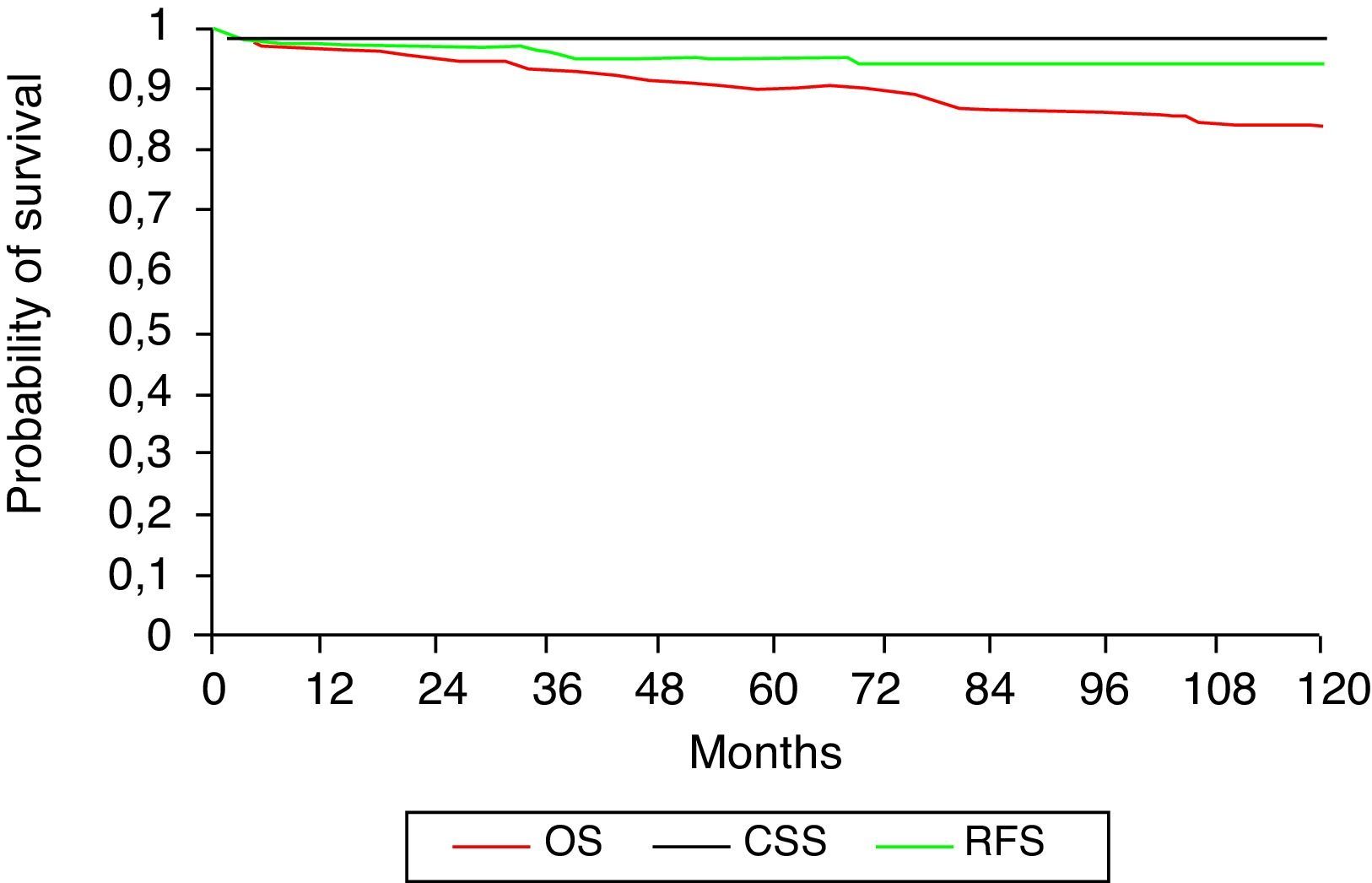
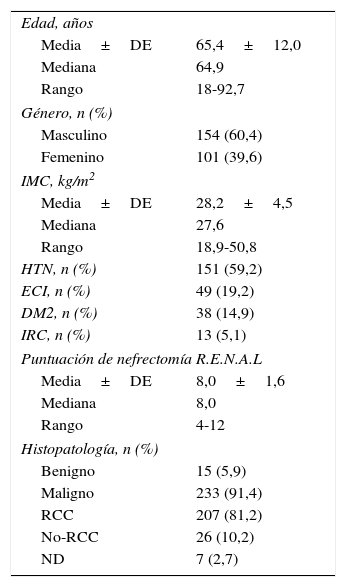
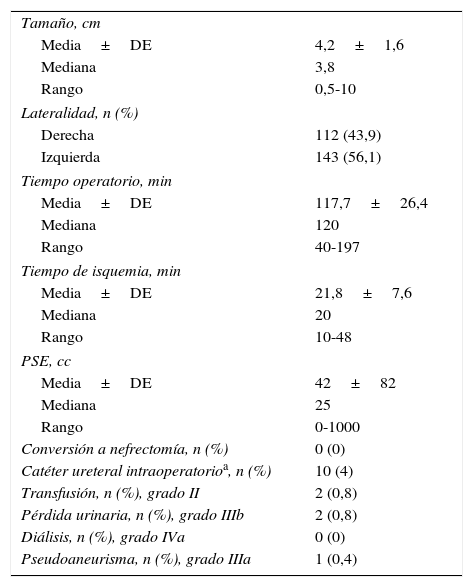
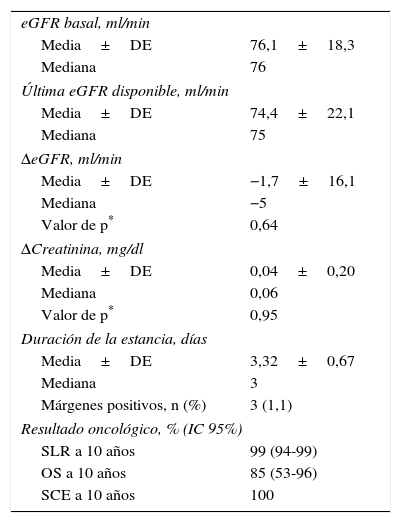
ResultadosLa media de edad de los pacientes fue de 65,4 años. El 5,1% de los pacientes tenía insuficiencia renal crónica preoperatoria. El diámetro medio de la masa renal fue de 4,2±1,6cm y la puntuación media de nefrometría R.E.N.A.L fue 8,0±1,6. El tiempo medio de isquemia fue 21,8±7,6. La pérdida de sangre media estimada fue de 42±82ml, y solo 2 pacientes requirieron transfusión de sangre. Se registraron pérdida de orina y pseudoaneurisma en 2 pacientes y en uno, respectivamente. Ninguna de las operaciones se convirtió a nefrectomía radical. El cambio medio entre la eGFR postoperatoria y preoperatoria (Δ=–1,7ml/min) fue insignificante en un seguimiento medio de 30,1±29,6 meses. La tasa de supervivencia libre de recurrencia a 10 años fue del 99%, y la tasa de supervivencia global a 10 años fue del 85%.
ConclusionesEl uso de BioGlue® para hemostasia después de CCN es una alternativa factible y segura a la sutura clásica. Su uso permite un resultado funcional satisfactorio y podría reducir potencialmente el tiempo de isquemia.
To report the results of the use of Bovine Serum Albumin-Glutaraldehyde tissue adhesive (BioGlue®) for tumor bed closure in open nephron-sparing surgery (NSS).
Materials and methodsThe cohort included 255 patients with enhancing renal mass who underwent open NSS. We used open flank approach, with in-situ hypothermia and enucleation of the tumor. For tumor bed closure, we used the BioGlue® sealant for tumor bed filling, without suturing the edges.
ResultsMean patients’ age was 65.4 years. 5.1% of patients had pre-operative chronic renal failure. Mean renal mass diameter was 4.2±1.6cm and mean R.E.N.A.L nephrometry score was 8.0±1.6. Mean ischemia time was 21.8±7.6. Mean estimated blood loss was 42±82ml and only two patients required blood transfusion. Urine leak and pseudo-aneurysm were recorded in two and one patient, respectively. None of the operations were converted to radical nephrectomy. The average change between post-operative and pre-operative eGFR (Δ=–1.7ml/min) was insignificant in a mean follow-up of 30.1±29.6 months. The 10-year recurrence-free survival rate was 99% and the 10-year overall survival rate was 85%.
ConclusionsThe use of BioGlue® alone for hemostasis after NSS is a feasible and safe alternative to classical suturing. Its use enables satisfactory functional outcome and could potentially reduce ischemia time.