


metricas
covid
Acta Otorrinolaringológica Española Impact of chronic rhinosinusitis with nasal polyps on Eustachian tube dysfunctio...
Journal Information
Vol. 76. Issue 4.
(July - August 2025)
Visits
5
Vol. 76. Issue 4.
(July - August 2025)
Original article
Impact of chronic rhinosinusitis with nasal polyps on Eustachian tube dysfunction
Impacto de la rinosinusitis crónica con pólipos nasales en la disfunción de la trompa de Eustaquio
Visits
5
Francisco Javier García-Callejoa,
Corresponding author
otorrinolaringologo65@gmail.com

Corresponding author.
, Miguel Juantegui-Azpilicuetaa, María Díaz-Ferrerb, Pablo Tiziano Guastella Almeidac, John Deiver Cardona Henaoc
a Servicio Otorrinolaringología, Hospital General de Requena, Requena, Valencia, Spain
b Servicio de Alergología, Hospital general de Requena, Valencia, Spain
c Servicio de Anatomía Patológica, Hospital General de Requena, Requena, Valencia, Spain
This item has received
Article information
Abstract
Full Text
Bibliography
Download PDF
Statistics
Figures (1)
Tables (7)
Table 1. Diagnostic criteria for eosinophilic otitis media described by Iino et al. in 2011. A case is described if it meets one major criterion and two or more minor criteria. Exclusion criteria include Churg-Straus syndrome and hypereosinophilic syndrome.
Tables
Table 2a. Description of the staging tables: 2a.- Eustachian Tube Dysfunction Questionnaire-7 (ETDQ-7), with questions about personal impressions for each of the 7 items. Each response scores from 1 (the mildest sensation) to 7 (the most severe). The scale scores from 7 to 49.
Tables
Table 2b. Lund-Mackay staging to assess the tomographic severity of CRS by the presence of disease in each paranasal sinus and osteomeatal complex of each nasal fossa. The scale scores proportionally to the radiological severity from 0 to 24.
Tables
Table 2c. Lildholdt staging scale for the observation of nasal polyps by endoscopy. Scored from 0 to 3.
Tables
Table 2d. Lund-Kennedy CRSwNP staging scale based on nasal endoscopic findings, with measurements in each nostril. The scale scores proportionally according to clinical-endoscopic severity from 0 to 20.
Tables
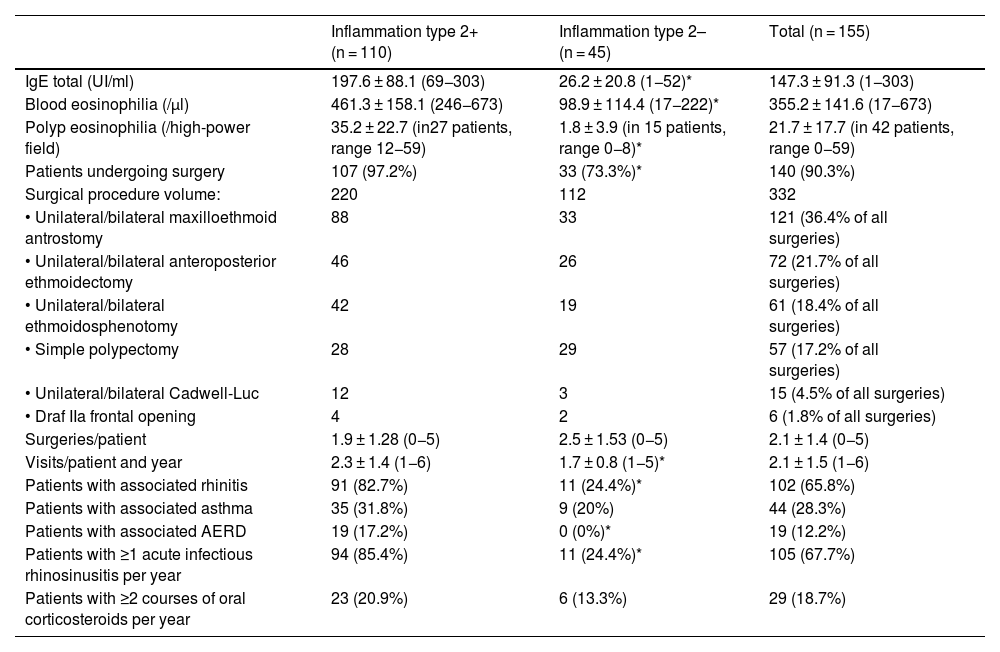
Table 3. Clinical-epidemiological characteristics of patients with CRSwNP considered according to whether or not they showed a type 2 inflammatory profile (*P < .001).
Tables
Table 4. Variation in each of the scales and questionnaires in patients with pre- and postoperative CRSwNP and comparative analysis of the findings suggestive of tubal dysfunction considered according to whether or not they showed a type 2 inflammatory profile (longitudinal statistical significance +P < .001; cross-sectional statistical significance *P < .001 and **P < .01).
Tables
Show moreShow less
Abstract
Introduction

Adequate nasal patency has been classically considered a crucial factor in middle ear ventilation. We valued the influence of nasosinusal polyposis on Eustachian tube (ET) function.

Material and methods

A prospective follow-up with all cases of chronic rhinosinusitis with nasal polyps (CRSwNP) assisted between January 2019 and October 2024 was carried out. Their endoscopic, radiological and clinical characteristics were noted, as well as the presence of a type 2 inflammation context (T2I) and the incidence of middle ear pathology. Polypoid involvement and tubal dysfunction were studied using several scores: Lidholdt’s scale, Lund-McKay nasal polyp grading, Lund-Kennedy endoscopic scoring system, SNOT-22 and Eustachian Tube Dysfunction Questionnaire-7 (ETDQ-7) score.

Results

Information was collected from 155 patients, with an incidence of 15,1 cases/100,000 inhabitants. 70,9% showed an T2I profile. This group showed a higher average of cases with acute otitis media and effusion (18,1% vs. 4,4%; P < .001), tympanometric alterations (12,7% vs. 4,4%; P < 0.01), conductive hearing loss (17,2%. vs 4,4%; P < 0.001) and needing for transtympanic drains (9,1% vs. 2,2%; P < .01) than the group without an eosinophilic profile or elevated IgE. The ETDQ-7 score correlated well with the SNOT-22 and Lund-Kennedy scales.

Conclusions

Regression analysis revealed that an T2I profile might play a more important role in tubal patency than nasal obstruction. Polyposis may alter ET function, but more likely due to its inflammatory-allergic aetiopathogenesis than to its obstructive nature.

Keywords:
Eustachian tube dysfunction
Chronic rhinosinusitis with nasal polyps
Sinonasal polyposis
Inflammation type 2
ETDQ-7
Resumen
Introduccion

La adecuada permeabilidad nasal ha sido clásicamente considerada factor fundamental en la ventilación del oído medio. Este estudio ha evaluado la influencia de la poliposis nasosinusal en la funcionalidad de trompa de Eustaquio (TE).

Material y metodos

Se efectuó seguimiento prospectivo de todos los casos con rinosinusitis crónica con pólipos nasales (RSCcPN) atendidos entre enero de 2019 y octubre de 2024. Se anotaron sus características endoscópicas, radiológicas y clínicas, si existió un contexto de inflamación tipo 2 (IT2) y la incidencia de patología del oído medio detectada. La afectación polipoidea y la disfunción tubárica se estudiaron mediante las escalas de Lidholdt, Lund-McKay, Lund-Kennedy, SNOT-22 y Eustachian Tube Dysfunction Questionnaire-7 (ETDQ-7).

Resultados

Se recogió información de 155 pacientes, con una incidencia de 15,1 casos/100.000 habitantes. El 70,9% presentó un perfil IT2. Este grupo mostró un mayor porcentaje de casos con otitis media aguda y serosa (18,1% vs. 4,4%; P < ,001), alteraciones timpanométricas (12,7% vs. 4,4%; P < ,01), hipoacusia conductiva (17,2% vs. 4,4%; P < ,001) y necesidad de drenajes transtimpánicos (9,1% vs. 2,2%; P < ,01) que el grupo sin perfil eosinofílico ni IgE elevada. La puntuación del ETDQ-7 se correlacionó bien con el SNOT-22 y la escala de Lund-Kennedy.

Conclusiones

El análisis de regresión reveló que el perfil IT2 podría desempeñar un papel más importante en la permeabilidad tubárica que la obstrucción nasal. La poliposis puede alterar la función de la TE, pero probablemente se deba más a su etiopatogenia alérgica-inflamatoria que a su naturaleza obstructiva.

Palabras clave:
Disfunción de la trompa de Eustaquio
Rinosinusitis crónica con pólipos nasales
Poliposis nasosinusal
Inflamación tipo 2
ETDQ-7

Article

These are the options to access the full texts of the publication Acta Otorrinolaringológica Española
Subscriber
Subscriber

If you already have your login data, please click here .

If you have forgotten your password you can you can recover it by clicking here and selecting the option “I have forgotten my password”
Subscribe
Subscribe to

Acta Otorrinolaringológica Española

Purchase
Purchase article

Purchasing article the PDF version will be downloaded

Purchase now
Contact
Phone for subscriptions and reporting of errors
From Monday to Friday from 9 a.m. to 6 p.m. (GMT + 1) except for the months of July and August which will be from 9 a.m. to 3 p.m.
Calls from Spain
932 415 960
Calls from outside Spain
+34 932 415 960
E-mail
Article options
Tools