



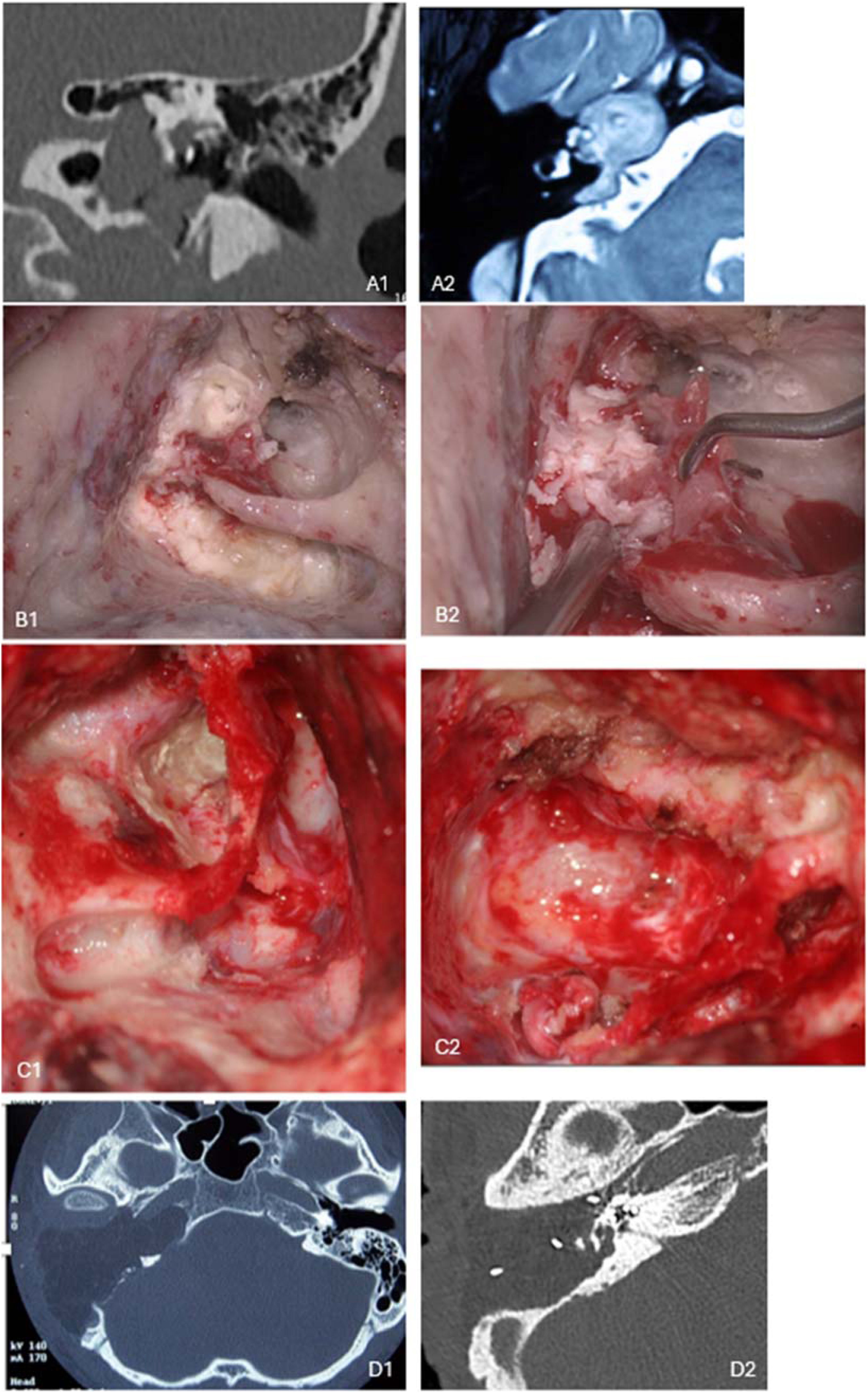


Petrous bone cholesteatoma (PBC) is a rare, potentially life-threatening condition requiring surgical management to prevent severe complications. While classification systems, such as Sanna’s, are widely used to guide surgical planning, actual decision-making is often influenced by additional clinical factors beyond lesion type.
Material and methodsA retrospective analysis of 94 PBCs in 92 patients operated between 1995 and 2024 was conducted. Data included demographics, clinical presentation, PBC classification, surgical approach, use of endoscopic assistance, recurrence, follow-up, and hearing rehabilitation. The aim of this study is to describe the surgical strategies applied to different PBC types in a series of 94 cases, evaluate the practical utility of classification systems, and propose a decision-making approach based on inner ear involvement and other critical factors
ResultsThe most common PBC type was supralabyrinthine (40.43%), followed by massive (18.09%) and retrolabyrinthine-infralabyrinthine (11.7%). A total of 102 surgeries were performed using various approaches, including modified translabyrinthine (24.51%), subtotal petrosectomy (22.55%), and transotic approach (18.63%). Endoscopic assistance was used in 11 cases. Recurrence occurred in 8.51% of cases, with a median follow-up of 48.5 months. Cochlear implantation was used in 8 patients and bone conduction implants in 3.
ConclusionsPBC classification provides valuable insights for understanding lesion behavior and planning surgery, but it is insufficient alone for determining the optimal surgical approach. Decisions must be individualized, considering hearing status, inner ear and facial nerve involvement, contralateral ear function, lesion extension, and anatomical factors. A classification-based strategy complemented by these considerations ensures safer and more effective management of PBC.
El colesteatoma intrapetroso (CIP) es una patología rara y potencialmente mortal que requiere de un manejo quirúrgico para prevenir complicaciones severas. Aunque se utilizan ampliamente sistemas de clasificación, como el de Sanna, para guiar la planificación quirúrgica, la toma de decisiones en la práctica se ve a menudo influenciada por factores clínicos adicionales más allá del tipo de lesión.
Material y métodosSe realizó un análisis retrospectivo de 94 CIP en 92 pacientes operados entre 1995 y 2024. Los datos incluyeron aspectos demográficos, presentación clínica, clasificación del PBC, abordaje quirúrgico, uso de asistencia endoscópica, recurrencias, seguimiento y rehabilitación auditiva. El objetivo de este estudio es describir las estrategias quirúrgicas aplicadas a los distintos tipos de CIP en una serie de 94 casos, evaluar la utilidad práctica de los sistemas de clasificación y proponer un enfoque de toma de decisiones basado en la implicación del oído interno y otros factores críticos.
ResultadosEl tipo de CIP más común fue el supralabiríntico (40.43%), seguido por el laberíntico masivo (18.09%) y el retrolabiríntico-infralabiríntico (11.7%). Se realizaron un total de 102 cirugías utilizando diversos abordajes, incluyendo el translaberíntico modificado (24.51%), la petrosectomía subtotal (22.55%) y el abordaje transótico (18.63%). En 11 casos la intervención se realizó con apoyo endoscópico. Un 8.51% de los casos presentaron recurrencia de la enfermedad, con una mediana de seguimiento de 48.5 meses. En 8 pacientes se realizó una implantación coclear, mientras que en 3 pacientes se utilizaron implantes de conducción ósea.
ConclusionesLa clasificación de los CIP ofrece información valiosa para entender el comportamiento de estas lesiones y planificar la cirugía, pero por sí sola no es suficiente para determinar el abordaje quirúrgico óptimo. Las decisiones deben individualizarse, considerando el estado auditivo, la implicación del oído interno y el nervio facial, la función del oído contralateral, la extensión de la lesión y factores anatómicos. Una estrategia basada en la clasificación, complementada por estas consideraciones, garantiza un manejo más seguro y eficaz del CIP.
