




Meningoencephalic herniation (MEH) of the temporal bone is a rare but potentially life-threatening condition that may lead to meningitis, encephalitis, cerebral abscess, or epilepsy. Its incidence appears to be increasing, particularly in spontaneous cases, which are frequently multifocal and associated with obesity and benign intracranial hypertension.
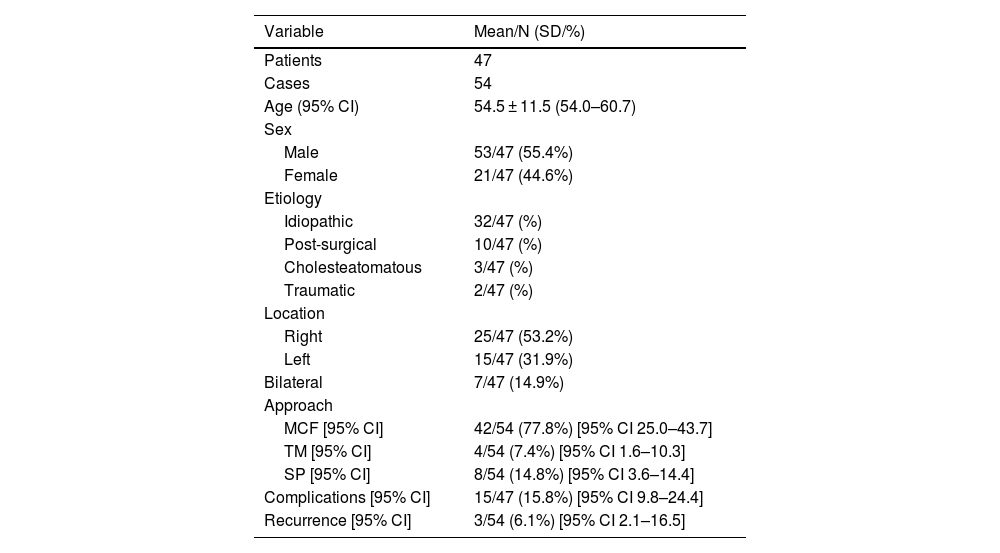
Materials and methodsA retrospective review was performed of 88 patients (95 cases) surgically treated for MEH at a tertiary referral center between January 2000 and February 2023. Inclusion criteria were intraoperatively confirmed MEH and a minimum follow-up of six months. Data collected included demographics, aetiology, surgical approach, symptoms, otoscopic findings, body mass index (BMI), imaging, complications, recurrences, and audiometric outcomes.
ResultsThe cohort comprised 35 females and 53 males, aged 22–78 years (mean 54.5). Seven patients had bilateral MEH. Aetiology was idiopathic in 46 patients, post-surgical in 29, cholesteatomatous in 10, and traumatic in 3. Surgical approaches included middle cranial fossa (57 patients), transmastoid (21), and subtotal petrosectomy (17). Hearing loss was the most common symptom (22 patients), followed by ear fullness (18), otorrhea (17), and meningitis (16). Life-threatening manifestations occurred in 34.5% of cases. Complications were reported in 11 patients, all transient or medically managed. Mean BMI was 30 (range 21–44); all patients with BMI > 34.99 had idiopathic MEH. Multiple hernias were strongly associated with idiopathic origin. No recurrences were observed.
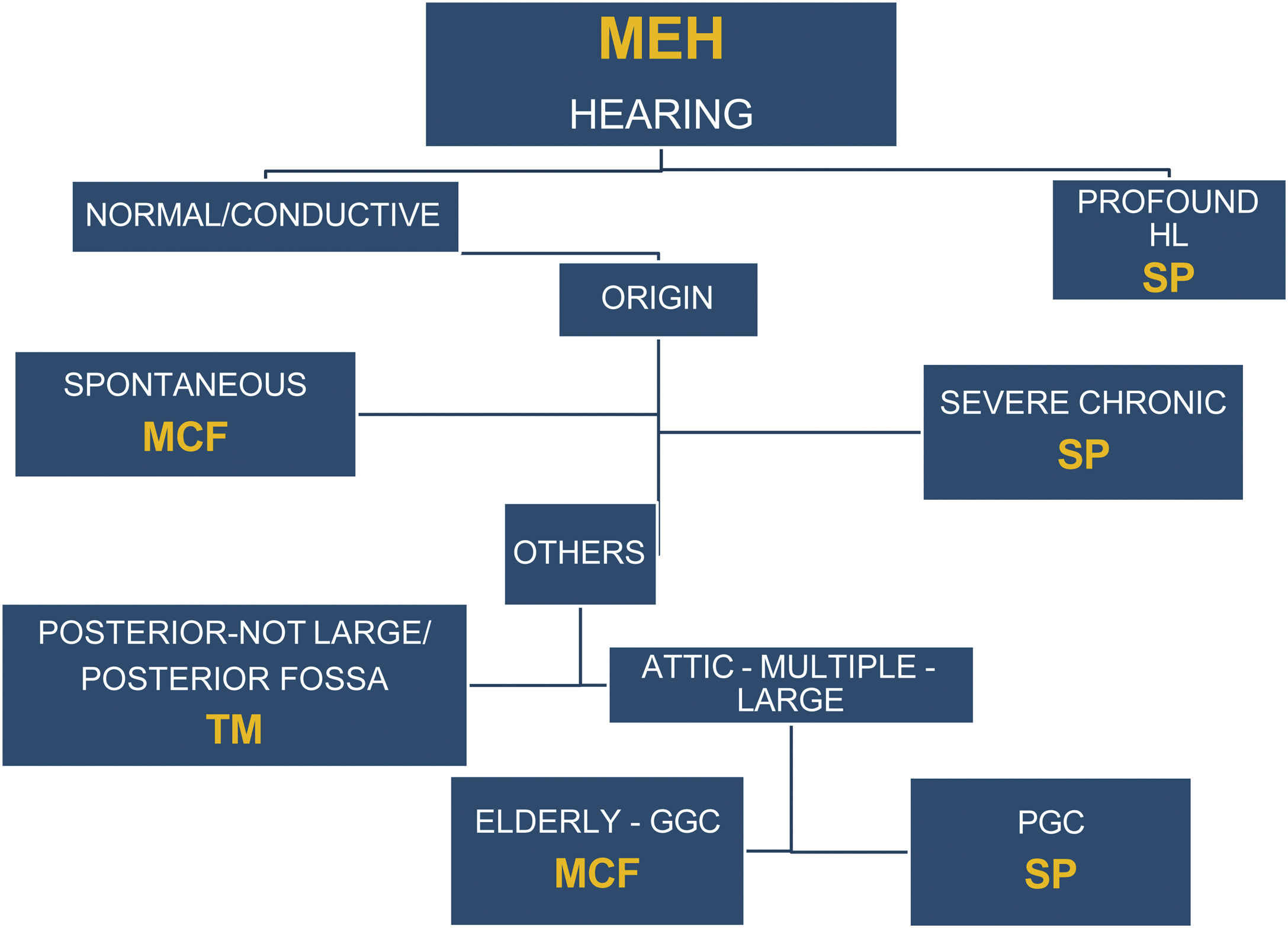
DiscussionSurgical repair is indicated in all confirmed cases of meningoencephalic herniation to prevent intracranial complications. The selection of approach is guided by hearing status, location, and aetiology. The middle cranial fossa approach is preferred in most spontaneous or multifocal cases, whereas subtotal petrosectomy is reserved for non-serviceable hearing or poor general condition. The transmastoid approach is suitable for isolated defects in the tegmen antri. Autologous grafts remain the gold standard for reconstruction.
ConclusionsThe rising incidence of spontaneous MEH highlights the need for tailored surgical strategies. We present one of the largest surgical series of MEH to date and confirm that a tailored surgical strategy is essential for achieving successful outcomes. Our data support an algorithm based on hearing status and aetiology to optimize outcomes while minimizing complications.
La hernia meningoencefálica (HME) del hueso temporal es una entidad poco frecuente pero potencialmente mortal, que puede dar lugar a meningitis, encefalitis, abscesos cerebrales o epilepsia. Su incidencia se encuentra en aumento, especialmente en los casos espontáneos, que suelen ser multifocales y se asocian con obesidad e hipertensión intracraneal benigna.
Material y métodosSe realizó una revisión retrospectiva de 88 pacientes (95 casos) tratados quirúrgicamente por HME en un centro de referencia terciario entre enero de 2000 y febrero de 2023. Los criterios de inclusión fueron HME confirmada intraoperatoriamente y un seguimiento mínimo de seis meses. Se recogieron datos sobre demografía, etiología, abordaje quirúrgico, síntomas, otoscopia, índice de masa corporal (IMC), hallazgos radiológicos, complicaciones, recurrencias y resultados audiométricos.
ResultadosLa muestra está compuesta por 35 mujeres y 53 varones, con edades entre 22 y 78 años (media 54,5). Siete pacientes presentaron HME bilateral. La etiología fue idiopática en 46 pacientes, postquirúrgica en 29, colesteatomatosa en 10 y traumática en 3. Los abordajes quirúrgicos incluyeron fosa craneal media (57 pacientes), transmastoideo (21) y petrosectomía subtotal (17). La hipoacusia fue el síntoma más frecuente (22 pacientes), seguida de plenitud ótica (18), otorrea (17) y meningitis (16). Manifestaciones potencialmente mortales se observaron en el 34,5% de los casos. Se registraron complicaciones en 11 pacientes, todas transitorias o controladas médicamente. El IMC medio fue de 30 (rango 21–44); todos los pacientes con IMC > 34,99 presentaban HME idiopática. La presencia de múltiples hernias se asoció fuertemente con origen idiopático. No se observaron recurrencias.
DiscusiónLa reparación mediante cirugía es necesaria en todos los casos confirmados de HME para evitar comlicaciiones intracraneales. La seleccion del abordaje dependerá del nivel de audición, de la localizaci´on y de la etiología. El abordaje por fosa craneal media es preferido en la mayoría de los casos espontáneos o multifocales, mientras que la petrosectomía subtotal se reserva para pacientes con audición no útil o mal estado general. El abordaje transmastoideo es adecuado para defectos aislados del tegmen antri. Los injertos autólogos siguen siendo el gold standard para la reconstrucción.
ConclusionesEl incremento de la incidencia de HME espontánea pone de manifiesto la necesidad de estrategias quirúrgicas individualizadas. Nuestra amplia serie respalda un algoritmo basado en la situación auditiva y la etiología, con el fin de optimizar los resultados y minimizar las complicaciones.
