



metricas

Revista de Psicodidáctica (English Edition)

Suggestions
Revista de Psicodidáctica (English Edition) Moral courage and defending behaviors in the face of bullying: A longitudinal st...
Journal Information
Visits
420
Vol. 31. Issue 1.
(January - June 2026)
Original
Full text access

Moral courage and defending behaviors in the face of bullying: A longitudinal study with Primary and Secondary School students

Coraje moral y conductas de defensa ante el acoso escolar: un estudio longitudinal con escolares de Educación Primaria y Educación Secundaria
Visits
420
Paula García-Carrera, Rosario Ortega-Ruiz, Antonio Camacho, Eva M. Romera
Corresponding author
eva.romera@uco.es

Corresponding author.
Universidad de Córdoba, Spain
This item has received
Article information
Abstract
Full Text
Bibliography
Download PDF
Statistics
Figures (2)
fig0005
fig0010
Tables (3)
Table 1. Descriptive statistics and bivariate correlations
Tables
Table 2. Differences by gender and educational stage
Tables
Table 3. Fit indices for measurement invariance by gender and educational stage
Tables
Show moreShow less
Additional material (1)
Abstract

While defending victims is recognized as a key behavior in anti-bullying interventions, the specific role of moral courage in its activation needs to be explored using a longitudinal approach. This study analyzes the association of moral courage with different forms of defense against peer harassment, as well as the possible moderating effect of gender and educational stage. The sample was composed of 540 schoolchildren in grades 5 and 6 (primary education) and grades 7 through 9 (lower secondary education) (53% girls; Mage = 12.6, SD = 1.5), who reported having witnessed situations of bullying in recent months. Using a structural equation model with multigroup analysis, the relationship between moral courage and four forms of defensive behavior were examined: comforting the victim, reporting to authority, employing solution-focused strategies, and aggressively defending the victim. Moral courage showed positive and significant associations with prosocial behaviors (comforting, reporting, and problem-solving), but not with aggressive defense in the overall model. However, the multigroup analysis revealed differential effects: moral courage was associated with aggressive defense by boys and students in primary education, and its influence on comforting the victim was greater in primary education than at the secondary level. These findings underscore the relevance of moral courage as an engine of prosocial action, shaped by developmental and contextual variables.

Keywords:
Moral cognition
Defending behaviours
Gender
Educational stage
Multi-group model
Resumen

Si bien la defensa de las víctimas se reconoce como un comportamiento clave en la intervención contra el acoso escolar, el papel específico del coraje moral en su activación requiere ser explorado desde un enfoque longitudinal. El presente estudio analiza la asociación del coraje moral con las distintas formas de defensa ante el acoso entre iguales, así como el posible efecto moderador del género y la etapa educativa. La muestra ha estado compuesta por 540 escolares de 5.º y 6.º de Educación Primaria y de 1.º a 3.º de Educación Secundaria (53% chicas; Medad = 12.6, DT = 1.5), que han afirmado haber presenciado situaciones de acoso escolar en los últimos meses. Mediante un modelo de ecuaciones estructurales con análisis multigrupo, se ha examinado la relación entre el coraje moral y cuatro formas de conducta defensiva: consolar a la víctima, informar a figuras de autoridad, emplear estrategias centradas en la solución y defender agresivamente. El coraje moral ha mostrado asociaciones positivas y significativas con las conductas prosociales (consolar, informar y solucionar), pero no con la defensa agresiva en el modelo general. Sin embargo, el análisis multigrupo ha revelado efectos diferenciales: el coraje moral se ha asociado con la defensa agresiva en chicos y en estudiantes de Educación Primaria, y su influencia sobre el consuelo a la víctima ha sido mayor en Educación Primaria que en Educación Secundaria. Estos hallazgos subrayan la relevancia del coraje moral como motor de la acción prosocial, condicionado por variables evolutivas y contextuales.
Palabras clave:
Cognición moral
Comportamientos de defensa
Género
Etapa educativa
Modelo multigrupo
Full Text
Introduction

Bullying is defined as an immoral, interactive phenomenon of an aggressive-violent nature that occurs within the framework of a group communication system that favors an imbalance of power and undermines ethical decision-making (Ortega-Ruiz et al., 2016). This globally prevalent problem has serious consequences for the mental health and well-being of children and adolescents (Van Geel et al., 2018). Internationally, the Health Behaviour in School-aged Children (HBSC) study (Cosma et al., 2024) indicates that 11% of European students have suffered frequent bullying and 6% have perpetrated it, with bullying being more common among boys. According to UNICEF (Andrade et al., 2021), 33.6% of students in Spain have suffered victimization, although only 19.9% met the criteria for bullying. Díaz-Aguado et al. (2023) reported a prevalence of 6.2% for victims and 2.1% for perpetrators, with higher rates in primary education and among boys. In addition, 16.3% of students report having frequently witnessed bullying.

Bullying remains within a complex group dynamic in which not only victims and aggressors participate, but also witnesses, who can adopt different patterns of behavior in situations of bullying (aggressor enablers, passive observers, or defenders of victims) (Salmivalli, 2010). Several studies have highlighted that interventions by these witnesses, especially through defensive behaviors, can significantly contribute to reducing the incidence of bullying and mitigating its effects on victims, thus promoting a safer and fairer school environment (Truskauskaitė-Kunevičienė et al., 2020).

Students who defend victims of abuses of power by peers are, in most cases, aware of the personal risks they run by intervening. This is particularly true when the aggressor is of high social status (Baumert et al., 2020), such that it may require high levels of moral courage for people to take prosocial action despite the costs associated with defensive action to protect victims (O’Connell et al., 2024). Factors such as educational stage and gender can moderate the expression of moral courage and defensive behaviors. The transition from childhood to adolescence entails greater reflection on the personal consequences of intervening (Pury et al., 2014), while gender differences, affected by developmental and socialization patterns, can affect the student’s predisposition towards certain forms of intervention (Rogers et al., 2017). This study seeks to improve our understanding of moral courage and its relationship to victim defending behaviors in the context of bullying. Understanding the variables that promote the transition from good intentions to action is especially necessary to inform the designs of prevention programs that seek to encourage bullying victim defending behaviors and improve coexistence at schools.

Moral courage and defending behaviors

The relationship between moral courage and defense of victims requires taking into account the different forms of victim support, which can be direct or indirect, given that the social risks taken are different and can affect the type of defense response that schoolchildren adopt. Moral courage is identified as a type of deliberate moral action in which the person recognizes the need to act in the face of injustice, even if they are aware of the personal or social risks associated with it (Dungan et al., 2019). It differs from other forms of courage, such as physical or psychological, in that it involves acting in accordance with ethical values or moral principles, despite the risk of suffering negative consequences, such as social rejection or group sanction (Osswald et al., 2010). While physical courage is associated with overcoming fear in the face of physical danger, and psychological courage with facing internal challenges, such as anxiety or trauma, moral courage is activated by the perception of injustices that violate the well-being of others, and demands a moral response that, although costly, is based on ethics of care (Dungan et al., 2019).

Previous studies have found that the defense of bullying victims requires the activation of moral courage precisely because of the visible and confrontational nature of this type of prosocial behavior, which means that its social costs have a high personal impact (Pouwels et al., 2019). However, these studies identify defense as a behavior consisting of direct confrontation with the aggressor, ignoring the multidimensionality of the construct, which encompasses both direct and indirect forms (Lambe et al., 2017; Wang et al., 2023). Direct forms of defense range from assertive and solution-focused responses, which seek to constructively intervene in the bullying situation, to manifestations of aggressive defense, characterized by an impulsive and reactive confrontation of the aggressor (Lambe & Craig, 2020). Indirect defense strategies involve seeking help from authority figures or providing emotional support to the victim, standing out for their potential to mitigate the impact of harassment without involving an explicit confrontation of the aggressor (Laninga-Wijnen et al., 2023), the former strategies favoring perceptions of collective support in victims, fostering their resilience and well-being (Wu, 2019).

Studies suggest that different forms of victim defense—direct and indirect, pro-social and aggressive—have different social costs. Direct defense is inherently riskier than indirect defense, as the aggressor typically possesses greater power and social dominance, placing defenders under greater pressure (Reijntjes et al., 2016). A recent meta-analysis shows that direct defense is more positively associated with the risk of victimization, particularly aggressive defense, precisely because of its combative and challenging nature, which increases the risk of retaliation (Tian et al., 2025). However, indirect defending behaviors are not devoid of social costs, since intervening, even indirectly, can also impact social acceptance and status within the group (Pronk et al., 2020). The literature suggests that people consider these costs when deciding whether to intervene, and how to do so, and that moral courage tends to be activated more when the costs of acting are high, since facing those consequences requires greater determination (Osswald et al., 2010). This is why moral courage can influence both direct and indirect defense, albeit in differentiated ways. In the case of direct defense, moral courage can boost willingness to face retaliation and social pressure, allowing for open and determined intervention on behalf of the victim. In contrast, in indirect defense, moral courage triggers less visible strategies, such as seeking support from authority figures, or comforting the victim, which makes it possible to reduce exposure to personal risks while still acting to oppose injustice (Pronk et al., 2019).

Although there are some longitudinal studies, such as those by Bronstein et al. (2007) and Nocentini et al. (2020), that have begun to explore how these decisions are initiated and developed when it comes to intervening in situations of bullying, most of the previous studies carried out feature cross-sectional designs (Barhight & Hubbard, 2013; Kollerová et al., 2014), which points to the need to address the temporal association between moral courage and different types of victim defense.

Age and gender

The development of moral courage and defending behaviors can vary with age and gender, which is consistent with the evolution of aggression and, specifically, bullying. During the primary education stage (from approximately 6 to 12 years old), initial progress is observed in the internalization of principles of justice and equity, which fosters a greater willingness to intervene in situations of injustice (Malti et al., 2020). However, this development is incipient, and students are often influenced by factors such as insecurity and the search for social acceptance, which limit the active manifestation of their moral courage in the form of defensive behaviors (Pury et al., 2014). In this stage interventions are usually more sporadic and marked by a fear of rejection or making mistakes in their moral judgments (Shaw et al., 2014). In the secondary education stage (from approximately 12 to 18 years old), adolescents develop a greater capacity for moral reflection and autonomous decision-making. These skills allow them to grapple with more complex moral dilemmas and assess the risks associated with their actions in greater depth (Gingo, 2017). However, peer pressure and the need for acceptance exert a greater influence, particularly in contexts where intervening can put their social status at risk or generate interpersonal conflicts (Eisenberg et al., 2015).

Regarding gender, developmental differences and socialization processes are important in the expression of moral courage. Girls, characterized by higher levels of empathy, care and cooperation, tend to show a greater proclivity towards defense, especially in indirect forms, such as emotional support for the victim or seeking help from adults (Bondü et al., 2016). In the case of boys, who present a greater biological predisposition towards aggression and confrontation in conflicts (Archer, 2004; Björkqvist, 2018), in addition to being immersed in a socialization process that reinforces values of competitiveness, independence and resilience, there is a tendency to inhibit prosocial behaviors that may be perceived as violating traditional norms of masculinity (Rudman & Glick, 2008). However, in situations where moral demands are particularly evident, or where the context favors collective interventions, boys and girls may challenge these norms and engage in defensive behaviors in their different forms (Rogers et al., 2017).

The present study

This study aimed to examine the longitudinal effect of moral courage on the different types of defending behaviors in response to unjustified aggression suffered by victims of bullying, considering the possible moderating role of gender and the educational stage. Based on a review of the previous literature, two hypotheses were proposed: (1) higher levels of moral courage are positively associated with both direct and indirect defending behaviors; particularly those that involve a greater perceived social cost, these being ones of direct defense, and (2) that these associations vary by gender and educational stage. Specifically, moral courage is expected to be more strongly associated with defensive behavior in girls (Hypothesis 2a) and primary school students (Hypothesis 2b). In both groups, defensive actions, though often less visible, may entail substantial social costs due to heightened relational sensitivity and the pressure to preserve peer group cohesion.

MethodParticipants

The initial sample of the study included 3784 students, ages 10 to 17, attending 5th and 6th grade (primary education) and 7th to 9th grade (compulsory secondary education) (48% girls, Mage = 12.6, SD = 1.5, 48% primary schools and 52% secondary schools) in the province of Cordoba. This longitudinal study was conducted in two waves over a period of 12 months. The first wave was conducted in May 2022 (Q1) and recruited a total of 2928 students. The second was carried out in May 2023 (Q2) with participation by 3059 schoolchildren. For the analyses conducted in this study, a specific sub-sample was selected consisting of 18% of the participants in T2 who reported having witnessed situations of bullying in recent months. This final subsample includes 540 students (53.2% girls; 53.9% secondary education). The loss of participants was due to a change of school or absence during data collection. To evaluate the impact on the data lost in the longitudinal analytical sample with respect to the total one, a logistic regression was performed. No significant differences were found between students who participated in both waves and those who participated in only one across the study variables (ps > .05).

Instruments

The Moral Courage Scale was designed specifically for this study to assess the degree to which students, after acknowledging an unfair situation, attempt to intervene to defend the victim. The scale measures participants’ willingness to act in defense situations, considering social costs (e.g., I would defend a victim of harassment, even if I knew it would not benefit me), relationship with the victim (e.g., I would defend someone who is being mocked, talked about, or treated unfairly, even if they were just an acquaintance), and the transgression of social norms (e.g., I would defend a victim in a bullying situation, even if most people did not support me). The scale consists of 6 items, answered on a five-point Likert scale (1 = strongly disagree, 5 = strongly agree). The internal consistency was adequate in the present sample (α = .82, ω = .79, ρc = .83). Confirmatory factor analysis showed good psychometric properties: χ2 = 185.334, df = 9, p < .001; CFI = .983, TLI = .972, RMSEA = .098, 90% CI [.086, .110] and SRMR = .027.

The Defending Behavior Scale (DBS) (Lambe & Craig, 2020) was used to measure the schoolchildren’s defending behaviors. The original scale was translated into Spanish and then translated back into English following the established back translation procedure (Brislin, 1986) (see Appendix with translated items). Before completing this scale, participants answered a preliminary question about how often they have witnessed situations of victimization, with 0 = indicating that they had not witnessed victimization among peers in the last two months, up to 4 = indicating that they had done so various times a week (Lambe & Craig, 2020). Only those participants who reported having witnessed bullying in recent months (scores greater than 0) completed the DBS. The instrument consists of 18 items to assess four defense subtypes: comforting the victim (five items), reporting to authority (four items), solution-focused (four items), and aggressive (five items). The schoolchildren reported the extent to which they had engaged in each type of defending behavior, using a 5-point Likert scale (1 = strongly disagree, 5 = strongly agree). In this study, the factors of the original scale showed good internal consistency indices: comforting (α = .81, ω = .82, ρc = .86), reporting to authority (α = .78, ω = .84, ρc = .85), solution-focused action (α = .82, ω = .83, ρc = .81), and aggressive action (α = .79, ω = .80, ρc = .80). The mean variance extracted from the subscales (AVE = .46 - .58) exceeded the square correlation between factors (φ2 = .13 - .45). Confirmatory factor analysis showed good psychometric properties of the four-factor structure: χ2 = 570.734, df = 129, p <  .001; CFI = .936, TLI = .924, RMSEA = .102, 90% CI [.094, .111] and SRMR = .070.

Procedure

The study was approved by the Bioethics and Biosafety Committee of the University of Cordoba, Spain. The schools and the participants were selected by non-probabilistic convenience sampling based on the accessibility of the collaborating schools. Data collection was carried out during school hours at the schools, which were informed in detail about the project’s objective. After securing the consent of each school’s administration, the informed consent of the students’ legal guardians was obtained (69 participants were not authorized to participate in the study by their families; 2%). The questionnaires were administered by trained psychologists and educators with research experience. Special emphasis was placed on the voluntary and confidential nature of data collection. Beforehand, the concept of bullying was explained to students in a clear and standardized way, including its essential characteristics (repetition, intentionality, and power asymmetry), distinguishing it from other types of sporadic violence or interpersonal conflicts. Only participants who had reported witnessing situations that met this definition were included in the analyses.

Gender (1 = boy, 2 = girl) and age, for which the “educational stage” indicator was used (1 = primary education, 2 = secondary education) were collected as sociodemographic information to analyze possible differences in variables based on these characteristics. We chose to use the term gender, rather than sex, as the information was provided directly by the students based on their gender identity. Although a third option was offered (3 = other), this category was excluded from the analyses due to its scant representation, which prevented adequate statistical analysis. Educational stage was selected as an indicator instead of age, since this variable classifies more precisely the structural and contextual differences that characterize the educational systems in Spain.

Data analysis

Self-report instruments were used, and their psychometric properties were analyzed, including internal reliability. To this end, reliability was assessed using Cronbach’s alpha (α), McDonald’s omega (ω), and composite reliability (ρc), following the recommendations of Viladrich et al. (2017). Values above .70 were considered acceptable (Geldhof et al., 2014). Likewise, the average variance extracted (AVE) was estimated to examine the external discriminant validity in instruments with multifactorial structures. In these cases, the AVE had to exceed the squared correlations between the factors of the scale (Fornell & Larcker, 1981).

As a preliminary step, students who had obtained scores greater than 0 on the previous Defending Behaviors Scale (DBS) were selected. Cross-tabulations were performed to analyze the association between gender and educational stage in relation to having witnessed victimization, using Pearson’s chi-square test (Satorra & Bentler, 2001). The effect size of the associations was evaluated using Cramer’s V (ϕc), following the criteria of Cramer (1999) for its interpretation: small (ϕc ≈ .10), moderate (ϕc ≈ .30) and large (ϕc ≈ .50), depending on the degrees of freedom on the table. Little’s test for missing data (Little, 2013) revealed that the missing data was random (χ2/df = 1.05, p = .14). Before performing the statistical analyses, compliance with the parametric assumptions of normality and homogeneity of variances was verified by means of the Kolmogorov-Smirnov and Levene tests, respectively. Since the results confirmed that the data met these assumptions, parametric statistical tests were applied Descriptive statistics, independent t-tests between gender and educational stage, and Pearson correlations were used to examine the relationships between the main variables, using the IBM SPSS 20.0 statistical package. The size of the effect of the differences was evaluated using Cohen’s d, categorized into low (d = 0.20), moderate (d = 0.50) and high (d = 0.80) effects (Cohen, 1977). To address the objectives of the study related to the moderating role of gender and educational stage on the effects of moral courage (independent variable in T1) defending behaviors (dependent variables in T2; comforting, reporting to authority, solution-focused, and aggression) a structural equations model (SEM) was developed using the Mplus program, version 8.11 (Muthén & Muthén, 1998-2017). The SEM was evaluated using standard fit indices: the chi-square/degrees of freedom ratio (χ2/df < 3), the root mean square error of approximation (RMSEA < .08), the comparative fit index (CFI > .90), and the Tucker-Lewis Index (TLI > .90) (Chen, 2007), depending on the complexity of the model and the sample size. However, the stricter criteria proposed by Hu and Bentler (1999) were also considered as an additional theoretical reference to strengthen the interpretation and robustness of the fit indices.

The model was estimated using the weighted least squares means and variance adjusted (WLSMV) estimator, to account for the ordinal nature of the data (Muthén & Muthén, 1998–2017). To evaluate the equivalence of the underlying structures of the theoretical model in different subgroups, a multigroup analysis of structural equations (MG-SEM) was used. Following recommendations for multigroup structural equation modeling analyses, measurement invariance was examined across gender and educational stage for the model. This was carried out using a sequence of hierarchical steps, as suggested by Little (2013), in which the parameters of the model were progressively constrained and changes in the fit of the model were compared. Configurational, metric and scalar models were estimated. Measurement invariance was established when at least two of the following criteria were met: (a) change in CFI < .01, (b) change in RMSEA < .015, and (c) chi-square difference test was significant, p < .05 (Chen, 2007; Satorra & Bentler, 2001). Finally, after establishing measurement invariance, the null hypothesis of equality of the effects of moral courage on defending behaviors across gender and educational stage groups was tested using a chi-square Wald test (Muthén & Muthén, 1998–2017).

ResultsPreliminary results

The results of the cross-tabulations indicated that no significant associations were found regarding the presence or absence of bystanders in peer bullying situations by gender (χ2 = 2.23, p = .53) or educational stage (χ2 = 5.61, p = .13). The descriptive statistics and correlations between study variables are presented in Table 1. The results indicate that all four types of defensive behavior are significantly and positively correlated with moral courage.

Table 1.

Descriptive statistics and bivariate correlations

Variables  n  M (SDSkewness  Kurtosis 
Moral courage  464  3.64 (1.02)  −0.49  −0.52  –       
Comforting the victim  514  3.41 (1.09)  −0.31  −0.80  .43***  –     
Reporting to authority  517  3.00 (1.30)  −0.06  −1.22  .34***  .68***  –   
Solution-focused action  522  2.73 (1.17)  0.17  −0.92  .34***  .66***  .67***  – 
Aggressive action  508  2.16 (1.06)  0.83  −0.18  .16***  .37***  .38***  .52*** 

*p <  .05. *** p <  .001.

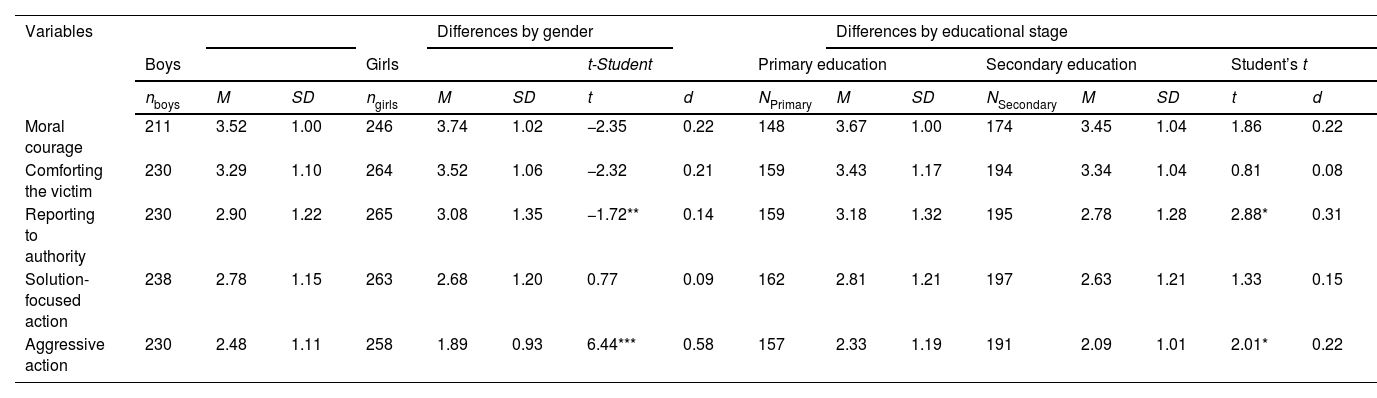
As regards gender differences, the Student’s t-test values indicated that the boys showed a greater disposition towards aggressive defense, with a moderate effect size (Table 2). The girls tended to opt, more than boys, to report incidents to authority figures, with a low effect size. Regarding the educational stage, primary education students scored significantly higher than secondary education students in aggressive defense, with a low effect size.

Table 2.

Differences by gender and educational stage

Variables    Differences by gender    Differences by educational stage
BoysGirlst-StudentPrimary educationSecondary educationStudent’s t
nboys  M  SD  ngirls  M  SD  t  d  NPrimary  M  SD  NSecondary  M  SD  t  d 
Moral courage  211  3.52  1.00  246  3.74  1.02  −2.35  0.22  148  3.67  1.00  174  3.45  1.04  1.86  0.22 
Comforting the victim  230  3.29  1.10  264  3.52  1.06  −2.32  0.21  159  3.43  1.17  194  3.34  1.04  0.81  0.08 
Reporting to authority  230  2.90  1.22  265  3.08  1.35  −1.72**  0.14  159  3.18  1.32  195  2.78  1.28  2.88*  0.31 
Solution-focused action  238  2.78  1.15  263  2.68  1.20  0.77  0.09  162  2.81  1.21  197  2.63  1.21  1.33  0.15 
Aggressive action  230  2.48  1.11  258  1.89  0.93  6.44***  0.58  157  2.33  1.19  191  2.09  1.01  2.01*  0.22 

*p < .05. **p <  .01. ***p < .001.

Predictive capacity of moral courage on defending behaviors

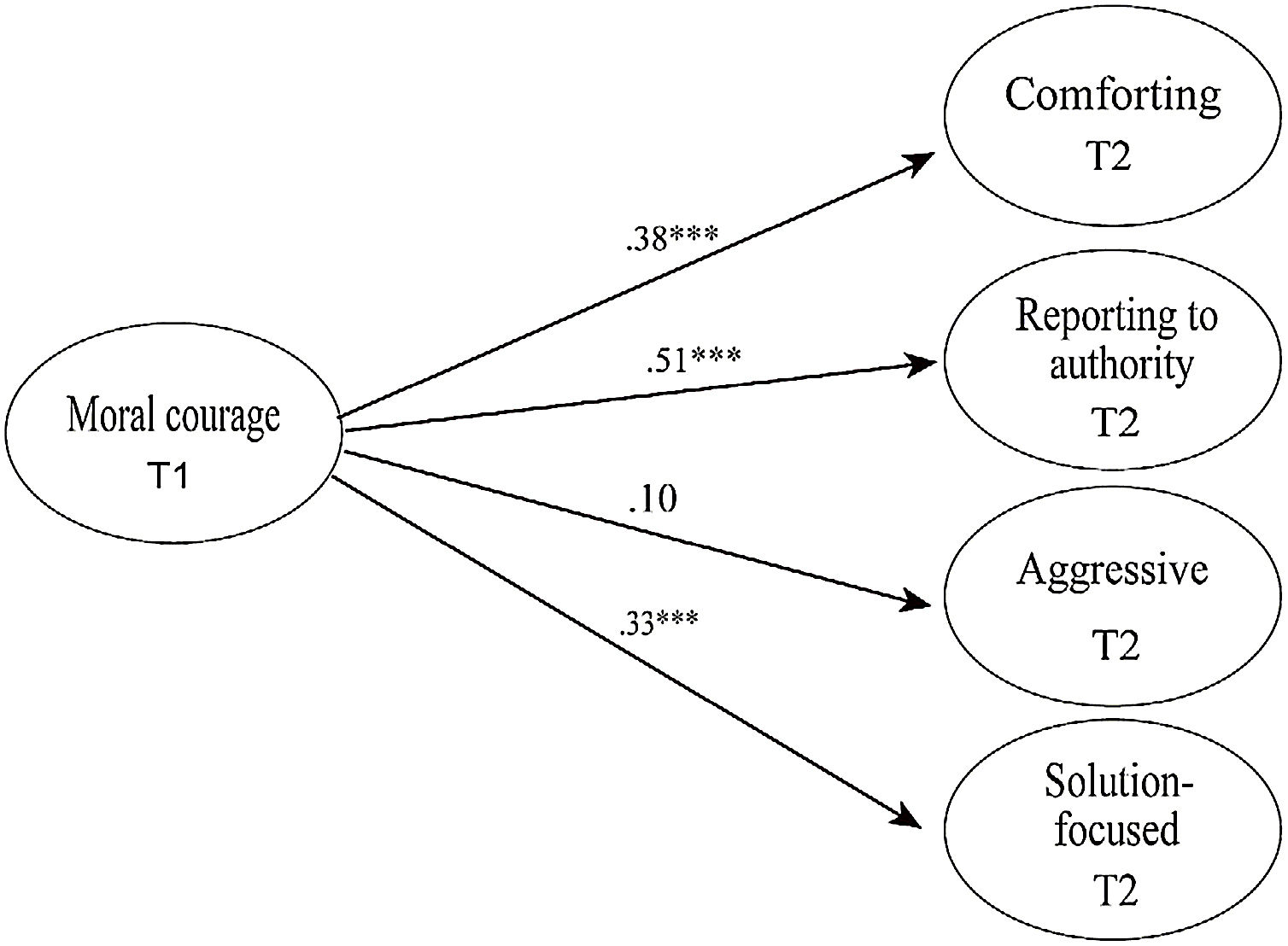
For the analysis of the structural model, all the trajectories represented in Figure 1 were tested. Model fit indices were adequate, with values of χ2 = 794.749, df = 242, p < .001, CFI = .946, TLI = .939, RMSEA = .069, 90% CI [.064-.075], and SRMR = .067, suggesting an acceptable fit. The results indicated that comforting behavior, reporting to authority, and solution-focused strategies were positively and significantly linked to moral courage. In contrast, aggressive defense did not show a significant association with this variable. The variance explained for each dependent variable, according to the total value of R², was, in terms of forms of defense, 22% for comforting, 15% for reporting to authority, and 10% for a solution-centered defense.

Figure 1.

Results of the tested model in the whole sample.

Note. N = 474.

* p <  .05. ** p <  .01. *** p <  .001.

Differences in the influence of moral courage by gender and educational stage

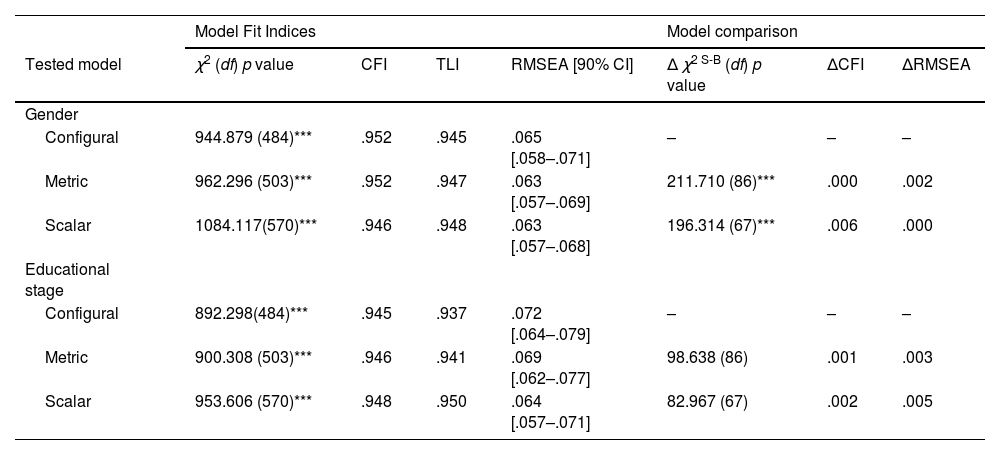
To analyze the equivalence of the SEM model by gender and educational stage, a multigroup analysis was carried out whose fit indices are presented in Table 3. Comparisons between nested models (configurational vs. metric; metric vs. scalar) indicated that the constraints imposed did not significantly impair the model’s fit. Although the chi-square difference tests (ΔX²) were significant, due to the sample size, the changes in the incremental indices (ΔCFI < .01; ΔRMSEA < .015) remained within the recommended thresholds (Chen, 2007). Following current criteria for the evaluation of invariance in large samples, measurement invariance was considered to hold across gender and educational stage groups, which allowed the multigroup SEM model to be developed with guarantees of comparability.

Table 3.

Fit indices for measurement invariance by gender and educational stage

  Model Fit IndicesModel comparison
Tested model  χ2 (df) p value  CFI  TLI  RMSEA [90% CI]  Δ χ2 S-B (df) p value  ΔCFI  ΔRMSEA 
Gender
Configural  944.879 (484)***  .952  .945  .065 [.058–.071]  –  –  – 
Metric  962.296 (503)***  .952  .947  .063 [.057–.069]  211.710 (86)***  .000  .002 
Scalar  1084.117(570)***  .946  .948  .063 [.057–.068]  196.314 (67)***  .006  .000 
Educational stage 
Configural  892.298(484)***  .945  .937  .072 [.064–.079]  –  –  – 
Metric  900.308 (503)***  .946  .941  .069 [.062–.077]  98.638 (86)  .001  .003 
Scalar  953.606 (570)***  .948  .950  .064 [.057–.071]  82.967 (67)  .002  .005 

Note. N = 457.

**p <  .01. *** p <  .001.

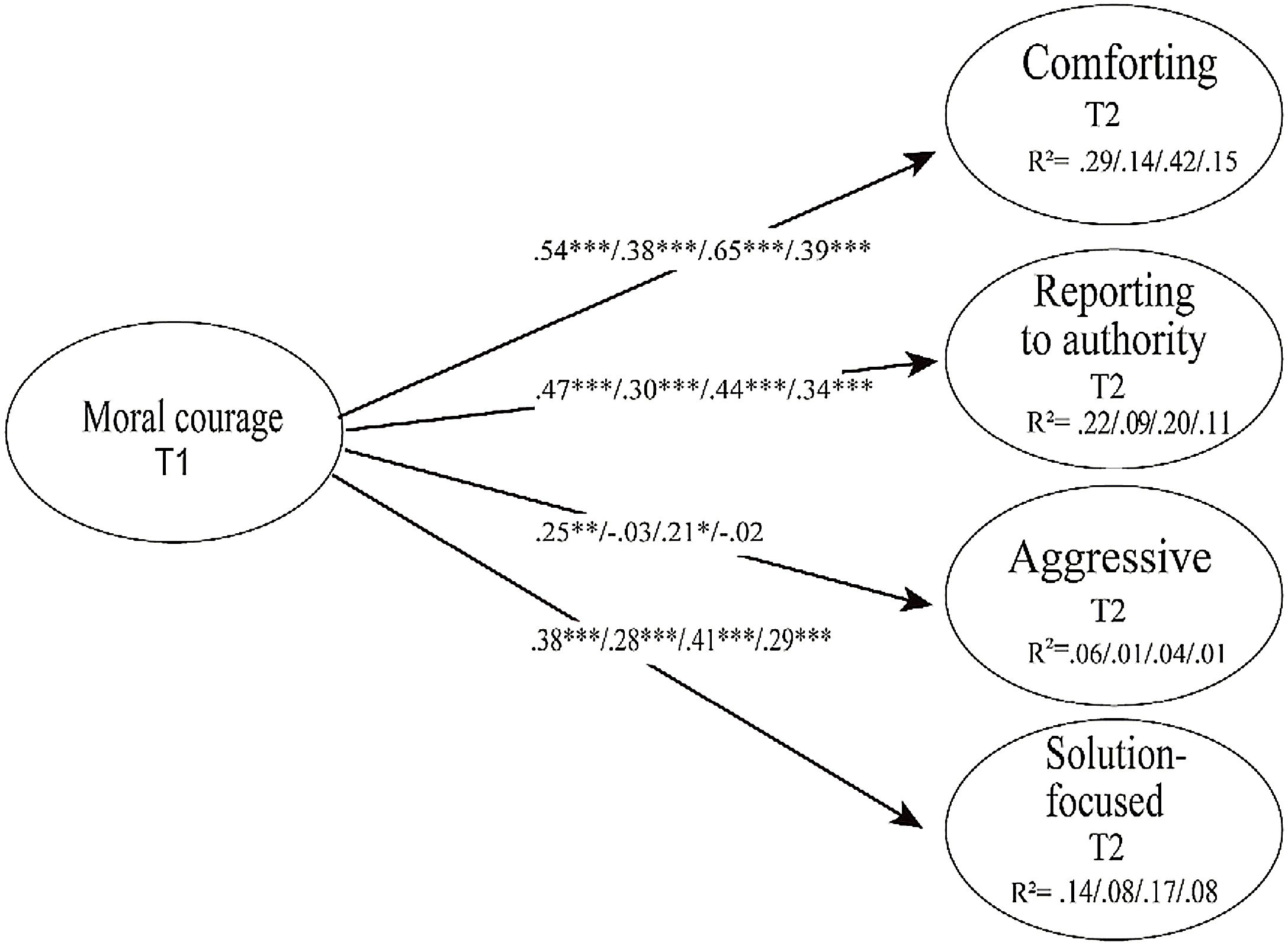
Figure 2 shows the results for gender groups and educational stage, respectively. Regarding gender, the Wald test showed statistical significance in the effect of moral courage on aggressive defense [χ2(1) = 4.63, p =  .03], only being significant in boys. Regarding the other effects of moral courage, although there was no moderation by gender, they were significantly positive on comforting the victim, reporting to authority figure, and solution-focused action. Comparisons across educational stages showed a significant Wald test for the effect of moral courage on defense in the form of comforting the victim [χ2(1) = 8.02, p =  0.01], with this effect being greater in primary than secondary school students. Regarding aggressive defense, moral courage only proved to be a predictor in primary school students, but not in secondary school students. Regarding the other effects of moral courage, although there was no evidence of moderation in the educational stage, significant effects were found with regards to reporting to authority figures and solution-focused actions.

Figure 2.

Non-standardized coefficients of multigroup analysis with structural equation modeling.

Note. N = 519, SEM for boys (named first; nboys = 243), girls (named second; ngirls = 276), primary education (named third; nPrimary = 170), and secondary education (named fourth; nSecondary = 199).

*p <  .05. **p <  .01. ***p <  .001.

Discussion

Defending victims of bullying requires not only a willingness to intervene, but also a deeper understanding and assessment of the costs associated with such interventions, which impacts the type of defense schoolchildren adopt to deal with immoral situations. While direct defending behaviors have been extensively studied in the context of bullying, the current literature presents important questions about predicting indirect defending behaviors. This study has explored the role of moral courage as a predictor of different defending behaviors in the context of bullying.

The results obtained partially support Hypothesis 1, which posited that moral courage would be associated with all forms of defense, and to a greater extent with direct ones, due to their higher inherent social costs. In this regard, it was observed that direct solution-focused strategies and indirect forms of defense were positively and significantly associated with moral courage. However, in terms of aggressive defense, no association with moral courage was observed. This discrepancy with respect to the starting hypothesis may indicate that moral courage is activated when intervening is perceived as an effective, strategic, and ethical action, rather than as an impulsive, risky response devoid of moral rationality (Osswald et al., 2010; Pronk et al., 2019). This result may suggest that students with high moral courage recognize the importance of acting in the face of injustice, but, at the same time, strategically evaluate the possible harm arising from direct, aggressive intervention (Lambe & Craig, 2022). Thus, although moral courage drives prosocial intervention, its manifestation is oriented towards strategies that balance moral commitment with prudent risk management, rather than adopting aggressive behaviors that can exacerbate the cycle of violence. The preliminary analyses indicated a positive, albeit weak, correlation between moral courage and aggressive defense. However, when considered simultaneously with the other forms of violence in the SEM model, the specific effect of moral courage on aggressive defense was attenuated or neutralized by a stronger relationship with prosocial defending behaviors, such as comforting victims, reporting incidents, or seeking solutions.

This finding highlights the need to refine Hypothesis 1 in future studies. Although moral courage influences forms of pro-social defense, its influence varies depending on the type of intervention and the risks perceived in the context of bullying. In the case of aggressive defense, other factors, such as the pursuit of social status or impulsivity, are likely to be more decisive than moral courage, suggesting an important line of future research (Meter et al., 2019).

The role of gender in moral courage and defending behaviors

As has been observed in previous studies (Santilli et al., 2021; Trach et al., 2010), boys tend to show a greater willingness to engage in forms of aggressive defense, while girls are more frequently inclined towards behaviors that involve comforting the victim. However, to understand the effect of moral courage on defensive behaviors according to gender, it is necessary to consider the results of the multigroup analysis. These results do not directly support Hypothesis 2a, as they reveal a gender-differentiated manifestation of moral courage: although moral courage significantly predicted defensive prosocial behaviors in both genders, it was only linked to aggressive defense by boys. This finding suggests that moral courage is channeled differently by boys vs. girls. From a developmental and psychosocial perspective, this finding can be interpreted considering that boys tend to engage in more action- and confrontation-oriented strategies as a way of affirming their status within their peer groups (Geary, 2021). In this context, moral courage functions as a mobilizing resource that promotes direct intervention in the face of injustice, even when this entails social risks. On the contrary, girls may use moral courage primarily as a mechanism for evaluating the possible consequences of their behavior, leading them to opt for more indirect and less visible, but no less significant, forms of defense (Lambe & Craig, 2022). This pattern not only reflects the impact of traditional norms of masculinity, which legitimize and reinforce visible and confrontational responses to situations of violence (Rudman & Glick, 2008) but also invites reflection on the implications of such interventions, particularly in boys. Although the activation of moral courage can facilitate intervention, in the case of boys high levels of activation can increase exposure to conflict and personal retaliation (Rogers et al., 2017), which underscores the importance of promoting effective but safe forms of defense by students of all profiles, taking into account their differences in socialization, perceptions of risk, and ways of channeling their sense of restorative justice.

The influence of the educational stage on moral courage and defending behaviors

In line with previous research on moral and prosocial development (Paciello et al., 2013; Thornberg, 2007), it is observed that students’ predisposition to defend victims varies according to educational stage. At the descriptive level, it was found that primary schoolchildren show greater moral courage and tend towards defense actions that involve reporting to authority figure. The results of the multigroup analysis partially confirmed Hypothesis 2b, showing that, although moral courage significantly predicted willingness to defend prosocially in both stages, its influence varied depending on the type of defensive behavior. In primary education, moral courage explained a higher percentage of the variance in the type of defense consisting of comforting the victim compared to secondary education. These findings prompt us to reconsider how social cost is evaluated in the different educational stages. Although in the adolescent context intervention may entail a higher cost, in pre-adolescence schoolchildren may perceive more direct threats to their social acceptance upon relating to victims, who, in the social hierarchy, are at a clear disadvantage in terms of their power within the group (Bravo et al., 2024). Therefore, the greater influence of moral courage in primary education can be explained by less sophisticated risk assessment and greater attention being paid to power relations within the group (Santilli et al., 2021).

In the case of aggressive defense, the results showed that moral courage had a significant influence only in primary education. This pattern can be explained by the maturation of emotional regulation strategies and the development of a greater awareness of the risks associated with direct confrontation during adolescence (Gingo, 2017). In earlier stages, moral outrage at injustice can translate into impulsive and confrontational responses, mainly by boys, while in adolescence the strategic assessment of consequences can inhibit these types of interventions (Shaw et al., 2014).

Practical implications, limitations and future lines of research

The findings of this study ratify the theories of moral behavior that highlight the multifunctionality of prosocial behaviors (Eisenberg et al., 2015; Paciello et al., 2013) and underscore the need to consider moral courage a central component in psychoeducational interventions. Hence, the need to approach morality from a holistic perspective is emphasized (Romera et al., 2024), considering key dimensions such as moral identity (Montero-Carretero et al., 2021), moral sensitivity (Wu, 2019) and moral reasoning (Wang & Goldberg, 2017). This positions moral courage as an essential preventive resource, especially if fostered from an early age, before negative power dynamics become entrenched in the scholastic setting. For its development in the school environment, it is recommended to incorporate moral dilemmas, case analyses, and metacognitive teacher modeling as strategies to promote moral reflection and prosocial intervention in the face of harassment.

Limitations include the exclusive use of self-reports, which can introduce social desirability biases, and the need for experimental approaches to establish causal relationships. In addition, although the initial sample was large, the analyses were only carried out with a subgroup of students. This delimitation means that the results obtained cannot be generalized to the entire school population, but rather just to those who identified themselves as active observers in situations of bullying. In addition, contextual factors, such as school climate and group dynamics, were not explored in depth. The absence of these variables restricts the analysis to an individual level and may limit a full interpretation of the results, since it is plausible that moral courage and defending behaviors interact with the characteristics of the peer group and the school climate in which they develop. School contexts where a climate of support, prosocial norms and a collective attitude against bullying are perceived can facilitate the expression of moral courage, while environments characterized by group passivity, or tolerance of aggressors, can inhibit it, even in students with a great willingness to intervene. It is suggested that future studies contemplate designs that make it possible to compare these profiles with students not directly exposed, as well as to explore how defensive dispositions vary depending on degree of exposure to and participation in these situations. Similarly, it is necessary to adopt complementary methodologies and multilevel approaches that simultaneously analyze individual and contextual factors, as well as experimental or quasi-experimental and intercultural analyses, to bolster knowledge of the impact of moral courage on defending behaviors.

Conclusions

The results of this study have relevant theoretical implications on moral courage as a key factor in the activation of behaviors defending bullying victims. In particular, the literature has expanded by demonstrating that moral courage not only drives direct and high-social-cost interventions, but also relates to more subtle forms of support, such as comforting the victim or reporting to authority figures, with gender and educational stage being noteworthy factors impacting these actions. This finding broadens our understanding of how moral cognitive processes are activated to drive different forms of intervention in victim defense dynamics. On the one hand, it has been shown that defense strategies are shaped by developmental and gender patterns, reflecting significant differences between the intervention styles of boys compared to girls. On the other hand, it is observed that progress in the educational stages modifies the ways in which schoolchildren evaluate and act in the face of immoral situations, evolving towards more deliberate and effective behaviors in adolescence.

Funding

This work was supported by the Spanish Research Agency, Ministry of Science and Innovation (PID2020-113911RB-I00, PI: Eva M. Romera) (https://www.ciencia.gob.es/).

Conflict of interest

The authors declare that they have no competing interests..

CRediT authorship contribution statement

Paula García-Carrera: formal analysis, investigation, methodology, writing – original draft preparation. Rosario Ortega-Ruiz: conceptualization, investigation, supervision, validation, visualization, writing – review and editing. Antonio Camacho: data curation, formal analysis, investigation, methodology, supervision, validation, visualization, writing – review and editing. Eva M. Romera: conceptualization, data curation, formal analysis, funding acquisition, investigation, methodology, project administration, resources, software, supervision, validation, visualization, writing – review and editing.

Appendix A
Supplementary data

The following is the supplementary data to this article:

Icono mmc1.docx

References
[Andrade et al., 2021]
B. Andrade, I. Guadix, A. Rial, F. Suárez.
Impacto de la tecnología en la adolescencia. Relaciones, riesgos y oportunidades.
UNICEF España, (2021),
[Archer, 2004]
J. Archer.
Sex differences in aggression in real-world settings: A meta-analytic review.
Review of General Psychology, 8 (2004), pp. 291-322
[Barhight and Hubbard, 2013]
L.R. Barhight, J.A. Hubbard.
Children´s physiological and emotional reactions to witnessing bullying predict bystander intervention.
Child Development, 84 (2013), pp. 375-390
[Baumert et al., 2020]
A. Baumert, M. Li, J. Sasse, L. Skitka.
Standing up against moral violations: psychological processes of moral courage.
Journal of Experimental Social Psychology, 88 (2020),
[Björkqvist, 2018]
K. Björkqvist.
Gender differences in aggression.
Current Opinion in Psychology, 19 (2018), pp. 39-42
[Bondü et al., 2016]
R. Bondü, T. Rothmund, M. Gollwitzer.
Mutual long-term effects of school bullying, victimization, and justice sensitivity in adolescents.
Journal of Adolescence, 48 (2016), pp. 62-72
[Bravo et al., 2024]
A. Bravo, R. Ortega-Ruiz, E.M. Romera.
Trayectorias de victimización en situaciones de acoso escolar: asociaciones con cambios en las dimensiones del estatus social dentro del grupo clase.
Psicothema, 36 (2024), pp. 207-216
[Brislin, 1986]
R.W. Brislin.
The wording and translation of research instruments.
pp. 137-164
[Bronstein et al., 2007]
P. Bronstein, B.J. Fox, J.L. Kamon, M.L. Knolls.
Parenting and gender as predictors of moral courage in late adolescence: A longitudinal study.
Sex Roles, 56 (2007), pp. 661-674
[Chen, 2007]
F.F. Chen.
Sensitivity of goodness of fit indexes to lack of measurement invariance.
Structural Equation Modeling: A Multidisciplinary Journal, 14 (2007), pp. 464-504
[Cohen, 1977]
J. Cohen.
Statistical power analysis for the behavioral sciences.
Academic Press, (1977),
[Cosma et al., 2024]
A. Cosma, M. Molcho, W. Pickett.
A focus on adolescent peer violence and bullying in Europe, Central Asia and Canada. Health Behaviour in School-aged Children, International Report from the 2021/2022 Survey (v.2).
World Health Organization. Regional Office for Europe, (2024),
[Cramer, 1999]
H. Cramer.
Mathematical methods of statistics.
Princeton University Press, (1999),
[Díaz-Aguado et al., 2023]
M.J. Díaz-Aguado, R. Martínez-Arias, L. Falcón, M. Alvariño.
Acoso escolar y ciberacoso en España en la infancia y en la adolescencia.
Universidad Complutense de Madrid / Fundación Cola-Cao, (2023),
[Dungan et al., 2019]
J.A. Dungan, L. Young, A. Waytz.
The power of moral concerns in predicting whistleblowing decisions.
Journal of Experimental Social Psychology, 85 (2019), pp. 1-12
[Eisenberg et al., 2015]
N. Eisenberg, T.L. Spinrad, A. Knafo-Noam.
Prosocial development.
[Fornell and Larcker, 1981]
C. Fornell, D.F. Larcker.
Evaluating structural equation models with unobservable variables and measurement error.
Journal of Marketing Research, 18 (1981), pp. 39-50
[Geary, 2021]
D.C. Geary.
Now you see them, and now you don’t: an evolutionarily informed model of environmental influences on human sex differences.
Neuroscience and Biobehavioral Reviews, 125 (2021), pp. 26-32
[Geldhof et al., 2014]
G.J. Geldhof, K.J. Preacher, M.J. Zyphur.
Reliability estimation in a multilevel confirmatory factor analysis framework.
Psychological Methods, 19 (2014), pp. 72-91
[Gingo, 2017]
M. Gingo.
Children’s reasoning about deception and defiance as ways of resisting parents’ and teachers’ directives.
Developmental Psychology, 53 (2017), pp. 1643-1655
[Hu and Bentler, 1999]
L.T. Hu, P.M. Bentler.
Cutoff criteria for fit indexes in covariance structure analysis: Conventional criteria versus new alternatives.
Structural Equation Modeling, 6 (1999), pp. 1-55
[Kollerová et al., 2014]
L. Kollerová, P. Janošová, P. Říčan.
Good and evil at school: Bullying and moral evaluation in early adolescence.
Journal of Moral Education, 43 (2014), pp. 18-31
[Lambe and Craig, 2020]
L.J. Lambe, W.M. Craig.
Peer Defending as a multidimensional behavior: Development and validation of the Defending Behaviors Scale.
Journal of School Psychology, 78 (2020), pp. 38-53
[Lambe and Craig, 2022]
L.J. Lambe, W.M. Craig.
The co-evolution of friendship, defending behaviors, and peer victimization: A short-term longitudinal social network analysis.
Social Development, 31 (2022), pp. 984-1000
[Lambe et al., 2017]
L.J. Lambe, C.C. Hudson, W.M. Craig, D.J. Pepler.
Does defending come with a cost? Examining the psychosocial correlates of defending behaviour among bystanders of bullying in a Canadian sample.
Child Abuse & Neglect, 65 (2017), pp. 112-123
[Laninga-Wijnen et al., 2023]
L. Laninga-Wijnen, Y.H.M. van den Berg, C.F. Garandeau, S. Mulder, B.O. de Castro.
Does being defended relate to decreases in victimization and improved psychosocial adjustment among victims?.
Journal of Educational Psychology, 115 (2023), pp. 363-377
[Little, 2013]
T.D. Little.
Longitudinal structural equation modeling.
Guilford, (2013),
[Malti et al., 2020]
T. Malti, J. Peplak, L. Zhang.
The development of respect in children and adolescents.
Monographs of the Society for Research in Child Development, 85 (2020), pp. 7-99
[Meter et al., 2019]
D.J. Meter, T.L Ma, S.E. Ehrenreich.
Telling, comforting, and retaliating: The roles of moral disengagement and perception of harm in defending college-aged victims of peer victimization.
International Journal of Bullying Prevention, 1 (2019), pp. 124-135
[Montero-Carretero et al., 2021]
C. Montero-Carretero, A. Roldan, T. Zandonai, E. Cervelló.
A-Judo: An innovative intervention programme to prevent bullying based on self-determination theory-a pilot study.
Sustainability, 13 (2021),
[Muthén and Muthén, 1998-2017]
L.K. Muthén, B.O. Muthén.
Mplus user’s guide.
8th ed., Muthén and Muthén, (1998),
[Nocentini et al., 2020]
A. Nocentini, T. Colasante, T. Malti, E. Menesini.
In my defence or yours: Children´s guilt subtypes and bystander roles in bullying.
European Journal of Developmental Psychology, (2020), pp. 1-17
[O’Connell et al., 2024]
E.I. O’Connell, R.M. Joseph, A.E. Shemin, J. Woodruff, C. Simsarian, F. Yepez Coello, B. Bongar.
Courage: moral and physical dimensions.
The routledge international handbook of multidisciplinary perspectives on character development, volume I: Conceptualizing and defining character, pp. 395-420
[Ortega-Ruiz et al., 2016]
R. Ortega-Ruiz, R. Del Rey, J.A. Casas.
Assessing bullying and cyberbullying: Spanish validation of EBIPQ and ECIPQ.
Psicología Educativa, 22 (2016), pp. 71-79
[Osswald et al., 2010]
S. Osswald, T. Greitemeyer, P. Fischer, D. Frey.
What is moral courage? Definition, explication, and classification of a complex construct.
The psychology of courage: Modern research on an ancient virtue, pp. 149-164 http://dx.doi.org/10.1037/12168-008
[Paciello et al., 2013]
M. Paciello, R. Fida, L. Cerniglia, C. Tramontano, E. Cole.
High cost helping scenario: The role of empathy, prosocial reasoning and moral disengagement on helping behavior.
Personality and Individual Differences, 55 (2013), pp. 3-7
[Pouwels et al., 2019]
J.L. Pouwels, T.H.J. Van Noorden, S.C.S. Caravita.
Defending victims of bullying in the classroom: The role of moral responsibility and social costs.
Journal of Experimental Social Psychology, 84 (2019),
[Pronk et al., 2020]
J. Pronk, T. Olthof, E.A. Aleva, M. van der Meulen, M.M. Vermande, F.A. Goossens.
Longitudinal associations between adolescents´ bullying-related indirect defending, outsider behavior and peer-group status.
Journal of Research on Adolescence, 30 (2020), pp. 87-99
[Pronk et al., 2019]
J. Pronk, T. Olthof, F.A Goossens, L. Krabbendam.
Differences in adolescents’ motivations for indirect, direct and hybrid peer defending.
Social Development, 28 (2019), pp. 414-429
[Pury et al., 2014]
C.L.S. Pury, T.W. Britt, H.M. Zinzow, M.A. Raymond.
Blended courage: Moral and psychological courage elements in mental health treatment seeking by active duty military personnel.
The Journal of Positive Psychology, 9 (2014), pp. 30-41
[Reijntjes et al., 2016]
A. Reijntjes, M. Vermande, T. Olthof, F.A. Goossens, L. Aleva, M. van der Meulen.
Defending victimized peers: Opposing the bully, supporting the victim, or both?.
Aggressive Behavior, 42 (2016), pp. 585-597
[Rogers et al., 2017]
A.A. Rogers, D. DeLay, C.L. Martin.
Traditional masculinity during the middle school transition: Associations with depressive symptoms and academic engagement.
Journal of Youth and Adolescence, 46 (2017), pp. 709-724
[Romera et al., 2024]
E.M. Romera, A. Bravo, A. Camacho, R. Ortega-Ruiz.
The moral domain in peer relationships: Opportunities for interventions to prevent bullying.
Handbook of school violence, bullying and safety, pp. 556-567 http://dx.doi.org/10.4337/9781035301362
[Rudman and Glick, 2008]
L.A. Rudman, P.S. Glick.
The social psychology of gender: How power and intimacy shape gender.
The Guilford Press, (2008),
[Salmivalli, 2010]
C. Salmivalli.
Bullying and the peer group: A review.
Aggression and Violent Behavior, 15 (2010), pp. 112-120
[Santilli et al., 2021]
S. Santilli, M.C. Ginevra, E. Camussi, E. Lodi, L. Nota, P. Patrizi.
Courage in childhood: Classifying the actions of courage performed by elementary school students.
European Journal of Developmental Psychology, 18 (2021), pp. 678-694
[Satorra and Bentler, 2001]
A. Satorra, P.M. Bentler.
A scaled difference chi-square test statistic for moment structure analysis.
Psychometrika, 66 (2001), pp. 507-514
[Shaw et al., 2014]
A. Shaw, N. Montinari, M. Piovesan, K.R Olson, F. Gino, M.I Norton.
Children develop a veil of fairness.
Journal of Experimental Psychology: General, 143 (2014), pp. 363-375
[Thornberg, 2007]
R. Thornberg.
A classmate in distress: Schoolchildren as bystanders and their reasons for how they act.
Social Psychology of Education, 10 (2007), pp. 5-28
[Tian et al., 2025]
X. Tian, E.S. Huebner, L. Tian.
Defending behavior in bullying and defenders’ psychosocial outcomes among children and adolescents: A series of three-level meta-analyses.
Journal of Youth and Adolescence, (2025), pp. 1-31
[Trach et al., 2010]
J. Trach, S. Hymel, T. Waterhouse, K. Neale.
Bystander responses to school bullying: A cross-sectional investigation of grade and sex differences.
Canadian Journal of School Psychology, 25 (2010), pp. 114-130
[Truskauskaitė-Kunevičienė et al., 2020]
I. Truskauskaitė-Kunevičienė, E. Romera, R. Ortega-Ruiz, R. Žukauskienė.
Promoting positive youth development through a school-based intervention program Try Volunteering.
Current Psychology, 36 (2020), pp. 705-719
[Van Geel et al., 2018]
M. Van Geel, A. Goemans, W. Zwaanswijk, G. Gini, P. Vedder.
Does peer victimization predict low self-esteem, or does low self-esteem predict peer victimization? Meta-analyses on longitudinal studies.
Developmental Review, 49 (2018), pp. 31-40
[Viladrich et al., 2017]
C. Viladrich, A. Angulo-Brunet, E. Doval.
A journey around alpha and omega to estimate internal consistency reliability.
Anales de Psicología, 33 (2017), pp. 755-782
[Wang and Goldberg, 2017]
C. Wang, T.S. Goldberg.
Using children’s literature to decrease moral disengagement and victimization among elementary school students.
Psychology in the Schools, 54 (2017), pp. 918-931
[Wang et al., 2023]
Z. Wang, L. Laninga-Wijnen, C.F. Garandeau, J. Liu.
Development and validation of the Adolescent Defending Behaviors Questionnaire among Chinese early Adolescents.
Assessment, 30 (2023), pp. 2258-2275
[Wu, 2019]
Wu, Y. (2019). Promoting behavioral intentions to defend victims of bullying among college students with an interactive narrative game [Dissertation, The Florida State University]. ProQuest Dissertations y Theses. https://repository.lib.fsu.edu/islandora/object/fsu%3A709858.
Copyright © 2025. Universidad del País Vasco
Download PDF