




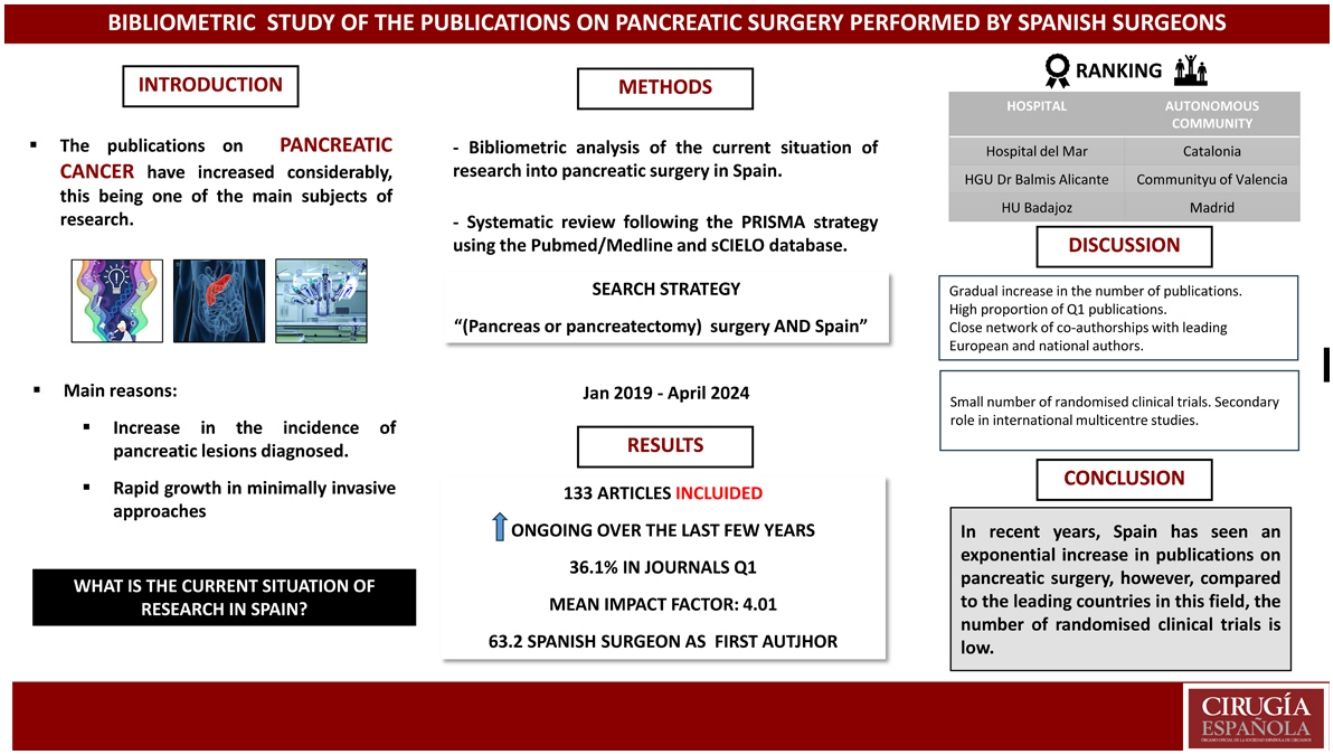


Pancreatic pathology is a constant multidisciplinary challenge. It is a growing pathology and one of the main research topics. The aim of the study is to analyse the current situation in Spain in this field from a bibliometric perspective.
MethodsWe conducted a systematic review following the PRISMA guidelines, utilizing the PubMed/Medline and sCIELO databases. The search strategy included the terms: ‘(pancreas OR pancreatectomy) AND surgery AND Spain.’ The publication period spanned from January 2019 to March 2024. Our inclusion criteria specified any article, in any language, where at least one participant was a surgeon in a hospital in Spain, and that had an impact factor (IF).
ResultsThe search yielded 522 citations, of which 133 articles were selected after applying our inclusion and exclusion criteria. The trend over time indicates a progressive increase in publications. Notably, 36.1% of the articles were published in Q1 journals, while 35.3% appeared in Q3 journals, with a mean impact factor of 4.07. Spanish authors accounted for 63.2% of publications. The most common types of articles were retrospective studies, case reports, and systematic reviews, with 35.3% being international multicenter studies. Key topics addressed included minimally invasive approaches, surgical techniques, and postoperative management. The journal Cirugía Española (Q3) published the highest number of papers (20.3%).
ConclusionIn recent years, Spain has experienced a significant increase in publications related to pancreatic surgery. However, when compared to leading countries in this field, the number of randomised clinical trials remains low.
La patología pancreática es un desafío constante multidisciplinar tratándose de una patología en aumentoꓼ siendo de uno de los principales temas de investigación. El objetivo del estudio es analizar desde una perspectiva bibliométrica la situación actual en España en este ámbito.
MétodosRealizamos una revisión sistemática según estrategia PRISMA empleando la base Pubmed/Medline y sCIELO. La estrategia de búsqueda empleada fue: «(pancreas or pancreatectomy) AND surgery AND Spain». El periodo de publicación fue enero2019-marzo 2024. Los criterios de inclusión fueron cualquier tipo de artículo, en cualquier idioma donde uno de los participantes fuera cirujano en un hospital de España y tuviera factor de impacto (FI).
ResultadosLa búsqueda produjo un total de 522 citas, de las cuales tras aplicar los criterios de inclusión y exclusión seleccionamos 133 artículos. La tendencia temporal muestra un aumento progresivo. El 36.1% eran Q1 y un 35.3% Q3. El FI medio fue de 4.07. El cirujano español ocupó el primer puesto en el 63.2%. En cuanto a los tipos de artículo más frecuentemente publicado por orden fueron estudios retrospectivos, casos clínicos y revisiones sistemáticas, siendo en un 35.3% estudios multicéntricos internacionales. Los temas más frecuentes fueron abordajes mínimamente invasivos, técnica quirúrgica y manejo postoperatorio. Cirugía española(Q3) (20.3%) fue la revista en la que se publicaron el mayor número de trabajos.
ConclusiónDurante los últimos en España ha aumentado progresivamente las publicaciones sobre cirugía pancreática, sin embargo, en comparación con los países que lideran este campo el número de ensayos clínicos aleatorizados es bajo.

Pancreatic pathology is a constant challenge for gastroenterologists, oncologists, and surgeons. In recent years, publications in pancreatic surgery have increased considerably, this being one of the main topics of research.1
This progressive increase in scientific interest in this oncological field responds to two main reasons. Firstly, this is due to the incidence of pancreatic cancer, which has increased significantly in recent decades. Factors associated with the appearance of this type of neoplasms have been identified, shedding light on etiological factors that have not been well known previously.2–5 The second reason responds to the rapid expansion of minimally invasive approaches, firstly from the laparoscopic approach; this constituting the approach of choice in most surgical units when we talk about distal pancreatic resections,6 and secondly the robotic approach that has seen a great boom in recent years, given the exponential increase in resources for this approach worldwide, as well as in the autonomous communities in this country.6–8
A national survey published in Caraga Española9 found that 53.6% of the groups that performed pancreatic surgery did not publish any articles in the years 2015–2017, with the average for the centres that did publish standing at 4.5 articles per unit, with an average impact factor of 1.88. On the other hand, the International Study Group of Pancreatic Surgery (ISGPS), in an analysis published in 2021, found that up to 46% of the randomised clinical trials that were run in the field of pancreatic surgery were run in other European countries.10
Given this context, we decided to undertake a bibliometric analysis of the current research situation in Spain in pancreatic surgery. This is a novel analysis not previously used in this country, to cover this limitation in knowledge in this field of surgery. The main objective was to analyse the publications on pancreatic surgery performed by Spanish surgeons, published in the last five years, to look at the care and research work done that had been passed to publication.
Material and methodsSearch strategy and selection criteriaWe conducted a systematic review following the PRISMA strategy, using the Pubmed/Medline database and sCIELO. The search strategy adopted was: "(pancreas or pancreatectomy) AND surgery AND spain". The publication period spanned from January 2019 to April 2024. The inclusion criteria were any type of article, in any language where one of the participants was a surgeon in a hospital in Spain, and the article was about pancreatic surgery or surgical treatment of pancreatic diseases, and that had an impact factor (IF). All studies not related to the subject under study, those not involving any Spanish surgeons, articles that referred to pancreatic transplantation, duplicate articles and publications indexed in Pubmed but without IF were excluded. The articles were filtered by three independent reviewers and, in cases of doubt, the criteria of the head of the unit was followed.
Data managementThe bibliographical variables studied were the journal where the study was published, the IF and the quartile, the type of article (retrospective studies, clinical cases, systematic reviews, surveys, clinical guidlelines and prospective studies), single centre and multicentre studies, position in the article (first/intermediate/last), the hospital, the autonomous community and the subject matter (minimally invasive approaches, surgical technique, postoperative management and/or complications and pancreatic adenocarcinoma). The IF was extracted from the Spanish Ministry of Science’s FECYT innovation tool, intended for this purpose.
Data analysisData was collected using the IBM-SPSS 25.0 programme, running its complete statistical analysis. In the descriptive analysis, quantitative variables were expressed as central tendency measures with mean and median, along with dispersion measurements such as standard deviation and statistical range. Qualitative variables were expressed in the form of proportions or percentages.
We used the VOSviewer 1.6.13 programme to build and visualise bibliographical networks. The selected articles were analysed using this tool to establish authorship relationships, obtaining graphical representations of the articles that were thus able to analyse the relationships between the different authors, obtaining a representation with circles for each of the citations. The size of the circle was proportional to the number of publications, as well as the intensity of the shading, depending on the graph used.11
ResultsThe search yielded a total of 522 citations, from which, after applying the inclusion and exclusion criteria, we selected 153 potentially relevant articles. Finally, 20 were excluded as the journal did not have an impact factor, despite being indexed, or was not related to pancreatic surgery. Finally, 133 articles were included, as can be seen in Fig. 1.

The time trend shows a progressive increase in the number of publications, from 19 in 2019 to 38 in 2023. The most frequent quartiles were Q1 (36.1%) and Q3 (35.3%), with an average IF of 4.07 (Min 0.6, Max 17.3). Spanish surgeons ranked first in 63.2% of the publications, followed by an intermediate position in 32.3% of the articles. The types of articles most frequently published, in order of frequency, were: retrospective studies, clinical cases, systematic reviews, surveys, clinical guidelines and prospective studies. Regarding the topic, the most frequent were minimally invasive approaches, surgical technique, postoperative management and/or complications and pancreatic adenocarcinoma. The results are shown in Table 1.
Main bibliographical characteristics of studies on pancreatic surgery published by Spanish surgeons.
| Spanish pancreatic surgery publications 133 posts | |
|---|---|
| Year | 2019: 19 (14.3%) |
| 2020: 12 (9%) | |
| 2021: 22 (16.5%) | |
| 2022: 33 (24.8%) | |
| 2023: 38 (28.6%) | |
| 2024: 9 (6.8%) | |
| Quarter | Q1: 48 (36.1%) |
| Q2: 29 (21.8%) | |
| Q3: 47 (35.3%) | |
| Q4: 9 (6.8%) | |
| Impact factor | 4.07 (17.3−0.6) (3.6) |
| Mean (Max- Min) (SD) | |
| Position held by the author | Intermediate: 43 (32.3%) |
| First: 84 (63.2%) | |
| Last: 6 (4.5%) | |
| Item Type | Retrospective: 85 (63.9%) |
| Case Study: 13 (9.8%) | |
| Systematic review: 8 (6%) | |
| Survey: 5 (3.8%) | |
| Clinical guidelines: 5 (3.8%) | |
| Prospective: 5 (3.8%) | |
| Editorial: 4 (3%) | |
| Basic research: 4 (3%) | |
| Randomised clinical trial: 3 (2.3%) | |
| Protocol: 1 (0.8%) | |
| Theme | Minimally invasive approaches: 35 (26.3%) |
| Surgical technique: 30 (22.6%) | |
| Postoperative management: 24 (18%) | |
| Pancreatic adenocarcinoma: 18 (13.5%) | |
| Other tumours: 11 (8.3%) | |
| Acute pancreatitis: 7 (5.3%) | |
| Basic research: 4 (3%) | |
| Nuroendocrine tumours: 2 (1.5%) | |
| IM/Postoperative Management: 1 (0.8%) | |
| NET/Surgical Technique: 1 (0.8%) | |
Cirugía Española (Q3) was the journal in which the largest number of papers were published: 27 (20.3%), followed by Annals of Surgery (Q1): 12 (9%); and Updates in Surgery (Q2), with a total of 7 articles (5.3%). Table 2 shows all the journals where a Spanish surgeon had published during that study period, as well as their quartile. In reference to the number of centres included in each article, 35.3% were international multicentre studies, with 52.6% being single centre. By autonomous communities, Catalonia with 65 articles (48.9%), the Valencian Community with 19 (14.3%) and Madrid with 17 (12.8%) were the regions with the highest number of publications. The Hospital del Mar was the centre that had published most, with 28 articles (21.1%), followed by HGU Balmis with 17 (12.8%). This distribution by autonomous communities and hospitals is shown in Table 3.
Journals where articles published by a Spanish surgeon on pancreatic surgery have been published.
| Spanish pancreatic surgery publications N = 133 | |
|---|---|
| Magazines | Cir Esp (Q3): 27 (20.3%) |
| Ann Surg (Q1): 12 (9%) | |
| Updates Surg (Q2): 7 (5.3%) | |
| Langenbecks (Q2): 5 (3.8%) | |
| Sci Rep (Q1): 5 (3.8%) | |
| Gastroenerol Hepatol (Q4): 4 (3%) | |
| HPB (Q2): 4 (3%) | |
| Int J Med Robot (Q3): 4 (3%) | |
| J HPB Sci (Q2): 4 (3%) | |
| Ann Surg Oncol (Q1): 3 (2.3%) | |
| Hepatobiliary Surgery Nutrition (Q1): 3 (2.3%) | |
| Int J Surg (Q1): 3 (2.3%) | |
| J Am Coll Surg (Q1): 3 (2.3%) | |
| Minerva Chir (Q3): 3 (2.3%) | |
| Pancreatology (Q1): 3 (2.3%) | |
| BJS Open (Q1): 2 (1.5%) | |
| Br J Surg (Q1): 2 (1.5%) | |
| Clin Trans Oncol (Q3): 2 (1.5%) | |
| Dig Surg (Q3): 2 (1.5%) | |
| Eur J Surg Oncol (Q1): 2 (1.5%) | |
| Int J Hypertermia (Q3): 2 (1.5%) | |
| Surg Endosc (Q1): 2 (1.5%) | |
| Surg Oncol (Q2): 2 (1.5%) | |
| Surgery (Q1): 2 (1.5%) | |
| Trials (Q3): 2 (1.5%) | |
| Acta Chir Belg (Q4): 1 (0.8%) | |
| Anticancer Res (Q3): 1 (0.8%) | |
| Autopsy Case Rep (Q3): 1 (0.8%) | |
| Biochim Biophys Acta Gen Subj (Q1): 1 (0.8%) | |
| BMJ Open (Q1): 1 (0.8%) | |
| Endocr Diabetes Nutr (Q4): 1 (0.8%) | |
| Eur J Cancer prev (Q2): 1 (0.8%) | |
| Front Surg (Q3): 1 (0.8%) | |
| Gland Surg(Q3): 1 (0.8%) | |
| Gut (Q1): 1 (0.8%) | |
| Int J Cancer (Q1): 1 (0.8%) | |
| J Gastrointest Oncol (Q3): 1 (0.8%) | |
| J Physio Biochem (Q3): 1 (0.8%) | |
| J Robot Surg (Q2): 1 (0.8%) | |
| JAMA Surg (Q1): 1 (0.8%) | |
| Nutr Hosp (Q4): 1 (0.8%) | |
| Pancreas (Q3): 1 (0.8%) | |
| Pathol Oncol Res (Q3): 1 (0.8%) | |
| Rev Endocr Metab Disord (Q1): 1 (0.8%) | |
| Rev Esp Pathology (Q4): 1 (0.8%) | |
| Scand J Surg (Q2): 1 (0.8%) | |
| Surg Lap Endosc Percut Tech (Q3): 1 (0.8%) | |
| Surgeon (Q2): 1 (0.8%) | |
Distribution of articles on pancreatic surgery published by a Spanish surgeon by autonomous community and hospital.
| Spanish pancreatic surgery publications N = 133 | |||
|---|---|---|---|
| Centres included | Autonomous community | Hospital | Hospital 2 |
| International multicentres: 47 (35.3%) | Catalonia: 65 (48.9%) | Hospital del Mar: 28 (21.1%) | Vall d’Hebron Barcelona H: 6 (40%) |
| Valencian Community: 19 (14.3%) | HGU Dr. Balmis Alicante: 17 (12.8%) | Hospital del Mar: 4 (26.7%) | |
| National multicentres: 16 (12%) | Madrid: 17 (12.8%) | HU of Badajoz: 9 (6.8%) | HM Sanchinarro: 2 (13.3%) |
| Extremadura: 9 (6.8%) | HU Germans Trias: 9 (6.8%) | H Clínico U de Valencia: 1 (6.7%) | |
| Single centres: 70 (52.6%) | Aragon: 6 (4.5%) | H Clinic Barcelona: 8 (6%) | HU Joan XXIII: 1 (6.7%) |
| Navarre: 4 (3%) | Bellvitge HU: 6 (4.5%) | HCU of Salamanca: 1 (6.7%) | |
| Castilla-La Mancha: 3 (2.3%) | HU Miguel Servet: 6 (4.5%) | ||
| Andalusia: 3 (2.3%) | Vall d’Hebron Barcelona H: 6 (4.5%) | ||
| Galicia: 2 (1.5%) | Clínica U de Navarra: 4 (3%) | ||
| Balearic Is.: 1 (0.8%) | The Princess HU: 4 (3%) | ||
| Cantabria: 1 (0.8%) | HU, October 12: 4 (3%) | ||
| Castilla y León: 1 (0.8%) | HM Sanchinarro: 4 (3%) | ||
| Basque Country: 1 (0.8%) | H Santa Creu and Sant Pau: 4 (3%) | ||
| Murcia: 1 (0.8%) | H Clínico U de Valencia: 2 (1.5%) | ||
| HU Reina Sofía de Córdoba: 2 (1.5%) | |||
| Jiménez Diaz Foundation: 2 (1.5%) | |||
| H K Sebadel: 2 (1.5%) | |||
| HCU of Salamanca: 2 (1.5%) | |||
| H Ribera Povisa: 2 (1.5%) | |||
| HCU Virgen de la Arrixaca: 1 (0.8%) | |||
| HGU of Ciudad Real: 1 (0.8%) | |||
| HCU San Carlos: 1 (0.8%) | |||
| HGU of Albacete: 1 (0.8%) | |||
| HU Virgen de la Victoria: 1 (0.8%) | |||
| Cruces HU: 1 (0.8%) | |||
| HU of Guadalajara: 1 (0.8%) | |||
| HU Joan XXIII: 1 (0.8%) | |||
| HU La Paz: 1 (0.8%) | |||
| HU Ramón y Cajal: 1 (0.8%) | |||
| HU Son Espases: 1 (0.8%) | |||
| Marqués de Valdecilla HU: 1 (0.8%) | |||
We also analysed the articles published in the journals that occupy the first quartile, as can be seen in Table 4. In line with the previous results, the time trend shows a progressive increase in the number of publications, from 7 in 2019 to 12 in 2022 and 2023. The mean IF was 7.3 (Min 2.9, Max 17.3). Spanish surgeons ranked first in 35.4% of the publications. As for the type of article most frequently published, in order of frequency, these were: retrospective studies, editorials, basic research and systematic reviews. Regarding the topic, the most frequent were: minimally invasive approaches and postoperative management and/or complications. The results are shown in Table 4. The most frequent study in these Q1 journals were international multicentre studies at 64.6%, with Catalonia and the Valencian Community leading the regional ranking with 68.8% and 10.4% respectively. As for hospitals, they followed the same distribution as described for the group of articles in general. This data is detailed in Table 5.
Main bibliographic features of studies on pancreatic surgery published by a Spanish surgeon in a Q1 journal.
| Spanish pancreatic surgery publications in Q1 journals N = 48 | |
|---|---|
| Year | 2019: 7 (14.6%) |
| 2020: 5 (10.4%) | |
| 2021: 7 (14.6%) | |
| 2022: 12 (25%) | |
| 2023: 12 (25%) | |
| 2024: 5 (10.4%) | |
| Impact factor | 7.3 (17.3−2.9) (4.3) |
| Media (Max- Min) (SD) | |
| Position held by the author | Intermediate: 29 (60.4%) |
| First: 17 (35.4%) | |
| Last: 2 (4.2%) | |
| Item Type | Retrospective: 32 (66.7%) |
| Systematic review: 2 (4.2%) | |
| Survey: 1 (2.1%) | |
| Clinical guidelines: 3 (6.3%) | |
| Prospective: 1 (2.1%) | |
| Editorial: 4 (8.3%) | |
| Basic Research: 3 (6.3%) | |
| Randomised clinical trial: 2 (4.2%) | |
| Subject | Minimally invasive approaches: 14 (29.2%) |
| Surgical technique: 8 (16.7%) | |
| Postoperatorive management: 10 (20.8%) | |
| Pancreatic adenocarcinoma: 6 (12.5%) | |
| Other tumours: 4 (8.3%) | |
| Pancreatitis aguda: 2 (4.2%) | |
| Basic Research: 3 (6.3%) | |
| Neuroendocrine tumours: 1 (2.1%) | |
Distribution of articles on pancreatic surgery, published by Spanish surgeons in Q1 journals, by autonomous community and hospital.
| Spanish pancreatic surgery publications in Q1 journals N = 48 | |||
|---|---|---|---|
| Centres included | Autonomous community | Hospital | Hospital 2 |
| International multicentre: 31 (64.6%) | Catalonia: 33 (68.8%) | Hospital del Mar: 20 (41.7%) | Vall d’Hebron Barcelona H: 5 (45.5%) |
| Comunidad Valenciana: 5 (10.4%) | HGU Dr. Balmis Alicante: 5 (10.4%) | Hospital del Mar: 3 (27.3%) | |
| National Multicentre: 4 (8.3%) | Madrid: 2 (4.2%) | HU of Badajoz: 3 (6.3%) | HM Sanchinarro: 1 (9.1%) |
| Extremadura: 3 (6.3%) | HU Germans Trias: 1 (2.1%) | H Clínico U de Valencia: 1 (9.1%) | |
| Single centre: 13 (27.1%) | Aragon: 3 (6.3%) | H Clinic Barcelona: 3 (6.3%) | HU Joan XXIII: 1 (9.1%) |
| Navarre: 2 (4.2%) | Bellvitge HU: 3 (6.3%) | ||
| HU Miguel Servet: 3 (6.3%) | |||
| Vall d’Hebron Barcelona H: 3 (6.3%) | |||
| Clínica U de Navarra: 2 (4.2%) | |||
| The Princess HU: 1 (2.1%) | |||
| HM Sanchinarro: 1 (2.1%) | |||
| H Santa Creu and Sant Pau: 2 (4.2%) | |||
| HCU of Salamanca: 1 (2.1%) | |||
In the co-authorship analysis (Fig. 2), run using the VOSviewer programme, we were able to assess the authors with the highest number of publications in this field of study, such as professors Ugo Boggi, Marc Besselink, Mohammed Abu Hilal, Benedetto Ielpo and Alessandro Zerbi. These authors come from Italy and Holland, countries that, as we can see, cover the key publications in pancreatic surgery, in addition to Dr. Ielpo from the Hospital del Mar. In addition, we found an important network of co-authorships among the aforementioned authors, a link with the main Spanish authors participating in international multicentre studies, as well as the multicentre network within Spain.
Discussion
In recent years, Spanish centres have exponentially increased the number of publications on pancreatic surgery; up to a total of 133 articles in the last five years, highlighting a significant number of these in Q1 journals with a high IF. The main topics of these publications are minimally invasive approaches and surgical technique. In addition, we have also verified an important network of collaborations with the main authors at European and national level. However, compared to countries that lead in this field, the number of randomised clinical trials is low.
At present, we do not have any other articles that have analysed the publications in this area of training at the national level and from this perspective. It was only in 1996 that an article was published by Pardo García et al. that analysed the productivity of national surgical authors without distinguishing between the different areas of training.12 There are also no international articles that have undertaken this type of analysis in this field but after running our analysis of collaborations and co-authorships, we detected that the weight of European research in this field corresponded to countries such as Italy and the Netherlands.
After analysing the 100 most cited articles in the field of the pancreas and laparoscopy, Manuel-Vázquez's work confirmed a similar distribution between Europe and America, with case series being the most frequent type of study, in line with our results; left pancreatectomy was the procedure most frequently analysed and morbidity and surgical outcomes the most debated topic.13
One of the main topics we have recorded is that of minimally invasive approaches, continuing with the main line of research at the international level. Given the progressive extension of the robotic approach, publications in this direction have increased exponentially, with the United States being the country with the highest number of publications, and the authors Zureikat and the University of Pittsburgh as the leading organisation, after the bibliometric analysis undertaken by Zhao et al.14
Pancreatic neoplasms are one of the clinical topics that have been published on the most in recent decades, demonstrating a growth of up to 12.5% per year from 1986 to 2022 in publications related to pancreatic cystic neoplasms, with the United States, Japan, China and Italy being the countries with the greatest number of publications.1,15 Despite these analyses, there are publications that place pancreatic cancer as one of the least studied tumours as regards the incidence of – and impact on – survival of this type of neoplasm.16
One of the weaknesses that we have detected in our analysis is the progressive decrease in Spanish authors in first place in publication in Q1 journals. In this regard, the main type of study was international multicentre studies that were not led by Spanish surgeons, with the exception of Dr. Ielpo, with authors such as Ugo Boggi, Marc Besselink, Mohammed Abu Hilal and Alessandro Zerbi leading in these studies. Being a national or international multicentre facilitated access to high-impact journals, as we see in Q1 journals. For this reason, we have seen an increase in this type of study in recent years.
Another limitation that we find in Spanish scientific production is the few randomised clinical trials published. Figures such as Marc Besselink lead the main randomised clinical trials, such as the PREOPANC study on neoadjuvant strategies in pancreatic cancer,17 the DIPLOMA study on minimally invasive approaches,18 the POINTER study on the management of chronic pancreatitis,19 or the PANDORINA study on the use of drainage after distal pancreatectomy.20 One of the factors that justifies the leadership of the Netherlands in the ranking of countries with the highest number of randomised clinical trials are two national working groups such as the Pancreatitis Werkgroep Nederland or the Dutch Pancreatic Cancer Group; multidisciplinary groups with oncologists, gastroenterologists, pathologists, radiologists and other specialists from all over the country, who also register cases in national databases, centralising the management and research of a pathology as complex as pancreatitis or pancreatic neoplasms.21,22
One of the main differences between Spain and the aforementioned countries with the authors of the main randomised clinical trials in pancreatic surgery is the availability of personnel assigned to manage and run this type of study. For example, in the Netherlands, PhD students receive payment for doing their doctoral thesis, as well as being able to dedicate themselves full-time to this and receive support from universities, hospitals and public institutions, unlike this country, where research is generally undertaken by surgeons with a demanding clinical schedule, and dependent on scarce public funding; or by research institutes that receive far less economic support than other European countries.
The strength of this study is that it is the first bibliometric analysis undertaken on publications on pancreatic surgery in Spain, identifying the main strengths and weaknesses and offering aspects to improve. As for the limitations, we may have overlooked articles not included in the aforementioned database, and errors in the identification of Spanish surgeons.
Once the results were analysed and the limitations in this area of research in surgery were verified, we would now like to encourage scientific societies to encourage the design and implementation of randomised clinical trials from different angles (awards, financial aid, visibility, etc.), as well as to encourage the various public institutions to take measures to stimulate research in this field and in this type of study. optimising doctoral courses and improving the conditions for research in surgery.
ConclusionIn recent years, Spain has progressively increased publications on pancreatic surgery, however, compared to the countries that lead in this field, the number of Spanish surgeons who head the key publications in Q1 journals is low, as well as the number of randomised clinical trials.
FundingThis work has not received any funding.


