


We read the article Postmortem visceral colouration due to methylene blue by Rueda Ruiz et al.1 with great interest, in which the authors, with impressive images, report on a characteristic autopsy staining of the brain and heart after administration of methylene blue.
We observed these colorations which, in addition to the brain and heart, also affected the serous membrane of the lungs and pancreas in individual cases, most frequently during the COVID-19 pandemic. Since then, it seems that methylene blue has been used more frequently as a drug not indicated in the summary of the product's characteristics and, as a last resort, in the treatment of refractory shock events.2,3
In relation to the turquoise colouration of organs due to the ingestion of foreign substances, we would like to draw attention to the gastrointestinal tract.
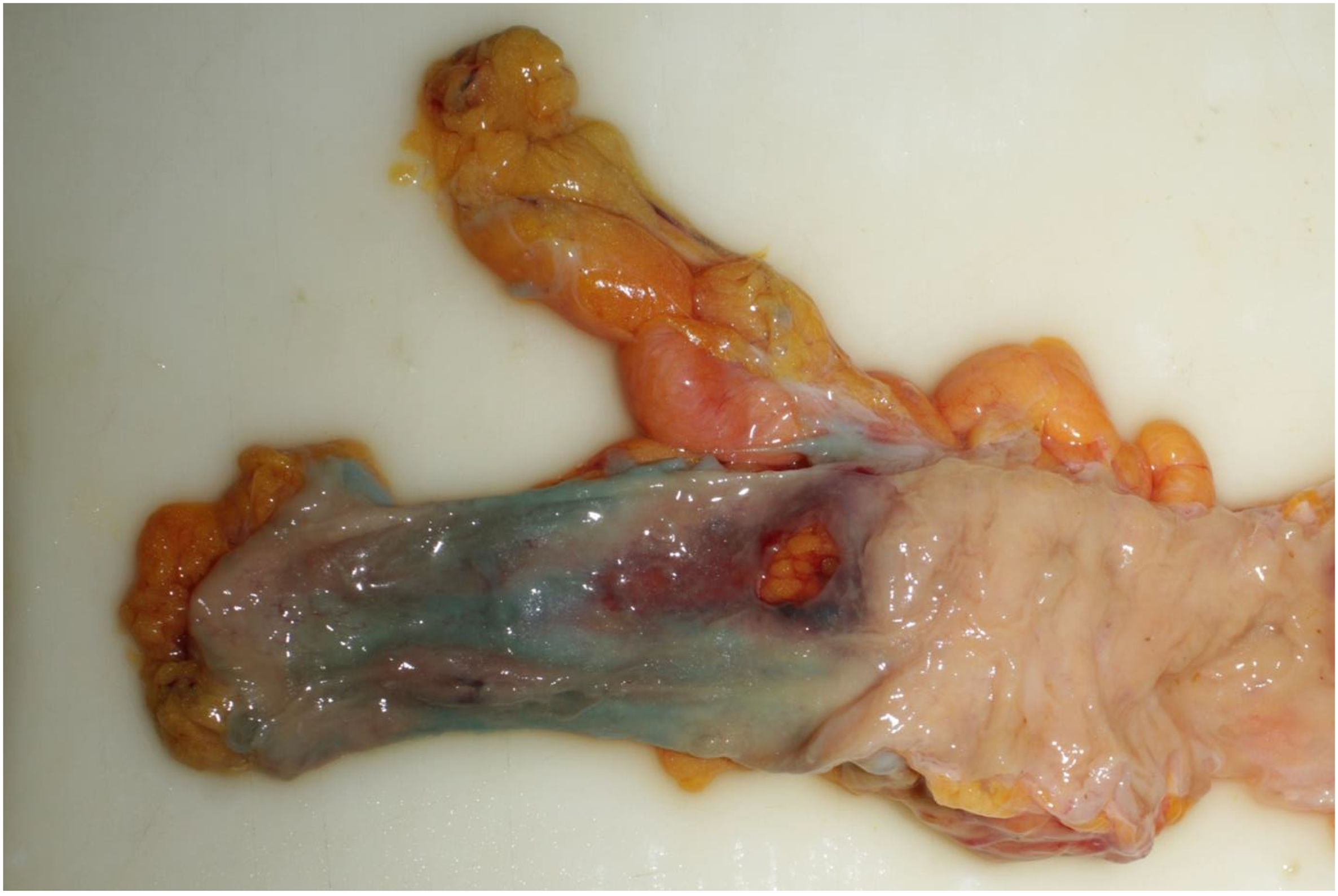
Methylene blue can also cause characteristic colouration when utilised in chromocolonoscopy,4 where it is used to increase the detection rate of colorectal neoplasms.5Fig. 1 shows an example of this type of staining at autopsy, which comes from a case in which a perforation of the colon occurred during a colonoscopy. The perforation was located in the area of a section of mucosa stained with methylene blue.

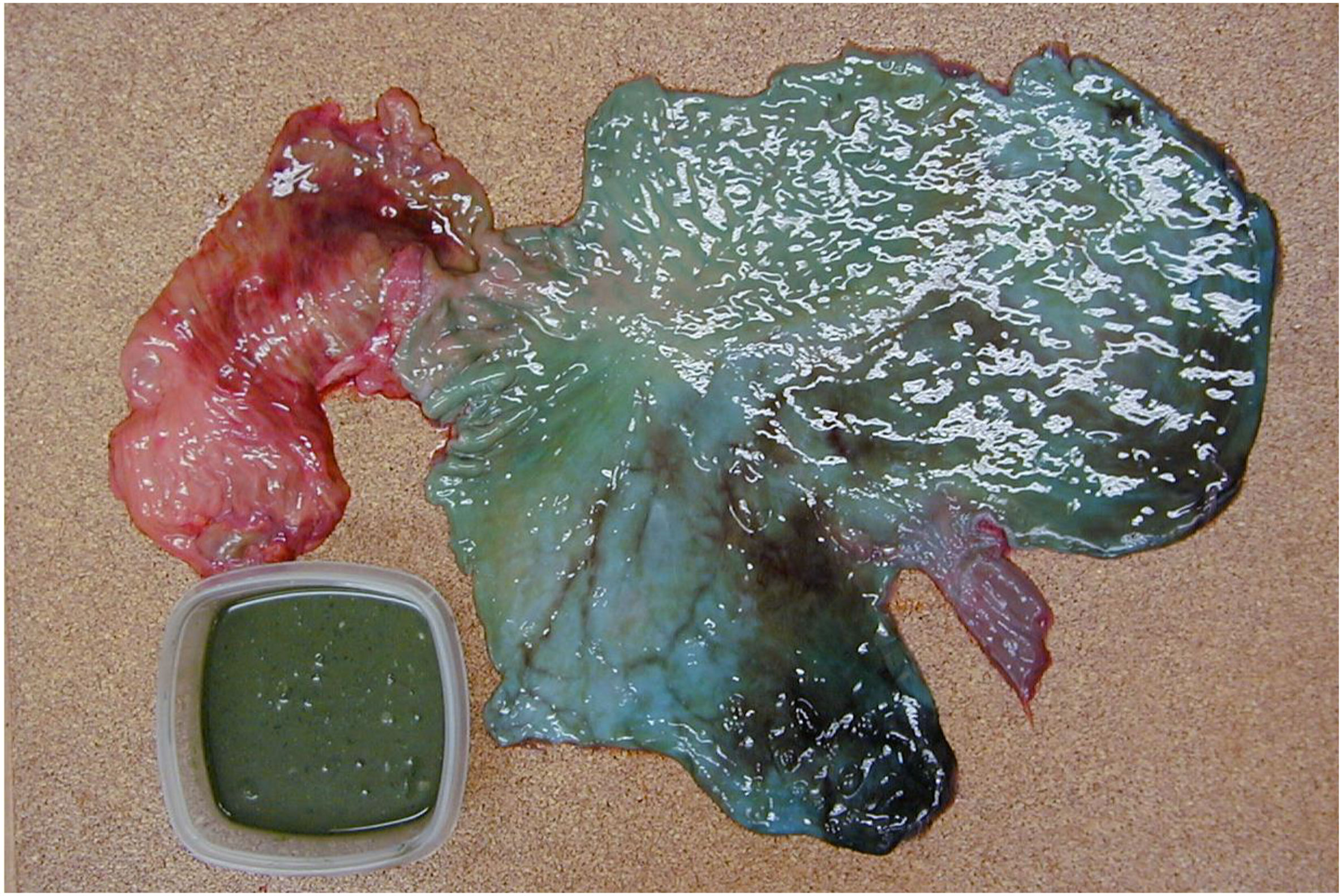
The differential diagnosis for turquoise colouration in the gastrointestinal tract, especially in forensic autopsies, should be oral poisoning.6 A particularly impressive finding was a strongly turquoise gastric mucosa in the death of a drug addict (Fig. 2). Toxicology tests revealed fatal poisoning with flunitrazepam, among other substances. To this benzodiazepine, which is also used as a substance that facilitates sexual aggression 7 Manufacturers add the indigocarmine (E 132) blue dye to it to make it difficult to administer unnoticed, for example, in drinks. In the present case, the drug was taken in the context of a polydrug addiction.

We would like to thank the authors for their valuable contribution. This clearly demonstrates how important macroscopic examination is and how significant unusual findings can be if the observer has extensive morphological knowledge. In this same vein, a quote from Goethe is highly significant for morphological diagnosis as a whole: “What is the most difficult thing of all? What seems easiest to you: to see with your own eyes what is actually in front of them.”
Please cite this article as: Birngruber CG, Plenzig S, Nieß C, Baumgarten J, Carta al editor sobre el artículo Coloración visceral post mortem debido al azul de metileno. Revista Española de Medicina Legal. 2025. https://doi.org/10.1016/j.reml.2024.08.002.
