






The evaluation of breast lesions with minimally invasive image-guided techniques (ultrasound, mammography or magnetic resonance imaging) is becoming more frequent and allows obtaining tissue material for diagnóstico and in case of malignancy to determine prognostic and predictive factors. In many cases, these techniques remove almost the entire lesion, requiring the placement of a marker for subsequent location of the area to be surgically removed.1
There are many devices that have been used as a marker of the lesion visible by imaging techniques. One of them is the HydroMark© (Devicor Medical Japan, Tokyo, Japan) which consists of a water-soluble, synthetic polyethylene glycol-based hydrogel with a centrally embedded titanium or stainless steel coil. This device is visible by ultrasound, mammography or magnetic resonance imaging, and it can be placed by any of these methods, being easily located during surgery by ultrasound.2
Once inserted, the HydroMark© absorbs water molecules from the surrounding tissue creating the hydrogel.3
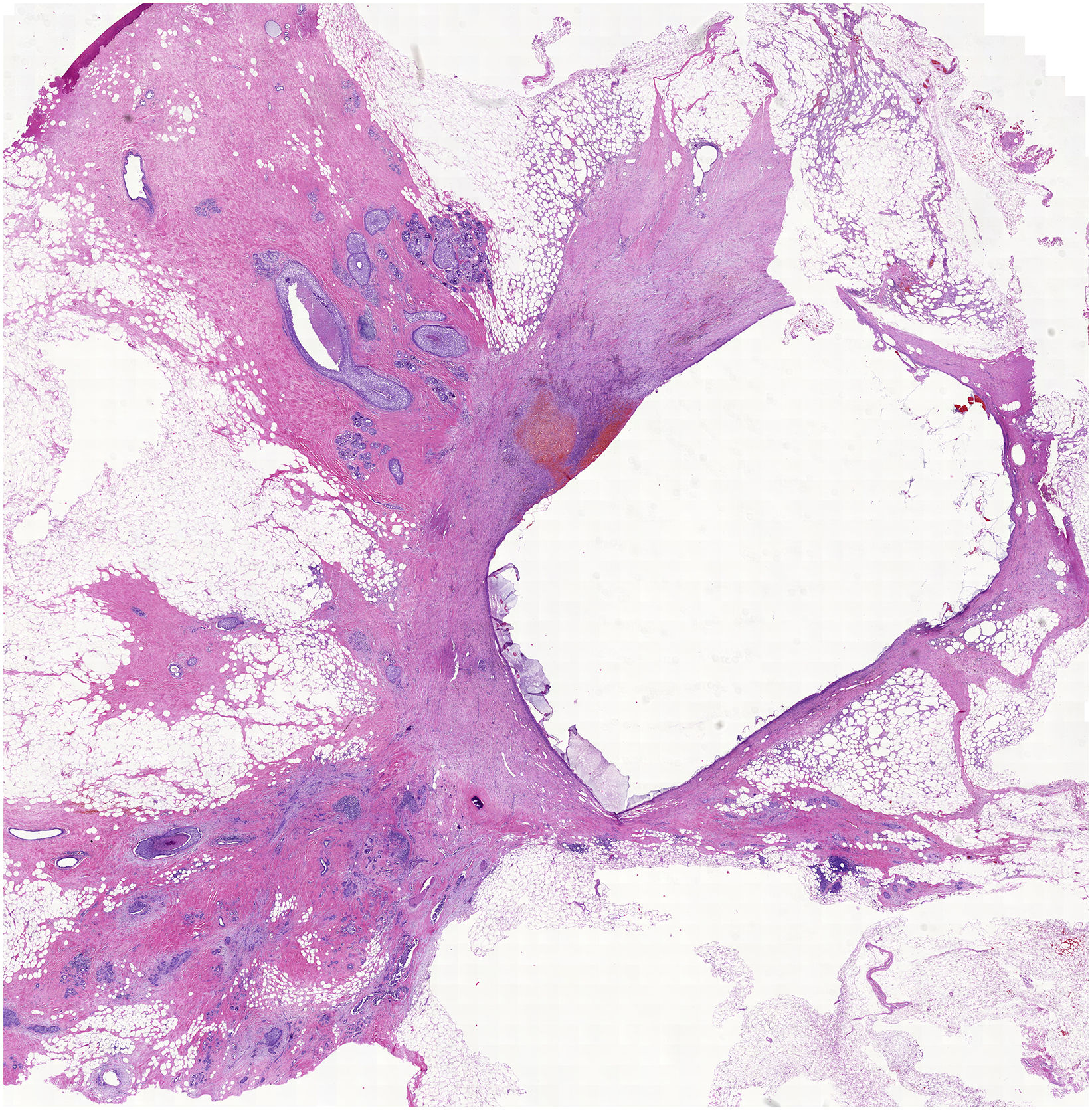
We present a case of a 49-year-old patient with a spiculated lesion in the right breast. This lesion was biopsied by vacuum assisted, and a HydroMark© was placed (Fig. 1). The result was infiltrating carcinoma of non-special type with foci of high-grade intraductal carcinoma with luminal A molecular subtype. After twenty days, the lesion was removed, and the surgical specimen showed the hydrogel in the center of a pseudocystic lesion (Fig. 2) surrounded by a histiocytic proliferation like the synovial lining in an image similar to that seen lining the pseudocapsule of breast prostheses (Fig. 3). There were also foci of residual carcinoma after the previous biopsy. Three sentinel lymph nodes were negative (Fig. 2).


Microscopic image of the surgical biopsy with the space of HydroMark© surrounded by fibrous tissue with residual infiltrating and intraductal carcinoma. The original device measures 3 mm in diameter by 16 mm in length. The space occupied by the HydroMark in the resection specimen measures approximately 7 × 10 mm. Its increase is due to the tissue water absorption by the device.

From the literature reviewed, we have found only one paper illustrating a histological picture of the hydrogel reaction describing a foreign body-type granulomatous reaction with multinucleated giant cells.2 We have not found data on synovial-like metaplasia in these cases. This type of metaplasia has been widely described in tissue reaction to breast implants and has been related to capsule contracture.4
Data confidentialityThe authors declare that they have followed their center's protocols on the publication of patient data and have obtained the corresponding permissions.
Patient consentThe authors declare that they have obtained the consent of the patient for the publication of the article, and the work has been approved by the ethics committee of the center with the reference 2024/109-GIN-DEX (19-12-2024).
FundingThis work has not received any type of funding.
FT is coeditor of the Revista Española de Senologia y Patología Mamaria. The other authors declare that they have no conflict of interest.


