


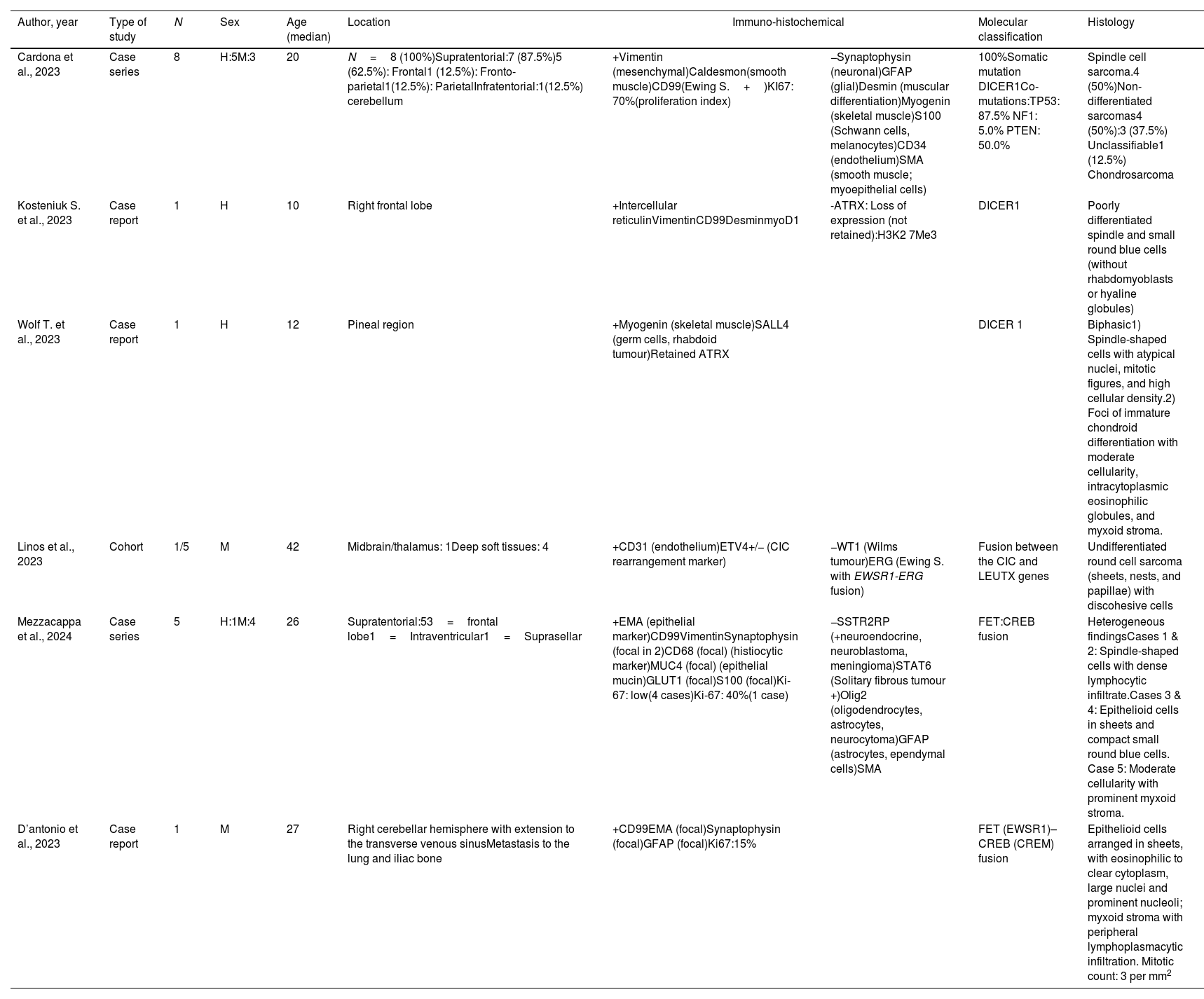
Primary mesenchymal tumours of the central nervous system with uncertain differentiation are rare. The 5th edition of the WHO classification groups three of these entities according to their molecular profiles into: intracranial mesenchymal tumours with FET-CREB fusion, sarcomas with CIC rearrangement, and primary intracranial sarcomas with DICER1 mutations. The objectives of this study were to carry out a systematic review of the literature and to determine whether a specific morphology predominates in relation to the proposed molecular types.
Materials and methodsA systematic review was performed using the PubMed database, with the search terms: “(sarcomas) and (central nervous system)”. Studies were included if they reported cases of patients with a diagnosis of primary sarcoma in the central nervous system (CNS) and provided information on both the molecular profile and histopathological characteristics.
ResultsOf the 173 articles identified, eight were ultimately selected for analysis.
ConclusionsHistopathological differences were observed that may assist in diagnosis in the absence of molecular testing; however, follow-up data are required to evaluate the benefits of this classification in clinical practice.
Los tumores mesenquimales primarios del sistema nervioso central con diferenciación incierta son poco frecuentes. La 5.ª edición de la clasificación de la OMS agrupa 3 de ellos según sus perfiles moleculares: tumores mesenquimales intracraneales con fusión FET-CREB, sarcomas con reordenamiento CIC y sarcomas intracraneales primarios con mutación en DICER1. Los objetivos de este trabajo fueron hacer una revisión sistemática del tema y determinar si existe un predominio morfológico específico en relación con los tipos moleculares propuestos.
Materiales y métodosSe realizó una revisión sistemática utilizando la base de datos PubMed, con los términos «(sarcomas) and (central nervous system)». Se incluyeron estudios que notificaron casos de pacientes con diagnóstico de sarcoma primario del sistema nervioso central y que proporcionaron información sobre el perfil molecular y las características histopatológicas.
ResultadosDe los 173 artículos encontrados, finalmente se seleccionaron 8.
ConclusionesSe observaron diferencias histopatológicas que pueden orientar el diagnóstico en ausencia de pruebas moleculares; sin embargo, se requiere información de seguimiento para evaluar los beneficios de esta clasificación en la práctica clínica.