


metricas
covid
Revista Española de Medicina Nuclear e Imagen Molecular (English Edition) PET/CT in breast cancer
Journal Information
Vol. 44. Issue 6.
(November - December 2025)
Visits
21
Vol. 44. Issue 6.
(November - December 2025)
Continuing Education
PET/CT in breast cancer
PET/CT en cáncer de mama
Visits
21
J.F. Bastidasa,b,c,
Corresponding author
jf.bastidas.ta@gmail.com

Corresponding author.
, M. Martínez de Bourio-Allonaa, A. Roteta Unceta Barrenechead,c, M. Rodríguez-Frailee,c, L. Sanchof,c
a Servicio de Medicina Nuclear, Hospital Universitario Fundación Jiménez Díaz, Madrid, Spain
b Servicio de Medicina Nuclear, Axxis Hospital de Especialidades, Quito, Ecuador
c Grupo de Trabajo de Oncología de la SEMNIM, Spain
d Servicio de Medicina Nuclear, Hospital Universitario Donostia – Onkologikoa, San Sebastián, Spain
e Servicio de Medicina Nuclear, Clínica Universidad de Navarra, Pamplona, Spain
f Servicio de Medicina Nuclear, Clínica Universidad de Navarra, Madrid, Spain
This item has received
Article information
Abstract
Full Text
Bibliography
Download PDF
Statistics
Figures (4)
Show moreShow less
Tables (5)
Table 1. Molecular classification of breast cancer and clinical characteristics.
Tables
Table 2. TNM classification of breast cancer.
Tables
Table 3. TNM classification of early, locally advanced and metastastic breast cancer.10
Tables
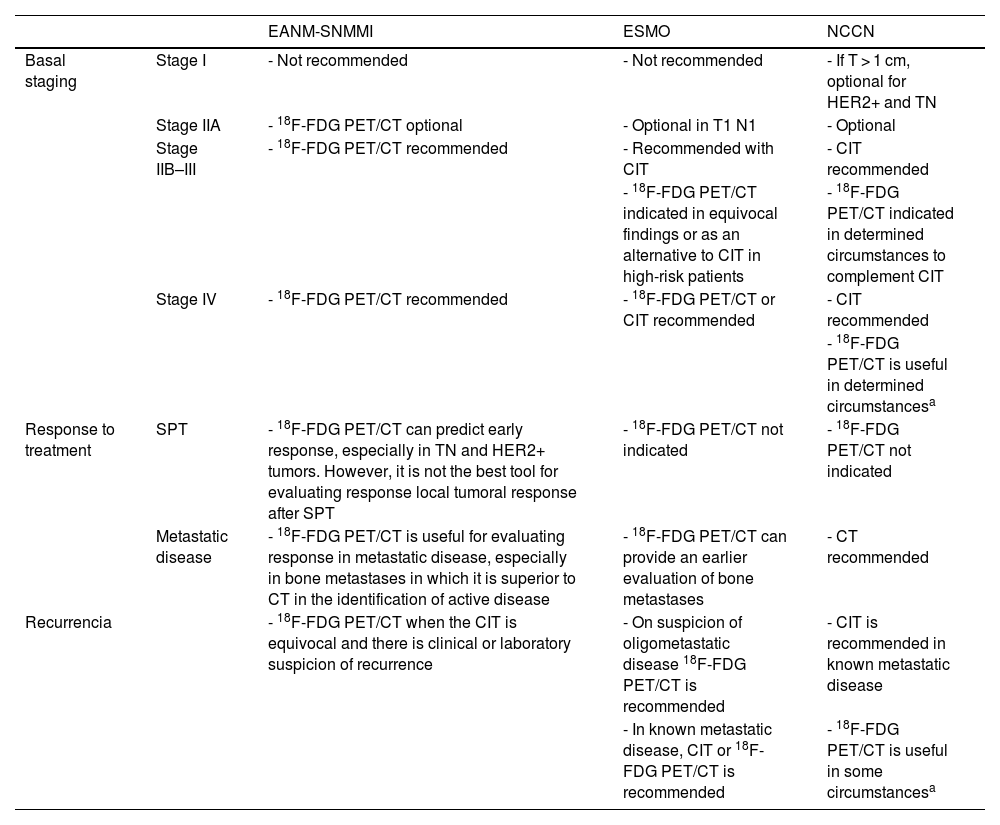
Table 4. Recommendations for the use of 18F-FDG PET/CT in breast cancer according to the EANM-SNMMI, ESMO and NCCN.
Tables
Table 5. Comparison of the main radiopharmaceuticals used in the evaluation of breast cancer.
Tables
Show moreShow less
Abstract

Breast cancer is one of the most prevalent neoplasms worldwide, with molecular subtypes that influence prognosis and therapeutic strategies. PET/CT with different radiopharmaceuticals has revolutionized diagnosis, staging, and treatment monitoring. [18F]-Fluorodeoxyglucose remains the most widely used radiotracer, but it has limitations in certain subtypes, such as invasive lobular carcinoma, where 16α-[18F] fluoro-17β-estradiol and [68Ga]-FAPI (fibroblast activation protein inhibitors) have demonstrated greater utility. Today, HER2-targeted radiopharmaceuticals, such as [89Zr]-trastuzumab, allow for a precise assessment of tumor heterogeneity. PET/CT also plays a key role in detecting bone metastases using [18F]-NaF and in identifying new therapeutic targets, such as PSMA (prostate-specific membrane antigen) and GRPR (gastrin-releasing peptide receptor). These advancements establish molecular imaging as an essential tool for personalizing breast cancer treatment, optimizing clinical decision-making, and improving diagnostic accuracy.

Keywords:
Breast cancer
NST
ILC
FDG
FES
HER2
FAPI
Resumen

El cáncer de mama es una de las neoplasias más prevalentes en el mundo, con subtipos moleculares que influyen en el pronóstico y las estrategias terapéuticas. La PET/CT con diferentes radiofármacos ha revolucionado el diagnóstico, la estadificación y la monitorización del tratamiento. La [18F]-Fluorodesoxiglucosa sigue siendo el radiofármaco más utilizado, pero presenta limitaciones en subtipos como el carcinoma lobulillar infiltrante, donde el16α-[18F]fluoro-17β-estradiol y el [68Ga]-FAPI (inhibidores de la proteína activadora de fibroblastos) han demostrado mayor utilidad. Hoy en día existen radiofármacos dirigidos a HER2, como el [89Zr]-trastuzumab, que permiten una evaluación precisa de la heterogeneidad tumoral. La PET/CT también desempeña un papel clave en la detección de metástasis óseas mediante [18F]-NaF y en la identificación de nuevas dianas terapéuticas, como PSMA (Antígeno prostático específico de membrana) y GRPR (Receptor del péptido liberador de gastrina). Estos avances consolidan la imagen molecular como una herramienta esencial para la personalización del tratamiento en cáncer de mama, optimizando las decisiones clínicas y mejorando la precisión diagnóstica.

Palabras clave:
Cáncer de mama
NST
CLI
FDG
FES
HER2
FAPI

Article

These are the options to access the full texts of the publication Revista Española de Medicina Nuclear e Imagen Molecular (English Edition)
Member
If you are a member of the Spanish Society of Nuclear Medicine and Molecular Imaging (SEMNIM), you can access the full text of the contents of the Revista Española de Medicina Nuclear e Imagen Molecular through the journal links published on the SEMNIM website (link: http://socios.semnim.es/?ir-a=remnim), after logging in as a member.

If you experience access problems, you can contact the SEMNIM Technical Secretariat by email at secretaria.tecnica@semnim.es or by phone at +34 619 594 780.
Subscriber
Subscriber

If you already have your login data, please click here .

If you have forgotten your password you can you can recover it by clicking here and selecting the option “I have forgotten my password”
Subscribe
Subscribe to

Revista Española de Medicina Nuclear e Imagen Molecular (English Edition)

Purchase
Purchase article

Purchasing article the PDF version will be downloaded

Purchase now
Contact
Phone for subscriptions and reporting of errors
From Monday to Friday from 9 a.m. to 6 p.m. (GMT + 1) except for the months of July and August which will be from 9 a.m. to 3 p.m.
Calls from Spain
932 415 960
Calls from outside Spain
+34 932 415 960
E-mail
Article options
Tools
