



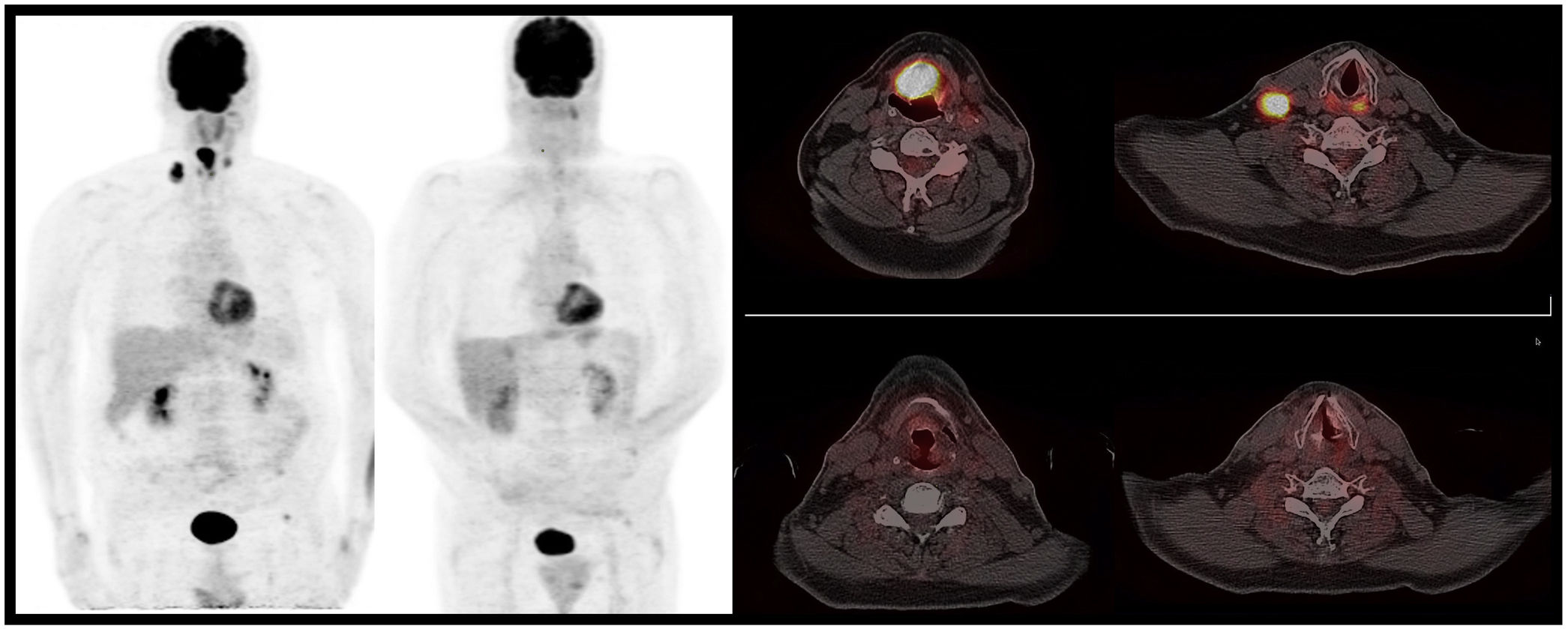



To assess the clinical utility of PERCIST and Hopkins criteria and changes in [18F]FDG PET/CT quantitative parameters as prognostic factors for progression-free survival (PFS) and cancer-specific survival (CSS) in patients with head and neck squamous cell carcinoma treated by chemoradiotherapy.
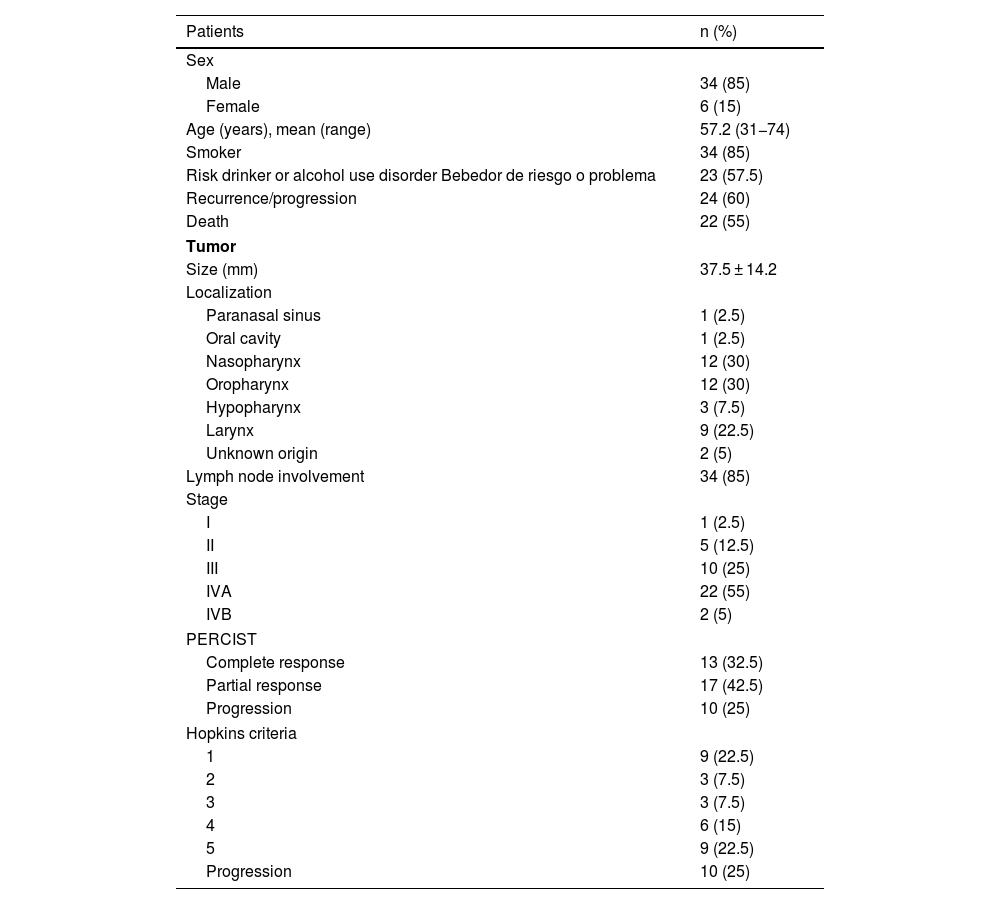
Material and methodsForty patients (34 men) diagnosed with head and neck squamous cell carcinoma were retrospectively assessed over an interval of 8 years. PERCIST and Hopkins criteria were used to assess response to treatment. Variations in the metabolic parameters maximum SUV (ΔSUVmax), metabolic tumor volume (ΔMTV) and total lesion glycolysis (ΔTLG) between pre- and post-treatment PET/CT studies were also determined. The Cox regression model, ROC curves and the Kaplan–Meier method were used for the analysis of prognostic factors and survival curves.
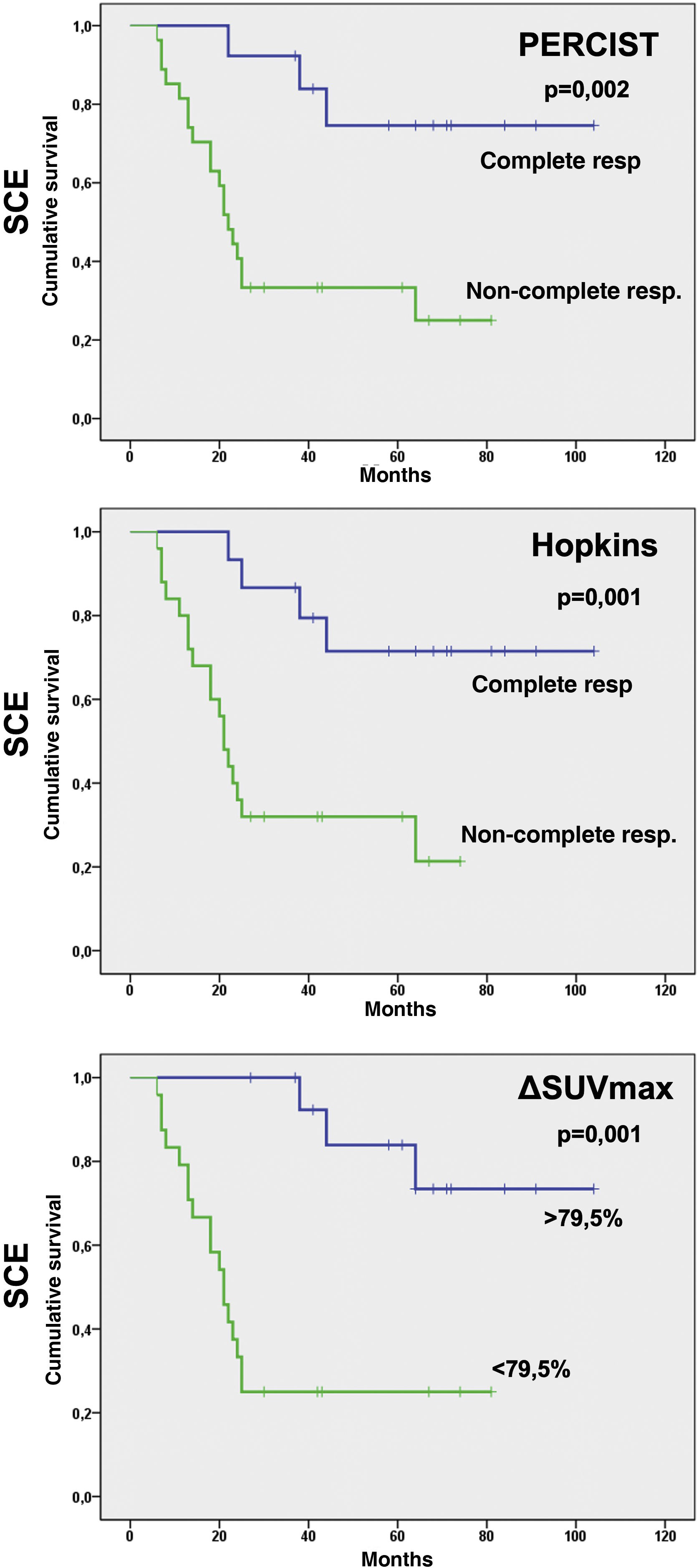
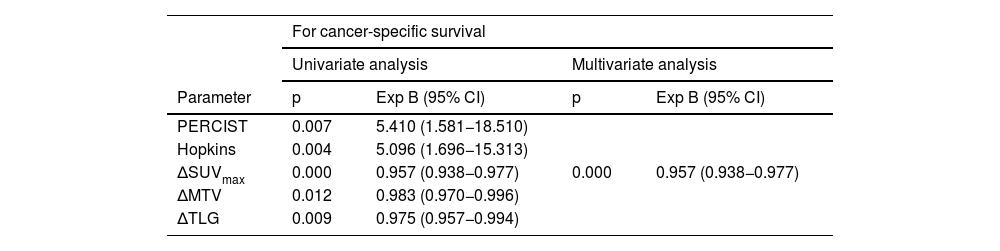
ResultsThe mean follow-up was 39.4 months, with 24 progressions and 22 deaths. Both PERCIST and Hopkins criteria and the three metabolic parameters were predictive factors in the univariate analysis and only ΔSUVmax was in the multivariate analysis. Survival analysis showed statistically significant differences in PFS and CSS curves for the five parameters considered.
ConclusionApplication of PERCIST and Hopkins criteria as well as ΔSUVmax, ΔMTV and ΔTLG from PET/CT studies proved to be prognostic factors for survival in patients in our setting for treating head and neck cancer. The results may help to personalize treatment.
Valorar la utilidad clínica de los criterios PERCIST, Hopkins y de los cambios en los parámetros cuantitativos de la PET/TC con [18F]FDG como factores pronósticos para la supervivencia libre de progresión (SLP) y la supervivencia cáncer específica (SCE) en pacientes con cáncer escamoso de cabeza y cuello tratados mediante quimiorradioterapia.
Material y métodosSe valoraron retrospectivamente 40 pacientes (34 hombres) diagnosticados de cáncer escamoso de cabeza y cuello durante un intervalo de 8 años. Se utilizaron los criterios PERCIST y Hopkins para determinar la respuesta al tratamiento. Asimismo, se cuantificaron las variaciones de los parámetros metabólicos SUV máximo (ΔSUVmax), volumen metabólico tumoral (ΔMTV) y glicólisis tumoral total (ΔTLG) entre los estudios PET/TC pre y postratamiento. El modelo de regresión de Cox, las curvas ROC y el método de Kaplan–Meier y se aplicaron para el análisis de factores pronósticos y curvas de supervivencia.
ResultadosEl seguimiento medio fue de 39,4 meses produciéndose 24 recidivas-progresiones y 22 muertes. Tanto los criterios PERCIST y Hopkins como los tres parámetros metabólicos fueron factores predictivos en análisis univariante y solo el ΔSUVmax en el multivariante. El análisis de supervivencia mostró curvas de SLP y SCE significativamente diferentes para los cinco parámetros considerados.
ConclusiónLa aplicación de los criterios PERCIST y Hopkins, así como los ΔSUVmax, ΔMTV y ΔTLG de los estudios PET/TC demostraron ser factores pronósticos para la supervivencia en pacientes de nuestro entorno tratados por cáncer de cabeza y cuello. Los resultados podrían ayudar a personalizar el tratamiento.
Article
If you experience access problems, you can contact the SEMNIM Technical Secretariat by email at secretaria.tecnica@semnim.es or by phone at +34 619 594 780.
Revista Española de Medicina Nuclear e Imagen Molecular (English Edition)

