



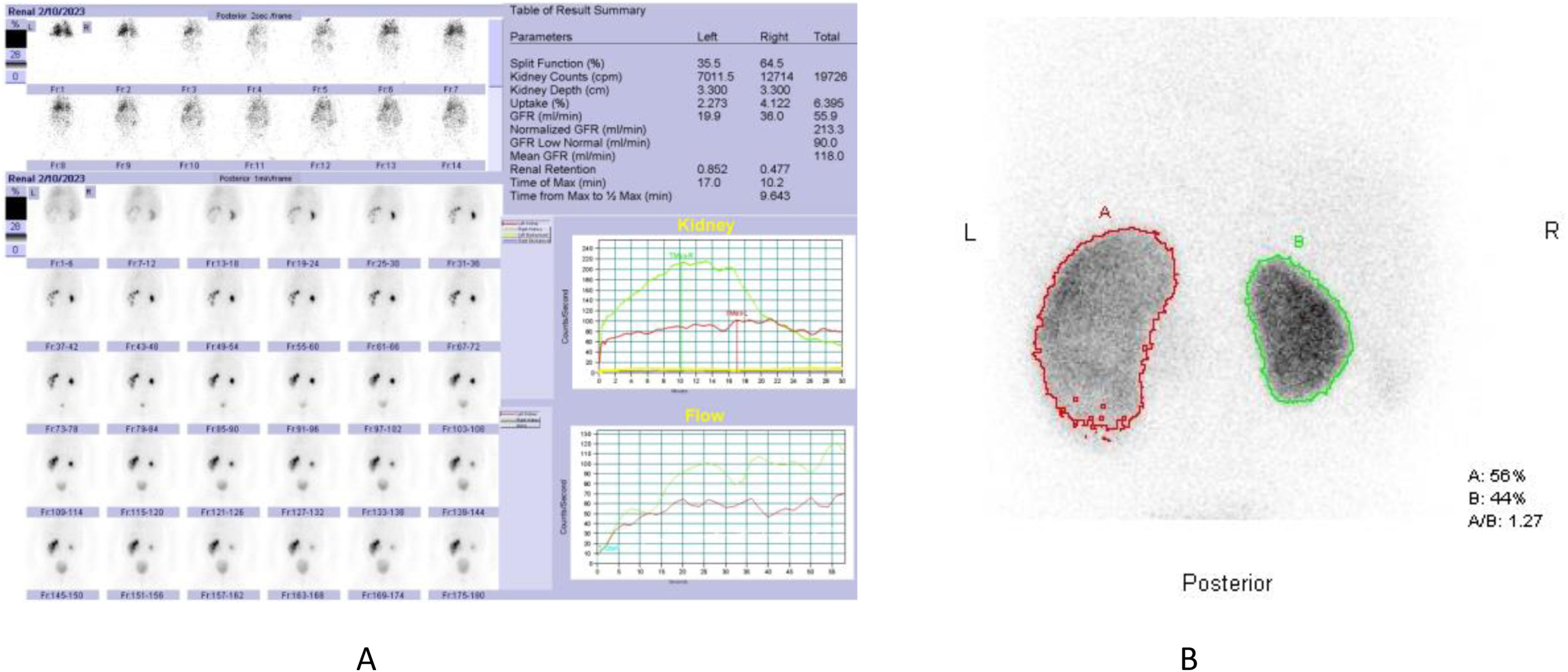
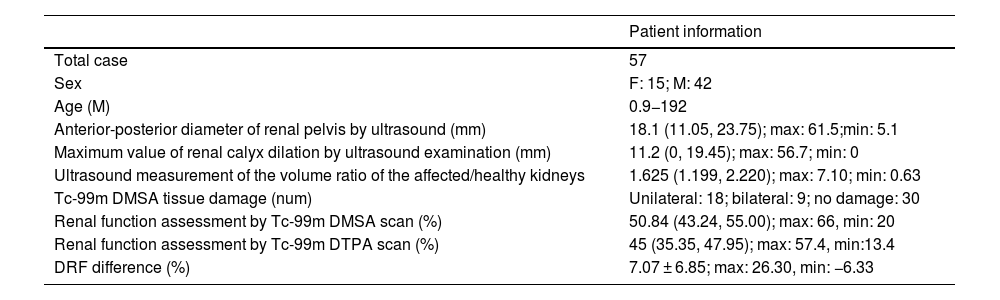
This study aims to compare differential renal function (DRF) results obtained from Tc-99m DTPA and Tc-99m DMSA scintigraphy in children with urinary tract infection (UTI) combined with varying degrees of hydronephrosis. We evaluate the diagnostic performance of both methods and provide recommendations for selecting individualized imaging strategies based on specific case characteristics.
MethodsA retrospective analysis was conducted on 57 children with UTI combined with ipsilateral hydronephrosis. Clinical data collected included gender, age, urinary ultrasound findings, and results from renal dynamic and static scintigraphy. Hydronephrosis was classified by ultrasound into mild (<15 mm), moderate (15–30 mm), and severe (>30 mm). The kidney volume ratio between the affected and unaffected sides was calculated. DRF percentages for each kidney were separately obtained from both scintigraphy methods, and the deviation in DRF of the affected kidney was calculated. Based on the degree of deviation, results were categorized as normal (<5%), differing (5%–10%), or significantly different (>10%). The non-parametric Mann–Whitney U test was used to compare DRF values between Tc-99m DMSA and Tc-99m DTPA. Spearman correlation analysis assessed the relationship between hydronephrosis and DRF deviation. Receiver operating characteristic (ROC) curves were used to determine diagnostic thresholds and assess the predictive value of renal pelvic and calyceal dilation for DRF deviations.
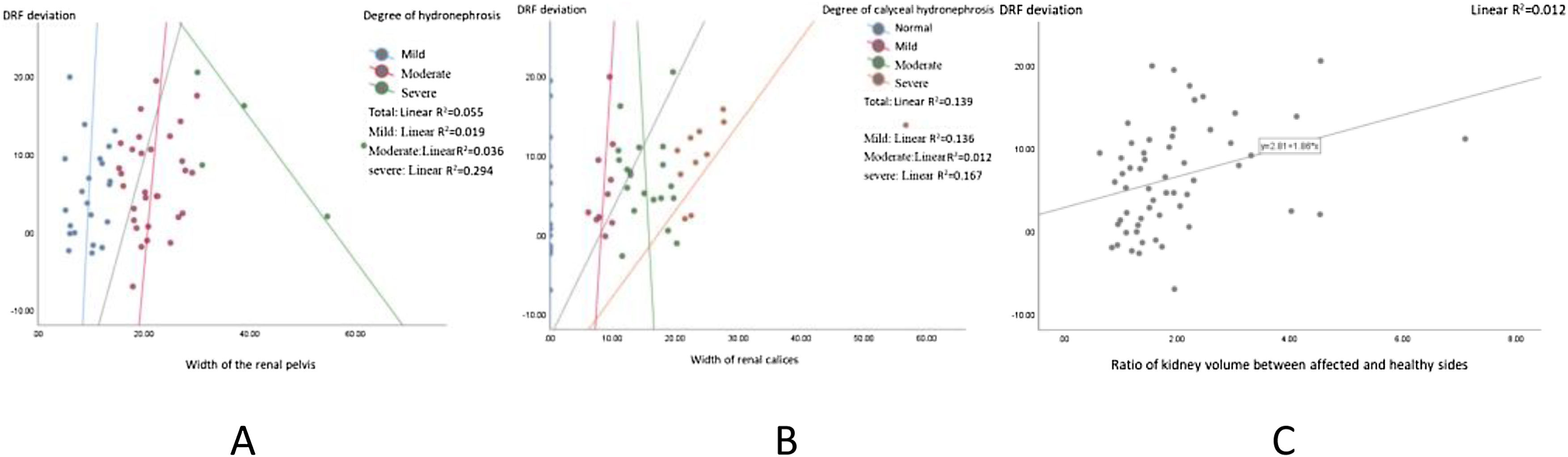
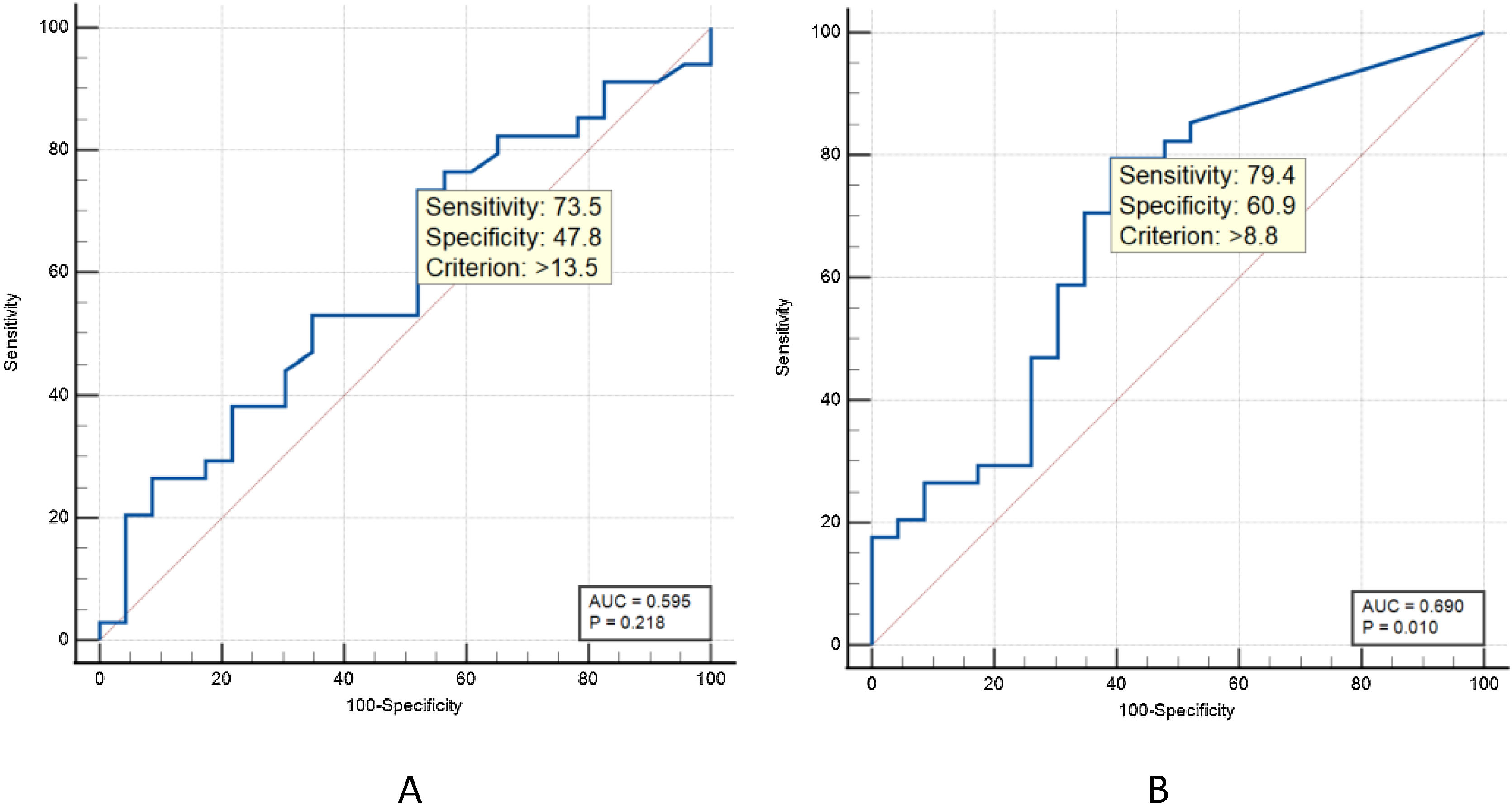
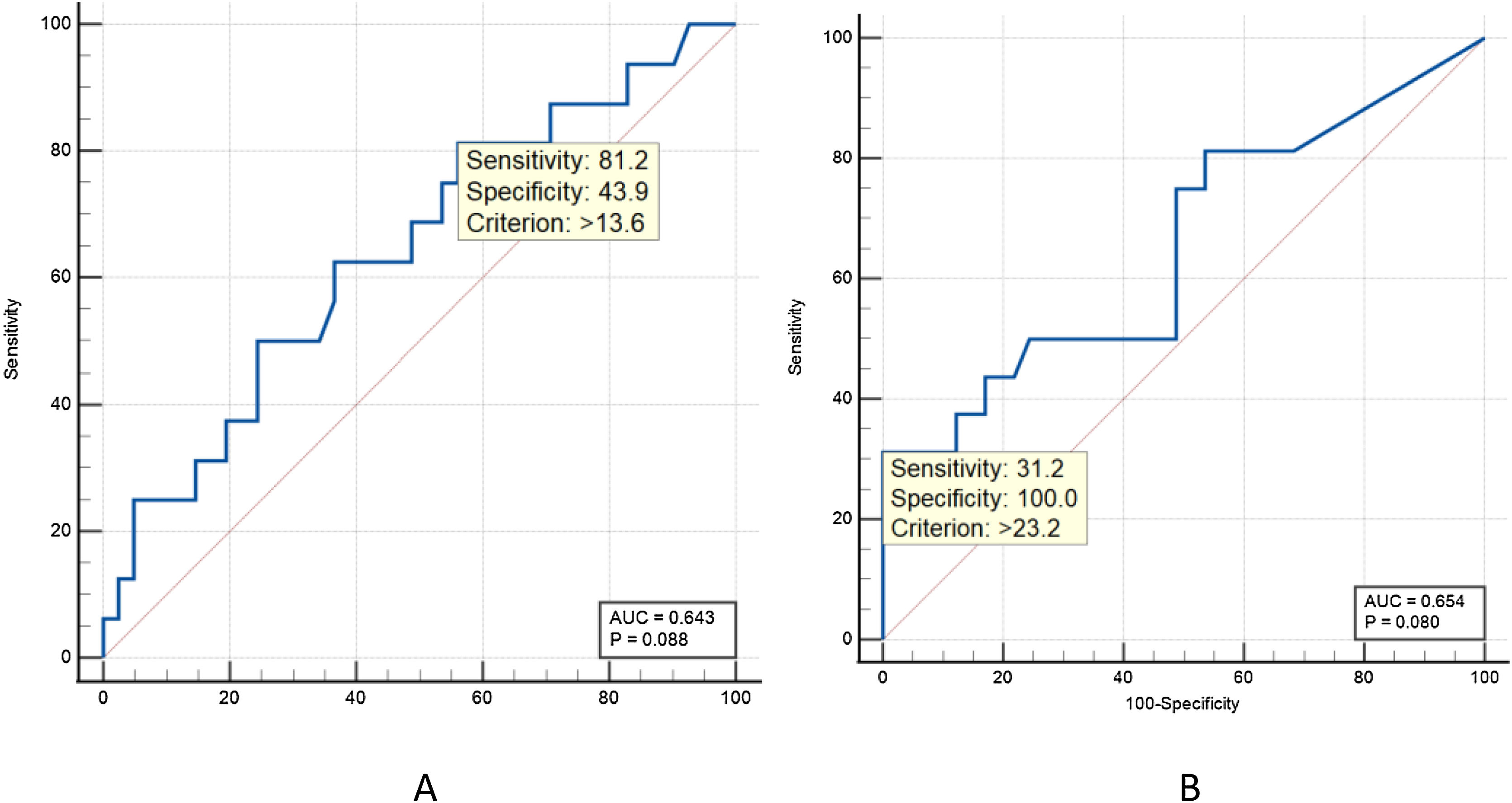
ResultsAmong the 57 children, the median DRF of the affected kidney was 50.84% (IQR: 43.24,55.00) by Tc-99m DMSA and45% (IQR: 35.35, 47.95) by Tc-99m DTPA, with the difference being statistically significant (Z = −4.074, p < 0.000). Of these, 34 children had a DRF deviation > 5%, and 16 had a deviation >10%. Positive correlations were observed between DRF deviation and renal pelvic dilation (r = 0.299, p = 0.024), calyceal dilation (r = 0.235, p = 0.078), and kidney volume ratio (r = 4.416, p = 0.001). A renal pelvic dilation >13.5 mm or calyceal dilation >8.8 mm predicted DRF deviations >5% with a sensitivity of 73.5% and 79.4%, respctively. For deviations >10%, a calyceal dilation long axis >23.2 mm yielded a diagnostic specificity of 100%.
ConclusionTc-99m DMSA-derived DRF may be affected by the degree of hydronephrosis. In children with UTI combined with hydronephrosis, significant differences in DRF assessment exist between Tc-99m DMSA and Tc-99m DTPA. When renal pelvic dilation exceeds 13.5 mm or calyceal diameter reaches 23.2 mm, Tc-99m DMSA may overestimate renal function. In such cases, Tc-99m DTPA should be considered for more accurate functional evaluation.
Este estudio tiene como objetivo comparar los resultados de la función renal diferencial (FRD) obtenidos de la gammagrafía con Tc-99m DTPA y Tc-99m DMSA en niños con infección del tracto urinario (ITU) combinada con diferentes grados de hidronefrosis.Evaluamos el desempeño diagnóstico de ambos métodos y proporcionamos recomendaciones para seleccionar estrategias de imágenes individualizadas basadas en las características específicas de cada caso.
MétodosSe realizó un análisis retrospectivo de 57 niños con IU combinada con hidronefrosis ipsilateral.Los datos clínicos recogidos incluyeron el sexo, la edad, los hallazgos ecouriny los resultados de la gammagrafía dinámica y estática renal. La hidronefrosis se clasificó mediante ecografía en leve (<15 mm), moderada (15−30 mm) y severa (>30 mm). Se calculó la relación de volumen renal entre el lado afectado y el no afectado. Los porcentajes de DRF para cada riñón se obtuvieron por separado de ambos métodos de gammagrafía, y se calculó la desviación en la DRF del riñón afectado.Con base en el grado de desviación, los resultados fueron categorizados como normales (<5%), diferentes (5%–10%) o significativamente diferentes (>10%). Se utilizó la prueba no paramétrica de la U de Mann–Whitney para comparar los valores de DRF entre Tc-99m DMSA y Tc-99m DTPA.El análisis de correlación de Spearman evaluó la relación entre la hidronefrosis y la desviación de DRF. Se utilizaron las curvas ROC para determinar los umbrales diagnósticos y evaluar el valor predicde la dilatde la pelvis renal y el cáliz para las desviaciones de la DRF.
ResultadosEntre los 57 niños, la mediana de DRF del riñón afectado fue de 50.84% (riq: 43.24,55.00) por DMSA Tc-99m y 45% (riq: 35.35, 47.95) por DTPA Tc-99m, siendo la diferencia estadísticamente significativa (Z = −4.074, p ≥ 0.000). De estos, 34 niños tuvieron una desviación de DRF > 5% y 16 tuvieron una desviación >10%. Se observaron correlaciones positivas entre la desviación del DRF y la dilatación pélvicrenal (r = 0,299, p = 0,024), la dilatcalyceal (r = 0,235, p = 0,078) y la relación de volumen renal (r = 4,416, p = 0,001). Una dilatación de la pelvis renal >13,5 mm o una dilatdel cáliz >8,8 mm predijeron desviaciones de la DRF > 5% con una sensibilidad de 73,5% y 79,4%, respectivamente. Para desviaciones >10%, una dilatcalicial eje largo >23,2 mm produjo una especificidad diagnóstica de 100%.
ConclusiónLa DRF derivada del Tc-99m dmsa puede verse afectada por el grado de hidronefrosis. En niños con ITU combinada con hidronefrosis, existen diferencias significativas en la evaluación de DRF entre Tc-99m DMSA y Tc-99m DTPA. Cuando la dilatación pélvicrenal excede 13,5 mm o el diámetro caliceal alcanza 23,2 mm, la DMSA Tc-99m puede sobreestimar la función renal. En tales casos, debe considerarse el Tc-99m DTPA para una evaluación funcional más precisa.
Article
If you experience access problems, you can contact the SEMNIM Technical Secretariat by email at secretaria.tecnica@semnim.es or by phone at +34 619 594 780.
Revista Española de Medicina Nuclear e Imagen Molecular (English Edition)

