



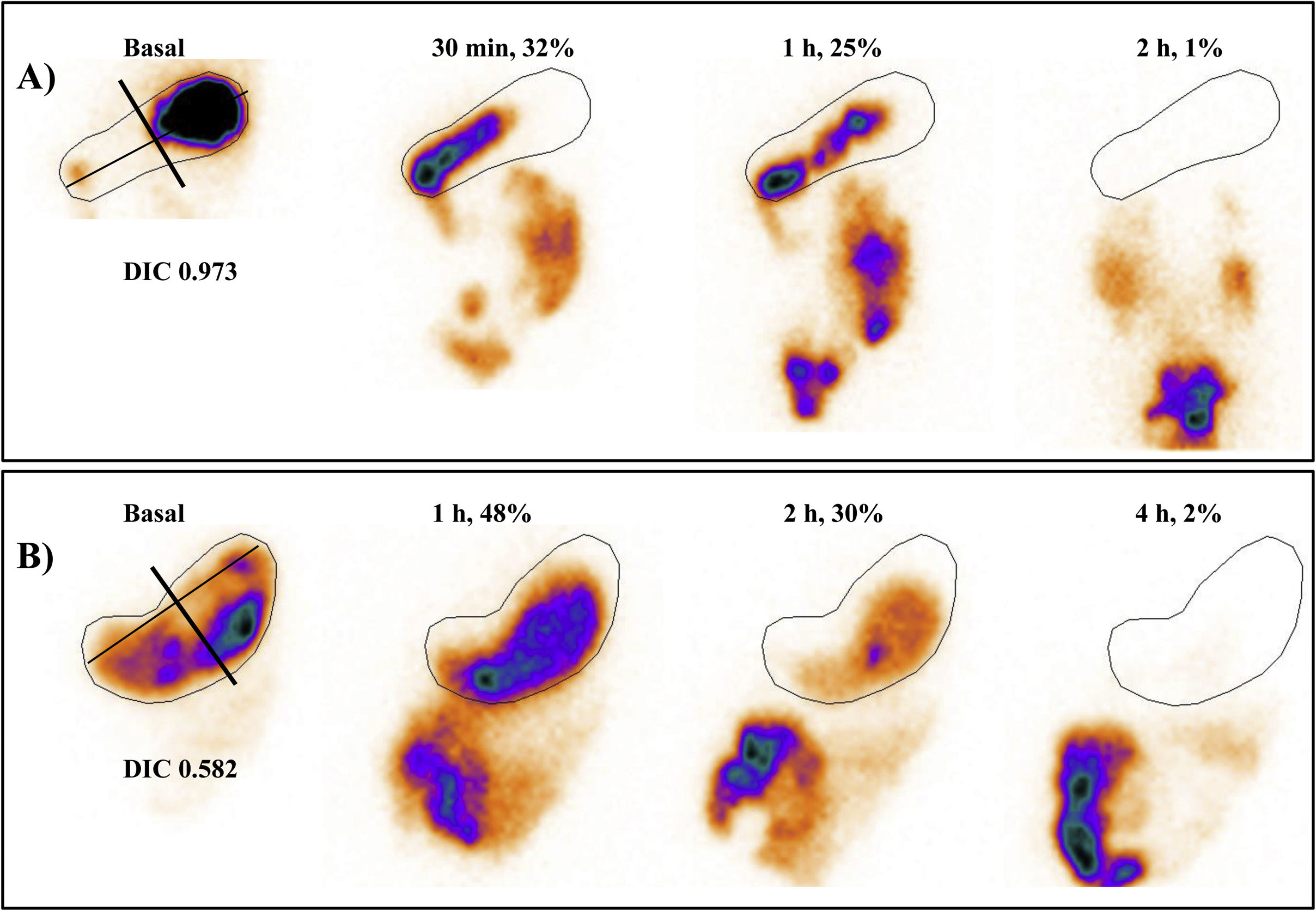
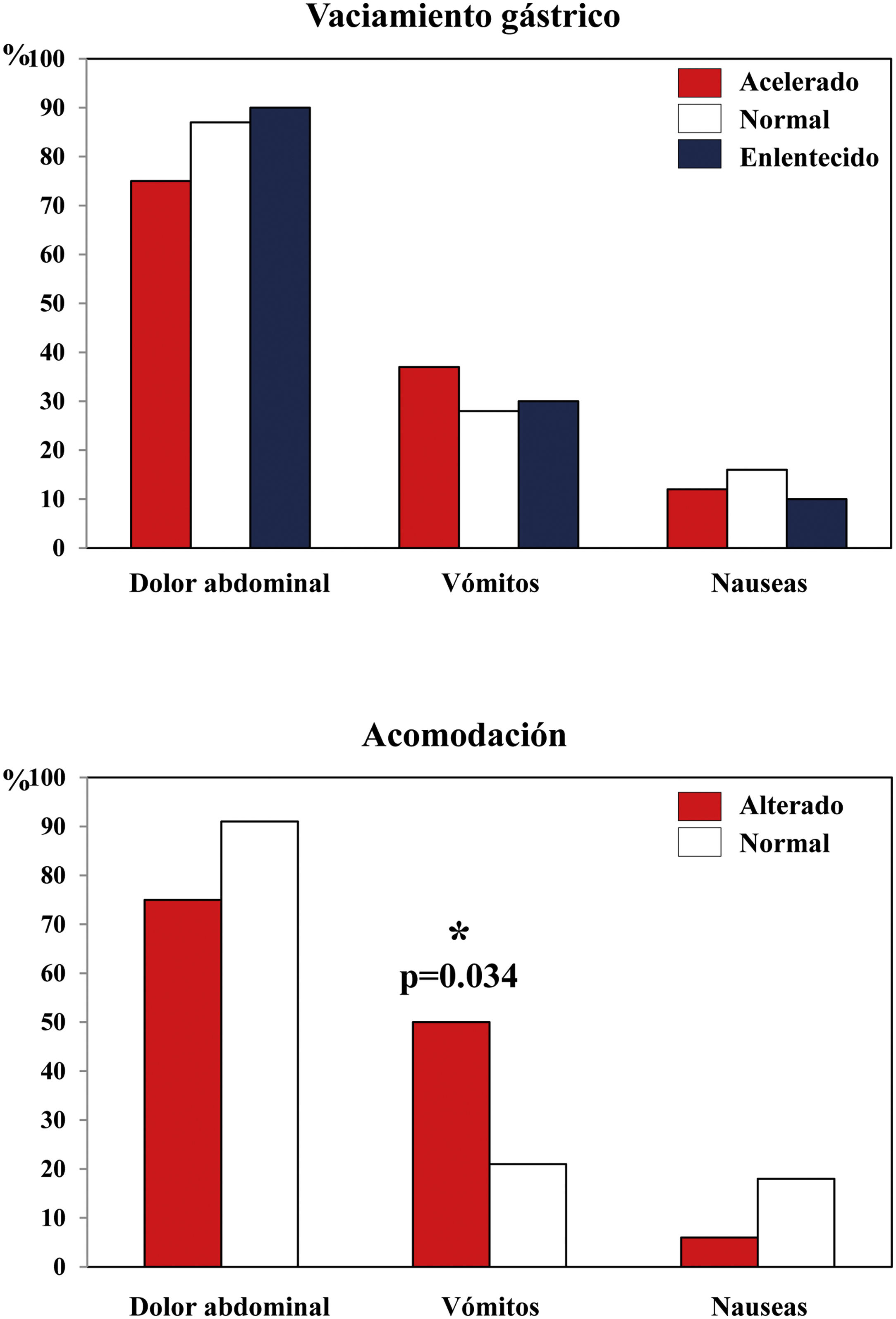
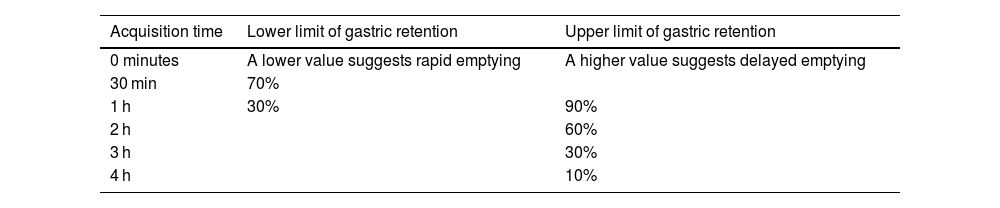
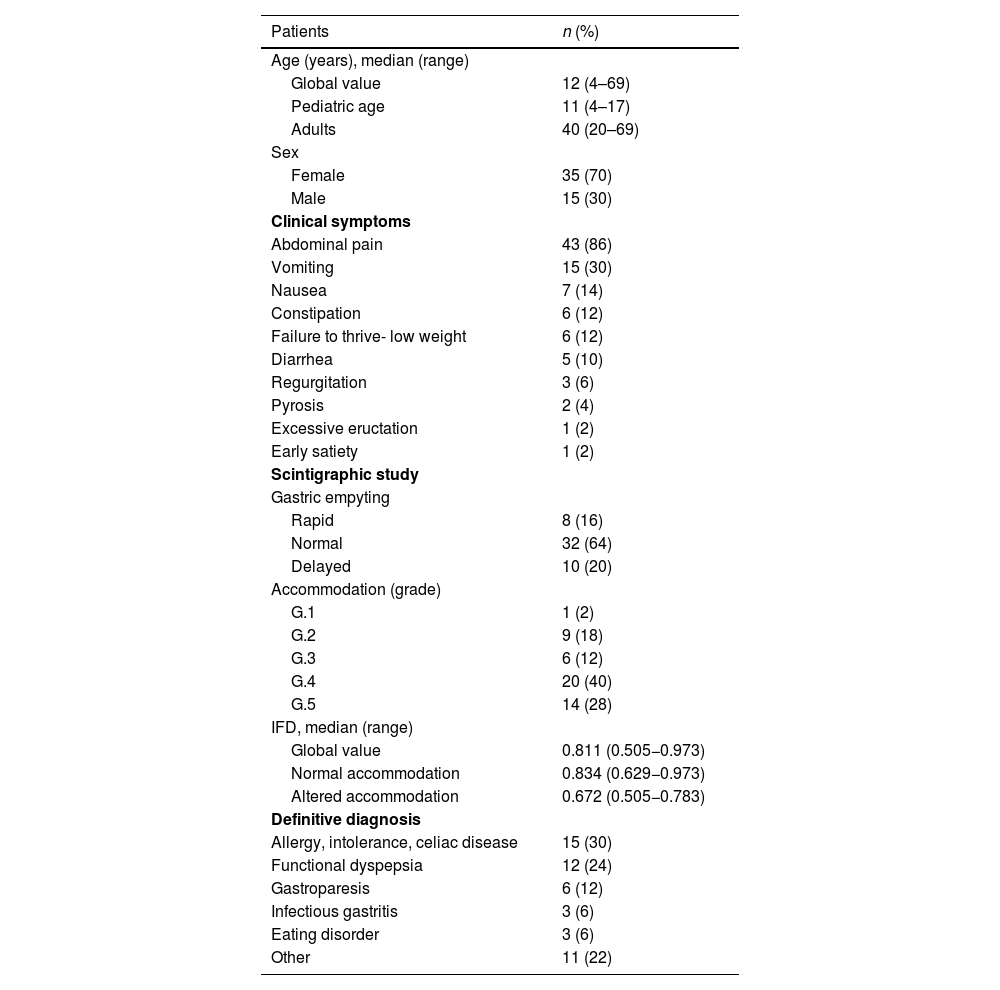


Gastric emptying scintigraphy is used to assess patients with symptoms of dyspepsia or gastroparesis. An alteration of fundus accommodation may explain these symptoms. The aim of this study was to determine the accommodation in gastric emptying scintigraphy studies performed in our institution.
Material and methods50 patients (43 children) referred for gastric emptying assessment were evaluated. After fasting for 8 h, and following international guidelines, egg labeling was performed with 37 mBq of [99mTc]Tc-DTPA and administration of standardized food. Areas of interest were defined in the stomach at different times, and the corresponding retention percentages were calculated. Considering the image at time zero, gastric accommodation was qualitatively and quantitatively assessed, calculating the ratio between proximal stomach counts and total counts.
ResultsOf the 50 patients studied, 32 had normal emptying, 10 had slowed emptying and 8 had accelerated emptying. Within the group of patients with normal emptying, 8 had altered accommodation (25%) and another 8 in the group with abnormal emptying (44%). Applying the ROC curve analysis to quantitative values, the most appropriate cut-off value was 0.785 with p < 0.001, sensitivity 82.4% and specificity 100%.
ConclusionGastric emptying scintigraphy in addition to determining motility, made it possible to assess both qualitatively and quantitatively the distribution of the radiotracer in the stomach and thus, indirectly, the accommodation in the fundus. It provided added diagnostic information in a simple manner, without protocol changes and allowing more specific treatments to be assessed.
La gammagrafía de vaciamiento gástrico se utiliza para valorar pacientes con síntomas de dispepsia o gastroparesia. Una alteración de la acomodación del fundus puede explicar estos síntomas. El objetivo del estudio fue determinar la acomodación en los estudios gammagráficos de vaciamiento gástrico realizados en nuestra institución.
Material y métodosSe valoraron 50 pacientes (43 niños) remitidos para la valoración del vaciamiento gástrico. Tras ayuno de 8 horas, y siguiendo guías internacionales, se realizó el marcaje del huevo con 37 mBq de [99mTc]Tc-DTPA y administración de comida estandarizada. Se definieron áreas de interés en estómago a diferentes horas, calculándose los porcentajes de retención correspondientes. Considerando la imagen a tiempo cero, se valoró cualitativa y cuantitativamente la acomodación gástrica, calculándose el cociente entre las cuentas en estómago proximal y las cuentas totales.
ResultadosDe los 50 pacientes estudiados, 32 presentaban vaciamiento normal, 10 enlentecido y 8 acelerado. Dentro de grupo de pacientes con vaciamiento normal, 8 presentaban alteración en la acomodación (25%) y otros 8 dentro del grupo con vaciamiento anormal (44%). Aplicando el análisis de la curva ROC a los valores cuantitativos, el valor de corte más adecuado fue 0.785 con p < 0.001, sensibilidad 82.4% y especificidad 100%.
ConclusiónEl estudio gammagráfico de vaciamiento gástrico, además de determinar la motilidad, permitió valorar tanto cualitativa como cuantitativamente la distribución del radiotrazador en el estómago y, con ello, de manera indirecta la acomodación en fundus. Proporcionó información diagnóstica añadida de manera sencilla, sin cambios de protocolo y permitiendo valorar tratamientos más específicos.
Article
If you experience access problems, you can contact the SEMNIM Technical Secretariat by email at secretaria.tecnica@semnim.es or by phone at +34 619 594 780.
Revista Española de Medicina Nuclear e Imagen Molecular (English Edition)

