



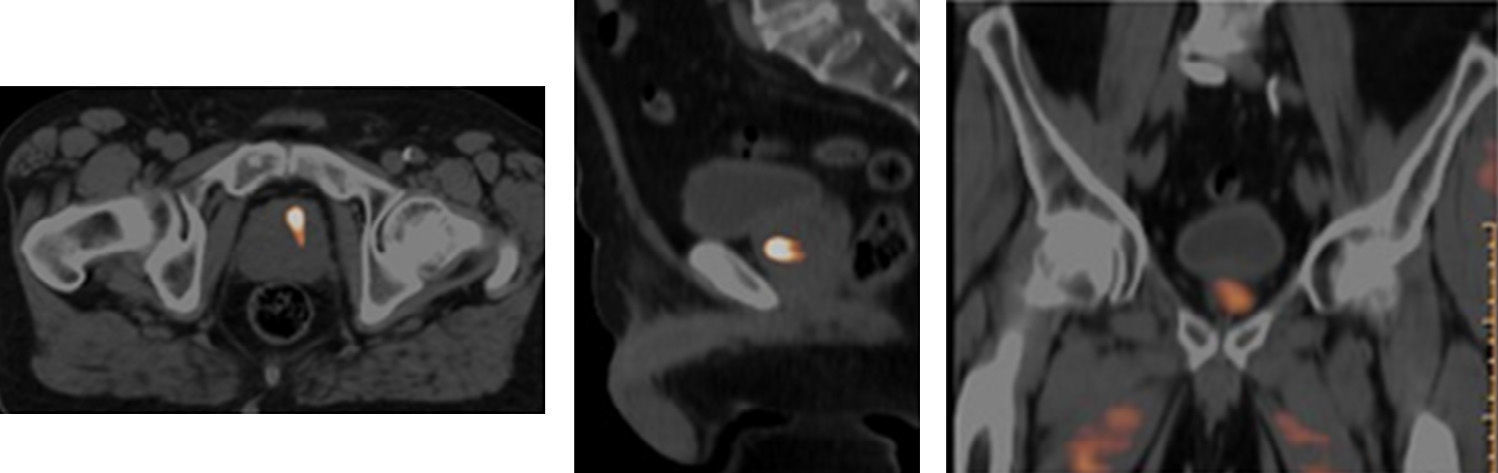

Prostate tumors originate 68% in the peripheral region and 24% in the transitional region whereas tumours originating in the central zone are rare (8%). However, diagnosis of the tumours in the central zone is important since they exhibit greater aggressiveness conditioned by their location and different biological behaviour.
Magnetic resonance imaging shows problems in identifying lesions in the central prostate zone, since this region has a heterogeneous signal, mainly after the primary treatment. Ultrasound guided sextant biopsy shows a negative result in 28% of the prostate tumours. Therefore, it is advisable to repeat or even to perform saturation biopsies. We present two patients, one of them with suspected biochemical prostate cancer and one with biochemical recurrence after radical treatment. In both, 11C-Choline PET/CT allowed detection of the tumour focus in the central zone of the prostate, with negative complementary diagnostic test and biopsies.
Los tumores prostáticos se originan en un 68% en la zona periférica y en un 24% en la transicional, mientras que son infrecuentes (8%) los tumores de la zona central. Sin embargo, es importante el diagnóstico de los tumores de la zona central puesto que presentan una mayor agresividad, que está condicionada por su localización y diferente comportamiento biológico.
La resonancia magnética muestra problemas en la identificación de lesiones en la zona central prostática, dado que esta región tiene una señal heterogénea, principalmente tras el tratamiento primario. La biopsia ecográfica por sextantes muestra un resultado negativo en un 28% de los tumores prostáticos, por lo que es recomendable su repetición o incluso la realización de biopsias por saturación.
Presentamos 2 pacientes, uno con sospecha bioquímica de un cáncer de próstata y otro con recidiva bioquímica tras tratamiento radical. En ambos, la PET/TC con 11C-Colina ha permitido la detección del foco tumoral en la zona central de la próstata, tras exploraciones complementarias y biopsias negativas.
Article
If you experience access problems, you can contact the SEMNIM Technical Secretariat by email at secretaria.tecnica@semnim.es or by phone at +34 619 594 780.
Revista Española de Medicina Nuclear e Imagen Molecular (English Edition)

