




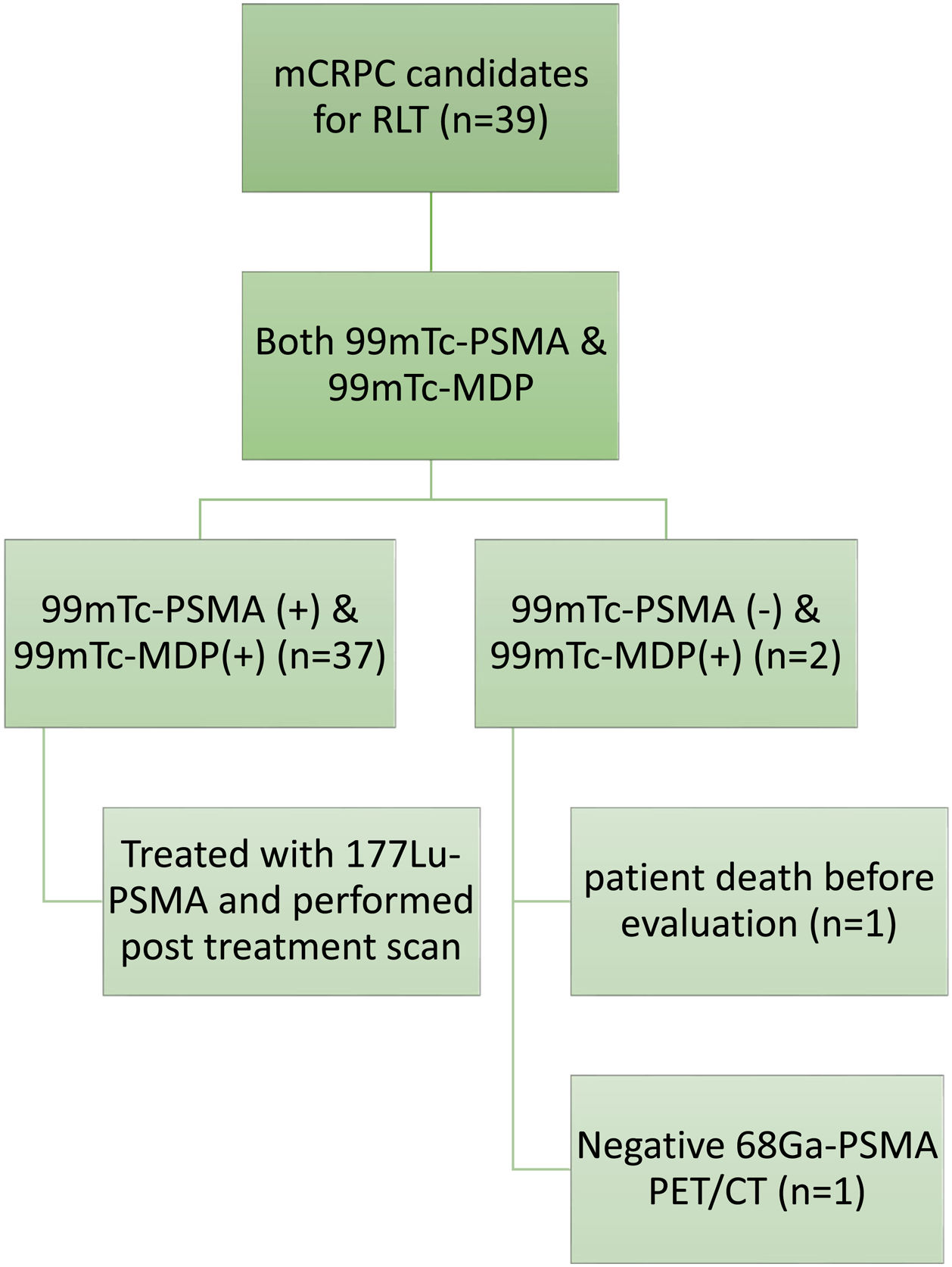


Prostate-Specific Membrane Antigen is overexpressed in primary and metastatic prostate cancer tissues. While PSMA PET agents have gained their role in the prostate cancer guidelines, Technetium-based PSMA agents have left behind. Given the novelty of 99mTc-HYNIC-PSMA-11, we conducted this study to compare its detection rate in tracing skeletal metastases in comparison to bone scans and also compared the number of metastatic lesions which showed PSMA uptake in the diagnostic scan with those detected in post-treatment scans after radioligand therapy (RLT) with 177Lu-PSMA-617-617.
MethodsBone and 99mTc-HYNIC-PSMA-11 scans with a maximum interval of 90 days were performed in thirty-nine patients with widespread bone metastases. If the PSMA scan was positive, patients were treated with 177Lu-PSMA-617 and post treatment scan was also obtained. For negative PSMA results, 68Ga-PSMA PET/CT was performed to compare its results with the bone scan. In patients with PSMA expression, detection of metastatic lesions in three consecutive whole-body scans in different regions were compared (99mTc-HYNIC-PSMA-11 with bone and post treatment scans, separately).
Results37 (94.9%) showed adequate 99mTc-HYNIC-PSMA-11 uptake in the metastatic regions. Compared to bone scan, 99mTc-HYNIC-PSMA-11 showed additional lesions in 13 (35.1%) participants which were mostly located in the appendicular skeleton and pelvic bones. Inversely, the bone scan detected more lesions in 12 (32.4%) patients. Both scans in 12 (32.4%) patients showed the exact same results. Comparison between the 99mTc-HYNIC-PSMA-11 scan and 177Lu-PSMA-617 showed completely similar results in 29 (78.4%) patients; however, 177Lu-PSMA-617 detected more lesions in eight (21.6%) participants.
ConclusionThe 99mTc-HYNIC-PSMA-11 scan demonstrates comparable results to bone scans in evaluating skeletal metastases in prostate cancer patients. It serves as a cost-effective modality for identifying suitable candidates for radioligand therapy, particularly beneficial in resource-limited countries.
El antígeno de membrana prostático específico está sobreexpresado en los tejidos del cáncer de próstata primario y metastásico. Mientras que los agentes PET PSMA han ganado su papel en las guías clínicas sobre el cáncer de próstata, los agentes PSMA a base de tecnecio han quedado atrás. Dada la novedad del [99mTc]Tc-HYNIC-PSMA-11, realizamos este estudio para comparar su tasa de detección de metástasis esqueléticas en comparación con las gammagrafías óseas y también comparamos el número de lesiones metastásicas que mostraron captación de PSMA en la exploración diagnóstica con las detectadas en las exploraciones posteriores al tratamiento después de la terapia con radioligandos (RLT) con [177Lu]Lu-PSMA-617.
MétodosSe realizaron gammagrafías óseas y con [99mTc]Tc-HYNIC-PSMA-11 con un intervalo máximo de 90 días en treinta y nueve pacientes con metástasis óseas diseminadas. Si la PSMA era positiva, los pacientes se trataban con [177Lu]Lu-PSMA-617 y también se obtenía una gammagrafía posterior al tratamiento. Para los resultados negativos de PSMA, se realizó una PET/TC con [68Ga]Ga-PSMA-11 para comparar sus resultados con la gammagrafía ósea. En pacientes con expresión de PSMA, se comparó la detección de lesiones metastásicas en tres exploraciones consecutivas de cuerpo entero en diferentes regiones ([99mTc]Tc-HYNIC-PSMA-11 con gammagrafías óseas y posteriores al tratamiento, por separado).
Resultados37 (94,9%) mostraron una adecuada captación de [99mTc]Tc-HYNIC-PSMA-11 en las regiones metastásicas. En comparación con la gammagrafía ósea, el [99mTc]Tc-HYNIC-PSMA-11 mostró lesiones adicionales en 13 (35,1%) participantes, que en su mayoría se localizaron en el esqueleto apendicular y los huesos pélvicos. Por el contrario, la gammagrafía ósea detectó más lesiones en 12 (32,4%) pacientes. Ambas exploraciones en 12 (32,4%) pacientes mostraron exactamente los mismos resultados. La comparación entre la gammagrafía con [99mTc]Tc-HYNIC-PSMA-11 y [177Lu]Lu-PSMA-617 mostró resultados completamente similares en 29 (78,4%) pacientes; sin embargo, [177Lu]Lu-PSMA-617 detectó más lesiones en ocho (21,6%) participantes.
ConclusiónLa gammagrafía con [99mTc]Tc-HYNIC-PSMA-11 muestra resultados comparables a las gammagrafías óseas en la evaluación de metástasis esqueléticas en pacientes con cáncer de próstata. Sirve como una modalidad rentable para identificar candidatos adecuados para la terapia con radioligandos, particularmente beneficiosa en países con recursos limitados.
Article
If you experience access problems, you can contact the SEMNIM Technical Secretariat by email at secretaria.tecnica@semnim.es or by phone at +34 619 594 780.
Revista Española de Medicina Nuclear e Imagen Molecular (English Edition)

