


metricas
covid
Revista Española de Medicina Nuclear e Imagen Molecular (English Edition) A rare case of a 123I-MIBG SPECT/CT positive, but 68Ga-DOTA-TOC PET/CT negative ...
Journal Information
Vol. 37. Issue 5.
Pages 315-317 (September - October 2018)
Visits
3
Vol. 37. Issue 5.
Pages 315-317 (September - October 2018)
Clinical note
A rare case of a 123I-MIBG SPECT/CT positive, but 68Ga-DOTA-TOC PET/CT negative pheochromocytoma of the bladder
Caso infrecuente de feocromocitoma vesical positivo en la SPECT/TC con 123I-MIBG, pero negativo en la PET/TC con 68Ga-DOTA-TOC
Visits
3
Alexander Stephan Kroissa,
Corresponding author
alexander.kroiss@i-med.ac.at

Corresponding author.
, Christian Uprimnya, Renate Pichlerb, Rudolf Wolfgang Gasserc, Irene Johanna Virgolinia
a Department of Nuclear Medicine, Medical University Innsbruck, Austria
b Department of Urology, Medical University Innsbruck, Austria
c Department of Internal Medicine I, Medical University Innsbruck, Austria
This item has received
Article information
Abstract
Full Text
Bibliography
Download PDF
Statistics
Figures (1)
Abstract

Pheochromocytoma (PHEO) is rare and belongs to the group of neuroendocrine tumours (NETs). These tumours can be found anywhere from the neck to the pelvis associated with sympathetic ganglia. Morphological imaging, for example CT, provides excellent anatomical detail and high sensitivity but lacks specificity as difficulties may occur when distinguishing between tumours derived from the sympathetic nervous system and other tumour entities. In contrast to anatomical imaging, functional imaging (123I-MIBG, 68Ga-DOTA-TOC PET) provides high sensitivity and specificity in detecting NETs.

Early detection of PHEO is crucial and has a major effect on treatment and prognosis.

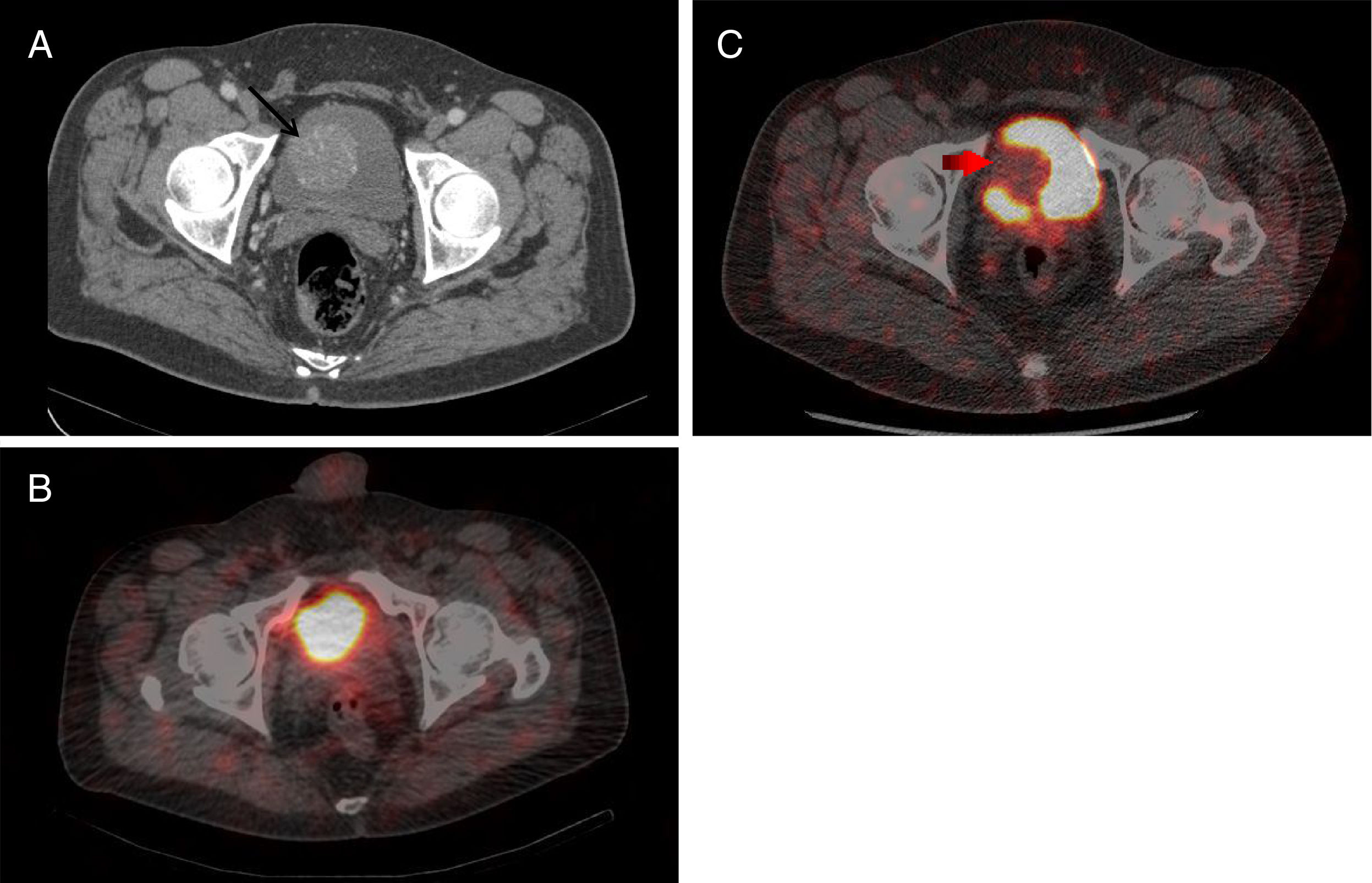
This case report describes the important role of anatomical and functional imaging in a patient with a neuroendocrine tumour of unusual origin.

Keywords:
68Ga-DOTA-TOC PET/CT
123I-MIBG SPECT/CT
Pheochromocytoma
Resumen

El feocromocitoma (PHEO) es poco frecuente, y se enmarca en el grupo de los tumores neuroendocrinos (TNE). Dichos tumores pueden encontrarse en cualquier parte, desde el cuello a la pelvis, asociados a los ganglios simpáticos. La imagen morfológica, como en el caso de la TC, aporta un detalle anatómico excelente y una elevada sensibilidad, pero carece de especificidad dado que pueden producirse dificultades a la hora de distinguir entre los tumores derivados del sistema nervioso simpático y otros tipos de tumores. A diferencia de la imagen anatómica, la imagen funcional (PET con 123I-MIBG, 68Ga-DOTA-TOC) aporta una alta sensibilidad y especificidad para la detección de TNEs.

La detección precoz de PHEO es esencial y tiene repercusiones importantes en el tratamiento y el pronóstico.

Este caso clínico describe la importancia del papel de la imagen anatómica y funcional en un paciente con tumor neuroendocrino de origen inusual.

Palabras clave:
68Ga-DOTA-TOC PET/TC
123I-MIBG SPECT/TC
Feocromocitoma

Article

These are the options to access the full texts of the publication Revista Española de Medicina Nuclear e Imagen Molecular (English Edition)
Member
If you are a member of the Spanish Society of Nuclear Medicine and Molecular Imaging (SEMNIM), you can access the full text of the contents of the Revista Española de Medicina Nuclear e Imagen Molecular through the journal links published on the SEMNIM website (link: http://socios.semnim.es/?ir-a=remnim), after logging in as a member.

If you experience access problems, you can contact the SEMNIM Technical Secretariat by email at secretaria.tecnica@semnim.es or by phone at +34 619 594 780.
Subscriber
Subscriber

If you already have your login data, please click here .

If you have forgotten your password you can you can recover it by clicking here and selecting the option “I have forgotten my password”
Subscribe
Subscribe to

Revista Española de Medicina Nuclear e Imagen Molecular (English Edition)

Purchase
Purchase article

Purchasing article the PDF version will be downloaded

Purchase now
Contact
Phone for subscriptions and reporting of errors
From Monday to Friday from 9 a.m. to 6 p.m. (GMT + 1) except for the months of July and August which will be from 9 a.m. to 3 p.m.
Calls from Spain
932 415 960
Calls from outside Spain
+34 932 415 960
E-mail
Article options
Tools
