






Interstitial Lung Disease Associated with Autoimmune Diseases
Más datosInterstitial lung disease occurs with high frequency as an initial or late manifestation of multiple rheumatic diseases, including systemic sclerosis, idiopathic inflammatory myopathies, rheumatoid arthritis, systemic lupus erythematosus, primary Sjögren's syndrome and antineutrophil cytoplasmic antibody-associated vasculitis. Thus, the rheumatologist must be clear about certain concepts of pneumology, including the evaluation of lung function tests, the approach to radiological patterns observed on high-resolution computed tomography of the chest, and concepts such as interstitial pneumonia with autoimmune features. In this article, we present our approach to patients with interstitial lung disease, in whom an autoimmune etiology is suspected. We propose a sequential diagnostic strategy, recognizing the importance of the multidisciplinary team and including the autoimmune perspective with emphasis on clinical and serological domains. Other diagnostic tools such as capillaroscopy and minor salivary gland biopsy are also considered. We also take a critical look at the latest guidelines for progressive pulmonary fibrosis, since it is essential that the rheumatologist understands these concepts that are vital in a multidisciplinary team.
La enfermedad pulmonar intersticial se presenta con alta frecuencia como manifestación inicial o tardía de múltiples enfermedades reumáticas, incluyendo esclerosis sistémica, miopatías inflamatorias idiopáticas, artritis reumatoide, lupus eritematoso sistémico, síndrome de Sjögren primario y vasculitis asociada a anticuerpos anticitoplasma del neutrófilo. El reumatólogo debe tener claros algunos conceptos de neumología, incluyendo la evaluación de las pruebas de función pulmonar y la aproximación a los patrones radiológicos observados en la tomografía computarizada de tórax de alta resolución, además de conceptos como la neumonía intersticial con características autoinmunes. En este artículo presentamos nuestra propuesta sobre el abordaje de pacientes con enfermedad pulmonar intersticial en los que se sospecha una etiología autoinmune. Proponemos una estrategia diagnóstica secuencial, la cual contempla la importancia del equipo multidisciplinario e incluye la perspectiva autoinmune con énfasis en los dominios clínicos y serológicos, con otras herramientas diagnósticas como la capilaroscopia y la biopsia de glándula salival menor. Adicionalmente, analizamos críticamente las últimas guías de fibrosis pulmonar progresiva, para una adecuada comprensión por parte del reumatólogo, a efectos de entender mejor estos conceptos, los cuales son vitales en el equipo multidisciplinario.
Interstitial lung diseases (ILDs) are a very diverse set of non-neoplastic and non-infectious pulmonary disorders that have in common an infiltrative pathology affecting the interstitial parenchyma. These diseases are associated with distinct clinical presentations and prognoses. The gold standard for diagnosis and management incorporates is a multidisciplinary approach (MMD) with input form various specialties, such as pulmonary, rheumatology, radiology and pathology, in order to reach a consensus regarding diagnosis and treatment.1 These entities include various clinical, radiological and histopathological manifestations that may guide the etiology of interstitial involvement.2 Throughout the years, evidence-based medicine has shown the close association between idiopathic ILD and connective tissue disease (CTD) which in general have a better prognoses. Within this document we pretend to review generalities of CTD-ILD and propose a strategy for an appropriate rheumatologic approach to patients who present with misclassified Idiopathic ILD. Emphasis will be placed on the approach to idiopathic ILD, and how once its association with CTD has been determined through five suggested steps (Fig. 1), the items needed to define its progressive course.3–5

Proposal of sequential approach of patients with ILD of unknown etiology.
Source: adapted from Tirelli et al.29.
Among the etiological factors of ILD we find: environmental factors (silicosis, asbestosis, berylliosis), environmental exposure related to hypersensitivity pneumonitis, cigarette exposure which causes desquamative interstitial pneumoniae, iatrogenic factors (drugs, radiation) and CTD. After a well addressed assessment with a multidisciplinary team (MDT), after ruling out these etiologies, we will determine ILD as idiopathic.6
Rheumatic diseases can compromise the lung either as an initial manifestation before any other clinical symptom arises, or as a complication in advanced stages of an underlying autoimmune disease.7 It is not a risk factor for lung involvement the time course of autoimmune disease, it can be the first manifestation of systemic autoimmune disease.7 Among the conditions that can involve the lung and develop ILD, we have: systemic sclerosis (SSc), idiopathic inflammatory myopathies (IIM), primary Sjögren syndrome (pSS), systemic lupus erythematosus (SLE), rheumatoid arthritis (RA), antineutrophil cytoplasmic antibody (ANCA)-associated vasculitis (AAV), mixed connective tissue disease (MCTD) and undifferentiated connective tissue disease (UCTD).8
Any of the mentioned entities of ILD can have a progressive behavior including those patients diagnosed as CTD-ILD.9
Epidemiology of ILD-CTDThe prevalence of specific ILD patterns varies according to CTD subtype. A systematic review with data of 65,008 patients, provided robust data on prevalence of CTD-ILD.10
RA has the higher prevalence of UIP in male patients, older age individuals and patients with active smoking, similar risk factors to the ones found in idiopathic Usual interstitial pneumonia (UIP).10 Some studies have shown that anti-cyclic citrullinated peptide antibodies (ACPA) in serum, were associated with lung involvement in patients with early RA.11 MUC5B mutation and smoking are also associated factors for the development of RA-ILD.12,13
The prevalence in IIM-ILD is 11–68%.10 Organizing pneumonia (OP) has the highest prevalence in IIM. OP can have a rapidly progressive form of ILD, having a bad prognosis, being refractory to immunosuppressive therapy with 51% mortality.5,10,14 There is a significant heterogeneity in ILD prevalence, with a wide range of prevalence especially in SSc-ILD (22–87%), 17% in pSS (12–21%), 56% in mixed connective tissue disease (MCTD) (39–72%) and 6% in SLE (3–10%). There are no studies of ILD in UCTD.10
The morbidity of CTD-ILD depends on its time of detection and its radiologic and histopathological pattern as well as the forced vital capacity (FVC) at the time of diagnosis.11 Other CTDs are more frequently associated with non-specific interstitial pneumonia (NSIP).10
Risk factors for ILD by CTD subtypeRisk factors for CTD-ILD where addressed in 108 studies with 43,978 patients. All studies had a wide range and variability in number and quality of studies. RA risk factors include: male sex, older age longer RA duration, older RA onset, smoking history, rheumatoid factor and anti-cyclic citrullinated peptide positivity and titer, higher C-reactive protein (CRP) and higher erythrocyte sedimentation rate (ESR). In SSc risk factors include: diffuse subtype, anti-Scl70 positivity, negative anti-centromere antibody. There where less than five studies which addressed risk factors for IIM, pSS and MCTD (Fig. 1). For IIM, risk factors found where: black race, mechanic's hands, arthritis, lateral hip erythema, anti-synthetase antibodies, anti-melanoma differentiation-associated gene 5 antibodies (anti-MDA5), anti-nuclear antibody (ANA), anti-Sjögren syndrome type B (anti/SSB), anti-RO52 and higher inflammatory markers (ESR, CRP).10 IIM associated to ILD can range from rapidly progressive disease with high mortality, to indolent disease with minimal morbidity. In a metanalysis including 4433 articles, the OR for risk of death regarding anti-MDA5 antibodies was of 6.20 (95% CI 3.58–10.71), and anti-tRNA synthetase antibodies were found to be protective (OR 0.24, 95% CI 0.14–0.41). Neither anti-nuclear antibodies, anti-52-kDa Ro antigen antibodies, nor SSA significantly altered mortality, nor was MDA5 titer predictive. Baseline surfactant protein-D and Krebs von den Lungen-6 levels were not predictors of mortality15 (Fig. 2).

Demographical, clinical and serological risk factors for CTD-ILD.
RF: rheumatoid factor; anti-CCP: anti-cyclic citrullinated peptide; ESR: erythrocyte sedimentation rate; CRP: C-reactive protein; LDH: lactate dehydrogenase; anti-Scl70: anti-scleroderma-70; anti/SSA: anti-Sjögren syndrome related antigen A autoantibodies; anti-MDA5: anti-melanoma differentiation-associated gene 5; anti-Ro52: anti-ro antibody; ANA: anti-nuclear antibodies; anti/SSB: anti-Sjögren syndrome type B antigen; ANCA: antineutrophil cytoplasmatic antibodies; anti-U1 RNP: autoantibodies against ribonucleoproteins; GI: gastrointestinal system involvement.
Source: Joy et al.10.
Risk factors for pSS-ILD include: older age, older age at onset, male sex, CTD duration, Raynaud phenomenon, fever, oral ulcers, xeropthalmia, elevated IgG, salivary gland biopsy focus score ≥4, seropositivity of ANA, anti/SSA, anti/SSB, anti-RO52 and higher inflammatory markers (ESR, CRP)10,16 (Fig. 2).
Radiological findings of ILD associated with connective tissue diseaseThe main radiological patterns of CTD-ILD in chest CT are non-specific interstitial pneumonia (NSIP), usual interstitial pneumonia (UIP), organizing pneumonia (OP) and lymphocytic interstitial pneumonia (LID). The association of autoimmunity with patterns of fibroelastosis pleuroparenchymatosis and the combination of pulmonary fibrosis and emphysema (CPFE) has also been described in rare cases.17 Different autoimmune diseases have a closer association with each radiologic pattern (Fig. 3).18–20

Association between radiological patterns in chest CT and autoimmune diseases.
UIP: usual interstitial pneumonia; NSIP: non-specific interstitial pneumonia; OP: organizing pneumonia; LIP: lymphocytic interstitial pneumonia; RA: rheumatoid arthritis; SSc: systemic sclerosis; pSS: primary Sjögren syndrome; MCTD: mixed connective tissue disease; SLE: systemic lupus erythematosus; AAV: associated ANCA vasculitis.
Source: adapted from Yoo et al.2.
The most frequent pattern is NSIP, characterized by relatively symmetric, homogeneous and bilateral ground-glass opacities with associated fine reticulations and pulmonary volume loss, resulting in mild or scant traction bronchiectasis. Immediate subpleural sparing, when present, is considered very specific for NSIP.18–20
Organizing pneumoniae (OP) involves subpleural or peribronchial patchy or nodular consolidations, with perilobular pattern and reverse halo sign. Although characteristically inflammatory, OP could be related to residual fibrosis despite treatment (fibrosing OP).20,21
UIP pattern is characterized by honeycomb-like cysts with typical distribution peripheral, subpleural and basal, with reticular opacities, traction bronchiectasis and architectural distortion; focal or few ground-glass attenuation in the areas of fibrosis could be present. It is classified as typical, probable and indeterminate.19,20
Recently, it has been described that three signs on CT can help to suspect autoimmune etiology in the presence of a UIP pattern: concentration of fibrosis within the anterior aspect of the upper lobes and concomitant lower lobe involvement (“anterior upper lobe” sign), exuberant honeycomb-like cysts within the lungs constituting greater than 70% of fibrotic portions of lung (“exuberant honeycombing” sign); and isolation of fibrosis to the lung bases with sharp demarcation in the craniocaudal plane without substantial extension along the lateral margins of the lungs on coronal images (“straight-edge” sign).22–24
Lymphoid interstitial pneumonia (LID) involves more commonly the lower lung with centrilobular nodules, diffuse and bilateral ground-glass attenuation, septal and bronchovascular thickening and thin wall cysts.20
Risk factors for ILD patterns by CTD subtypeRisk factors for specific ILD patterns in HRCT were addressed in 11 studies, including 1827 patients with CTD subtypes. The majority of studies (eight studies) where related to ILD patterns of RA. It was found in one study that UIP pattern was the most common in patients with longer duration of RA,25 other study reported UIP pattern in older patients with higher pack-year history of smoking (p<0.001).26 In pSS, UIP was associated with male sex (OR 8.4, 95% CI 1.7–40.5, p=0.008) and older age at onset (OR 1.1, 95% CI 1.11–2, p=0.04).16 In UCTD, age less than 60 years predicted ILD pattern inconsistent with UIP (OR 11.53, 95% CI 2.7–47.69, p<0.01).10
In IIM, the NSIP patterns was the most frequent in patients with positive anti-synthetase antibodies compared to those anti-synthetase antibodies negative (p=0.03).27 IIM-ILD can be distinguished from other connective tissue disease-associated ILDs also by radiological presentation. There is a high proportion of patients with IIM-ILD whom present with an acute onset of the disease. Radiological overlap pattern between NSIP/OP, the simultaneous onset of both ILD and CTD symptoms and younger age of onset, are also associated to IIM-ILD.10,28
Rheumatologist's approach to ILDConsidering the close relationship between CTD and ILD, it is considered that screening for autoimmune diseases should always be performed in patients with ILD of undetermined etiology before stating the diagnosis of Idiopathic ILD.18,29 We propose a sequential diagnostic approach which includes clinical and serological domains with other diagnostic tools that would be needed according to the initial clinical and serological findings.
This approach should be carried out in five steps (Fig. 3), and according to findings (Fig. 4), the patient should be taken to further diagnostic tools and to a multidisciplinary team assessment.19,20
We propose that if any patient has a clinical suspicion by a rheumatologist of inflammatory myopathy (or a HCRT findings such as overlap of NSIP/OP) or findings suggestive of systemic sclerosis, this patient must be taken to a capillaroscopy which will help us determine if vasculopathy is present, helping us to determine its autoimmune etiology. On the other hand, if a patient has any clinical findings or antibodies that are suggestive of primary Sjögren syndrome, or a HCRT with LIP, a minor salivary gland biopsy will be needed for its diagnosis.
In the article, you will find our suggested approach described in the form of an algorithm.
CapillaroscopyVideo nail capillaroscopy is a non-invasive, inexpensive diagnostic tool that can provide valuable information in determining the cause of ILD.30 A recent systematic review showed that up to 80% of patients with CTD-ILD had capillaroscopic abnormalities and highlights the utility of this study within an appropriate clinical context.31 The most relevant findings found in capillaroscopy are (a) giant capillaries, (b) decreased capillary density, and (c) avascular areas.5,9,32-35
In accordance with these abnormalities, it is possible to determine capillaroscopy patterns that increase the likelihood of a patient having a specific pathology, particularly systemic sclerosis or dermatomyositis.
In order to streamline the diagnostic approach to these capillaroscopy findings, a simple decision tree called the “Fast track algorithm” has been created, which aims to categorize patients into two groups: “scleroderma patterns” or “non-scleroderma patterns”.36
This algorithm is based on three rules:
- 1.
The presence of ≥7 capillaries (capillary density) AND the absence of giant capillaries (capillary dimension) allows the evaluator to classify the capillaroscopic image as a “non-scleroderma pattern”.
- 2.
The presence of giant capillaries or an extremely reduced capillary density (≤3 capillaries) in combination with abnormal shapes (=“late” scleroderma pattern) allows the capillaroscopist to categorize the capillaroscopic image as a “scleroderma pattern (category 2)”.
- 3.
If the image does not meet rule number 1 or rule number 2, then it is automatically classified as a “non-scleroderma pattern (category 1)”.
It is crucial to include capillaroscopy in the evaluation of these patients, as it aids in the early or very early diagnosis of systemic sclerosis, especially in those patients who present with Raynaud's phenomenon and specific antibodies without involvement of other organs, particularly the lungs.36,37
Minor salivary gland biopsyThe most frequent radiologic patterns found in pSS-ILD are those of NSIP and UIP. Diagnosing this disease can be difficult, especially when we have negative ANAs and negative anti-RO/SSA and anti-LA/SSB.38 Minor salivary gland biopsy is considered the gold standard for the diagnosis of pSS. Several studies have shown how in asymptomatic patients, with negative serologies, minor salivary gland biopsy was compatible with Sjögren syndrome. In addition, Almahad et al., documented how patients with idiopathic interstitial pneumonia who had a salivary gland biopsy positive for pSS had better survival compared to patients with idiopathic interstitial pneumonia and negative biopsy.39,40 In patients with ILD of idiopathic etiology, in a cohort of patients, 38.7% were found to have SSp-ILD.40 Although more studies are required to fully elucidate whether ILD and a positive salivary gland biopsy compatible with pSS diagnosis, provides valuable information in the orientation of the etiology of presumed idiopathic ILD.40,41
Lung biopsyFor many years the gold standard for the diagnosis of ILD required histopathological demonstration of interstitial involvement and the identification of a specific morphological pattern of interstitial lesion.42,43 Surgical lung biopsy (SLB) was also the ideal method for taking biopsies since it allows obtaining large samples free of crush artifacts.44 Currently, high-resolution chest tomography (HRCT) has considerably displaced the use of lung biopsy and in the diagnostic approach of CTD-ILD, HRCT allows in the first instance to confirm the presence of ILD and additionally, in many scenarios, it is able to identify a morphological pattern of interstitial damage, therefore lung biopsy should only be performed in very specific scenarios and after analyzing on a case-by-case basis in an MDT.45 Additionally, several recently published studies have warned about the risk of mortality and exacerbation of PID after a SLB, therefore clinical practice guidelines have decided to include the use of cryobiopsy as a less invasive alternative as a method of obtaining a lung biopsy, safer and with high diagnostic performance, which should be performed in expert centers.46–48
OthersIt is necessary to include, according to findings in clinical and serological domain, other diagnostic tools, such as contrasted nuclear magnetic resonance muscle image, muscle biopsy, joint ultrasound or open lung biopsy or cryobiopsy.29,49–51
Multidisciplinary teamsThe guidelines for classification and evaluation of interstitial lung disease published by the American Thoracic Society (ATS)/European Respiratory Society (ERS) recommend that the diagnostic approach of these patients be carried out through a multidisciplinary team (MDT) such as the gold standard.21,52
While the main objective of the MDT should be to reach a consensus of the patient's diagnosis, it has been reported that the therapeutic approach is also discussed in this meeting.53,54
The diagnostic approach should emphasize defining whether the patient has idiopathic pulmonary fibrosis (IPF), or if it is a secondary ILD; especially autoimmune diseases or hypersensitivity pneumonitis. Regarding the therapeutic approach, multidimensional management should be discussed, and in particular, the rheumatologist contributes his knowledge regarding the use of corticosteroids, immunosuppressive and antifibrotic therapy.55
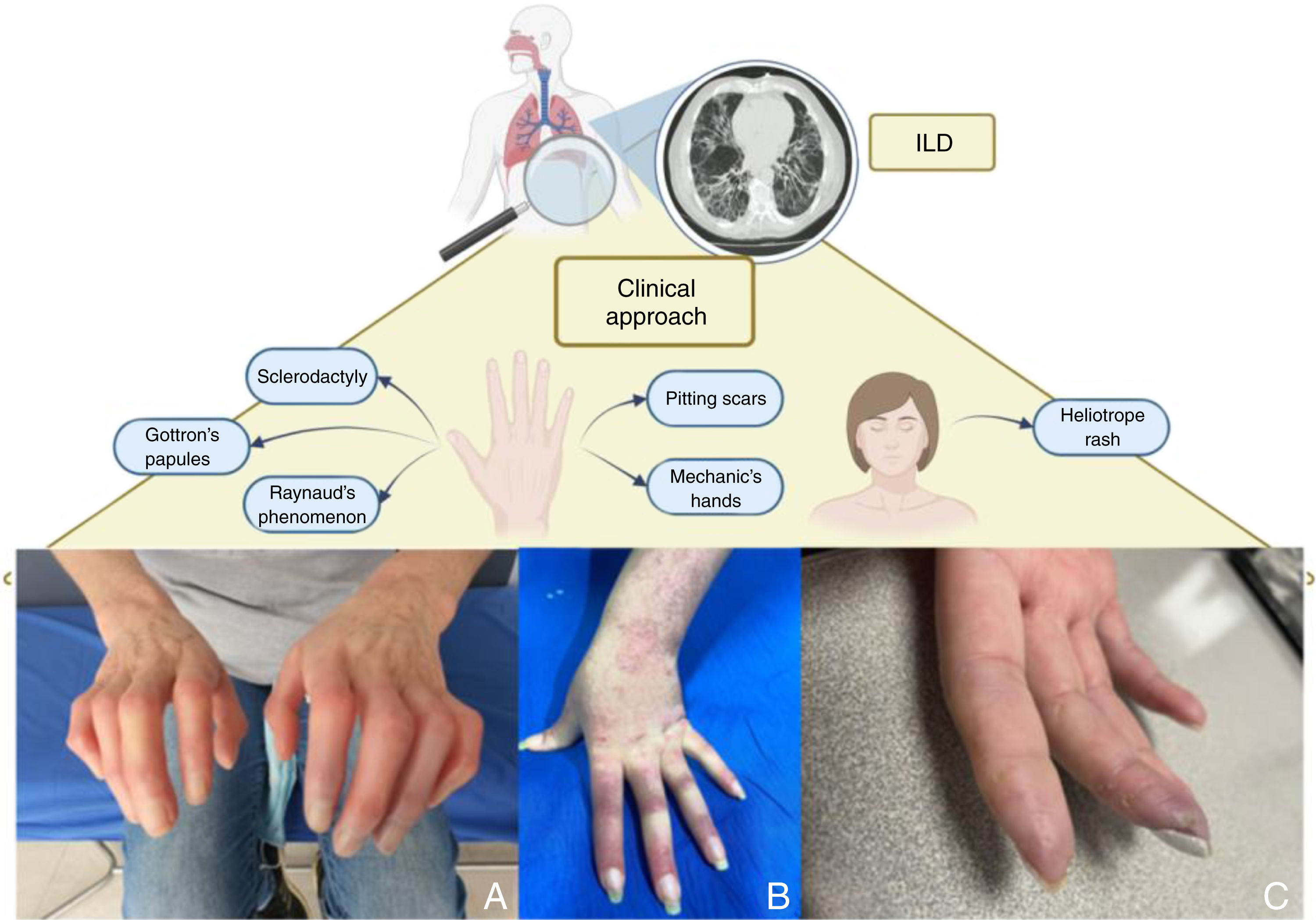
To promote an adequate diagnostic approach, there should be variables such as general information, clinical features, environmental exposures, symptoms and signs of autoimmune diseases, family history of interstitial lung disease and autoimmune diseases, pulmonary function tests, chest tomography, serological evaluations (including specific antibodies depending on the autoimmune disease that the patient may present) and lung biopsy if considered necessary (Figs. 2 and 3).55 According to the patient's clinical features, the rheumatologist should evaluate serologic domain and myositis-specific antibodies (Jo1, PL12, PL7, OJ, EJ, Mi2, SRP) (Figs. 4 and 5).53

Clinical features, biomarkers and specific antibodies in the approach of interstitial lung disease of indeterminate etiology.
DVT: deep vein thrombosis; ANA: anti-nuclear antibodies; anti-CCP: anti-citrulline antibodies; ENAS: extractable anti-nuclear antibodies; CPK: creatin phosphokinase.
Source: adapted from Tirelli et al.29.
A systematic review on the MDT in the evaluation of ILD, evaluated the role of the rheumatologist in this team, showing that he is not always included in the team, in fact, only 24% of the cases, the rheumatologist was included in the MDTs. Multiple studies show how the rheumatologist contributes his knowledge in the physical examination of the patient and in the interpretation of serologies, in fact, modifies the diagnosis of IPF to CTD-ILD, which modifies in a very important way the treatment and prognosis of these patients.56,57 It has even been described that including the rheumatologist can save resources and diagnostic procedures.58
There is an important limitation for the implementation of this MDT strategy: the lack of availability of human, physical and technological resources.53
Interstitial pneumonia with autoimmune featuresSome patients with ILD do not meet ACR or EULAR classification criteria for any specific autoimmune disease, however their clinical, serological, radiological and histopathological characteristics suggest an autoimmune etiology.59 In 2015, a new concept emerged from the European Respiratory Society (ERS) and American Thoracic Society (ATS), defined as interstitial pneumonia with autoimmune features (IPAF).59,60
This concept should be individualized according to each case since IPAF clinical features are scarce, not including all autoimmune symptoms. Serologic domain also lacks certain important diagnostic tools such as; anticytoplasmic antibodies (ANCA) either by ELISA or by immunofluorescence, capillaroscopy and minor salivary gland biopsy. We consider these three elements must be considered to be added to IPAF classification criteria (Fig. 6).59

Interstitial pneumonia with autoimmune features.
HRCT: high-resolution computed tomography; ANA: anti-nuclear antibodies; anti-CCP: anti-citrulline antibodies; anti-dsDNA: anti-double strand DNA; NSIP: non-specific interstitial pneumonia; OP: organizing pneumonia; LIN: lymphoid interstitial pneumonia.
Source: adapted from Fischer et al.60 Capillaroscopy and salivary gland biopsy accordingly. See text.
It is important to note that usual interstitial pneumonia (UIP) is excluded from the morphological domain of IPAF classification criteria. Patients with UIP have to be carefully assessed with clinical and serological variables, since UIP is the most common radiologic pattern in RA, followed by AAV and SSc (Fig. 3).61
It is well known that ILD may be the initial manifestation of a CTD (connective tissue disease). Taking this fact into consideration, a careful clinical follow-up of patients with IPAF is an important conduct to determine, throughout time, if this IPAF will eventually develop into a TD-ILD. In a cohort of patients with idiopathic NSIP, 10% developed clinical manifestations of a defined CTD almost 2 years after ILD diagnosis.61,62
Progressive pulmonary fibrosisA feature of progression can occur in interstitial lung diseases with a wide variety of etiologies, most commonly including, idiopathic pulmonary fibrosis (IPF), fibrotic hypersensitivity pneumonitis (fHP), NSIP, CTD-ILD, unclassifiable interstitial lung disease (uILD), silicosis, and sarcoidosis. Data from different reference centers indicate that progression in patients with ILD occurs in 31–52%.63,64
With the idea of clarifying this concept, the four major global lung health care associations (American Thoracic Society, European Respiratory Society, Japanese Respiratory Society and Latin American Thoracic Association) grouped the progressive behavior of ILDs in a definition called progressive pulmonary fibrosis (PPF). PPF is not a diagnosis, is a definition intended to determine patient's prognosis, and determine who benefits from antifibrotic therapy. This concept has been defined from several clinical studies, and the proposed criteria are based on the determination of the prognosis of patients. In the literature, synonyms of PPF such as progressive fibrosing disease or progressive fibrosing phenotype can be found. Fig. 7 shows the variables that we must consider to assess PPF.63
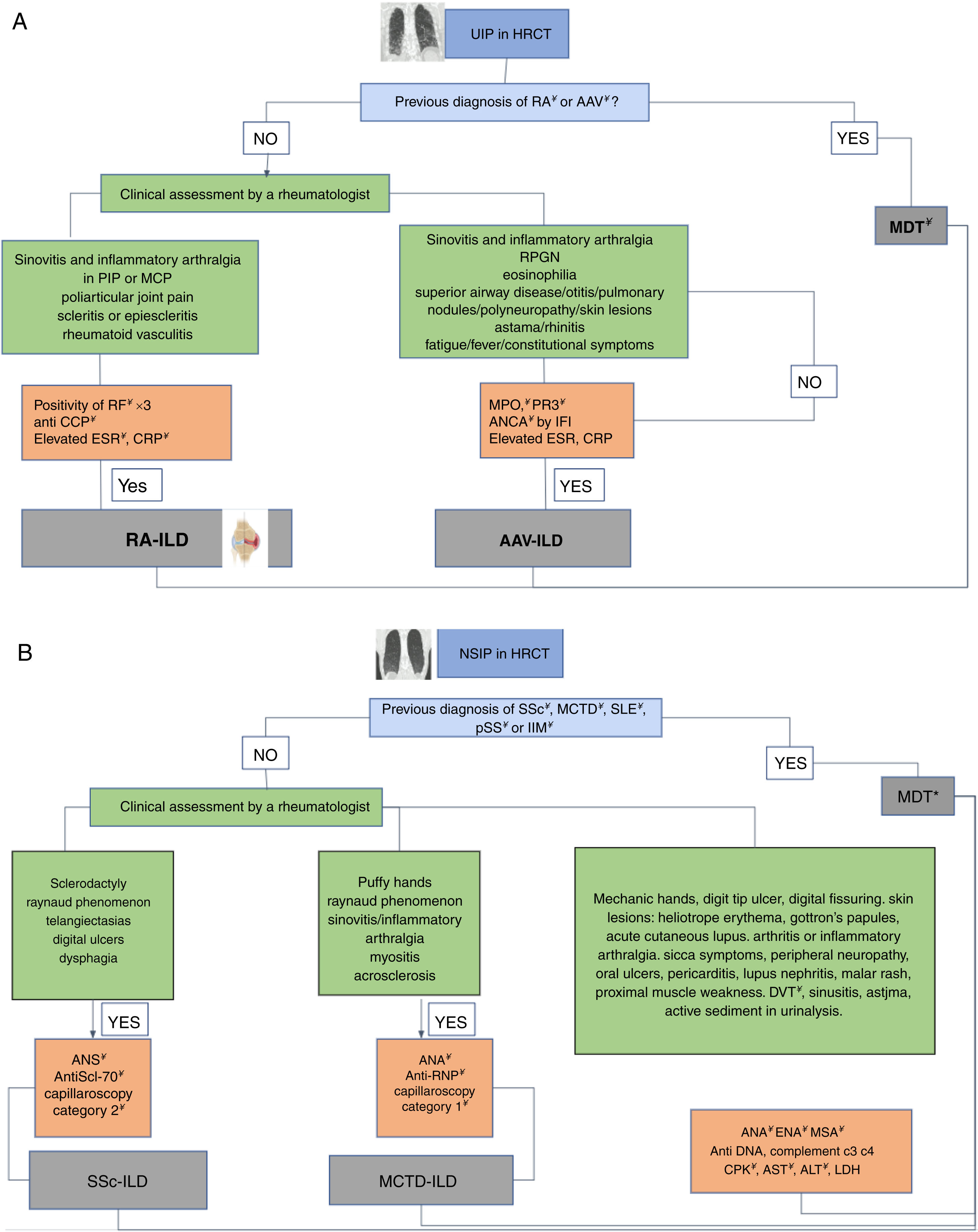
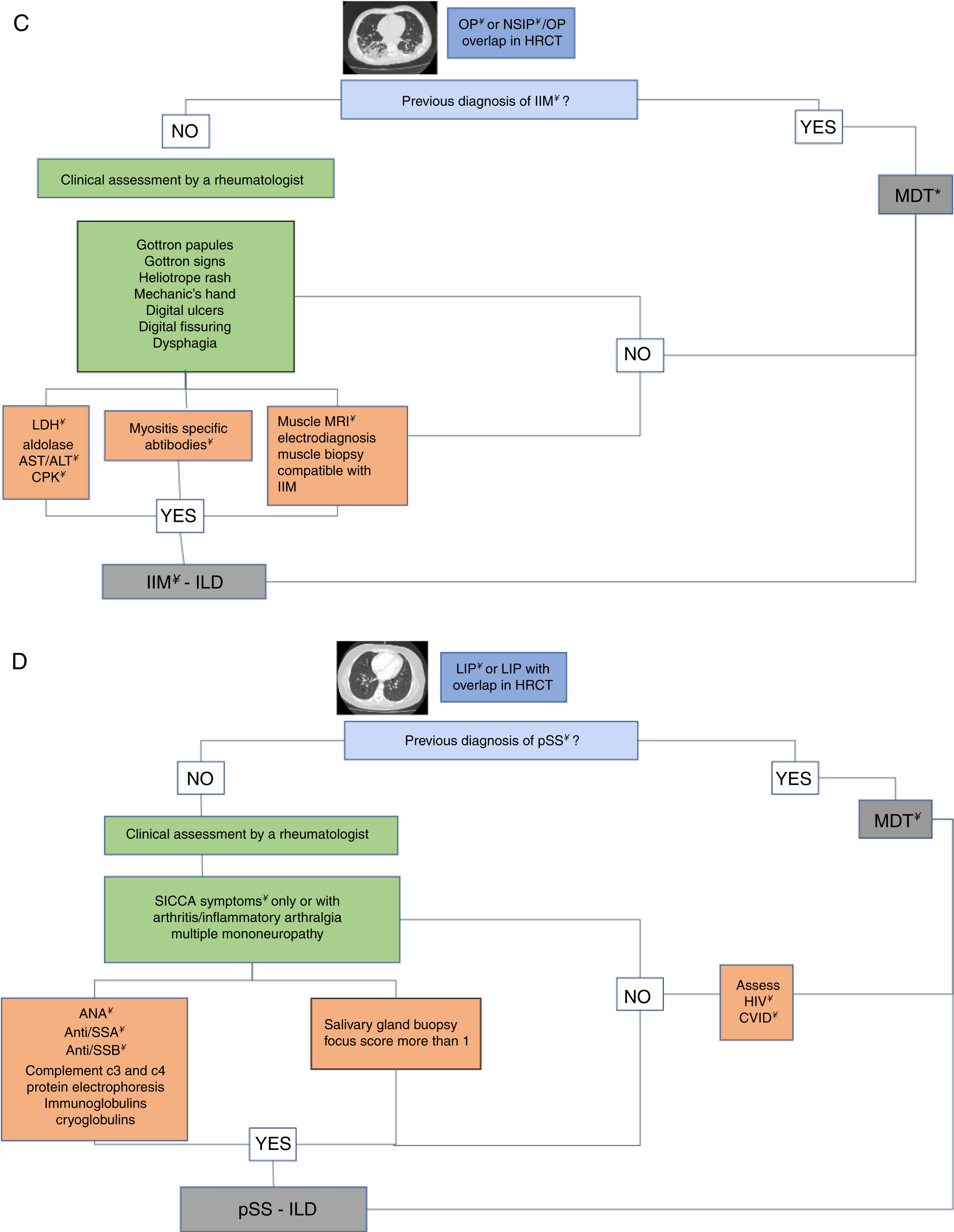
Sequential algorithms according to radiological patterns. (a) UIP: usual interstitial pneumonia. With this radiologic pattern, rheumatoid arthritis and ANCA associated vasculitis has to be ruled out. This pattern was not included in IPAF classification. The main differential diagnosis is idiopathic pulmonary fibrosis. (b) NSIP: non-specific interstitial pneumonia. This pattern is mainly associated to autoimmune diseases and is the most common pattern in autoimmunity, this is why a wider range of studies need to be performed. (c) OP: organizing pneumonia. OP pattern is the most specific pattern associated with idiopathic inflammatory myopathies. (d) LIP: lymphocytic interstitial pneumonia. LIP pattern is mainly associated with Sjögren syndrome. Human immunodeficiency viruses (HIV) and common variable immunodeficiency must be ruled out.
HRCT: high-resolution CT scan; RF: rheumatoid factor; anti-CCP: anti-cyclic citrullinated peptide; ESR: erythrocyte sedimentation rate; CRP: C-reactive protein; LDH: lactate dehydrogenase; anti-Scl70: anti-scleroderma-70; anti/SSA: anti-Sjögren syndrome related antigen A autoantibodies; anti-MDA5: anti-melanoma differentiation-associated gene 5; anti-Ro52: anti-ro antibody; ANA: anti-nuclear antibodies; anti/SSB: anti-Sjögren syndrome type B antigen; ANCA: antineutrophil cytoplasmatic antibodies; anti-U1 RNP: autoantibodies against ribonucleoproteins; GI: gastrointestinal system involvement; CVID: common variable immunodeficiency; HIV: human immunodeficiency virus; MDT: multidisciplinary team; IIM: idiopathic inflammatory myositis; MSA: myositis-specific autoantibodies; SICCA: dry symptoms; AST: aspartate aminotransferase; ALT: alanine aminotransferase; CPK: creatine phosphokinase; LDH: lactate dehydrogenase; MCTD: mixed connective tissue disease; pSS: primary Sjögren syndrome; SSc: systemic sclerosis; RA: rheumatoid arthritis; AAV: ANCA associated vasculitis; SLE: systemic lupus erythematosus.
We must think of PPF in a patient with ILD, especially who has radiological evidence of fibrosis and two of the following three criteria that have occurred in the last year without another explanation (Fig. 8)63:
- 1.
Increased respiratory symptoms
- 2.
Physiological evidence of disease progression (see text below)
- 3.
Radiological evidence of disease progression (see text below)

Multiple rheumatic diseases can manifest as PPF, including connective tissue diseases (SSc, RA, SLE, IIM, pSS) and sarcoidosis. Histologically, connective tissue diseases may show patterns of fNSIP, fibrosing pneumonia and UIP. Sarcoidosis on the other hand, shows a histological pattern with discrete non-necrotizing granulomas of lymphatic distribution with coexisting fibrosis.63
Physiological criteria of PPFSince the physiological and prognostic behavior of PPF is similar to idiopathic pulmonary fibrosis (IPF), the authors of the guideline extrapolate the physiological criteria of IPF to those of PPF.65,66 The authors define disease progression as the presence of the following findings, if they are attributable to worsening fibrosis.63
- 1.
Absolute decrease in forced vital capacity (FVC) >5% of predicted value within 1 year of follow-up (absolute FVC: initial FVC−final FVC).
- 2.
Absolute decrease in carbon monoxide diffusion (DLCO) (Hb-corrected) >10% of predicted value within 1 year of follow-up.
The use of the relative decline in FVC has been proposed as a substitute for the absolute decline in FVC. However, the recent guidelines published by multiple expert scientific societies in pulmonology (idiopathic pulmonary fibrosis, an update, and progressive pulmonary fibrosis in adults) recommend using the absolute decline in forced vital capacity. This is because the absolute decline demonstrates a worse prognosis and is a significant predictor of mortality in patients with idiopathic pulmonary fibrosis compared to relative changes in forced vital capacity.
Other variables such as 6-minute walk distance and exacerbations or hospitalizations were not included because they may appear or be modified by other pathologies or clinical contexts other than pulmonary fibrosis.63
Despite the clinical practice guideline recommendation, two studies (INBUILD and RELIEF) have included the relative decline in forced vital capacity as one of the evaluated outcomes. This leads us to consider that the relative reduction in forced vital capacity could serve as an early indicator of progression and, therefore, a worse prognosis.67,68 Additional investigations in this topic are needed.
Hemoglobin-corrected DLCO is a strong predictor of mortality in patients with fibrosing lung disease, but despite this, it has not been included as an outcome in clinical studies of patients with pulmonary fibrosis, because its results may have determined by the sampling technique of the test, with high variability of results in the same patient.63,69,70
Radiological criteria of PPFPPF is determined visually depending on the percentage of compromised lung volume that contains fibrotic characteristics according to the pulmonary area involved (upper, middle and lower). It is evaluated in transverse, coronal, and sagittal section in high-resolution computed tomography (HRCT). If an increase in fibrosis is documented, it is defined as PPF.63,71
Radiological evidence of disease progression (at least one of the following)63:
- •
Increased extent or severity of bronchiectasis and traction bronchiectasis
- •
Increased extent or severity of traction bronchiectasis and bronchiolectasis
- •
New ground-glass opacity with traction bronchiectasis
- •
New fine reticulation
- •
Increased extent or increased coarseness of reticular abnormality
- •
New or increased honeycombing
HRCT follow-up is indicated if PPF is suspected. There is no defined interval time at which follow-up with HRCT should be performed. It is known that in SSc, with stable pulmonary function tests, HRCT follow-up can be performed at 12–24 months to detect progression and impact prognosis.63
Treatment of PPFThe treatment of patients with CTD-ILD poses a significant challenge, as it involves assessing the need for individualized immunosuppressive and antifibrotic therapy for each patient. Given the inherent challenges in these cases and the associated costs, a multidisciplinary team must collaborate to determine the best therapeutic strategy.
The use of antifibrotic management is recommended in patients with interstitial lung disease associated or not with connective tissue disease, when they present with PPF. The two antifibrotics available are pirfenidone and nintedanib.63,72–74
Pirfenidone is an oral, anti-inflammatory, antioxidant medication with antiproliferative effects. There are two studies that evaluated the effects of the drug on PPF, one of them was discontinued due to lack of patient recruitment. In a meta-analysis, the decrease in FVC 100ml and 2.3% in 24 weeks was documented, with a 10% mortality rate. The RELIEF study showed no statistically significant difference in progression-free time, FVC and mortality at 48 weeks. Meta-analysis also showed a decrease in walking impairment of 6min by 25.2m. Respiratory symptoms had no difference between pirferidone and placebo. Pirferidone worsened gastrointestinal discomfort and increased photosensitivity. The quality of the evidence is poor as there is only one controlled clinical trial that has been completed, with a very small sample.63,68,75,76
Pirfenidone has been assessed in the treatment of interstitial lung disease associated with systemic sclerosis (LOTUSS Trial). In this study, only the tolerability of this medication was evaluated by comparing a dose titration time of 2 weeks to 4 weeks. Patients received a total of 16 weeks of treatment. A total of 63 patients were included, and 96.8% of the patients experienced adverse events related to the use of pirfenidone. The most commonly reported adverse effects were nausea, headache, and fatigue, which were similar in both titration schedules. Particularly, patients who were titrated with pirfenidone over a 2-week period discontinued the medication more frequently than those who received titration over 4 weeks.77
The use of pirfenidone in patients with rheumatoid arthritis and interstitial lung disease is currently under study in the TRAIL 1 trial, which is in Phase II and the initial results have not been promising.78
Nintedanib is an oral medication, which inhibits intracellular tyrosine kinase inhibitor that blocks pathways involved in fibrogenesis, inhibits PDGF receptor, FGF receptor and vascular endothelial growth receptor.67,79,80
The INBUILD trial evaluated 663 patients with PPF with placebo or nintedanib for 52 weeks. FVC declined in both groups but the mean decline was 107ml in the nintedanib arm, also decreased the risk of progression 2.4 times, with a difference in decline per year of 128ml/year in UIP pattern. It also decreased the risk of progression 2.3 times in UIP pattern.67
Among 170 patients with CTD-ILDs, 50% had RA-ILD. The rate of decline in FVC over 52 weeks was −75.9ml/year with nintedanib versus −178.6ml/year with placebo (difference 102.7ml/year [95% confidence interval 23.2, 182.2]; nominal p=0.012). No heterogeneity was detected in the effect of nintedanib versus placebo across subgroups based on ILD diagnosis (p=0.91). The most frequent adverse event was diarrhea, reported in 63.4% and 27.3% of subjects in the nintedanib and placebo groups, respectively. AEs led to permanent discontinuation of trial drug in 17.1% and 10.2% of subjects in the nintedanib and placebo groups, respectively.67,75,81
Nintedanib has also been tested in patients with systemic sclerosis and interstitial lung disease (SENSCIS trial). The patients included in the trial had systemic sclerosis and had experienced non-Raynaud symptoms for less than 7 years, with a high-resolution computed tomography (HRCT) scan showing at least 10% fibrotic involvement. Patients were randomized to receive nintedanib 150mg every 12h compared to a placebo. A total of 576 patients were recruited, with 48.6% of them receiving mycophenolate as immunosuppressive therapy.82
The primary outcome assessed was the annual rate of decline in forced vital capacity (FVC) over a 52-week period. The adjusted annual rate of change in FVC was −52.4ml per year in the nintedanib group and −93.3ml per year in the placebo group (a difference of 41.0ml per year; 95% confidence interval [CI], 2.9–79.0; p=0.04). This demonstrates that the annual rate of decline in FVC was lower with nintedanib compared to placebo.82
Nintedanib can be initiated close to the initiation of immunosuppressive therapy, with the only consideration to be able to evaluate if adverse effects arise are due to immunosuppressive therapy or antifibrotic therapy.82
Ethical considerationsThe images are of our own authorship, and the photographs were taken with the patients’ consent. The authors declare that this article does not contain any personal information that could identify the patients. Additionally, the writing and the images in this work have been approved by all the authors.
ConclusionsILD is a common manifestation of systemic autoimmune diseases, being an important cause of morbidity and mortality. It is vital to distinguish between ILD-CTD and idiopathic ILD since there will be a significant change in prognosis according to ILD etiology. The MDT remains being the gold standard for the diagnostic strategy of patients with ILD. The rheumatologist's involvement is essential for an appropriate and sequential clinical and serological approach. The rheumatologist also gains importance in the follow-up of patients with IPAF considering this entity will possibly be an initial manifestation of an autoimmune disease. The classification used for IPAF is a concept that will possibly need refinement. Distinguishing between UIP and NSIP has prognostic and therapeutic implications, as well as determining if ILD-CTD has a PPF course.
This sequential strategy for evaluating interstitial lung disease in patients with autoimmune diseases has some significant limitations. The primary limitation stems from the active involvement of medical specialists, such as rheumatologists, pulmonologists, radiologists, and pathologists, who are scarce in our country, greatly hindering patients’ access to these healthcare services independently. Additionally, multidisciplinary meetings are a fundamental component of our approach, and organizing teams of this nature requires extensive logistical capabilities, which can be challenging in developing countries. This is where technology can play a crucial role in facilitating access to these professionals. Tools like teleguidance or teleconsultation can significantly extend the reach of our strategy.
The limitations are not only restricted to the availability of medical professionals but also extend to access to diagnostic aids, such as the measurement of various specific and non-specific antibodies, salivary gland biopsies, capillaroscopy, pulmonary function tests, and chest tomographies, among others. This also presents a challenge for healthcare systems.
Conflict of interestThe authors declare that they have no conflict of interest.
The following are the supplementary material to this article:

