










Evaluar la efectividad y seguridad de la radiofrecuencia pulsada (RFP) en espasticidad.
DiseñoEstudio observacional ambispectivo de pacientes con espasticidad refractaria a tratamiento convencional, incluidos desde julio/2019 hasta diciembre/2024, tratados con RFP.
Material y métodosSe evaluaron las escalas: Ashworth Modificada (MAS), Visual Analógica (EVA) antes, dos y seis meses después del procedimiento, y de consecución de objetivos Goal Attainment Scale (GAS), Physician Global Assessment (PGA) y Patient Global Impression of Change (PGI-C). Obtuvimos la aprobación del Comité de ética de investigación con medicamentos de Galicia (código registro 2023/153). Todos los pacientes firmaron el Consentimiento Informado. Utilizamos el test de Wilcoxon para analizar diferencias significativas, la concordancia mediante el Coeficiente Kappa de Cohen para la MAS, y Coeficiente de Correlación Intraclase (CCI) para la EVA.
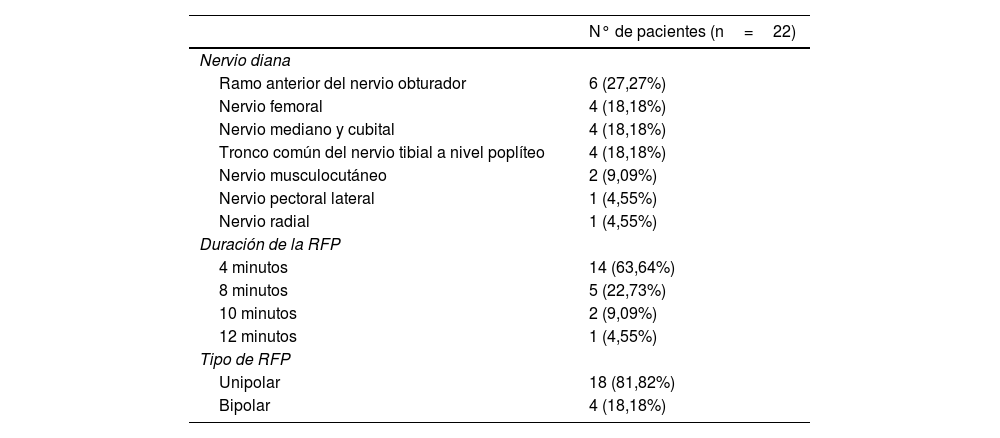
ResultadosSe incluyen 22 pacientes. No hubo diferencias significativas entre la MAS inicial y a los dos meses (p=0,096) y seis meses (p=0,257), ni entre la EVA inicial y a los dos meses (p=0,109) y seis meses (p=0,102). La concordancia fue moderada entre la MAS inicial y a los dos meses (Kappa=0,549, p<0,001), buena entre la MAS inicial y a los seis meses (Kappa=0,698, p <0,001), y excelente tanto para la EVA inicial y a los dos meses (CCI=0,935, p <0,001) como a los seis meses (CCI=0,975, p <0,001). La media para la GAS, PGA y PGI-C fue de -1,35, 0,1 y 0,05 a los seis meses. No se registraron efectos adversos.
ConclusionesLa RFP a 45V no parece ser efectiva en el tratamiento de la espasticidad ni del dolor asociado. Necesarios más estudios para confirmarlo.
To evaluate the efficacy and safety of pulsed radiofrequency (PRF) in spasticity.
DesignAmbispective observational study of patients with spasticity refractory to conventional treatment, enrolled from July/2019 to December/2024 and treated with PRF.
Materials and methodsThe following scales were evaluated: Modified Ashworth (MAS), Visual Analogue (VAS) before, 2 and 6 months after the procedure, and GAS, PGA and PGI-C. The study was approved by the Galician Ethics Committee for Pharmaceutical Research (registration number 2023/153). All patients signed the informed consent form. We used the Wilcoxon test to analyse significant differences, concordance using Cohen's Kappa Coefficient for MAS and Intraclass Correlation Coefficient (ICC) for VAS.
Results22 patients were included in the study. There were no significant differences between baseline MAS and at 2 months (p=0.096) and 6 months (p=0.257), nor between baseline VAS and at 2 months (p=0.109) and 6 months (p=0.102). Agreement was moderate between baseline and 2-month MAS (Kappa=0.549, p<0.001), good between baseline and 6-month MAS (Kappa=0.698, p<0.001), and excellent for both baseline and 2-month VAS (ICC=0.935, p<0.001) and 6-month VAS (ICC=0.975, p<0.001). The mean GAS, PGA and PGI-C at 6 months were -1.35, 0.1 and 0.05, respectively. No adverse events were observed.
Conclusions(PRF) at 45V appears to be ineffective for the treatment of spasticity and related pain. Further research is warranted to confirm these findings.

