

metricas

Radiología

Sugerencias
Radiología Carcinomatosis peritoneal, como medirla
Información de la revista
Vol. 67. Núm. 4.
(Julio - Agosto 2025)
Cita
Cita
Compartir
Descargar PDF
Más opciones de artículo
Visitas
6720
Vol. 67. Núm. 4.
(Julio - Agosto 2025)
Radiología en Imágenes

Carcinomatosis peritoneal, como medirla

How to measure peritoneal carcinomatosis
Visitas
6720
A. Mesa Álvareza,
Autor para correspondencia
marina_94_dst@hotmail.com

Autor para correspondencia.
, M. da Silva Torresa, A. Fernández del Vallea, A. Cernuda Garcíab, E. Turienzo Santosc, L. Sanz Álvarezc
a Radiodiagnóstico, Hospital Universitario Central de Asturias (HUCA), Oviedo, Asturias, España
b Radiodiagnóstico, Hospital de Cabueñes, Gijón, Asturias, España
c Cirugía General, Hospital Universitario Central de Asturias (HUCA), Oviedo, Asturias, España
Este artículo ha recibido
Información del artículo
Resumen
Texto completo
Bibliografía
Descargar PDF
Estadísticas
Resumen

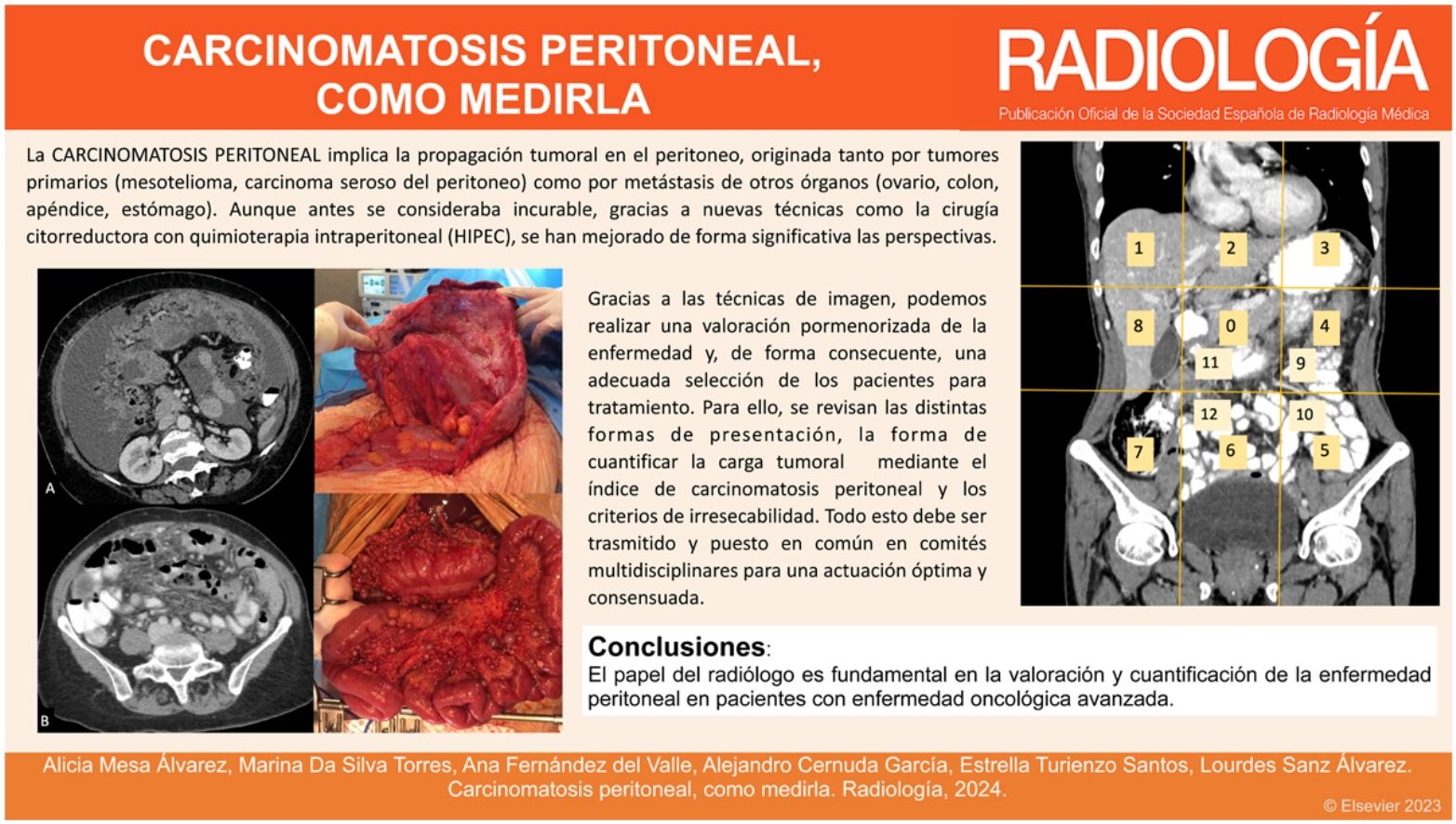
La carcinomatosis peritoneal (CP) implica la propagación tumoral en el peritoneo, originada tanto por tumores primarios (mesotelioma, carcinoma seroso del peritoneo) como por metástasis de otros órganos (ovario, colon, apéndice, estómago). Aunque antes se consideraba incurable, gracias a las nuevas técnicas como la cirugía citorreductora con quimioterapia intraperitoneal (HIPEC), se han mejorado de forma significativa las perspectivas. Para identificar a los pacientes que se benefician de estos tratamientos el papel del radiólogo es fundamental y se apoyará en técnicas de imagen como la tomografía computarizada (TC), la resonancia magnética (RM) y la tomografía por emisión de positrones (PET/TC). Es necesario conocer las distintas formas de presentación, la forma de cuantificar la carga tumoral (índice de carcinomatosis peritoneal [ICP]) y los criterios de irresecabilidad para una adecuada valoración del estado de la enfermedad. Todo esto debe ser trasmitido y puesto en común en comités multidisciplinares para una actuación óptima y consensuada.

Palabras clave:
Carcinomatosis peritoneal
Quimioterapia hipertérmica intraperitoneal
Tomografía computarizada
Índice de carcinomatosis peritoneal
Abstract

Peritoneal carcinomatosis (PC) is the spread of a tumour in the peritoneum, sometimes originating from a primary tumour (mesothelioma, peritoneal serous carcinoma) and other times arising from a metastasis from another organ (ovary, colon, appendix, stomach). While it was previously considered incurable, significant improvements have been made thanks to new techniques such as cytoreductive surgery with hyperthermic intraperitoneal chemotherapy (HIPEC). Patients who can benefit from these treatments are identified by radiologists who use imaging techniques such as computed tomography (CT), magnetic resonance imaging (MRI), and positron emission tomography (PET/CT). It is important to have an awareness of the different forms of presentation, methods of quantifying tumour burden (peritoneal carcinomatosis index, PCI), and criteria for unresectability for an accurate assessment of the disease's status. All this information should be shared and discussed in multidisciplinary boards for optimal and consensus-driven decision-making.

Keywords:
Peritoneal carcinomatosis
Hyperthermic intraperitoneal chemotherapy
Computed tomography
Peritoneal carcinomatosis index
Resumen gráfico

Artículo

Opciones para acceder a los textos completos de la publicación Radiología
Suscriptor
Suscriptor de la revista

Si ya tiene sus datos de acceso, clique aquí.

Si olvidó su clave de acceso puede recuperarla clicando aquí y seleccionando la opción "He olvidado mi contraseña".
Comprar
Comprar acceso al artículo

Comprando el artículo el PDF del mismo podrá ser descargado

Comprar ahora
Contactar
Teléfono para suscripciones e incidencias
De lunes a viernes de 9h a 18h (GMT+1) excepto los meses de julio y agosto que será de 9 a 15h
Llamadas desde España
932 415 960
Llamadas desde fuera de España
+34 932 415 960
E-mail
Bibliografía
[1]
R.C. Auer, D. Sivajohanathan, J. Biagi, J. Conner, E. Kennedy, T. May.
Indications for hyperthermic intraperitoneal chemotherapy with cytoreductive surgery: A systematic review.
Eur J Cancer, 127 (2020), pp. 76-95
[2]
P.B. Panagiotopoulou, N. Courcoutsakis, A. Tentes, P. Prassopoulos.
CT imaging of peritoneal carcinomatosis with surgical correlation: A pictorial review.
Insights Imaging, 12 (2021), pp. 168
[3]
E.A. Aherne, H.M. Fenlon, C.J. Shields, J.J. Mulsow, C.G. Cronin.
What the radiologist should know about treatment of peritoneal malignancy.
AJR Am J Roentgenol, 208 (2017), pp. 531-543
[4]
P.J. Pickhardt, A.A. Perez, M.M. Elmohr, K.M. Elsayes.
CT imaging review of uncommon peritoneal-based neoplasms: Beyond carcinomatosis.
[5]
A.D. Diop, M. Fontarensky, P.F. Montoriol.
CT imaging of peritoneal carcinomatosis and its mimics.
Diagn Interv Imaging, 95 (2014), pp. 861-872
[6]
A. Laghi, D. Bellini, M. Rengo, F. Accarpio, D. Caruso, D. Biacchi, et al.
Diagnostic performance of computed tomography and magnetic resonance imaging for detecting peritoneal metastases: Systematic review and meta-analysis.
Radiol Med, 122 (2017), pp. 1-15
[7]
J.L. Koh, T.D. Yan, D. Glenn, D.L. Morris.
Evaluation of preoperative computed tomography in estimating peritoneal cancer index in colorectal peritoneal carcinomatosis.
Ann Surg Oncol, 16 (2009), pp. 327-333
[8]
P. Jacquet, J.S. Jelinek, D. Chang, P. Koslowe, P.H. Sugarbaker.
Abdominal computed tomographic scan in the selection of patients with mucinous peritoneal carcinomatosis for cytoreductive surgery.
J Am Coll Surg, 181 (1995), pp. 530-538
[9]
I. Van ‘t Sant, W.J. van Eden, M.P. Engbersen, N.F.M. Kok, K. Woensdregt, D.M.J. Lambregts, et al.
Diffusion-weighted MRI assessment of the peritoneal cancer index before cytoreductive surgery.
Br J Surg, 106 (2019), pp. 491-498
[10]
R.N. Low, R.M. Barone.
Combined diffusion-weighted and gadolinium-enhanced MRI can accurately predict the peritoneal cancer index preoperatively in patients being considered for cytoreductive surgical procedures.
Ann Surg Oncol, 19 (2012), pp. 1394-1401
[11]
R.N. Low, R.M. Barone, P. Rousset.
Peritoneal MRI in patients undergoing cytoreductive surgery and HIPEC: History, clinical applications, and implementation.
Eur J Surg Oncol, 47 (2021), pp. 65-74
[12]
S.J. Kim, S.W. Lee.
Diagnostic accuracy of 18F-FDG PET/CT for detection of peritoneal carcinomatosis; A systematic review and meta-analysis.
Br J Radiol, 91 (2018), pp. 20170519
[13]
P.H. Sugarbaker.
Peritoneal carcinomatosis: Natural history and rational therapeutic interventions using intraperitoneal chemotherapy.
Cancer Treat Res, 81 (1996), pp. 149-168
[14]
M.D. Ray, K. Dhall.
Hyperthermic Intraperitoneal Chemotherapy (HIPEC) in the management of peritoneal surface malignancies - An evidence-based review.
[15]
V.J. Verwaal, S. van Ruth, E. de Bree, G.W. van Slooten, H. van Tinteren, H. Boot, et al.
Randomized trial of cytoreduction and hyperthermic intraperitoneal chemotherapy versus systemic chemotherapy and palliative surgery in patients with peritoneal carcinomatosis of colorectal cancer.
J Clin Oncol, 21 (2003), pp. 3737-3743
[16]
P. Jacquet, P.H. Sugarbaker.
Clinical research methodologies in diagnosis and staging of patients with peritoneal carcinomatosis.
Cancer Treat Res, 82 (1996), pp. 359-374
[17]
F. Bozzetti, W. Yu, D. Baratti, S. Kusamura, M. Deraco.
Locoregional treatment of peritoneal carcinomatosis from gastric cancer.
J Surg Oncol, 98 (2008), pp. 273-276
[18]
B. Jónsdóttir, M. Lomnytska, I.S. Poromaa, I. Silins, K. Stålberg.
The Peritoneal Cancer Index is a strong predictor of incomplete cytoreductive surgery in ovarian cancer.
Ann Surg Oncol, 28 (2021), pp. 244-251
[19]
A. Llueca, A. Serra, I. Rivadulla, L. Gomez, J. Escrig, MUAPOS working group (Multidisciplinary Unit of Abdominal Pelvic Oncology Surgery).
Prediction of suboptimal cytoreductive surgery in patients with advanced ovarian cancer based on preoperative and intraoperative determination of the peritoneal carcinomatosis index.
World J Surg Oncol, 16 (2018), pp. 37
[20]
A. Bhatt, P. Rousset, N. Benzerdjeb, P. Kammar, S. Mehta, L. Parikh, et al.
Prospective correlation of the radiological, surgical and pathological findings in patients undergoing cytoreductive surgery for colorectal peritoneal metastases: Implications for the preoperative estimation of the peritoneal cancer index.
Colorectal Dis, 22 (2020), pp. 2123-2132
[21]
S. Abdalla Ahmed, H. Abou-Taleb, N.M. Ali, D. Badary.
Accuracy of radiologic-laparoscopic peritoneal carcinomatosis categorization in the prediction of surgical outcome.
[22]
D. Elias, O. Glehen, M. Pocard, F. Quenet, D. Goéré, C. Arvieux, et al.
A comparative study of complete cytoreductive surgery plus intraperitoneal chemotherapy to treat peritoneal dissemination from colon, rectum, small bowel, and nonpseudomyxoma appendix.
[23]
A. Reginelli, G. Giacobbe, M.T. Del Canto, M. Alessandrella, G. Balestrucci, F. Urraro, et al.
Peritoneal carcinosis: What the radiologist needs to know.
Diagnostics (Basel), 13 (2023), pp. 1974
[24]
D.J. Bartlett, P.G. Thacker Jr., T.E. Grotz, R.P. Graham, J.G. Fletcher, W.M. VanBuren, et al.
Mucinous appendiceal neoplasms: Classification, imaging, and HIPEC.
Abdom Radiol (NY), 44 (2019), pp. 1686-1702
[25]
A. Dohan, C. Hobeika, H. Najah, M. Pocard, P. Rousset, C. Eveno.
Preoperative assessment of peritoneal carcinomatosis of colorectal origin.
J Visc Surg, 155 (2018), pp. 293-303
[26]
G. Psathas, M. Zarokosta, M. Zoulamoglou, D. Chrysikos, I. Thivaios, I. Kaklamanos, et al.
Leiomyomatosis peritonealis disseminata: A case report and meticulous review of the literature.
Int J Surg Case Rep, 40 (2017), pp. 105-108
[27]
S. Kim, S. Kang, S. Kim, M.H. Jang, J.H. Kim.
Abdominopelvic actinomycosis mimicking peritoneal carcinomatosis: A case report.
Ann Coloproctol, 36 (2020), pp. 417-420
[28]
A.E. Canda, S. Sokmen, C. Terzi, C. Arslan, I. Oztop, B. Karabulut, et al.
Complications and toxicities after cytoreductive surgery and hyperthermic intraperitoneal chemotherapy.
Ann Surg Oncol, 20 (2013), pp. 1082-1087
asdasdasd
Opciones de artículo
Herramientas

