



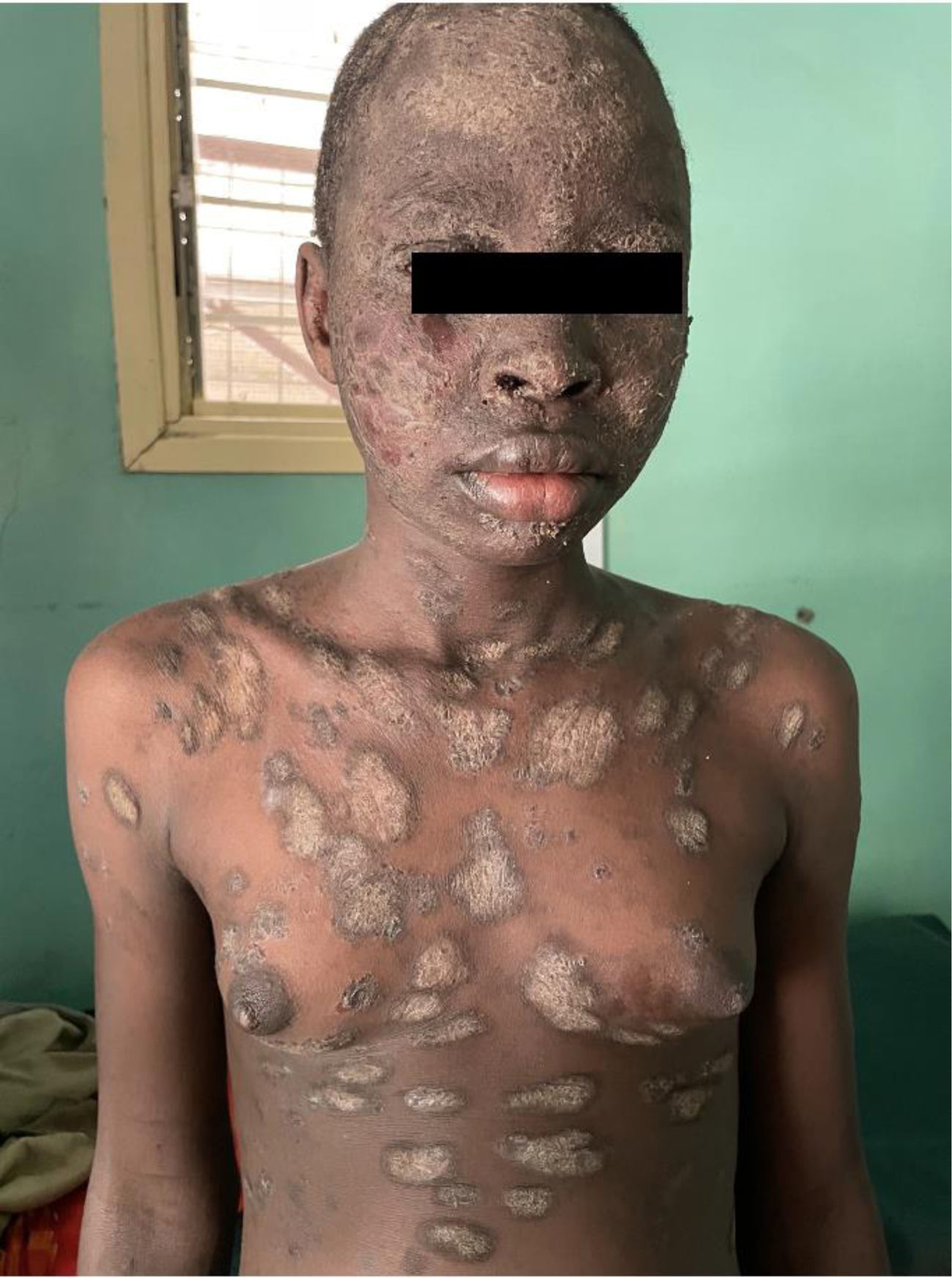
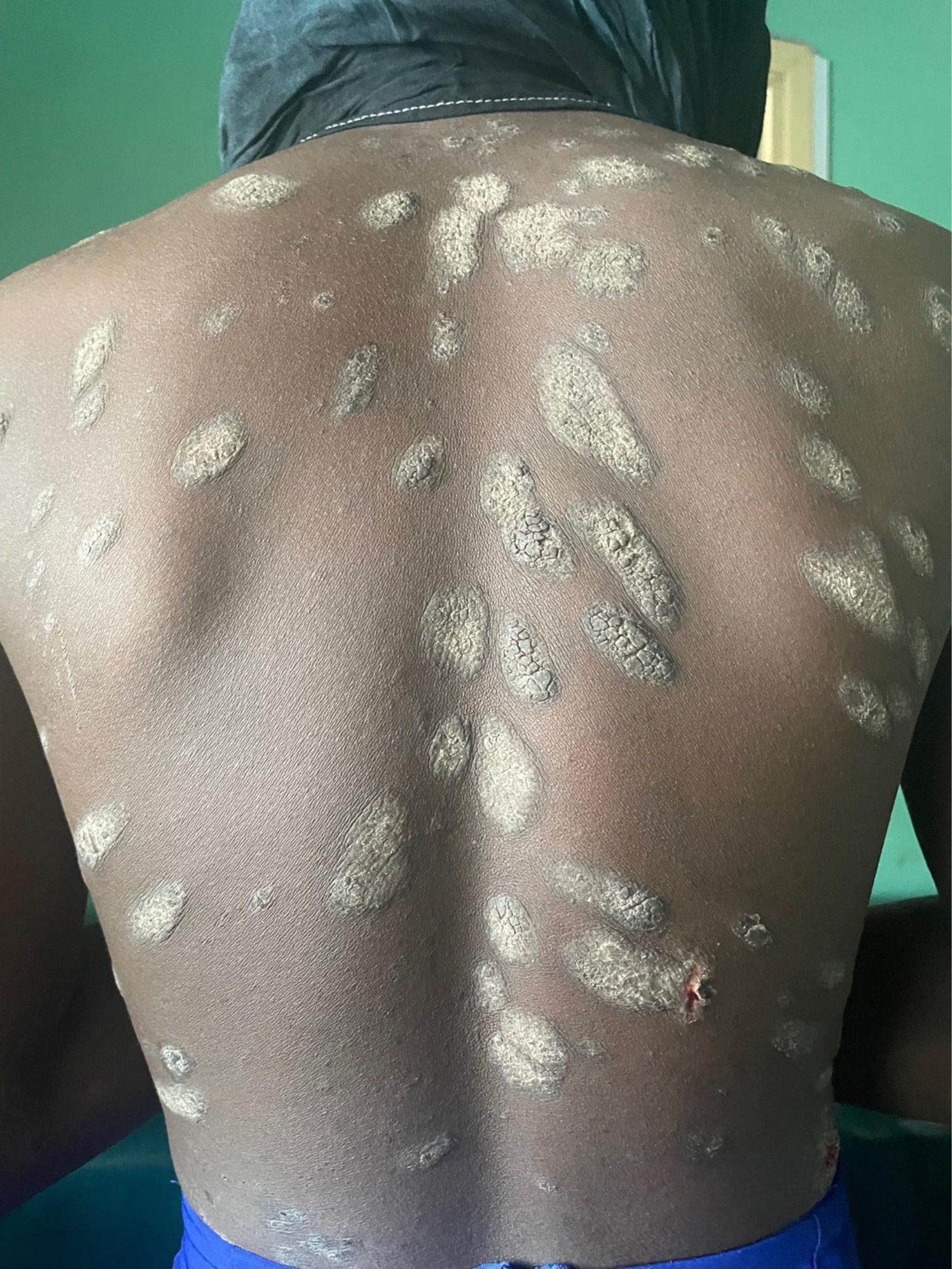
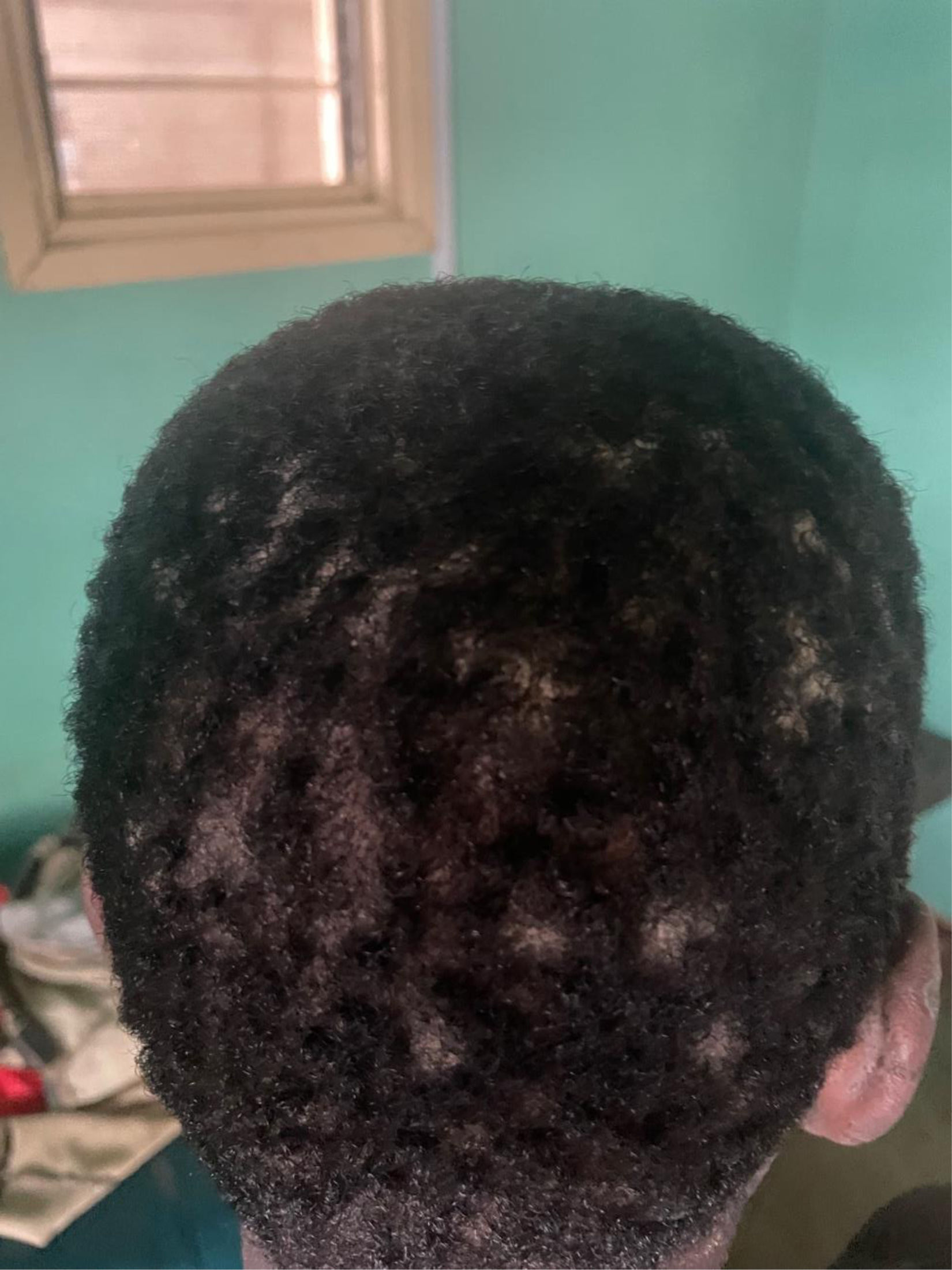
Our patient is a 14-year-old girl from Burundi who attends a consultation at a cooperation project in Turkana, Kenya, where she is assessed by a Family Medicine resident.
She reports a 4-year history of well-defined, non-pruritic annular skin lesions mainly on the face, scalp (without alopecia) and the trunk, with occasional isolated lesions on the lower limbs (respecting palms, soles, and flexures). The mentioned lesions are separated by lichenified tissue.
There appear to be no aggravating factors, and there has been no clinical improvement at any point (without treatment). She has not experienced fever, and there are no signs of arthritis. She has not presented with systemic symptoms, and there are no family history of psoriasis or inflammatory disease.
Upon examination, well-defined annular lesions with scaling and silvery, hyperkeratotic, non-pruritic characteristics are observed on the face, scalp, and trunk (Figs. 1–3). There are also some isolated lesions on the lower limbs (spared palms, soles, and flexures). The papular elementary lesions and hyperkeratotic plaques are separated by lichenified tissue. There are no signs of superinfection, and no scratch lesions, although their exclusion is challenging despite the absence of itching.


A basic blood test revealed no abnormalities, and an HIV test returned a negative result. In this setting, we did not have access to a dermatoscope or pathology services. However, macroscopic images of the mentioned lesions are provided.
One of the initial clinical entities to rule out is HIV infection, as it can easily alter clinical manifestations.
Mycosis fungoides, widely known as the most common cutaneous lymphoma (50%) and characterized by the progression of lesions from erythematous macules to plaques,1 is ruled out due to the patient's age and low incidence. Helminthiasis is excluded due to the lack of concordance with the presented lesions.
Eczemas, whether atopic or seborrheic dermatitis, are characterized by a clinical course of flare-ups with periods of improvement and worsening. The presence of lesions on the head could suggest seborrheic dermatitis. In this case, it would fit based on age, but the clinical course and the unclear concordance of the lesions, along with a negative HIV test, make it less probable. In the case of a positive HIV result, it would be an option to consider due to the mentioned fact that its positivity could modify the clinical presentation.
It is important not to forget that seborrheic dermatitis is a very common condition, also known as seborrheic eczema, sebopsoriasis, dandruff or pityriasis capitis, reflecting the complexity of the pathology. However, its high frequency has not allowed for a clear understanding of its etiopathogenesis, and there continues to be significant controversy, classifying it as a dermatitis, fungal disease, or even an inflammatory disease closely related to psoriasis.
Lichen planus is disallowed a priori for two reasons: the absence of itching and the involvement of mucous membranes (which are absent in our patient).
Other conditions such as leprosy and lupus are ruled out due to the lack of correlation with the mentioned lesions.
Well-defined plaques with silvery scales on the chest and back suggest psoriasis. However, the lesions on the scalp and face are not as clear. The anatomical distribution is atypical.
The epidemiology of psoriasis in Africa is not well-described. However, prevalence rates vary from 1.9% to 2.5% and from 0.025% to 0.9% in East and West African countries, respectively.2
Although most biopsy samples of psoriasis and eczematous dermatitis have undeniably distinct characteristics, in a small but not insignificant percentage, these features overlap, creating greater diagnostic uncertainty.3
Sebopsoriasis typically affects the head and face with overlapping features of psoriasis and seborrheic dermatitis, accompanied by psoriasiform eruptions.3
In 2022, Kaduna State University in Guinea published an article in which they reviewed all cases of psoriasis diagnosed over a 20-year period. The study reported that a quarter of the patients developed the disease before the age of 20, although it is not the most common age range, and the mean age of onset was lower in women. The most common presentation was plaque psoriasis (90%), followed by guttate psoriasis (6%). Clinical diagnosis accounted for 93.6% of the cases, and 19.6% of the patients had severe psoriasis, defined as involvement of >10% of the body surface area.4
The most probable diagnosis, with the available resources in that setting, after an extensive literature review, in the absence of a dermatologist but using telemedicine tools (teleconsultation), is sebopsoriasis or atypical psoriasis.
Sebopsoriasis is a term that refers to the inflammatory involvement of the skin with combined characteristics of both psoriasis and seborrheic dermatitis.4 The classic phenotype of sebopsoriasis is characterized by a distribution of lesions similar to seborrheic dermatitis, affecting sebum-rich areas such as the scalp, face, and chest. Common areas of involvement include the eyebrows, nasolabial region, periorbital region, and the hairline. Lesions on the rest of the body are more common in flexural areas, although a diagnostic clue is the coexistence of plaque psoriasis.5
We initiated topical treatment with corticosteroids on selected lesions due to the extensive involvement. In the case of an objective response, the patient would be a candidate for considering systemic treatment with methotrexate or cyclosporine.
In conclusion, in a resource-limited setting, the diagnosis was clinical and based on probabilities. We must never forget that a thorough and rigorous medical history is essential and can provide diagnostic clues, always keeping in mind that common diseases with atypical presentations are more prevalent than rare diseases.
Additionally, in this case, it is crucial to consider endemic diseases and nutritional deficiencies, as it is widely known that racial, geographical, and environmental factors influence the development of papulosquamous diseases.6
Faced with an atypical clinical picture in a region like Kenya, it is important to rule out HIV and secondary syphilis infections, significant mimickers.
We must remember that in the face of an atypical presentation in a region like Kenya, it is important to rule out HIV infection and secondary syphilis, significant mimickers.
Ethical considerationsThe patient's consent was obtained and the protocols of the work centers on the treatment of patient information were followed.
FundingThe article was financed exclusively with the authors’ own assets.
Conflict of interestThe authors state that there are no conflicts of interest in the article.

