





While acute myocardial infarction is rare in children, a part of the pediatric population is at a higher risk due to preexisting non-modifiable conditions. To mitigate the risk, modifiable risk factors such as unhealthy diet or sedentary lifestyle should be controlled from childhood, promoting healthy habits from the earliest stages. The primary purpose of this review is to assess the evidence on lifestyle/nutrition related modifiable risk factor intervention on the risk of acute myocardial infarction in children found in four databases, PubMed, Embase, Scopus and WoS. After screening, 29 of 272 articles assessed met the inclusion criteria. We found evidence that a healthy lifestyle, including an adequate dietary pattern and good eating habits in childhood, reduces the prevalence of acute myocardial infarction. The data retrieved from this review are consistent with the hypothesis that a healthy lifestyle might contribute lower the risk of acute myocardial infarction in at-risk children.
Aunque el infarto agudo de miocardio es poco frecuente en niños, una parte de la población pediátrica presenta un riesgo más elevado debido a afecciones preexistentes no modificables. Para mitigar el riesgo, los factores de riesgo modificables, como una dieta poco saludable o un estilo de vida sedentario, deben controlarse desde la infancia, promoviendo hábitos saludables desde las etapas más tempranas. El objetivo principal de esta revisión es evaluar las pruebas sobre la intervención de factores de riesgo modificables relacionados con el estilo de vida/nutrición sobre el riesgo de infarto agudo de miocardio en niños, encontradas en cuatro bases de datos, PubMed, Embase, Scopus y WoS. Tras el cribado, 29 de los 272 artículos evaluados cumplían los criterios de inclusión. Se encontraron pruebas de que un estilo de vida saludable, que incluya un patrón dietético adecuado y buenos hábitos alimentarios en la infancia, reduce la prevalencia del infarto agudo de miocardio. Los datos recuperados de esta revisión concuerdan con la hipótesis de que un estilo de vida saludable podría contribuir a disminuir el riesgo de infarto agudo de miocardio en niños de riesgo.
Acute myocardial infarction (AMI) is a clinical condition that develops in association with a sudden reduction or interruption of the blood flow in coronary vessels supplying the heart for several reasons.1 Myocardial infarction is a common event in adults but is exceedingly rare in children.2 People who suffer an AMI usually have more than one vascular territory affected, thus demonstrating its multifactorial and systemic origin.3–5
Pediatric AMI is seen more often in the presence of congenital heart disease (CHD); however, it may also be seen in patients without CHD.6 Other commonly identified etiologies include coronary arteritis (mainly in Kawasaki disease), myocarditis, familial hypercholesterolemia, idiopathic or inherited cardiomyopathy, collagen vascular disease-induced coronary arteritis, substance abuse (cocaine, glue sniffing), coronary artery trauma in open or closed thoracic trauma, complications from surgical or interventional procedures in which surgical correction requires coronary artery reimplantation, congenital prothrombotic diseases, primary thrombocytosis, vasculitis, myocardial bridging, mediastinal irradiation, chronic rejection in heart transplantation, metastatic tumors that compress coronary arteries, sickle cell disease, genetic or metabolic disorders like progeria, pseudoxanthoma-elasticum, mucopolysaccharidoses, Fabry disease, gangliosidosis, and homocystinuria, nephrotic syndrome, sepsis, occult malignancy and several other rare conditions.1,2,6
Reliable data on the prevalence of congenital and acquired heart conditions in children is scarce. According to the 2016 NSCH, 1.3% and 1.1% of U.S. children had a current or past heart condition, respectively but the specific types of heart conditions (i.e., congenital versus acquired) were unknown.7 However, the birth prevalence of CHDs is nearly 1%, and approximately 1million U.S. children have CHDs.8
Efforts should be taken to adopt preventive strategies for surveillance, screening, early identification, and intervention of other cardiovascular risk factors (CVRFs) among children and in a specifically targeted way in those with congenital or acquired heart conditions at an increased risk of AMI.
Risk factors (RFs) are conditions that increase the risk of developing a disease and may be either modifiable (lifestyle and nutrition) or non-modifiable (age, gender, genealogy, and ethnicity). RFs play a vital role in CV health, thus necessitating strategies to address the leading modifiable RFs. A large number of CVRFs are already detectable in childhood and include modifiable elements susceptible to intervention.9 It is important to advise individuals at higher risk of AMI to maintain a healthy lifestyle and minimize CVRFs.
Progressively more evidence is available for unfavorable lifestyle playing a major role in the development and progression of chronic diseases while adherence to a healthy lifestyle may help prevent, delay their onset or slow their progression.10 Most AMI and associated pathologies are preventable through adequate control of the main CVRFs in primary and secondary care by means of optimal intervention in lifestyle habits and pharmacological treatment together with knowledge of the seriousness of this pathology, like the rest of CVD on the part of the population.
Clinical research on the effects of lifestyle on cardiovascular (CV) health in the last decades has increased with most current recommendations based on observational studies of large cohorts, or on clinical trials evaluating the relationship between lifestyle and multiple surrogate markers of cardiovascular risks (CVR).10,11 However, due to the scarcity of intervention studies, especially in younger populations, on CV morbidity and mortality and although the results of published studies are consistent with the findings in adults,10,11 further studies specifically geared toward the pediatric populations are warranted.
There is evidence of a relationship between diet composition and the occurrence of acute myocardial infarction (AMI).12 Dietary factors can modulate atherogenesis directly or through the modification of classical CVRFs, such as plasma lipid profile, arterial hypertension (AHT) or basal glucose concentration.13 However, the greatest CVRF in children (as in adults) is excess weight, and the serious problem is that excess weight as a child will almost certainly lead to obesity as an adult. Likewise, nutritional education and/or personalized nutrition in early life is fundamental given that the consolidation of a healthy lifestyle and dietary habits at this stage may be extremely beneficial for long-term health.11,14 Children's nutritional interventions should target not only the individual child but also the family and community, emphasizing family-based lifestyle modifications, such as parental education and nutrition in order to avoid the development of excess weight in children.10,15,16
The main objective of this review is to assess the evidence on lifestyle/nutrition related modifiable risk factor intervention on the risk of AMI in children.
Materials and methodsThis review was registered with the Open Science Framework (OSF) Registry with DOI: https://doi.org/10.17605/OSF.IO/UAXC3 and with PROPERO with ID: CRD42023429066.
PICO strategyWe used the PICO strategy to identify potentially relevant studies. In PICO, the question needs to identify the Patients or Population, the planned Intervention or treatment, the Comparison of one intervention with another (if applicable), and the anticipated Outcome. In this review, P is children, I is lifestyle/nutritional interventions or modifications, C is lifestyle/nutritional habits or status, and O is improvement in CVRF in order to prevent AMI. The main outcome of the study is to establish which are the major CVRF for children, susceptible to improvement through lifestyle or nutritional changes and what these interventions may be. Our PICO framework derives the following question: “Is it possible to improve CVRF in order to prevent AMI in children through lifestyle/nutritional interventions?
Study inclusion/exclusion criteria and data extractionSpecific inclusion/exclusion criteria were developed and only published works meeting all criteria were included. Studies included in this review meet the following criteria:
- 1.
Original research (excluding nonanalytic studies) or non-original reviews
- 2.
Available in English or Spanish
- 3.
Published between January 1st 2017 and May 23rd 2023
- 4.
Study carried out in humans
- 5.
Exposure of interest is lifestyle/nutrition in children
- 6.
Outcomes of interest include CVRF in children (≤18 years old).
We searched three databases, PubMed, Embase, Scopus and Web of Science. The keywords used in PubMed were: (children OR child OR childhood OR pediatric) AND (prevention) AND (myocardial infarction) AND (dietary OR diet OR nutrition OR nutritional). The keywords used in EMBASE were: (‘children’/exp OR children OR ‘child’/exp OR child OR ‘childhood’/exp OR childhood OR ‘pediatric’/exp OR pediatric) AND (‘prevention’/exp OR prevention) AND (‘myocardial infarction’/exp OR ‘myocardial infarction’ OR myocardial OR ‘infarction’/exp OR infarction) AND (dietary OR ‘diet’/exp OR nutrition OR nutritional). The keywords used in Scopus were: (ts=AND children OR ts=AND child OR ts=AND childhood OR ts=AND pediatric) AND (ts=AND prevention) AND (ts=AND myocardial AND infarction) AND (ts=AND dietary OR ts=AND diet OR ts=AND nutrition OR ts=AND nutritional). The keywords used in Web of Science were: (TS=(children) OR TS=(child) OR TS=(childhood) OR TS=(pediatric)) AND (TS=(prevention)) AND (TS=(myocardial infarction)) AND (TS=(dietary) OR TS=(diet) OR TS=(nutrition) OR TS=(nutritional)).
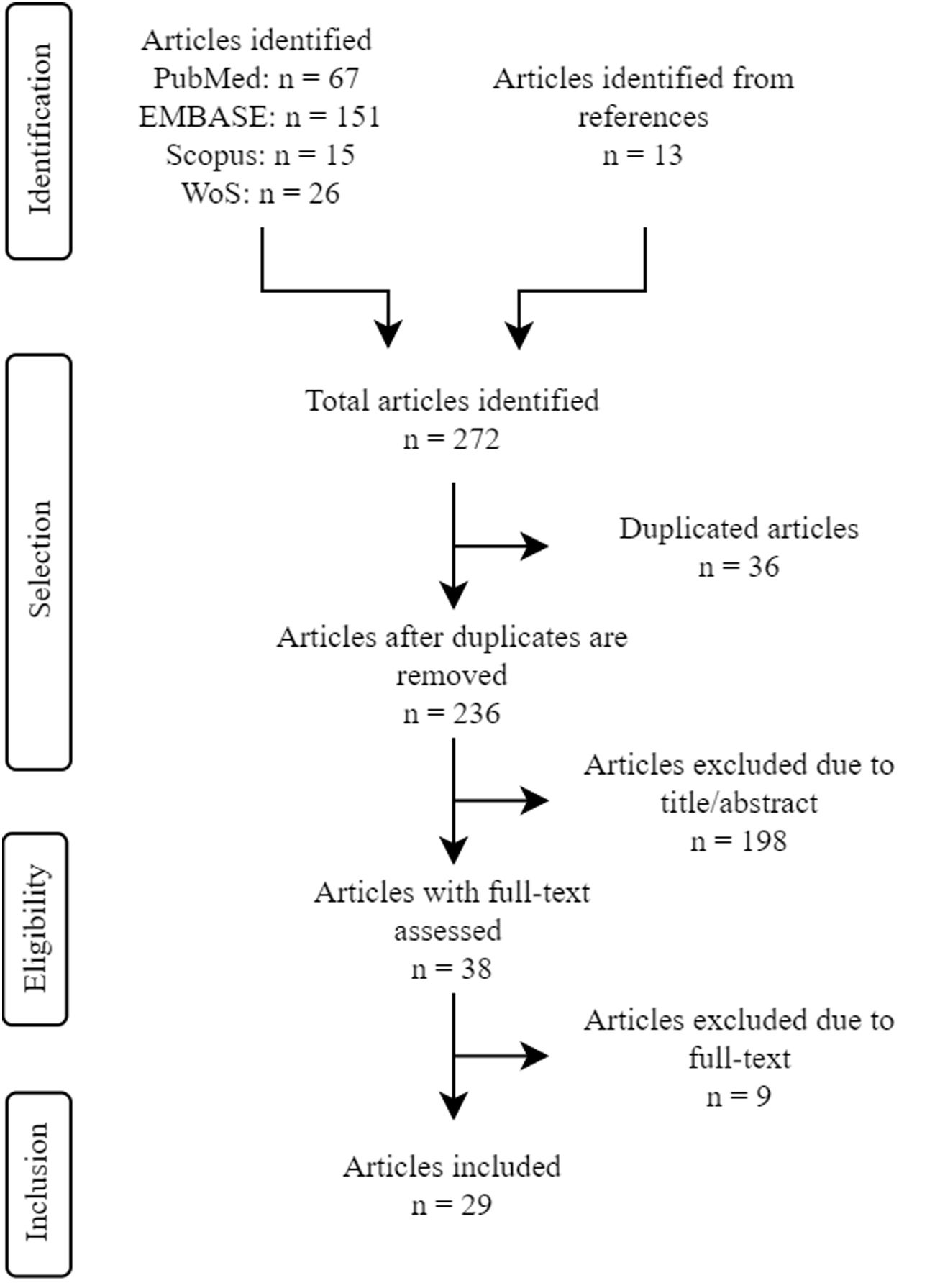
We recovered 67 studies from PubMed, 151 from Embase, 15 from Scopus, 26 from Web of Science and 13 from the references of the identified studies, for a total of 272 studies. The results obtained were screened using a three-stage process based on duplication, title/abstract, and full-text. At each stage a review was performed in duplicate by the authors. Studies selected independently were compared and discrepancies resolved by discussion among the authors until a consensus was reached. Studies not meeting any of the established selection criteria were removed at each screening stage. The first stage was the removal of duplicates, after which 236 studies remained. These studies were assessed for inclusion based on title and abstract only with 38 candidate studies remaining. The full text of these studies was retrieved and after assessment, 29 met all inclusion and exclusion criteria. Fig. 1 details the article screening process.
Quality assessment
Original articles chosen were assessed according to design, year, methodology, sample size, sample age, study period, objectives, main findings, and limitations. Non-original articles were assessed in the tables according to design, year, methodology, sample size, objectives, main findings, characteristics, limitations, and strengths.
The quality of included studies was assessed using the Scottish Intercollegiate Guidelines Network (SIGN).17 Using SIGN ensures the robust assessment of a study's validity, possible bias and confounding factors. Evidence-based medicine aims to ensure that the most up-to-date, reliable, and scientifically solid evidence available is used in making decisions, a pillar on which SIGN was developed. SIGN establishes different levels of evidence and recommendations based on study design and/or methodological quality and strength of the evidence respectively. Levels of evidence are ranked best to worst as 1, 2, 3, and 4, and with ++, +, and − signs. Grades of recommendation are, best to worst, A, B, C, and D, and do not reflect clinical importance.
ResultsThe main characteristics of the selected original articles are shown in Table 1 and Table 2 reflects the main characteristics of the selected non-original articles.
Main characteristics of the original articles included for review.
| Author, year | Study period and location | Study type | Participants | Objective | Methodology | Results | Limitations | Sign |
|---|---|---|---|---|---|---|---|---|
| Arman et al., 2019 | June 2017–September 2017Turkey | Prospective study | n=135Term, healthy infants. | To determine the relationship between 25(OH)D level and aortic intima-media thickness and carotid intima-media thickness in term healthy neonates. | Blood samples were obtained from the umbilical cord at birth. Serum 25(OH)D levels were measured with Architect immunoassay method. Serum 25(OH)D level of ≤20ng/mL is considered as vitamin D deficiency.Ultrasonographic measurements were performed at 24–48h after birth. | Correlation was found between aortic intima-media thickness and 25(OH)D levels (r′=0.295 p=<0.001). Aortic intima-media thickness values were higher in babies with vitamin D deficiency.No correlation was found between carotid intima-media thickness and 25(OH)D levels (Mean: r′=−0032 p=0.710; Max: r′=0.088 p=0.309). Vitamin D deficiency may induce atherosclerotic changes in vascular structure in term healthy infants. | Small sample size, lack of longitudinal data, and mother's vitamin D levels may be defined as the limitations. | LE: 2−GR: D |
| Bassols et al., 2018 | -Spain | Cross-sectional study | n=702Asymptomatic prepubertal Caucasian children (418 lean, 142 overweight and 142 obese). | To investigate the relationship of perirenal fat and other abdominal fat depots (including preperitoneal, intra-abdominal and subcutaneous fat) with carotid intima-media thickness (a surrogate marker of CV risk) in prepubertal children, so as to identify novel markers that can be easily assessed and used in the early prevention of cardiovascular disease. | Ultrasound measurements [perirenal, preperitoneal, intra-abdominal and subcutaneous fat and carotid intima-media thickness], clinical [body mass index and systolic blood pressure] and metabolic parameters [insulin resistance, high molecular-weight adiponectin and serum lipids] were assessed. | Perirenal fat was associated with diverse metabolic and CVRFs in all the studied subjects. However, in overweight and obese children, perirenal fat was mostly associated with carotid intima-media thickness (p<0.001) and was the only fat depot that showed independent associations with carotid intima-media thickness in multivariate analyses (overweight children: β=0.250, p=0.003, r2=12.8%; obese children: β= 0.254, p=0.002, r2=15.5%) after adjusting for BMI, gender, age and metabolic parameters. Perirenal fat was also the only fat depot that showed independent associations with high molecular-weight-adiponectin in obese children (β= –0.263, p=0.006, r2=22.8%).Perirenal fat is the main abdominal fat depot associated with carotid intima-media thickness, especially in overweight and obese children, and may thus represent a helpful parameter for assessing CV risk in the pediatric population. | Due to the cross-sectional study design, a causal relationship between perirenal fat and carotid intima-media thickness cannot be inferred. | LE: 2−GR: D |
| Bhattarai et al., 2020 | 2017–1990Nepal | Cross-sectional | All data from the Institute of Health Metrics and Evaluation's Global Burden of Diseases database on CVD for Nepal and other countries between 27 years. | Develop population-specific CVD management and prevention strategies for Nepal. | Collection of the Institute of Institute of Health Metrics and Evaluation's Global Burden of Diseases database on CVD in Nepal to describe the most recent data available and trends by age, sex and year. | One of the main CVRFs in Nepal was, among others, a diet low in nuts, seeds and seafood with ω-3 FAs.One of the main CVRFs in Nepal among others was a diet low in whole grains and fruits.The country has an unhealthy dietary pattern.The average daily consumption of fruits and vegetables in 99% of the participants was less than 5 servings.Dietary habits influence a wide range of cardiometabolic risk factors through multiple pathways.The burden of CVD in Nepal is particularly attributable to high blood pressure and unhealthy diet.Effective strategies help minimize the development of increased risk, as well as detect and prevent the progression of CVD across the lifespan; such efforts should include the promotion of healthy diets.The traditional Nepalese diet remains high in refined grains and low in fruits, vegetables, nuts and seeds. It is considerad unhealthy.Dietary habits influence a wide range of cardiometabolic risk factors through multiple pathways, including energy intake and expenditure, and body composition. | The principal is the lack of primary sources of data from Nepal, as it does not have a cause of death surveillance system or other nationally validated forms of verbal or social autopsy to document CVD. Therefore, data were classified using the statisticians’ model. Estimates include misclassification and bias due to incorrect coding of death certificates | LE: 2−GR: D |
| Dahiya et al., 2020 | Specific time after 3 months to 1 year that family member has suffered AMIIndia | Cross-sectional and observational | n= 382Members of family members who have suffered AMI older than 18 years and minors with consent for the study. | To determine the level of CV health awareness among family members of patients who have suffered an AMI. | Voluntary baseline analysis of fasting glucose and lipid profile; and subsequent assessment in several domains (knowledge of CVRF, dietary habits, WC, BMI, etc.). | Only 25.4% of the participants were advised at some point about increasing fruit and vegetable intake.10.2% report consuming at least≥2 servings of fruits per day, and only 1% 3 servings. In contrast, almost all consume at least 2–3 servings of vegetables daily, including green leafy vegetables.Higher consumption of fruits and vegetables decreases risk factors for AMI.People with a higher level of education are more likely to consume more fruit, which is why it is said that in this country the rate of CVD is higher in rural areas.Only 44.2% took measures to reduce their intake; and 69% said they ate the right amount.The average sodium intake of 1787–2391mg/day reduces the risk of CVD 10-fold. With the recommended daily dietary intake of elemental sodium being <2000mg/day.Many participants believed they were consuming the correct amount of salt, and through elaboration of certain questions it was found to be higher than the recommendations.Excess weight is associated with increased risk of coronary heart disease.WC is higher than WHO guideline values, in 3.73% of men and 22.8% of women; and in 20.52% of men and 44.73% of women had WC above the cut-off points of the Indian classification.The mean BMI for men and women was 25.07±3.55kg/m2 and 26.83±4.75kg/m2. 13.4% and 50.5% of our participants were OB according to WHO and Indian classification, respectively.Only 15.4% of male and 4.3% of female participants with BMI>25kg/m2 had a daily hypocaloric intake according to the American Heart Association recommendation.OB was identified as a CVRF by 47.1% of patients. | It only includes 382 participants, who are relatives/caregivers of AMI patients, so the findings may not represent a larger population. | NE: 2-GR: D |
| Du et al., 2020 | 2011–2012China | Longitudinal observational and prospective | n= 259.657Community-dwelling adults aged 40 and over from 25 centers in mainland China | To investigate whether exposure to Chinese famine in early life is associated with CVD risk. | Participants were classified into 4 groups: unexposed or exposed in the fetal stage, childhood or adolescence. | Those individuals who were exposed to fetal, childhood, or adolescent starvation had a significantly increased risk of CVD, specifically AMI.In general, all individuals who had experienced severe famine had a significantly increased risk of total CVD.Those exposed to famine in late childhood were associated with the highest risk of total CVD and AMI.For AMI, the highest effect was observed in the group exposed in infancy. Exposure to severe malnutrition in early life could permanently alter the structure and/or function of the heart, potentially increasing the risk of metabolic syndrome and CVD.The influence of undernutrition in early life is unlikely to be offset by healthy lifestyle factors during adulthood.The prevalence of certain CVRFs such as OB was higher in the starvation-exposed group, mainly in early life. | Further studies are needed to reveal the exact mechanisms behind the association.The relationship between hunger and CVD may not be fully explained through the metabolic syndrome pathway alone. | LE: 2+GR: C |
| GBD 2017 Risk Factor Collaborators 2017 | 2016–1990U.E. | Cohort studies, randomized trials, and case-control studies | 81 risk-outcome pairs that met the Global Burden of Diseases, Injuries, and Risk Factors Study criteria. | The reduction or modification of exposure to risks, including metabolic, behavioral, environmental, and occupational factors.Establishing evidence for new risks or risk-outcome pairs or reducing the strength of evidence for existing risks. | Extracts estimates of relative risk and exposure from 22,717 randomized controlled trials, cohorts, pooled cohorts, household surveys, census data, satellite data, and other sources, according to Global Burden of Diseases, Injuries, and Risk Factors Study 2016 source-counting methods.Conducted for 195 countries and populations. | Decreased from 1990 to 2016 by 51.3% the value exposure to food high in TFA.Specific dietary factors, such as sugar-sweetened beverages, have been the target of dietary policies in several countries.Among the individual dietary risks that accounted for the highest number of deaths was a diet low in whole grains, followed by a diet low in fruits.Among the three individual dietary risks that accounted for the highest number of deaths was a diet high in sodium.Forms of malnutrition, poor eating habits, and in particular low intake of healthy foods, are the main risk factors for mortality.Poor dietary habits account for almost one in five deaths. The overall burden of dietary risk worldwide was 14.8%.Different interventions to reduce OB will require policies that effectively control weight in childhood, and in young and middle-aged adults.Countries with low and medium socio-demographic indices tend to have few financial resources for nutrition programs and rely mainly on external donors whose programs often focus preferentially on undernutrition.The analysis of this study showed that dietary components and OB are among the most prominent global risks.The study shows that from 1990 to 2016 trends in exposure values varied, increased by 60.2% for high BMI. | Does not assess the quality of each of these studies with a standardized approach and work toward an overall evidence summary.Scarce population and financial resources.Limitations in the analytical approach for each CVRF and in the data of populations with medium and low socioeconomic level. | LE: 2++GR: B |
| Kumari et al., 2022 | 2022India | Nonexperimental descriptive exploratory study | n=350Higher secondary school children. | To identify the risk factors of coronary artery disease among higher secondary school children. To associate the risk factors of coronary artery disease with selected demographic variables among higher secondary school children. | In this study the research variable was the risk factors of coronary artery disease. The extraneous variables such as age, gender, and dietary pattern, place of residence, religion, family income and family history of hypertension/diabetes. The data collection instrument consists of 3 sections which included socio- demographic characteristics, semi-structured questionnaire on coronary artery disease risk factors and bio physiological measurements. | The result shows that less consumption of fruits and vegetables 160 (46%), less frequency of fruits and vegetable consumption 80 (23%), high consumption of fast food 82 (23%), exercise less than 30min/day 263 (75%), watching TV/using computers for more than 2h/day 140 (40%), always adding extra salt to food 42 (12%), always felt stressed 24 (7%). The finding of the study shows that significant association exist between intensity of CAD score with family history of heart attack, family history of hypertension/diabetes and age of the children (p<0.05). No significant association was found between intensity of CAD score with BMI and place of residence. | A quantitative exploratory research approach using a non-experimental descriptive exploratory design. It associates selected demographic variables with CVRF. | LE: 3GR: D |
| Laitinen et al., 2017 | Recruited between February 1990 and June 1992 and followed until age 20.Recruited in 1986 and followed up in 2011.Finland | Longitudinal cohorts | n=827Children participating in the longitudinal Special Turku CoronaryRisk Factor Intervention Project (STRIP) and The Cardiovascular Risk in Young Finns Study (YFS). | To study the association of the ideal CVH in childhood with current and future cardiac structure and function. | Childhood idealCVH metrics were applied. The echocardiographic examinations were performed according to the American and European guidelines All laboratory measurements were performed using fasting blood samples. Serum cholesterol determinations were performed with standard methods reported previously. Height and weight were measured, and BMI calculated. Diet, smoking, and physical activity were recorded. Ideal CVH score was generated from the individual health factors. | Higher ideal CVH score was associated with lower left ventricle mass index during childhood (p=0.004). There was no age×score or sex×score interaction indicating that the effect of the ideal CVH score on left ventricle mass and left ventricle mass index was similar at ages 15, 17 and 19, and in females and males.Childhood ideal CVH score was inversely associated with left ventricle mass index, left ventricle mass, left ventricle end-diastolic volume, E/e′ ratio, and left atrium end-systolic volume in adulthood independently of change in ideal CVH score between childhood and adulthood.For the ideal CVH behavior score, a favorable change in it was inversely associated with E/e’ ratio. Association of change in the CVH behavior score with left atrium end-systolic volume was different in males and females [sex×change in CVH behavior score interaction: p=0.004]. Favorable change in CVH behavior score was inversely associated with left atrium end systolic volume in females, but not in males. The association of change in the CVH behavior score with left ventricle mass was borderline significant while a favorable change in the score was inversely associated with left ventricle mass index (ß=1.1, SE=0.3, p=0.0003).Ideal CVH score in childhood is favorably associated with left ventricle mass already at this young age. The association of childhood ideal CVH score on cardiac structure and function was long-lasting; children with greater ideal CVH score had also better measures of cardiac structure and function almost three decades later in adulthood. In addition, a favorable change in ideal CVH during the life-course was associated with better cardiac structure and function in adulthood. | Cardiac magnetic resonance imaging may be a more sensitive way to measure left ventricle mass and volumes than transthoracic echocardiography. Apical two-chamber view was not obtained in this study, and thus we were not able to assess left ventricle ejection fraction with the biplane method of disks, which is the recommended method of choice.Data on diet was obtained using food records that may be associated with changed eating habits during the data collection or underreporting of foods perceived as unhealthy. Marked differences in the dietary assessment methods and definition of ideal diet in childhood at least partly explain the observed differences in having ideal diet. Physical activity and smoking were assessed by questionnaires in both cohorts, however, different questions and thus criteria for childhood ideal physical activity and childhood ideal smoking status were applied.The generalizability of the results is limited to white Caucasian populations. | LE: 2+GR: D |
| Maunder et al., 2019 | August 2016–January 2017Canada | Cross-sectional study of an at-risk cohort | n=286Adult patients at two academic family health team sites. | To explore the relationship of adverse childhood experiences with high psychological distress, low quality of life, attachment insecurity, smoking and hazardous drinking among primary care patients with cardiometabolic disease or at elevated risk of cardiometabolic disease. | Eligible patients were asked to complete the study survey either electronically or on paper. The Adverse Childhood Experiences Questionnaire was used. Information on objective cardiovascular risk was gathered from their electronic medical record to confirm screening self-report, to get data for Framingham risk calculations and to provide data for relevant secondary analyses. | Univariate ANOVAs, controlling for age, gender, relationship status and income, showed that adverse childhood experiences category had a significant relationship with drinking alcohol on 4 or more days a week (F=4.0, p=.008) and smoking (F=2.7, p=.04) and no significant relationship with drinking 6 or more drinks in one sitting at least monthly (F=1.1, p=.33), or typically drinking 3 or more drinks in a sitting (F=2.3, p=.08).There was a strong linear relationship between adverse childhood experiences and psychological distress, lower quality of life and attachment anxiety.Current smoking was more common with greater exposure to adverse childhood experiences.Children who suffer adverse childhood experiences may be more likely to drink alcohol excessively in adulthood. Individuals who have been exposed to adverse childhood experiences are at greater risk of developing CVD. | Incidents of childhood maltreatment were self-reported, with the possibility that recollection was limited by recall bias or that incidents were intentionally under-reported.The cross-sectional design of the survey prevents drawing causal conclusions about the associations that were found.Patients’ preferences about behavior change goals and resources are linked to actual behavior cannot be assessed. | LE: 2−GR: D |
| Schwarz et al., 2017 | 10 daysU.E. | Cohort | n=41Latino and African American children 9–18 years-old with high levels of sugar intake. | To determine the effect of 9 days of fructose restriction on de novo lipogenesis, liver fat, visceral fat, subcutaneous fat, and insulin kinetics in Latino and African American children with OB and high habitual sugar intake. | They received 2 groups for 9 days meals with the same energy and macronutrient composition; one of them with sugar substituted by starch, reducing by 4% of total kilocalories.Metabolic evaluations were performed before and after fructose restriction. | Fasting insulin levels remained significantly higher in the high liver fat group, although insulin sensitivity, secretion and clearance improved.Improvement of the amount of hepatic fat in children with OB, when substitution of dietary sugar by starch. In addition, it improves insulin dynamics, independent of calories or weight.It supports recent public health efforts to reduce sugar consumption to improve metabolic health.Association of visceral and/or hepatic fat with metabolic dysfunction, including insulin.Improvements in liver fat in children with OB when dietary sugar is replaced with starch, i.e., glucose is exchanged for fructose.Elimination of fructose from the diet simultaneously reduces liver fat and improves insulin dynamics independent of calories or weight. | It does not allow speculation about the benefits of fructose restriction in normal-weight children or adults, nor does it allow extrapolation of our results to obese persons whose diets are low in fructose.It does not allow us to determine the efficacy of long-term fructose restriction as a means of preventing or referring nonalcoholic fatty liver disease and its associated metabolic sequelae. | LE: 2+GR: D |
Main characteristics of the non-original articles included for review.
| Author, year | Type of article | Period reviewed | N° articles reviewed | Article publication years | Objective | Relevant results | Summary | Sign |
|---|---|---|---|---|---|---|---|---|
| Bray et al., 2018 | Narrative reviewSystematic | Up to 2018 | 416 | 1760–2018 | Scientific statement from the Endocrine Society on managing obesity. | Reducing or eliminating sugar-sweetened beverages has effectively reduced rates of weight gain in children and adolescents.Carbohydrates such as sugar or high-fructose corn syrup create additional challenges for a weight-reduction diet because of additional energy and reduced satiety.Diets rich in fruits and vegetables and low in fat and sugars reduced blood pressure across the range of salt intake in individuals who maintained their body mass.A low-fat diet is not supported for weight maintenance, given its low adherence. Instead, those with higher fat led to slightly greater weight loss and better adherence, although the magnitude of the differences in weight loss was small.Very low-calorie diets produced significantly greater short-term weight loss than low-calorie diets, but similar long-term weight loss.Volumetric diets as a strategy to reduce energy density produced greater weight loss compared to fat reduction alone.Low glycemic index diets have a significant, albeit small difference in decreasing weight, total cholesterol and LDL-C. People with higher fasting glucose levels may respond better with this diet.Adherence to protein-rich diets resulted in greater loss of more weight along with fat mass and decreased TG; less reduction in lean mass and resting energy expenditure; resulting in long-term weight maintenance.Mediterranean-style diets in diabetics produced greater weight loss over 4 years than a low-fat diet.Balanced deficit diets are used to promote weight loss among patients with OB and DM-2. Portion control can increase the quality of the diet.Most individuals can achieve modest long-term weight loss with any of the diets evaluated in this paper. Although, improved diet quality is associated with less weight gain.A modest weight loss of 5–10% has demonstrated health benefits.The presence of OB tends to track from childhood into adulthood. There is a high probability that a child with OB will become an obese adult, often increasing in weight and severity over time.Control of OB is the most important public health strategy for the prevention of DM and its devastating consequences.Gradual increase in heart disease risk with increasing WC or BMI.Central adiposity is a strong predictor of CVD risk. When increased central adiposity is added to other components of the metabolic syndrome, the prediction is even stronger.BMI is the most useful approach in children >2 years, due to the lack of standardization of WC. | Difference between adults and children OB control is the most important public health strategy for prevention of DM and its consequences. | LE: 4GR: D |
| Cabeza de Baca et al., 2018 | Narrative review | Up to 2018 | 69 | 1994–2018 | To describe the importance of considering sociodemographic, psychosocial, and behavioral factors as key strategies to achieve the American Heart Association 2020 goals. | Evidence suggests that socioeconomic status in childhood may influence CVH trajectories in adulthood. When traditional risk factors were accounted for, parental socioeconomic status predicted offspring CVH. Socioeconomic status in adulthood mediated the association, but childhood socioeconomic position was still a predictor for CVH.Adolescents with more educated parents obtained higher levels of CVH.Favorable childhood psychosocial composite measures of socioeconomic status, household quality, and self-regulatory and adjustment assessments, predicted better adult CVH. Positive childhood experiences were associated with higher levels of CVH, even when controlling for age, sex, race, and other psychosocial factors. Early childhood factors which promote the development of psychological resources in adulthood, including family emotional climate and self-control, can positively impact ideal CVH in adulthood.Diet and physical activity are important childhood and adolescent CVH behaviors to consider. | Socioeconomic status, parental education, positive childhood experiences, diet and physical activity are all positively associated with better CVH. | LE: 4GR: D |
| Capra et al., 2023 | Narrative review | Up to 2023 | 139 | 1993–2023 | To analyze the effect of long-chain polyunsaturated fatty acids (LCPUFAs) on cardiovascular risk factors and on cardiovascular risk prevention in developmental age, focusing on specific conditions such as weight excess and dyslipidemia. | LCPUFAs’ effects in developmental age have been widely studied.LCUPFAs’ effect on cardiovascular prevention in developmental age has been recently studied, even if it has been less investigated than in adult subjects.The use of nutraceuticals in pediatric patients with hypercholesterolemia is still debated because there are scarce and contrasting results about their long-term efficacy and safety in pediatric age.Their use is of particular interest in pediatric patients with familial hypercholesterolemia.Further studies are needed to investigate the effect of omega-3 LCPUFAs on the lipid profile in pediatric patients with hypercholesterolemia in order to perform a preventive and individualized therapeutic intervention.Hypertriglyceridemia, especially in its mild and moderate form, is a very common dyslipidemia in childhood and adolescence.The first line treatments for patients with hypertriglyceridemia are nutritional intervention and lifestyle change.LCPUFAs’ effect on pediatric patients with hypertriglyceridemia is still debated, and further studies are needed to verify the effect of these nutraceuticals ontriglycerides levels.Dietary intake of LCPUFAs during the first months of life appears to be associated with lower blood pressure in later childhood.Consequently, since blood pressure trends originate from childhood, early supplementation of LCPUFAs in the diet may decrease cardiovascular risk in adulthood | The effect of LCPUFAs on cardiovascular risk factors in developmental age seems to be promising, but further studies are needed to better define the specific effects of different intakes on various coronary heart disease risk factors. | LE: 4GR: D |
| Chrissini et al., 2022 | Narrative review | Up to 2021 | 65 | 1987–2021 | To assess whether excess weight from the first years of life acts as a predisposing factor in increasing the risk of AMI in young adults. | The risk factor profile among young AMI patients mainly encompasses cigarette smoking (and, nowadays, electronic cigarette use, too), adherence to unhealthy diets, physical inactivity, and obesity, which lead to excess blood lipids levels, arterial stiffness, high blood pressure, and, consequently, the development of atherosclerosis. Among the cluster of risk factors in young AMI patients, obesity plays a significant role.Obesity is also an independent risk factor for coronary atherosclerosis.A large body of scientific evidence has emphasized the importance of dietary habits, concluding that promotion of healthy eating from every stage of life may significantly reduce the risk of CVD, underlying that among all the conventional lifestyle-related CVD risk factors, dietary habits maybe the most significant discriminating factors for premature AMI.Health Literacy has dynamic and important interfaces with CVD prevention, recognition, management, and treatment and poor health literacy could be implicated in the etiology of obesity and could act as an essential cause behind obese people's inability to encounter difficulties in overcoming obesity issues. | Whether the impact of the obesity epidemic in children might shorten the life span of the next generation due to its association with the premature advent of CVD morbidity is an understudied issue. | LE: 4GR: D |
| Cormick et al., 2019 | Narrative review | Up to 2019 | 114 | 1972–2019 | To update the various effects of Ca on health. To know its availability and intake, and to suggest strategies to achieve an adequate intake. | Dairy products are calcium-rich foods, especially hard cheese.They account for about 14% of total dietary energy intake, and in developed countries only about 4%.Significant differences in Ca intake between rich and poor populations. Intake<recommendations in most low- and middle-income countries, and some special age groups.Inverse relationship between Ca intake and blood pressure, especially among the young.There is no established threshold for the benefits of Ca intake on blood pressure, nor have benefits been observed for increased intake with adequate intake.In people with low intake, blood pressure improves when intake is increased, reaching the recommended levels.It is preferable to increase calcium intake through diet; calcium supplementation does not seem a feasible strategy to increase intake in all populations. | Achieving Ca intake recommendations could have important health benefits for individuals and populations, and efforts to do so are fully justified. | LE: 4GR: D |
| Drogalis-Kim et al., 2021 | Expert opinion | Up to 2021 | 171 | 1992–2018 | To synthesize the evidence on nutritional factors that may influence the development of CVD, from conception through adolescence. | Socioeconomic status has been correlated with dietary choices in adults; these dietary choices are in turn transmitted to children in the home.Correlation between dietary intake of parents, particularly mothers, and beliefs about nutrition and consumption of similar foods by their children.A greater number of meals together as a family unit has been related to a higher intake of fruits and vegetables; and a lower intake of sugar-sweetened beverages.There is no association between consumption of full-fat dairy products and increased cardiometabolic risk.Low-fat dairy products improved outcomes for some CVRFs.Changing dietary SFA to w-6 PUFAs without balancing with ω-3 has been associated with increased CVD mortality rates.Replacing dietary SFA with w-6 PUFA without balancing them with ω-3 has been associated with higher CVD mortality rates; and replacing them with high glycemic index CHs with increased CVD risk.Lower socioeconomic status has been correlated with higher consumption of added fats.In the U.S, children whose families have high socioeconomic status follow diets reduced in trans-fat, saturated fat, and cholesterol.Association between consumption of sugar-sweetened beverages and development of weight gain/OB, specifically high fructose corn syrup.Strong positive associations between sugar-sweetened beverages and risk of DM-2 and coronary heart disease, independent of adiposity.Fewer family meals were associated with lower consumption of sugar-sweetened beverages. Likewise, watching television during meals positively influenced the intake of soft drinks and ultra-processed foods.Lower socioeconomic status was related to higher consumption of refined cereals.Permissive parenting was inversely associated with fruit and vegetable consumption.Higher socioeconomic status has been correlated with higher consumption of whole grains, fruits and vegetables, along with vegetable variety.Patterns in U.S. children with diets that include an increase in fruits and vegetables are associated with higher socioeconomic status.More meals together as a family unit have been associated with higher fruit and vegetable intake. Likewise, watching television at mealtimes has a negative influence on fruit and vegetable intake.A higher number of meals together as a family unit has been associated with a higher intake of fat-soluble vitamins.Possible micronutrient deficiencies in individuals following a strict vegan diet, specifically vitamin B12, vitamin D and iron. In contrast, individuals following a vegetarian diet did not show these deficiencies.With age-appropriate meal planning, fortification and supplementation as needed, a vegan diet can be followed while achieving adequate growth and normal micronutrient levels.Mothers with SP were more likely to feed their children nutrient-dense foods of low quality and to consume high-fat diets.Healthy diets were positively associated with household income and educational level.Polish children aged 5 to 10 years who follow a plant-based diet have lower prevalence of elevated LDL-C and fat mass compared to omnivores.Adherence to a Mediterranean diet has been associated with higher micronutrient adequacy, and reduction of some CVRFs.The DASH diet is recommended as a tool in the treatment of AHT. Programs aimed at adherence in children have shown small decreases in systolic and diastolic blood pressure and improvements in endothelial function.Nutrition is not the only contributor to childhood weight gain.Children with SP or OB are more likely to continue to have an elevated BMI in adulthood and to contract noncommunicable diseases such as DM and CVD at a younger age.Strong evidence that OB in childhood is associated with a higher incidence of atherosclerosis in adulthood.Rapid weight gain within the first years of life, particularly with larger WC, is associated with increased cardiometabolic risk.The school environment is the main target for interventions to control weight and CVRFs. | Given the escalating healthcare costs associated with CVD, it is imperative that medical professionals and scientists remain steadfast in prioritizing and promoting early CVD prevention, even within the first few years of life. Though not the only contributing risk factor, diet is a modifiable risk factor and has been shown to have a profound impact on the reduction of cardiovascular morbidity and mortality in adult literature. Nutritional choices should be targeted on multiple levels: prenatally with the mother, individually with the patient, in conjunction with their family unit, and also within the broader community wherein they reside. Healthcare providers can play a key advocacy role for local and national food environment policy changes. | LE: 4GR: D |
| Drozdz et al., 2021 | Narrative review | Up to 2021 | 173 | 1904–2021 | To know the importance of early diagnosis and effective treatment of childhood OB; and the associated early and reversible CV damage in children and adolescents to prevent CV complications. | Preventive strategies should include entire families and ideally begin before conception.Families with members with OB are also likely to share environmental and lifestyle-related exposures.Chronic use of SFA or sugars in the diet increases the risk of developing CVD.Exposure to palmitic acid may activate the inflammatory response by activating the inflammasome. In contrast, this effect was not observed after exposure to MUFA, oleic acid.Association of increased caloric intake and CVR, along with all-cause mortality, with consumption of ultra-processed foods, high in fat and sugars, and low in fiber and antioxidant/anti-inflammatory bioactive compounds.Chronic consumption of sugars in the diet increases the risk of developing CVD. Its high consumption causes weight gain and is associated with the development of OB, IR and dyslipidemia.Simultaneous consumption of sugar and salt in patients with OB is a greater risk factor for developing AHT than if they are consumed separately.Significant direct relationship between consumption of added sugars and increased CVR in adults; most added sugars are glucose, fructose, and sucrose.Excess glucose is directly associated with hyperinsulinemia and excess fructose increases uric acid and very low-density lipoprotein levels, leading to hyperuricemia and hepatic steatosis.The simultaneous consumption of sugar and salt in patients with OB is a greater risk factor for developing HT than if they are consumed separately.Massive sodium restriction should be beneficial, but it has been shown to occur only in certain groups, and not in all patients with OB and/or AHT. Although, it is a crucial element in the treatment of OB-associated AHT.The relationship between sodium and potassium intake is important, because it positively affects the physiological rise in blood pressure in childhood. A high sodium/potassium ratio is a strong CVRF and of AHT.It is recommended to follow the DASH diet, which helps to reduce sodium load and increase potassium intake.The role of diet is complex; restriction of consumption of highly processed foods should be promoted and consumption of natural or minimally processed foods should be encouraged.Personalized interventions are recommended to prevent CVD and all-cause mortality.A DASH diet is recommended to control OB.Childhood OB is a CVRF, can lead to early atherosclerosis and premature CVD in adulthood.Strong correlation between childhood and adult OB; transferring its adiposity to adulthood.Association of childhood OB with increased cholesterol, LDL-C and TG levels; and decreased HDL-C.Body fat distribution implies CVR excess visceral fat.Among children with OB, the prevalence of AHT is ≥30%. In contrast, it is <3% in the normopese pediatric population. Weight gain accounts for ≥75% of the risk for primary AHT.Even a small weight loss is associated with a significant decrease in TG concentration and an increase in HDL-C.CVR and carotid artery atherosclerosis among children with SP or OB who were no longer overweight in adulthood were similar to those who were never overweight. | Cardiovascular disorders with their origin in childhood obesity have multiple medical, social, and economic consequences that might be incurable at a later stage. Thus, the only effective strategy seems to be prevention. Preventive strategies should include entire families and start ideally before conception. | LE: 4GR: D |
| Fontecha et al., 2019 | Overview of systematic reviews and meta-analyses | Up to 20182013–2018 | 1712 | 2004–20172013–2018 | To synthesize the evidence for the influence of dairy consumption on the risk of CVD-related outcomes and whether different dairy products affect responses. | Dairy products, with their full fat and salt content, do not increase CVR and may in fact be beneficial. Inverse association between dairy consumption and AMI.Fermented dairy products may play a special protective role.Cheese is negatively associated with plasma TG and positively associated with c-HDL. | The articles reviewed support evidence of no negative effect of dairy consumption and CVR and may even have a subtle protective effect. | LE: 1+GR: A |
| Gil et al., 2019 | Executive summary of a series of systematic reviews | Up to 2019 | 38 | 2006–2019 | To review the available scientific literature on the association between dairy consumption and non-communicable chronic diseases. | The risk of DM-2 gradually decreases as consumption of total and low-fat dairy products increases.Inverse relationship between consumption of low-fat dairy products and prediabetes.Dairy consumption does not adversely affect mortality or CVR; it is even associated with a subtle protective benefit.In Western countries 50–65% of calcium intake comes from dairy products. Lower dairy consumption is associated with<recommended intake of Ca and other nutrients.It has been found that dietary SFA substitution with n-6 PUFA may lead to an increased risk of CVD death unless these are balanced with ω-3 PUFA.Most people exceed the SFA intake recommendations.Most people exceed the recommended intake of refined grains and added sugars.Ca, vitamin D and potassium are nutrients of public health concern because their insufficient intake has been associated with adverse health effects.A balanced diet provides adequate amounts of energy and nutrients to ensure health and wellness, allowing to meet nutrient recommendations and reference values, nutritional targets and adequate intake levels without exceeding tolerable upper intake levels. | All reviews reviewed support the optimal consumption of milk at various stages of life for the prevention or control of various noncommunicable diseases. | LE: 1+GR: A |
| Ho et al., 2019 | Narrative review | Up to 2019 | 20 | 2006–2016 | To explore the association between youth obesity and development of cardiovascular disease risk factors and to discuss potential biomarkers to identify CVD risk among obese youth. | Systolic and diastolic blood pressure are raised among obese children.Rising prevalence of childhood hypertension.Correlation between BMI≥95th percentile and increased blood pressure.Overweight and obese girls and boys are 11 and eight times more likely to have hypertension compared with normal weight adolescents.Threefold increase in risk of hypertension when comparing severe with moderate obesity.Increase in total cholesterol, LDL, and triglyceride levels and lower HDL level in obese youth.42.9% of 823 obese patients aged between 2 and 18 years had dyslipidaemia, particularly hypertriglyceridaemia.Serum levels of cholesterol precursors are higher in overweight and obese children.Abnormal lipid levels in childhood are strongly associated with abnormal levels in adulthood.Increased arterial stiffness and endothelial dysfunction in obese youth.Arterial stiffness increased rapidly from early to late adolescence among obese youth.Obese subjects had larger peripheral arterial vessel diameter.Vascular dysfunction not observed among pre-pubertal obese children.Increase in diabetes prevalence among children, particularly T2DM.More than 85% of children with type 2 diabetes are either overweight or obese at diagnosis.High prevalence of impaired fasting glucose among obese children.Arterial stiffness is higher in obese diabetic youth. | Overweight or obese children have a higher prevalence of CVRF compared with normal weight peers. | LE: 4GR: D |
| Lawson et al., 2021 | Narrative review | 1950–2021 | 13 | 1999–2019 | To know whether the combination of childhood and subsequent infections and overeating contribute to coronary atherosclerosis. | Higher intakes of all fats (SFA and IFA) are not associated with an increased risk of coronary heart disease.High energy intakes in general and specifically high-fat diets lead to significant increases in serum lipopolysaccharide levels.A diet with high levels of fats, meats and sweet products leads to a high risk of coronary heart disease.The main food group associated with coronary heart disease risk is sugar-sweetened beverages.Eating high levels of sweet products leads to a high risk of coronary heart disease.Excess foods, particularly excess refined sugars, acting in isolation, can promote atherosclerosis and infections in combination, contribute to the development of atherosclerosis in childhood and to its development in adulthood.Individuals from traditional societies who consume a diet rich in cereals and vegetables have high infection burdens, low BMI, low serum cholesterol and low risk of coronary heart disease.The Mediterranean diet is associated with a lower risk of CVD, not specifically coronary heart disease.Infections combined with “excess” diet contribute to the development of atherosclerosis in childhood and its development in adulthood.Weight gain is associated with a higher prevalence of coronary artery disease. There is a relationship between overeating, weight gain, OB, abnormal lipids, inflammation, and atheromatous CVD.The direct consequence of OB is the development of low-grade inflammation that induces atherosclerosis.Excess weight is an indication of excessive food intake, although BMI is only a broad guide. A BMI≥30 is associated with a nearly doubled risk of CVD. | Consistent evidence of the relationship between excess weight and increased risk of coronary heart disease; and between childhood infections in economically developed countries with abundant food consumption and primary atherosclerosis. | LE: 4GR: D |
| Lordan et al., 2017 | Narrative review | Up to -2018 | 269 | 1961–2018 | To evaluate the effect of dairy products on cardiometabolic health. | TFA of ruminant origin may be associated with beneficial effects against CVD and their SFA content is associated with a lower incidence of several cardiometabolic pathologies.Dairy products are associated with lower blood pressure, independently of their fat content.Consumption of whole dairy products is positively associated with higher vitamin D stores and lower BMI, especially in young children.Whole fermented dairy products are preferable because of their potential CV benefits and vitamin K content.They can provide up to 60% of the recommended daily amount of Ca. | Not all SFA are the same. The presence of specific AGs in circulation are associated with a lower incidence of various CVD. | LE: 4GR: D |
| Marangoni et al., 2019 | Narrative review | Up to 2019 | 128 | 1930–2019 | To discuss the most relevant evidence on the role of linoleic acid | Minimum intake of linoleic acid to prevent signs of deficiencies is 2g/day.Linolenic acid concentrations are significantly lower in individuals with SP and/or OB than in normal weight.Association between higher intake of w-6 PUFA, and reduction of TG and CV incidence, improving its prognosis; and between plasma levels of this FA, decrease of certain CVRF and incidence, and increase of c-HDL levels.All-cause mortality seems to be inversely associated with a high content of w-6 PUFA, specifically linoleic acid.Reduced CVR when high intakes of PUFA and low intakes of SFA. | Recommendations for linoleic acid are homogeneous. | LE: 4GR: D |
| O'Sullivan et al., 2020 | Systematic review | Up to 2019 | 29 | 2003–2019 | To evaluate the association between dairy fat and types of dairy products with measures of adiposity and cardiometabolic health in pediatric populations. | Consumption of full-fat dairy products is not associated with the development of OB or cardiometabolic disease in adults; it may even be beneficial.Little likelihood of association between reduced-fat dairy consumption and prevention of OB or reduction of excess adiposity in children.No positive association between adiposity measures and dairy consumption.No studies reported a positive association between adiposity measures and whole dairy consumption.Whole dairy products were not associated with an increased risk of weight gain or adiposity measures. Including them as part of the diet does not promote excessive energy intake or weight gain.Consumption of reduced-fat dairy products is unlikely to prevent OB or reduce excess adiposity in children. | The study design provides stronger evidence and minimizes biases in the assessment of dietary intakes the risk of confounding inherent in observational studies. | LE: 1+GR: B |
| Ortega et al., 2019 | Narrative review | Up to 2019 | 29 | 2003–2019 | Review the nutritional value of this food group and its recommended consumption. | Dairy fat does not seem to affect CVR and may even have a protective effect in CV prevention.Fermented dairy products have a greater antioxidant and mineral absorption capacity.Recommended consumption: 2–4servings/day to prevent and control chronic diseases.Its average consumption is lower than recommended, only 37.1% of Spanish children cover it.A glass of whole cow's milk or 2 yogurts cover all daily requirements of essential amino acids in adults (except for lysine which covers 95%).As for micronutrients, there are synergisms that contribute to enhance their nutritional value.>75% of individuals have Ca intakes lower than recommended, and >50% of dietary Ca comes from dairy products, suggesting that increasing their consumption may be advisable.Knowing whether the average Ca requirements are met is relative, since it varies depending on the reference intake used.Ca, vitamin D and potassium are nutrients of public health concern, since their deficiency is associated with negative health effects.>75% of individuals have Ca intakes lower than recommended. | It indicates the grams of FA and essential amino acids, together with the % of the daily requirement of essential amino acids covered by a glass of whole cow's milk or 2 yogurts. | LE: 4GR: D |
| Visioli et al., 2022 | Narrative review | 1970s–2021 | 23 | 1976–2021 | Use of esencial FAs as CV therapy. | The bioavailability of ω-3 has a high interindividual variability, to some extent depending on fat intake and/or adequate food volume.EPA and DHA are generally administered together, both reduce basal TGs concentrations and are useful as treatment in hypertriglyceridemia.High doses of pure EPA are cardioprotective. | Use of ω-3 Index as a predictor of CV mortality risk, in order to draw solid conclusions regarding the effectiveness of ω-3 GA in CV therapy. | LE: 4GR: D |
| Volpe et al., 2018 | Consensus document | Up to 2018 | 454 | 2018 | To present practical recommendations to support the preventive actions within the physician community and the general practice setting. | Increasing evidence that exposure to CV risk starts early, even during the first years of life.Obesity is a warning phenomenon, thus its early diagnosis and prompt treatment is strongly advised. Diet is the main factor affecting the increase of obesity. Dietetic advises with a caloric intake adequate to the metabolic demand typical of young age are recommended. Special focus should be given to breakfast.Physical activity should be part of the daily educational programs. | Adequate diet and exercise are recommended for all children independent of their lifetime estimated risk of CVD. | LE: 4GR: D |
| Wikoff et al., 2017 | Systematic review | Up to June 2015 | 203 | 2001–June 2015 | Review of data on five outcomes (acute toxicity, cardiovascular toxicity, bone and calcium effects, behavior, and development and reproduction) in four healthy populations (adults, pregnant women, adolescents, and children) relative to caffeine intake | 400mg/day acceptable for adults but insufficient data to develop a conclusion for adolescents or children on the possible effects on CV outcomes. | Not possible to discuss or present all aspects of each study, including limitations.Uncertainties in the characterization of exposure of the body of evidence assessed. | LE: 1+GR: B |
| Zirpoli et al., 2020 | Narrative review | Up to 2020 | 149 | 1989–2020 | To review novel approaches to ω-3 AG therapy and the molecular mechanisms related to CVD and the central nervous system. To compare chronic and acuteAcute and chronic treatments with ω-3 FAs in cardiac injury. To summarize and discuss recent randomized clinical trials and meta-analyses of ω-3 FAs. | EPA and DHA are useful in primary and secondary prevention of CVD; both prevent a major step in atherosclerotic plaque formation and progression.Oral supplementation requires a prolonged period to increase their serum concentration; if chronic, they have cardioprotective and neuroprotective effects.The exclusive use of EPA was effective in reducing CVR. In contrast, DHA showed more neuroprotection.The effects in individuals with ω-3 FA supplementation were significant, reducing the risks: 28% of heart attacks, 50% of fatal heart attacks and 17% of total heart disease events. | Acute treatment with omega-3 FAs offers a novel approach for preserving cardiac and neurological functions, and the combinations of acute treatment with chronic administration of omega-3 FAs might represent an additional therapeutic strategy for ameliorating adverse cardiovascular and CNS outcomes. | LE: 4GR: D |
The review by Drozdz et al.11 indicates that preventive strategies for obesity (OB) should include the entire family and ideally begin before conception, given the high likelihood that those members with OB share both genetic risks and environmental and lifestyle-related exposures.
The article by Drogalis-Kim et al.18 positively associates healthy diets with household income and educational level. It correlates socioeconomic status with dietary choices in adults, which are transmitted to children as evidenced by the relationship between the dietary intake of parents and children's nutritional habits and beliefs. It inversely associates permissive parenting and fruit and vegetable intake while also correlating high socioeconomic status with a higher consumption of whole grains, and an increased number and variety of fruits and vegetables present in the diet. The context around meals also influences dietary intake with meals eaten together as a family, which is associated with higher intake of fruits and vegetables and a lower intake of sugar-sweetened beverages and programs to distribute free fruits and vegetables in schools with an increase in the number of daily servings, familiarity and preferences for fruits and vegetables. On the other hand, watching television at mealtimes, lower parental education or lower income levels are shown to positively affect the intake of soft drinks and ultra-processed foods. In addition, children whose families have a high socioeconomic status follow diets reduced in trans-fat, saturated fat, and cholesterol.
In another review by Cabeza de Baca et al.,19 socioeconomic status, parental education, positive childhood experiences, diet and physical activity are all positively associated with better CVH.
In the consensus statement by Volpe et al.20 that presents practical recommendations to support the preventive actions within the physician community and the general practice setting highlights the importance of adequate diet and exercise for all children independent of their lifetime estimated risk of CVD.
According to the findings of Maunder et al.,21 children who have been exposed to adverse childhood experiences are at greater risk of developing CVD in adulthood.
A descriptive exploratory study by Kumari et al.,22 in higher secondary schoolchildren shows a significant association between intensity of CAD score with family history of heart attack, family history of hypertension/diabetes but not for place of residence.
Energy expenditure and body massLawson et al.23 associated weight gain with a higher prevalence of coronary heart disease, establishing the relationship between overeating, weight gain, OB, abnormal lipids, inflammation, and atheromatous CVD. They further state that the direct consequence of OB is the development of atherosclerosis and a BMI≥30 which is associated with an almost doubled risk of developing CVD.
The review by Drozdz et al.11 relates childhood OB to increased levels of total cholesterol, LDL-C and TG and decreased HDL-C. Elevated childhood levels of LDL-C and insulin, as well as OB, predicted an increased carotid intima-media thickness. The atherosclerosis was higher with increasing BMI, blood pressure, and serum LDL-C levels and total levels. It also confirms that the distribution of body fat is associated with CVR, specifically excess visceral fat. It also points out that the prevalence of AHT in children with OB is up to 30%, while in children with normal weight it is less than 3%, demonstrating that weight gain increases the probability of developing primary hypertension by up to 75%. Furthermore, it emphasizes the strong correlation between childhood and adult OB. Obese children are five times more likely to become obese adults, although only 20% of adults with OB were obese as children. On the other hand, it indicates that while an increase in BMI during childhood does not connote OB it does increase the risk of CVD. It shows that the risks of DM-2, AHT, dyslipidemia, and carotid artery atherosclerosis were similar between normal-weight adults who were never obese and those with OW or OB in childhood; however, it also shows that OB in childhood causes changes in the blood vessels, although especially in adolescence, alluding that the appearance of fatty streaks and atherosclerotic lesions in the wall are the first signs of atherosclerosis, being directly related to childhood OB. The authors suggest prevention is the only effective strategy for these pathologies.
Drogalis-Kim et al.18 indicates that nutrition is not the only factor in childhood weight gain, despite the strong association between childhood OB and a higher incidence of atherosclerosis in adulthood. Children with OW or OB are more likely to continue with OW or OB in adulthood and contract non-communicable diseases, such as DM and CVD, at an earlier age. Rapid weight gain during the first years of life is associated with increased cardiometabolic risk. Furthermore, it makes different associations in terms of the probability of presenting OW, being higher when skipping meals and lower when they never watch television during meals, or have more frequent meal intakes, while maintaining optimal total energy intake. Although, it suggests that there seems to be an upper limit of 3 meals. Likewise, the article shows that a school educational program reduced certain biochemical parameters such as total cholesterol and TGs and produced healthy weight changes. It also indicates that school interventions with promotion of physical activity showed greater improvements in students’ BMI.
The narrative review by Ho et al.24 that explores the association between youth obesity and development of CVRFs, states that overweight or obese children have a higher prevalence of CVRFs compared with normal weight peers.
The article by Bray et al.25 states that a modest weight loss of 5–10% has demonstrated health benefits and that there is a high probability that a child with OB will become an obese adult. Furthermore, the severity of OB tends to increase with time and weight with children and adolescents with OB are likely to develop associated diseases over time. While OB control is the most important public health strategy for the prevention of DM. Waist circumference (WC) in pediatric patients is a strong predictor of CVD risk, moreover, when increased central adiposity is evaluated along with other components of the metabolic syndrome, the prediction value is even greater.
A narrative review published in 2022 by Chrissini et al.26 concluded that how the obesity epidemic in children might shorten the life span of the next generation due to its association with the premature advent of CVD morbidity is an understudied issue that still requires more in-depth analysis.
The cross-sectional study by Bhattarai et al.27 shows that dietary habits influence a wide range of CVRF through multiple pathways, including dietary intake, energy expenditure, and body composition.
Dahiya et al.28 identified OB as a CVRFs in 47.1% of the patients and associated excess weight with an increased risk of coronary heart disease.
The longitudinal study by Du et al.29 corroborates that early life exposure to severe malnutrition due to starvation can permanently alter heart structure and/or function, raising the risks of metabolic syndrome and CVD. It indicates that it is unlikely that the influence of malnutrition early in life can be offset by healthy lifestyle factors in adulthood. The prevalence of OB, AHT, DM, and dyslipidemia were higher in the starvation-exposed group, mainly in early life.
The cohort study by Schwarz et al.30 associates visceral and/or hepatic fat with metabolic dysfunction, including insulin. Occurring improvements in liver fat in children with OB when dietary sugar is replaced by starch, and occurring in insulin dynamics, albeit, independent of calories or weight.
GBD 2017 Risk Factor Collaborators10 showed that one of the main risk factors for mortality is malnutrition and that trends in exposure values varied from 1990 to 2016, increasing by 60.2% for a high BMI.
Bassols et al.31 found that perirenal fat was associated with diverse metabolic and CVRFs in all the studied subjects. In overweight and obese children, perirenal fat was mostly associated with carotid intima-media thickness, however, due to the cross-sectional study design, a causal relationship cannot be inferred.
In the study by Laitinen et al.32 childhood ideal CVH score was inversely associated with left ventricle mass index, left ventricle mass, left ventricle end-diastolic volume, E/e′ ratio, and left atrium end-systolic volume in adulthood independently of change in ideal CVH score between childhood and adulthood.
Kumari et al.22 found no significant association between intensity of CAD score with BM.
Type of diets and dietary patternLawson et al.23 associate the Mediterranean and Japanese diets with a lower risk of CVD while infections combined with “overeating” contribute to the development of atherosclerosis.
The review by Drozdz et al.11 recommends personalized interventions to prevent CVD mortality and the promotion of lowering the consumption of highly processed foods while increasing the consumption of natural or minimally processed foods. It also suggests following a DASH diet in people with OB to help reduce sodium load and increase potassium load.
The article by Drogalis-Kim et al.18 associates Mediterranean or plant-based dietary patterns with baseline HDL-C concentrations and these may reduce CVD incidence and mortality. It corroborates that plant-based diets together with adequate planning and fortification are associated with a lower prevalence of elevated LDL-C and lower fat mass. Likewise, it associates plant-based diets with low systolic and diastolic blood pressure. It relates adherence to the Mediterranean dietary pattern with multiple health benefits such as greater micronutrient adequacy and reduction of CVRFs. As for the DASH diet, a tool in the treatment of AHT and prevention in subjects with high CVR, programs aimed at its adherence show small decreases in blood pressure and glycemia with improvements in endothelial function. Likewise, the greater the adherence to the DASH diet, the lower the risk of developing metabolic syndrome in children and adolescents.
According to Gil et al.,33 a balanced diet provides adequate amounts of energy and nutrients to ensure health and well-being; however, most people have a deficient intake of some of the food groups associated with a healthy eating pattern and exceed the recommendations for sodium, saturated fatty acids (SFA), refined cereals and added sugars.
Bray et al.25 review multiple diets for weight reduction and maintenance. They do not support a low-fat diet for weight maintenance. Regarding very low-calorie diets, they produced significantly greater short-term weight loss than low calorie diets; however, in the long term it was similar, as were low carbohydrate (CH) diets. Low glycemic index diets present a small but significant difference in weight loss and a decrease in total cholesterol and LDL-C. Adherence to protein-rich diets produces a greater weight loss together with a decrease in fat mass and plasma TGs. In addition, lean mass and resting energy expenditure are less reduced, resulting in long-term weight maintenance. As for balanced deficit diets, they are used to control OB, being effective in promoting weight loss among patients with OB and DM-2, compared to a usual care diet group. Bray et al.25 also reviewed the volumetric diet, which produces more weight loss, compared to fat reduction alone. The article shows that a Mediterranean style diet in diabetics produced a greater weight loss than low-fat diets. The authors conclude that most individuals can achieve modest long-term weight loss with either diet, with improved diet quality being associated with less weight gain.
The cross-sectional study by Bhattarai et al.27 shows that CV risk factors can be influenced by dietary habits through a wide range of pathways, suggesting the development of effective strategies to detect and prevent the progression of CVD across the lifespan, including the promotion of a healthy diet.
Du et al.29 shows that individuals exposed to starvation in childhood or adolescence have a significantly higher risk of CVD, specifically AMI. In addition, individuals who had experienced severe famine showed a significantly increased risk of total CVD with those exposed in late childhood that were associated with the highest risk of total CVD and AMI.
Global Burden of Disease (GBD) 2017 Risk Factor Collaborators10 expose that some of the main risk factors for mortality are poor dietary habits, particularly, low intake of healthy foods. A suboptimal diet was the second leading risk factor for deaths and disability-adjusted life years globally. Likewise, poor dietary habits account for nearly one in five. The article states that diet, BMI risk, or both, are a true primary risk driver of deaths and disability-adjusted life years worldwide, with important drivers being the dietary patterns of OB, which are adopted in childhood and adolescence. It further states that there is a need for interventions to promote the production, distribution and consumption of healthy foods, especially in young age groups.
Dairy productsDrogalis-Kim et al.18 published an expert opinion in 2021 that does not establish an association between consumption of whole dairy products and increased cardiometabolic risk, weight and/or adiposity. However, it associates dairy together with a lower risk of mortality and relevant CVD-related events, considering this food group is an important element in a balanced diet. Likewise, it indicates that those low in fat improve the evolution of some CVRFs.
O’ Sullivan et al.34 published a systematic review in 2020 and stated that there is no positive association between whole milk consumption and measures of adiposity or the development of obesity, OB or CVD in adults. Furthermore, the finds that they could even be beneficial. It also shows that consumption of reduced-fat dairy products is unlikely to prevent OB or reduce excess adiposity in children, as full-fat dairy products are not linked to an increased risk of weight gain or adiposity. In addition, the intake of whole, rather than reduced-fat, dairy may increase satiety. It suggests that the child population with OW, OB or family history with OB consume reduced-fat dairy to reduce their caloric intake, and underweight children consume whole dairy products.
Ortega et al.35 published a narrative review in 2019 that shows that the high proportion of saturated fatty acids (SFA) in this food group does not affect CVR and may even have a protective effect in CV prevention.
Gil et al.33 published a meta-analysis in 2019 that indicates an inverse association between total and/or low-fat dairy intake and the risk of mortality, prediabetes, type 2 DM, AHT and CVD, with a subtle protective benefit. It also suggests that an adequate intake of essential nutrients such as calcium (Ca) can be achieved through optimal dairy intake. Furthermore, the fortification of dairy products with vitamin D, phytosterols and omega-3 (ω-3) fatty acids (FAs) appear to be a good approach to improve biomarkers of cardiometabolic risk.
Fontecha et al.36 published a meta-analysis in 2019 that inversely associates the consumption of dairy products with the appearance of AMI and shows that its fat and salt content do not increase the RCV, in fact, they may be beneficial. It also indicates that fermented dairy products may play a protective role, negatively associating cheese consumption with plasma triglycerides (TGs) and positively with cholesterol bound to high density lipoproteins (HDL-C). Likewise, he states that an increased intake of 14g of butter or cream per day is not associated with an increase in CVR.
Lordan et al.37 published a narrative review in 2018 indicating that trans fatty acids (TFA) of industrial origin are associated with a higher CVR, while those of ruminant origin may be associated with beneficial effects against CVD. Children who consume yogurt daily have higher dietary quality and nutrient intake, along with lower AHT, indicating favorable cardio metabolic health; suggesting that a relationship between dairy consumption and lower AHT are independent of lipid content. The intake of full-fat dairy products is associated with higher vitamin D stores and lower BMI, especially in young children, both of which can have positive effects on CV health. Low vitamin K plays a potential role in the development of CVD, and whole fermented dairy products, are an excellent source of vitamin K. The review recommends moderate consumption of whole dairy products as part of a balanced diet and healthy lifestyle.
Food rich in fiberThe article by Lawson et al.23 shows that individuals who follow a diet rich in grains and vegetables have a low BMI, plasma cholesterol and risk of coronary heart disease.
The review by Bray et al.25 found that diets rich in fruits and vegetables and low in fat and sugar reduced blood pressure in individuals who maintained their body mass.
The study by Bhattarai et al.27 found that Nepal follows an unhealthy dietary pattern, with one of the main CVRFs being a diet low in whole grains and fruits.
Dahiya et al.28 published a cross-sectional study in 2020, which corroborates that higher fruit and vegetable consumption decreases risk factors for AMI and that people with a higher level of education are more likely to consume more fruit, with higher rates of CVD in rural areas.
GBD 2017 Risk Factor Collaborators10 showed that a diet low in whole grains and low fruit intake were the individual dietary risks for increased morbidity that accounted for the highest number of deaths.
Sugar or refined productsThe article by Lawson et al.23 shows that sugar-sweetened beverages are the main food group associated with the risk of coronary heart disease. Excessive intake of refined sugar can promote atherosclerosis contributing to its development in childhood and progression in adulthood.
The review by Drozdz et al.11 indicates that dietary sugar intake increases the risk of developing CVD, and high intake is associated with weight gain, OB, IR and dyslipidemia, the most important risk factors for the development of AHT and CV disorders. It corroborates the significant direct relationship between the consumption of added sugar and an increase in CVR in adulthood. Likewise, a systematic review concludes that there is a strong correlation between fructose intake and increased BMI in U.S. children and adolescents.
Drogalis-Kim et al.18 shows a strong link between the consumption of sugar-sweetened beverages and the development of weight gain or OB in both children and adults, specifically due to the consumption of high-fructose corn syrup, the main sweetener in many sugar-sweetened beverages. Likewise, they point out a high positive association between the consumption of sugar-sweetened beverages and the risk of DM-2 and coronary heart disease, independently of adiposity.
The article by Bray et al.25 published a narrative review in 2018 shows that reducing or eliminating sugar-sweetened beverages has effectively reduced rates of weight gain in children and adolescents; and that CHs create additional challenges for a weight-reduction diet due to the additional energy and reduced satiety provided by added sugar in beverages, increasing total energy intake. It also states that diets rich in fruits and vegetables and low in fat and sugars reduce blood pressure regardless of salt intake in individuals who maintained their body mass.
Schwarz et al.30 published a cohort study in 2017 demonstrating that dietary substitution of fructose for starch reduces hepatic fat and improves insulin dynamics, sensitivity, secretion, and clearance. However, fasting insulin levels remained significantly higher in the high liver fat group. The improvements occurred independently of liver fat content or weight change, supporting recent public health efforts to reduce sugar intake to improve metabolic health.
Food rich in polyunsaturated fatty acidsVisioli et al.38 published a narrative review in 2022 indicating that the consumption of fatty fish is moderately inversely associated with CVD. In addition, recent trials reviewing high doses of pure eicosapentaenoic acid (EPA) reported a cardioprotective effect, with its use being approved by the Food and Drug Administration in patients with hypertriglyceridemia. It concludes that frequent intake of EPA and docosahexaenoic acid (DHA) could contribute to a better prognosis of degenerative diseases due to their anti-inflammatory action; and that maintaining an adequate intake of essential FAs would improve CV health.
The articles of Gil et al.33 and Drogalis-Kim et al.18 showed that changing dietary SFA to omega-6 (ω-6) without balancing them with ω-3, has been associated with higher CVD mortality rates.
Zirpoli et al.39 published a narrative review in 2020 which states that EPA and DHA prevent the formation and progression of atherosclerotic plaque, being useful for primary and secondary CV prevention. They indicate that their chronic supplementation has cardioprotective and neuroprotective effects, with the exclusive use of DHA presenting greater neuroprotection. In the case of oral supplementation, a prolonged period is required to increase its serum concentration. It also shows that acute administration is intravenous and more feasible for rapid intervention and may limit organ injury. In the case of oral administration, one of the studies it reviewed showed that the use of 4 grams daily of ethyl-EPA in patients with high TGs levels reduces death from CVD.A randomized placebo-controlled trial showed that the effects of ω-3 supplementation were significant, reducing heart attack risks by 28%, fatal heart attacks by 50% and total heart disease events by 17%. It recommends consuming ω-3 supplements along with fatty foods for greater absorption.
Marangoni et al.40 published a narrative review in 2020 showing that a minimum intake of 2g daily of linoleic acid prevents signs of deficiency in humans, with an association between higher intakes and reduction in plasma TGs; and between its intake or circulating levels with a better prognosis in terms of CVD incidence. Furthermore, it states that in people with dyslipidemia and insulin resistance (IR), the dietary replacement of SFA with ω-6 polyunsaturated fatty acids (PUFA) reduces the production and number of LDL-C particles and concentrations are significantly lower in those with excess weight. There is an inverse association between plasma levels of ω-6 and body mass, BMI, WC, insulin, and basal TG; and a direct association with c-HDL levels. An increased intake of ω-6 may help to improve long-term glycemic control, IR and insulin secretion capacity. In both adults and children, the substitution of SFA for PUFA appears to contribute to the prevention of age-related weight gain and a reduction of CVR. All-cause mortality appears to be inversely associated with high ω-6 PUFA, specifically linoleic acid intake.
The most recently published narrative review on the issue, by Capra et al.41 concluded that the effect of long-chain PUFAs (LCPUFAs) on CVRF and on cardiovascular risk prevention in developmental age seems promising, but further studies are needed to better define the specific effects of different intakes on various coronary heart disease risk factors. LCPUFAs’ effect on pediatric patients with hypertriglyceridemia is still debated, and further studies are needed to verify the effect of these nutraceuticals on triglycerides levels, however, dietary intake of LCPUFAs during the first months of life appears to be associated with lower blood pressure in later childhood.
Food rich in fats other than polyunsaturated fatty acidsLawson et al.23 published a narrative review in 2021, which does not establish an association between a higher intake of all types of fats with an increased risk of coronary heart disease. However, it does indicate that high caloric intakes, specifically in fats, lead to significant increases in serum lipopolysaccharide levels. They also indicate that eating a diet high in fats, meats and sweet products increases the risk of coronary heart disease.
The article by Drozdz et al.11 published a narrative review in 2021 corroborates that habitual use of SFA in the diet increases the risk of developing CVD, along with all-cause mortality and that exposure to palmitic acid can activate the inflammatory response by activating the inflammasome. However, this effect was not observed after exposure to monounsaturated fatty acids (MUFA), oleic acid.
The article by Drogalis-Kim et al.18 shows that the substitution of SFA for high glycemic index CHs has an increased risk of CVD.
Bhattarai et al.27 published a cross-sectional study in 2020 showing that one of the main CVRFs in Nepal among others is a diet low in nuts, seeds, and seafood rich in fats other than PUFA.
Micronutrient contentThe review by Drozdz et al.11 states that, in patients with OB, the simultaneous consumption of sugar and salt is a greater risk factor for the development of AHT than if they are consumed separately, and that sodium restriction should be beneficial. Limiting salt intake is a crucial part of the treatment of OB-associated hypertension. It also highlights that a high sodium/potassium ratio physiologically increases blood pressure in childhood and is a strong risk factor for AHT and CVD. The article suggests a diet called the Dietary Approaches to Stop Hypertension (DASH) helps reduce sodium load and increases potassium intake.
Drogalis-Kim et al.18 correlate a higher number of meals eaten together as a family with a higher intake of fat-soluble vitamins. They also report that cobalamin and Ca deficiencies are common in all children and that a vegan diet can be followed, and normal micronutrient levels achieved. However, age-appropriate meal planning with fortification and supplementation as needed is essential to avoid micronutrient deficiencies.
The review by Cormick et al.42 shows that there are significant differences between Ca intake in rich and poor populations with intake being well below recommendations in most low- and middle-income countries, and in certain age groups, such as adolescents in high-income countries. It also finds an inverse relationship between Ca intake and blood pressure, especially in young people, suggesting that achieving its recommendations could have important health benefits. However, it indicates that there is no established threshold for achieving blood pressure benefits from Ca intake, nor is it useful to increase intake when it is adequate. On the contrary, when it is low, blood pressure improves with its increase, together with advice and guidance, especially if the individuals belong to high-risk groups, such as children. As for increasing its intake, he points out that it is preferable to increase it through diet, given that its supplementation does not seem to be a feasible strategy in every population. The benefits of dietary Ca are the reduction of serum cholesterol, and those of supplementation are the reduction in LDL-C and the increase in HDL-C. Likewise, the authors point out that the ideal approach to improve intake is targeted supplementation and food fortification, although they indicate that the strategies to achieve optimal intake will depend on the level of intake of each population.
The meta-analysis of Gil et al.33 refers that Ca, vitamin D and potassium are nutrients of interest for public health, due to their association with detrimental health effects. It also shows that most people exceed the sodium intake recommendations according to the Essential Nutrient Requirements Guidelines of the Institute of Medicine.
Ortega et al.35 state that knowing whether the average Ca requirements are covered is relative, given that it varies according to the reference intake used. This being a micronutrient of concern for public health, due to the association of its insufficient consumption with harmful effects on health; together with vitamin D and potassium. In addition, it shows that 76.7% of Spanish schoolchildren between 7 and 11 years of age have Ca intakes lower than recommended, and that more than 50% of this mineral in the diet comes from dairy products.
A systematic review by Wikoff et al.43 reviews the data on the cardiovascular toxicity of caffeine in children and adolescents. However, due to but insufficient data it is impossible to develop a conclusion for adolescents or children on the possible effects of caffeine on CV outcomes. The cross-sectional study by Dahiya et al.28 shows that 76% of the relatives of AMI patients were aware of the harms of increased intake of salt; however, only 44.2% of the participants took measures to reduce their intake. It indicates that 69% of the participants think that they consume the right amount of salt; however, by asking certain questions it is revealed that many of them ingested a higher dose than the recommendations. Furthermore, it states that the average sodium intake of 1787–2391mg/day reduces the risk of CVD 10-fold, with the recommended daily dietary intake being less than 2000mg/day.
GBD 2017 Risk Factor Collaborators10 expose that a diet high in sodium is among the three individual dietary risks that accounted for the highest number of deaths.
Arman et al.44 found that vitamin D deficiency may induce atherosclerotic changes in vascular structure in term healthy infants. Correlation was found between aortic intima-media thickness, a surrogate marker of CV risk, and vitamin D levels.
DiscussionFirst of all, we cannot think that a child's lifestyle or dietary cardiovascular risk can be related to a single particular component or that single components can have isolated protective effects. However, in order to be able to provide specific recommendations on how a diet may be improved to reduce its associated CVR we must break it down into some of its more easily identifiable and modifiable components.
Studies that directly focus on myocardial infarction in children with lifestyle/nutrition as the exposure of interest are almost non-existent, probably due to the prevalence of this event, therefore we have assessed the evidence presented in those whose results can be used as proxies to assess the lifestyle/nutritional risk factors of acute myocardial infarction in children.
Lopez-Sobaler's study45 demonstrates that habits adopted in childhood and adolescence can be maintained into adulthood and by improving them could help prevent future diet-related problems. Overall, this review suggests that dairy products are neutrally or even beneficially associated with a lower risk of adiposity, mortality, CVD, or other related pathologies.18,33–36,42,46,47 Despite the controversy about the role of milk fat content in CVR, it has been shown that lauric and stearic acids decrease total basal cholesterol levels and increase HDL-C.48 Ortega et al.35 also indicates that the consumption of a glass of whole cow's milk or two yogurts covers all the daily requirements of essential amino acids in adults, except for lysine, for which it covers 95%. Cormick et al.42 published a narrative review in 2019 which states that dairy products are one of the richest foods in large amounts of numerous nutrients, and with a relatively low caloric content. Given this and their nutritional properties such as a higher concentration of micronutrients, mainly in fermented dairy, in particular, vitamin D and K,33,35,42,46 the moderate consumption of dairy products is recommended.36
Both at the dietary and biochemical levels, lipids are the most important element in the genesis and evolution of atheromatosis, being a macronutrient of special relevance. A diet with high lipid levels together with other characteristics is associated with an increase in CVR.11,23 Low socioeconomic status has been correlated with higher consumption of added fats.18 In childhood, however, their intake should not be restricted, particularly of SFA, nor should they be replaced by other macronutrients such as CHs high glycemic index.18,49,50 No reviewed article mentions quantitatively the lipid recommendations in the diet, which according to the Spanish Agency of Pediatrics Nutrition Manual of 2021 should be 25–35% of the total caloric value for children aged 4–18 years.49
The meta-analysis by Gil et al.33 shows that most people exceed the SFA intake recommendations according to the Institute of Medicine's Essential Guidelines for Nutrient Requirements. GBD 2017 Risk Factor Collaborators10 published a summary of cohort studies, randomized trials, and case-control studies in 2018, showing that from 1990 to 2017 trends in exposure values varied across the risk factor set, with diet high in TFA decreasing by 46.6%.
Regarding certain FAs, chronic consumption of palmitic acid may increase CVR. In contrast, this effect was not observed after exposure to MUFA, specifically oleic acid11 which decreases LDL-C and increases HDL-C values.49 The most extensive systematic review on the effects of ω-3 on CV health to date shows that there is low evidence on the relationship between increased EPA and DHA, and the slight reduction in the risk of mortality and coronary events; however, there is high evidence that they reduce TGs, approximately 15%,51 with the use of pure EPA being approved by the Food and Drug Administration in patients with hypertriglyceridemia. Regarding ω-6 FAs, the Spanish Agency of Pediatrics Nutrition Manual of 2021 shows that linoleic acid is associated with a reduction in CVR, favoring a decrease in fat mass and an increase in lean mass; and it states that the recommended ω-6/ω-3 ratio is 4:1 or lower,49 even though no reviewed article refers to the qualitative or quantitative consumption of foods containing these nutrients.
Excessive consumption of refined sugars may promote atherosclerosis, leading to a high risk of coronary heart disease.10,18 Excessive consumption of fructose or other simple sugars is related to the basal elevation of TGs, the development of other pathologies such as metabolic syndrome, and the induction of increased appetite, mainly when consumed in syrup form. Gil et al.33 show that most people exceed the recommendations for consumption of refined cereals and added sugars according to the Institute of Medicine's Essential Guidelines for Nutrient Requirements. GBD 2017 Risk Factor Collaborators article10 shows that from 1990 to 2016 trends in sugar exposure values varied and some increased such as consumption of sugar-sweetened beverages, specifically by 44.7%.
The consumption of sugar-sweetened beverages is associated with weight gain, development of OB and risk of coronary heart disease.18,30 Therefore, different measures are being implemented to reduce their consumption such as increased taxes,10,30 or the prohibition in Spain from the beginning of the year 2022 of advertising aimed at children under 16 years of age of products with a high calorie content and rich in sugars.52 Bray et al.25 also reviews a U.S. study that shows that taxation of sugar-sweetened beverages has become a major focus in the U.S, thereby decreasing consumption.
High consumption of complex CHs has important CV benefits, such as reduction of BMI, plasma cholesterol and risk of coronary heart disease.23,30,53 Likewise, their low consumption increases individual morbidity42 and is considered a CVRF.27 The Nutrition Manual of the Spanish Agency of Pediatrics of 2021 recommends that 90% or more of dietary CHs should be complex.49 The PREvencion con DIeta MEDiterranea (PREDIMED) study shows that participants who consumed more daily servings of vegetables and fruits experienced a 40% reduction in CVD compared to those who consumed 5 or less.54
Protein foods do not present special relevance in terms of dietary-nutritional prevention of AMI, which is why this macronutrient is not mentioned in the review.
The deficiency of some micronutrients in pediatrics has important consequences on growth and development, with Ca, iron and vitamin D being common.16,33,34,49 When Ca intake is low it seems to trigger an increase in blood pressure.42 López-Sobaler et al.45 published a cross-sectional study in 2017 indicating that 53.5% of dietary Ca comes from dairy. The results of the López-Sobaler study45 indicate that 66% of boys and 80.6% of girls aged 9 to 13 years have Ca intakes lower than the mean requirement estimated by the Institute of Medicine. The prevalence of mineral insufficiency in older children and adolescents was generally very low, although vitamin D deficiency appears in 47% of Spanish schoolchildren who had hypovitaminosis and 35% had a clear deficit.
Regarding other micronutrients, potassium intake is inadequate and is a cause for concern,33,45 with a high sodium/potassium ratio being associated with an increased risk of AHT and CVD. Habitual sodium intake exceeds recommendations in a high percentage of children and adolescents and inadequate potassium intake is a cause for concern for Spanish children and adolescents. The usual sodium intake exceeds the maximum daily levels in a high percentage of individuals, being a CVR and one of the individual dietary risks associated with the highest number of deaths.29,35,42,53 Li et al.53 published a cohort study in 2017 showing that a sodium reduction intervention program significantly reduces systolic blood pressure in all adult and elderly family members by 2.3mmHg. Aparicio et al.55 published a cross-sectional study in 2017 showing that the mean 24h urinary sodium excretion in individuals between 7 and 11 years old in Spain was 132.7±51.4mmol/24h, equivalent to 7.8±3.1g of salt daily, 72% higher than what is recommended. It indicates that 84.5% of the children≤10 years-old have a daily intake>4g and participants with OW or OB presented a greater elimination of sodium than those with normal weight.
It is recommended to follow a healthy dietary pattern, restricting the intake of highly processed foods, and promoting the intake of natural or minimally processed foods, to prevent the onset or progression of CVD.27,33 The Mediterranean diet is associated with a lower risk of mortality and CVD, not specifically coronary heart disease, and leads to lower risks of heart attacks.18,45,56 The DASH diet is recommended for people with OB or higher CVR, children and adolescents11,18 and adherence produces improvements in endothelial function and a lower risk of developing components of the metabolic syndrome, the greater the adherence.18
It should be noted that body fat distribution is a CVR, particularly excess abdominal-visceral fat, even at a low BMI, with adiposity being transferred to adulthood.27,49,56 As for undernutrition, it is one of the main risk factors for mortality,10 being able to raise the risks of metabolic syndrome and CVD if it occurs in early life, being unlikely that its influence in childhood can be compensated by healthy lifestyle factors in adulthood.11,13
Weight gain and OB are associated with a higher prevalence of coronary heart disease,11,24,25,38 particularly when it occurs rapidly during the first years of life, with ischemic cardiopathy being particularly related to a higher cardiometabolic risk.11,18 Wilson et al.57 published a narrative review in 2017 which corroborates that maintaining a healthy weight markedly reduces CVD-related morbidity and mortality and that OB is the most common CVRF in clinical practice. Breyer et al.58 published a study that measures the presence of atherosclerosis based on the ankle-brachial index, with values<1.3 indicating medium sclerosis and <0.9, peripheral arterial disease. It also indicates that increased OB in children and young adults is associated with the early onset of insulin resistance, prediabetes, and DM.
The GBD 2017 Risk Factor Collaborators10 suggest following different interventions to reduce OB, such as restricting the advertisement of unhealthy foods, improving school meals, taxing unhealthy products, providing subsidies for healthy foods, and using supply chain incentives to increase healthy food production.
The ALADINO 2019 study shows that the prevalence of OW and OB in Spanish schoolchildren depends on the educational and socioeconomic level of the parents, with OB doubling in those whose parents that have primary education and/or have low incomes.59 Parental socioeconomic level is associated with their dietary choices, which are in turn transmitted to children, which results in a correlation between the nutrition beliefs and intakes of parents, particularly mothers, and their children.18 Socioeconomic position in childhood predicts cardiovascular health in adulthood. Although upward social mobility mitigates some of the effect of early socioeconomic disadvantage on later cardiovascular health, childhood SEP remains an important predictor of future health.60
Other more easily modifiable family habits include eating as a family, in a specific place in the house designated for this purpose, and to focus on the meal.18,29 Scaglioni et al.56 published a narrative review in 2018 that corroborates that school children with more exposure to television consume foods high in sugars and fats. It also reflects that maladaptive influences on the child's eating behavior such as using high-fat or high-sugar foods as a reward is a frequent parental practice.56
Strengths and limitationsAs any review, this work uses a retrospective, observational research design, and as such is subject to systematic and random error.61 Apart from the limitations of the review itself, it is also conditioned by the limitations of the included studies. These may include risks of bias, such as selection or publication bias, inadequate blinding, attrition bias, and selective outcome reporting; inconsistency that includes clinical or statistical heterogeneity; and imprecision that can lead to Type I and Type II errors.
In this work specifically, there was a paucity of data on lifestyle-nutritional prevention of AMI in the pediatric population. Also, the articles included here show great variability among them, which makes it difficult to obtain a consensus. In addition, we may not have been able to access all publications on the relationship between AMI prevention and lifestyle/nutrition during childhood because the area of analysis is limited to published studies available through the searched databases.
This review has been prospectively registered in PROSPERO (CRD42023429066), which is associated with higher-quality reviews,62 and follows the PRISMA reporting standard checklist.
Some of the main strengths of this review are; the specificity of the research question (the focus of the search on a specific type of CVD, in a very specific age range, and solely on prevention stands out); the explicit methodology with each stage of the review predefined, the research question is formulated using the PICO approach, and a strict eligibility (inclusion and exclusion) criteria; the presentation of reliable and accurate results after qualitative analysis; the comprehensive search of all the available data and the exhaustive consideration of all evidence in synthesizing the outcome; and finally, its replicability due to every detail in each stage of the review process being pre-determined and published.
ConclusionsDespite the aforementioned limitations, which restrict the ability to draw definitive conclusions across studies, several noteworthy findings have emerged. Collectively, these studies indicate a strong association between the decline of healthy lifestyle practices in children, including poor dietary habits, and an increased risk of incidence and prevalence of AMI. The reviewed articles consistently demonstrate a direct relationship between a consistently balanced diet and the preservation of CV health and quality of life in both healthy children and those with CVR.
Within this literature review, we encountered varying opinions regarding the recommendation of dairy products based on their lipid content, supported by scientific evidence. Optimal consumption of dairy products becomes crucial for meeting the recommended intake of Ca and vitamin D, as these micronutrients hold special significance for public health. Insufficient intake of Ca and vitamin D during childhood can have significant consequences on growth and development. While some reviewed articles acknowledge the importance of fats, particularly PUFAs, in relation to AMI, none explicitly address recommendations for preventing this condition with regard to the ratio of ω-6 to ω-3 fatty acids, nor do they provide guidance on the qualitative or quantitative consumption of foods rich in these nutrients. Nevertheless, it is desirable to establish greater consensus on the criteria defining the influence and significance of diet in CVD and AMI. This would enable the use of scientifically substantiated arguments for primary prevention efforts in pediatrics.
Nutritional interventions during childhood play a pivotal role in preventing numerous chronic diseases associated with diet. Given that dietary habits are formed during childhood and adolescence and tend to persist throughout life, such interventions hold particular relevance. The family unit plays a critical role in the primary prevention of AMI, as the dietary choices made by parents are transmitted to their children.
Ethical standards disclosureN/A.
Financial supportThis research received no specific grant from any funding agency, commercial or not-for-profit sectors.
AuthorshipConceptualization, MMSV; Methodology, CTB, MS, IPC, and MMSV; Formal analysis, CTB, MS, IPC, and MMSV; Investigation, CTB, MS, IPC, and MMSV; Writing-original draft preparation, MMSV, and IPC; Writing-review & editing, CTB, MS, IPC, and MMSV; Visualization, CTB, MS, IPC, and MMSV; Supervision, MMSV; Project administration, MMSV.
We would like to acknowledge that the idea for this work arises from the Science & Technology in childhood Obesity Policy (STOP) project (H2020 SC2; ref. 774548).

