


metricas
covid
Medicina Clínica (English Edition) Effect of oral anticoagulant treatment on mortality in patients with acute heart...
Journal Information
Original article
Available online 10 November 2025
Effect of oral anticoagulant treatment on mortality in patients with acute heart failure: Propensity score analysis. TAO-ICA study
Efecto del tratamiento anticoagulante oral en la mortalidad de pacientes con insuficiencia cardiaca aguda: análisis por propensity score. Estudio TAO-ICA
Maria de los Angeles Fernandez-Rodrigueza, Belén Prieto-Garcíab, María Pilar López Díezc, Pere Llorensd, Francisco Javier Martín-Sáncheze, Víctor Gilf, Javier Jacobg, Lluís Llaugerh, Òscar Miróf, Pablo Avanzasi, Pablo Herrero-Puentej,
Corresponding author
pabloherrero71@gmail.com

Corresponding author.
, on behalf of the ICA-SEMES Group
a Servicio de Hematología y Hemoterapia, Hospital Universitario Central de Asturias, Instituto de Investigación Sanitaria del Principado de Asturias (ISPA), Oviedo, Spain
b Area de Gestión Clínica del Laboratorio de Medicina, Hospital Universitario Central de Asturias, Universidad de Oviedo, Grupo de Investigación en Urgencias y Emergencias, Instituto de Investigación Sanitaria del Principado de Asturias (ISPA), Oviedo, Spain
c Servicio de Urgencias, Hospital Universitario de Burgos, Burgos, Spain
d Servicio de Urgencias, Corta Estancia y Hospitalización a Domicilio, Hospital General de Alicante, Instituto de Investigación Sanitaria y Biómedica de Alicante (ISABIAL), Universidad Miguel Hernández, Alicante, Spain
e Servicio de Urgencias, Hospital Clínico San Carlos, Universidad Complutense, Madrid, Spain
f Área de Urgencias, Hospital Clinic, Barcelona, Grupo de Investigación “Urgencias: procesos y patologías”, IDIBAPS, Barcelona, Spain
g Servicio de Urgencias, Hospital Universitari de Bellvitge, l’Hospitalet de Llobregat, Barcelona, Spain
h Servicio de Urgencias, Hospital Universitari de Vic, Barcelona, Spain
i Área de Gestión Clínica del Corazón, Universidad de Oviedo, Hospital Universitario Central de Asturias, Instituto de Investigación Sanitaria del Principado de Asturias (ISPA), Oviedo, Spain
j Unidad de Gestión Clínica de Urgencias, Universidad de Oviedo. Hospital Universitario Central de Asturias, Grupo de Investigación en Urgencias y Emergencias, Instituto de Investigación Sanitaria del Principado de Asturias (IISPA), Oviedo, Spain
Ver más
Article information
Abstract
Full Text
Bibliography
Download PDF
Statistics
Figures (2)
Tables (2)
Table 1. Baseline characteristics of the population included and analysis of the groups according to whether or not they were receiving oral anticoagulant therapy in the overall sample and in the matched cohort.
Tables
Table 2. Analysis of the effect of oral anticoagulant treatment overall and by subgroups (propensity score-adjusted HR).
Tables
Show moreShow less
Abstract
Introduction and objective

There are no data on the effect of oral anticoagulant treatment on the prognosis of patients with acute heart failure (AHF). This study aimed to evaluate the effect of oral anticoagulant treatment on the short- and long-term prognosis of patients with an episode of AHF requiring hospital emergency department (ED) care.

Method

This was a prospective, multicentre, observational study with cohort follow-up. Basal and clinical data of the episode of patients diagnosed with AHF in the EDs of 41 Spanish hospitals were collected. Propensity score matching was performed and the crude and adjusted association of oral anticoagulant treatment with mortality was analysed at 30 days (primary objective) and at one year.

Results

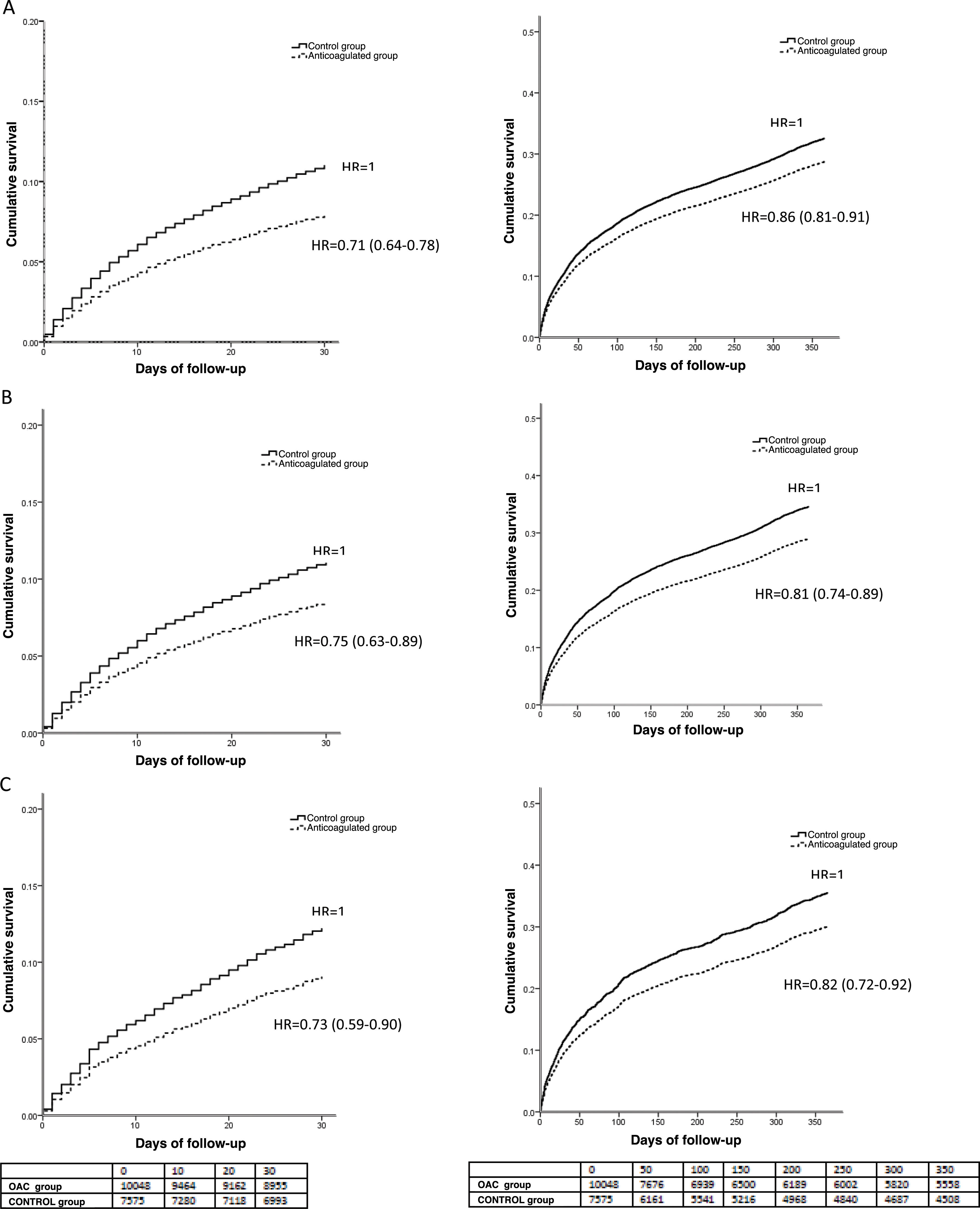
A total of 17,635 patients were included, 42.9% of whom were previously receiving oral anticoagulants. Compared with non-anticoagulated patients, anticoagulated patients had a higher mean age (80.6 vs 80.3, p = 0.02), were predominantly female (56.5 vs 54.9; p = 0.035), had a high prevalence of risk factors and cardiovascular disease, and had a higher thrombotic risk. The 30-day [adjusted HR: 0.75 (95% CI: 0.63–0.89); p < 0.001] and 1-year [adjusted HR: 0.81 (95% CI: 0.73–0.89); p < 0.001] prognosis was better in patients in the anticoagulated group. After propensity score matching, the results did not differ at 30 days [HR: 0.73 (95% CI: 0.59–0.90); p < 0.001] and at 1 year [HR: 0.82 (95% CI: 0.72–0.92); p < 0.001].

Conclusions

Oral anticoagulation may be beneficial in patients with heart failure, regardless of the presence of AF. However, more randomized studies are needed to evaluate this hypothesis.

Keywords:
Acute heart failure
Emergency departments
Oral Anticoagulation Treatment
Propensity Score
Mortality
Resumen
Introducción y objetivo

No existen datos relativos al efecto del tratamiento anticoagulante oral sobre el pronóstico en pacientes con insuficiencia cardíaca aguda (ICA). El objetivo del estudio fue evaluar el efecto del tratamiento anticoagulante oral en el pronóstico a corto y a largo plazo de pacientes con un episodio de ICA que han precisado atención en un Servicio de Urgencias Hospitalaria (SUH).

Método

Estudio observacional, multicéntrico, prospectivo con seguimiento de cohortes. Se recogieron datos basales y clínicos del episodio de pacientes con ICA en el servicio de urgencias de 41 hospitales españoles. Se realizó un emparejamiento mediante un propensity scores y se analizó la asociación cruda y ajustada del tratamiento anticoagulante oral con mortalidad a 30 días (objetivo principal) y anual.

Resultados

Se incluyeron 17635 pacientes, de los que recibían previamente tratamiento con anticoagulantes orales 42,9%. En comparación con pacientes no anticoagulados, los pacientes anticoagulados tenían una edad media superior (80,6 vs 80,3, p = 0,02), había un predominio del sexo femenino (56,5 vs 54,9; p = 0,035), tenían una alta prevalencia de factores de riesgo y enfermedad cardiovascular y su riesgo trombótico era superior. El pronóstico a 30 días [HR ajustada: 0,75(IC95%:0,63-0,89);p < 0,001] y al año [HR ajustada: 0,81(IC95%:0,73-0,89);p < 0,001] fue mejor en los pacientes del grupo que estaba anticoagulado. Tras el emparejamiento por propensity score, los resultados no difrerían a los 30 días [HR: 0,73 (IC95%:0,59-0,90);p < 0,001] y al año [HR: 0,82(IC95%:0,72-0,92);p < 0,001].

Conclusiones

El tratamiento anticoagulante oral ofrece un beneficio sobre la mortalidad global tanto a corto plazo (30 días) como a largo plazo (anual) en pacientes con ICA atendidos en SUH.


Palabras clave:
Insuficiencia cardiaca aguda
Servicios de Urgencias Hospitalarios
Tratamiento anticoagulante oral
Propensity Score
Mortalidad

Article

These are the options to access the full texts of the publication Medicina Clínica (English Edition)
Subscriber
Subscriber

If you already have your login data, please click here .

If you have forgotten your password you can you can recover it by clicking here and selecting the option “I have forgotten my password”
Subscribe
Subscribe to

Medicina Clínica (English Edition)

Purchase
Purchase article

Purchasing article the PDF version will be downloaded

Purchase now
Contact
Phone for subscriptions and reporting of errors
From Monday to Friday from 9 a.m. to 6 p.m. (GMT + 1) except for the months of July and August which will be from 9 a.m. to 3 p.m.
Calls from Spain
932 415 960
Calls from outside Spain
+34 932 415 960
E-mail
Article options
Tools