






In response to mounting sustainability challenges, integrating sustainability into business-related education has become crucial for preparing specialized professionals capable of advancing sustainable business models. Addressing key research gaps and building on the knowledge-based view (KBV), this study examines trends in the implementation of sustainability-focused business degree programs across Italian universities, offering insights into the role of business education in facilitating corporate sustainability knowledge acquisition. Statistical evidence reveals an unprecedented shift in Italian business curricula toward sustainability, characterized by an interdisciplinary approach that encompasses economic, environmental, social, and governance dimensions. Moderate evidence of a positive impact of these curricula on employability suggests an evolving labor market demand for corporate sustainability professionals. Qualitative findings highlight the targeted preparation of roles such as sustainability managers and business consultants, followed by sustainability-savvy accountants, managers in sustainable digital innovation, circular economy specialists, and a range of emerging niche positions. This study contributes novel insights to the literature by foregrounding the strategic role of universities in supplying corporate sustainability knowledge as a specialized resource that organizations can acquire to support the development of sustainable business models. It also offers practical insights that may inform efforts by universities and policymakers to reimagine business education strategies, effectively equipping the contemporary corporate world with the evolving expertise required to meet growing sustainability challenges.
Business organizations today face unprecedented sustainability challenges—from climate change and environmental degradation to social inequalities and mounting corporate governance pressures. These systemic challenges are reshaping corporate priorities, compelling businesses to embed sustainability knowledge into their strategic models to ensure long-term resilience and value creation (Bansal et al., 2025). In today’s shifting landscape, companies confront intensifying scrutiny over their environmental, social, and governance (ESG) performance, driven by rising stakeholder expectations and evolving regulatory frameworks. Corporate social responsibility (CSR) and ESG-related risks and opportunities have taken center stage in contemporary discussions on corporate sustainability and stakeholder value creation (Adams, 2017; Domingo‐Posada et al., 2024). As a result, demand has surged for specialized corporate sustainability professionals capable of leading sustainable business models, highlighting the need for business education to evolve accordingly (Lespinasse‐Camargo et al., 2024; Schaltegger et al., 2024).
Universities and business schools play a pivotal role in educating the next generation of sustainability-driven professionals by both generating and transferring sustainability knowledge (Fearon, 2024). A transformative educational approach—especially within business-related degree programs that embed sustainability—can foster interdisciplinary competencies that blend technical expertise with values-based and ethical mindsets, essential for navigating complex corporate sustainability challenges (Bradley, 2024; Carbone et al., 2025; Olalla & Merino, 2019). However, to close the skills gap and meet labor market demands, curricula must adapt (Aljohani et al., 2022), thereby requiring business and management education to align pedagogical innovation with market needs and the broader sustainability transition of corporate systems. Master’s programs, in particular, are key to incorporating sustainability-focused subjects (Sastre Segovia et al., 2023), thereby equipping graduates with the expertise needed to assume both operational and leadership roles within sustainable business models.
Building on the theoretical perspective of the Knowledge-Based View (KBV), this study positions business schools—and universities more broadly—as dynamic hubs for generating and disseminating specialist corporate sustainability knowledge. Universities have assumed a pivotal role as catalysts for societal, ecological, and technological transitions, acting as intellectual capital reservoirs, generating and disseminating knowledge to support organizational sustainability transformation (Del Gesso et al., 2024).
By embedding sustainability into curricula, these institutions also support the achievement of the United Nations’ Sustainable Development Goals (SDGs), preparing future leaders for ethical and responsible action in business contexts (Purcell et al., 2019; Singhal et al., 2024; Tasdemir & Gazo, 2020). In particular, embedding sustainability within business programs is essential to achieving the SDGs because they equip future executives, managers, and employees with the knowledge, responsibility, and ethical orientation required to respond to sustainability challenges (Chiang & Chen, 2022; Painter-Morland et al., 2016). Business school education can play a pivotal role in advancing the SDGs when intentionally structured to cultivate future leaders and employees who are not only sustainability-savvy and motivated but also committed to generating positive societal impact and embracing their broader responsibilities to society (Glavas et al., 2024; Singhal et al., 2024). Integrating sustainability into the curriculum fosters students’ knowledge and preparedness to tackle pressing sustainability challenges. This transformation not only empowers them to engage actively in sustainability efforts but also develops a skilled, mindful workforce and decision-makers capable of fulfilling their societal roles (Boafo et al., 2024; Singhal et al., 2024). With this in mind, universities have begun incorporating sustainability into their academic offerings by developing either sustainability curricula or standalone courses aimed at cultivating future professionals’ awareness as both experts and leaders in the field (Galleli et al., 2022; Obrecht et al., 2022).
The SDGs, in fact, have redefined university priorities globally, influencing new educational policies that prioritize sustainability (Stensaker & Hermansen, 2025). Recognition of education as a catalyst for societal transformation has led to an increased focus on sustainability education, with terms such as “education for sustainable development,” “sustainability education,” and “green curriculum” capturing this shift in academic focus and training objectives (Agbedahin, 2019; Ni et al., 2024; Sánchez-Carracedo et al., 2021). Since the launch of the 17 SDGs in 2015—which laid out a global roadmap for sustainable development, notably through Goal 4 advocating inclusive and equitable quality education—there has been a growing body of research examining how sustainability is being integrated into university education programs (Leal Filho et al., 2019). Initiatives like UNESCO’s Global Action Programme (GAP) on Education for Sustainable Development and the Principles for Responsible Management Education (PRME) have further underscored the role of education as a key driver of societal change (Figueiró et al., 2022; Parkes et al., 2020).
Despite increasing academic and policy attention, empirical evidence on the scope and evolution of sustainability integration within business curricula remains limited (Jun & Moon, 2021). As Leal Filho et al. (2019) argued, the concrete integration of sustainability topics into curricula—and their priority in teaching—still requires further attention. Specifically, little evidence exists on sustainability-focused business curricula—that is, focused-integration practices involving specifically designed, structured business curriculum offerings (Painter-Morland et al., 2016)—thus highlighting several research gaps. First, to the authors’ knowledge, no longitudinal, system-wide quantitative studies have empirically traced the transformation of sustainability-focused business curricula over an extended period within a national university context. Second, although some case-based insights exist (Hesselbarth & Schaltegger, 2014), studies examining the relationship between the implementation of such curricula and graduates’ employability, as well as the types of sustainability professionals these programs are designed to develop, remain lacking. This leaves both this relationship and universities’ role as providers of corporate sustainability knowledge virtually unexplored. Third, while knowledge creation and acquisition are central to a firm’s innovation and sustainability capabilities—and CSR has been identified as a promising field for extending the KBV’s application (Pereira & Bamel, 2021)—this theoretical lens has not yet been applied to examine the strategic role of universities in corporate sustainability knowledge provision.
Addressing these gaps, this study examines trends in the implementation of sustainability-focused business degree programs across Italian universities, offering insights into the role of business education in facilitating corporate sustainability knowledge acquisition. Specifically, this study explores the development of full sustainability-focused business-related curricula and examines their impact on graduates’ employability and the shaping of corporate sustainability professionals. The following research questions guided the study:
RQ1: What is the trend in the implementation of sustainability-focused curricula in business education curricular offerings across Italian universities?
RQ2: To what extent does the implementation of sustainability-focused business curricula influence the employability of business graduates?
RQ3: What kinds of corporate sustainability professionals are Italian universities preparing students for through these programs?
The study adopts a mixed-method approach to answer these questions. First, we conducted a trend analysis of sustainability-focused business-related degree offerings across Italian universities, covering the academic years from 2001/2002 to 2023/2024. We further used statistical methods to evaluate the impact of these degree programs on employability and a qualitative, type-building approach to identify the types of corporate sustainability roles for which graduates are prepared.
The study findings contribute novel insights to the literature by providing an evidence-based perspective on the Italian university system’s trends in implementing structured, sustainability-focused business curricula, with a nuanced discussion of their relationship to employment and their role in preparing business graduates for specialized sustainability-related roles. Drawing on the KBV perspective, this study foregrounds the strategic role of universities in supplying corporate sustainability knowledge as a specialized resource that organizations can acquire to support the development of sustainable business models. The findings offer actionable insights for educators, policymakers, recruiters, business leaders, and scholars, potentially informing efforts to align business-related academic programs with the evolving labor market and growing societal demand for corporate sustainability expertise.
The remainder of the article is structured as follows: Section 2 presents the research background and the KBV perspective framing the study; Section 3 outlines the data and methods; Section 4 presents the results, followed by the discussion in Section 5; and Section 6 concludes the paper by summarizing key findings, discussing implications for theory and practice, and outlining limitations and future research directions.
Literature overviewResearch background: sustainability integration in business educationFrom basic to more substantial levels of sustainability integration in business school curricula, the focusing approach involves embedding sustainability throughout the entire curriculum with interdisciplinary perspectives, incorporating courses that feature sustainability-related content as a significant part of the program (Painter-Morland et al., 2016). Indeed, sustainability knowledge entails tailoring inter/transdisciplinary learning and transcending disciplinary pedagogical boundaries (Gutierrez-Huerter et al., 2024; Sidiropoulos, 2014). In their survey of sampled European business schools, Painter-Morland et al. (2016) found that most institutions were at a basic or low level of sustainability integration, with focusing practices still viewed as aspirational. Similarly, Doh and Tashman’s (2014) global survey revealed a general lack of sustainability integration within business school curricula. However, spurred by the release of SDGs, a transformative shift in business-related educational fields—particularly in accounting—has been conceptually emphasized in recent work by Twyford et al. (2024), through autoethnographic vignettes from educators across Australia, South Africa, and New Zealand.
Overall, empirical research highlighted that the full integration of sustainability topics into business-related academic education is still in its infancy. For instance, in Brazil, Galleli et al. (2022) found that integrating sustainability-related content within individual courses of management curricula is at an early stage, with regional differences in course offerings—exclusively by public universities—and a prevalent focus on environmental sustainability. In Spain, Andrades Peña et al. (2018) found limited integration of sustainability topics in a university case study, and, similarly, Sastre Segovia et al. (2023) highlighted the need for implementing specific business school education programs on sustainability. Jun and Moon (2021) observed that, despite an increase in sustainability-related courses across ten sampled Korean business schools between 2013 and 2019, teaching remained fragmented. Their classification showed that only a few programs were effectively sustainability-focused, highlighting ongoing efforts to implement more structured and comprehensive curricula. Likewise, Naeem and Neal (2012) revealed the absence of systematic sustainability integration in the Asia-Pacific region. Scholars attributed this underdeveloped integration to several barriers, including a lack of faculty training on sustainability issues, resistance to pedagogical change, and time constraints (Andrades Peña et al., 2018; Naeem & Neal, 2012). Yadav and Prakash (2022) highlighted faculty resourcefulness and institutional and policy framework among the enabling factors for successfully integrating sustainability into Indian management education curricula in alignment with industry demands.
In contrast, Sharma and Hart (2014) observed that many U.S. business schools now offer programs that fully integrate sustainability—marking a shift from their initial inertia, when they integrated new courses into existing curricula only in response to the PRME initiative. More recently, Harrison et al. (2025) also noted that U.S. business schools are addressing the growing demand for sustainability skills through curriculum transformations to foster interdisciplinary learning and innovative mindsets. In Italy—the focus of this study—Venturelli et al. (2021) examined the content of CSR courses integrated into management curricula during the 2021/2022 academic year, revealing the presence of 71 such courses. However, trends in the implementation of comprehensive sustainability-focused business curricula remain unexplored. Recent research has called for a more radical rethinking of business pedagogy in Europe, emphasizing the urgency of reimagining curricula to instill a more holistic and integrated understanding of sustainability among future generations (Carbone et al., 2025).
Scholarly engagement with sustainability in business education is expanding, as demonstrated by several special issues in academic journals devoted to this topic. Notably, the 2005 special issue of Business Strategy and the Environment published some contributions addressing sustainability teaching and innovative curriculum development within business-related contexts (Springett & Kearins, 2005), highlighting the urgency of transforming business education for sustainability (Springett, 2005). Similarly, the Academy of Management Learning & Education’s 2010 special issue advocated a transformative sustainability approach to management education (Starik et al., 2010). More recently, The International Journal of Management Education launched two special issues addressing the challenges of responsible management education and business schools’ engagement in advancing the SDGs: the first marking the 10th anniversary of the PRME initiative in 2017 (Parkes et al., 2017), and the second in 2018 (Parkes et al., 2020). These collective contributions underscore the critical need to reshape business school education to adapt it to the needs of an evolving relationship between business and society.
Sustainability curricula make students future competitive professionals in the job market (Tasdemir & Gazo, 2020). However, as Klingenberg and Kochanowski (2015) noted, the supply of qualified professionals trained through business curricula needs to be aligned with the demand of recruiting organizations. Corporate sustainability as a profession has only recently begun to receive scholarly attention (Pollach et al., 2024). Corporate sustainability professionals represent a relatively new and evolving group, spanning both operational and leadership roles—including analysts, specialists, consultants, managers, and leaders—who act as agents of change, advancing sustainable business practices that support society’s broader sustainability transition (Lespinasse‐Camargo et al., 2024; Schaltegger et al., 2024). A trend of emerging professions related to sustainability is taking shape globally (Hesselbarth & Schaltegger, 2014). Lespinasse‐Camargo et al. (2024) conducted a global survey of professionals in sustainability-related positions, revealing that their tasks primarily focused on environmental sustainability rather than social and governance dimensions, with relatively few individuals in leadership roles. The authors mentioned the crucial role of education in addressing these gaps, also emphasizing the need for more specific sustainability training with interdisciplinary curricula, given that the surveyed professionals came from over 25 different degree programs. Limited evidence from a case study by Hesselbarth and Schaltegger (2014), based on alumni survey responses from a German university, illustrated how graduates of a pioneering master’s program in sustainability management effectively translated their acquired competencies into their professional roles.
Theoretical framework: the KBV perspectiveWhile the previous subsection outlined the research background, this subsection introduces the theoretical lens that underpins the present study. This study is theoretically grounded in the KBV perspective. Considered an extension of the Resource-Based View (RBV)—which argues that an organization’s sustainable competitive advantage stems from its unique base of resources and its ability to manage them innovatively—the KBV shifts the focus to knowledge-based resources, emphasizing the role of specialized knowledge held by an organization’s members (Grant, 1996). Within the KBV, knowledge is conceptualized as a primary strategic resource—an intangible, dynamic, and essential asset driving an organization’s innovation and overall performance. This includes specialized knowledge related to sustainability, which has emerged as a significant domain for applying the KBV (Pereira & Bamel, 2021).
The KBV also incorporates the notion of knowledge acquisition or organizational learning (Hörisch et al., 2015). One way to acquire and develop knowledge in corporate contexts is through external recruitment from the labor market of highly educated professionals with specialized expertise (Teece, 2003). Thus, sustainability-related knowledge can be intentionally accessed through hiring qualified specialists, such as those in sustainability management (Hörisch et al., 2015).
This dynamic creates a direct link between the KBV and business education. If sustainability knowledge is understood as a specialized resource that organizations can acquire by hiring corporate sustainability professionals, then universities play a pivotal role in developing and supplying this expertise. We thus assume that, by implementing structured, sustainability-focused business curricula, universities contribute to the dissemination of corporate sustainability knowledge by preparing future professionals who will act as knowledge carriers and drivers of innovation within organizations. Accordingly, the KBV provides a suitable theoretical perspective to frame this study, which explores how Italian universities contribute to corporate sustainability knowledge acquisition through implementing sustainability-focused business curricula, their relationships with employability, and the types of sustainability-oriented professional profiles being developed.
The KBV was originally developed with a primary focus on firms, rather than educational institutions. However, by conceptualizing knowledge as the most critical source of a sustainable, competitive advantage—whether developed internally or acquired externally—the KBV inherently involves universities, given their central role as institutional creators and providers of knowledge. Indeed, it is one of the most widely applied frameworks to explain university-to-industry knowledge transfer and resource access (Anatan, 2015). Yet, as Anatan (2015) noted, the process of knowledge exchange and absorption between academia and industry is not straightforward. It is shaped by complex intermediary dynamics and divergent institutional logics that may create friction points within the knowledge flow. As further emphasized by Tesfaye and Jilcha (2025), although generating and sharing knowledge with industry is a core mission of universities, the effective management of knowledge in university-industry linkage is constrained by several determinant factors, including limited knowledge management capacity, weak networks, inadequate leadership, conflicts of interest, and the often-low absorptive capacity of firms.
The strategic role of universities in the contemporary knowledge-based economy and society is also well captured by the Triple Helix framework, which conceptualizes university-industry-government cooperation, positioning the university as a fundamental helix of sustainable innovation through knowledge generation and dissemination in its host community (Cai & Etzkowitz, 2021; Del Gesso et al., 2024). However, Heaton et al. (2019) argued that making the Triple Helix model work requires flexible and entrepreneurial university management. To this end, they adopted the Dynamic Capabilities framework—focused on organizations’ ability to integrate, build, and reconfigure internal and external competencies in response to changing environments—to examine how universities can effectively contribute to innovation ecosystems.
Both the Triple Helix and Dynamic Capabilities perspectives highlight the strategic role of universities as innovation actors embedded within broader socio-economic systems. The former emphasizes systemic, multi-actor collaboration, while the latter focuses on universities’ capacity to adapt and reconfigure their capabilities in dynamic contexts. While these frameworks are valuable for capturing broader institutional and adaptive dimensions of universities in innovation systems, the KBV offers a more focused and appropriate lens for this study. Specifically, it enables a sharper analytical focus on knowledge as a strategic asset, allowing for a precise interpretation of universities’ role as suppliers of specialized corporate sustainability-related knowledge that firms can acquire and internalize by recruiting qualified professionals. The KBV, which also underscores the relevance of university-industry collaboration for innovation, foregrounds knowledge as a transformative firm-level resource that catalyzes innovation aligned with organizational needs and enhances responsiveness to rapidly evolving market demands (Zhang et al., 2024).
Materials and methodsBuilding on the theoretical framework outlined in the previous section, this study examines trends in the implementation of sustainability-focused business degree programs in Italian universities, intending to contribute insights into how business education integrates sustainability to shape sustainability professionals and thus facilitate corporate sustainability knowledge acquisition. The focus on all universities is relevant because business-related education in Italy is primarily delivered through these institutions. Indeed, Italy’s higher education system is predominantly composed of universities—currently 99 institutions, including 61 public (state) universities, 20 private (non-state) universities, seven special-order university institutes, and 11 private online universities, all recognized by the Ministry of University and Research (MUR). The study’s aim was addressed using a mixed-method approach, as detailed in the following data collection and analysis sub-sections.
Data collectionThe dataset analyzed in this study was obtained from the website of the Italian MUR. The Excel file examined, entitled “Offerta formativa - Lista dei corsi di laurea a partire dall’a.a. 2001/2002″ (translated as “Educational offer – List of degree programs starting from the academic year 2001/2002”), was downloaded in early September 2024 (available at https://dati-ustat.mur.gov.it/dataset/metadati). The data, updated as of April 9, 2024, encompass all types of degree programs implemented in the Italian university system over a 23-year period, from the academic year 2001/2002 to 2023/2024. Accordingly, this study focuses on business bachelor’s and master’s degree programs—first and second-cycle degrees, respectively—excluding post-graduate doctoral programs, which are not covered by this dataset. Additionally, we focused on entire degree programs rather than individual courses or modules that might address sustainability issues. Thus, single courses covering sustainability-related content are outside the scope of this study.
As an initial step, the dataset was filtered to identify all business-related degree programs, encompassing the various disciplines typically included in business school education, such as business, management, accounting, finance, economics, marketing, public administration, and other related subjects that reflect the interdisciplinary nature of modern business education. For this purpose, we relied on the CESTOR database, a comprehensive guide to university education in Italy (available at https://www.cestor.it/atenei/guida.htm). This resource provides detailed information on all universities and departments/schools, including a complete list of degree classes—that is, standardized disciplinary categories established by the Italian MUR that group together similar degree programs—across bachelor’s (first-level) and master’s (second-level) degree programs. It allows for targeted searches by degree class, making it a suitable tool for filtering and selecting relevant degree classes in the broader economic-disciplinary area. Examples of included classes are l-18 (Bachelor’s degree class in Business Administration), l-33 (Bachelor’s degree class in Economic Sciences), LM-77 (Master’s degree class in Management), LM-56 (Master’s degree class in Economic Sciences), LM-63 (Master’s degree class in Public Administration), and LM-16 (Master’s degree class in Finance).
As a second step, we identified sustainability-focused curricula by reviewing the titles of individual degree programs for each academic year across all the business-related programs in the economic area identified in the previous step. Indeed, based on the literature, the title indicates an explicit focus on sustainability content (Jun & Moon, 2021; Obrecht et al., 2022; Zorio-Grima, 2020). Accordingly, sustainability-focused business curricula were selected based on the presence of relevant keywords in their titles (Obrecht et al., 2022) such as “sustainable”/ “sustainability,” “sustainable development,” “environment*”/ “green,” “social responsibility,” “ecology,” “ethics,” “circular economy,” and “human rights.” These terms appeared in Italian and English, reflecting the increasing number of degree programs taught in English.
The data collection process was completed by reviewing the descriptions of degree programs (i.e., their flyer/manifesto/factsheet) available on the websites of Italian universities offering active sustainability-focused business curricula. These descriptions mostly included learning objectives/outcomes, program syllabi, occupational opportunities, and study plans. Additionally, data on the employment conditions of business graduates (in any related discipline in the economic area) were gathered from the Alma laurea database (available at https://www.almalaurea.it/i-dati/le-nostre-indagini/condizione-occupazionale-laureati), which contains annual surveys monitoring the employment outcomes of graduates across various disciplines, with data available from 2008 onwards.
Data analysisRQ1 sought to identify the trend in the implementation of sustainability-focused curricula in Italian universities’ business education over time, exploring their presence and expansion longitudinally.
To identify potential growth patterns, the evolution of these curricula was tracked by measuring their number for each year and calculating their percentage relative to the total number of business-related degree programs offered each academic year. It is important to note that, for the purpose of this analysis, each degree program was counted as a single unit, even when divided into multiple curricular paths—because curriculum here refers to the entire degree program. We measured both the absolute number and the percentage of sustainability-focused business curricula, and applied trend analysis to examine their evolution from the academic year 2001/2002 through 2023/2024. We utilized linear regression to analyze the relationship between time (academic years) and the data, because this trend analysis method is commonly applied for trend identification and is particularly suitable for detecting long-term changes in quantitative data (Aydin, 2014; Meshram et al., 2020). This approach enabled us to examine historical trends and shifts in the number and percentage of sustainability-focused business curricula across academic years. Additionally, to further evaluate the presence of trends in the data, we conducted a non-parametric Mann-Kendall test in R software that is usually applied to identify significant trends in a time series (Meshram et al., 2020). This test is well-suited for detecting monotonic trends in time series data without assuming a specific distribution (Nunifu & Fu, 2019), thus providing a robust method for our analysis. The Mann-Kendall test was applied separately to both the absolute number of sustainability-focused business curricula and their percentage relative to the total number of curricula offered within the economic-disciplinary area.
Finally, we also performed a structural change analysis to explore the presence of non-linear patterns or disruptive shifts in implementing these curricula. Specifically, we used the strucchange package in R to apply the Bai-Perron multiple breakpoint test, which identifies structural changes in a linear regression model by estimating breakpoints that minimize the residual sum of squares through a least-squares approach (Bai & Perron, 2003). The analysis was applied to the annual ratios of sustainability-focused business curricula to the total number of business-related curricula within the economic area to ensure consistency and comparability over time. This approach accounted for fluctuations in the total number of business-related curricula offered over the years and avoided applying least-squares methods directly to percentage values. The optimal number of breakpoints was determined using the Bayesian Information Criterion (BIC), which balances model fit and parsimony. To assess the statistical significance of the overall structural change, we employed the supF test. Both procedures are standard components of the Bai-Perron framework (Bai & Perron, 2003). Finally, we analyzed the fitted regression model across the time segments defined by the identified breakpoints to assess the magnitude and direction of each phase.
To address RQ2, we employed Pearson correlation and regression analysis to investigate the relationship between the implementation of sustainability-focused curricula in business-related education and the employability of graduates from business-related disciplines in the economic-disciplinary area. Given that bachelor’s degree programs typically span three years and master’s degree programs two, and because we considered employment rate data referring to one year after graduation, a six-year time lag was applied. This allowed us to evaluate how implementing sustainability-focused business curricula at the outset of students’ academic journey may influence their employability upon completing both degree levels.
To explore the types of corporate professionals targeted by sustainability programs in response to RQ3, we conducted a systematic qualitative text analysis (SQTA) on descriptions of sustainability-focused business degree programs active in the latest year of our data (i.e., the 2023–2024 academic year). We focused on these programs due to the lack of available information on programs introduced or discontinued over the years. We applied Kuckartz’s type-building approach (Kuckartz, 2014), a structured method for grouping similar cases—in this context, sustainability curricula offered in 2023/2024—by type, specifically focusing on sustainability professionals. Through inductive coding of target professional profiles within program descriptions, we relied on a general framework of potential roles prepared by business degree programs—that is, corporate sustainability professionals such as analysts, specialists, consultants, managers, and leaders (Lespinasse‐Camargo et al., 2024; Schaltegger et al., 2024)—to guide the analysis. Recurring patterns were identified and clustered into distinct types based on similarities and differences among cases (Kuckartz, 2014). The coding process, supported by QDA Miner software, systematically differentiated specialized sustainability-trained professionals across curricula, capturing the breadth of content, competencies, subjects taught, and occupational opportunities emphasized in each program. Although traditional reliability measures were not applied, the consensual coding approach added rigor by resolving any discrepancies between the two authors, ensuring coherence in coding (Kuckartz, 2014). Consequently, each program was assigned various professional roles aligned with its description, reflecting nuanced distinctions across curricula.
FindingsBuilding on the mixed-method approach described in the previous section, this section presents the study’s findings for our three research questions.
Trend analysis results answering RQ1Fig. 1 illustrates the evolution of the implementation of sustainability-focused business curricula from 2001/2002 to 2023/2024, addressing RQ1. The chart presents both the absolute number of these curricula and their percentage relative to the total number of bachelor’s and master’s curricula within the economic degree classes offered by Italian universities. From 2001 to 2008, business-related curricula integrating sustainability remained relatively stable, fluctuating between 15 and 22 and representing approximately 3 % to 4.6 % of the total offerings in the economic area. However, between 2008 and 2013, a notable decline occurred, with sustainability-focused programs dropping below 2 % of total business curricula starting in the early 2010s. Beginning in 2013, a gradual recovery emerged, followed by a marked acceleration after 2020. Specifically, the number of these programs rose from 22 in the 2020/2021 academic year to 55 in 2023/2024, now accounting for over 8 % of all business-related curricula in the economic area.

The sharp rise observed in recent years points to a growing recognition of the relevance of sustainability in business education, likely spurred by international policy agendas and mounting societal and stakeholder pressures for ethical and responsible corporate practices. The linear trend line in the graph highlights an overall upward trajectory, indicating that, despite some periods of stagnation or decline, the long-term direction has been positive. The trend line equation, y=0.6047x+11.047, suggests that the number of sustainability-focused business curricula has increased by approximately 0.6 programs per year on average. This trend reflects a growing emphasis on implementing these curricula in Italian universities, particularly in recent years. However, the relatively low R2 value of 0.1422 indicates that the linear model accounts for only 14 % of the variance in the data. This suggests that other influencing factors may have contributed to driving universities’ curricular decision-making over time. These factors arguably include structural changes in institutional strategic priorities, national or supranational policy developments, limited funding in certain periods, heightened global awareness of sustainability imperatives, or increasing external pressures to address environmental crises—thereby shaping the trend in sustainability-focused business curricula.
The Mann-Kendall test results for the absolute number of sustainability-focused business curricula (Table 1) suggest insufficient statistical evidence to reject the null hypothesis (p-value > 0.05). This indicates that no significant upward or downward trend exists in the implementation of sustainability-focused curricula over time. Similarly, the results for the percentage of sustainability curricula also show a z-value of -0.15872 (i.e., < ±1.96) and a p-value of 0.8739 (i.e., > 0.05), further confirming the absence of a significant trend in the percentage of sustainability-focused business curricula relative to the total number of curricula offered within the economic-disciplinary area. These findings imply that, although fluctuations in both the number and percentage of sustainability-focused programs may occur, no consistent upward or downward trend can be statistically identified over the period analyzed. In summary, despite an overall increase in their number in recent years, no statistically meaningful trend in the implementation of sustainability-focused business curricula is evident over the examined time frame.
Mann-Kendall test results.
Both the relatively low R² value (0.1422) from the linear regression model in Fig. 1 and the non-significant results of the Mann-Kendall test in Table 1 suggest that the implementation trend of sustainability-focused business curricula in Italian universities has not followed a strictly linear or gradual trajectory. Instead, these findings indicate the possible presence of disruptions or structural shifts over time. Accordingly, we conducted a structural change analysis using the Bai-Perron multiple breakpoint test to better capture these non-linear dynamics. As shown in Fig. 2, this test identified three statistically significant breakpoints—2008/2009, 2013/2014, and 2020/2021—automatically selected based on model fit and parsimony, as determined by the BIC. The supF test confirmed the presence of structural change (supF = 19.496, p-value = 0.0003), thereby validating the segmentation of the time series. In the figure, the black curve represents the observed trend in the ratio of sustainability-focused to total business-related curricula in the economic area, with the red horizontal lines depicting the average fitted values for each time segment. The vertical dashed blue lines indicate the estimated locations of the breakpoints. These turning points delineate three distinct phases: a sharp decline following 2008/2009, a modest recovery after 2013/2014, and a marked acceleration starting in 2020/2021, thus confirming the existence of a non-monotonic, segmented trend.

The most recent phase is particularly noteworthy. As reported in Table 2, the average ratio of sustainability-focused business curricula nearly doubled after 2020 (i.e., in the fourth segment), rising from approximately 0.0226 in the preceding third segment (2014–2015 to 2020–2021) to around 0.0595 in the most recent one (2021–2022 to 2023–2024). The increase between the third and fourth segments is statistically significant (p-value = 0.00342), indicating that this shift is unlikely to be due to random variation. Furthermore, the earlier breakpoints in 2008 and 2013 help contextualize the magnitude of this recent change: following more than a decade of decline and slow recovery—likely influenced by broader institutional and economic constraints in the aftermath of the global financial crisis—the post-2020 surge constitutes a structural turning point of unprecedented significance in the implementation of sustainability-focused business curricula.
Results of the fitted regression model across four segments defined by the Bai-Perron structural breakpoints.
Notes: Estimated coefficients are relative to the baseline intercept. Mean ratios are approximated as intercept ± coefficient. Segment 4 coefficient is statistically significant (p-value = 0.00342).
The Pearson correlation coefficient was calculated to address RQ2 on the influence of sustainability curricula on employability, yielding a value of 0.5061. This indicates a moderate positive relationship between the implementation of sustainability-focused business curricula and the employment rate of business graduates. To assess the statistical significance of the correlation, a t-test was conducted, resulting in a p-value of 0.046, below the 0.05 threshold. This confirms that the observed correlation is statistically significant at the 5 % level. While the correlation is not exceptionally strong, the results suggest a noticeable trend: an increase in sustainability-focused business education is associated with improved one-year employability of business graduates. Fig. 3 illustrates a positive trend, where the data points, despite some dispersion, generally follow an upward linear trajectory. Although the relatively low R² value (0.2561) indicates that only about 25.6 % of the variation in employability can be explained by the increase in sustainability-focused business curricula, it suggests that other factors also contribute to the outcome.

Indeed, it is not unexpected that multiple overlapping factors influence labor market performance. Employability is widely recognized as being influenced by a broad set of variables beyond the academic knowledge acquired during university studies, and thus beyond curriculum content alone. These variables include, for example, macroeconomic conditions and economic conjunctures, regional labor demand, internship and placement opportunities, institutional and fiscal labor incentives for new graduates, as well as their individual profiles and soft skill competencies. Nonetheless, while acknowledging that these contextual variables matter to comprehensively assess the drivers of employability in sustainability-oriented business education, the moderate and statistically significant correlation detected herein highlights that sustainability-oriented business curricula may contribute meaningfully, though not exclusively, to the employability of graduates educated in this field. Indeed, this positive trend likely reflects an increasing demand in the labor market for business graduates equipped with sustainability expertise. Given that Italian universities are now increasingly implementing sustainability-focused business curricula, it is reasonable to expect that employment rates for business graduates equipped with these competencies will arguably improve further in the coming years.
Qualitative analysis results answering RQ3Addressing RQ3, an SQTA was conducted by examining the descriptions of the 55 sustainability-focused business degree programs offered within the Italian university system in the 2023/2024 academic year.
Fig. 4 provides an overview of the key features of these programs through six pie charts depicting their distribution by degree level, teaching language, university type and geography, year of implementation, and sustainability dimension, respectively. Notably, sustainability-focused business second-cycle (master’s) degree programs are predominant over first-cycle (bachelor’s) degrees, representing 74.5 % of Italian universities’ business education offerings aimed at preparing future corporate sustainability professionals. Additionally, 16 of the 55 curricula (29.1 %) are taught in English, and five (9.1 %) programs combine both Italian and English-taught courses. Sustainability-focused business degree programs are also predominantly provided by public universities (87.3 %), and a significant portion (52.7 %) is offered by institutions located in northern Italy, with southern universities still accounting for a smaller share (14.5 %). This disparity may reflect the traditional north-south employment gap in the Italian labor market—that is, the north generally offers more job opportunities than the south—which might differentially stimulate local universities’ business education offerings for the training of sustainability professionals in their respective regions.

Fig. 4 further shows that the majority of the 55 active degree programs were introduced in the 2023/2024 (nearly 31 %) and 2022/2023 (27.3 %) academic years, with only 12.7 % introduced before 2015. This trend underscores the recent and timely commitment of Italian universities to embedding sustainability within business education. Notably, 71.4 % of the programs adopt a comprehensive sustainability perspective—including economic, environmental, social, and governance dimensions—reflecting a growing awareness of the need to equip students with targeted education to prepare expert corporate sustainability professionals. Among those focused on a single dimension, environmental sustainability is the most common (25 %), compared to social sustainability (only 3.6 %).
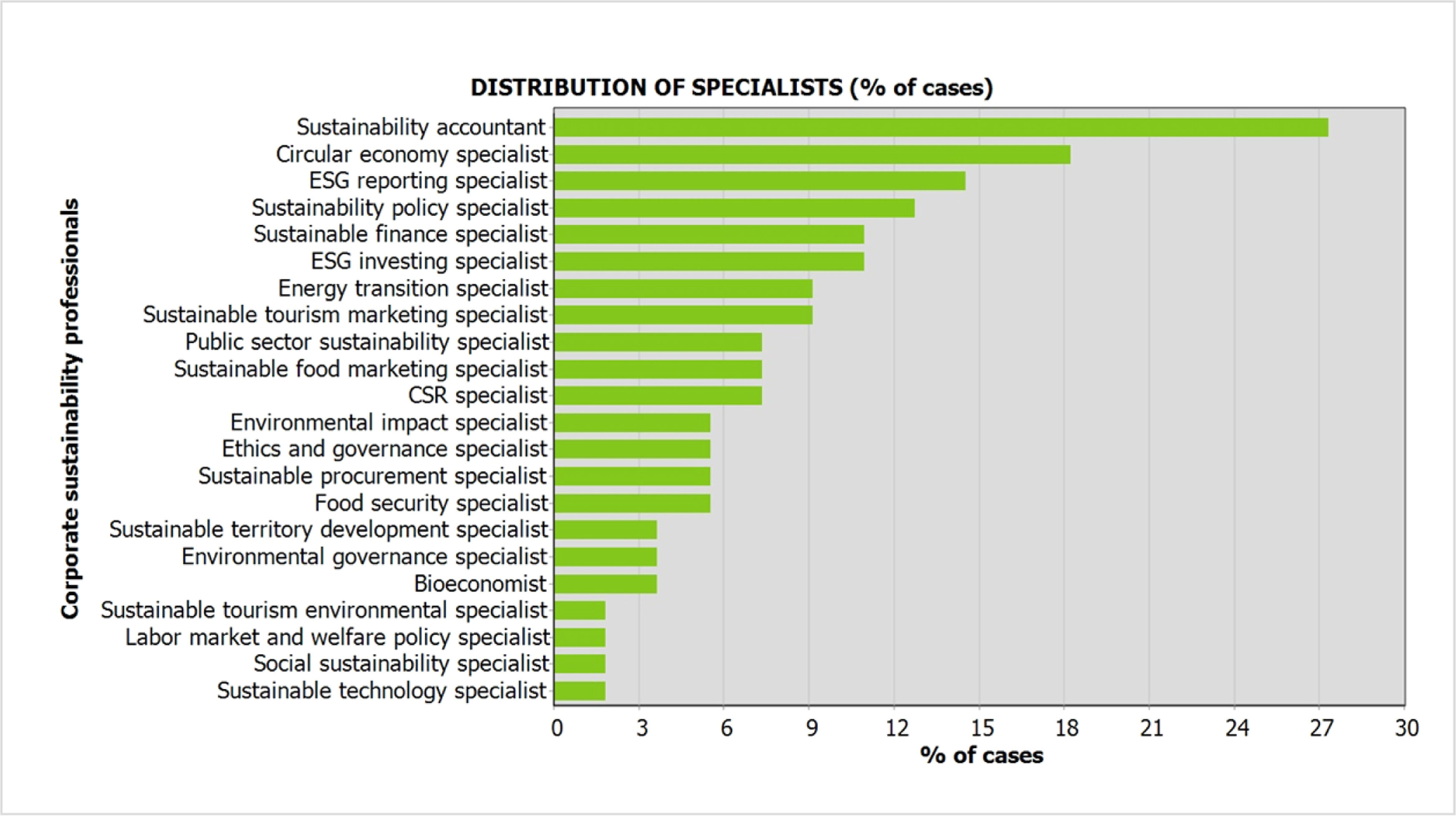
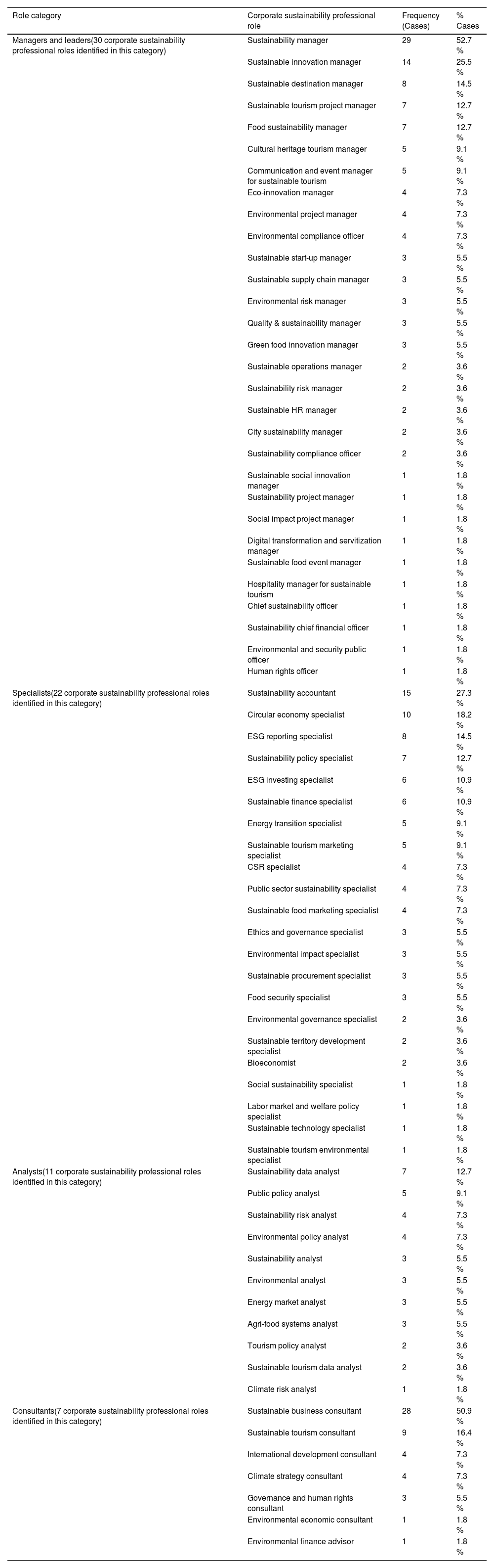
Fig. 5 illustrates 70 specialized corporate sustainability professionals identified across the examined curricula in response to RQ3. These roles span managerial and leadership positions, consultancy, specialists, and analytical profiles. The most frequently represented role is the “sustainability manager,” appearing in 29 curricula (52.7 %), followed by “sustainable business consultant” in 28 curricula (50.9 %), “sustainability accountant” in 15 curricula (27.3 %), “sustainable innovation manager” in 14 curricula (25.5 %), and "circular economy specialist" in 10 curricula (18.2 %). These are followed by a wide array of niche profiles found in fewer than 10 degree programs, reflecting the varied scope of the Italian universities’ sustainability-focused business education. These professionals showcase high levels of specialization, ranging from management and accounting to finance and economics, while also addressing different sustainability dimensions. Several roles address sustainability as a whole (e.g., “sustainability policy specialist” and “sustainability data analyst”), while some also focus specifically on the environment (e.g., “energy transition specialist,” “environmental policy analyst,” and “environmental risk manager”), on the social dimension (e.g., “social impact project manager” and “human rights officer”) and even governance (e.g., “ethics and governance specialist”). In addition, while some programs train sustainability professionals for the public sector, some degree of focus is also evident in the food and tourism domains, with several specialized roles tailored to these sectors (see also Table 3).

Summary of identified corporate sustainability professional roles across the curricula, organized by role category and frequency.
Figs. 6, 7, 8, and 9 display the identified corporate sustainability professionals, divided into the four categories of professional roles used in the analysis: managers and leaders (N = 30), specialists (N = 22), analysts (N = 11), and consultants (N = 7), respectively. These figures underscore the focus of Italian universities on shaping future managerial and leadership profiles in sustainability. They present a broad spectrum of roles, from the more general “sustainability manager” to highly specialized innovation-driven positions such as in environmental and technological domains (Fig. 6), supported by a diverse array of technical specialists (Fig. 7). This suggests a clear emphasis on preparing leaders and decision-makers by equipping students with strategic and managerial competencies to tackle sustainability challenges and lead the implementation of sustainable strategies in organizations. In contrast, a smaller variety of professionals is found for analysts (Fig. 8) and consultants (Fig. 9).


To complement the visual representation of the role categories, Table 3 provides a structured summary of the 70 identified corporate sustainability professional roles, organized by category and annotated with their frequency and percentage of occurrence across the curricula.
DiscussionA transformative shift in Italian sustainability-focused business curricula implementationThe findings for RQ1, presented in the previous section, revealed an overall upward trend in implementing sustainability-focused business curricula in Italian universities over time, with a recent transformative growth phase beginning in the academic year 2020/2021. The Mann-Kendall test results indicate no statistically significant long-term monotonic trend from 2001 to 2024, and the low R² value from linear regression suggests that the trend has not followed a simple, gradual path. This irregular pattern is further supported by the results of the structural change analysis, which confirmed the presence of non-linear dynamics and discontinuities in the implementation process. Specifically, the Bai-Perron test identified three breakpoints (2008–2009, 2013–2014, and 2020–2021) with the third breakpoint marking the most recent time segment (from the academic year 2021–2022 to 2023–2024), which exhibits unprecedented significance. This result confirms that a statistically robust and ongoing transformative shift began in 2020/2021 in the implementation process of sustainability-focused business curricula across the Italian university system. This evidence supports the view that, in contrast to earlier periods characterized by gradual change, universities are now embracing a more transformative approach—marking a decisive departure from traditional educational models.
Italian universities appear capable of making substantial shifts in curriculum design, reconfiguring their educational priorities to more systemically integrate sustainability. This change may be driven by growing awareness of global sustainability imperatives, rising societal expectations and pressures for responsible and ethical business practices, and policy priorities arguably catalyzed by the release of the UN SDGs in 2015 (Stensaker & Hermansen, 2025; Twyford et al., 2024). As such, the current implementation pattern does not conform to past trajectories but reflects a potentially disruptive structural transition in business-related educational disciplines. This shift, long advocated in the literature (Starik et al., 2010), is also being institutionally shaped by Italy’s National Recovery and Resilience Plan (PNRR), introduced in 2021 under the European Union’s Next Generation EU initiative in response to the pandemic crisis. The PNRR’s missions for Italy include promoting the country’s digital transformation, fostering ecological transition and sustainability in the economic system, modernizing sustainable transport infrastructure, and strengthening the education system.
As a result, the policy framework surrounding innovation, sustainability, and education has arguably influenced Italian university offerings, aligning them with the PNRR’s national priorities and providing institutional support for sustainability integration—a factor recognized as critical in other national contexts (Yadav & Prakash, 2022). This interpretation is further supported by qualitative analysis findings, which show that most currently active sustainability-focused study programs were introduced between the 2021/2022 and 2023/2024 academic years (see Fig. 4). Moreover, the titles of some programs reflect innovation and sustainability priorities, such as the master’s degree program in Innovazione, Governance e Sostenibilità (Innovation, Governance and Sustainability), introduced by the University of Bari in 2021/2022, and the Management for Energy and Environmental Transition program, introduced by the University of Genova in 2022/2023. These program titles reflect a deliberate curricular strategy aimed at responding to policy encouragements and organizational knowledge demands, reinforcing the KBV perspective of universities as external knowledge sources. As such, they play a pivotal role in facilitating knowledge acquisition (or organizational learning), particularly in emergent domains like sustainability. The active offerings also show the prevalence of master’s degree programs over bachelor’s programs addressing sustainability in business education, consistent with the literature’s emphasis on the development of such master’s programs (Sastre Segovia et al., 2023).
Consistent with prior findings, despite referring to sustainability-related subjects embedded within business curricula (Galleli et al., 2022; Venturelli et al., 2021), we found that sustainability-focused programs are predominantly offered by public universities, with regional differences in implementation. However, unlike previous studies highlighting issues such as fragmented teaching and a narrow curricular focus on sustainability topics (e.g., Jun & Moon, 2021), our results revealed a more systemic approach in Italy that addresses sustainability in all dimensions. Notably, while Painter-Morland et al. (2016) found that sustainability-focused curricula remained largely aspirational in most European business schools, with a few pioneering exceptions such as in Germany (Hesselbarth & Schaltegger, 2014), our findings document that such focusing practices are spreading while advancing with momentum across Italian universities. This development reinforces recent calls for a proactive rethinking of business pedagogy that fosters a more holistic sustainability education in Europe (Carbone et al., 2025). Overall, this study demonstrates that the Italian university system for business-related education is experiencing an unprecedented transformation, marked by structured, interdisciplinary integration of sustainability. Moreover, while other regional experiences reported in previous studies highlighted low or uneven integration (e.g., Andrades Peña et al., 2018; Doh & Tashman, 2014; Naeem & Neal, 2012), the Italian case shows that some relevant sustainability-focused curricula were already implemented as early as the 2000s. However, these early programs primarily addressed environmental economics and sustainable tourism—likely due to the key importance of the tourism sector in the Italian economy—with only a few more specific offerings, such as the master’s degree program in Decisioni Economiche, Impresa e Responsabilità Sociale (Economic Decisions, Business and CSR) offered by the University of Trento from 2003/2004 to 2009/2010.
Furthermore, the active offerings highlight the interdisciplinary character typical of the focusing mode of integrating sustainability into curricula (Gutierrez-Huerter et al., 2024; Painter-Morland et al., 2016). This trait was evident in nearly all the curriculum descriptions examined, often achieved through interdepartmental collaboration within the university. For example, the University of Turin’s master’s degree program in Georisorse e Gestione Ecosostenibile d’Impresa (Georesources and Eco-sustainable Business Management) is jointly implemented by the university’s Departments of Management and Earth Sciences. Interuniversity partnerships also emerged, such as the Transformative Sustainability master’s degree program jointly offered by Bocconi University and the Polytechnic of Milan, which combines social science and technical knowledge, reflecting the respective educational focuses of the two institutions. This finding mirrors Harrison et al.’s (2025) recently observed trends in the United States, where business schools redesign curricula to foster innovative, interdisciplinary sustainability competencies. The widespread interdisciplinary collaboration observed in program design further supports the KBV perspective because it reflects a deliberate effort to generate integrated knowledge configurations that organizations may find especially valuable in addressing complex sustainability challenges.
Employability outcomes and the emergence of sustainability-related professional rolesThe specialized professionals trained by sustainability-focused business curricula necessarily require integrated and transversal interdisciplinary skills. This is exemplified by the training of the bioeconomist through two degree programs at the University of Parma—the bachelor’s program in Sistema Alimentare: Sostenibilità, Management e Tecnologie (Food System: Sustainability, Management and Technologies) and the master’s program in Economia e Management dei Sistemi Alimentari Sostenibili (Economics and Management of Sustainable Food Systems). The training arguably reflects the local business landscape, closely tied to food companies, and points to a likely labor market demand. This is further supported by the RQ2 findings, which revealed that a moderate positive relationship exists between the implementation of sustainability-focused business curricula and the employability of business graduates, indicating that the labor market is likely to absorb professionals with expertise in sustainability. This finding echoes prior claims that up-to-date curricula are essential in order for qualified business graduates in sustainability to meet industry demands (Yadav & Prakash, 2022).
Furthermore, the qualitative analysis of sustainability professionals in response to RQ3 revealed that sustainability-focused business curricula in Italian universities prepare graduates for five key roles in corporate sustainability: manager, consultant, and accountant with sustainability expertise, followed by a manager specialized in sustainable digital innovation and a specialist in circular economy. These roles appear to be mainstream because they represent the dominant trend across the sustainability-focused business curricula, followed by an array of niche profiles (see Figs. 5–9 and Table 3). Additionally, the findings highlight a broad spectrum of managerial and leadership roles being prepared, extending beyond the environmental dimension to encompass economic and broader ESG dimensions. This suggests that Italian universities are actively addressing the need for professionals in these positions, which, as noted by Lespinasse‐Camargo et al. (2024), remain relatively few and limited in terms of comprehensive sustainability focus, thus emphasizing the critical role of education in closing these gaps. From a KBV perspective, the emergence of specialized sustainability-oriented roles highlights universities’ evolving function as knowledge providers within the corporate ecosystem, thereby contributing to the development of the knowledge assets organizations need to adapt to and thrive in sustainability-oriented environments.
ConclusionSummary of key findingsThis study contributes to the expanding debate on sustainability integration in business school curricula (e.g., Carbone et al., 2025; Doh & Tashman, 2014; Harrison et al., 2025; Jun & Moon, 2021; Painter-Morland et al., 2016; Singhal et al., 2024; Springett, 2005) by analyzing trends in implementing sustainability-focused business degree programs within the Italian university system from 2001/2002 to 2023/2024. Adopting a mixed-method approach, the study addressed three research questions: (1) the trend in the implementation of sustainability-focused business curricula over time; (2) the influence of these curricula on graduates’ employability; and (3) the types of corporate sustainability professionals being prepared. The results help bridge research gaps related to sustainability-focused curricula transformation in business education, the employability impact of these programs, and the professionalization of corporate sustainability roles.
The findings reveal an unprecedented shift in business-related curricula across Italian universities toward sustainability, characterized by an interdisciplinary approach that encompasses economic and ESG dimensions. This aligns with the global movement toward the SDGs and highlights universities’ evolving role in fostering sustainable business models to advance societal progress. There is also moderate evidence that these curricula positively influence employability, suggesting that labor market demand for skilled corporate sustainability professionals is evolving. Qualitative insights indicate that Italian universities are proactively preparing graduates for emerging sustainability-focused roles such as managers, leaders, specialists, analysts, and consultants, covering a broad range of managerial and leadership positions. The most prominent roles include sustainability managers and sustainable business consultants, complemented by professionals such as sustainability-savvy accountants, managers specialized in sustainable digital innovation, and circular economy specialists—reflecting a growing diversification of sustainability-oriented career paths.
Implications for theory and practiceThis study offers a theoretical contribution through a novel application of the KBV to sustainability-oriented business education. It extends the KBV’s notion of knowledge acquisition (Hörisch et al., 2015; Teece, 2003) to the context of sustainability-focused business curricula, positioning universities as strategic external knowledge providers that generate and supply specialized sustainability knowledge to organizations through highly educated professionals, thereby contributing to firms’ sustainability-oriented innovation and learning. In addition to this theoretical contribution, the study carries several implications for theory and practice, particularly for researchers and educators in business-related fields, university leaders, organizational recruiters, business executives, and policymakers.
First, the Italian case highlights the critical role of universities in the global transition toward sustainable business models. Structured sustainability-focused business curricula cultivate graduates’ awareness of issues affecting organizational value-creation, equipping them with interdisciplinary competencies essential for driving corporate sustainability. By implementing these curricula, universities provide graduates with the knowledge and tools to support business transitions toward sustainable models, preparing students—the decision-makers and workforce of tomorrow—for the complex challenges of corporate sustainability.
Second, the diverse range of roles identified herein—from managerial to more specialized positions—suggests that universities are beginning to meet the need for a wide range of professionals with sustainability expertise, highlighting the urgent need for business education to evolve in step with emerging labor market expectations. This aligns with global calls for corporate sustainability professionals, particularly in leadership roles where representation remains limited, and where education plays a critical role in bridging related training gaps (Lespinasse‐Camargo et al., 2024).
Third, this study contributes to the emerging research area on corporate sustainability professionals as transformative agents in the labor market and society (Pollach et al., 2024; Schaltegger et al., 2024), offering a perspective on the essential role of their education. As the market demand for sustainability professionals grows, universities are urged to expand and adapt their curricula to address evolving employment needs, particularly in fostering decision-making and governance capabilities related to sustainability.
Fourth, the findings suggest an evolving labor market demand for sustainability-related corporate professionals, underscoring their employability potential. This implies an alignment between the demand from recruiting organizations and the supply provided by university educational offerings (Klingenberg & Kochanowski, 2015), also considering that local job markets play a significant role in shaping both educational demand and supply, with regional differences likely reflected in specific curricula offerings. This alignment between knowledge demand and supply reflects the KBV view of knowledge as a strategic resource for meeting organizational innovation needs and enhancing responsiveness to rapidly evolving market demands (Zhang et al., 2024).
Finally, this study offers practical implications for reimagining university strategies in a rapidly evolving landscape, positioning universities as strategic knowledge providers increasingly expected to redefine their roles in close alignment with the corporate world. The emergence of new competencies and the transformation of job profiles call for innovative curriculum design strategies that reflect the dynamic relationship between business education and labor market needs. The study may inform and encourage practices in this regard, offering evidence-based insights that could inspire universities and policymakers to develop suitable educational approaches to equip the contemporary corporate world with the evolving professionalism demanded by increasing sustainability challenges. Ultimately, the study’s findings point to a broader implication: business academic programs can serve as pivotal bridges between corporate practices and societal needs, fostering responsible organizational actors and advancing sustainable development.
Limitations and future research directionsWhile this study helps bridge existing research gaps by providing an evidence-based analysis, framed through a KBV perspective, of implementation trends in sustainability-focused business curricula across Italian universities, it also acknowledges several limitations that open pathways for future research.
First, although addressed in this study, the impact of sustainability-focused business curricula on graduates’ employability requires further investigation to allow for full validation, including long-term effects on the career trajectories of graduates trained as specialized corporate sustainability professionals. As more recent employability data are not yet available, the current transformative phase of sustainability curriculum implementation in Italy is not fully reflected in the correlation findings. Accordingly, the findings should be interpreted as indicative rather than conclusive because they are based on data predating the recent disruptive surge in sustainability-focused programs.
Second, the regression model adopted in this study accounts for 25.6 % of the variance in employability outcomes, suggesting that additional variables arguably influence these results. Future research could therefore benefit from adopting multivariate models that incorporate a broad set of contextual variables to more comprehensively assess employability determinants in sustainability-oriented business curricula—such as macroeconomic trends, regional labor market conditions, fiscal or institutional incentives for new graduates, and individual-level characteristics.
Third, future research could explore how these curricula evolve in response to shifting labor market demands and policy initiatives. Such an inquiry would provide valuable insights into the dynamic interplay between business education, employment, and the development of corporate sustainability professionals.
Fourth, further studies could investigate similar trends in implementation in other national or regional contexts, enabling cross-country comparisons that uncover broader global patterns and localized divergences. Comparative analyses may also help identify enabling or constraining factors influencing curriculum transformation across different higher education systems.
Fifth, while the SQTA of curriculum descriptions enabled the identification of the types of corporate professionals targeted by sustainability-focused programs, the study does not delve deeply into the granular content or pedagogical architecture of individual course units within each program. Future research could build on this approach by examining how specific teaching strategies and actual pedagogical delivery align with the intended professional profiles, offering a more detailed assessment of curricular coherence and effectiveness.
Finally, subsequent research could examine corporate perceptions of graduates from sustainability-focused business programs. Incorporating the perspectives of recruiting organizations—those hiring graduates equipped with specialized sustainability knowledge—would support a more effective alignment between curricular offerings and the evolving professional demands of the corporate world. Such a line of inquiry would enrich the expanding body of literature on advancing sustainable development through academic education, while identifying both exemplary practices and areas for improvement. In turn, it would help ensure that business curricula align with global sustainability goals and are capable of preparing students for impactful roles in corporate settings. Moreover, it would deepen understanding of the strategic role universities and business schools play in supplying the specialized knowledge assets essential for fostering corporate innovation and enabling long-term sustainable value creation.
Funding statementThis research did not receive any specific grant from funding agencies in the public, commercial, or not-for-profit sectors. It was supported by institutional departmental funds allocated to the authors.
Author agreement statementBoth authors have seen and approved the final version of the submitted manuscript.
Data statementData will be made available on request.
CRediT authorship contribution statementCarla Del Gesso: Writing – review & editing, Writing – original draft, Supervision, Software, Methodology, Investigation, Formal analysis, Data curation, Conceptualization. Paola Parravicini: Writing – review & editing, Writing – original draft, Supervision, Software, Methodology, Investigation, Formal analysis, Data curation, Conceptualization.
None. On behalf of both authors, the corresponding author states that there is no conflict of interest.
