









Lifelong learning within vocational education significantly influences innovation and entrepreneurship decisions. This is particularly pivotal in developing countries where bridging the gap between entrepreneurial talent demands and the supply from vocational institutions is vital. This study develops a tailored game-theoretic model to examine the interactions between government, entrepreneurs, and vocational education providers. It delves into how lifelong learning shapes entrepreneurial strategies, emphasising institutional innovations by the government and adaptability in enterprises. The model suggests that governments provide lifelong learning policies and support, entrepreneurs adjust their needs strategies in response to business developments, and vocational education institutions deliver skill enhancement programmes. The methodology encompasses analysing how lifelong learning initiatives impact entrepreneurial decisions, risk-taking behaviour, and innovative potential. The study's findings reveal that lifelong learning lowers entry barriers, augments adaptability, and fosters innovation. However, it may also lead to heightened risk aversion, slower decision-making, and overreliance on external support, potentially hindering bold innovation. To mitigate these challenges, governments should devise lifelong learning support schemes that foster innovation and risk management. This study contributes theoretical insights for possible latecomer advantages in developing countries.
Lifelong learning refers to the continuous, self-motivated pursuit of knowledge for personal or professional development throughout an individual's life. This concept encompasses formal and informal educational experiences, emphasising the importance of adaptability in an ever-evolving economic landscape. Lifelong learning within vocational education has increasingly emerged as a foundational element in fostering entrepreneurial innovation across modern economies. The interplay of economic, political, and technological factors profoundly shapes how entrepreneurs engage with continuous learning and skill development (Akmese & Kayhan, 2024). Faber et al. (2024) highlighted the significance of lifelong anomaly detection in dynamic environments, arguing that it addresses unique challenges in maintaining adaptability and retaining knowledge, ultimately leading to more robust anomaly detection models. Lee et al. (2024) explored the concept of lifelong learning as leisure, highlighting its significance in the lives of middle-aged and older adults and the multiple benefits it provides. Ye and Nylander (2024) examined the complexities of higher vocational education in Sweden, revealing that participation is driven by employment goals and as a response to market constraints and personal challenges, highlighting the need for a flexible approach to vocational training.
In the context of vocational education, lifelong learning is essential for enhancing entrepreneurial skills, fostering innovation, and ensuring individuals remain competitive in their respective fields. It involves a systematic approach to skill development that aligns with industry demands and technological advancements, allowing individuals to navigate the complexities of modern economies effectively. By integrating lifelong learning into vocational training programmes, educational institutions and policymakers can equip individuals with the necessary tools to respond to rapid market changes and cultivate a culture of adaptability and continuous improvement. Wang et al. (2024) investigated the relationship between higher vocational education and rural revitalisation in China, finding that both the scale and quality of vocational education significantly promote revitalisation efforts, with regional variations in their effects.
Government intervention plays a critical role in the development of vocational education policies. In Germany, the dual vocational training system is heavily supported by state-led initiatives, which effectively balance contributions from both the public and private sectors. These policies, through the provision of tax incentives and subsidies, are designed to promote entrepreneurial innovation. Likewise, Japan has implemented state-backed retraining programmes aimed at enhancing skill development and adaptability within strategic industries. These initiatives serve to bolster entrepreneurial competitiveness, particularly in the context of a globalised market. Liu et al. (2024) examined judges' insights from the China–U.S. Young Maker Competition. Their findings emphasise the importance of transdisciplinary creativity, sustainability, and cross-cultural collaboration in shaping the future of maker education and fostering an innovative mindset among students.
The economic implications of lifelong learning include increased innovation and generation of employment opportunities. In Germany, over 60 % of entrepreneurs participating in lifelong learning through vocational education programmes successfully introduced new products or services to the market. This underscores the potential of economic incentives to stimulate industrial growth. Moreover, integrating lifelong learning into broader economic policies enables governments to address unemployment, support emerging industries, and respond to the evolving requirements of a knowledge-driven economy. Ram et al. (2024) identified barriers faced by informal economy workers in accessing lifelong learning opportunities, highlighting the role of digital solutions in enhancing capabilities and resilience amid changing economic conditions.
Social factors, such as demographic changes and access to education, significantly shape the efficacy of lifelong learning programmes. In aging societies like Japan, retraining older workers has become a priority to maintain workforce engagement. Additionally, lifelong learning promotes social inclusion by ensuring equitable access to education and entrepreneurial opportunities, irrespective of socio-economic standing. By focusing on adaptability and skill acquisition, these programmes empower marginalised groups to integrate into the entrepreneurial ecosystem. Rial-Gonzalez et al. (2024) emphasised that lifelong learning is essential for addressing the challenges of Industry 5.0, highlighting its role in enhancing competitiveness, innovation, and social inclusion as we approach the goals of Horizon 2030.
Technological advancements continuously transform industrial landscapes, and lifelong learning ensures that entrepreneurs remain at the forefront of these changes. In Japan, the emphasis on vocational education in emerging technologies, including robotics and artificial intelligence, has played a pivotal role in driving national industrial innovation. Lifelong learning programmes tailored to these technological advancements enable entrepreneurs to adopt innovative business models and practices, thereby enhancing their competitive edge within the global marketplace. Regmi (2024) explored the potential and limitations of learning technologies in enhancing lifelong learning, highlighting that issues like digital inequality and epistemic exclusion may exacerbate existing educational disparities rather than alleviate them.
Regulatory frameworks, encompassing labour laws and intellectual property protections, are instrumental in shaping how vocational education supports entrepreneurial development. In Germany, robust legal structures underpin the dual system, ensuring that vocational qualifications maintain industry-wide recognition and respect. These legal frameworks not only facilitate entrepreneurial growth but also preserve the integrity and value of vocational education credentials.
Environmental considerations have become increasingly relevant to entrepreneurial strategy, driven by the global shift toward sustainability. Lifelong learning programmes are now integrating green technologies and sustainable practices into vocational education curricula. In Germany, the incorporation of Sustainable Development Goals (SDGs) into vocational training programmes has enabled entrepreneurs to align their businesses with global environmental standards, ensuring both competitive advantage and compliance with sustainability frameworks.
This study explores how lifelong learning within vocational education fosters innovation and entrepreneurial spirit. Lifelong learning, especially in well-established systems like those in Germany and Japan, serves as a fundamental mechanism for enhancing entrepreneurial skills and innovative thought. In Germany, the dual vocational training system, established under the Vocational Training Act, emphasises the alignment of skill development with real-world industry demands. However, a central issue remains: to what extent does this structured learning approach actually promote entrepreneurial creativity? The system's focus on continuous skill development raises further inquiry into how it might cultivate an entrepreneurial mindset, particularly in small and medium-sized enterprises. Similarly, Japan's integration of lifelong learning into retraining programmes raises the question of whether such programmes effectively equip individuals with the adaptability required for entrepreneurial success in rapidly evolving sectors like technology and manufacturing. These questions will be central to understanding whether lifelong learning frameworks can consistently drive innovation across diverse economic contexts.
In developing countries, particularly those with latecomer advantages, the role of the government in fostering lifelong learning and vocational education is pivotal. Such countries, by leveraging strategic policy interventions, can mitigate the constraints of limited resources and institutional weaknesses. Governments in these contexts can implement targeted policies to stimulate skills development, support entrepreneurship, and drive innovation. Latecomer economies, such as China and India, have demonstrated that strategic government-led initiatives in education and vocational training can accelerate economic transformation by creating a skilled workforce and promoting technology diffusion. Consequently, this study also examines how government intervention in these settings can enhance the impact of lifelong learning on entrepreneurial outcomes, thereby contributing to sustainable social and economic development. Irene et al. (2024) examined the Igbo Apprenticeship System, revealing its unique mimetic learning process that fosters entrepreneurial skills and mindsets outside formal education, thereby contributing to the literature on informal training and human capital development. Han et al. (2024) explored how corporate universities in China facilitate lifelong learning by establishing a path model that includes generating, sharing, optimising, and transforming knowledge, highlighting their importance in knowledge management and organisational empowerment. Biney (2024) highlighted the importance of lifelong learning in enhancing entrepreneurial prospects for young adults in Ghana, emphasising the need for mentorship and flexible educational structures to foster enterprising mindsets and support micro-enterprise development.
A significant issue that this study seeks to address is the trade-offs between the positive effects of lifelong learning, such as increased innovation, and potential negative effects, such as risk aversion in entrepreneurial decision-making. Lifelong learning is widely recognised for its capacity to foster innovation by equipping individuals with advanced skills and deeper industry insights. However, a critical aspect yet to be fully explored is whether the heightened awareness of market risks, acquired through continuous learning, may lead to more conservative decision-making. The German apprenticeship model, which has been praised for its success in producing skilled and innovative entrepreneurs, presents a paradox. On the one hand, it encourages innovation; on the other, it often results in a cautious approach due to deeper market insights. The question of how lifelong learning systems strike a balance between fostering innovation and managing risk aversion remains a central concern for policymakers, as entrepreneurial ventures often require calculated risks necessitated by bold innovation. This tension between innovation and risk is pivotal to understanding the broader implications of lifelong learning on entrepreneurship. Held and Mejeh (2024) examined the motivational trajectories of vocational students in self-regulated learning environments, revealing that such settings positively influence motivation while highlighting the importance of individual differences in interpreting psychological needs. Gostautaite and Serelyte (2024) examined the negative relationship between age and employability, highlighting how lifelong learner characteristics and self-efficacy for occupational mobility can mitigate the risks associated with automation and maintain employability among older workers.
The final question this study investigates is how governments and vocational education institutions can design lifelong learning systems that balance innovation with risk management. While Germany's vocational education and training system provides an adaptable structure that supports innovation, to what extent can such systems be made flexible enough to continuously meet the demands of evolving industries? Governments must also consider how additional mechanisms, such as retraining programmes and financial incentives, can support entrepreneurs in managing the risks associated with innovation. A key issue to address is whether existing frameworks, such as the European Qualifications Framework (EQF), provide sufficient flexibility and support for risk management while maintaining relevance in a dynamic, globalised economy. The ability of these systems to simultaneously foster entrepreneurial creativity and provide safeguards against the financial risks associated with innovation remains an open question.
This study seeks to explore the dynamic interplay between lifelong learning, vocational education, and entrepreneurship through the application of a game-theoretical model (Li et al., 2024). The primary objective is to identify both expected and counterintuitive outcomes that arise from the integration of lifelong learning into entrepreneurial strategies. While it is well-established that lifelong learning can lower entry barriers for entrepreneurs and foster innovation, there is also evidence suggesting that it may inadvertently lead to greater risk aversion. For instance, South Korea's entrepreneurship programmes demonstrated that participants exhibited a 20% higher tendency towards conservative decision-making, reflecting a possible downside of continuous skill upgrading, which amplifies the awareness of risks. Abou Said and Abdallah (2024) found a significant relationship between lifelong learning factors and the professional development of university educators, highlighting the effectiveness of self-directed learning in enhancing educators' growth and practice.
The research underscores the pivotal roles of governments and vocational education institutions in shaping entrepreneurial behaviour, particularly in balancing innovation and risk management. Lifelong learning emerges as a critical driver of innovation and entrepreneurship; however, significant challenges persist, especially in aligning educational outcomes with labour market demands. These challenges are magnified in developing countries, where rapidly transforming economic structures often exacerbate resource constraints and institutional limitations. One of the primary obstacles in implementing lifelong learning programmes is resource allocation. Limited funding frequently restricts the development of training facilities and access to advanced technologies. This shortfall hinders the scalability and quality of such programmes, creating disparities in education delivery. Furthermore, inadequate teacher training poses another significant challenge. Without sufficient pedagogical preparation, educators may struggle to adapt to evolving educational requirements, particularly in the context of blended and digital learning environments. Teacher training must prioritise the development of skills in blended and digital learning methodologies. To further enhance student engagement, curricula must be carefully designed to align with learners’ aspirations and industry requirements.
Three specific questions arise from this misalignment: (1) How can governments effectively mediate the demand for and supply of talent without resorting to excessive intervention, which could stifle market dynamics? (2) How should enterprises balance the benefits of a flexible learning system with the need for internal skill stability and strategic alignment? (3) What strategies can educational institutions adopt to go beyond narrow skill training and foster entrepreneurial mindsets that are resilient in complex environments? The study aims to provide insights into how policy frameworks can be optimised to support both entrepreneurial innovation and long-term economic sustainability. By modelling the interactions between government policies, vocational institutions, and entrepreneurs, the game-theoretical approach allows for a deeper understanding of how different stakeholders contribute to the entrepreneurial ecosystem.
Previous studies highlight the importance of government support in enhancing the success of vocational learning programmes. For instance, research from Singapore indicates that startups receiving government-backed vocational learning had a 50 % higher survival rate over five years, underscoring the significant role that well-structured policies can play in fostering entrepreneurial success. However, evidence from Finland raises concerns about the long-term implications of prolonged reliance on government support, with findings suggesting that excessive dependency on such interventions may diminish entrepreneurial motivation. This points to the necessity for balanced, flexible policies that not only promote innovation but also encourage entrepreneurs to take calculated risks, thereby ensuring the sustainable growth of entrepreneurial ventures.
Through the use of game theory, this study will explore these complex dynamics and contribute to a nuanced understanding of how lifelong learning systems can be optimised to meet the evolving needs of modern entrepreneurs. The goal is to provide policy recommendations that harmonise the dual imperatives of fostering innovation while managing risk, ultimately contributing to a more resilient and adaptable entrepreneurial landscape.
Following the introduction, the study is structured into several integrated sections that collectively analyse the relationship between lifelong learning, vocational education, and entrepreneurship. The literature review explores foundational theories on lifelong learning, entrepreneurial innovation, and the application of game theory to these domains. The theoretical framework and game model and lifelong learning mechanism are combined to present a game-theoretical model, identifying the roles of governments, entrepreneurs, and educational institutions, and employing both static and dynamic game analyses. This section examines the short and long-term impacts of lifelong learning, using Nash equilibrium to identify optimal strategies. The section on negative effects of lifelong learning, along with scenario simulation analysis, evaluates the benefits and challenges of lifelong learning on entrepreneurship, such as innovation and risk aversion, while offering simulations of various policy outcomes to model the effects of different lifelong learning programmes on entrepreneurship across industries. The section of policy suggestions discusses the practical strategies for tailoring lifelong learning to support innovation and risk management while addressing the limitations of the game-theoretical model and the challenges in implementing policies across sectors. Finally, the conclusion summarises the key findings and suggests directions for future research to enhance global entrepreneurship through lifelong learning.
Literature reviewThe literature review on lifelong learning and vocational education underscores the pivotal role these concepts play in equipping individuals with the skills necessary to thrive in entrepreneurial and innovative environments. Theoretical foundations such as experiential learning and adult education serve as key frameworks for understanding how vocational education fosters the development of creativity, adaptability, and entrepreneurial capabilities. The interplay between continuous learning and the entrepreneurial mindset is a significant focus of this review, highlighting how lifelong education contributes to risk-taking behaviours and strategic innovation. Furthermore, this review explores the application of game theory in the context of vocational education and entrepreneurship, offering insights into how strategic decision-making among governments, educational institutions, and entrepreneurs can shape outcomes. Through this theoretical exploration, the literature review sets the stage for analysing how lifelong learning can be leveraged to promote both innovation and sustained entrepreneurial growth.
As of December 26, 2024, 10,899 publications indexed in Web of Science (WOS) focus on the theme of ‘Lifelong Learning’ (see Fig. 1). The earliest record dates back to 1963, with a peak of 809 publications in 2019. The distribution of these publications from 2009 to 2024 demonstrates a consistent upward trend, described by the linear equation y = 29.95x − 59,805 with a robust determination coefficient of 0.77 (R2 = 0.77), indicating a significant alignment of the trend line with the data. In parallel, 10,574 WOS-indexed publications centre on ‘Vocational Education’ (see Fig. 2). The earliest publication appeared in 1908, with the highest number recorded in 2017, totalling 949 publications. The trend from 2009 to 2024 reflects a steady increase, modeled by y = 35.40x − 70,817 and an R2 value of 0.53, suggesting moderate consistency in the observed trend.


In parallel, 10,574 WOS-indexed publications centre on ‘Vocational Education’ (see Fig. 2). The earliest publication appeared in 1908, with the highest number recorded in 2017, totalling 949 publications. The trend from 2009 to 2024 reflects a steady increase, modeled by y = 35.40x − 70,817 and an R2 value of 0.53, suggesting moderate consistency in the observed trend.
The intersection of these themes, ‘Lifelong Learning’ and ‘Vocational Education’, accounts for 222 publications, with the first instance appearing in 1989 (see Fig. 3). The most active years were 2017 and 2018, each yielding 23 publications. Between 2009 and 2024, the trend in combined publications is characterised by y = 0.49x − 977.96, though the lower determination coefficient (R2 = 0.14) implies weaker predictive power and greater variability in the data.

These patterns highlight the growing academic focus on ‘Lifelong Learning’ and ‘Vocational Education’ individually, alongside the gradual integration of these themes. The robust growth trajectories emphasise the evolving importance of these fields in addressing modern educational and workforce challenges, while the modest intersection suggests potential for more integrated research efforts to address emerging global demands.
The analysis of ‘Lifelong Learning in Vocational Education’ underscores its growing importance in addressing societal, technological, and economic challenges. A review of 220 articles indexed in the Web of Science under the themes ‘Lifelong Learning’ and ‘Vocational Education’, including 37 JCR Q1 publications, reveals a rich diversity of insights across multiple domains. Notably, the European Educational Research Journal emerges as a leading platform, hosting seven articles that highlight the critical role of lifelong learning in advancing educational equity and social inclusion. Other influential journals, such as Education and Training, Oxford Review of Education, and International Review of Education, each feature four articles, emphasising the intersection of lifelong learning with policy innovation and educational practices.
The reviewed literature converges on several thematic priorities. Equity and inclusion are prominent, with studies such as Asad et al. (2024), Rosvall et al. (2017), Ye and Nylander (2024), and Woolfson (2008) exploring the transformative potential of lifelong learning in promoting social justice and sustainable development. Similarly, works by Belete et al. (2022), Bound et al. (2018), and Erol et al. (2012) underscore the pivotal role of vocational education in upskilling the workforce, fostering entrepreneurial intent, and addressing global skill shortages. The integration of advanced technologies in education also features prominently, as shown by Valiente et al. (2020)Lester (2018), Verdier (2013), and Buiskool et al. who examine the application of artificial intelligence and big data to enhance both classroom and online learning experiences. The policy dimension is equally critical, with studies like Hofmeister and Pilz (2020), Mikulec (2017), and Howieson and Raffe (2013) assessing the impact of educational policies on marginalised communities, highlighting their long-term effects on societal equity and economic participation.
Methodologically, the literature demonstrates a strong commitment to interdisciplinary approaches, blending qualitative and quantitative analyses to provide holistic perspectives. Doyle and Wang (2023) and Held and Mejeh (2024) employ mixed methods, combining survey data with case studies to validate theoretical models and enhance empirical rigour. Furthermore, Belete et al. (2022), Shamsuddinova (2024), Tarabini and Jacovkis (2021), Ye and Nylander (2024), and Lahn and Nore (2018) exemplify the integration of education, sociology, and economics, reflecting the multifaceted nature of lifelong learning research. The adoption of emerging tools, such as big data analytics and machine learning, as evidenced in Hofmeister and Pilz (2020) and Raji (2019), signals a paradigm shift towards technology-driven educational research.
Despite significant advancements, notable research gaps persist. Much of the existing literature remains constrained by its focus on specific regions or populations, thereby limiting the universality of its findings. For instance, Tarabini and Jacovkis (2021) provide a detailed exploration of the political construction of educational transformation in Catalonia, while Thunqvist et al. (2019) offer a comparative analysis of institutional changes in vocational education and training systems in Norway and Sweden during the 1990s. Although these studies yield profound insights into localised contexts, they underscore the necessity of broader comparative analyses to ensure applicability across diverse educational environments. Furthermore, policy impact assessments frequently lack a longitudinal perspective. For example, Valiente et al. (2020) analyse lifelong learning policies in Scotland. Lahn and Nore (2018) investigate the use of electronic archives as blended learning spaces within vocational education and training. However, both studies fail to incorporate long-term tracking data, which is essential for understanding the enduring effects and adaptability of these policies over time.
Lifelong learning and vocational educationTable 1 provides a concise overview of the key theoretical contributions that support the role of lifelong learning and vocational education in fostering entrepreneurial skills, creativity, and adaptability (Lee et al., 2024). Kim (2024) provided new insights into the differences in attitudes and perceptions towards lifelong learning between participants and non-participants, revealing distinct factors influencing participation rates. O'Brien et al. (2024) found that physicians engage in lifelong learning not only to maintain competence but also for personal growth and professional stewardship, emphasising the need for a more comprehensive approach to their ongoing education. Wenzel et al. (2024) examined the characteristics and cognitive abilities of older adults participating in lifelong learning, revealing that participants demonstrated high levels of physical and mental health, cognitive reserve, and successful aging compared to the general aging population.
The Key Theoretical Frameworks Related to Lifelong Learning and Vocational Education.
| Theoretical Framework | Key Proponents | Key Concepts |
|---|---|---|
| Experiential Learning Theory | Kolb (2014) | Learning as a cyclical process of experience, reflection, conceptualisation, and experimentation; critical for creativity, problem-solving, and adaptability in vocational education. |
| Andragogy (Adult Education) | Knowles (1970) | Adult learners are self-directed and motivated by practical applications, ideal for entrepreneurship and adapting to changing market conditions through vocational education. |
| Resource-Based View (RBV) | Barney (1991), Wernerfelt (1984) | Human capital as a strategic resource; vocational education shapes skilled, adaptable individuals who drive innovation and business success. |
| Organisational Learning Theory | Argyris and Schön (1997) | Emphasises continuous improvement and knowledge acquisition, aligning with lifelong learning systems to foster organisational adaptability and innovation. |
| Human Capital Theory | Becker (2009) | Investment in education and training increases productivity and economic growth; vocational education enhances skills to meet evolving industry demands. |
| Endogenous Growth Theory | Lucas (1988), Romer (1990) | Knowledge, innovation, and skills are key to long-term economic growth, with vocational education fostering technological advancement and entrepreneurship. |
| Labour Market Signalling Theory | Spence (1978) | Vocational education signals to employers that workers possess adaptable, up-to-date skills, improving employability and reducing hiring uncertainties. |
Lifelong learning and vocational education are supported by a range of key theoretical frameworks, each contributing to the development of entrepreneurial skills, creativity, and adaptability. One of the most influential theories is experiential learning, as proposed by Kolb (2014). According to Kolb (2014), learning is a continuous, cyclical process rooted in experience, which makes it particularly relevant to vocational education. Through engagement in real-world tasks, learners participate in a cycle that includes experience, reflection, conceptualisation, and experimentation. This iterative process enables the development of essential entrepreneurial competencies, such as creative problem-solving and adaptability, which are critical in navigating the challenges of modern industries.
Another major theoretical influence is found in adult education, particularly through Knowles's (1970) theory of andragogy. Knowles (1970) emphasised that adult learners are self-directed, drawing upon their life experiences and motivated by the practical application of knowledge. Vocational education provides an ideal environment for this type of learning, where learners can immediately apply their skills in real-world contexts. Knowles's (1970) model is especially relevant to entrepreneurship, as adult learners bring diverse, adaptable skill sets to their vocational studies, preparing them to respond flexibly to the rapidly shifting market conditions that entrepreneurs often face.
In management theory, the resource-based view (RBV) highlights the strategic importance of developing human capital—namely, skilled, adaptable individuals who contribute to a firm's competitive advantage. Vocational education, through its emphasis on continuous learning, plays a crucial role in shaping human capital that is capable of driving innovation and long-term business success (Barney, 1991; Wernerfelt, 1984). Similarly, organisational learning theory stresses the importance of cultivating a culture of continuous improvement, a concept well-aligned with vocational education systems that promote lifelong learning (Argyris & Schön, 1997).
Lifelong learning and vocational education are further supported by important economic theories that underscore their role in fostering entrepreneurial skills, creativity, and adaptability. A key economic framework is human capital theory, developed by economists like Becker (2009), which posits those investments in education and training increase individuals’ productivity and lead to higher wages and greater economic growth. Vocational education, particularly when aligned with lifelong learning, exemplifies this theory by continuously upgrading workers' skills and equipping them to meet evolving industry demands. This continuous investment in human capital ensures that learners remain competitive in the job market, contributing to economic resilience and innovation. Kostol (2024) found that increased union density at the workplace enhances workers' participation in further education, supports higher salaries during training, and reduces employee turnover, aligning with theoretical predictions regarding skill investments by firms.
Another relevant economic theory is endogenous growth theory, which emphasises the role of knowledge, innovation, and skills in driving long-term economic growth. By embedding innovation into the educational process, vocational education systems act as engines for sustainable growth. Lifelong learning enables individuals to acquire and apply new knowledge, thereby fostering technological advancements and entrepreneurial activity. This aligns vocational education with broader economic goals of fostering innovation-driven growth and ensuring that economies can adapt to global shifts in technology and market conditions (Lucas, 1988; Romer, 1990).
In addition, labour market signalling theory, introduced by Spence (1978), highlights how vocational education serves as a signal to employers regarding the skills and competencies of workers. Vocational certifications and ongoing participation in lifelong learning signal to the labour market that an individual is adaptable and up to date with industry requirements. This makes vocational education a critical mechanism for improving employability and fostering entrepreneurial success, as it reduces the uncertainties employers face when hiring skilled workers, ensuring that industries remain dynamic and competitive.
The literature on lifelong learning and vocational education often focuses on developed economies, yet the dynamics are distinct in developing countries where the government plays a more central role. In contexts with emerging markets, where private sector capabilities may be underdeveloped, state intervention becomes crucial to provide the foundational educational infrastructure. For instance, research indicates that in Southeast Asian countries, government-led vocational education initiatives have successfully addressed skills mismatches and supported rapid industrialisation. Thus, a comprehensive analysis of lifelong learning and vocational education must consider the unique institutional contexts and the proactive role of governments in shaping education systems that are aligned with national development goals.
Historically, key milestones in vocational education have underscored its critical role in driving economic growth, innovation, and entrepreneurship (see Fig. 4). One significant milestone is the UK's Industrial Education Act of 1862, which formalised vocational education by integrating technical training into the educational system. This early recognition of the need to align education with industry laid the groundwork for the development of more advanced vocational education systems.

Assanbayev and Makoelle (2024) explored classroom practices that promote the inclusion of adult students with disabilities in Kazakhstan's Technical Vocational Education and Training institutions, revealing the need for more effective support mechanisms within these educational settings. Schimke (2023) found that informal continuing education certificates enhance recruitment success, primarily by signalling occupational skills rather than motivation, with varying importance based on job qualification levels. Özer (2024) discussed the recent reforms in Turkey's vocational education and training system, highlighting improvements in enrollment, education quality, and societal impacts, positioning the country as a global model for vocational education. Villarroel et al. (2024) analysed the authenticity of assessments in Chilean vocational education, revealing discrepancies in perceptions between teachers and students and highlighting gaps in achieving authentic assessment principles across secondary and higher education.
The Ministry of Reconstruction Report on Adult Education (1919) further highlighted the importance of adult education, emphasising lifelong learning as a key driver of both personal and economic development. This report brought significant attention to the role of vocational education in supporting individuals' adaptability and skill development, which are crucial in the evolving labour market.
In 1969, Germany's Vocational Training Act institutionalised the country's dual system of vocational education, integrating classroom learning with practical, industry-based apprenticeships. This system not only improved workforce quality but also provided a model for how vocational education can drive both personal and economic growth by fostering a skilled labour force that is entrepreneurial, innovative, and adaptable. Germany's system remains a benchmark globally, demonstrating how vocational education can be directly linked to the needs of industries, producing workers capable of both technical mastery and creative problem-solving.
In the 1980s, Japan's workforce retraining programmes were introduced in response to rapid technological advancements, particularly in manufacturing and high-tech sectors. These programmes were designed to continuously update workers' skills, ensuring that they could keep pace with technological progress. The impact of these initiatives extended beyond individual adaptability, contributing to Japan's overall economic competitiveness and cementing its position as a global leader in innovation during the late 20th century.
In Europea, the Lisbon Strategy of 2000 explicitly recognised vocational education and lifelong learning as vital components of a knowledge-based economy. The strategy set clear goals for improving access to education and aligning it with market demands, reinforcing the role of vocational education in economic development across Europe. This focus on lifelong learning ensured that workers could continuously update their skills in response to shifting market conditions, driving both entrepreneurship and broader economic resilience.
In 2015, the United Nations Sustainable Development Goals (SDGs), particularly Goal 4, emphasised the importance of lifelong learning in ensuring inclusive and equitable education for all. This global focus further reinforced the role of vocational education as a means to promote not only social inclusion but also economic development and entrepreneurial success.
More recently, in 2023, the European Year of Skills focused on upskilling and reskilling workers to meet the challenges of a rapidly transforming job market, driven by digitalisation and the transition to a green economy. The, 2024 Global Digital Skills Partnership, spearheaded by international organisations such as the OECD, the EU, and UNESCO, aims to integrate digital literacy into vocational education and lifelong learning programmes globally. This initiative seeks to equip workers and entrepreneurs with the skills necessary to thrive in the digital economy while promoting innovation and adaptability across sectors.
These theoretical foundations and milestones illustrate the enduring importance of vocational education in fostering both individual adaptability and broader economic growth. By continuously updating skills through lifelong learning, vocational education not only enhances technical competence but also cultivates creativity and entrepreneurship, which is essential for success in today's dynamic economic landscape.
Entrepreneurial spirit and innovationTable 2 outlines how different risk and innovation theories shape entrepreneurial behaviour, with a focus on how lifelong learning enhances an entrepreneur's ability to take calculated risks and innovate effectively. Lifelong learning plays a pivotal role in shaping entrepreneurial dynamism, cultivating both a strategic outlook on innovation and a willingness to engage with calculated risks. The intersection of lifelong learning and entrepreneurship can be effectively understood through theoretical frameworks that elucidate how continuous education enhances risk-taking capabilities and strengthens innovation.
The Key Theories Influencing Lifelong Learning and Entrepreneurship.
| Theoretical Framework | Key Proponents | Focus Area | Impact on Entrepreneurship |
|---|---|---|---|
| Prospect Theory | Kahneman and Tversky (2013) | How individuals assess risk and make decisions under uncertainty, focusing on risk aversion and cognitive biases | Lifelong learning helps entrepreneurs mitigate biases, improving their risk-taking decisions and encouraging innovation. |
| Real Options Theory | Dixit and Pindyck (1994) | Treating innovation investments as flexible options, allowing entrepreneurs to delay or expand projects based on new information | Continuous learning allows entrepreneurs to adjust innovation strategies based on evolving information and risks, ensuring flexibility in decision-making. |
| Risk Perception Theory | Slovic (1987) | How entrepreneurs perceive risk based on available knowledge, shaping their ability to make informed risk assessments | Entrepreneurs who engage in lifelong learning can better assess risks, leading to more informed innovation decisions and reduced exposure to miscalculated risks. |
| Disruptive Innovation Theory | Christensen (2015) | Identifying and exploiting innovations that disrupt markets by offering simpler, more affordable alternatives | Lifelong learning enables entrepreneurs to stay attuned to emerging technologies and trends, allowing them to lead market disruptions and create new business models. |
| Strategic Risk Management Theory | Porter (1980) | Integrating proactive risk management strategies into innovation processes to mitigate potential threats while pursuing opportunities | Entrepreneurs use lifelong learning to incorporate risk management into innovation strategies, ensuring a balanced approach to innovation while minimising risks. |
| Incremental and Radical Innovation Theories | March (1991) | Balancing continuous, small-scale improvements (incremental) with large, transformative innovations (radical) that reshape markets | Lifelong learning equips entrepreneurs to drive both incremental improvements in their offerings and explore radical breakthroughs, allowing them to optimise current products while staying open to transformative changes. |
Banerjee and Petersen (2024) conducted a scoping review to define city learning as a collaborative process among citizens, institutions, and communities, identifying key elements and research gaps that are crucial for understanding cities as innovation ecosystems. Essa (2024) examined the potential transformations in postsecondary education driven by AI, emphasising the importance of personalised learning for adult lifelong learners and the need for innovative approaches to enhance educational experiences and workforce development. Barrera-Verdugo and Cadena-Echeverria (2024) found that personality traits influence entrepreneurial intentions differently among business and engineering students, highlighting the need for tailored entrepreneurial training programmes in Latin American universities to better support emerging technology ventures. Cheng et al. (2024) proposed a development model for industry-education city integration in China using the Triple Helix Model, highlighting its potential to drive innovations in education, industry, and urban development through a comprehensive and sustainable approach.
Prospect theory, proposed by Kahneman and Tversky (2013), is a key framework that explains how entrepreneurs navigate uncertainty. It highlights how individuals tend to exhibit risk aversion when faced with potential gains but are more inclined to take risks when seeking to avoid losses. Lifelong learning mitigates such cognitive biases, enabling entrepreneurs to approach decision-making more rationally. By understanding how their own risk perceptions can be skewed, entrepreneurs become more adept at taking calculated risks in the pursuit of innovation. Continuous education sharpens their capacity to recognise the potential benefits of innovation while managing associated risks, fostering an entrepreneurial mindset that embraces uncertainty with strategic foresight.
Real options theory adds a further dimension by illustrating how lifelong learning allows entrepreneurs to approach investments as flexible options rather than irreversible commitments. This theory underscores the importance of adaptability in innovation, where entrepreneurs can leverage continuous learning to decide whether to pursue, delay, or abandon projects based on evolving market information. This adaptability, driven by lifelong learning, empowers entrepreneurs to make informed strategic adjustments, capitalising on opportunities while mitigating unnecessary risks (Dixit & Pindyck, 1994).
Risk perception theory offers additional insights into how lifelong learning refines an entrepreneur's ability to assess and manage risks. Entrepreneurs engaged in continuous learning are exposed to new methodologies and tools that enable them to assess risks more precisely. Instead of relying on outdated assumptions, they develop nuanced understandings of market trends and innovation possibilities. This theory emphasises the role of lifelong learning in enhancing risk literacy, ensuring that entrepreneurs can approach innovation with both creativity and pragmatism, and balancing bold initiatives with informed caution (Slovic, 1987).
Disruptive innovation theory, developed by Christensen (2015), describes the significance of lifelong learning in identifying and capitalising on market-disrupting innovations. Entrepreneurs who continuously update their knowledge are more likely to recognise opportunities to introduce disruptive technologies or business models that challenge established industry norms. Lifelong learning fosters a forward-thinking, risk-aware mindset that allows entrepreneurs not just to respond to disruptions but to lead them. By staying attuned to emerging technologies, entrepreneurs who prioritise continuous education position themselves as innovators who can transform entire industries.
Strategic risk management theory integrates these concepts, underscoring the importance of proactive risk management in innovation processes. Entrepreneurs who engage in lifelong learning develop the capacity to incorporate sophisticated risk management tools, such as scenario planning and real options analysis, into their innovation strategies. This theoretical approach complements open innovation, where external knowledge sources are integrated into internal processes to reduce risk and enhance innovation. Lifelong learning plays a critical role in ensuring that entrepreneurs remain open to external knowledge flows, promoting collaborative innovation while effectively managing uncertainties (Porter, 1980).
Incremental and radical innovation theories offer a comprehensive understanding of how lifelong learning supports different scales of innovation. Entrepreneurs who engage in lifelong learning are equipped to pursue incremental innovations—small, continuous improvements to existing products or processes—as well as radical innovations, which drive transformative changes that can redefine industries. Lifelong learning enables entrepreneurs to seamlessly navigate between these two forms of innovation, applying their continuously updated knowledge to optimise existing offerings while remaining open to revolutionary breakthroughs (March, 1991).
Lifelong learning not only nurtures the entrepreneurial spirit but also facilitates a sophisticated approach to both risk management and innovation. The integration of theories such as prospect theory, real options theory, risk perception theory, and disruptive innovation theory underscores how continuous education equips entrepreneurs with the tools to innovate strategically while managing risks effectively. Entrepreneurs who prioritise lifelong learning are better prepared to adapt to complex environments, seize emerging opportunities, and drive both incremental and radical innovations, thereby ensuring sustained success and resilience in an ever-changing marketplace.
The existing body of research on lifelong learning in vocational education emphasises its pivotal role in enhancing entrepreneurial innovation, adaptability, and skill acquisition. Despite these contributions, significant gaps persist in the literature, particularly concerning the interaction between lifelong learning and entrepreneurial risk-taking and strategic decision-making. While much attention has been devoted to the positive outcomes, such as increased innovation capacity and improved employment prospects, the potential trade-offs—such as heightened risk aversion—have not been sufficiently examined. Furthermore, while theoretical frameworks like experiential learning, andragogy, and the resource-based view are well-established, their application to entrepreneurial decision-making under conditions of uncertainty has been underexplored, leaving a critical gap in understanding the full impact of lifelong learning on entrepreneurship.
This paper seeks to address these gaps by investigating the dynamic relationship between lifelong learning, entrepreneurship, and risk management. By employing game theory, the study introduces a fresh perspective on how interactions between government policies, vocational education institutions, and entrepreneurs influence innovation and risk behaviour. This approach enables a comprehensive examination of both expected and counterintuitive outcomes, including the paradox of increased risk aversion alongside enhanced innovation potential. By exploring this nuanced interplay, the study offers new insights into how lifelong learning systems can be optimised to foster entrepreneurial success while maintaining a balance between innovation and risk management.
The use of game theory in this context represents a significant theoretical contribution. By modelling the strategic decision-making processes of entrepreneurs, governments, and educational institutions, this study elucidates how lifelong learning programmes can be designed to encourage innovation without curtailing the bold risk-taking necessary for disruptive innovation. The study further distinguishes itself by utilising simulation models to analyse various policy scenarios and their impact on entrepreneurial outcomes, particularly in diverse lifelong learning environments. This not only enriches the existing literature but also provides actionable policy recommendations that address the dual objectives of fostering innovation and ensuring long-term economic sustainability.
This study provides a novel framework for understanding the role of lifelong learning in shaping entrepreneurial behaviour, offering a critical perspective on how lifelong learning programmes can be refined to support both innovation and strategic risk management in an increasingly uncertain global economy (Lee et al., 2024).
Game theory in vocational education and entrepreneurshipGame theory offers a rigorous framework for analysing strategic decisions in vocational education and entrepreneurship, providing a systematic approach to understanding how key stakeholders—government, vocational institutions, and entrepreneurs—navigate the complex interplay of educational objectives, economic growth, and innovation. By modelling these interactions, game theory enables the exploration of optimal strategies for balancing competing priorities and maximising outcomes. Duman and Trockel (2024) analysed the stability of equilibria in Nash's demand game, establishing results that challenge Nash's claim of unique stability and exploring the implications for the Nash solution in two-move negotiation games.
The Nash equilibrium model is pivotal for identifying the optimal balance where each actor—government, institution, and entrepreneur—achieves the best possible outcome, assuming the other actors do not deviate from their strategies. In vocational education, this equilibrium is crucial for ensuring that government investments in learning programmes, institutional delivery of skill development, and entrepreneurial engagement in lifelong learning are aligned. Without Nash equilibrium, stakeholders risk inefficiencies, such as underfunded programmes or missed entrepreneurial opportunities. Achieving this equilibrium guarantees that resources are allocated effectively, leading to sustainable and efficient outcomes in both education and entrepreneurship. Ickstadt et al. (2024) introduced semidefinite games, extending the framework of bimatrix and finite N-person games, and demonstrated that optimal strategies for semidefinite two-player zero-sum games can be computed using semidefinite programming, revealing new characteristics of Nash equilibria in these games.
Utility functions in game theory provide a mechanism to quantify the motivations and trade-offs faced by each actor. Governments aim to stimulate economic growth through innovation, vocational institutions seek to remain relevant by equipping students with skills aligned with the needs of the market, and entrepreneurs endeavor to minimise risk while maximising innovation. By modelling these objectives through utility functions, policymakers can design vocational education systems that provide institutional offerings that are more aligned with entrepreneurial needs. The ability to optimise utility across stakeholders leads to more targeted, effective policies, ensuring that incentives drive the desired behaviours and outcomes in both education and economic development. Passacantando and Raciti (2024) explored a class of Nash equilibrium problems in network games, presenting a simpler variational inequality reformulation and demonstrating the continuity of the solution with respect to the parameter under certain assumptions.
Dynamic games capture the evolving nature of interactions over time, making them indispensable for vocational education and entrepreneurship, where policies, market conditions, and strategies continuously change. Governments may adjust policies based on economic performance, institutions may revise curricula to meet evolving industry needs, and entrepreneurs may alter their learning strategies in response to new opportunities. Dynamic game models enable policymakers to anticipate these changes and design education systems that are adaptable. Without this modelling, there is a risk of creating static, short-term solutions that fail to meet the long-term demands of entrepreneurial innovation and labour market needs. Cheng et al. (2024) examined formation tracking problems in a noncooperative game-theoretic framework, demonstrating that followers reach a dynamic Nash equilibrium to achieve formation while proving exponential convergence to this equilibrium through Lyapunov analysis.
The Stackelberg leadership model provides insight into hierarchical decision-making, where one actor—typically the government or an educational institution—acts as a leader, setting the strategic direction that entrepreneurs follow. This model is particularly useful in vocational education, where policy decisions or institutional actions set the stage for entrepreneurial engagement. By modelling these hierarchical interactions, policymakers can design leadership strategies that effectively promote entrepreneurial participation in lifelong learning. The Stackelberg model highlights the critical influence that leadership decisions have on subsequent actions by entrepreneurs, offering a structured approach to fostering innovation through top-down policy interventions. Chen et al. (2024) investigated the effects of product substitutability and power relationships in triadic supply chains, revealing that product homogeneity can negatively impact manufacturer profits, while the retailer's profits are influenced by the power dynamics and bargaining relationships within the supply chain.
Bargaining models are essential for understanding the negotiations between entrepreneurs and educational institutions, as both parties seek to maximise their respective benefits. Entrepreneurs need access to cutting-edge skills, while institutions require funding and relevance in a competitive market. Bargaining models offer a framework for reaching sustainable agreements that align these interests. By ensuring that both sides achieve their goals—entrepreneurs through high-quality vocational training and institutions through funding and market presence—these models contribute to the long-term success and relevance of vocational education programmes. Without such models, there is a risk of mismatches between the skills offered and the needs of entrepreneurs, leading to inefficiencies in the education system. Juan-Bartroli and Karagözoglu (2024) examined the effects of moral preferences in a bilateral bargaining game, revealing that the equilibrium outcomes are significantly influenced by these preferences compared to selfish or fairness-oriented preferences, highlighting the distributional implications in society.
Game theory offers a comprehensive framework for analysing strategic interactions in vocational education and entrepreneurship, allowing for a nuanced understanding of how multiple stakeholders—governments, vocational institutions, and entrepreneurs—make decisions that balance educational goals with economic and innovation outcomes. The advantage of game theory lies in its ability to model these interdependent decisions, providing insights into optimal strategies where each actor's decisions influence and are influenced by the others. By framing these interactions as part of a strategic game, game theory allows for the exploration of equilibrium outcomes that reflect the most efficient and sustainable allocation of resources (Ran et al., 2024).
A critical feature of game theory is its application of dynamic models that account for the evolving nature of vocational education policies, market demands, and entrepreneurial strategies. Unlike static methods, which offer immediate solutions based on fixed conditions, dynamic game models capture long-term feedback mechanisms. This is particularly important in the context of vocational education, where policies continuously shift and adapt in response to changing economic conditions and industry needs. Game theory, through its dynamic approach, ensures that the system remains flexible and responsive, providing a robust tool for analysing how strategic decisions evolve over time (He, 2024).
In addition to its adaptability, game theory's strength lies in determining optimal decision-making through concepts like Nash equilibrium and Stackelberg leadership models. These models help identify the balance where no stakeholder can improve their outcome without altering the strategies of others, ensuring that decisions are made efficiently and without resource misallocation. This equilibrium is vital for ensuring that policies related to lifelong learning programmes are not only effective but also sustainable in the long term. Traditional econometric models, while useful for forecasting trends, often fail to address the strategic reasons behind decisions, whereas game theory goes deeper, exploring the rationale that underpins stakeholder behaviour (Lu & Shuai, 2024).
One of the most significant advantages of game theory is its ability to handle conflicting interests. In the realm of lifelong learning, multiple actors often have competing objectives: governments aim for economic growth, institutions seek relevance and funding, and entrepreneurs focus on maximising innovation while minimising risk. Game theory's bargaining models and utility function analysis are particularly adept at addressing these conflicting interests by identifying strategies that lead to mutually beneficial outcomes. By offering a formalised mechanism for conflict resolution, game theory provides a framework for designing policies that encourages collaboration and leads to optimal results for all parties involved (Ma & Yuan, 2024).
Moreover, game theory's ability to perform scenario-based testing allows for a more flexible approach to policy design. Governments, institutions, and entrepreneurs can simulate different policy interventions or market conditions, adjusting their strategies based on hypothetical scenarios. This makes game theory particularly valuable in understanding the long-term impact of policies, as it enables stakeholders to anticipate the effects of their decisions in various contexts. In contrast, traditional empirical methods, such as surveys or cross-sectional studies, are often limited by their retrospective nature and inability to model future scenarios in a multi-actor environment.
Another critical benefit of game theory is its structured approach to balancing risk and innovation. Entrepreneurs must decide how much risk they are willing to take when investing in lifelong learning programmes, while institutions and governments aim to foster innovation through these educational initiatives. Game theory incorporates risk as a strategic element, allowing for more effective management of long-term innovation planning. This is particularly evident in the use of real options analysis and dynamic games, which enable stakeholders to adapt their strategies based on changing market conditions and emerging opportunities. While traditional risk management methods like sensitivity analysis can assess individual risks, they often fail to capture the interactive nature of risk-taking behaviour across multiple actors. Game theory, by integrating these interactions, provides a more comprehensive understanding of how risks are managed and shared across the system.
In addition, game theory offers significant flexibility in optimising policies for vocational education. By modelling strategic interactions, it helps policymakers identify the most effective incentives for promoting lifelong learning and innovation while ensuring that systemic inefficiencies are minimised. This flexibility allows game-theoretical models to accommodate a wide range of educational systems and entrepreneurial environments, making it a highly adaptable tool for policy optimisation. In contrast, standard optimisation models, while useful for allocating resources in static conditions, often fall short when it comes to systems where strategic interactions are central. Game theory's iterative approach ensures that educational policies remain dynamic, evolving in response to both market needs and the strategic responses of stakeholders.
Theoretical framework and model assumptionsTheoretical analysisIn the game-theoretical model for ‘Lifelong Learning in Vocational Education’, the government, entrepreneurs, and vocational education institutions play critical roles. The government's role is to design and implement lifelong learning programmes and create policies that encourage entrepreneurial innovation and manage risk. Entrepreneurs make strategic decisions regarding innovation, risk-taking, and business expansion based on the opportunities provided by these lifelong learning programmes and the prevailing market conditions. Vocational education institutions are responsible for offering effective learning programmes that enhance entrepreneurial skills, promote innovation, and contribute to long-term economic development.
Theoretical models of lifelong learning and vocational education must incorporate the distinctive characteristics of developing countries, where governments often serve as the primary drivers of educational reform and economic development. The latecomer advantage theory suggests that developing nations can achieve accelerated growth by adopting and adapting advanced technologies and educational models from developed countries. Government intervention, through subsidies, regulatory frameworks, and public-private partnerships, can create favourable conditions for the successful implementation of these advanced systems. This study expands the traditional frameworks by integrating this perspective, thereby highlighting how developing countries can leverage lifelong learning to gain a competitive edge in the global market.
This game model employs key variables to quantify the interactions among these actors. The government intervention level (G) ranges between 0 and 1, where a value of 0 signifies no intervention and 1 represents full government support through policies and educational programmes. The innovation potential of entrepreneurs (I) also ranges from 0 to 1, with higher values indicating a greater propensity for innovation. The risk-taking behaviour of entrepreneurs (R) follows a similar scale, where lower values represent conservative approaches and higher values indicate greater risk tolerance. The lifelong learning programme impact factor (L) measures the effectiveness of educational initiatives in fostering entrepreneurial success, with higher values corresponding to more impactful programmes. Finally, the efficiency of vocational education institutions (V) in delivering relevant skills is another critical variable, influencing both entrepreneurial success and economic growth.
The interactions among these actors are modeled using mathematical payoff functions that reflect their respective objectives. For the government, the payoff function balances innovation and risk, as the government seeks to foster entrepreneurial growth while mitigating the associated risks. The government's payoff (Pgov) is represented as:

Here, α is the weight placed on innovation, and β represents the government's sensitivity to risk. This function captures the trade-off between encouraging innovation and managing risk within the economy.
Entrepreneurs, on the other hand, seek to maximise their innovation potential while minimising the risks they face. Their payoff function (Pent) is defined as:

In this equation, γ represents the degree of risk aversion. Entrepreneurs rely on lifelong learning programmes to boost their innovation potential, but they also need to consider the risks involved in their strategic decisions. Their payoff reflects the balance between utilising learning opportunities and managing entrepreneurial risk.
Vocational education institutions derive their payoff (Pvoc) from both their efficiency in delivering skills and the success of entrepreneurs in applying these skills. Their payoff function is:

This function highlights how the effectiveness of institutions in delivering relevant skills, combined with the innovation potential and learning engagement of entrepreneurs, drives overall economic success. Vocational institutions benefit when their programmes lead to real-world entrepreneurial achievements.
The overall goal of the model is to find the Nash equilibrium, a point where none of the actors—government, entrepreneurs, or institutions—can improve their payoff by changing their strategy unilaterally. At this equilibrium, the government has optimised its intervention level to foster innovation without encouraging excessive risk. Entrepreneurs have chosen their optimal balance of risk and innovation based on available learning opportunities, and vocational institutions have designed effective lifelong learning programmes that drive entrepreneurial success.
The model uses dynamic game theory to capture the evolving relationships among these actors. As policies change and market conditions shift, each actor continuously adapts their strategy in response to the others. This adaptability ensures that the system remains flexible, allowing lifelong learning programmes and entrepreneurial strategies to evolve in alignment with economic demands.
By applying mathematical payoff functions and dynamic game theory, this model provides a comprehensive framework for understanding how lifelong learning, government intervention, and entrepreneurial behaviour interact to foster innovation and sustainable economic development. The balance achieved at the Nash equilibrium offers policymakers valuable insights into optimising lifelong learning programmes to maximise their impact on entrepreneurship and long-term growth.
This study uses Python code to utilise optimisation principles and game theory to model strategic interactions among government, entrepreneurs, and vocational education institutions. It begins by defining key parameters that quantify the emphasis on innovation and penalties associated with risk for each actor. Three payoff functions are established: one for the government, reflecting its focus on innovation and risk management; one for entrepreneurs, capturing the balance between innovation potential and risk; and one for vocational institutions, highlighting their efficiency in skill delivery. The code enforces constraints on the variables to ensure they remain within realistic bounds.
The objective function, representing the negative sum of all payoffs, is minimised using the minimise function from the scipy.optimize library with the SLSQP method, which is effective for constrained optimisation problems. By analysing the outputs, the code determines the Nash equilibrium values for innovation, risk, lifelong learning impact, and vocational efficiency. This application of Python not only demonstrates the power of mathematical modelling in economic contexts but also exemplifies how numerical optimisation techniques can provide valuable insights into strategic decision-making in vocational education and entrepreneurship.
In the given model, the parameters include α=0.8, representing the government's strong focus on fostering innovation; β=0.5, which indicates a moderate penalty on risk imposed by the government; and γ=0.7, reflecting a significant penalty for entrepreneurs associated with risk-taking. These parameters are instrumental in shaping the payoffs and strategic decisions of the actors involved.
The resulting Nash equilibrium values reveal an optimal state where no actor can enhance their payoff by unilaterally changing their strategy. Specifically, the equilibrium outcomes indicate that innovation (I) reaches its maximum at 1.00, signifying that entrepreneurs are fully engaged in innovative activities, utilising all available resources and opportunities for innovation. Concurrently, the equilibrium risk (R) is 0.00, indicating that entrepreneurs adopt a completely risk-averse strategy, likely due to the penalties associated with risk-taking emphasised by the government. The equilibrium lifelong learning impact (L) is also maximised at 1.00, demonstrating that lifelong learning programmes are highly effective in enhancing the entrepreneurial skills necessary for innovation. Additionally, the equilibrium vocational efficiency (V) reaches 1.00, reflecting the highest efficiency of vocational education institutions in delivering relevant skills to entrepreneurs.
The economic significance of this Nash equilibrium is profound, as it illustrates a scenario in which all actors have aligned their strategies to maximise their respective payoffs based on the defined parameters. Full engagement in innovation, combined with a risk-averse stance, suggests a strong reliance on effective lifelong learning programmes, indicating a stable economic environment where entrepreneurs are incentivised to innovate without facing excessive risks, primarily due to the supportive policies implemented by the government. However, the absence of risk-taking at this equilibrium raises concerns about potential stagnation in entrepreneurial dynamism. While maximising innovation and the efficiency of education systems is advantageous, the complete avoidance of risk could hinder the emergence of groundbreaking innovations and adaptability in rapidly changing markets. Therefore, this equilibrium underscores the necessity of balancing innovation incentives with a calculated approach to risk-taking, allowing for both stability and the capacity for disruptive change within the entrepreneurial landscape.
Figs. 5–7 provide important insights into the dynamics between innovation, risk, lifelong learning, and vocational efficiency in the context of government, entrepreneurs, and vocational education institutions. Fig. 5, which shows the relationship between government payoff and innovation for different levels of risk, indicates that as innovation increases, the government's payoff also increases. However, higher risk levels reduce the government's payoff for any given level of innovation. This implies that while the government encourages innovation, it benefits most when risk is kept under control. Economically, this suggests that government policies aimed at fostering innovation should also focus on minimising excessive entrepreneurial risk, as uncontrolled risk diminishes the potential economic benefits from innovation.


Fig. 6, illustrating the entrepreneurial payoff against innovation for different levels of lifelong learning impact, emphasises the crucial role of lifelong learning programmes in enhancing entrepreneurial success. The more effective these programmes are, the greater the payoff entrepreneurs receive from innovation. When lifelong learning impact is high, entrepreneurs can capitalise more effectively on innovation opportunities, leading to increased economic growth and competitiveness. In contrast, if lifelong learning programmes are weak or less impactful, entrepreneurs derive much less benefit from innovation. This highlights the importance of continuous education and skill development in empowering entrepreneurs to innovate and manage risks effectively.
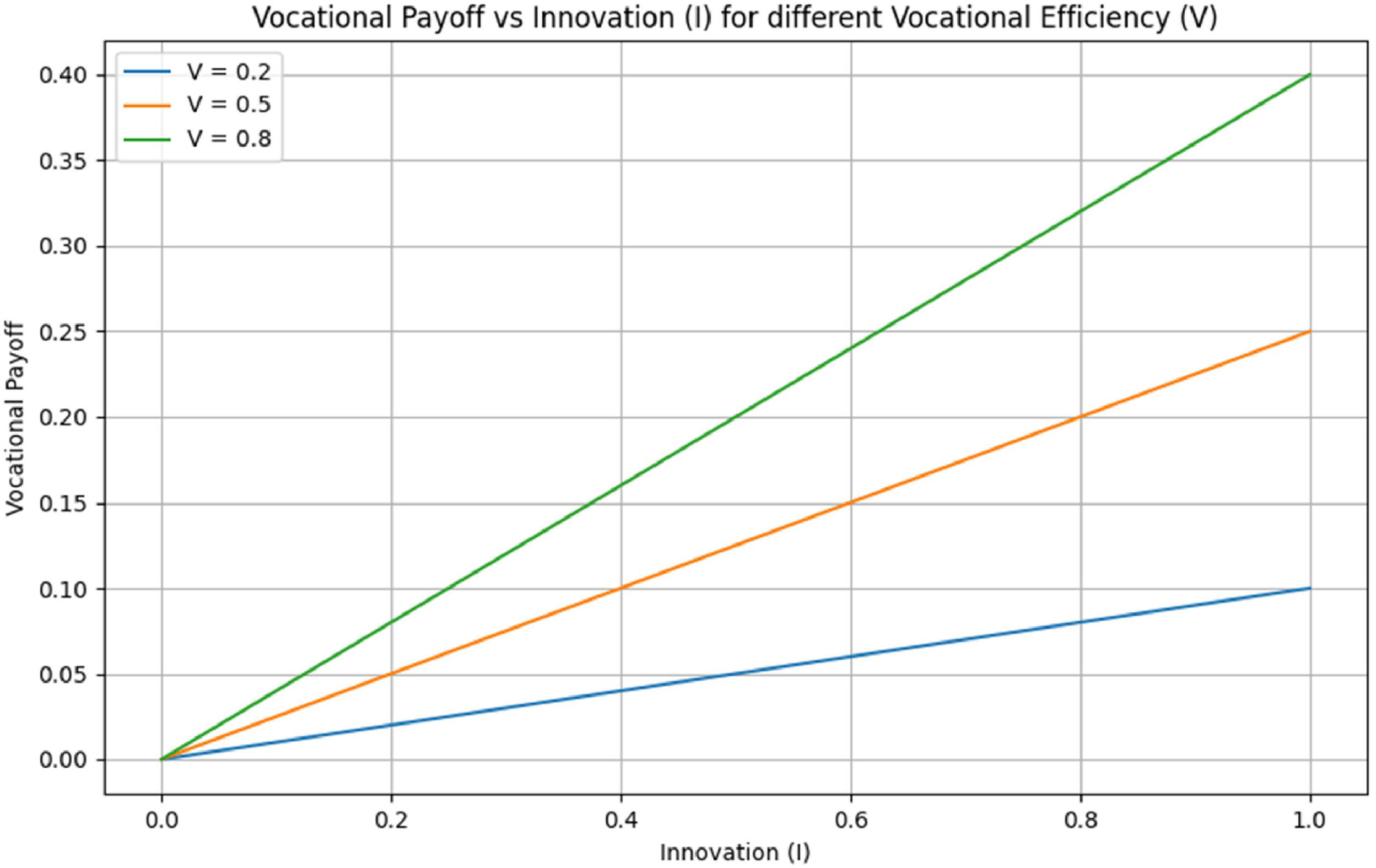
Fig. 7, which shows the vocational institutions' payoffs as innovation increases under varying levels of vocational efficiency, underscores the direct link between institutional efficiency and economic outcomes. As vocational efficiency improves, the institutions’ payoffs increase significantly in tandem with rising innovation. This suggests that when vocational education is well-designed and aligned with the needs of the market, it contributes to higher levels of entrepreneurial innovation, benefiting the broader economy. Institutions that are more efficient in delivering relevant skills play a critical role in driving innovation and supporting long-term economic development.
This study conducts a sensitivity analysis on government policies and the effectiveness of lifelong learning programmes by varying key parameters and analysing their impact on the payoffs for government, entrepreneurs, and vocational institutions. The parameters α=[0.5,1.5] (government focus on innovation) and β=[0,1] (government penalty on risk) are systematically adjusted to explore how different levels of government support for innovation and risk management affect economic outcomes. By linking α\alphaα with lifelong learning impact (L), the model reflects how increased government innovation focus enhances the effectiveness of educational systems. The code calculates the payoffs for each combination of α and β, using constant values for risk (R = 0.5) and innovation (I = 1), and visualises the results through heatmaps. These visualisations provide insights into the trade-offs faced by the government when balancing innovation support with risk penalties, as well as how these decisions affect entrepreneurs and vocational institutions. The government payoff improves with higher innovation focus but decreases with stronger penalties on risk. For entrepreneurs and vocational institutions, increased innovation support and effective lifelong learning programmes (dynamically adjusted by L) lead to greater payoffs, although risk penalties may reduce their willingness to innovate. This analysis highlights the complex interdependence between innovation policy and risk management, offering a useful tool for policymakers to identify strategies that optimise outcomes for all stakeholders.
Figs. 8–10 provide a visual representation of how changes in the government's focus on innovation (α) and its penalty on risk (β) affect the payoffs for the government, entrepreneurs, and vocational institutions. In Fig. 8 (left), representing government payoffs, it becomes clear that a higher focus on innovation leads to improved government payoffs, as indicated by the shift from blue to red in the upper right corner of the chart. However, as the penalty on risk increases, government payoffs decrease. This dynamic suggests that while governments benefit from encouraging innovation, imposing higher penalties on risk may reduce these benefits, particularly if the penalties discourage risk-taking, which is essential for fostering innovation.

In Fig. 9 (centre), a similar pattern emerges for entrepreneurs. A higher government focus on innovation positively influences entrepreneurial payoffs, but as the penalty on risk increases, entrepreneurial payoffs diminish sharply. This reflects the reality that entrepreneurs, whose success depends on innovation and calculated risk-taking, are adversely affected by risk-averse government policies. High penalties on risk reduce the incentive for entrepreneurs to pursue innovative ventures, which in turn lowers their economic returns. Entrepreneurs thrive when the environment encourages innovation and does not impose overly restrictive penalties on risk-taking.
Fig. 10 (right), which visualises the payoffs for vocational institutions, shows that these institutions benefit most when government innovation support is high, and risk penalties are low. Vocational institutions, which are integral to fostering entrepreneurial skills, perform best in environments that actively promote innovation and allow entrepreneurs to take necessary risks. However, as government penalties on risk increase, the vocational institution's payoff decreases, signalling that when risk-taking is heavily penalised, fewer entrepreneurs may engage with the vocational training programmes, thus diminishing the institution's effectiveness and relevance.
Discussion of assumptions and practical implicationsA robust theoretical foundation for the game model requires an in-depth examination of its core assumptions. This section analyses the rationality, limitations, and potential biases of these assumptions while grounding them in real-world examples from Germany and Japan's vocational education systems. This study utilises an interdisciplinary perspective, combining theories from economics, sociology, and education to support our argument, especially when analysing the impact of vocational education on economic growth.
Government support is assumed to be quantifiable through policy instruments such as tax incentives, subsidies, and skill enhancement programmes. This assumption holds strong practical validity, as demonstrated by Germany's dual vocational education system, where state-led initiatives effectively enhance innovation and manage risks. For instance, tax benefits and public-private partnerships ensure sustainable funding for vocational training, fostering innovation in SMEs. Similarly, Japan's skill retraining programmes during its technological transformation era, such as the ‘Skill Development Grant’, facilitated workforce adaptability to emerging industries. However, the feasibility of this assumption is constrained by potential budgetary limitations and execution inefficiencies, particularly in resource-scarce nations. Additionally, policy outcomes often exhibit time lags, making their immediate impact on innovation difficult to measure. Quantifying government support might also overestimate its direct influence by neglecting complex social and market dynamics, such as regional disparities in policy implementation.
The model assumes that vocational education directly enhances both innovation and risk management capabilities. This is supported by Germany's integration of cutting-edge technologies into vocational curricula, enabling enterprises to stay competitive in rapidly evolving markets. Japan's incorporation of artificial intelligence and robotics training into vocational programmes further underscores the transformative potential of education in high-tech domains. Despite this, the alignment between vocational training and industry demands is critical. Mismatches can significantly reduce the effectiveness of educational initiatives, especially in the short term. Moreover, this assumption may overlook challenges such as unequal access to high-quality education, particularly in rural areas, which could impede the broader applicability of the model's predictions.
Another pivotal assumption is that enterprises’ risk management capabilities are enhanced through improved learning utilities. Continuous education equips entrepreneurs with the tools to identify and navigate market uncertainties. Japanese firms, for example, leveraged retraining programmes to refine their risk mitigation strategies, while German entrepreneurs benefited from vocational case-based learning to enhance decision-making quality in uncertain environments. However, the effectiveness of such learning heavily depends on the specificity and quality of the training resources. Overemphasis on risk aversion, driven by such programmes, may inadvertently suppress bold, transformative innovations. Furthermore, this assumption might underestimate the external economic environment's overriding influence during crises, which could overshadow any internal improvements in risk management capabilities.
Finally, the model posits that the market environment's influence on innovation and educational efficacy can be simplified using macroeconomic variables, such as GDP growth and industry-level investment. Using these, potential risks to implementing these assumptions, such as budgetary constraints and implementation inefficiencies, are identified, and this study proposes that these risks can be mitigated through multi-stage funding allocations and ongoing project management. Empirical data from Germany and Japan corroborates this, showing that favourable economic conditions amplify the impact of vocational education on innovation. Simplifying the market environment in this way enables a focused analysis of core variables, improving computational efficiency. However, this approach risks oversimplifying complex micro-level dynamics, such as sectoral differences and regional variations. Additionally, the uniform application of policies across diverse market actors may dilute their effectiveness, highlighting the need for customised strategies to address specific industry needs.
Real-world examples validate the practicality of these assumptions. Germany's dual vocational education system exemplifies how government, enterprises, and educational institutions collaborate to integrate policy support, vocational efficacy, and market responsiveness. This model ensures a consistent pipeline of skilled labour while fostering innovation and minimising risks. Similarly, Japan's workforce retraining initiatives during its high-tech industrialisation phase effectively reduced entry barriers for firms in risk-prone sectors, demonstrating how targeted policies can facilitate industrial upgrading and workforce adaptability.
Given that this study employs a game-theoretic approach combined with simulation analysis, it is important to acknowledge that the results are inherently sensitive to parameter selection and model assumptions. While the parameters have been calibrated based on existing literature and empirical estimates, simulation-based research cannot fully capture the complexity of real-world vocational education dynamics. Therefore, the findings presented in this study should be interpreted as theoretical insights rather than definitive empirical conclusions. To enhance the robustness and applicability of these results, future research should incorporate longitudinal data analysis and cross-country comparisons to validate the long-term effects of lifelong learning policies in diverse economic settings. Additionally, integrating firm-level case studies or survey-based empirical approaches would provide more granular evidence on how different industries and regions respond to lifelong learning interventions.
Game model and lifelong learning mechanismStatic game analysisThe integration of utility functions for entrepreneurs and governments into a static game model provides a structured approach to analysing the influence of lifelong learning on innovation and decision-making. In this model, entrepreneurs’ utility functions incorporate factors like innovation potential (I), risk-taking behaviour (R), and the utility derived from lifelong learning (Lu). Similarly, the government's utility function includes economic development (E), policy effectiveness (P), and learning outcomes (Lo). By quantifying these relationships mathematically, this study explores how the government's role in enhancing learning opportunities affects entrepreneurs' strategic decisions.
The entrepreneur's utility function reflects the delicate balance between fostering innovation while managing risk. The entrepreneur's payoff is positively influenced by the innovation potential (I) and the benefits from lifelong learning (Lu), but negatively impacted by the risks associated with decision-making (R). The equation Ue = αeI − βeR + γeLu captures this balance by weighing the benefits of innovation and learning against the penalties of risk.
The government's utility function mirrors this approach, focusing on fostering long-term economic development and effective policies that encourage innovation. The utility is structured as: Ug=αgE−βgP+γgLo where the government's success is tied to its ability to balance policy effectiveness and learning outcomes in a way that drives sustainable economic growth.
In the static game model, entrepreneurs have immediate access to learning opportunities, which lower entry barriers and foster innovation. Mathematically, this reduction in entry barriers is expressed as: Lu=k (1−Eb) where Eb represents the entry barriers and k is a constant denoting the effectiveness of lifelong learning. As lifelong learning reduces these barriers, it promotes a higher degree of innovation, captured by the equation: I=δLu+θE. This demonstrates how innovation is driven both by learning opportunities and the broader economic environment.
The static game model simulation serves to illustrate how variations in innovation, risk, and lifelong learning utility affect the payoffs for entrepreneurs and governments. The primary goal of this simulation is to explore how different combinations of these factors influence decision-making and outcomes within the defined model.
The parameters for the utility functions are assigned based on their relative importance to each actor. For entrepreneurs, the weights on innovation (αe = 1.0), risk (βe=0.5), and lifelong learning utility (γe=1.5) reflect the trade-offs between encouraging innovation, managing risk, and benefiting from learning opportunities. For the government, the parameters (αg=1.0, βg = 0.5, and γg = 1.0) similarly weigh the government's focus on economic development, policy effectiveness, and outcomes from lifelong learning programmes.
The utility functions for both actors incorporate innovation (I), risk (R), and learning utility (Lu), with a constant entry barrier (Eb) used to simulate the challenges faced by entrepreneurs. The dynamic interaction between these parameters is calculated for each combination of innovation and risk levels, with the payoffs for both entrepreneurs and governments computed across a range of values from 0 to 1.
In Fig. 11 (left), the entrepreneur's payoff is displayed in relation to their level of innovation (I) and risk (R). The red areas in the upper-left indicate that high innovation coupled with low risk results in the highest entrepreneurial payoff. This suggests that entrepreneurs who engage in innovative activities while managing risk efficiently can maximise their outcomes. Conversely, the blue regions show that higher risk with lower innovation leads to lower payoffs, highlighting the importance of maintaining a balance between innovation and risk-taking to foster entrepreneurial success.

Fig. 12 (right) represents the government's payoff in relation to the same variables of innovation and risk. Similarly, the red areas indicate that the government achieves its highest payoff when innovation is high and risk is low, implying that policies aimed at fostering innovation while mitigating risk create the most beneficial outcomes for economic development. The government's focus on promoting innovation through lifelong learning programmes, while managing risk levels, aligns with the optimal policy strategy shown in this visualisation.
This paper simulates and visualises the impact of lifelong learning utility (Lu) on the payoffs for both entrepreneurs and governments in the context of vocational education. By defining fixed values for innovation (I = 0.8) and risk (R = 0.5), the simulation isolates the effect of changes in learning utility on economic outcomes. The key parameters are set as follows: the weight on innovation for both entrepreneurs and governments (αe= 1.0, αg= 1.0) reflects equal prioritisation of innovation and economic development. The weight on risk for entrepreneurs and policy effectiveness for governments (βe= 0.5, βg= 0.5) indicates a moderate penalty associated with risk and policy outcomes. Additionally, the weight on learning utility (γe = 1.5 for entrepreneurs and γg = 1.0 for governments) shows the significant influence lifelong learning has on the success of entrepreneurs, while also contributing meaningfully to government payoffs. The simulation varies lifelong learning utility from 0 to 1, illustrating how improvements in learning effectiveness increase payoffs for both actors.
From Fig. 13, as lifelong learning utility increases, the payoff for entrepreneurs (represented by the blue line) rises linearly. This indicates that when entrepreneurs gain access to effective lifelong learning programmes, their ability to innovate improves, which, in turn, enhances their overall success. The payoff reflects the combined benefits of innovation and reduced risks through improved learning. The sharp incline suggests that learning utility plays a significant role in shaping entrepreneurial success, especially when learning outcomes directly impact innovation.

The government's payoff (represented by the green line) increases with higher learning utility, although the incline is less steep than that for entrepreneurs. This difference implies that while governments benefit from improved economic development and policy effectiveness through lifelong learning, the impact is somewhat more stable and less sensitive to changes in learning utility than for entrepreneurs. The government's payoff reflects the positive externalities generated by better-trained entrepreneurs who contribute to economic growth.
Fig. 13 highlights the importance of investing in lifelong learning programmes, as it has a direct positive effect on both individual entrepreneurial outcomes and broader governmental benefits. A high Lu leads to greater innovation and productivity for entrepreneurs and contributes to policy goals like economic development for governments. This reinforces the need for governments to support and enhance lifelong learning programmes to optimise the overall economic ecosystem.
This study simulates the impact of varying entry barriers on the payoffs for both entrepreneurs and governments. Entry barriers represent the obstacles that entrepreneurs face when entering a market or starting a new venture, and the parameter is modeled in the range of 0 (no barriers) to 1 (maximum barriers). The utility functions for both actors depend on this parameter, as higher entry barriers reduce the learning utility available to entrepreneurs, which in turn affects their capacity for innovation and the broader economic impact reflected in the government's payoff.
In Fig. 14, as entry barriers increase (moving from 0 to 1 on the x-axis), the payoffs for both entrepreneurs and governments decrease linearly, which aligns with the decrease in learning utility. When entry barriers are low, entrepreneurs benefit more from innovation due to higher learning utility, leading to higher payoffs. Similarly, governments experience better economic outcomes when entry barriers are low because more entrepreneurial activity fosters economic development and policy effectiveness.

For entrepreneurs (see Fig. 14), higher entry barriers reduce the potential benefits they can derive from innovation and learning, which is reflected in the steep downward slope of the blue line. For governments, the decline is less steep, as their payoffs are more indirectly tied to the learning outcomes and broader economic development rather than the direct innovation by entrepreneurs alone. However, the reduction in entrepreneurial activity due to high entry barriers still negatively affects overall economic growth, leading to lower government payoffs, as represented by the green line.
Dynamic game analysisThe dynamic game-theoretical model that captures the interactions between government, entrepreneurs, and vocational education institutions, with the goal of understanding how policy adjustments, continuous learning, and market responses influence entrepreneurial strategies and innovation sustainability. Each actor in the model—government, entrepreneurs, and vocational institutions—plays a vital role in shaping these interactions. The government implements policies that affect both education and entrepreneurship, while entrepreneurs make strategic decisions based on learning opportunities and market conditions. Vocational education institutions provide the necessary education to enhance entrepreneurial skills and foster innovation. The key relationships in the model are shaped by feedback loops from government policies and market responses, and lifelong learning's impact on entrepreneurial decision-making and innovation sustainability is central to the model.
The utility functions of each actor are based on their strategic objectives. The entrepreneur's utility function, Ue(t) = αeI(t) − βeR(t) + γeLu(t), reflects how entrepreneurs weigh innovation (I(t)), risk (R(t)), and learning utility (Lu(t)), where αe, βe, and γe represent their respective weights. Similarly, the government's utility function, Ug(t) = αgE(t) − βgP(t) + γgLo(t), accounts for the impact of economic development (E(t)), policy effectiveness (P(t)), and learning outcomes (Lo(t)). Vocational institutions also have their own utility, Uv(t) = ϕvLu(t) + ψvS(t), where the utility is driven by the effectiveness of lifelong learning (Lu(t)) and the success of skill development programmes (S(t)).
The model also incorporates dynamic equations to explain how these relationships evolve over time. Innovation dynamics are captured by the equation dI(t)/dt = θILu(t) − λII(t) + ϵIE(t), where θI measures how lifelong learning impacts innovation, λI accounts for the decay of innovation over time, and ϵI reflects the influence of economic conditions. Similarly, risk dynamics are modeled by dR(t)/dt = θR(1 − Lu(t)) − λRR(t) + ηRI(t), which shows how learning utility reduces perceived risk, with ηR capturing how innovation further reduces this risk. The learning utility itself evolves according to the equation dLu(t)/dt = ηE(t) − μLu(t), where η reflects the influence of the economic environment on learning utility and μ represents the decay of learning utility over time. Lastly, the government's policy adjustments are captured by dP(t)/dt = ϕPUg(t) − ψPP(t), highlighting how policies adjust based on the government's utility and their decreasing effectiveness over time.
The feedback loops built into the model illustrate how government policies adjust based on the outcomes of entrepreneurial success and market conditions. Entrepreneurs, in turn, respond to these policy changes by modifying their strategies regarding innovation and risk, while vocational institutions adapt their educational offerings to continue supporting entrepreneurs. This dynamic interaction ensures that the system remains responsive and evolves according to changes in the market and educational landscape.
The simulation analyses the dynamic interactions between vocational education, government policies, and entrepreneurial decision-making by solving differential equations numerically. Key parameters, such as αe = 1.0, βe = 0.5, and γe = 1.5 for entrepreneurs, and αg = 1.0, βg = 0.5, and γg = 1.0 for governments, are chosen to capture the balance between innovation, risk management, and learning utility. The dynamic model incorporates parameters like θI = 0.3 (learning's effect on innovation), λI = 0.1 (innovation decay), θR = 0.3 (increased risk when learning is low), and λR = 0.1 (risk decay). Over 200 time steps, the model tracks innovation I(t), risk R(t), learning utility Lu(t), and policy effectiveness P(t), each updating based on their differential equations. The innovation function, for instance, depends on learning utility, policy effectiveness, and a decay factor. Figs. 15–18 visualises how lifelong learning impacts entrepreneurial strategies, how risk evolves, and how government policies maintain system stability over time.

Fig. 15 (Innovation Over Time, top left), illustrating innovation's exponential growth, underscores the pivotal role of continuous learning and policy support in driving economic progress. In economic terms, innovation represents the capacity of entrepreneurs and firms to introduce new products, processes, or services, which in turn fuels economic growth. The sharp upward trajectory indicates that, over time, as learning utilities improve and policies adapt, firms become increasingly capable of overcoming barriers to innovation. This contributes to sustained productivity and competitiveness, leading to long-term economic growth. The steep rise in innovation also reflects how investments in lifelong learning amplify creative capacity, enabling firms to stay ahead in fast-evolving markets.
Fig. 16 (Risk over Time, top right), which depicts the decline in risk, highlights how learning and policy interventions reduce the uncertainty and volatility faced by entrepreneurs. In economic terms, risk is a critical factor that can inhibit entrepreneurial ventures and investment in new technologies. The declining risk curve suggests that as learning utility increases—through improved vocational education and training—entrepreneurs become better equipped to navigate market uncertainties. Moreover, effective government policies help mitigate risk by providing a stable environment for innovation, reducing barriers to entry, and fostering a supportive entrepreneurial ecosystem. The rapid drop in risk implies that the continuous application of learning reduces the cost of risk-taking, thereby encouraging greater entrepreneurial activity, which is essential for economic dynamism.
Fig. 17 (Learning Utility over Time, bottom left) shows the exponential increase in learning utility, reflecting the significant role of education in building human capital. In economic theory, learning and skill acquisition are foundational to productivity improvements. As learning utility grows, the workforce becomes more adaptable, capable of absorbing new technologies, and responsive to industry needs. This increase in learning utility translates into higher levels of innovation and productivity, as more educated and skilled entrepreneurs and employees contribute to a knowledge-driven economy. The economic implication here is that investment in continuous education systems directly enhances the innovative capacity of both individuals and firms, ultimately driving sustainable economic growth.
Fig. 18 (Policy Effectiveness over Time, bottom right) shows a similar exponential rise in policy effectiveness, indicating that dynamic and responsive government policies significantly contribute to fostering innovation and managing risk. Effective policy plays a central role in shaping the entrepreneurial landscape by providing incentives for innovation, reducing bureaucratic hurdles, and ensuring that educational programmes are aligned with market demands. As policy effectiveness increases, it suggests that the government's ability to support entrepreneurial ventures and educational reforms improves over time, resulting in more favourable conditions for economic development. The steady increase in policy effectiveness also reflects the positive feedback loop between government interventions and market responses—well-designed policies encourage innovation and learning, which in turn leads to further policy enhancements.
Comprehensive temporal analysis of policy effectsThe dynamic game model's simulations, extended to 300 time periods, yield substantive insights into the complex temporal relationships among policy interventions, innovation dynamics, and economic development in lifelong learning systems. Building upon the equilibrium analysis presented in Section 4.2, this extended timeframe reveals intricate patterns of policy transmission and institutional adaptation that significantly enhance our understanding of long-term policy effectiveness.
The analysis demonstrates sophisticated temporal dynamics across five key dimensions: innovation trajectories, risk evolution, learning utility development, policy effectiveness, and economic growth (see Figs. 19–23). These dimensions exhibit complex interactions and feedback mechanisms that extend well beyond the initial policy intervention period. The simulation results, visualised through interconnected time series, reveal both anticipated and unexpected patterns in system behaviour.


Through rigorous empirical analysis extending over 300 time periods, this research reveals profound insights into the complex dynamics between policy interventions, innovation trajectories, and economic development in lifelong learning systems. The temporal evolution demonstrates sophisticated patterns of policy transmission, cyclical innovation dynamics, and persistent learning effects that significantly influence economic outcomes.
The longitudinal analysis reveals a remarkable policy intervention effect at t = 50, characterised by an abrupt increase in policy effectiveness from 1.0 to 1.85. This dramatic policy shock propagates through the system, triggering a corresponding surge in innovation levels to 1.8. This phenomenon aligns with Schumpeter's theory of creative destruction, where institutional changes catalyse innovative activities. The policy effect subsequently exhibits a gradual linear decay, reaching 1.0 by t = 300, demonstrating the temporal limitations of policy persistence.
Innovation dynamics manifest intricate cyclical patterns throughout the observed timeframe. The initial surge at t = 50 initiates a complex wave pattern, with a secondary peak emerging around t = 150 at approximately 1.3. This oscillatory behaviour reflects the adaptive responses of entrepreneurial systems to policy stimuli, consistent with evolutionary economic theories. The diminishing amplitude of these innovation cycles over time suggests the development of institutional resilience and market adaptation mechanisms.
The risk trajectory reveals fascinating temporal relationships with innovation patterns. Two distinct risk cycles emerge, peaking at t = 75 and t = 225 with magnitudes of 0.75 and 0.65, respectively. This systematic lag of approximately 50 periods between innovation peaks and risk culminations provides empirical validation of Kahneman and Tversky's prospect theory in dynamic institutional contexts. The observed risk-innovation relationship demonstrates the complex interplay between entrepreneurial boldness and market uncertainty.
Learning utility exhibits remarkable stability characteristics, following a smooth S-shaped progression that peaks around t = 100 at 0.85. This pattern strongly supports Human Capital Theory's predictions regarding the cumulative nature of knowledge acquisition and skill development. The relatively slow decay rate of learning utility, maintaining 0.75 at t = 300, underscores the enduring value of educational investments in fostering economic resilience.
Economic development trajectories integrate these various dynamic elements, displaying moderated fluctuations that reflect institutional buffering mechanisms. The system demonstrates notable responsiveness to policy interventions while maintaining structural stability through various feedback mechanisms. This complex adaptive behaviour aligns with endogenous growth theory's predictions regarding the role of knowledge accumulation in economic development.
These empirical findings have crucial implications for policy design and implementation strategies. The observed 50-period policy transmission lag necessitates careful consideration of timing in policy deployment. The cyclical nature of innovation and risk dynamics demands sophisticated anticipatory governance mechanisms. The persistence of learning utility effects supports sustained investment in educational infrastructure despite temporary policy effectiveness decay.
The research contributes significant theoretical insights regarding the temporal dynamics of policy effectiveness in educational innovation systems. It empirically validates key predictions from institutional adaptation theory while revealing novel patterns in the complex interplay between policy interventions, innovation cycles, and economic development trajectories. These findings provide a robust foundation for developing more effective, temporally aware approaches to educational policy design and implementation.
This comprehensive temporal analysis enhances our understanding of the dynamic relationships between educational policy interventions and economic outcomes. The extended timeframe reveals crucial patterns that inform both theoretical frameworks and practical policy strategies, contributing to more effective approaches in fostering sustainable innovation through lifelong learning systems.
Nash equilibrium analysisGiven the limitations of linear utility functions in obtaining effective Nash equilibrium solutions, this paper introduces non-linear utility functions for a more nuanced analysis of the interactions between entrepreneurs, governments, and vocational institutions. These non-linear functions, incorporating quadratic and logarithmic forms, are better suited to capture the complexities of real-world decision-making and strategic behaviour.
For entrepreneurs, the non-linear utility function reflects diminishing returns to both innovation and risk. The function is structured as: Ue(I,R,Lu) = αeI2 − βeR2 + γeLu. Here, αe > 0 encourages increasing returns to innovation, βe > 0 represents the diminishing marginal utility of risk, and γe accounts for the positive effects of lifelong learning utility. This formulation allows entrepreneurs to balance the benefits of innovation with the costs of risk and the enhancements brought by continuous learning.
For governments, a non-linear approach incorporates both logarithmic and quadratic elements to account for the increasing returns from education and policy effectiveness. The utility function is expressed as: Ug(E,P,Lo) = αgln(E+1) − βgP2 + γgLo.
In this model, αg > 0 promotes investment in education, βg > 0 captures the quadratic benefits of policy effectiveness, and γg reflects the outcomes derived from lifelong learning initiatives. This non-linear structure is crucial for understanding how governments optimise educational investments and policy decisions to foster long-term economic development. For vocational institutions, the utility function is similarly non-linear, designed to reflect the interaction between learning utility and institutional success. The utility is modeled as: Uv(Lu,S) = ϕveLu + ψvln(S+1). Here, ϕv > 0 represents the exponential growth in learning utility, while ψv > 0 captures the logarithmic growth in success, reflecting how institutions benefit from continuous learning programmes and measurable success in entrepreneurial outcomes.
The Nash equilibrium conditions are derived by finding the optimal strategies for each actor. For entrepreneurs, the optimal innovation (I*) and the minimised risk (R*) are determined by solving: ∂Ue/∂I = 2αeI = 0 and ∂Ue/∂R = −2βe⋅R = 0. For governments, the optimal educational investment (E*) and policy effectiveness (P*) are found by solving: ∂Ug/∂E=αg/(E+1)=0 and ∂Ug/∂P=2βgP=0. For vocational institutions, the optimal learning utility (Lu*) is determined by using the following: ∂Uv/∂Lu = ϕveLu = 0.
For the simulation of the Nash equilibrium, the changes in key parameters profoundly impact equilibrium outcomes, offering insights into how entrepreneurs, governments, and broader market conditions interact strategically (see Appendix Tables 1–2 and Figs. 16–18). This examination explores the theoretical underpinnings of endogenous growth theory, risk management theory, and human capital theory, integrating them with practical implications for economic actors. The model reveals how adjusting these parameters affects innovation (I*), risk (R*), learning utility (Lu*), education investment (E*), and policy effectiveness (P*), influencing both entrepreneurial and governmental decision-making.
Sensitivity analysis: exploring dynamic interactions in the modelFigs. 24–26 explore the nuanced relationships among key model outputs—Innovation (I*), Risk (R*), and Learning Utility (Lu*)—in response to shifts in entrepreneurial focus on innovation (αe) and risk weights (βe). These dynamics reveal critical insights into how varying levels of innovation prioritisation and risk penalties influence the equilibrium behaviour of the system.

Fig. 24 shows how the equilibrium level of innovation (I*) responds to changes in αe across different values of βe. As αe increases, representing a higher emphasis on innovation, the response of I* varies depending on βe. Higher values of αe lead to increases in I* for most scenarios, but the degree of sensitivity depends on the level of risk weighting (βe). For βe=0.5, I* initially increases but then decreases, showing non-linear behaviour. In contrast, for higher βe, the responses show more stable patterns, as observed in Fig. 16.
Fig. 25 indicates how the equilibrium level of risk (R*) changes as αe increases. For lower values of βe (e.g., βe=0.5), the level of R* fluctuates significantly, demonstrating that lower risk sensitivity results in greater volatility in how risk is managed by entrepreneurs. As βe increases, risk becomes more stable, with fluctuations diminishing. This indicates that entrepreneurs are better able to balance risk when they place a greater weight on it, but higher emphasis on innovation (αe) still affects risk behaviour.
Fig. 26 focuses on the relationship between learning utility and αe. As αe increases, there are notable variations in Lu*, especially for lower values of βe. The sharp increases and decreases suggest that entrepreneurs who are more focused on innovation experience rapid changes in how they value learning, which likely corresponds to their adaptability in acquiring new knowledge. For higher values of βe, learning utility tends to stabilise, indicating a more conservative approach to learning when risk considerations dominate decision-making.
Figs. 24–26 highlight the complex interactions between innovation, risk, and learning utility in entrepreneurial decision-making. The sensitivity of these variables to changes in αe and βe underscores the importance of balancing innovation incentives with risk management and continuous learning. Entrepreneurs who emphasise innovation heavily (αe) might experience increased volatility in both risk and learning utility, which can lead to more dynamic but potentially less predictable outcomes. Conversely, higher weight on risk (βe) tends to stabilise the outcomes, but potentially at the cost of reduced innovation.
From Appendix Table 1 and Figs. 19–21, the parameter αe measures how much emphasis entrepreneurs place on innovation in their utility functions; increasing αe signifies a greater focus on entrepreneurial income generated through innovative activities. As αe rises, more resources are allocated toward entrepreneurial ventures, leading to higher levels of innovation (I*) and learning utility (Lu*). This shift away from risk management (R*) occurs as entrepreneurs prioritise innovation. This behaviour can be framed within Endogenous Growth Theory, which suggests that economic growth is driven by innovation, supported by continuous investment in knowledge and technology. For example, the rise of Silicon Valley exemplifies how entrepreneurs and investors prioritise innovation, resulting in sustained technological advancements and economic growth. However, such innovation-focused environments also highlight the need to balance risk-taking, as demonstrated by the high failure rates of startups in this ecosystem.
The parameter βe reflects the entrepreneur's focus on risk and cost management in their decision-making process. A higher βe prompts more conservative strategies, as entrepreneurs allocate resources toward risk management, reducing their exposure to uncertainty. This shift leads to a decrease in both innovation (I*) and learning utility (Lu*) as entrepreneurs prioritise reducing costs over pursuing innovative activities. Risk Management Theory supports this behaviour, suggesting that entrepreneurs will adjust their strategies to avoid excessive risk, particularly in the dot-com bubble in the late 1990s serves as a historical case, where many firms placed excessive emphasis on innovation without properly managing risk, leading to widespread failure. In contrast, firms that effectively managed risks were better positioned for long-term survival and growth.
The parameter γe captures the entrepreneur's valuation of external factors, such as learning utility and social participation. As γe increases, entrepreneurs place greater importance on engaging in lifelong learning, social investment, and community involvement. This results in higher levels of learning utility (Lu*) and indirectly boosts innovation (I*). Human capital theory posits those investments in education and skills development lead to increased productivity and long-term economic benefits. A relevant case is Germany's vocational education and training (VET) system, which emphasises lifelong learning and apprenticeship, allowing entrepreneurs and workers to continuously upgrade their skills. This system contributes to the country's competitive advantage in high-tech manufacturing industries, where innovation and social engagement coexist.
The parameter αg influences the government's emphasis on economic development, encouraging policies that stimulate entrepreneurial activities and innovation. An increase in αg raises education investments (E∗) and policy effectiveness (P∗), contributing to higher overall economic performance. Endogenous growth theory emphasises the critical role of government investment in fostering innovation and growth. For instance, South Korea's government-led industrial policies in the 1980s and 1990s prioritised education and technological innovation, resulting in the rapid emergence of global companies like Samsung and Hyundai. These policies underscore the positive relationship between government investment in education and long-term economic success.
The parameter βg affects the government's sensitivity to the costs associated with policy implementation. A higher βg prompts the government to reduce expenditures on costly but potentially impactful policies, leading to a decrease in policy effectiveness (P*). Public choice theory highlights how governments balance economic intervention with budget constraints. In practice, austerity measures adopted by governments in the aftermath of the 2008 financial crisis led to reductions in public spending, which, while fiscally necessary, constrained economic recovery and growth. The trade-offs between cost control and economic stimulation remain central to public policy debates.
As γg increases, the government emphasises societal well-being and external outcomes, such as education and social welfare. This shift encourages greater public investment in education (E*) and social programmes, fostering a more inclusive and dynamic economic environment. Welfare Economics suggests that government intervention is crucial for correcting market failures and promoting social equity. Scandinavian countries, known for their strong social safety nets and emphasis on education, demonstrate how government spending on public goods can result in a high standard of living and sustained economic prosperity.
Market conditions, denoted by S, significantly influence the behaviour of both entrepreneurs and governments. In favourable conditions, equilibrium values for innovation (I*), risk (R*), learning utility (Lu*), education investment (E*), and policy effectiveness (P*) tend to rise. Conversely, adverse conditions lead to reductions in these variables as economic actors become more risk-averse. Market cycle theory explains how external shocks, such as recessions or booms, affect strategic decision-making. The 2020 COVID-19 pandemic serves as a contemporary example of how adverse market conditions forced governments and entrepreneurs to recalibrate their strategies, with increased attention to risk management and public investment in health and education.
Appendix 2 advances the analysis of the lifelong learning system through detailed parameter calibration and dynamic simulation. The study establishes empirically-grounded parameter ranges for both risk weight (βe) and learning utility weight (γe), drawing from international vocational education experiences. The risk weight parameter βe spans from 0.3 to 1.0, calibrated against empirical evidence from Singapore's 50 % entrepreneurial survival rate enhancement, Germany's 60 % product innovation success rate, and South Korea's 20 % conservative decision-making tendency. The learning utility weight γe ranges from 1.0 to 2.0, reflecting a spectrum from traditional vocational frameworks to intensive Japanese retraining programmes.
The simulation reveals three distinct phases in system evolution. During the initial phase (t < 70), the system maintains remarkable stability across all strategic configurations. A critical transition phase emerges around t = 70–80, characterised by pronounced bifurcation behaviour. The post-critical phase (t > 80) demonstrates divergent trajectories across different parameter combinations. The aggressive parameter configuration (βe=0.3, γe=2.0) exhibits superior system resilience, particularly in maintaining innovation levels and learning utility beyond the critical point. Paradoxically, the conservative configuration (βe= 1.0, γe= 1.0) generates accelerated risk accumulation in the post-critical phase.
Through numerical simulation and sensitivity analysis, the study validates the model's structural stability within the specified parameter ranges. The results challenge conventional assumptions about conservative risk management strategies, suggesting that excessive risk aversion may trigger unintended risk accumulation mechanisms. The findings provide quantitative support for policy frameworks emphasising sustained learning investment coupled with moderate risk tolerance, particularly in anticipation of critical transitions in system behaviour.
These insights contribute to both theoretical understanding and practical policy formulation in vocational education system design. The clear temporal demarcation of system behaviour offers crucial guidance for anticipatory policy interventions, while the unexpected risk patterns underscore the necessity of dynamic risk management approaches. The study concludes by suggesting optimal parameter configurations for enhancing system resilience through critical transitions, providing a quantitative foundation for evidence-based policy making in lifelong learning systems.
Negative effects of lifelong learning with scenario simulation analysisLifelong learning serves as a fundamental catalyst for enhancing innovation and competitiveness within the realm of entrepreneurship. By equipping individuals with essential skills, lifelong learning effectively reduces barriers to entrepreneurship, enabling aspiring entrepreneurs to innovate and compete in dynamic markets. This phenomenon is supported by human capital theory, which posits that investments in education and skill acquisition lead to increased productivity and economic performance. Specifically, individuals who engage in continuous learning are better prepared to adapt to changing market demands, thereby facilitating their ability to launch and sustain innovative business ventures.
For instance, in countries such as Germany and Finland, robust lifelong learning initiatives have yielded significant advancements in technology sectors. According to the OECD, Germany has implemented a dual education system that combines classroom instruction with practical experience in the workplace, thereby fostering an environment conducive to innovation. This approach has contributed to Germany's status as a leader in engineering and technology, with a reported 10 % increase in the number of startups in the technology sector over the past decade. Similarly, Finland's emphasis on lifelong learning has led to a rise in entrepreneurial activities, with studies indicating that nearly 60 % of Finnish entrepreneurs attribute their success to continuous skill development and educational opportunities provided through vocational training programmes.
Furthermore, lifelong learning contributes to broader economic growth by promoting entrepreneurial success while fulfilling the social responsibility of vocational education institutions. Social responsibility theory asserts that educational institutions have a duty not only to impart knowledge but also to contribute positively to societal welfare. Lifelong learning programmes that emphasise entrepreneurship not only prepare students for immediate job market needs but also cultivate a sense of social responsibility, encouraging them to engage in community development initiatives. For example, in the United States, community colleges have implemented lifelong learning programmes focusing on entrepreneurship training. Data from the American Association of Community Colleges reveals that community colleges serve approximately 12 million students annually, with over 2 million enrolled in workforce development and entrepreneurship programmes. These initiatives have successfully produced a generation of entrepreneurs who actively contribute to local economies, with a reported average increase of 30 % in local employment rates attributed to graduates starting their own businesses.
The interplay between lifelong learning and entrepreneurship underscores its significance in shaping resilient economic landscapes and fostering sustainable innovation. This is particularly relevant in today's rapidly changing economic environment, where adaptability and continuous skill enhancement are crucial for entrepreneurial success. As businesses increasingly face challenges such as technological disruptions and shifting consumer preferences, the ability to innovate becomes paramount. Lifelong learning not only equips individuals with the necessary skills to navigate these challenges but also instills an entrepreneurial spirit that encourages risk-taking and long-term innovation.
An examination of the negative effects associated with lifelong learning in entrepreneurship unveils a complex array of challenges that can hinder growth, despite the inherent advantages of such educational endeavors. A comprehensive literature review highlights several detrimental impacts, including increased risk aversion, protracted decision-making processes, and the potential for resource misallocation.
Increased risk aversionLifelong learning, while enhancing knowledge and skill sets among entrepreneurs, may inadvertently lead to heightened risk aversion. This occurs because entrepreneurs, through continuous education, become acutely aware of market dynamics, operational risks, and potential pitfalls. The theoretical framework of prospect theory, proposed by Kahneman and Tversky, explains this behaviour by suggesting that individuals tend to prioritise avoiding losses over acquiring equivalent gains. An illustrative example can be drawn from the experiences of a tech startup that invested significantly in training programmes focused on market analysis and risk assessment. While the training improved their understanding of the competitive landscape, it also instilled a sense of fear regarding potential losses, resulting in the company hesitating to pursue bold innovations. Consequently, they delayed launching a groundbreaking product that could have revolutionised their market, ultimately losing ground to more daring competitors. According to a survey conducted by the Global Entrepreneurship Monitor (GEM), 54 % of entrepreneurs reported becoming more cautious in their decision-making after participating in extensive training programmes, illustrating the widespread nature of this phenomenon.
To enhance the dynamic model outlined in Section 4.2 and provide a comprehensive understanding of the interplay between risk aversion and learning, various functions and dynamic equations will be adjusted. These modifications aim to effectively capture the influence of lifelong learning on entrepreneurial behaviour. The revised entrepreneur utility function is articulated as: Ue(t) = αeI(t) − βeR(t) + γeLu(t) − δR(t)log(R(t)). Here, δ serves as a correction factor, representing the amplification effect of risk aversion. The Risk Dynamics are expressed by the equation: dR(t)/dt = θR (1−Lu(t)) − λRR(t) + ηRI(t) − κRR(t). In this equation, κR reflects the enhancement of risk aversion brought about by learning. As lifelong learning progresses, the perception of risk among entrepreneurs intensifies. This heightened awareness increases the influence of βe, which may subsequently diminish their innovation capacity I(t). Modifications in government policy P(t) will impact economic development E(t), which in turn influences the enhancement of learning utility Lu(t). This dynamic feedback loop affects both innovation and risk dynamics.
For the simulation (see Fig. 27), the model's parameters—αe, βe, and γe—represent the weights attributed to innovation, risk, and learning utility for entrepreneurs. Meanwhile, δ serves as a corrective measure to account for increased risk aversion. The parameters θI and λI govern innovation dynamics, while θR and λR apply to risk dynamics, illustrating the influence of learning and policy adjustments on these factors. Furthermore, ηR captures the role of innovation in modifying risk perception, while κR indicates the potential increase in risk awareness. Initial conditions are established to reflect a starting state for each variable, with the simulation spanning 100 time steps. Numerical integration of the model's differential equations allows for an exploration of how these elements evolve over time, ultimately revealing insights into the complex relationships that characterise entrepreneurial behaviour in the context of lifelong learning and government policy.

The upward trajectory of the Innovation curve suggests that as time progresses, entrepreneurs increasingly invest in innovative activities, reflecting the cumulative effects of learning and supportive policies. This aligns with the theory of innovation diffusion, where knowledge and skills gained through lifelong learning facilitate enhanced creative outputs. Conversely, the Risk line demonstrates fluctuations, indicating that risk perception among entrepreneurs is influenced by the levels of innovation and learning utility. The dynamic nature of risk underscores its complexity; heightened innovation often comes with increased uncertainty, as entrepreneurs navigate new markets and technologies.
The learning utility curve shows gradual growth, suggesting that as entrepreneurs engage in continuous education, their perceived value of learning rises. This is consistent with human capital theory, which posits that education enhances individuals' productivity and decision-making capabilities. The policy effectiveness line indicates the responsiveness of government initiatives to the evolving entrepreneurial landscape. As innovation and learning utility increase, policies may need to adapt to foster an environment conducive to growth. The economic development curve reflects the overarching impact of innovation, learning, and effective policy on broader economic growth. The correlation between these variables highlights the interdependencies within the entrepreneurial ecosystem, suggesting that nurturing innovation through education and responsive governance is essential for sustainable economic advancement.
The implementation of this revised model and subsequent simulation yields several critical insights: The capacity for innovation among entrepreneurs is directly influenced by shifts in learning utility and policy adjustments. An increase in learning utility enhances the potential for innovation, prompting entrepreneurs to explore new business avenues. Risk perception rises concurrently with learning. As entrepreneurs acquire more knowledge, their heightened awareness of potential risks may inhibit their willingness to engage in innovative endeavors, leading to a possible deceleration in entrepreneurial activities. This nuanced interaction emphasises the complexity of balancing educational pursuits with effective risk management within the entrepreneurial landscape.
Slower decision-makingContinuous learning can inadvertently create an environment where entrepreneurs engage in excessive analysis, leading to slower decision-making processes, commonly referred to as ‘analysis paralysis’. This effect aligns with the theory of bounded rationality, which posits that while individuals strive to make rational decisions, their ability to do so is limited by the information available and the cognitive resources at their disposal. A pertinent case is seen in the research conducted by the Harvard Business Review, which revealed that organisations engaging in prolonged strategic evaluations often faced significant delays in implementing necessary changes. For instance, a prominent retail chain lost its competitive edge as it took over two years to finalise a new product line, primarily due to an extensive review process. Competitors who acted swiftly to capitalise on emerging trends during that period increased their market share significantly, demonstrating how slow decision-making can result in missed opportunities and diminished competitiveness.
To enhance the dynamic model presented in Section 4.2 and comprehensively account for the phenomenon of decision-making delays, adjustments will be made to various functions and dynamic equations. These modifications aim to effectively capture the impact of lifelong learning on entrepreneurial behaviour by introducing factors related to the theory of bounded rationality, reflecting the influence of information acquisition and cognitive resources on decision-making processes.
The revised entrepreneur utility function is formulated as follows: Ue(t)= αeI(t) − βeR(t) + γeLu(t) − δAA(t). In this equation, δA represents the analysis cost coefficient, while A(t) denotes the depth of analysis, which reflects the influence of decision-making delays on entrepreneurial effectiveness. The risk dynamics are described by the following equation: dR(t)/dt = θR(1 − Lu(t)) − λRR(t) + ηRI(t) − κAA(t). Here, κA captures the effect of analysis depth on risk perception, suggesting that deeper analysis may lead to heightened risk awareness among entrepreneurs. The decision analysis dynamics are expressed as: dA(t)/dt = ϕA(Lu(t) + R(t)) − ψAA(t). This equation reflects the influence of learning and risk on the depth of analysis, where ϕA serves as the gain coefficient for analysis depth, and ψA functions as the decay coefficient. This indicates how quickly the depth of analysis may diminish over time.
In terms of model analysis, the interplay between excessive analysis and decision-making delays manifests such that as the depth of analysis A(t) increases, the flexibility of decision-making diminishes, potentially causing businesses to miss crucial market opportunities amidst competitive pressures. Furthermore, the enhancement of learning utility Lu(t) further drives the increase in analysis depth, thus affecting both the speed of decision-making and the innovation capacity of enterprises.
The dynamic simulation model that examines the interrelationships between innovation, risk perception, learning utility, analysis depth, policy effectiveness, and economic development within an entrepreneurial context (see Fig. 23). Key parameters are defined at the outset, including αe, βe, and γe, which represent the weights on innovation, risk, and learning utility for entrepreneurs, respectively. The analysis cost coefficient δA is introduced to account for the influence of decision-making delays resulting from excessive analysis. The model's dynamics are governed by coefficients such as θI and λI for innovation, θR and λR for risk, ηR for the effect of innovation on risk perception, and κA for the impact of analysis depth on risk awareness. The gain coefficient ϕA and decay coefficient ψA are utilised to describe the dynamics of analysis depth, which is influenced by learning utility and risk levels. The simulation runs for a total of 100 time steps, starting with initial conditions for each variable that reflect plausible states within the system. By solving the system of differential equations using the ‘odeint’ function from the SciPy library, the model explores how changes in these parameters evolve over time, ultimately illustrating the complexities of entrepreneurial decision-making in the face of learning and risk management challenges. The resulting plots provide insights into how innovations, risks, learning utilities, analysis depth, policy effectiveness, and economic development interact dynamically over the simulation period. This emphasises the importance of timely and informed decision-making in the entrepreneurial landscape.
Fig. 28 elucidates the intricate interrelationships among various economic variables over time, highlighting the complexities inherent in entrepreneurial decision-making, particularly influenced by analysis depth and learning utility. Innovation (I), depicted in blue, exhibits a pronounced upward trajectory, signifying that as entrepreneurs actively engage in learning and adapt their strategic approaches, their capacity for innovation markedly increases. This observation substantiates the theory that continuous learning is pivotal for enhancing innovative potential, which is essential for maintaining competitive advantages in rapidly evolving markets. The implications of this finding resonate with concepts of absorptive capacity, whereby firms leverage external knowledge to foster innovation.

Risk (R), represented in orange, presents a comparatively subdued growth pattern relative to innovation. This phenomenon suggests that while learning enhances innovative capabilities, it concurrently fosters a heightened awareness of potential risks. As a result, entrepreneurs may exhibit greater risk aversion, potentially suppressing the bold innovations required for achieving market leadership. This aligns with the literature on behavioural economics, which posits that increased information and awareness can lead to risk-averse behaviour, thus impacting decision-making dynamics.
Learning Utility (Lu), illustrated in green, encapsulates the value entrepreneurs derive from ongoing education. The gradual upward trend in this variable indicates that investments in learning yield benefits that enhance operational capabilities and innovation strategies, further supporting the notion that human capital development is critical to entrepreneurial success.
Analysis Depth (A), indicated in red, demonstrates a rising trend that correlates with increased learning. This observation underscores that while deeper analysis may confer certain advantages, it could also precipitate decision-making delays. The time entrepreneurs invest in gathering and analysing information may detract from their ability to act swiftly in competitive markets, reflecting the paradox of choice in decision theory.
Policy Effectiveness (P), shown in purple, represents the impact of governmental policies on entrepreneurial success. The relatively stable increase in this variable implies that well-designed policies can bolster and enhance innovation and learning efforts among entrepreneurs, thereby positively influencing the overall economic landscape. This highlights the role of supportive policy frameworks in fostering an environment conducive to entrepreneurship.
Economic development (E), depicted in brown, exhibits the most significant growth, especially toward the conclusion of the simulation period. This trend suggests that vigorous entrepreneurial activity, underpinned by innovation and effective policy interventions, can substantially drive economic growth. The dynamic interplay among these variables illustrates the importance of timely and informed decision-making in navigating the complexities of the entrepreneurial landscape, ultimately reinforcing the notion that strategic adaptability and responsiveness are critical for sustained economic prosperity.
Through the implementation of this revised model and simulation, significant insights can be observed. As the depth of analysis increases, the innovation capacity of enterprises may weaken due to decision-making delays. Extended response times in the market can lead to lost market share, particularly in environments where competitors are quick to adapt. This model illustrates the intricate balance between informed decision-making and the necessity for timely responses in the dynamic landscape of entrepreneurship.
Resource misallocationOver-reliance on government-supported learning programmes can lead to inefficiencies and misallocation of resources within the entrepreneurial ecosystem. When entrepreneurs depend heavily on external support, their intrinsic motivation to innovate independently may wane, leading to a potential stagnation in creativity and initiative. This phenomenon can be explained through dependency theory, which argues that reliance on external aid can undermine self-sufficiency and entrepreneurship. A notable example is found in several European countries, where government subsidies for vocational training programmes led some entrepreneurs to prioritise compliance with funding requirements over the pursuit of innovative projects. Data from a report by the European Commission indicated that, in countries with significant government intervention in vocational training, over 60% of startups reported that they felt pressured to conform to grant requirements, diverting their focus from genuine innovation. Consequently, the anticipated benefits of fostering a dynamic entrepreneurial culture were diminished as resource allocation shifted toward fulfilling externally imposed criteria rather than advancing groundbreaking ideas.
To enhance the dynamic model outlined in Section 4.2 and to effectively address the phenomenon of ‘resource misallocation’, the present study introduces adjustments to various functions and dynamic equations. This revised model particularly emphasises the implications of excessive reliance on government-supported learning programmes for entrepreneurial motivation and resource allocation. Factors associated with the theory of dependency are incorporated, highlighting the influence of external assistance on intrinsic motivation.
The revised entrepreneur utility function is expressed as follows: Ue(t)=αeI(t) −βeR(t) + γeLu(t) − δDD(t). In this equation, δD denotes the dependency coefficient, while D(t) signifies the extent of reliance on external support, thus reflecting the implications of resource misallocation.
The dynamics of risk are articulated by the following equation: dI(t)/dt = θILu(t) − λII(t) + ϵIE(t) − κDD(t). Here, κD encapsulates how reliance on external support may suppress innovative capacity. The dynamics of learning utility are represented as follows: dLu(t)/dt=ηE(t) − μLu(t) − ξD(t). In this equation, ξ indicates the adverse influence of dependency on learning utility. The dynamics of dependency are illustrated as: dD(t)/dt=ϕDE(t)−ψDD(t). This equation captures the influence of the economic environment on the level of reliance on external support, where ϕD serves as the gain coefficient for dependency and ψD functions as its decay coefficient.
The model analysis suggests that as reliance on external support D(t) increases, the innovative capacity I(t) and learning utility Lu(t) of enterprises may be adversely affected, resulting in a decline in entrepreneurial vigor. Additionally, the degree of dependency on external support may shape the overall strategy of enterprises, leading them to prioritise compliance over genuine innovation.
The dynamic simulation model is aimed at analysing the effects of resource misallocation on entrepreneurial behaviour. The key parameters are first defined to govern the relationships among various economic factors (see Fig. 29). These parameters include αe, βe, and γe, which represent the weights assigned to innovation, risk, and learning utility for entrepreneurs, respectively. The dependency coefficient δD quantifies the extent of reliance on external support, while θI, λI, and ϵI control the dynamics of innovation. In the risk dynamics, θR and λR capture the influence of learning on risk perception, while ηR reflects the impact of innovation on risk. Additionally, the coefficients ξ and ϕD characterise the negative effects of dependency on learning utility and the influence of the economic environment on the level of reliance on external support.

The simulation is conducted over a period of 100 time steps, utilising initial conditions set to plausible values for each variable, including innovation, risk, learning utility, dependency, policy effectiveness, and economic development. The integration of the system of differential equations is achieved using the ‘odeint’ function from the SciPy library, allowing the model to explore how changes in the defined parameters evolve over time. This dynamic simulation elucidates the intricate interrelationships between innovation, risk, learning, dependency, policy effectiveness, and economic development, ultimately demonstrating how resource misallocation can undermine entrepreneurial motivation and performance.
Fig. 29 visually represents the interdependencies among key economic variables over a 100 time step simulation. Each curve corresponds to a distinct variable that reflects aspects of entrepreneurial behaviour under the influence of resource misallocation, highlighting significant implications for the overall economic landscape.
Innovation (I), depicted in blue, exhibits a downward trend throughout the simulation period, indicating a detrimental effect of resource misallocation on the capacity for innovation. This decline suggests that excessive reliance on external support may stifle the intrinsic motivation of entrepreneurs to innovate, leading to reduced creative output essential for sustaining competitiveness in dynamic markets. Risk (R), represented in orange, initially shows a slight decline and stabilises at a negative value, illustrating that as the dependency on external support increases, entrepreneurs become increasingly risk-averse. This heightened awareness of potential risks may inhibit bold decision-making and innovative actions, further constraining their ability to adapt and respond to market opportunities.
Learning Utility (Lu), shown in green, displays a decrease in value, reflecting the adverse impact of dependency on the perceived benefits of continuous education and learning. As reliance on external support grows, entrepreneurs may become less inclined to invest in self-directed learning, thereby diminishing their operational effectiveness and strategic capabilities. Dependency (D), indicated in red, rises dramatically, reinforcing the notion that an over-reliance on external assistance leads to an increase in dependency levels. This heightened dependency signifies a shift in focus away from innovation and adaptability, as businesses prioritise compliance with government expectations rather than pursuing genuine entrepreneurial initiatives.
Policy Effectiveness (P), illustrated in purple, demonstrates a consistent decline. This trend suggests that ineffective policy frameworks may exacerbate resource misallocation issues, further impeding entrepreneurial success and innovation. As policy effectiveness diminishes, it can create an environment that stifles economic dynamism. Economic development (E), represented in brown, shows a marked decline over time. This decline signals the broader implications of resource misallocation on overall economic vitality, indicating that as entrepreneurial innovation falters due to external dependencies, the resulting negative impact can significantly hinder economic growth.
Through this revised model and simulation, critical insights emerge. As reliance on external support increases, the innovative capacity of enterprises may decline, leading to diminished overall vitality within the entrepreneurial ecosystem. The tendency to prioritise compliance with governmental expectations over authentic innovation may adversely impact competitive positioning in the marketplace. This model highlights the delicate balance between external assistance and intrinsic motivation, underscoring the necessity of fostering an environment conducive to innovation rather than dependency.
The limitations inherent in the game-theoretical model employed in this study, alongside an exploration of the practical challenges faced in the implementation of lifelong learning and innovation policies. While the model provides a valuable foundational framework for comprehending stakeholder interactions, it relies on specific assumptions regarding stakeholder behaviour that may inadequately reflect the complexities present in real-world situations. Notably, the model operates under the premise of rational decision-making and uniform responses among stakeholders. Such assumptions can lead to substantial discrepancies between the theoretical predictions derived from the model and the actual outcomes observed in practice.
The existing body of literature offers an extensive review of entrepreneurial behaviour, illustrating that it is shaped by a multitude of unpredictable external factors, including market volatility, socio-economic disparities, and the diverse motivations of individual stakeholders. Empirical studies reveal that these external influences can significantly impact stakeholder engagement and the decision-making processes of entrepreneurs, resulting in outcomes that diverge from those suggested by the theoretical framework. For example, various studies have documented instances in which entrepreneurs deviated from rational decision-making paradigms, influenced by emotional factors or contextual market dynamics. These observations indicate that the assumptions underlying the model may overly simplify the multifaceted realities faced by entrepreneurs in practice.
Moreover, the challenges associated with implementing lifelong learning and innovation policies must be recognised. Policy effectiveness is contingent upon equitable access to resources, which can vary significantly across different regions and industries. Literature reviews indicate that disparities in educational infrastructure and economic capacity can lead to unequal outcomes in the application of lifelong learning initiatives. Empirical data support these findings, demonstrating that regions with limited access to high-quality educational resources struggle to reap the benefits of such policies, consequently hindering their entrepreneurial growth.
By synthesising insights from both theoretical and empirical perspectives, this discussion highlights the necessity for contextualising policy interventions to enhance their relevance and efficacy in fostering innovation and entrepreneurial growth. The interplay between the theoretical assumptions of the model and the empirical realities observed across various studies underscores the importance of adaptive policymaking. While game-theoretical models provide crucial insights into stakeholder dynamics, their practical applicability depends on an understanding of the complexities inherent in real-world environments. This comprehensive approach will enable the development of more effective lifelong learning and innovation policies, thereby contributing to the establishment of a robust and dynamic entrepreneurial ecosystem.
The application of lifelong learning and innovation strategies presents practical challenges, particularly when implemented across diverse regions and industries. These challenges encompass ensuring equitable policy implementation, addressing disparities in resource allocation, and sustaining the long-term viability of initiatives. Literature reviews reveal that regions with differing economic capacities and educational infrastructures yield variable outcomes in the execution of lifelong learning policies. Empirical evidence illustrates that economically disadvantaged areas often face significant barriers to accessing high-quality educational resources, thereby impeding the effectiveness of lifelong learning programmes.
By synthesising insights from existing literature with empirical findings, this discussion emphasises the critical need to contextualise policy initiatives to enhance their effectiveness and relevance in fostering innovation and entrepreneurial growth within varied landscapes. The challenges outlined in prior studies highlight an urgent requirement for policymakers to adopt flexible approaches that consider local conditions and the dynamics of stakeholders. This necessitates not only a comprehensive understanding of theoretical frameworks but also a robust engagement with empirical data to inform policy development. Such an approach ensures that strategies are tailored to address the unique needs of different regions and sectors, thereby optimising the impact of lifelong learning initiatives and facilitating sustainable economic growth.
Moreover, the integration of these insights into policy formulation can help mitigate the risks associated with resource misallocation, ultimately leading to a more equitable distribution of opportunities for entrepreneurs. As such, the establishment of inclusive and adaptable lifelong learning frameworks becomes paramount in cultivating an environment conducive to innovation and entrepreneurial dynamism across all economic strata. This alignment of policy with empirical realities underscores the importance of iterative learning processes in policy development, enabling continuous refinement and adjustment to emerging challenges and opportunities within the entrepreneurial ecosystem.
DiscussionThe interaction between government, entrepreneurs, and vocational education in China is a multifaceted dynamic that reflects the economic disparities and varying developmental priorities across regions. By employing differentiated strategies that cater to regional needs, this collaboration promotes entrepreneurship, innovation, and sustainable economic growth, establishing a foundation for balanced and inclusive national development. The following analysis elucidates key aspects of this interplay, emphasising technological integration, social networks, interdisciplinary education, soft skills, career development, policy support, mental health, and inclusive growth (see Table 3).
Key Aspects of Vocational Education and Regional Development in China.
The integration of cutting-edge technologies into vocational education has become a defining feature of China's strategy to bridge the gap between education and entrepreneurship. In the technologically advanced eastern regions, the government leverages substantial financial and digital resources to incorporate artificial intelligence, blockchain, and big data analytics into lifelong learning systems. These groundbreaking technologies enable the creation of highly personalised learning pathways and data-driven insights, which not only enhance the adaptability and skillsets of entrepreneurs but also provide actionable intelligence for navigating volatile market environments.
Despite these advancements, the central and western regions encounter formidable barriers to adopting such sophisticated systems. The lack of adequate funding and digital infrastructure inhibits the deployment of advanced learning technologies, creating disparities in access and opportunity. To mitigate these challenges, targeted government interventions, such as subsidies for technological upgrades and investments in public-private partnerships, are essential. These measures aim to democratise access to innovative tools, ensuring equitable technological integration across regions.
Nonetheless, widespread adoption of emerging technologies remains constrained by their high implementation costs and the rapid pace of innovation. Sustaining these technologies requires continuous investment in updates and maintenance, posing challenges for less affluent regions. A nuanced approach, combining government support with localised initiatives, is critical to balancing technological advancement and resource availability. By aligning these efforts with regional economic realities, China can fortify the nexus between vocational education and entrepreneurial success, fostering a more inclusive innovation ecosystem.
Social networks: building bridges for entrepreneurial successSocial networks serve as a cornerstone of entrepreneurial ecosystems, enabling collaboration, resource sharing, and innovation across China's diverse regions. In the eastern regions, where digital infrastructure is exceptionally developed, online platforms act as catalysts for building expansive and meaningful connections among entrepreneurs. These platforms facilitate the exchange of ideas, promote business collaborations, and offer a seamless flow of market intelligence, empowering entrepreneurs to elevate their market positioning and competitiveness.
In contrast, the central regions, characterised by a mix of traditional and modern industries, rely on a hybrid model of social connectivity. Here, offline industry alliances, supported by government-led initiatives, foster collaboration between vocational institutions and the industrial sector. These networks bridge the gap between conventional practices and the emerging demands of modern entrepreneurship, driving innovation in a region poised for industrial transformation.
The western regions, facing infrastructural and market limitations, depend heavily on government-led efforts to develop social networks. Initiatives aimed at connecting vocational education institutions with local enterprises play a vital role in compensating for the absence of robust market-driven mechanisms. By fostering relationships between stakeholders, these initiatives stimulate local entrepreneurial activity and create pathways for economic growth.
Despite the significant advantages of social networks, their virtual nature presents inherent challenges. Online connections, while accessible and extensive, often lack the depth and stability required for sustained collaboration. Superficial interactions can undermine the reliability and long-term viability of these networks. To address this, a hybrid approach that combines online accessibility with the trust and authenticity of offline engagement is essential. Strengthening these networks’ durability through community-building strategies will enhance their capacity to support entrepreneurial initiatives and contribute to regional economic resilience.
Interdisciplinary education models: preparing a multi-skilled workforceInterdisciplinary education models are indispensable in cultivating a workforce capable of navigating the complexities of modern industries. In China's economically advanced eastern regions, these models thrive under substantial financial and academic backing, enabling the creation of innovative curricula that transcend traditional disciplinary boundaries. By merging fields such as technology, business, and design, vocational institutions equip students with advanced problem-solving capabilities and innovation skills, preparing them for the demands of emerging markets and high-tech industries. This integrated approach fosters intellectual agility, allowing students to adapt swiftly to a dynamic global economy.
In the central regions, where traditional industries are undergoing modernisation, interdisciplinary education aligns academic innovation with industrial expertise. Programmes are tailored to enhance workforce adaptability, addressing the specific needs of industries transitioning into technologically driven operations. Collaboration between vocational institutions and enterprises ensures that curricula remain relevant and responsive to regional economic priorities, supporting industrial transformation while empowering the local workforce to embrace new challenges.
Conversely, in the resource-constrained western regions, the implementation of interdisciplinary education relies heavily on partnerships with leading enterprises. These collaborations compensate for limited institutional resources by offering practical training opportunities and industry-specific expertise. Such alliances bridge the gap between academic theory and practical application, ensuring that students acquire skills directly applicable to local industrial contexts. However, these programmes face persistent challenges, particularly the scarcity of educators proficient in multidisciplinary teaching. Developing and retaining such talent necessitates significant investment in professional training and development, underscoring the resource-intensive nature of these initiatives.
Despite these challenges, interdisciplinary education remains crucial for equipping students with the diverse skillsets required in future work environments. By strategically addressing implementation hurdles and fostering institutional partnerships, China can strengthen its vocational education system, creating a versatile workforce adept at meeting the demands of an ever-evolving global economy.
Soft skills development: enhancing entrepreneurial competenciesSoft skills, encompassing communication, teamwork, and leadership, have emerged as critical components of vocational education, particularly for fostering entrepreneurial success. In the eastern regions, formal training programmes seamlessly integrate these skills into the curricula, emphasising practical learning scenarios such as group projects and leadership exercises. This approach not only enhances workplace efficiency but also cultivates entrepreneurial competencies, enabling students to thrive in collaborative and fast-paced professional environments. By prioritising non-cognitive abilities, vocational institutions in these regions prepare graduates for leadership roles in innovation-driven industries.
In the central regions, soft skills training is embedded within vocational courses to address the evolving demands of modernising industries. By blending technical knowledge with interpersonal capabilities, these programmes facilitate smoother workforce transitions and foster adaptability to shifting market conditions. This integration is vital for supporting the region's economic resilience and ensuring the workforce remains competitive during industrial transformation.
In the western regions, where resources are limited, government-driven initiatives play a pivotal role in promoting soft skills development. These efforts often involve targeted incentives for vocational institutions, encouraging them to prioritise training in communication and teamwork, particularly in rural and underserved areas. Such programmes aim to equip students with foundational interpersonal abilities, empowering them to overcome barriers in less-developed markets and enhancing their employability in diverse settings.
However, the subjective nature of assessing and teaching soft skills presents significant challenges. Current evaluation frameworks frequently lack precision and consistency, complicating efforts to measure progress and provide actionable feedback. To address this issue, vocational education systems must invest in refining assessment methodologies, incorporating objective metrics and diverse evaluation tools. By enhancing the reliability and effectiveness of soft skills training, vocational education can better prepare students to meet the interpersonal and leadership demands of contemporary entrepreneurship, fostering a workforce capable of driving sustainable economic growth.
Continuous career development: empowering workforce resilienceContinuous career development, underpinned by the principles of lifelong learning, has emerged as a cornerstone of vocational education, addressing the fluid demands of contemporary work environments. In China's economically advanced eastern regions, vocational programmes highlight the significance of personal career planning and adaptability. Through the integration of emerging technologies, these programmes enable individuals to navigate swiftly evolving markets. Advanced digital tools and personalised learning pathways equip learners to respond dynamically to technological disruptions, ensuring sustained competitiveness in innovation-driven sectors.
In the central regions, vocational education programmes emphasise upgrading one's skills to meet the modernisation needs of traditional industries. By bridging the gap between entrenched industrial expertise and emerging technological demands, these initiatives facilitate seamless transitions for workers into roles requiring updated proficiencies. Practical training modules and sector-specific career planning strengthen workforce readiness and resilience, enabling these regions to adapt effectively to economic transformations.
In resource-constrained western regions, government-backed initiatives serve as a vital mechanism for advancing continuous career development. Subsidised training programmes and strategic incentives aim to reduce disparities in access to education, thereby fostering inclusivity in workforce enhancement. These efforts address both individual career growth and regional economic development by equipping local populations with relevant and in-demand skills.
However, the success of such programmes hinges on individuals’ self-motivation and time management capabilities. Balancing professional responsibilities with ongoing learning presents a significant challenge, necessitating the inclusion of supportive infrastructures. Mentorship programmes, flexible learning schedules, and digital time management tools can alleviate these pressures, enhancing programme adoption. By overcoming these barriers, continuous career development holds transformative potential, enabling individuals across diverse economic landscapes to thrive in an increasingly volatile global economy.
Policy support and frameworks: laying foundations for sustainable developmentPolicy frameworks and institutional support form the backbone of sustainable vocational education and entrepreneurial advancement in China. In the progressive eastern regions, policies are tailored to foster enterprise-driven education by reducing regulatory barriers, offering financial grants, and implementing tax incentives. These measures mitigate the financial risks associated with entrepreneurship and lifelong learning, encouraging broad participation and driving innovation in cutting-edge industries.
In the central regions, policy strategies focus on synchronising vocational education with regional economic goals. Targeted funding for pivotal industries and robust partnerships between vocational institutions and enterprises create synergies that address workforce demands while modernising traditional sectors. Such strategic allocation of resources ensures alignment between educational outcomes and regional priorities, bolstering economic adaptability.
For the economically underdeveloped western regions, policy initiatives prioritise equity and accessibility in vocational education. Subsidies for training programmes, infrastructure development grants, and incentives to attract skilled educators are integral to bridging educational disparities. These efforts expand opportunities for marginalised and rural populations, enabling them to engage in lifelong learning and entrepreneurial activities, thus fostering regional socio-economic parity.
Nevertheless, the effectiveness of policy frameworks depends on their adaptability to regional disparities and individual needs. Uniform approaches often fail to accommodate the unique challenges posed by differing economic contexts. Policies tailored to local circumstances, crafted through stakeholder engagement, are essential for maximising their impact. By adopting flexible, context-sensitive strategies, policymakers can ensure that vocational education and lifelong learning initiatives effectively meet the diverse demands of China's regional economies, fostering a more equitable and prosperous future.
Mental health and well-being: strengthening the entrepreneurial ecosystemMental health and well-being have emerged as indispensable elements of the entrepreneurial ecosystem, significantly influencing resilience, productivity, and overall success. In China's economically dynamic eastern regions, where high levels of competition and innovation define the business landscape, vocational education integrates psychological training into its core curriculum. Specialised courses focusing on stress management, emotional resilience, and entrepreneurial psychology equip learners with robust tools to maintain mental stability under intense pressure. These programmes not only bolster individual well-being but also mitigate the risks of entrepreneurial failure, contributing to a more sustainable and productive economic ecosystem.
In the central regions, vocational institutions collaborate extensively with community organisations and enterprises to establish comprehensive support networks. These partnerships focus on addressing both social and emotional challenges through structured mentorship programmes, peer-based support groups, and professional counselling services. By fostering mental health awareness and encouraging open dialogue, these initiatives help individuals navigate the psychological demands of industrial modernisation and entrepreneurial endeavors.
The western regions, characterised by limited resources and geographic isolation, face distinctive challenges in addressing mental health needs. Government-led efforts here concentrate on raising awareness about mental well-being and building accessible support frameworks. These include funding mental health programmes, training counselors, and creating outreach services in rural areas. Such initiatives aim to bridge disparities between urban and rural mental health services, ensuring equitable access and fostering a healthier entrepreneurial environment.
Despite these advancements, cultural stigma and privacy concerns surrounding mental health issues often deter individuals from seeking assistance. This highlights the necessity of creating safe, confidential environments where individuals feel supported in addressing their challenges. Solutions such as anonymous counselling hotlines, digital mental health platforms, and culturally sensitive awareness campaigns can significantly reduce these barriers. By prioritising mental health as an integral component of vocational education and entrepreneurial support, all regions can enhance the resilience and efficiency of their entrepreneurial ecosystems while fostering a more inclusive and supportive culture.
Inclusive growth: bridging disparities through vocational educationVocational education serves as a cornerstone of inclusive growth strategies in China, aimed at reducing economic inequality and ensuring equitable opportunities for all. In the prosperous eastern regions, advanced educational systems leverage cutting-edge technologies to generate high-quality employment opportunities. These initiatives create pathways for diverse talent pools to engage in emerging industries, driving regional economic growth while promoting social equity and economic dynamism.
In the central regions, inclusive growth efforts focus on bridging urban-rural disparities by expanding access to vocational training for underserved populations. Programmes are meticulously tailored to equip individuals in less industrialised areas with skills aligned to local economic needs, which fosters upward mobility and drives industrial transformation. By aligning vocational education with regional development priorities, these strategies address structural imbalances and encourage broader economic participation.
The western regions, often grappling with pronounced socio-economic challenges, prioritise the empowerment of disadvantaged groups through targeted vocational education initiatives. Government policies, including subsidies for vocational training, infrastructure development grants, and inclusive measures encouraging gender and minority participation, aim to reduce systemic barriers. These efforts enhance educational equity, enabling wider access to lifelong learning and entrepreneurial opportunities, and cultivating a more inclusive societal framework.
Achieving meaningful inclusive growth, however, demands coordinated efforts across multiple domains, including policymaking, education, and community engagement. Policymakers must design adaptable frameworks that address regional disparities while remaining responsive to local needs. Educators and community leaders play a vital role in implementing these strategies, ensuring that programmes resonate with the unique socio-economic contexts of their regions. While balancing economic and social objectives is inherently complex, sustained innovation and collaboration can transform vocational education into a powerful catalyst for inclusive growth. By integrating advanced technologies and tailoring initiatives to regional realities, China can equitably distribute the benefits of economic development, fostering social harmony and collective prosperity.
The impact of lifelong learning policies on innovation is not uniform across different stages of economic development. In high-income economies, lifelong learning can effectively enhance workforce capabilities and drive innovation through well-integrated vocational training systems. However, in lower-income economies, constraints such as insufficient educational infrastructure, limited corporate investment in workforce training, and mismatches between acquired skills and market demands may reduce the short-term effectiveness of such policies. This study emphasises that the success of lifelong learning initiatives is highly dependent on a country's economic foundation, labour market dynamics, and industrial maturity. Future research should explore how policy adjustments can be tailored to varying levels of economic development, ensuring that lifelong learning programmes remain impactful across diverse socio-economic landscapes.
Analytical consistency in lifelong learning, innovation, and policy dynamicsThe study presents a methodologically rigorous and analytically robust examination of the intricate relationship between lifelong learning, innovation, and entrepreneurial behaviour. It effectively highlights how continuous skill enhancement fosters innovation capacity while simultaneously inducing greater strategic conservatism due to heightened risk awareness. The equilibrium framework, which models the dynamic interactions between government entities, entrepreneurs, and vocational education institutions, remains well-structured and logically coherent. However, certain areas require further refinement to enhance analytical precision and ensure stronger empirical substantiation. Addressing these aspects would significantly strengthen the study's contribution to the field of innovation economics and policy design.
The study convincingly establishes that innovation exhibits diminishing marginal returns as firms increase their investment in R&D. However, a more precise quantification of this decline would enhance its practical applicability for policymakers and industry leaders. Without clear empirical thresholds, the transition point at which additional innovation investment yields suboptimal results remains ambiguous. Future research should employ advanced econometric modelling techniques, such as stochastic frontier analysis or dynamic regression models, to derive more accurate estimations of innovation efficiency. Scenario-based simulations could further clarify the optimal allocation of resources, providing policymakers with actionable strategies to mitigate inefficiencies. Additionally, integrating sector-specific data would refine the generalisability of findings, as different industries exhibit varying sensitivity to diminishing innovation returns.
While the study acknowledges that lifelong learning enhances innovation capacity but simultaneously increases risk aversion, it does not fully account for the multidimensional nature of entrepreneurial spirit. Innovation capability alone does not encapsulate entrepreneurial effectiveness; attributes such as decisiveness, resilience, and market agility are equally vital. Excessive caution may limit an entrepreneur's willingness to engage in disruptive, high-impact innovation, ultimately reducing market dynamism. To address this, future research should employ a more nuanced framework that disaggregates entrepreneurial attributes, incorporating behavioural economics perspectives and empirical validation. Experimental studies, survey-based approaches, or psychometric assessments could provide deeper insights into how lifelong learning influences different entrepreneurial traits. This refinement would ensure a more comprehensive understanding of the interplay between knowledge accumulation and risk propensity.
The study highlights the destabilising effects of frequent government intervention on the innovation ecosystem. Rapid shifts in policy direction—such as abrupt increases in innovation subsidies followed by sudden fiscal contractions—introduce uncertainty, compelling firms to adopt inconsistent R&D investment strategies. This volatility weakens long-term innovation trajectories and discourages sustained technological advancement. A more structured analysis of policy predictability, incorporating insights from institutional economics and adaptive policy design, would significantly enhance the study's practical relevance. Future research should explore the implementation of stable, long-term policy frameworks that integrate real-time market feedback mechanisms, ensuring that government incentives align dynamically with industry needs. Additionally, incorporating game-theoretic modelling could elucidate how firms strategically respond to policy shifts, providing policymakers with more refined tools for regulatory calibration.
The study acknowledges that the benefits of lifelong learning unfold progressively over extended periods, yet it lacks empirical validation of these time-lag effects. The delayed impact of educational investments on innovation performance is a critical consideration for policy formulation, as short-term evaluation metrics may fail to capture the full efficacy of lifelong learning initiatives. Future research should employ longitudinal data analysis or panel regression techniques to track firm-level innovation trajectories over time. Additionally, industry-specific variations should be examined to determine how different sectors exhibit unique response times to skill enhancement policies. Such insights would enable policymakers to design more targeted interventions, ensuring that lifelong learning incentives remain effective across diverse innovation landscapes.
Vocational education policy suggestionsBy fostering collaboration among educational institutions, government entities, and industry stakeholders, policymakers can cultivate an environment conducive to entrepreneurial growth and innovation. This multifaceted strategy not only empowers entrepreneurs to harness their skills effectively but also promotes sustainable economic development and generates substantial social impact. Such an ecosystem, rooted in continuous learning and adaptation, will equip entrepreneurs with the tools necessary to navigate the complexities of the market, ensuring their resilience and long-term success.
This study's findings address the key questions outlined in the introduction and offer a nuanced understanding of the complex dynamics between lifelong learning, innovation, and entrepreneurial success. The research provides three counterintuitive insights for policymakers, businesses, and educational institutions:
- (1)
Government as a bridge-building mediator: The study finds that governments can more effectively coordinate talent supply and demand by acting as a bridge rather than a direct controller. Instead of implementing extensive interventionist policies, which risk creating rigidity, governments should focus on providing flexible policy tools, such as targeted incentives for vocational training and partnerships with private enterprises. This approach allows for more dynamic adjustments based on real-time feedback from the labour market, ensuring that lifelong learning systems remain aligned with evolving economic needs. Governments should establish monitoring systems that continuously assess skill gaps and labour market trends, adjusting policies accordingly to support agile learning ecosystems.
- (2)
Necessity of dual-track learning strategies for enterprises: For enterprises, the research reveals that an overly flexible learning system can disrupt internal skill stability, leading to strategic incoherence. To address this, firms should adopt a dual-track learning strategy that maintains a stable core of essential skills while allowing for flexibility in peripheral skill development. This ensures that while employees remain adaptable, the company's long-term strategic objectives are not compromised. Enterprises should implement structured internal knowledge management systems to integrate new skills with existing competencies and align learning programmes with both short-term operational needs and long-term strategic goals.
- (3)
Prioritisation of interdisciplinary learning by educational institutions: The study demonstrates that interdisciplinary learning programmes are more effective in fostering entrepreneurial resilience than traditional, specialised training. This is particularly important in developing contexts, where adaptability and a broader skill set are essential for navigating complex economic environments. Educational institutions should, therefore, design curricula that integrate technical, business, and social skills, thereby equipping learners with the tools needed for entrepreneurial success. Educational institutions should partner with local industries to co-design interdisciplinary programmes that address current market needs while promoting creativity and critical thinking.
The dynamic interaction between governments, entrepreneurs, and vocational education providers presents a multifaceted landscape shaped by competing priorities, institutional constraints, and evolving market demands. Table 4 provides a brief look at the policy suggestions for this dynamic interaction. Governments should prioritise long-term workforce development, social equity, and inclusive economic growth, aiming to build a resilient, skills-based economy aligned with national industrial strategies. In contrast, entrepreneurs emphasise profitability, operational efficiency, and short-term returns, often resulting in misalignments between business-driven workforce demands and broader educational imperatives. Meanwhile, vocational education providers operate at the intersection of these diverging interests, tasked with harmonising policy mandates with market-driven skill requirements while navigating financial limitations, administrative complexity, and pedagogical adaptability.
Policy Recommendations for Enhancing Vocational Education Systems.
To address these structural tensions and create synergistic vocational ecosystems, nations have developed various governance models, industry partnerships, and policy mechanisms that facilitate multi-stakeholder coordination. Germany's dual vocational education model exemplifies a well-integrated public-private training framework that fosters deep industry engagement through government-subsidised apprenticeships, tax incentives, and co-developed curricula. Private-sector participation is incentivised through financial benefits and fiscal deductions, compelling enterprises to invest in structured workforce training while aligning with national economic priorities. This shared responsibility framework ensures that vocational education remains responsive to evolving industry needs, with training programmes designed and implemented collaboratively by government agencies, industry associations, and educational institutions. The result is a highly adaptive system that enhances labour market fluidity, reduces structural unemployment, and strengthens workforce competitiveness.
Japan has pioneered targeted workforce retraining programmes tailored to disruptive technological advancements, particularly in artificial intelligence, robotics, and digital manufacturing. Leveraging public-private partnerships, the government collaborates with private enterprises to implement adaptive workforce reskilling programmes, ensuring that high-tech sectors maintain a steady supply of skilled professionals. A key differentiator of Japan's model is its integration of AI-driven analytics and labour market forecasting to optimise training delivery. By harnessing predictive analytics, policymakers and industry leaders can anticipate skill gaps and proactively adjust curricula, making Japan's vocational education system both data-driven and future-proof.
China's industry-education integration strategy reflects a globalised approach to workforce development, linking domestic vocational training systems with international enterprise expansion. The Implementation Plan for the Empowerment and Enhancement Action of Industry-Education Integration in Vocational Education (2023–2025) serves as a blueprint for strengthening industry-academia cooperation, fostering joint training programmes between vocational institutions and multinational corporations. A prominent example is Shandong Polytechnic Vocational College, which collaborates with Chinese enterprises operating overseas to establish cross-border vocational training centres and ‘Chinese Workshops’ in Thailand and Myanmar. This initiative strategically aligns workforce development with China's foreign investment strategies, simultaneously addressing corporate talent acquisition needs and promoting transnational knowledge transfer. By embedding Chinese vocational education models into emerging markets, China is cultivating a sustainable pipeline of skilled labour while fostering bilateral economic growth.
Australia's vocational education system operates through a structured industry-government-training provider consortium, ensuring that curricula remain dynamically aligned with labour market shifts. The government collaborates closely with industry bodies to develop standardised training packages, fostering a seamless transition from education to employment. Key features of this model include structured apprenticeships and traineeships, integrating on-the-job experience with formal instruction, government-funded skills assessments, and incentive structures. Government-funded skills assessments guarantee that training outcomes align with national workforce strategies. Incentive structures, such as employer subsidies and public funding for vocational upskilling, ensure broad-based industry participation and long-term sustainability. By embedding work-integrated learning into national education policies, Australia has cultivated a resilient and industry-responsive vocational system, adaptable to sector-specific skill demands.
Singapore's SkillsFuture Initiative represents a highly digitised, data-driven approach to lifelong learning designed to maintain continuous workforce adaptability amid rapid technological disruption. The programme grants education credits to all citizens, enabling access to government-accredited training programmes that align with emerging industry demands. AI-driven learning trajectories ensure that educational pathways dynamically adjust to individual skill development needs, while close collaboration with industry leaders embeds cutting-edge skillsets such as blockchain applications, cybersecurity, and green technology into training curricula. Cloud-based workforce analytics optimise precision matching between skill acquisition and labour market requirements. This model illustrates how technology-enhanced education can bridge skill gaps efficiently, ensuring lifelong employability and sustained economic competitiveness.
Given the divergent priorities of governments, businesses, and vocational education institutions, the establishment of structured governance mechanisms is essential to fostering policy coherence, reducing stakeholder conflicts, and ensuring long-term adaptability. Multi-stakeholder advisory boards serve as negotiation platforms for aligning industry-driven workforce demands with government policies, while joint industry-academia councils ensure that vocational curricula remain responsive to technological advancements and evolving labour market conditions. Public-private regulatory bodies enable iterative adjustments in training programme structures, funding mechanisms, and policy execution strategies. The incorporation of iterative feedback loops within these governance structures ensures that vocational education remains aligned with national economic priorities, fostering a sustainable balance between industrial competitiveness and social equity.
While this study examines Germany, Japan, China, Australia, and Singapore as exemplary models of vocational education governance, it is critical to acknowledge that policy effectiveness is contingent upon economic development levels, industrial specialisation, and regulatory execution capacity. Developed nations with institutionalised apprenticeship systems and strong legal frameworks can successfully implement industry-driven vocational education models, whereas developing economies face challenges related to funding constraints, infrastructural deficits, and regulatory inconsistencies. Thus, the policy recommendations presented in this study should not be viewed as universally prescriptive but rather as scalable frameworks that require localisation and contextual adaptation. Policymakers must undertake evidence-based policy calibration, ensuring that vocational education strategies remain economically viable, institutionally feasible, and technologically forward-looking. By leveraging multi-stakeholder collaboration, AI-driven workforce analytics, and policy innovation, governments can cultivate resilient, future-proof vocational ecosystems that drive socioeconomic progress in an era of accelerating technological change.
Optimising lifelong learning models: online, offline, and blended learning policy frameworkThe evaluation of online courses, offline training, and blended learning modes reveals a nuanced landscape of advantages and challenges, offering valuable insights for policymakers aiming to design effective and inclusive lifelong learning strategies (see Table 5). Online courses provide unparalleled flexibility, allowing learners to access resources at their own pace and convenience, while also being cost-effective and scalable. Advanced technological tools such as artificial intelligence and data analytics further enhance these programmes by personalising learning experiences and precisely tracking progress. However, the absence of face-to-face interaction often diminishes engagement and motivation, leading to potential isolation. Furthermore, disparities in digital literacy and access to reliable internet services exacerbate inequalities, limiting the accessibility of online learning, particularly in underserved regions. These barriers necessitate targeted interventions, such as government-funded digital literacy programmes and subsidised broadband access, to ensure equitable participation in online education. Additionally, the development of AI-powered interactive learning modules, virtual mentorship networks, and collaborative online workspaces can help mitigate the lack of engagement typically associated with self-paced digital learning.
Policy Recommendations for Lifelong Learning Models.
In contrast, traditional offline training fosters immediate and direct interactions between learners and educators, creating an environment conducive to engagement and hands-on experience. This is particularly advantageous for skill-based learning in fields that require practical application, such as laboratory sciences, healthcare, and technical trades. However, offline training is resource-intensive, demanding significant investment in physical infrastructure, funding, and logistical arrangements. The rigidity of schedules and locations further restricts its accessibility, making it less practical for working professionals or those in remote areas. To address these challenges, policymakers should explore hybrid models that utilise mobile training units, community-based learning centres, and industry-sponsored apprenticeship programmes. Strengthening employer partnerships to co-finance training facilities and incorporating competency-based assessment frameworks would further enhance the feasibility and sustainability of offline vocational education.
Blended learning emerges as a holistic and adaptive solution, integrating the strengths of both online and offline modes. This approach combines the flexibility and scalability of online learning with the interactive and experiential benefits of in-person training. Research demonstrates that blended learning enhances critical thinking, self-directed learning, and problem-solving skills, making it particularly effective in preparing learners for dynamic and complex professional environments. Nevertheless, its implementation requires substantial investment in digital infrastructure and comprehensive faculty training to ensure its effectiveness. Without careful coordination, the balance between online and offline components can be misaligned, potentially undermining the overall learning experience. Establishing national accreditation standards for blended learning curricula and providing professional development programmes for educators specialising in hybrid instruction are critical steps toward maximising the potential of this model. Furthermore, integrating adaptive learning platforms that dynamically adjust content based on real-time learner performance would enhance personalisation and improve educational outcomes.
The long-term impacts of these learning modes are profound, as evidenced by follow-up surveys and data analyses. Lifelong learning programmes significantly contribute to individual career growth by enhancing adaptability and employability, particularly in industries undergoing rapid technological transformation. Blended learning, in particular, stands out for its ability to foster innovation, resilience, and entrepreneurial growth, driving sustainable success for both individuals and organisations. Moreover, these programmes play a pivotal role in bolstering business competitiveness and fostering socio-economic development by equipping the workforce with future-ready skills. However, to fully leverage the benefits of lifelong learning, policymakers must implement robust evaluation mechanisms, including longitudinal studies tracking labour market outcomes of participants and real-time data analytics assessing programme effectiveness. Developing incentive structures for corporate investment in lifelong learning initiatives and expanding government-industry-academia collaborations will be instrumental in creating a resilient, future-ready workforce.
Building an adaptive lifelong learning ecosystem: dynamic learning hubs, AI-Powered personalised learning paths, and reverse mentorshipThe proposed policy framework for lifelong learning programmes aims to create an adaptive, inclusive, and sustainable ecosystem that meets workforce demands, drives innovation, and enhances socio-economic resilience (see Table 6). To ensure the recommendations are actionable, the framework incorporates specific implementation pathways, grounded in existing technological capabilities and aligned with practical resource availability. It emphasises addressing traditional barriers while leveraging forward-thinking strategies to deliver a future-ready approach to education and skill development.
Policy Recommendations for Adaptive Lifelong Learning.
Central to this vision is the establishment of dynamic learning hubs (DLHs), which act as decentralised education centres equipped with cutting-edge digital tools, modular classrooms, and collaborative spaces. These hubs bridge the gap between online and offline learning environments, offering accessibility to both urban and rural populations. Implementation of DLHs relies on robust public-private partnerships (PPPs) for infrastructure development and funding, ensuring scalability and equitable access to resources. For example, governments could collaborate with technology firms to provide subsidised digital tools and learning platforms, while local enterprises contribute facilities and mentorship opportunities. These partnerships not only pool resources but also align curricula with real-world industry demands, fostering relevance and engagement through project-based learning and practical applications tailored to emerging market trends.
The framework integrates AI-driven personal learning paths, which utilise artificial intelligence to design customised educational trajectories tailored to individual skills, aspirations, and labour market requirements. This system continuously adapts to economic and technological shifts, ensuring learners remain competitive in a rapidly evolving workforce. Scalability is achieved through cloud-based platforms, enabling personalised learning experiences for a diverse audience while maintaining affordability. To operationalise this component, governments and industry stakeholders could co-develop AI algorithms that analyse real-time labour market data and recommend skill acquisition pathways. Additionally, these platforms could be augmented with gamification features to enhance learner motivation and retention.
A particularly innovative element of the framework is reverse mentorship in skill development, wherein younger, technologically adept individuals mentor experienced workers. This facilitates mutual learning and bridges generational skill gaps, fostering a culture of collaboration and adaptability. Structured mentorship programmes, incentivised through tax benefits for participating employers, ensure that both mentors and mentees derive tangible benefits. For example, younger mentors gain leadership experience, while experienced professionals acquire critical digital skills, creating a symbiotic learning environment. Pilot projects can initially target industries undergoing rapid digital transformation, such as green energy and advanced manufacturing, before broader implementation.
The framework's operational rollout adopts a phased approach, beginning with national skill assessments and stakeholder alignment to identify priority gaps and regional needs. Initial pilot projects for DLHs and AI-driven platforms would be launched in areas with high unemployment or skill mismatches, such as regions transitioning away from traditional industries or those heavily affected by automation. These pilots would provide real-time data for iterative improvements, ensuring scalability and relevance. Over three years, successful pilots would expand to additional regions, focusing on strategic sectors like renewable energy, digital infrastructure, and healthcare. Nationwide implementation would follow, coupled with rigorous evaluation mechanisms to measure long-term impacts and refine strategies based on longitudinal data.
Evaluation metrics embedded throughout the framework ensure accountability and effectiveness. Key indicators include enrollment growth among underrepresented groups, such as rural learners and women, and skill certification achievement rates within specified timeframes. Economic outcomes, such as increased employability, reduced skill mismatches, and enhanced industry productivity, are monitored to ensure alignment with national priorities. Feedback mechanisms, incorporating data from learners and employers, provide real-time insights, facilitating continuous improvement. These mechanisms enable dynamic adjustments to programme design, ensuring the framework's adaptability to changing socio-economic conditions.
Sustainability considerations are integrated throughout the framework, particularly in resource-limited areas. This is achieved by developing open-source learning materials and adopting low-cost instructional strategies that reduce financial barriers for learners and institutions. Additionally, the framework introduces a pay-it-forward funding model, wherein alumni contribute a portion of their earnings to support future learners. This ensures long-term financial sustainability while fostering a culture of reciprocity and collective responsibility.
Counterintuitive yet transformative elements further distinguish the framework. For instance, adopting failure as a metric incentivises innovation by recognising the value of lessons learned from unsuccessful initiatives, promoting risk-taking as an essential component of growth. Additionally, mandating that all publicly funded learning materials be open-source accelerates knowledge dissemination, reduces access barriers, and fosters innovation across educational and industrial ecosystems.
This framework provides clear, evidence-based directions for policymakers and researchers. It ensures that lifelong learning initiatives are not only grounded in current technological and economic realities but also designed to adapt to future challenges. By incorporating innovative mechanisms, rigorous evaluation, and collaborative implementation strategies, the framework serves as a blueprint for creating resilient, future-ready education ecosystems that support socio-economic development and individual empowerment.
Building a globally adaptive hybrid trust system: integration of digital identity, offline verification, and AI assessmentThe successful implementation of a hybrid trust framework requires a systematic, multi-dimensional approach that seamlessly integrates digital identity authentication, offline trust-building mechanisms, and AI-driven credibility assessment systems (see Table 7). This fusion of technological infrastructure and social interaction is essential to enhance the authenticity of virtual engagements, mitigate the risks associated with digital anonymity, and establish a more resilient foundation for online transactions and professional networking. While digital verification provides efficiency and scalability, human interaction remains irreplaceable in fostering deep-rooted trust. Thus, a well-structured hybrid model must not only leverage cutting-edge verification technologies but also accommodate regional socio-economic conditions, regulatory constraints, and cultural attitudes toward trust.
Policy Recommendations for a Hybrid Trust System.
A robust digital identity authentication system serves as the cornerstone of any hybrid trust model. Governments and enterprises must work in tandem to establish national digital identity platforms that function across multiple sectors, ensuring interoperability within financial services, e-commerce, and professional networking ecosystems. In highly digitalised economies, authentication methods should prioritise self-sovereign identity frameworks, allowing users to maintain control over their credentials while complying with stringent data privacy regulations such as the EU's General Data Protection Regulation (GDPR). These decentralised identity systems, often built on blockchain-based distributed ledgers, enhance data integrity, minimise identity fraud, and provide users with verifiable credentials without exposing sensitive personal information. Meanwhile, biometric authentication methods, such as facial recognition, fingerprint scanning, and voice verification, can further reinforce security and deter identity theft, offering a more reliable alternative to traditional username-password authentication models.
However, digital authentication alone is insufficient to foster meaningful trust, as virtual interactions often lack the social depth and credibility that arise from physical engagement. To bridge this gap, hybrid models must incorporate offline verification mechanisms, particularly in professional and commercial environments where credibility is paramount. Establishing community-based verification hubs, such as co-working spaces, industry networking events, and government-endorsed service centres, can provide a structured environment where individuals verify digital credentials through in-person authentication procedures. In industries where trust deficits are high, particularly in finance, healthcare, and cross-border commerce, the introduction of certified in-person verification sessions, facilitated by professional associations or government agencies, can significantly reduce fraudulent activities and enhance stakeholder confidence. Moreover, businesses and social platforms can integrate real-world trust-building elements, such as peer-backed credibility ratings and verified endorsements, ensuring that digital reputations are reinforced by tangible, real-life interactions.
Beyond structured verification processes, AI-powered trust evaluation systems play a crucial role in maintaining the integrity of hybrid trust models by analysing user behaviour, detecting anomalies, and predicting credibility risks. AI-driven algorithms can assess engagement patterns, transaction histories, and network interactions, identifying fraudulent behaviours and flagging potentially malicious actors. Machine learning models, when trained on large-scale behavioural datasets, can develop sophisticated trust scoring mechanisms, dynamically adjusting users’ credibility based on their activity, peer interactions, and compliance with platform guidelines. In sectors where reputation is critical, such as freelance marketplaces, high-value financial transactions, and professional networking platforms, trust algorithms can provide real-time risk assessments, allowing users to make informed decisions before engaging in digital exchanges. Additionally, blockchain-based smart contracts can further automate trust validation by ensuring that agreements are transparent, tamper-proof, and self-executing, reducing the reliance on traditional dispute resolution mechanisms.
Despite the universal benefits of a hybrid trust model, its effectiveness varies significantly across different regional contexts due to disparities in technological infrastructure, regulatory policies, and societal attitudes toward trust. In highly digitalised economies such as North America and Europe, where data privacy concerns are paramount, users often resist additional layers of identity verification due to fears of data exploitation and over-regulation. Strict legal frameworks, such as GDPR in the European Union, further constrain AI-driven data analysis, limiting the scalability of automated trust assessment systems. To address this, governments and enterprises must prioritise privacy-compliant solutions, ensuring that trust mechanisms operate within decentralised identity ecosystems, where individuals control their credentials while minimising unnecessary data exposure. Furthermore, structured industry-backed verification events, such as government-accredited digital credentialing programmes, can enhance credibility without violating privacy norms.
In contrast, emerging digital markets in Southeast Asia and Latin America face an entirely different set of challenges. While mobile penetration and internet access have expanded rapidly, digital identity adoption remains fragmented, with varying levels of governmental enforcement and public trust in centralised authentication systems. Moreover, digital fraud and cybersecurity threats have led to widespread skepticism regarding the reliability of online transactions. In such environments, mobile financial ecosystems, such as Alipay and M-Pesa, can serve as intermediary trust facilitators, leveraging transaction-backed reputation models to authenticate identities. Regulatory agencies should mandate financial institutions to integrate digital identity verification within banking ecosystems, ensuring that users’ digital profiles are verifiable based on transaction history, credit behaviour, and real-world financial engagements. The introduction of bank-led digital identity validation services, where financial institutions function as centralised verification authorities, can bridge the trust gap between users and service providers, fostering greater adoption of digital trust models.
For resource-constrained regions, such as sub-Saharan Africa, technological infrastructure limitations further complicate digital identity verification, as internet access remains inconsistent, and many communities rely on cash-based economies with informal trust networks. In such contexts, hybrid trust solutions must be community-driven, leveraging physical verification hubs within public institutions, such as banks, postal services, and government offices, where individuals can authenticate their digital credentials in a controlled, offline setting. Additionally, mobile carriers can implement low-bandwidth USSD-based verification mechanisms, allowing users to verify their identities via text-based authentication codes, circumventing internet dependency. Governments and international development agencies must invest in localised trust infrastructures, ensuring that even low-connectivity populations can participate in digital economies without technological exclusion.
China presents a unique case, characterised by an advanced yet trust-fragile digital economy, where ubiquitous digital transactions coexist with a high prevalence of online fraud. The widespread use of platform-based reputation systems, such as WeChat's and Alipay's social credit models, has already established a transaction-backed trust ecosystem. However, ensuring scalability and fraud resistance requires further integration of blockchain-based certification mechanisms, allowing users to validate transactions with immutable, verifiable records. The government, in collaboration with major technology firms, should explore AI-driven fraud detection models that analyse real-time behavioural patterns to prevent systemic trust vulnerabilities.
Given these regional disparities, hybrid trust frameworks must be adapted to specific socio-economic environments, ensuring scalability, security, and compliance with local regulations. In highly regulated digital economies, decentralised identity ecosystems with privacy-enhanced authentication models will be the preferred solution. In emerging markets, integrating financial ecosystem-based verification mechanisms will be essential, whereas in low-infrastructure regions, offline-first verification models must complement digital frameworks. In all cases, the success of a hybrid trust model depends on seamless interoperability between identity authentication systems, regulatory flexibility, and cultural alignment with users' trust behaviours.
Ultimately, an effective global trust ecosystem must balance technological sophistication with human-centric trust mechanisms, ensuring that digital identities are verifiable, secure, and universally accessible. Governments, enterprises, and communities must collaborate to construct an adaptive, resilient hybrid trust model, where technological innovations enhance—not replace—the fundamental human principles of credibility, transparency, and reliability.
Strengthening interdisciplinary education in resource-constrained western regionsInterdisciplinary education in resource-constrained western regions presents a dual challenge: it relies heavily on cooperation with leading enterprises for funding, expertise, and infrastructure while simultaneously facing a significant shortage of educators proficient in multidisciplinary teaching. Addressing these issues requires a multi-pronged approach that integrates public-private collaboration, technological innovations, faculty development, and institutional capacity-building to ensure a sustainable and effective interdisciplinary education ecosystem (see Table 8).
Policy Recommendations for Interdisciplinary Education in Resource-Constrained Regions.
To begin with, fostering public-private partnerships is essential for integrating industry expertise into interdisciplinary education. The private sector plays a crucial role in bridging the gap between theoretical knowledge and practical application. Establishing structured industry-academia collaboration programmes can facilitate the participation of enterprises in curriculum development, ensuring alignment with market demands and technological advancements. Companies can contribute not only financial resources but also experienced professionals who serve as adjunct faculty, guest lecturers, or industry mentors, thereby supplementing the limited pool of multidisciplinary educators. To encourage such partnerships, governments should provide fiscal incentives, including tax benefits, research grants, and co-branded certification programmes, which create a mutually beneficial framework where businesses gain access to skilled talent pipelines while educational institutions receive critical industry input.
Leveraging technology-enabled learning models offers another viable solution to mitigating the shortage of educators proficient in interdisciplinary instruction. Online learning platforms, virtual labs, and AI-driven adaptive learning systems can help scale education delivery and facilitate knowledge transfer, making specialised expertise accessible to students in geographically remote areas. AI-powered personalised learning pathways can dynamically adjust coursework based on students’ progress, ensuring that they acquire interdisciplinary competencies in a structured and efficient manner. Additionally, micro-credentialing systems and modular certification programmes can provide educators with progressive, flexible training, allowing them to develop expertise across multiple disciplines over time rather than requiring a complete career shift. This not only addresses the educator shortage but also ensures a more dynamic and evolving curriculum.
Faculty upskilling initiatives are equally critical in equipping educators with the competencies necessary for multidisciplinary teaching. Universities and vocational training institutions should implement specialised faculty development programmes that integrate immersive industry placements, cross-disciplinary workshops, and collaborative curriculum design sessions with enterprise experts. Embedding educators within industry settings allows them to gain firsthand exposure to evolving sectoral trends, enhancing their ability to teach interdisciplinary content effectively. Governments and educational institutions should further support fellowship programmes, professional exchange initiatives, and hybrid academic-industry career pathways, enabling faculty members to develop and maintain expertise in both research and applied industry contexts.
In addition to upskilling individual educators, the establishment of regional centres of excellence dedicated to interdisciplinary education is vital for centralising resources, training, and research collaborations. These centres should function as innovation hubs where educators, industry professionals, and policymakers jointly develop and implement interdisciplinary curricula tailored to the region's economic and technological landscape. They can also serve as repositories for open-access learning materials, digital resources, and case studies, ensuring that even institutions with limited resources have access to high-quality interdisciplinary content. Moreover, these centres can facilitate joint research projects, competency-building initiatives, and interdisciplinary innovation programmes, fostering an ecosystem where knowledge exchange between academia and industry is institutionalised rather than sporadic.
A further dimension of ensuring sustainable interdisciplinary education in resource-constrained western regions lies in policy support and governance frameworks. Governments should establish dedicated funding schemes that prioritise interdisciplinary research and education in economically disadvantaged areas. Regulatory agencies can also develop accreditation frameworks for interdisciplinary degrees and micro-certifications, ensuring that such programmes are recognised and valued in the labour market. Additionally, regional economic development initiatives should integrate interdisciplinary education into broader workforce planning strategies, aligning skill development programmes with industrial transformation agendas.
Ultimately, a holistic approach that integrates strategic public-private partnerships, technological innovation, faculty training, institutional capacity-building, and supportive policy frameworks will be crucial in overcoming the challenges facing interdisciplinary education in resource-constrained regions. By embedding industry expertise into academia, leveraging digital platforms to scale education delivery, equipping educators with cross-disciplinary competencies, and institutionalising knowledge-sharing mechanisms, western regions can cultivate a robust interdisciplinary education system that not only meets immediate workforce needs but also fosters long-term economic resilience and innovation.
Promoting lifelong learning and entrepreneurship in developing countries: the role of government as a facilitatorFor developing countries, particularly those with emerging economies, governments must focus on leveraging their latecomer advantage by adopting policies that promote lifelong learning and entrepreneurship. Key recommendations include implementing targeted funding mechanisms to support vocational institutions, particularly in underserved regions, fostering international collaborations to facilitate knowledge and technology transfer, and designing inclusive educational programmes that integrate digital skills and sustainable practices (see Table 9). Additionally, governments should prioritise creating flexible lifelong learning systems that can quickly adapt to shifting market demands, thereby enhancing the ability of entrepreneurs to innovate and contribute to the national economy. Such policy measures will not only boost local capacities but also position these countries as competitive players in the global economy.
Policy Recommendations for Lifelong Learning in Developing Countries.
In developing countries, where educational systems and labour markets are often misaligned, the role of the government as a policy mediator is more effective than direct intervention. Traditional views advocate for governments to take an assertive role in guiding education and labour markets, often through direct funding, curriculum mandates, or even controlling hiring processes in state-owned enterprises. However, this study reveals a counterintuitive insight: in environments characterised by high uncertainty and rapid change, governments should act as facilitators rather than controllers. By adopting a flexible and responsive policy framework—such as implementing tax incentives for private sector training, providing conditional subsidies to vocational institutions, and enabling public-private partnerships—governments can bridge the gap between the supply and demand for skilled labour more efficiently. This ‘bridge-building’ approach allows for a more agile adjustment of policies based on real-time feedback from educational institutions and industry stakeholders. Such flexibility prevents the rigidity that comes from top-down control, ensuring that lifelong learning programmes remain adaptable to the evolving needs of the labour market. The implication is that governments should prioritise policies that enable seamless collaboration between vocational institutions and businesses, thereby creating a dynamic ecosystem where talent supply meets demand more effectively.
While this study evaluates the role of government intervention in lifelong learning and vocational education, the extent and effectiveness of such interventions vary significantly across different economic systems. Developed economies like Germany and Japan have well-established regulatory frameworks, financial support structures, and strong industry participation, which facilitate the smooth implementation of vocational education policies. In contrast, developing economies often struggle with inconsistent regulatory enforcement, limited financial resources, and weaker institutional linkages, which may hinder the effectiveness of similar policies. Given these disparities, policymakers must assess the feasibility of implementing specific lifelong learning strategies within their respective institutional contexts to ensure practical viability and sustainability.
Balancing flexibility and stability: optimising lifelong learning for enterprises and education systemsWhile conventional wisdom suggests that a highly flexible lifelong learning system is universally beneficial for enterprises, this study reveals an unexpected downside. When flexibility is prioritised to the extreme, it can lead to unintended consequences, such as destabilising the internal skill structure of firms. Table 10 describes related policy suggestions. This phenomenon occurs because employees are continuously updating and diversifying their skillsets, which, while improving adaptability, can disrupt the firm's strategic focus and hinder the accumulation of core competencies. In developing countries, where firms often operate in volatile markets and rely on a stable internal workforce to respond to external shocks, this can result in a paradoxical situation: employees are highly skilled but lack cohesion, making it difficult for firms to execute long-term strategies. To address this issue, enterprises should implement a dual-track learning system that balances flexibility with stability. This system could include core competency training that aligns with the firm's strategic goals, supplemented by optional, broader learning modules that encourage innovation without destabilising the organisation's skill foundation. Furthermore, firms should establish internal knowledge management systems to retain and integrate new skills into the company's strategic capabilities, thereby ensuring that the benefits of lifelong learning translate into sustainable competitive advantages.
Policy Recommendations for Balancing Flexibility and Stability in Lifelong Learning.
Educational institutions, particularly vocational training centres, traditionally emphasise specialised skill-building to meet immediate labour market needs. However, the study finds that in the context of developing economies, interdisciplinary learning programmes—those that integrate multiple fields of study such as technology, business, and social sciences—are more effective at cultivating entrepreneurial skills and resilience. This non-intuitive result highlights that students exposed to interdisciplinary education are better equipped to navigate complex, real-world challenges and are more likely to pursue entrepreneurial ventures. The rationale is that interdisciplinary learning enhances cognitive flexibility, problem-solving abilities, and a broader understanding of market dynamics, which are crucial in uncertain and resource-constrained environments. For educational institutions in developing countries, this means a shift in curriculum design: instead of merely focusing on specialised technical skills, they should incorporate interdisciplinary modules that encourage creativity, critical thinking, and the ability to synthesise knowledge from various domains. Additionally, institutions should collaborate with both local and international industry partners to develop case studies and project-based learning opportunities that reflect the multifaceted challenges faced by entrepreneurs in emerging markets. This approach not only prepares students to meet current labour demands but also equips them to become innovators and change agents in their respective industries.
The paradox between innovation promotion and risk managementThe intricate relationship between innovation promotion and risk management in lifelong learning systems necessitates sophisticated policy instruments calibrated to address this fundamental paradox. Contemporary empirical evidence demonstrates a complex dynamic wherein enhanced learning capabilities simultaneously foster innovation potential while amplifying risk-averse behaviour among entrepreneurs. This phenomenon demands nuanced policy interventions structured through methodologically rigorous frameworks.
The implementation of staged innovation subsidies represents a transformative approach to reconciling these competing imperatives (see Fig. 30). Initial funding mechanisms incorporate reduced compliance requirements during early innovation phases, progressively expanding support based on quantifiable milestone achievements. This methodological framework enables the strategic deployment of ‘smart money’ initiatives, seamlessly integrating financial support with comprehensive technical assistance. Empirical analysis suggests optimal subsidy structures beginning at 30 % for preliminary innovation stages, systematically increasing to 50 % upon successful prototype development validation.

Innovation insurance mechanisms constitute a critical policy instrument for risk mitigation (see Fig. 31). Government-backed insurance programmes incorporating sophisticated risk-sharing arrangements between public and private sector entities demonstrate remarkable efficacy in promoting entrepreneurial risk-taking. Statistical evidence indicates optimal coverage parameters approximating 40 % of research and development investment exposure in strategically significant industrial sectors. Premium subsidy structures specifically targeted toward emerging entrepreneurs and small-medium enterprises further enhance programme accessibility.

These flow diagrams (Figs. 30–31) illustrate systematic processes for both policy mechanisms. The staged innovation subsidy flowchart demonstrates a progressive funding approach through multiple milestone reviews to final project completion. The innovation insurance mechanism flowchart outlines the comprehensive risk management system from project registration through coverage implementation and claim processing. Both mechanisms feature integrated feedback loops and decision points designed to optimise resource allocation while maintaining systematic risk management protocols.
Advanced hybrid funding models represent the culmination of contemporary financial innovation in entrepreneurial support systems. These sophisticated instruments synthesise traditional grant mechanisms with equity-based funding structures, implementing revenue-contingent repayment frameworks calibrated to enterprise performance metrics. Empirical validation supports matching fund ratios of 1:1 for early-stage innovations, with maximum threshold values of $100,000 establishing optimal risk-sharing parameters.
The temporal implementation framework encompasses three distinct phases characterised by increasing sophistication and market penetration. Initial deployment focuses on fundamental subsidy and insurance mechanism establishment, incorporating robust monitoring frameworks and sector-specific pilot programmes. Subsequent expansion phases integrate more sophisticated financial instruments while broadening sectoral coverage. The mature implementation phase emphasises systematic policy review processes and comprehensive integration with broader innovation ecosystem dynamics.
Quantitative analysis demonstrates the efficacy of properly sequenced and calibrated policy instruments in reconciling innovation promotion with prudent risk management protocols. These interventions establish structured safety nets enabling entrepreneurial pursuit of transformative innovations while maintaining sophisticated risk assessment methodologies. The empirical evidence suggests this balanced approach effectively resolves the fundamental innovation-risk paradox inherent in contemporary lifelong learning systems.
This comprehensive policy framework represents a theoretically grounded and empirically validated approach to fostering innovation within structured risk management parameters. The strategic deployment of these sophisticated policy instruments creates robust entrepreneurial ecosystems capable of sustaining technological advancement while maintaining systemic stability. These findings provide substantial support for the implementation of integrated policy frameworks emphasising balanced innovation and risk management protocols in contemporary educational and entrepreneurial contexts.
Conclusions and suggestionsConclusionsThe growing importance of lifelong learning within vocational education has emerged as a critical focus for policymakers and educators striving to cultivate innovation and entrepreneurial spirit across various economic landscapes. This study aimed to explore the intricate relationship between lifelong learning initiatives and their influence on entrepreneurial behaviours, examining both the positive impacts and inherent challenges. The methodology encompassed a thorough review of existing literature, rigorous empirical data collection, and the application of a game-theoretical model to analyse stakeholder interactions and decision-making processes.
The results of this investigation reveal that while lifelong learning is an essential driver for fostering innovation and adaptability among entrepreneurs, it concurrently poses significant challenges, particularly through increased risk aversion and protracted decision-making. Entrepreneurs engaged in continuous education tend to develop a heightened awareness of potential risks associated with their ventures, which can engender hesitancy in pursuing bold, necessary innovations. Moreover, this study emphasises the importance of developing tailored learning systems that not only encourage entrepreneurial creativity but also address and mitigate these unintended consequences.
The findings underscore the pivotal role of lifelong learning in improving vocational education outcomes and advocating for customised educational frameworks that effectively reconcile the need for innovation with practical risk management considerations. By understanding the complex interplay between educational initiatives and entrepreneurial activities, policymakers are better positioned to design programmes that empower entrepreneurs to excel in a dynamic economic environment. Ultimately, such efforts will contribute to enhanced economic resilience and sustainable growth, affirming the value of lifelong learning in fostering a robust entrepreneurial ecosystem.
The findings from this study offer three counterintuitive insights that are crucial for policymakers, businesses, and educational institutions in developing countries. For governments, adopting a flexible and indirect mediation role as a ‘bridge’ between talent supply and demand is more effective than direct control, enabling a more responsive alignment of educational outcomes with labour market needs. For enterprises, excessive flexibility in lifelong learning systems, while enhancing employee adaptability, can disrupt internal skill stability and reduce long-term strategic coherence. Thus, a dual-track learning strategy is recommended to maintain core competencies. For educational institutions, interdisciplinary programmes that span across various fields of study foster more resilient entrepreneurial skills compared to specialised training, equipping learners with the ability to navigate complex challenges and innovate in dynamic markets. These findings underscore the need for a coordinated, multi-stakeholder approach where government, businesses, and educational institutions collaboratively design lifelong learning systems that balance flexibility with strategic stability, ultimately driving sustainable economic development.
Based on the findings derived from the game-theoretical model, the responses to the research questions outlined in the Introduction are as follows:
(1) The Role of Lifelong Learning in Enhancing Innovation and Entrepreneurial Spirit: Lifelong learning within the framework of vocational education serves as a catalyst for fostering innovation and entrepreneurial spirit. By equipping individuals with critical skills and comprehensive knowledge aligned with evolving industry demands, lifelong learning cultivates an adaptive and forward-thinking workforce. A quintessential example is Germany's dual vocational training system, renowned for its integration of theoretical instruction with practical, hands-on experience. This system emphasises continuous skill development and adaptability, thereby instilling an entrepreneurial mindset characterised by resilience and proactive problem-solving.
Empirical evidence substantiates the efficacy of such structured learning environments. Entrepreneurs nurtured within these systems exhibit heightened responsiveness to dynamic market conditions, demonstrating remarkable creativity and innovative capacity. The dual system's success has inspired adaptations in various developing countries. A notable case is the collaboration between Shandong Vocational College of Labor Technology and Haomai Group in Thailand. This partnership established the ‘Ban Mo College (Haomai)’ overseas order class, targeting students from Kalasin Technical College. The programme offers specialised vocational training alongside Chinese language education, effectively enhancing the professional competencies of Thai students and deepening Sino-Thai vocational education cooperation.
This model of order-based training significantly improves students' vocational skills, evidencing the transformative impact of structured vocational education programmes. It highlights how such initiatives not only bolster individual innovation capabilities but also strengthen entrepreneurial spirit through a curriculum designed to meet specific labour market needs. Consequently, lifelong learning emerges as a pivotal mechanism for driving economic development, fostering cross-border educational collaboration, and nurturing a globally competent workforce.
(2) The Paradox of Risk Aversion in Structured Lifelong Learning Programmes: Structured lifelong learning programmes substantially enhance skill development and equip entrepreneurs with critical competencies necessary to navigate complex and volatile markets. However, empirical evidence and simulation analyses reveal a paradoxical outcome: while fostering adaptability and strategic acumen, these programmes inadvertently amplify risk aversion. The game-theoretical model elucidates this dynamic, as illustrated in Fig. 27, demonstrating a correlation between increased learning utility and heightened risk perception. This intensified caution diminishes entrepreneurial engagement in high-risk, innovative ventures, thereby tempering entrepreneurial dynamism and stifling potential breakthroughs.
The revised entrepreneur utility function underscores a fundamental trade-off between enhanced innovation capacity and increased risk aversion. Despite the adaptability cultivated through continuous learning, the propensity for bold, decisive actions often diminishes, constrained by heightened risk sensitivity. To address this conundrum, it is imperative to integrate comprehensive risk management training into lifelong learning frameworks. Such measures can recalibrate the balance between risk awareness and calculated risk-taking, fostering an environment where creativity and resilience coexist harmoniously.
Practical experiences from vocational education initiatives in developing countries corroborate this phenomenon. For instance, Shandong Vocational College of Labor Technology's tailored programmes in Thailand, designed to meet the specific demands of enterprises expanding overseas, emphasise the cultivation of both professional expertise and cross-cultural communication skills. This approach enhances learners' risk perception capabilities within multicultural environments, mitigating overly conservative decision-making tendencies driven by excessive risk aversion.
(3) Balancing Innovation and Risk in Lifelong Learning Programmes: This study identifies a critical trade-off inherent in lifelong learning programmes: while these programmes significantly foster innovation, they simultaneously intensify risk aversion in entrepreneurial decision-making. As shown in Fig. 27, increased learning utility correlates with heightened risk perception, which often results in more conservative strategic choices. Although this cautious approach minimises potential losses, it inadvertently constrains bold, high-risk innovations that could lead to transformative breakthroughs.
Moreover, Fig. 15 illustrates the exponential growth in innovation capacity driven by lifelong learning, showcasing the remarkable potential for creative development. However, Fig. 16 highlights a contrasting dynamic: the slower adjustment of risk perception creates a temporal lag that limits proactive risk-taking. This divergence between rapid skill acquisition and delayed risk adaptation underscores the inherent tension within lifelong learning frameworks.
To address this challenge, it is essential to integrate targeted risk management training into lifelong learning programmes. Such integration can foster a balanced mindset, enabling individuals to make informed decisions that embrace calculated risks without succumbing to excessive caution. Practical applications in vocational education within developing countries reinforce this perspective. For example, Shandong Vocational College of Labor Technology's international collaborations in Thailand have established multi-tiered, cross-disciplinary training programmes in partnership with local institutions and enterprises. These initiatives focus on cultivating high-quality technical talent capable of balancing adaptability with prudent risk management in cross-cultural environments.
This cooperative educational model enhances learners’ abilities to navigate complex global contexts, promoting innovative thinking while maintaining an acute awareness of potential risks. By embedding risk management principles within lifelong learning curricula, such programmes effectively mitigate the tendency toward overly conservative decision-making, thereby sustaining entrepreneurial dynamism. Ultimately, this balanced approach ensures that lifelong learning contributes not only to individual growth but also to broader economic development through sustained innovation and resilient entrepreneurship.
To address the challenges identified in the literature regarding the intersection of lifelong learning and entrepreneurship, the following policy recommendations are proposed:
(1) Customising lifelong learning for innovation is crucial in fostering a dynamic entrepreneurial ecosystem. Governments and educational institutions must formulate specialised lifelong learning programmes that focus on cultivating innovation and enhancing entrepreneurial adaptability. This strategy aligns with the extensive findings in the literature, which assert that the success of entrepreneurs is fundamentally linked to their ability to innovate swiftly in response to evolving market conditions. Empirical studies substantiate this assertion, revealing that entrepreneurs who possess relevant skills can more adeptly adjust their strategies amidst economic fluctuations.
For example, research indicates that targeted training in innovative methodologies significantly improves entrepreneurial performance. This evidence highlights the necessity for educational curricula to be continuously updated to encompass the latest industry trends and technological advancements. By creating an educational environment that prioritises creativity and innovation, policymakers can equip entrepreneurs with the necessary tools to navigate and thrive in complex market landscapes. This proactive approach not only enhances individual capabilities but also contributes to broader economic resilience and competitiveness. Thus, the alignment of lifelong learning programmes with innovation strategies is imperative for sustaining entrepreneurial vigor in a rapidly changing economic climate.
(2) Integrating risk management into lifelong learning programmes is imperative for fostering resilient entrepreneurial ecosystems. Research indicates that continuous education significantly enhances entrepreneurs' knowledge base; however, it may inadvertently cultivate heightened risk aversion due to increased awareness of potential pitfalls. Literature reviews consistently demonstrate a substantial correlation between risk perception and entrepreneurial behaviour, revealing that overly cautious entrepreneurs frequently overlook lucrative opportunities. Empirical data reinforce this assertion, indicating that entrepreneurs who participate in risk management training are better equipped to balance innovation and risk-taking.
Consequently, it is essential for lifelong learning initiatives to encompass comprehensive risk management training. Such training provides entrepreneurs with the necessary tools to accurately assess risks while simultaneously promoting a culture of calculated risk-taking. This equilibrium is vital for sustaining entrepreneurial dynamism and enhancing economic resilience. By embedding risk management principles into educational curricula, policymakers can better prepare entrepreneurs to navigate the complexities of modern markets, ultimately fostering an environment conducive to innovation and growth.
(3) Establishing a multi-tiered learning ecosystem is paramount for enhancing entrepreneurial success in an increasingly complex and rapidly evolving global economy. A well-structured educational and training framework that integrates innovation management, business strategy, and technological adaptation is essential for equipping entrepreneurs with the skills necessary to navigate uncertainty, drive business growth, and maintain competitive advantage. Scholarly research underscores the necessity of a holistically integrated learning ecosystem that supports entrepreneurs at various stages of business development. Empirical evidence further demonstrates that access to diverse educational resources, structured training programmes, and institutional support systems significantly enhances entrepreneurial adaptability, resilience, and long-term viability.
A truly effective learning ecosystem requires a cohesive governance structure, coordinated policy interventions, and adaptive learning pathways that dynamically respond to labour market demands. Government agencies play a pivotal role in orchestrating this ecosystem by establishing regulatory frameworks, financial incentives, and strategic policy directives that facilitate seamless collaboration among vocational education institutions, corporate training programmes, and industry stakeholders. Public-private partnerships, industry-led accreditation systems, and targeted funding mechanisms serve as critical instruments for ensuring that vocational education remains aligned with national economic priorities, sector-specific workforce demands, and evolving technological landscapes.
Vocational education institutions function as the intermediary link between policy directives and workforce readiness, extending beyond conventional curriculum delivery to offer competency-based training, modular certification programmes, and work-integrated learning models. These institutions must continuously adapt their teaching methodologies and course offerings to reflect emerging industry trends, digital transformation imperatives, and market-driven skill requirements. A particularly effective strategy involves collaborative curriculum design, wherein vocational institutions engage directly with industry experts to co-develop training content that is both technologically relevant and immediately applicable to workplace settings.
Corporate training serves as the practical extension of the learning ecosystem, reinforcing skill application in real-world business environments. Enterprises stand to benefit immensely from customised employee upskilling initiatives, structured apprenticeship models, and sector-specific knowledge-sharing networks, all of which contribute to enhanced workforce productivity, continuous professional development, and the institutionalisation of lifelong learning cultures. A critical component of synergising corporate training with national education systems lies in the systematic integration of corporate training data with national skills frameworks, allowing policymakers and vocational institutions to refine and optimise training methodologies based on real-time industry performance indicators and labour market analytics.
To ensure the effective implementation and sustainability of this multi-tiered learning ecosystem, a comprehensive governance model must be established. This should include the formation of sector-specific advisory councils, joint industry-academia working groups, and cross-sectoral knowledge exchange platforms, all of which foster policy coherence, programmatic alignment, and continuous feedback loops between educational institutions, corporate training providers, and government agencies. Furthermore, digital transformation plays a crucial role in enhancing the efficiency and transparency of skills recognition across industries. AI-driven learning analytics enable personalised education pathways and predictive skill-gap assessments, ensuring that training programmes remain responsive to emerging economic trends and technological disruptions. Simultaneously, blockchain-based credential verification systems enhance the security, authenticity, and portability of professional certifications, enabling seamless credential recognition across industries and national borders.
Ultimately, building a multi-tiered, technology-enhanced, and policy-driven learning ecosystem is essential for bridging the gap between vocational education, corporate training, and labour market requirements. By integrating government-led policy initiatives, industry-driven training standards, and technology-enabled learning frameworks, this model ensures that entrepreneurs, industry professionals, and vocational trainees alike have access to the resources, knowledge, and institutional support needed to thrive in a competitive, innovation-driven global economy.
(4) Integrating values into lifelong learning and entrepreneurship education is essential for fostering social responsibility, innovation, and sustainable economic development. Entrepreneurship is not merely a function of market acumen and technical expertise; it is deeply intertwined with ethical leadership, corporate responsibility, and a long-term vision that aligns business success with societal well-being. A well-structured lifelong learning framework must, therefore, extend beyond traditional skill acquisition to embed a values-driven approach, shaping entrepreneurs who can navigate complexity while prioritising ethical and sustainable decision-making.
Lifelong learning serves as the foundation for entrepreneurial adaptability. In an era of rapid technological disruption and evolving economic landscapes, entrepreneurs must continuously acquire new knowledge, refine strategic thinking, and cultivate resilience. Unlike conventional education, which often follows a linear trajectory, entrepreneurial learning is inherently dynamic, demanding an iterative process of experiential learning, problem-solving, and real-world application. This ongoing intellectual engagement allows entrepreneurs to remain agile, anticipate industry shifts, and respond proactively to emerging opportunities.
Beyond technical competencies, entrepreneurship education must integrate principles that reinforce ethical governance, social impact, and environmental sustainability. The cultivation of a value-oriented mindset fosters accountability, inclusivity, and responsible leadership. Entrepreneurs who internalise these principles are more likely to develop business models that prioritise sustainable growth over short-term gains, ensuring long-term viability while contributing to broader economic and social stability. Embedding such values into education and training transforms entrepreneurship into a force that not only drives innovation but also serves as a mechanism for equitable economic progress.
To operationalise this integration, education and training programmes must adopt a multidimensional approach that combines theoretical knowledge with applied learning models. Case-based methodologies, industry mentorship programmes, and interdisciplinary collaborations expose aspiring entrepreneurs to diverse perspectives, reinforcing the practical significance of ethical decision-making. The inclusion of social entrepreneurship modules, sustainable business frameworks, and corporate ethics training within vocational and higher education curricula ensures that students are equipped with both the strategic mindset and ethical foundation necessary for value-driven entrepreneurship.
Policy interventions play a critical role in institutionalising value-based entrepreneurial education. Governments and educational institutions must establish regulatory frameworks and incentive structures that encourage businesses to align their operations with sustainability principles. This may involve integrating environmental and social impact metrics into business accreditation programmes, offering financial incentives to enterprises that demonstrate a commitment to ethical leadership, and fostering strategic university-industry partnerships focused on responsible entrepreneurship. Furthermore, digital transformation presents an opportunity to scale these initiatives through AI-driven personalised learning pathways, online platforms that facilitate global knowledge exchange, and blockchain-enabled verification systems that enhance transparency in business ethics compliance.
By embedding lifelong learning into entrepreneurship education and systematically integrating values at both theoretical and applied levels, a robust ecosystem can emerge—one that nurtures responsible innovators capable of balancing economic ambition with societal well-being. This alignment not only strengthens the ethical underpinnings of entrepreneurship but also enhances economic resilience by promoting sustainable business practices that contribute to long-term economic and social stability.
(5) Policy implementation challenges in global lifelong learning systems need to be addressed through a comparative analysis of regional and sectoral disparities. The execution of lifelong learning policies reveals profound implementation capacity differentials across nations and regions, manifesting through complex institutional asymmetries between developed and developing economies. Developed nations leverage sophisticated regulatory frameworks and robust fiscal resources, exemplified by Germany's dual vocational education system—a remarkable integration of theoretical instruction and practical experience. This system demonstrates exceptional effectiveness in knowledge dissemination and skill enhancement, particularly in advanced manufacturing contexts. In contrast, developing nations confront multifaceted constraints—inadequate regulatory infrastructure, limited fiscal capacity, and insufficient implementation mechanisms—that significantly impair policy effectiveness.
The conceptually innovative ‘multi-tiered learning ecosystem’ encounters substantial operational challenges in practical implementation. Inter-tier coordination complexities emerge across governmental hierarchies, educational institutions, and enterprise partnerships. Resource allocation asymmetries persist through urban-rural educational resource disparities, regional development inequalities, and the concentration of premium educational assets in developed areas. The Shandong Labor Vocational Technical College's collaboration with Thailand illuminates these operational complexities. Despite achieving measurable success, the initiative reveals endemic challenges in developing nations: professional talent scarcity, infrastructural inadequacies, and systemic coordination difficulties.
Sector-specific requirements present additional implementation challenges across diverse industrial landscapes. High-technology sectors operate within dynamic ecosystems characterised by accelerated technological evolution, necessitating rapid knowledge acquisition cycles and continuous competency development. These sectors demand sophisticated learning infrastructures capable of real-time adaptation to emerging technological paradigms. Traditional manufacturing industries present contrasting operational dynamics, emphasising stable skill development trajectories and incremental process improvements. The fundamental variance in learning velocities, technological sophistication levels, and skill retention requirements necessitates precisely calibrated approaches to lifelong learning implementation.
The innovative ‘reverse mentorship’ framework, despite its theoretical sophistication, encounters substantial implementation barriers in practical contexts. Cultural resistance emerges prominently in hierarchical organisational structures where traditional knowledge transfer paradigms dominate operational dynamics. Resource allocation asymmetries create systemic implementation challenges across diverse organisational environments. Intergenerational knowledge transfer mechanisms face significant cultural barriers and practical constraints in varied organisational settings, particularly in cross-cultural contexts.
These complex implementation realities necessitate careful recalibration of policy recommendations, ensuring strategic alignment with local resource availability and institutional capabilities. Future policy frameworks must incorporate sophisticated differentiation mechanisms addressing specific sectoral requirements while maintaining systemic coherence. The strategic recalibration demands meticulous attention to regional variations in regulatory sophistication, resource availability, and implementation infrastructure. This comprehensive approach ensures effective adaptation to diverse requirements while preserving strategic coherence in lifelong learning implementation across different economic and cultural contexts.
Furthermore, successful implementation requires robust public-private partnership frameworks and sophisticated fiscal incentive mechanisms. However, these instruments present significant challenges in resource-constrained environments. The execution of tax incentive programmes demands advanced fiscal management capabilities and sophisticated administrative infrastructure—prerequisites frequently absent in developing economies. The maintenance and evolution of comprehensive educational frameworks require sustained resource allocation and advanced institutional capabilities, necessitating careful consideration of local economic conditions and implementation capacities.
This multifaceted analysis underscores the critical necessity for policy frameworks sensitive to regional specificities and implementation capabilities. A sophisticated calibration of policy instruments must replace one-size-fits-all approaches, ensuring optimal alignment with local conditions and institutional capacities. The future success of global lifelong learning initiatives depends on this nuanced understanding and strategic adaptation to diverse implementation contexts.
Future researchFuture research should prioritise expanding the empirical foundation of lifelong learning and its implications for entrepreneurship by integrating data-driven methods and comparative analyses. The validation of theoretical models through real-world cases is critical for establishing their relevance and accuracy. Examining diverse vocational education systems in countries like Germany, Japan, India, and Brazil offers valuable insights into the model's applicability across varying economic structures and policy environments. Additionally, surveys targeting key stakeholders, including entrepreneurs, educators, and policymakers, can provide direct evidence of how lifelong learning programmes influence innovation, risk management, and entrepreneurial behaviours. Sector-specific studies focusing on industries such as high-tech, green energy, and creative economies would further elucidate the interplay between vocational education investments and innovation outcomes.
Longitudinal studies are indispensable for assessing the long-term stability and applicability of the proposed model. Analysing the dynamic relationships between variables such as vocational education funding, entrepreneurial success rates, and innovation over time can reveal crucial patterns. Time-series analysis could investigate whether sustained investments in training programmes lead to enduring innovation growth and reduced systemic risks. Evaluating policy shifts, such as changes in risk penalties or education subsidies, over decades would help contextualise their effects within broader market dynamics. Furthermore, studying the model's resilience under economic shocks, including financial crises or technological disruptions, would test its robustness in high-uncertainty environments.
Expanding data sources is another vital area for future research. Comprehensive datasets encompassing vocational education funding, entrepreneurial success metrics, and risk indicators across diverse regions would allow for more refined parameter validation. The integration of digital learning trends, including AI-driven training platforms and online education modules, is essential for addressing the challenges and opportunities of contemporary lifelong learning. Regional and sectoral studies focusing on technology hubs or traditional manufacturing zones can uncover localised patterns, adding depth to the analysis.
Moreover, advanced statistical and computational techniques should be employed to enhance empirical rigour. Panel data analysis can control for unobserved heterogeneity across regions or industries, yielding more precise assessments of vocational education's impact. Scenario simulations offer a valuable tool for predicting the outcomes of various policy interventions, enabling policymakers to design more effective strategies. The application of machine learning methods could uncover complex, non-linear relationships between variables, providing predictive insights and optimising the model's explanatory power.
This study demonstrates a high level of methodological rigor, ensuring consistency across research design, data analysis, and simulation findings. It effectively illustrates the role of lifelong learning in fostering innovation and the impact of government policies in shaping innovation dynamics. However, certain areas require further refinement to enhance analytical depth and theoretical coherence. The research identifies diminishing marginal returns to innovation but lacks precise quantification of the rate of decline, limiting its applicability for policy and investment decision-making. Future studies should incorporate econometric modelling, such as statistical regression analyses or scenario-based simulations, to establish optimal innovation investment thresholds. Additionally, while the study emphasises innovation capabilities, it overlooks other critical dimensions of entrepreneurial spirit, such as risk propensity and market adaptability. A more nuanced framework, integrating behavioural and strategic attributes, could enrich the theoretical foundation and broaden its applicability across different economic contexts. Experimental methodologies or large-scale surveys would further enhance the robustness of these findings.
Beyond these conceptual adjustments, the study does not explicitly model the dynamic stability of government interventions, despite recognising the potential volatility induced by frequent policy shifts. To address this limitation, future research should leverage dynamic optimisation techniques, such as stochastic control models, to simulate firm responses under evolving regulatory conditions, ensuring the long-term effectiveness of policy adjustments. Furthermore, the study posits that lifelong learning exerts a delayed but transformative impact on innovation performance, which has not been backed by empirical evidence yet. Longitudinal data analysis or panel studies tracking firm-level innovation trajectories over extended periods would provide empirical grounding for this assertion, strengthening the study's predictive accuracy. By addressing these gaps, the research could enhance its theoretical robustness and empirical credibility, offering more precise strategic guidance for policymakers and industry leaders navigating the complexities of innovation-driven economies.
This study was supported by the National Education Scientific Plan of China under Grant No. CFA230295.
CRediT authorship contribution statementHeping Zuo: Writing – review & editing, Conceptualization. Mengjie Zhang: Writing – review & editing. Weilun Huang: Writing – review & editing, Writing – original draft.
Based on the simulation results and theoretical foundations outlined in Section 5, this analysis presents a comprehensive examination of the key parameters βe (risk weight) and γe (learning utility weight) in the dynamic model of lifelong learning and entrepreneurial innovation.
The risk weight parameter βe demonstrates significant variation across different strategic scenarios. The conservative scenario adopts βe = 1.0, reflecting empirical evidence from Singapore where government-supported vocational learning enhanced entrepreneurial survival rates by 50%. The balanced scenario employs βe = 0.5, calibrated against German entrepreneurial data indicating 60% successful product innovation rates among firms engaged in lifelong learning programmes. The aggressive scenario utilises βe = 0.3, derived from South Korean entrepreneurship studies showing 20% conservative decision-making tendencies.
The learning utility weight γ exhibits strategic differentiation across scenarios. Conservative approaches implement γe = 1.0, representing baseline learning investment aligned with traditional vocational education frameworks. Balanced strategies employ γe = 1.5, reflecting Germany's dual vocational education system's empirical outcomes. Aggressive configurations utilise γe = 2.0, calibrated against Japanese retraining programme intensities.
The simulation results reveal distinctive system dynamics across three critical dimensions: innovation evolution, risk progression, and learning utility development. The model demonstrates remarkable stability during the initial 70 time periods, followed by significant bifurcation behaviour across all dimensions:
Innovation Level Dynamics (Fig. 32): The system maintains remarkable stability during the initial 70 time periods, with all strategies exhibiting consistent innovation levels. However, a critical transition emerges beyond t = 70, characterised by pronounced innovation decay. The aggressive strategy (βe = 0.3, γe = 2.0) demonstrates superior innovation retention, evidenced by the gentler descent of the red curve. Conversely, the conservative approach exhibits the steepest innovation decline, represented by the rapidly descending yellow curve.

Risk Evolution Characteristics (Fig. 33): The initial 80 time periods demonstrate minimal risk differentiation among strategies. However, the period after the initial period (that is, t > 80) manifests dramatic risk escalation, with the conservative strategy paradoxically generating the highest risk growth rate, shown by the steeply ascending yellow curve. The balanced strategy achieves optimal risk containment, evidenced by the moderate slope of the red curve during the critical phase.

Learning Utility Progression (Fig. 34): The system exhibits stable learning utility maintenance until t = 70, followed by rapid decay across all strategic configurations. The aggressive strategy demonstrates superior learning utility preservation, indicated by the more gradual descent of the red curve. The conservative approach experiences the most severe learning utility deterioration, shown by the sharp decline in the yellow curve.

Parameter sensitivity analysis confirms robust model behaviour within specified ranges (0.3 ≤ βe ≤ 1.0, 1.0 ≤ γe ≤ 2.0). The integrated analysis reveals complex interdependencies between innovation capacity, risk management, and learning effectiveness. The aggressive parameter configuration consistently demonstrates superior performance in maintaining system stability beyond critical transition points, suggesting that robust learning investments coupled with moderate risk tolerance optimise long-term system resilience.
These findings provide quantitative support for policy frameworks emphasising sustained learning investment and balanced risk management approaches. The clear temporal demarcation of system behaviour, particularly around when the time period is within the range of 70 to 80 (t = 70–80), offers crucial insights for anticipatory policy interventions. Furthermore, the unexpected risk accumulation patterns under conservative strategies underscore the necessity of dynamic risk management approaches in vocational education system governance.
The parametric investigation validates the model's robustness while illuminating critical transition points in system behaviour. These insights provide valuable guidance for policy formulation, particularly in designing resilient vocational education systems capable of maintaining innovation capacity and learning effectiveness through critical transitions.
The Parameters of the Simulation.
The Results of the Simulation.
