









The changes that are taking place in consumers’ media consumption in and outside the home pose a challenge as to how to accurately assess the impact of cross-media advertising campaigns. An innovative measurement solution based on audio-matching technology, and taking a cross-media, single-source approach, provided a holistic view of the effectiveness of advertising campaigns across different media and platforms. This research applied this new methodology to a cross-media campaign to understand how emerging digital media (connected TV and Spotify) can contribute to meeting advertising objectives, in terms of coverage and frequency, when combined with other media. The new measurement solution provides a more effective comparison of these emerging media in terms of advertising effectiveness, that is, attitude toward ads and brands, brand image and purchase intentions for advertised products. The results also reveal the complementary nature of the digital media analyzed, and provide important recommendations for communication managers and media planners.
The growing complexity of the current media landscape has significantly disrupted the planning and evaluation of brands’ advertising strategies (Dens et al., 2018). With the advent of the internet, and the proliferation of connected devices, audiences are consuming content through a variety of channels and platforms, which in turn has created new media consumption trends. This shift has ushered in a new advertising era, where cross-media campaigns have become a fundamental way to reach consumers, using multiple touchpoints (Hatzithomas et al., 2024; Lin et al., 2021).
In recent years, there has been a proliferation of new formats, platforms and digital outlets, such as connected TV (CTV), video streaming platforms (e.g., Netflix) and audio platforms (e.g., Spotify). These channels, together with more conventional digital media, such as social networks and online video platforms (e.g., YouTube), shape the current media landscape.
Digital media can be distinguished based on their level of maturity and adoption within the advertising ecosystem. While social networks and YouTube have long been fundamental pillars of digital advertising (Alsharif et al., 2022; Prihatiningsih et al., 2025), newer formats, such as CTV and digital audio streaming services, are reshaping consumer engagement and creating new advertising opportunities (Coffey & Hollifield, 2023; Wang & Chan-Olmsted, 2023). In this study, we categorize social networks and YouTube as "conventional digital media", due to their consolidated role in advertising strategies, and describe CTV and Spotify as "emerging digital media" because of their growing influence and evolving roles in brand communications.
Users have transitioned from having only a passive role in traditional media, to playing a more active role, choosing where, how and when to consume content, while enjoying access to a wide range of options, all available at any time (Bharadwaj et al., 2020; Dehdashti et al., 2024). Media consumption has become increasingly fragmented, with users moving seamlessly across multiple channels, devices and formats. As a result, the advertising industry demands solutions that can provide a unified measurement system capable of capturing and standardizing metrics across multiple devices and consumption types (Neijens & Voorveld, 2015). A key challenge in this regard lies in accurately determining who has been exposed to an advertising campaign, and how often. Since each medium reports its own metrics and audience, some individuals may be overexposed to campaigns while others barely encounter them.
In response to this challenge, new measurement methods leveraging automatic content recognition (ACR) audio-matching technologies have been developed. This approach uses a single metric to assess the impact of all media within a cross-media campaign, including the “walled gardens”—platforms like Meta and Netflix that operate with proprietary measurement systems and restrict full access to audience data. This methodology is adapted to current consumption patterns, enabling continuous 24/7 measurements, both in and out of the home, with no restrictions on devices or viewing times (Sanz-Blas et al., 2024). Moreover, in this study it was applied to a single source panel group (individuals who provide information about their media consumption and purchasing behaviors), which offers insights into the effectiveness of advertising campaigns. The new methodology merges two research approaches—observational and exploratory—in a single panel, overcoming existing limitations in audience research (Fluzo, 2024).
While previous literature has mainly explored the impact of conventional digital media, such as social networks and online video platforms, little research has taken place into how to effectively measure the impact of campaigns that integrate emerging digital media, such as video and music streaming platforms. Thus, there is a need to develop tools and methodological approaches that provide a comprehensive evaluation of advertising campaign effectiveness within today’s fragmented and dynamic media landscape (Keller, 2016).
This research, thus, analyzes a cross-media campaign based on digital media, using a new measurement method. The aim is to understand how emerging digital media contribute to meeting advertising objectives (in terms of frequency and coverage/reach) when combined with conventional digital media. To provide a clear focus, we pose a series of research questions. (RQ1) Do emerging digital media contribute to meeting advertising objectives? We assess the role of this new media in achieving key advertising objectives, and their potential to improve campaign performance. In addition, an assessment is made of whether conventional and emergent digital media are complementary. (RQ2) addresses whether the interaction between different platforms can provide synergies that optimize audience engagement and brand impact. We examine whether emergent digital media contribute more to advertising effectiveness than do conventional digital media (RQ3), exploring their relative impact on critical effectiveness indicators such as ad and brand attitudes, brand image and purchase intentions. By linking advertising stimuli with brand perceptions and purchase decisions, this research offers a deeper understanding of the impact of advertising campaigns in a complex media environment currently dominated by cross-media strategies.
The main contribution of the research is, thus, the application of a new measurement methodology that allows advertisers, media agencies and advertising researchers to gain a more precise understanding of who has been reached by campaigns, and where and when, both in and out of home, regardless of the device, platform or the limitations imposed by the "walled gardens." This approach eliminates the need to gather metrics from different sources, thus addressing the calls for audience measurement solutions that overcome the existing fragmentation based on device or platform type (Keller, 2016). Moreover, this single-source methodology solves a long-standing problem in advertising audience research: the inability to merge two research methodologies, observational and exploratory, within a single panel (Sanz-Blas et al., 2024). Аudio-matching technology allows consumer behaviors to be observed in a real media consumption environment; and this can be complemented by quantitative survey-based research. This individual-centered measurement, focused on specific consumption patterns, provides a more detailed and holistic perspective on the reach and effectiveness of advertising campaigns.
A further contribution of this research is its assessment of how emerging digital media help achieve advertising objectives when combined with conventional media. This novel approach allows the measurement of the incremental reach provided by emerging media in relation to other digital media. Furthermore, the study assesses the impact of emerging media on ad attitude, brand image and purchase intentions, by adapting classic models of advertising effectiveness measurement to the new emerging media. In doing so, the study establishes the validity of the classic models to effectively measure advertising effectiveness in new digital environments, and extends the limited body of research on emerging digital media (Chen & Panyaruang, 2021; Ford, 2019; Malthouse et al., 2018).
This remainder of this study is organized into five sections. The first presents the literature review, contextualizing the study in relation to previous research and establishing its theoretical basis. The second describes the methodology used, the study design, data collection process and analytical techniques. Thereafter, the results are presented, and we highlight the main findings of the research. This is followed by the conclusions and discussion section, which interprets the results in relation to existing literature and the research objectives. Finally, the practical implications and limitations of the study, as well as future lines of research, are presented.
Literature reviewCross-media campaignsA cross-media campaign is an advertising approach that delivers a company's message or content across multiple media in a complementary and coordinated manner. The goal is to create an integrated experience for the consumer, maximizing the impact of the message while leveraging the strengths of each medium (Coffey & Hollifield, 2023; Diehl et al., 2022). The assessment of cross-media campaigns has attracted considerable research interest in the last decade (Dehdashti et al., 2024; Theodorakioglou et al., 2023). The existing literature has measured the success of this type of campaign from three main perspectives: impact, media synergy and complementarity, and efficiency. Regarding impact, the aim is to identify the optimal frequency of ad exposures to enhance ad attitudes. As for media synergy and complementarity, the interaction between various media channels is analyzed to improve overall campaign results. As to efficiency, the contribution of each medium to increasing awareness, recall, brand image and sales is evaluated.
Scholars have investigated various combinations of both traditional and digital media. For instance, previous research has examined the impact of campaigns integrating television and display ads (Taylor et al., 2013); television, radio and email (Sridhar et al., 2022); television, online video, web and print media (Snyder & Garcia-Garcia, 2016); social media platforms such as Facebook and outdoor advertising (Voorveld et al., 2018); and television, radio, online display ads and social networks (Danaher & Dagger, 2013), among others.
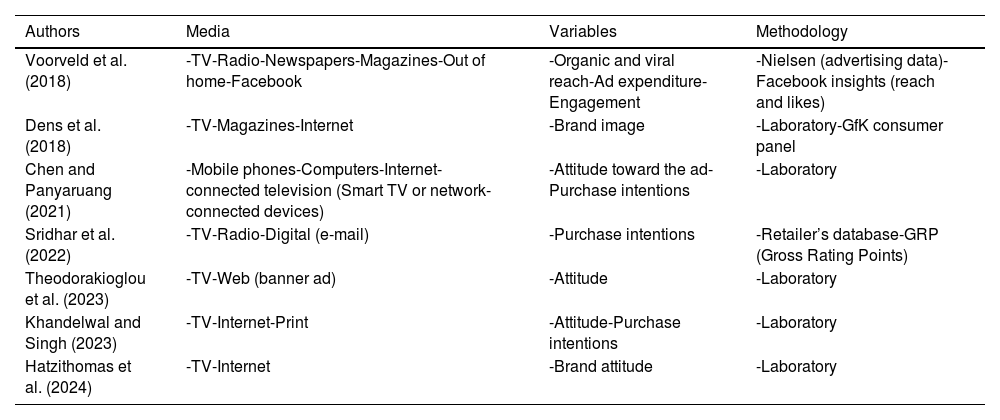
A recent study explored the effectiveness of advertising campaigns by comparing the impact of delivering a single message through one medium with spreading the message across multiple platforms (Khandelwal & Singh, 2023). Other research has examined the relationship between advertising and sales, focusing on the contribution of various media to sales growth and the relationship between additional coverage and increased sales (Taylor et al., 2013). Still more research has investigated the credibility of ad creativity, and which media combinations yield greater message credibility when delivered via TV, the internet and mobile TV (Lim et al., 2015). Scholars have also assessed which media combinations generate more favorable brand attitudes (Hatzithomas et al., 2024) and how television increases Facebook engagement (Voorveld et al., 2018). Ruso et al. (2020) demonstrated that prior exposure to a radio ad improved brand attitude among individuals later exposed to the same ad on television. Other studies have examined brand recognition and interest, such as Aleksandrovs et al. (2015), who reported that increasing advertising frequency on television enhanced brand recognition but reduced brand interest; conversely, increasing advertising exposure in magazines negatively affects recognition, while increasing brand interest. Dens et al. (2018) argued that cross-media campaigns integrating television and the internet positively impact on brand value and interest among heavy media users. Table 1 summarizes key studies on cross-media campaigns, outlining the analyzed media, variables examined and technologies applied.
Studies on cross-media.
| Authors | Media | Variables | Methodology |
|---|---|---|---|
| Voorveld et al. (2018) | -TV-Radio-Newspapers-Magazines-Out of home-Facebook | -Organic and viral reach-Ad expenditure-Engagement | -Nielsen (advertising data)-Facebook insights (reach and likes) |
| Dens et al. (2018) | -TV-Magazines-Internet | -Brand image | -Laboratory-GfK consumer panel |
| Chen and Panyaruang (2021) | -Mobile phones-Computers-Internet-connected television (Smart TV or network-connected devices) | -Attitude toward the ad-Purchase intentions | -Laboratory |
| Sridhar et al. (2022) | -TV-Radio-Digital (e-mail) | -Purchase intentions | -Retailer’s database-GRP (Gross Rating Points) |
| Theodorakioglou et al. (2023) | -TV-Web (banner ad) | -Attitude | -Laboratory |
| Khandelwal and Singh (2023) | -TV-Internet-Print | -Attitude-Purchase intentions | -Laboratory |
| Hatzithomas et al. (2024) | -TV-Internet | -Brand attitude | -Laboratory |
An analysis of the methodologies used reveals that many studies were conducted in laboratory settings, which presents limitations as laboratories cannot fully replicate real consumption environments (Neijens & Voorveld, 2015). Ciceri et al. (2020) employed a variety of techniques including eye tracking, electroencephalograms and memory tests, to deepen the understanding of consumer responses to advertising. Lin et al. (2021) conducted a cross-media study on product placement in television and online videos, while Khandelwal and Singh (2023) and Hatzithomas et al. (2024) examined the relationship between television and the internet in a cross-media campaign context.
Some researchers have complemented lab results and measurement methodologies with real-world data. For instance, Zenetti et al. (2014) combined the observation of web search tasks in a laboratory setting with surveys on media consumption, and with cookie tracking. Taylor et al. (2013) used GFK's Media Efficiency Panel, which provides data on consumer media usage and offline and online purchasing behaviors. Snyder and Garcia-Garcia (2016) merged meta-analyses of data produced by audience measurement companies, such as Comscore and Millward Brown, with neuroscientific metrics obtained in laboratories. Similarly, Voorveld et al. (2018) combined direct observation of user activity on Facebook pages with advertising investment data provided by Nielsen.
To understand the measurement of cross-media campaigns from the advertising industry perspective, one must examine their implementation in the industry. Kantar Media and GfK Dam assess cross-media campaigns. Kantar Media measures in-home television consumption using technologies such as People Meter (audiometers) and Focal Meter, which monitors online traffic within the household network. These technologies collect data from devices connected to the home Wi-Fi, including Smart TVs, computers, laptops, tablets and smartphones. GfK Dam measures digital consumption in Spain. The company provides information on digital consumption of all devices used. That is, any browsing activity on websites and applications is recorded, whether it comes from PCs, laptops, tablets, smartphones, smartwatches, connected cars, gaming consoles or Internet of Things (IoT) devices, among others.
A review of the methodologies used in the advertising industry and academic research reveals limitations in their application to the current media consumption scenario. Specifically, there is a growing need for a unified cross-media methodology that employs consistent metrics, thus eliminating duplication and controlling for excessive frequency of ad exposure. For example, Kantar Media does not measure out-of-home consumption, while GfK Dam does not measure in-app usage, or track users across different devices. Thus, there is a need for a single-source measurement approach that gathers data from closed user groups; the focus of measurement must shift from media, devices and platforms to the audience and its fragmented, cross-platform advertising consumption.
The advertising effectiveness of cross-media campaigns: the relationship between attitude, image and purchase behaviorsClassic models of advertising effectiveness primarily analyze how ad attitudes are formed and how they, in turn, influence brand perceptions and purchase intentions (Gardner, 1985; Keller, 1991; MacKenzie & Lutz, 1989). Importantly, these models emphasize the role of attitudes in the brand value creation process (Olney et al., 1991).
Attitude has been defined as a general evaluation, either positive or negative, of an object or stimulus (Faircloth et al., 2001; MacKenzie et al., 1986). In the advertising context, the object of evaluation can either be the ad itself or the promoted brand. More specifically, attitude toward an ad refers to a consumer’s predisposition to respond favorably or unfavorably to a specific advertising stimulus (MacKenzie et al., 1986; Muehling & McCann, 1993).
Congruity theory (Osgood & Tannenbaum, 1955) proposes that attitude toward an ad can shape brand attitude through an affective transfer process. In other words, when a consumer gains a positive perception of an ad, this can lead him/her to develop a favorable attitude toward the advertised brand, ultimately increasing the likelihood of him/her purchasing the product (Batra & Ray, 1985). Brand attitude, which has been conceptualized as an evaluative variable, reflects the overall assessment that a consumer makes of a brand (Mitchell & Olson, 1981).
Other researchers have also evidenced that attitude toward an ad directly and positively influences brand attitude (Gardner, 1985; MacKenzie et al., 1986), thus establishing it as a key variable in the persuasion process (Batra & Ray, 1985; Park & Young, 1986).
The direct relationship between ad attitude and brand attitude has also been documented in studies on the advertising effectiveness of traditional media (television, radio, press, among others) (Qolbi & Kusumawati, 2023; Sander et al., 2021; Spears & Singh, 2004). For example, Yoo and MacInnis (2005) showed that the brand attitude formation process, when using an emotional execution format, is directly influenced by attitudes generated toward ads. Similarly, Warren et al. (2021), in a study analyzing print and television ads, found that brand attitudes are more strongly influenced by the emotional responses elicited by ads. Raja et al. (2023) explored how ad attitudes shaped by music directly impacted on brand perceptions.
Recent studies, using classic measurement scales adapted to new media and digital formats, have also shown that ad attitude is a direct antecedent of brand attitude (Abzari et al., 2014; Lee et al., 2017). For example, Mukherjee and Banerjee (2019) analyzed users’ interactions with Facebook ads. Their results revealed that interactions foster the development of positive ad attitude, which exerts a direct and significant affective impact on brand attitude. Grant et al. (2015) analyzed sponsored videos on YouTube and confirmed that ads that evoked favorable emotional attitudes positively influenced brand attitude. Banerjee and Pal (2023) examined the influence of ad attitude on both brand attitude and attitude toward YouTube. They found that, while positive ad attitude strengthened brand perceptions, it had a negative impact on viewers' attitudes toward the platform hosting the ad.
However, while some studies have examined the relationship between ad attitude and brand attitude in traditional media and conventional digital media, a significant research gap exists regarding the nature of this relationship in emerging media, such as CTV, video streaming platforms (e.g. Netflix) and digital audio platforms (e.g. Spotify). To optimize advertising´s impact in this new, dynamic media ecosystem, it will be essential to analyze this relationship in these new media formats. Therefore, the following is proposed:
H1 Attitude toward the ad directly and positively influences attitude toward the brand.
Favorable brand attitude can also trigger positive effects on other advertising effectiveness metrics, such as brand image. Brand image has been defined as the perceptions of a brand reflected through brand associations (attributes, benefits, attitudes) present in the consumer's memory (Keller, 1993). These brand-related associations are created through exposure to marketing communications, consumption experiences and social influence (Helmi et al., 2022; Ihzaturrahma & Kusumawati, 2021).
The relationship between brand attitude and brand image was established by Faircloth et al. (2001) who, in line with Keller (1993), demonstrated that brand attitude had a direct and positive effect on brand image. Similarly, Cho (2010) energy drink-focused study concluded that brand attitude positively influenced perceptions of brand image.
To understand how consumers form their perceptions of brands in new digital environments, the effectiveness of cross-media campaigns must be evaluated. Digital media presents new opportunities and challenges for brands, given that they allow for more interactive image formation. For instance, Byun (2020), examining sports content videos on YouTube, showed that a direct relationship exists between brand attitude and brand image. This relationship has also been noted by other research, such as Lee (2019), who found that consumers’ positive preexisting attitudes toward sportswear brands enhanced brand image. The validity of this relationship in conventional digital media leads us to propose that it will hold true for emerging digital media. Thus, we propose the following:
H2 Brand attitude directly and positively influences brand image.
Brand image, as it reflects one´s overall perception of a brand based on both rational and emotional associations, also plays a central role in purchase intentions. A positive brand image drives brand recognition and preferences and increases consumers’ purchase intentions, especially when the consumer develops associations related to quality, reliability and brand appeal (Aaker, 1991; Keller, 1993). Previous studies have found that consumers tend to buy brands with a good image (Jalilvand et al., 2011), indicating that brands that establish a solid and positive image have a competitive advantage in the market. The relationship between brand image and purchase intentions is especially important in saturated markets, where brands must stand out not only because of their functional attributes, but also by cultivating a cohesive and appealing emotional identity (Huthasuhut et al., 2022; Mubarok, 2018).
In the social media context, brand image has a more dynamic and complex dimension, as online platforms facilitate constant interaction between brands and consumers (Rimadias et al., 2021; Zhang et al., 2019). This interactive environment amplifies the impact of brand image on purchase intentions, as consumers tend to trust brands positively evaluated on social networks (Dehghani & Tumer, 2015). For instance, Raji et al. (2019), in the context of automotive brand advertising on social media, found that both hedonic and functional brand image significantly influenced consumers' purchase intentions. Sanny et al. (2020), in a social media study into men’s skincare products, showed that a direct and significant link existed between brand image and purchase intentions. Tauran et al. (2022) showed that a positive relationship existed between brand image and consumer purchasing decisions on Instagram.
In the specific context of YouTube: Kharisma et al. (2022) demonstrated that brand image generated by video ads significantly influenced purchase intentions for advertised products; Irfandi and Abdurrahman (2023) confirmed that a direct and positive relationship existed between brand image and purchase intentions in an examination of millennials' interactions with advertising; Pratama and Astuti (2023) identified brand image as a driver of purchase intentions evoked by smartphone ads. This evidence leads us to posit that this relationship will also hold in the context of emerging digital media. Thus, we propose the following:
H3 Brand image directly and positively influences purchase intentions.
Another key predictor of purchase intentions is consumer attitude toward the ad. MacKenzie et al. (1986) found that ad attitudes influenced both brand recognition and purchase intentions. Previous traditional media-focused studies have also established that a relationship exists between these two variables, that is, that ad attitude is a direct antecedent of purchase intentions for advertised products (Davtyan & Cunningham, 2017; Rodríguez-López et al., 2024).
The attitude-intention relationship has also been shown in the digital media literature (Disastra et al., 2019; Lee et al., 2017). Chen et al. (2023) identified that attitudes toward ads published on social media were directly and positively related to behavioral intentions. Furthermore, studies conducted on social media platforms have confirmed that ad attitude is a determinant of purchase intentions (Chetioui et al., 2021; Ho Nguyen et al., 2022). Lin and Kim (2016) also showed that the more positive was the consumer´s attitude toward ads published on Facebook, the higher would be his/her purchase intentions for products.
Similarly, in the YouTube context, ad attitude has been shown to significantly impact on purchase intentions. By interacting with video ads, consumers often form positive impressions, perceiving the ad content to be attractive and reliable, which increases the attention they pay to them. This prolonged attention, combined with a positive perception, enhances the consumer-brand bond, which enhances purchase intentions (Febriyantoro, 2020). Yang et al. (2017) revealed that consumers’ positive attitudes toward broadcast ads strengthened their purchase intentions for advertised products. Chen and Panyaruang (2021) analyzed users' attitudes toward ads displayed on YouTube through various devices, such as smartphones, CTVs and personal computers, and established that a direct and significant relationship exists between ad attitude and purchase intentions.
This relationship has been corroborated for Generation Z audiences, as documented by Ngo et al. (2023) through the analysis of short videos on YouTube. Quan et al. (2023) confirmed that attitude toward online video ads significantly affected advertising effectiveness, that is, it increased purchase intentions. However, to date, the impact of ad attitude on purchase intentions has not been tested in the emerging digital media. We predict, however, that it will be confirmed in the present study. Based on the above, we propose the following:
H4 Attitude toward the ad directly and positively influences purchase intentions.
While the review of the advertising literature supports the hypotheses regarding traditional and digital media, there is a lack of studies addressing emergent digital media, such as CTV, Netflix and Spotify. To date, the primary focus of previous marketing studies on emergent digital media has mainly been on customer loyalty (Arif et al., 2023; Philip & Pradiani, 2024), brand image (Pandjaitan & Ambarwati, 2022), WOM (Elliot, 2024; Fitriyah, 2023; Nurazizah & Pauzy, 2024), viral marketing (Tricahyono et al., 2019), use and purchase intentions (Lin et al., 2020; Nurazizah & Pauzy, 2024; Pandjaitan & Ambarwati, 2022; Suminto et al., 2023) and engagement (Meidivia et al., 2023). However, no previous studies have examined the advertising effectiveness of these new media, whether individually, or in comparison to traditional/conventional media, such as social networks and YouTube.
In addition, the literature on advertising effectiveness measurement has highlighted the need to combine various media; studies examining the impact of cross-media campaigns show that consumers are more affected by exposure to multiple media channels than by exposure to a single medium (Chen & Panyaruang, 2021; Hoeck, 2019; Taylor et al., 2013). However, previous studies have addressed only the effects of individual media (Hoeck, 2019; Taylor et al., 2013).
The lack of prior research in the digital media context supporting our hypotheses, together with the paucity of research assessing the impact of the integration of various media on advertising effectiveness, leads us to pose the following research questions:
RQ1 Do emergent digital media contribute to meeting advertising objectives?
RQ2 Is there complementarity between conventional and emergent digital media?
RQ3 Do emergent digital media contribute more than conventional digital media to advertising effectiveness?
Fig. 1 depicts the theoretical model used in this study. The model addresses the relationships between ad attitude, brand attitude, brand image and purchase intentions. It incorporates digital media typology as a key factor influencing these relationships, which allows us to undertake a comparative analysis between conventional and emergent digital media.

This model addresses the research questions by assessing whether emerging digital media contribute to meeting advertising objectives (RQ1) through their impact on key effectiveness metrics. It examines, also, the complementarity between conventional and emerging media (RQ2) by analyzing how each type influences the relevant pathways. Last, by comparing the strength of these relationships across media types, the study determines whether emerging digital media enhance advertising effectiveness more than do conventional digital media (RQ3).
MethodologyMeasurement tool and sampleThe cross-media campaign analysis was carried out using the single-source passive measurement tool developed by the media research company Fluzo. This tool employs automatic content recognition (ACR) technology, which allows real-time data collection on audiovisual consumption, covering TV, radio, online video and online radio. This new approach is more advanced than conventional cross-media assessment methods. The relevant technology is installed via an app on the mobile devices of the Netquest panel of consumers (over 10,000 individuals). The software identifies those consumers exposed to an ad, or content, and reveals their digital behavior after exposure. In addition, the tool allows for the combining of declarative and observational data, thus providing a holistic understanding of audience behaviors.
Of the panelists, 2732 individuals aged 18 and older were identified as active. To qualify as active, participants needed to engage daily in one of the following during the campaign’s three-week broadcast period (June–July 2023): audiovisual consumption, app use, web browsing and/or geolocation tracking. Of this 2732, a representative sample of 260 women aged 18 to 54 was selected, following industry standards for cross-media campaign measurement, which define a valid sample as between 250 and 300 individuals (Fluzo, 2024). Only women were recruited as the campaign promoted a new women’s shampoo. Some 60 % were exposed to conventional digital media, while 40 % interacted with emerging digital platforms. The data were collected through a structured online questionnaire assessing respondents’ perceptions of, and attitudes and behaviors toward, the brand and its advertising campaign. Some 50.8 % of the sample held higher education degrees, including bachelor's, master’s and/or doctoral qualifications. In terms of product use, 70.8 % reported using the shampoo multiple times per week, while 24.6 % used it daily.
Measurement instrumentThe measurement scales used in the quantitative research were adapted from previous studies. Most of the variables were assessed by 4-point Likert scales (ranging from 1 "strongly disagree" to 4 "strongly agree") and continuous 10-point scales (ranging from 0, the lowest rating, to 10, the highest rating). The 4-point scales were used to avoid neutral responses that could dilute the interpretation of the participants' perceptions of the campaign (Matas, 2018).
Attitude toward the ad was measured by adapting the scales of Lin and Kim (2016), and Olney et al. (1991) to the study context. Attitude toward the brand was assessed using the scale of García and Alcañiz (2001). Brand image was measured drawing on the scales of Aaker (1997) and Keller (1993). Purchase intentions were measured using a continuous scale, following Esch et al. (2006).
Data analysisPartial Least Squares (PLS) regression was used to test the proposed structural model. This methodology was used, also, to assess the psychometric properties of the measurement model. The software used to analyze the data was SmartPLS version 4.1.0.9. The use of PLS-SEM is justified by its flexibility in handling models with latent variables, its suitability for moderate sample sizes and its emphasis on prediction and explained variance (Hair et al., 2019). These features make it an appropriate method for addressing our research objectives, as they provide a detailed analysis of advertising effectiveness across different digital media, and validate the existence of differences between conventional and emerging media in terms of brand attitude and purchase intentions.
ResultsResults of the single-source toolFigs. 2, 3, 4 and 5 provide data on the reach and frequency of the campaign across both conventional and emerging digital media. Fig. 2 displays a key element for evaluating the campaign’s effectiveness, that is, the number of impacts on the consumer (the total number of times a person is exposed to an advertisement across different media channels during a specific campaign period). As shown, the impacts range from 1 to 7, from a single impact to a maximum of seven. Figs. 3 and 5 depict the demographic and contextual variables. The comparisons across the platforms are based on the campaign’s total impact. Thus, all the subcategories of the platforms were analyzed (without specific segmentation), all time slots were included; no demographic filters were applied; and no distinction was made based on the type of advertising format used. All the figures share the same analysis period, which allows for cross-platform comparisons.

Total reach of conventional and emerging digital media (Source: Fluzo (2024)).

Comparative reach YouTube-Social Media-Spotify (Source: Fluzo (2024)).

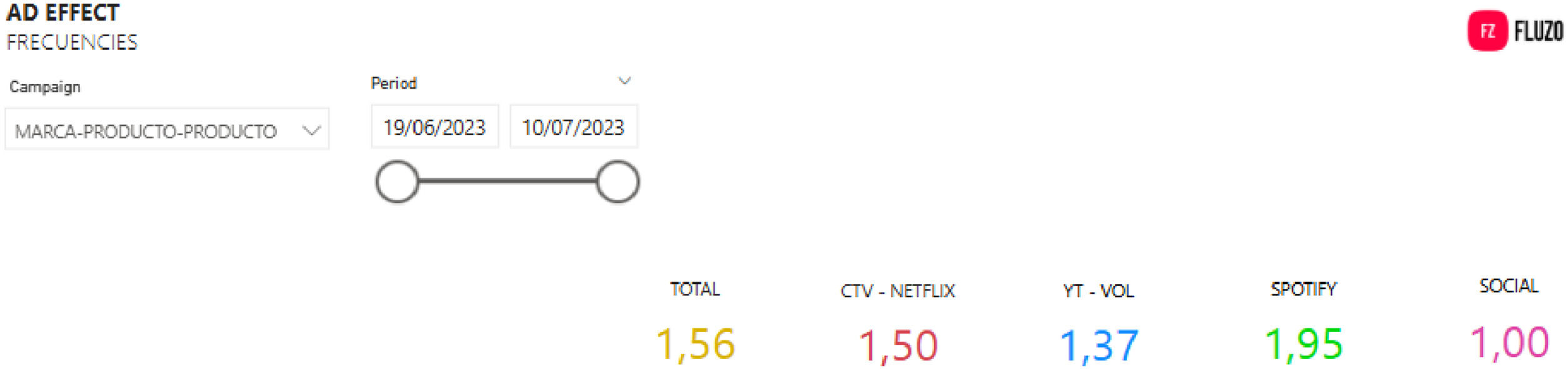
Total frequency of conventional and emerging digital media (Source: Fluzo (2024)).

Comparative frequencies: YouTube-Social Media-Spotify (Source: Fluzo (2024)).
Fig. 2 shows that the effective reach of the campaign was 7.51 %, which is the percentage of the target audience reached through both conventional and emerging digital media. More specifically, the highest percentage of effective reach achieved was in YouTube (4.49 %), followed by Spotify (2.34 %). Spotify performed better than social networks (0.57 %) (conventional digital medium) in terms of reach, thus it can be used to complement advertising on YouTube and social media.
Fig. 4 shows the total frequency, and the frequency per digital medium, obtained by the campaign, representing the average number of times a person is exposed to the advertising message on each medium. In the campaign the frequency of the emerging digital media (Spotify) was higher than the frequency of the conventional digital media (YouTube and social networks) (1.37 and 1.00, respectively, see Figs. 4 and 5). The higher frequency of the emerging digital media indicates that more consumers repeatedly viewed the ad on the platform. This result also supports the proposal that emerging digital media should be used to complement more conventional digital media.
Overall, the results indicated that emerging digital media, such as Spotify, play a crucial role in increasing ad frequency and ensuring multiple message exposures. Nonetheless, conventional digital media, such as YouTube, achieve greater reach, delivering ads to a wider audience, but with lower repetition rates. These findings suggest that emerging media may be more effective in campaigns aimed at brand reinforcement and recall, while conventional digital media may be more suitable for increasing initial brand awareness.
Results of the validation of the measurement instrument and the structural modelCombining the coverage and frequency data with post-tests conducted through panel surveys provides a deeper understanding of campaign effectiveness. Following the evaluation of the reliability and validity of the measurement model, the proposed theoretical model was assessed.
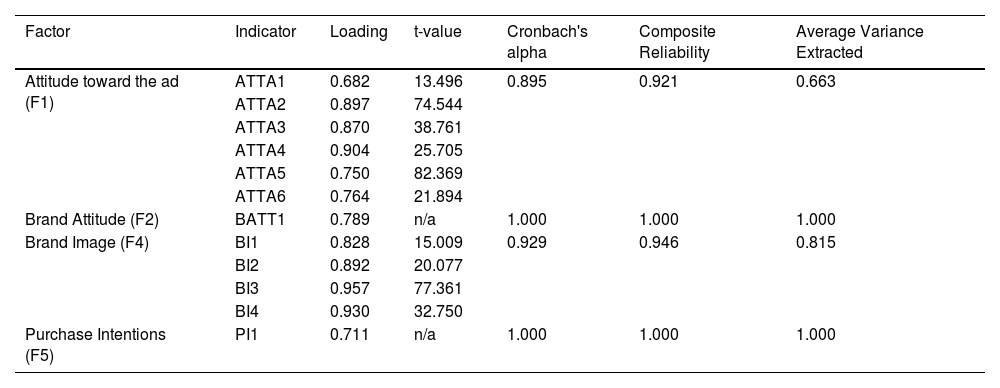
The reliability of the reflectively operationalized variables (attitude toward the ad and brand image) was confirmed, all Cronbach´s alpha values being above 0.8 (Nunnally & Bernstein, 1994), with composite reliability (CR) exceeding 0.9 (Nunnally & Bernstein, 1994). Convergent validity was also established, all loadings being significant, with values exceeding 0.68 (Bagozzi & Yi, 1988) (see Table 2).
Reliability and convergent validity results.
Notes: n/a: not applicable.
Discriminant validity was also verified through the two most common procedures: first, by confirming that the square roots of the AVE for each construct was higher than the inter-construct correlations (Fornell & Larcker, 1981) and, second, by confirming that the heterotrait-monotrait ratio (HTMT) values (Henseler et al., 2015) were below 0.90 (see Table 3).
Discriminant validity result.
| Factor | ATTA | BATT | BI | PI |
|---|---|---|---|---|
| F1. ATTA | 0.814 | 0.789 | 0.401 | 0.724 |
| F2. BATT | 0.833 | 1.000 | 0.235 | 0.892 |
| F3. BI | 0.403 | 0.249 | 0.903 | 0.331 |
| F4. PI | 0.765 | 0.586 | 0.313 | 1.000 |
Notes: on the main diagonal: square root of the average variance extracted from each factor; below the diagonal: correlations between the factors; above the diagonal: HTMT ratio.
Once the quality of the measurement instrument was established, the proposed theoretical model was assessed. For this purpose, the sample was divided into two groups: (1) consumers exposed to conventional digital media and (2) consumers exposed to emerging digital media.
The proposed structural model was assessed using standardized path coefficients (β), observed t-values and the significance obtained from a bootstrap test with 5000 subsamples (Hair Jr et al., 2017). The values of the variance explained by the model (R2), and its predictive relevance (Q2) were also obtained. The results for both subsamples are presented in Table 4 and Figs. 6 and 7.
Structural model results.


The results supported all the hypotheses. However, significant differences were observed between the two subsamples. The relationship between attitude toward the ad and purchase intentions was stronger (β=0.729, p < 0.001 versus β=0.307, p < 0.01) in the subsample exposed to conventional digital media. Conversely, in the subsample exposed to emerging digital media, the following relationships were stronger: ad attitude–brand attitude (β=0.808, p < 0.001 versus β=0.729, p < 0.001); brand attitude–brand image (β=0.245, p < 0.05 versus β=0.145, p < 0.001); and brand image–purchase intentions (β=0.252, p < 0.05 versus β=0.194, p < 0.001). Thus, purchase intentions for the advertised product differed based on digital media advertising type. This result suggests that conventional digital media may be more effective for direct conversion-focused campaigns, while emerging digital media may enhance consumer-brand emotional connections.
The predictive value of both models was established, as both the explained variance and predictive relevance tests returned satisfactory results. More specifically, the R2 values of the dependent variables (brand attitude, brand image and purchase intentions) exceeded the recommended minimum of 10 % (Falk & Miller, 1992), and all Q2 values were above zero (Chin, 1998).
The findings discussed in sections 4.1 and 4.2. suggest that advertisers aiming to maximize ad exposure should take advantage of the complementary nature of these media by using conventional media to increase broad initial awareness, and using emerging media to reinforce engagement and message retention.
In addition, the differences observed in the structural model suggest that campaign objectives should determine media selection. If the aim is to influence purchasing decisions, conventional digital media should be prioritized. However, if the objective is to improve brand perceptions and foster long-term engagement, emerging digital media offer greater potential. These results highlight the importance of cross-media approaches for optimizing advertising effectiveness.
Conclusions and discussionThe study analyzed a cross-media campaign integrating conventional and emerging digital media. The research aim was to understand the complementarity between media and to examine their contributions to achieving the most important advertising objectives, reach and frequency. The study tested a classic model for measuring advertising effectiveness, linking advertising stimuli with brand perceptions and purchase intentions, thus providing deeper insights into the impact of advertising campaigns in today's dynamic and ever-changing media environment. Hence, the research adds to current knowledge on the measurement of cross-media campaigns that integrate emerging digital media, a topic which has received, to date, scant research attention.
The reach-focused results demonstrated the complementarity nature of the conventional and emerging digital media relationship, with YouTube being the conventional medium with the highest percentage of effective reach, followed by the emerging medium Spotify. The frequency analysis results indicated that the greatest number of ad impacts occurred in emerging media (see Fig. 8). Thus, conventional digital media, with their broader reach, may be more effective for building initial brand awareness, while emerging media, with their higher frequency of exposure, may promote greater brand reinforcement and recall. These findings address RQ1 and RQ2, confirming that emerging digital media contribute to achieving advertising objectives when integrated with conventional digital media, enhancing the effectiveness of communication campaigns.

Advertising effectiveness was analyzed through the proposed theoretical model, with a focus on attitude-image-behavioral intention relationships. The results of the model highlighted the role of attitudes in the process of value creation for brands and responding to advertising stimuli (see Fig. 9). Furthermore, by evaluating these relationships in the context of cross-media campaigns—integrating conventional digital media with emerging digital media—the impact of attitudes in more dynamic and complex advertising environments has been demonstrated.

The results supported the hypotheses proposed in the research, as all the relationships posited in the theoretical model were confirmed. Hence, it can be concluded that favorable ad attitudes not only improve attitudes toward brands, but also trigger positive outcomes for other advertising effectiveness metrics, such as purchase intentions. These findings are in line with previous studies which identified a direct relationship between attitudes toward ads for consumer goods and purchase intentions in the social media context (Chen et al., 2023;Chetioui et al., 2021; Ho Nguyen et al., 2022; Lin & Kim, 2016). Similarly, the results are consistent with previous YouTube-focused research (Chen & Panyaruang, 2021; Febriyantoro, 2020; Ngo et al., 2023; Quan et al., 2023).
The study also demonstrated that attitude toward the brand directly and positively influenced brand image, which in turn determines purchasing behavior. There is, therefore, a connection between overall brand evaluations and the creation of positive associations about the brand (Byun, 2020; Faircloth et al., 2001; Lee, 2019), which directly impact on purchase intentions. In this study, purchase intentions were shown to be a construct that reflects the impact of two key variables for measuring advertising effectiveness: brand image and ad attitude. Both variables serve not only as proxies of advertising effectiveness, but also represent the psychological and emotional link between consumers and brands. This finding corroborates past research which identified a direct and significant relationship between brand image and purchase intentions in the context of skincare product ads broadcast on social media (Ellitan et al., 2022; Sanny et al. (2020)). This product category shares some similarities with the product examined in this study, thus reinforcing the importance of the results. Furthermore, the findings align with previous YouTube-focused research, which also established the impact of advertising-driven brand image on purchase intentions (Irfandi & Abdurrahman, 2023; Kharisma et al., 2022; Pratama & Astuti, 2023).
Despite the confirmation of the proposed hypotheses in both subsamples, significant differences were seen between the two models. More specifically, two pathways to purchase intentions for the advertised product were observed. The first, the direct pathway, is grounded in ad attitude, which plays a more prominent role in conventional digital media. The second, the indirect pathway, operates through attitude toward the brand and brand image, and is more important in emerging digital media. In this second pathway, attitude toward the ad and the brand translate into improved brand perceptions, which in turn drive purchasing behaviors. The identification of the existence of two pathways, which increase purchase intentions for the advertised product, and are driven by different digital media, also highlights the complementarity of conventional and emerging digital media in triggering behavioral responses in individuals exposed to advertising. Since purchasing behavior is influenced through more than one pathway, it cannot be assumed that emerging digital media improve advertising effectiveness to a greater extent than do conventional digital media, as this depends on the objectives of the advertising campaign (RQ3). Thus, if the main objective of a campaign is to influence purchase intentions, the conventional media model seems to deliver better results. However, if the aim is to improve the image of, or attitude toward, the brand, the emerging media model would be more effective.
Overall, the findings of the study highlight that, in the analyzed advertising campaign, media complementarity plays a key role in optimizing ad impact and achieving strategic objectives. Each platform offers distinct advantages in terms of reach and frequency of exposure, suggesting that combining them not only increases campaign visibility, but also allows companies to adapt to different content consumption patterns.
Combining platform type, thus, allows for the balancing of the strengths and weaknesses of each medium, which should maximize the efficiency of campaigns, through an adaptation process based on different digital consumption habits. While YouTube ensures wide coverage, Spotify reinforces recall through repetition, and social media facilitates interaction with the audience. In parallel, CTV offers a less intrusive, but highly effective, advertising experience in terms of engagement. The integration of these channels not only optimizes message delivery, but also allows for greater flexibility in media strategy, ensuring that awareness, recall and engagement objectives are achieved in a complementary manner.
Our findings confirmed the contribution of emerging media to advertising objectives (RQ1) and the complementarity between conventional and emerging digital media (RQ2), demonstrating how their strategic integration improves campaign effectiveness. The results suggest that emerging media can enhance key aspects of the persuasion process (RQ3), though they do not replace the role of conventional media, which must be used jointly within a cross-media strategy.
From a methodological perspective, the study also validates the Fluzo tool as an innovative system for measuring advertising effectiveness in digital campaigns. Its application provides an accurate assessment of each medium’s impact in terms of reach, frequency and ad attitude, which represents an important contribution both to academic research and to strategic planning in digital marketing and advertising.
Implications for management, limitations and future research directionsThe findings of the study raise significant implications for marketing professionals, particularly in terms of the design and execution of cross-media campaigns in an increasingly fragmented and complex media environment. The integration of conventional digital media, such as YouTube, and emerging media, such as Spotify, was shown to provide excellent complementarity in terms of reach and frequency. Hence, brands can optimize their advertising investments by strategically diversifying their media choices and combining these new platforms to maximize the impact of their cross-media campaigns.
In terms of advertising effectiveness, marketing professionals and media planners should use emerging media to strengthen key variables such as attitude toward the ad and brand, brand image and purchase intentions. More specifically, the use of emerging digital media, such as Spotify, not only increases exposure frequency but also generates a more positive perception of the brand, which is essential for building long-term relationships with customers.
Audio-matching technology offers an opportunity for media research companies to overcome traditional measurement limitations. It allows advertisers to identify who is being impacted by their campaigns, optimize reach without duplication and to adjust frequency to prevent consumer saturation. Brands and agencies can leverage these technologies to make more precise measurements, and to gain valuable insights into consumer behaviors across multiple platforms.
Finally, advertising campaign managers should tailor their strategies based on product type, audience and desired outcomes. For instance, conventional media may be more effective in influencing purchase intentions, whereas emerging media may be better for enhancing brand perceptions and creating positive emotional associations.
The validation of Fluzo as a measurement tool represents an important theoretical contribution, as it has been shown to assess advertising effectiveness in a cross-media context more accurately than do traditional methods. The study expands current knowledge on advertising campaign measurement in emerging digital media, providing a replicable methodology for future research.
From a theoretical perspective, the study contributes to the growing body of literature on advertising effectiveness in digital environments, particularly in the underexplored area of cross-media synergies. The findings support the proposal that media complementarity enhances advertising performance, which aligns with previous research into integrated media strategies. In addition, the study demonstrates the value of incorporating real exposure data into advertising effectiveness models, an approach that might be further explored in future academic research.
From a practical standpoint, this research provides valuable insights for advertisers, agencies and media planners seeking to refine their media selection strategies. As digital consumption habits continue to evolve, understanding how to combine different media types to maximize effectiveness is crucial. The findings suggest that advertisers should consider not only the reach and frequency of the media mix, but also how various platforms contribute to key brand metrics. Moreover, the results highlight the potential for emerging digital audio platforms to serve as strategic complements to traditional digital video formats, offering new opportunities to enhance brand image and attitude.
The main limitation of the present study is based on the characteristics of the sample, which consisted of female consumers only, due to the product category examined. Future studies should include both men and women in their samples, to allow comparative analyses of gender-based differences in advertising effectiveness to be undertaken.
A second limitation is the research focus on a single product category. It would be interesting to examine the effectiveness of cross-media campaigns across various product categories, particularly those with higher consumer involvement, such as technology, luxury goods and health-related products. These categories may exhibit different patterns of media interaction, requiring the development of tailored advertising strategies.
Future work might extend the proposed model by adding more variables to measure advertising effectiveness, such as brand recall and brand preference; this may provide a more comprehensive understanding of how different media contribute to consumer responses. The moderating effect of variables, such as prior purchase experience with the brand/product advertised, and/or prior brand knowledge, might be analyzed, as these may influence how individuals process advertising messages. Last, it would also be valuable to explore if the relationships proposed in the theoretical model vary based on the type of ads used in the campaign (functional versus emotional), as different creative strategies might enhance advertising effectiveness in distinct ways.
Future research might also analyze cross-media campaigns in different cultural contexts, assessing whether regional media consumption habits, advertising regulations and cultural perceptions impact on advertising effectiveness. Comparative studies across western and eastern markets, and/or between developed and emerging economies, could provide valuable insights into how media complementarity operates in diverse environments.
Finally, future research might employ longitudinal designs to understand the long-term effects of cross-media campaigns on brand perceptions and purchase behaviors. Most advertising studies focus on immediate responses; therefore, examining how media complementarity shapes brand loyalty, and fosters long-term consumer engagement, would provide valuable theoretical and practical insights.
FundingThis research did not receive any specific grant from funding agencies in the public, commercial or not-for-profit sectors.
CRediT authorship contribution statementSilvia Sanz-Blas: Validation, Supervision, Software, Methodology, Investigation, Formal analysis, Data curation, Conceptualization. Victor Ballester-Riera: Visualization, Validation, Project administration, Conceptualization. Daniela Buzova: Writing – review & editing, Writing – original draft, Visualization, Conceptualization.
The authors declare that they have no known competing financial interests or personal relationships that could have influenced the work reported in this paper.
