



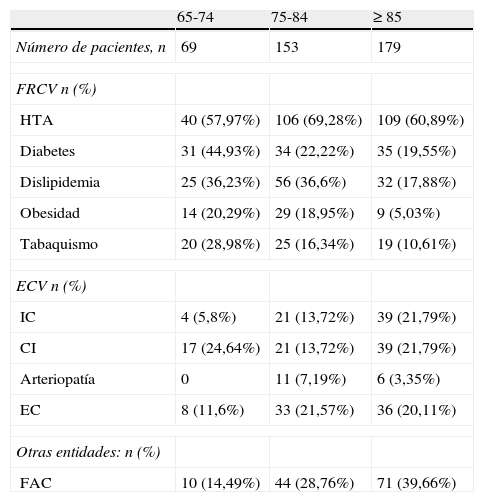
Estudiar la prevalencia de los factores de riesgo cardiovascular (FRCV) y de enfermedad cardiovascular (ECV) de la población anciana ingresada en un centro sociosanitario y valorar su distribución por grupos de edad y por sexo.
Material y métodosEstudio descriptivo retrospectivo de los pacientes ≥65 años ingresados en un centro sociosanitario desde el 1de enero de 2009 al 31de diciembre de 2010. Los datos de prevalencia se obtuvieron de los antecedentes personales y/o toma de medicación crónica que constaban en la historia clínica.
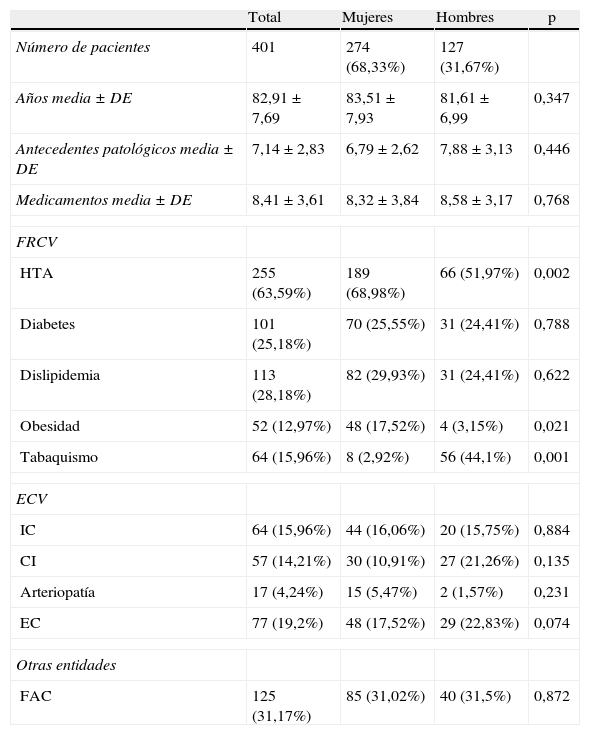
ResultadosIngresaron 401 pacientes ≥65 años. Edad media 82,91±7,69 años. El 68,33% fueron mujeres. Los pacientes presentaron 7,14±2,83 antecedentes patológicos de media, siendo los más frecuentes los del aparato cardiovascular.
El 79,9% de los pacientes presentaron FRCV; 35,41% un FRCV; 27,27% 2 FRCV; 13,4% 3 FRCV y 3,83% 4 FRCV. Se presentaron de la siguiente manera: hipertensión arterial 63,59%; tabaquismo 15,96%; dislipidemia 28,18%; diabetes 25,18% y obesidad 12,97%. Por sexos (mujer/hombre, en %): HTA 68,98/51,97; tabaquismo 2,92/44,1; dislipidemia 29,93/24,41; diabetes 25,55/24,41; obesidad 17,52/3,15.
El 44,02% de los pacientes presentaba ECV: 34,91% de pacientes una ECV; 7,18% 2 ECV y 1,43% 3 ECV. Se distribuyeron: enfermedad cerebrovascular 19,2%; cardiopatía isquémica 14,21%; arteriopatía periférica 4,24%; insuficiencia cardiaca 15,96%. Por sexos (mujer/hombre, en%): enfermedad cerebrovascular 17,52/22,83; cardiopatía isquémica 10,91/21,26; arteriopatía periférica 5,47/1,57; insuficiencia cardiaca 16,06/15,75.
ConclusionesLa mayoría de los pacientes ingresados fueron mujeres.
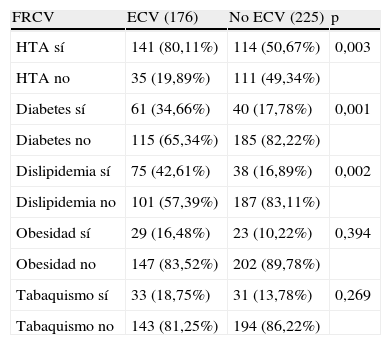
El FRCV más prevalente fue la HTA (63,59%). La ECV más frecuente fue la enfermedad cerebrovascular (19,2%). Los pacientes con ECV presentaron más FRCV.
Las mujeres presentaron más FRCV que los hombres, excepto tabaquismo, y más insuficiencia cardiaca y arteriopatía periférica. Los hombres presentaron más cardiopatía isquémica y enfermedad cerebrovascular.
To determine prevalence of cardiovascular risk factors (CVRF) and cardiovascular disease (CVD) of the elderly population admitted to a geriatric center and to evaluate its distribution by age and sex groups.
Material and methodsA retrospective descriptive study of patients over 65 years admitted to a geriatric center from January 1, 2009, to December 31, 2010 was performed. Prevalence data were obtained from the patient's medical record regarding personal data and/or taking of chronic medication.
ResultsA total of 401 patients (68.3% women) over 65 years, mean age 82.91±7.69 years, were admitted. Mean disease background found was 7.14±2.83, those of the cardiovascular system being more frequent.
CVRF was found in 79.9%: 35.41% patients 1 CVRF, 27.27% 2 CVRF, 13.4% 3 CVRF and 3.83% 4 CVRF. These presented as: hypertension 63.59%, smoking 15.96%, dyslipidemia 28.18%, diabetes 25.18% and obesity 12.97%. By gender (female/male, in %): hypertension 69.98/51.97, smoking 2.92/44.1, dyslipidemia 29.93/24.41, diabetes 25.55/24.41, obesity 17.52/3.15.
CVD was found in 44.02% of patients: 34.91% 1 CVD, 7.18% 2 CVD and 1.43% 3 CVD. These were distributed as: cerebrovascular disease 19.2%, ischemic heart disease 14.21%, peripheral arterial disease 4.24% and heart failure 15.96%. By gender (female/male, in %): cerebrovascular disease 17.52/22.83, ischemic heart disease 10.91/21.26, peripheral arterial disease 5.47/1.57, heart failure 16.06/15.75.
ConclusionsMost patients admitted were women.
The most prevalent CVRF was hypertension (63.59%). The most frequent CVD was cerebrovascular disease (19.2%). More CVRF were presented in patients with CVD.
Women had a higher prevalence of CVRF than men, except smoking, and more heart failure and peripheral arterial disease. Men had more ischemic heart disease and cerebrovascular disease.
