





Esophageal squamous cell carcinomas (ESCC) are often accompanied by head and neck squamous cell carcinoma (HNSCC) and vice versa. Our study aimed to describe the prevalence of HNSCC in patients with ESCC, the chronology of appearance and the impact on survival.
MethodsA retrospective review was carried out through a computerized database of patients diagnosed with ESCC at Hospital Clinic of Barcelona between January 1999 and June 2019. Demographic data, date of ESCC diagnosis, survival time, primary tumor location, diagnosis of HNSCC and chronological relationship were recorded.
ResultsA total of 231 patients with ESCC confirmed histologically were included in the study with a median age of 64 years (IQR, 56.0–72.0), and 178 (77%) were male. The majority of the patients had a history of smoking and alcohol consumption (69.7% and 60.6%, respectively). The predominant location of ESCC was the middle esophagus (n=124, 53.7%).
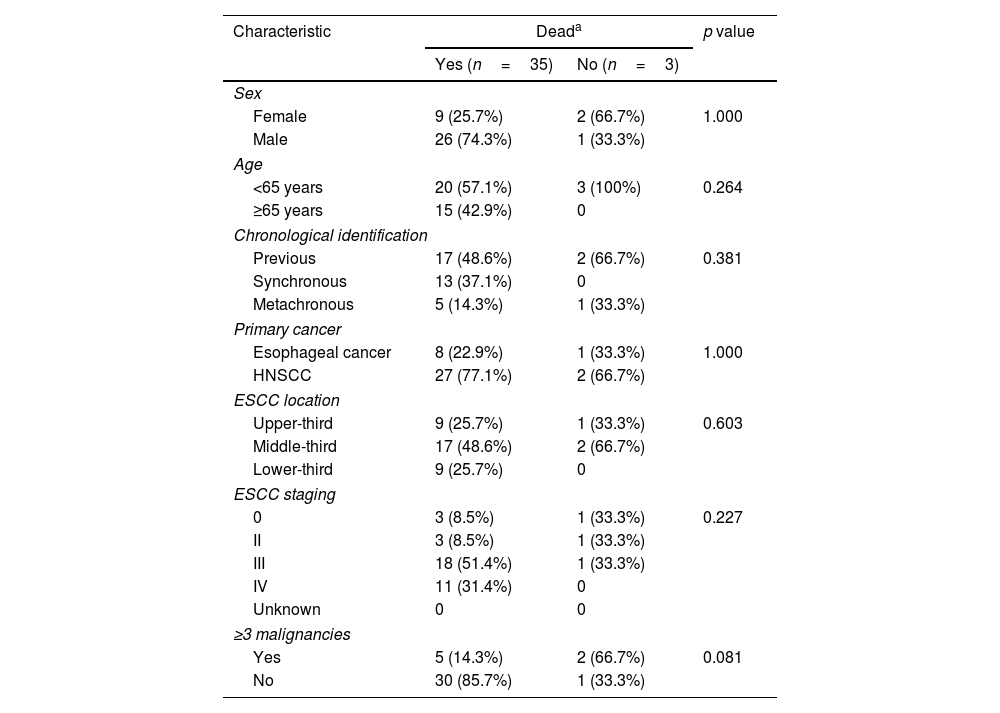
Forty-one patients (17.7%) had HNSCC: 21 (51.2%) were previous, 14 (34.1%) synchronous and 6 (14.6%) metachronous.
All the patients were followed and 196 (84.8%) died with a median survival time of 19 months (IQR, 7–66). There were not statistically significant differences among the living patients and the deceased.
ConclusionsIn our setting, a 17.7% of patients with ESCC have an associated HNSCC with no significant differences in survival between patients with both ESCC and HNSCC compared to those with only ESCC. However, the implementation of a screening program could allow the detection of a second primary tumor at early stages.
Los carcinomas de células escamosas de esófago (CEE) están frecuentemente acompañados de carcinoma de células escamosas de cabeza y cuello (CECC) y viceversa. El objetivo de nuestro estudio fue describir la prevalencia de CECC en pacientes con CCEE, la cronología de aparición y el impacto en la supervivencia.
MétodosSe realizó una revisión retrospectiva en una base de datos de todos los pacientes diagnosticados de CEE en el Hospital Clínic desde enero de 1999 hasta junio del 2019. Se analizaron datos demográficos, fecha de diagnóstico de CEE, tiempo de supervivencia, localización del tumor primario, diagnóstico de CECC y cronología de relación entre neoplasias.
ResultadosSe incluyó un total de 231 pacientes con CEE confirmado histológicamente con una mediana de edad de 64 años (IQR, 56,0-72,0) y 178 (77%) eran hombres. La mayoría tenían antecedentes de tabaquismo y consumo de alcohol (el 69,7 y el 60,6%, respectivamente). La localización predominante del CEE fue el esófago medio (n=124, 53,7%).
Cuarenta y un pacientes (17,7%) tuvieron CECC: 21 (51,2%) fueron previos, 14 (34,1%) sincrónicos y 6 (14,6%) metacrónicos.
Todos los pacientes fueron seguidos y 196 (84,8%) fallecieron con una mediana de supervivencia de 19 meses (IQR 7-66).
ConclusiónEn nuestro medio, un 17,7% de los pacientes con CEE tienen asociado un CECC, sin diferencias significativas en la supervivencia entre pacientes con CEE y CECC en comparación que aquellos con solo CEE. Sin embargo, la implementación de un programa de cribado podría permitir la detección de un segundo tumor primario en fases tempranas.

