


metricas
covid
Gastroenterología y Hepatología (English Edition) Colonoscopy in symptomatic patients: Validation of AEG-SEED prioritization crite...
Journal Information
Vol. 48. Issue 9.
(November 2025)
Share
Download PDF
More article options
Vol. 48. Issue 9.
(November 2025)
Original article
Colonoscopy in symptomatic patients: Validation of AEG-SEED prioritization criteria and added value of FIT. The endoprior study
Colonoscopia en pacientes sintomáticos: validación de criterios de priorización AEGSEED y valor añadido del FIT. Estudio Endoprior
Liseth Rivero-Sáncheza,
Corresponding author
lrivero@clinic.cat

Corresponding author.
, Joaquín Castillo-Iturraa, Ana García-Rodríguezb, Beatriz García Zafrab, Pilar Díez Redondoc, Henar Núñez Rodríguezc, Marta Ponced, Mileidis San Juane, Pilar Borque Barrerae, Agustín Seoanef, Marc Albert Carrascog, Diana Zaffalonh, Carlos Guarneri, Marianette Murzii, Rodrigo Joverj, Lucía Medina-Pradoj, Kattalin Aspuru Rubiok, Diana João Matiasl, Begoña González Suáreza, Henry Córdovaa..., Alejandro Fernández-Simóna, Isis Araujoa, Àngels Ginésa, María Pelliséa,1, Francesc Balaguera,1, Gloria Fernández-Esparracha,1Ver más
a Department of Gastroenterology, Hospital Clínic de Barcelona, Institut d’Investigacions Biomèdiques August Pi i Sunyer (IDIBAPS), Centro de Investigación Biomédica en Red de Enfermedades Hepáticas y Digestivas (CIBEREHD), University of Barcelona, Barcelona, Spain
b Hospital de Viladecans, Barcelona, Spain
c Hospital Universitario Río Hortega, Valladolid, Spain
d Hospital Clínico Universitario de Valencia, Valencia, Spain
e Hospital Universitario Nuestra Señora Candelaria, Tenerife, Spain
f Parc de Salut Mar, Hospital del Mar, Barcelona, Spain
g Hospital Universitari de Girona Dr. Josep Trueta, Girona, Spain
h Hospital de Terrassa, Barcelona, Spain
i Hospital de la Santa Creu i Sant Pau, Barcelona, Spain
j Hospital Universitario de Alicante, Alicante, Spain
k Hospital San Jorge de Huesca, Huesca, Spain
l Hospital Universitario de Salamanca, Salamanca, Spain
Ver más
Article information
Abstract
Full Text
Bibliography
Download PDF
Statistics
Figures (3)
Show moreShow less
Tables (3)
Table 1. Diagnostic performance of the different indications according to the AEG-SEED prioritization criteria (n=1078).
Tables
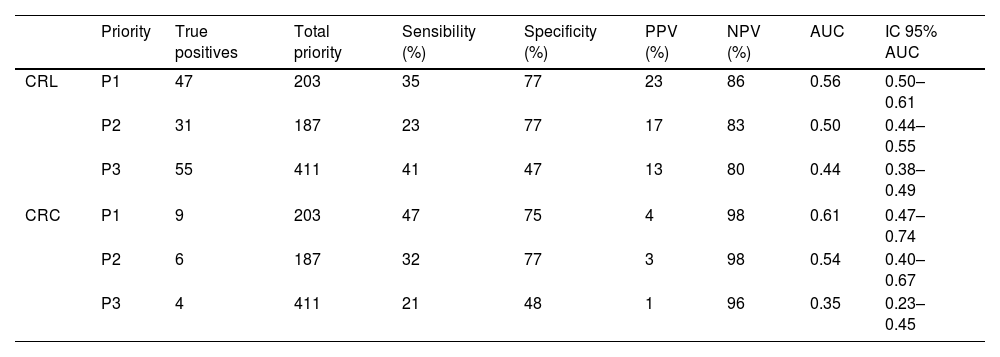
Table 2. Diagnostic performance of the priority levels of the AEG-SEED clinical criteria (n=1078), including patients with prior FIT.
Tables
Table 3. Diagnostic performance according to the priority levels of the AEG-SEED clinical criteria, excluding patients with prior FIT (n=801).
Tables
Show moreShow less
Abstract
Background and aims

Colorectal cancer (CRC) is one of the leading causes of cancer-related mortality. Colonoscopy is the diagnostic gold standard, although its performance in symptomatic patients is limited. During the COVID-19 pandemic, the AEG-SEED societies proposed a clinical prioritization system. The aim of this study was to validate its diagnostic performance in detecting clinically relevant lesions (CRLs), including CRC, and to compare it with the fecal immunochemical test (FIT).

Patients and methods

A national multicenter retrospective study was conducted in 12 Spanish hospitals. A total of 1078 adult patients with digestive symptoms attended between April and December 2020 were included. Colonoscopies were prospectively classified according to priority levels (P1, P2, P3).

Results

CRLs were identified in 18% of patients, including 36 cases of CRC (3%). The diagnostic yield was highest in P1 (PPV 27%, AUC 0.57 for CRLs; PPV 7%, AUC 0.64 for CRC), and decreased in P2 and P3. FIT was performed in 26% of patients based on the referring physician's clinical judgment, showing higher sensitivity and negative predictive value (NPV) for CRC (100%) and a higher AUC (0.69) compared to clinical criteria.

Conclusions

The AEG-SEED clinical criteria offer moderate value for prioritizing colonoscopies in the absence of FIT. However, FIT demonstrates superior diagnostic performance and should be systematically incorporated. The combination of symptoms improves accuracy compared to isolated symptoms.

Keywords:
Colonoscopy
Prioritization
Clinically relevant lesions
Colorectal cancer
Fecal immunochemical test
Resumen
Antecedentes y objetivos

El cáncer colorrectal (CCR) es una de las principales causas de mortalidad por cáncer. La colonoscopia es el estándar diagnóstico, aunque su rendimiento en pacientes sintomáticos es limitado. Durante la pandemia por COVID-19, las sociedades AEG-SEED propusieron un sistema de priorización clínico. El objetivo del estudio fue validar su rendimiento diagnóstico para detectar lesiones clínicamente relevantes (LCR) incluido el CCR y compararlo con la prueba inmunoquímica fecal (FIT).

Pacientes y métodos

Estudio retrospectivo multicéntrico nacional realizado en 12 hospitales españoles. Se incluyeron 1.078 pacientes adultos con síntomas digestivos atendidos entre abril y diciembre de 2020. Las colonoscopias se clasificaron prospectivamente según los niveles de prioridad (P1, P2, P3).

Resultados

Se identificaron LCR en el 18% de los pacientes, incluyendo 36 casos de CCR (3%). El rendimiento fue mayor en P1 (VPP 27%, AUC 0.57 para LCR; VPP 7%, AUC 0.64 para CCR), y disminuyó en P2 y P3. En el 26% de los pacientes se realizó FIT según criterio clínico del médico solicitante, observándose una mayor sensibilidad y VPN para CCR (100%) y AUC superior (0.69) frente a los criterios clínicos.

Conclusiones

Los criterios clínicos AEG-SEED ofrecen un valor moderado para priorizar colonoscopias en ausencia de FIT. No obstante, el FIT demuestra mayor rendimiento diagnóstico y debería incorporarse sistemáticamente. La combinación de síntomas mejora la precisión frente a síntomas aislados.


Palabras clave:
Colonoscopia
Priorización
Lesiones clínicamente relevantes
Cáncer colorrectal
Sangre oculta en heces inmunológica

Article

These are the options to access the full texts of the publication Gastroenterología y Hepatología (English Edition)
Subscriber
Subscriber

If you already have your login data, please click here .

If you have forgotten your password you can you can recover it by clicking here and selecting the option “I have forgotten my password”
Subscribe
Subscribe to

Gastroenterología y Hepatología (English Edition)

Purchase
Purchase article

Purchasing article the PDF version will be downloaded

Purchase now
Contact
Phone for subscriptions and reporting of errors
From Monday to Friday from 9 a.m. to 6 p.m. (GMT + 1) except for the months of July and August which will be from 9 a.m. to 3 p.m.
Calls from Spain
932 415 960
Calls from outside Spain
+34 932 415 960
E-mail
Article options
Tools