
Colorectal cancer (CRC) is the second cause of cancer-related deaths worldwide. Five-year survival rate in Spain is 57%. The most important prognostic factor is the stage of the tumor at the diagnosis. CRC can be early diagnosed, but the adherence to screening programs is low (<50%). This study aims to ascertain the influence of social support and stressful life events on the adherence to the population screening of CRC with fecal occult blood test in Spanish average risk population.
MethodsMulticenter case–control study. We conducted a simple random sampling among individuals invited to participate in the colorectal cancer screening program. We analyzed epidemiological and social variables associated with lifestyle and behavioral factors. We performed a descriptive and a bivariant analyses and a logistic regression analysis.
ResultsFour hundred and eight patients (237 cases and 171 controls) were included. Multivariant analyses showed independent association between higher adherence to the screening program and older age (OR: 1.06; 95% CI: 1.01–1.10), stable partner (OR: 1.77, 95% CI: 1.08–2.89) and wide social network (OR: 1.68; 95% CI: 1.07–2.66). Otherwise, lower adherence was associated to perceiving barriers to participate in the program (OR: 0.92; 95% CI: 0.88–0.96). We find a statistically significant association between lower adherence and high impact stressful life events in the bivariant analyses, and the tendency was maintained (OR: 0.63, 95% CI: 0.37–1.08) in the multivariant.
ConclusionSocial variables decisively influence the adherence to colorectal cancer screening. The implementation of social interventions that improve social support, reduce impact of stressful life events and the design of screening programs that decrease the perceived barriers, will contribute to increase the participation on these programs. Secondary, the colorectal cancer diagnosis will be made in early-stages with the consequent mortality reduction.
El cáncer colorrectal (CCR) es la segunda causa de muerte por cáncer en el mundo. La tasa de supervivencia a cinco años en España es de 57%. El factor pronóstico más importante es el estadio del tumor en el momento del diagnóstico. El CCR se puede diagnosticar precozmente, pero la adherencia a los programas de cribado es baja (< 50%). Este estudio pretende conocer la influencia del apoyo social y los acontecimientos vitales estresantes en la adherencia al cribado poblacional de CCR con sangre oculta en heces en población española de riesgo medio.
MétodosEstudio multicéntrico de casos y controles. Realizamos un muestreo aleatorio simple entre los individuos invitados a participar en un programa de cribado de CCR. Analizamos variables epidemiológicas y sociales asociadas al estilo de vida y factores conductuales. Realizamos un análisis descriptivo, un análisis bivariante y una regresión logística.
ResultadosSe incluyeron 408 pacientes (237 casos y 171 controles). El análisis multivariante demostró una asociación independiente entre una mayor adherencia al programa de cribado y mayor edad (OR: 1,06; IC 95%: 1,01-1,10), tener pareja estable (OR: 1,77, IC 95%: 1,08-2,89) y disponer de una amplia red social (OR: 1,68; IC 95%: 1,07-2,66). Por el contrario, la menor adherencia se asoció a la percepción de barreras para participar en el cribado (OR: 0,92; IC 95%: 0,88-0,96). Encontramos una asociación estadísticamente significativa entre menor adherencia y acontecimientos vitales estresantes de alto impacto en el análisis bivariante. La tendencia se mantuvo (OR: 0,63, IC 95%: 0,37-1,08) en el análisis multivariante.
ConclusiónLas variables sociales influyen decisivamente en la adherencia al cribado del CCR. La implementación de intervenciones sociales que mejoren el apoyo social y reduzcan el impacto de los acontecimientos vitales estresantes junto al diseño de programas que disminuyan las barreras percibidas, contribuirá a aumentar la participación en el cribado. Con ello, el diagnóstico de CCR en estadios precoces será mayor, con la consiguiente reducción en la mortalidad.

Colorectal cancer (CRC) is the second most common cause of cancer-related deaths in the world, accounting for over 953,173 deaths in 2020. The incidence of this neoplasm is also the third highest after breast and lung cancer irrespective of gender, with an estimated 1,931,590 new cases in 2020. Five-year relative survival rate for patients with CRC in Spain is just 57%. Survival of CRC patients detected in a screening program is higher than that of patients diagnosed for symptoms.1 The screening strategy for average risk population (individuals between 50 and 70 years old without additional risk factors) is a biennial Fecal Occult Blood Test (FOBT), sigmoidoscopy every 3–5 years or colonoscopy every 10 years.2 Although coverage of the screening programs is nearly universal in Spain, participation in such programs is still below 50% and most CRCs are still being diagnosed outside of the screening programs. There are three groups of factors associated with adherence to population screening: those related to the organization of the screening program, those dependent on the views of the individual3 and those related to social and familial factors. In this article, we will focus on these last constraints.
There are many social factors that influence adherence to screening and many of them, such as income level, race or ethnicity, geographical factors, gender, level of education and the degree of knowledge about CRC,4 are well assessed in the literature. There are, however, two social and familial factors whose relationship with CRC screening is less thoroughly studied, such as social support (SS) and stressful life events (SLE).
SS may be defined as an interactive process through which individuals obtain emotional, instrumental or financial aid from the social network in which they are involved.5,6 SLE would be those events requiring a degree of adjustment to the daily activities of the individuals, who perceive such adjustments as undesirable.7 Prevalence of low social support is estimated between 20 and 35% in the general population. This percentage is higher for individuals with chronic pathologies living in disadvantaged areas, with figures of low social support of up to 65%. The influence of SS on the mortality risk has been shown to be comparable with well-established risk factors. Patients with chronic conditions such as high blood pressure or diabetes and lower social support are at a higher risk of developing cardiovascular events and dying during long-term follow-up.8 In population studies, social isolation has been associated with higher mortality, accident and suicide rates; likewise, recent studies show the influence of SS on mortality due to heart failure or cancer.9 On the other hand, the influence of SLE on high blood pressure, physical and psychological problems or the chance of suffering a cerebrovascular accident for patients with high blood pressure has been demonstrated, with a prevalence of about 50%.10 Due to their knowledge about the patient and his or her environment, Primary Care professionals play an important role in the detection of the SLE referred by the individuals along their lifes, as well as those cases with lower SS.
There is scarce evidence about the impact of the SS and SLE on the adherence to a CRC screening program. Two systematic reviews11,12 showed the importance of the perceived family support and the social network, as well as the marital status. Moreover, two meta-analysis and two systematic reviews of interventional studies showed that peer support, partner's support and a cohesive health team increase the participation in the screening.13–16 These interventions are more efficient if the barriers to the screening program are reduced, if an education “one to one” strategy is conducted and if they are implemented in a community level. Finally, although there is no evidence about the effect of the SLE on the adherence to the screening programs, two epidemiologic studies suggest an association between SLE and the risk of CRC detection.17,18
This study aims to ascertain the influence of social support and stressful life events on the adherence to the population screening of CRC with FOBT in Spanish average risk population.
Material and methodsWe designed a case–control study performed in three Primary Health Centers in Valencia, Spain: Chile, Argentina and Serrería II. We performed a simple random sampling among all the individuals who were invited to participate in the colorectal cancer screening program an belonged to those centers.
Data were collected by previously trained researchers from March to September 2019. The individuals agreeing to participate in the study were scheduled for an in-person appointment on the invitation of the researchers.
We included subjects invited to participate in the CRC screening program of the Comunitat Valenciana, to which all individuals between the ages of 50 and 70 years without symptoms and not meeting any of the permanent exclusion criteria to participate in the CRC screening programs were invited. Permanent exclusion criteria are a personal history of CRC, inflammatory bowel disease, colorectal polyposis, colorectal adenoma, colectomized patients, individuals suffering from severe comorbidity or with a family history of familial adenomatous polyposis or other hereditary polyposis syndromes, hereditary nonpoliposis colorectal cancer, two or more first-degree relatives with CRC or one first-degree relative with CRC diagnosed before age 60.
Exclusion criteria for this study were:
- 1.
Individuals that declined to participate in the study.
- 2.
Individuals meeting any of the permanent exclusion criteria of the CRC screening programs.
We defined the cases as those individuals who agreed to participate in any round of the CRC screening program of the Clínico-Malvarrosa health area in Valencia and took the FOBT test. Results of the FOBT test were registered in the colorectal cancer screening section of the Abucasis electronic medical records program. On the other hand, we defined controls as those individuals who did not provide the feces sample needed to perform the FOBT after being invited via post to participate in the CRC screening program. Consequently, their participation is not registered in the colorectal cancer screening section of the Abucasis electronic medical records program. Sample size was calculated on the basis of an expected prevalence of low social support of 30% 8 a confidence interval of 95% and a potency of 80%. The necessary number of individuals is 342 for an odds ratio of 2.
The variables analyzed were as follows:
- 1.
Sociodemographic factors:
We collected data regarding age, gender, level of education, family history of CRC, personal history of other cancers, tobacco, alcohol, body mass index, participation in other preventive activities, social class.
- 2.
Factors associated with quality of life:
Measured using the EuroQol-5D questionnaire, an instrument for measuring health-related quality of life. The individuals themselves assess their health status, first in levels of severity by dimensions and then in an analogic visual scale of a more general assessment. The descriptive system contains five health dimensions (mobility, personal care, usual activities, pain/discomfort and anxiety/depression), each one of them with three levels of severity (no problems, slight or moderate problems and severe problems).19
- 3.
Behavioral factors based on the health belief model (HBM):
These factors are quantified by means of Rawl's questionnaire, which measures the benefits and barriers to CRC screening. This instrument was adapted and validated by our team in Spanish population, with satisfactory results in terms of validity, reliability and reproducibility.20
- 4.
Social and familial factors:
Among the variables collected to evaluate socio-familial factors we included the marital status, the type of family and the social support measured by means of the MOS-SSS scale.21
It is a multidimensional, self-administered questionnaire intended to measure social support (Appendix 1). It consists of 20 items which assess structural social support (social network) and functional or perceived social support, consisting of five dimensions:
- a)
Total functional support: subjective perception of global support availability. Includes all questions.
- b)
Emotional support: expression of positive affect, empathic comprehension and encouragement of the expression of feelings. Questions: 3–4–8–9–13–16–17–19.
- c)
Instrumental support: tangible aids and services. Questions: 2–5–12–15.
- d)
Positive social interaction: availability of persons with whom to have fun or to have a good time. Questions: 7–11–14–18.
- e)
Emotional support: expressions of love and affection. Questions: 6–10–20.
It is assessed with a Likert scale which provides a global index distributed into a maximum of 94 points, intermediate score of 57 points and a minimum of 19 points. Inadequate or absent SS is defined as a global score lower than 57 points, and cutoff points for lack of emotional support, instrumental support, positive interaction and affective support are <24, <12, <12 and <9, respectively.
Finally, we collected SLE by the readjustment scale of Holmes and Rahe (Appendix 2)22 which establishes a score in accordance with the severity of each SLE. An SLE is considered to be a high impact event if the total score results of the different SLEs experienced by the individual is higher than 150 life change units, and a lower impact event if scores are lower than 150 life change units.
Statistical analysisA descriptive analysis was carried out in which the categorical variables were summarized in terms of absolute frequency and percentages and the quantitative variables by mean values and standard deviation, together with their confidence intervals at 95%. All tests were performed under a bilateral approach. Values of p<0.05 were considered significant. A bivariate analysis was conducted with the Chi-square test or Fisher's exact test for qualitative variables and Student's T-test for quantitative variables. Functional form of the variables was previously specified with the Kolmogorov–Smirnov test; non-parametric Mann–Whitney U test was used in the cases in which non-normality was observed. Variables associated with adhesion to the screening program were identified with models of logistic regression. Variables with a value of p<0.05 in the bivariate analysis were included in the initial multivariate model, save for the variables which were deemed collinear, so as to avoid confounding variables. The final model was built using a step by step approach and likelihood ratio tests were applied to compare the models.
Statistical analysis was carried out using IBM SPSS Statistics software for Windows, Version 22.0. Armonk, NY: IBM Corp, and Epidat 4.2 software (Consellería de Sanidade – Xunta de Galicia [Department of Health, Galician Regional Government], in cooperation with the Organización Panamericana de la Salud [Pan-American Health Organization], OPS-OMS).
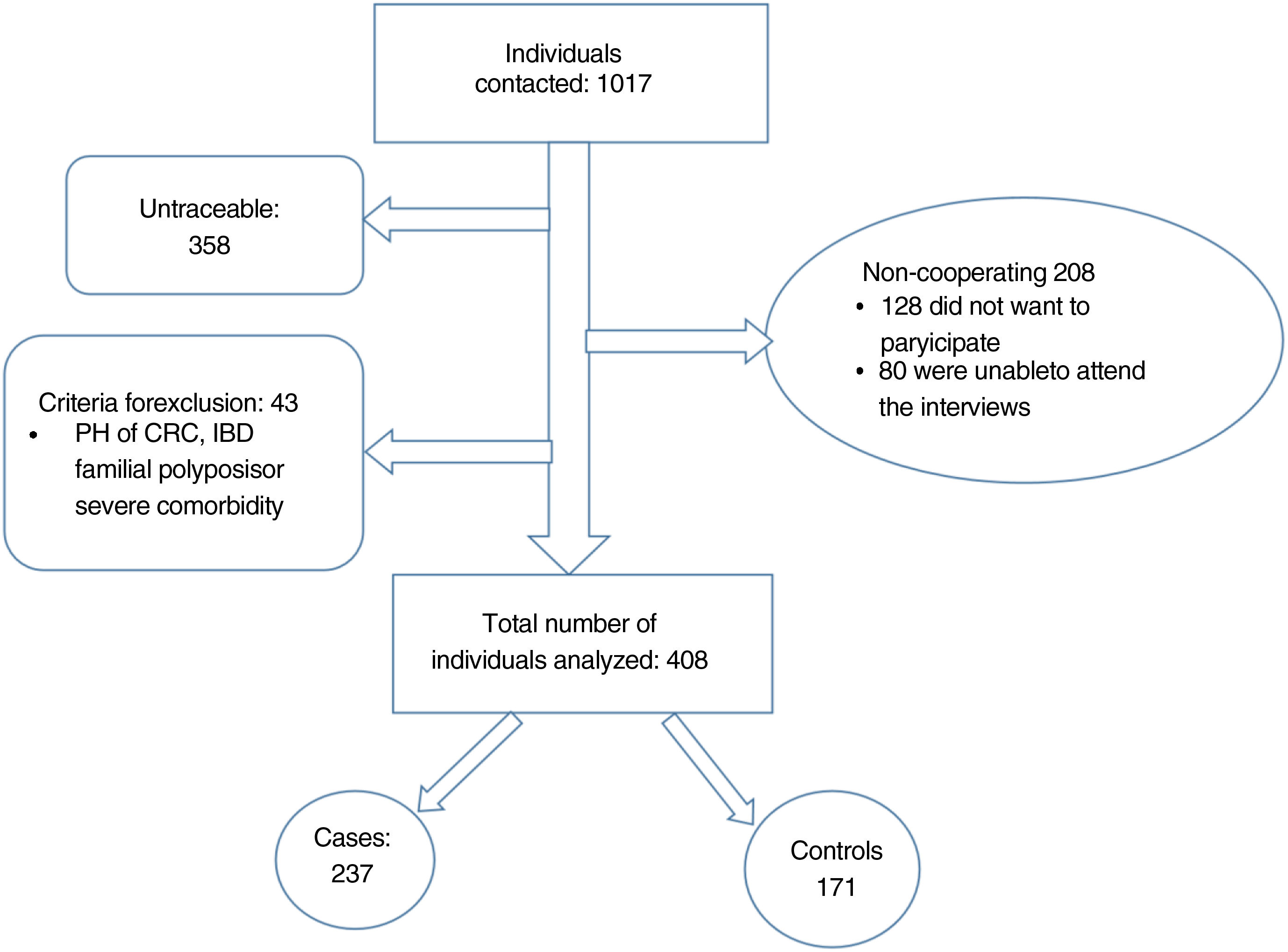
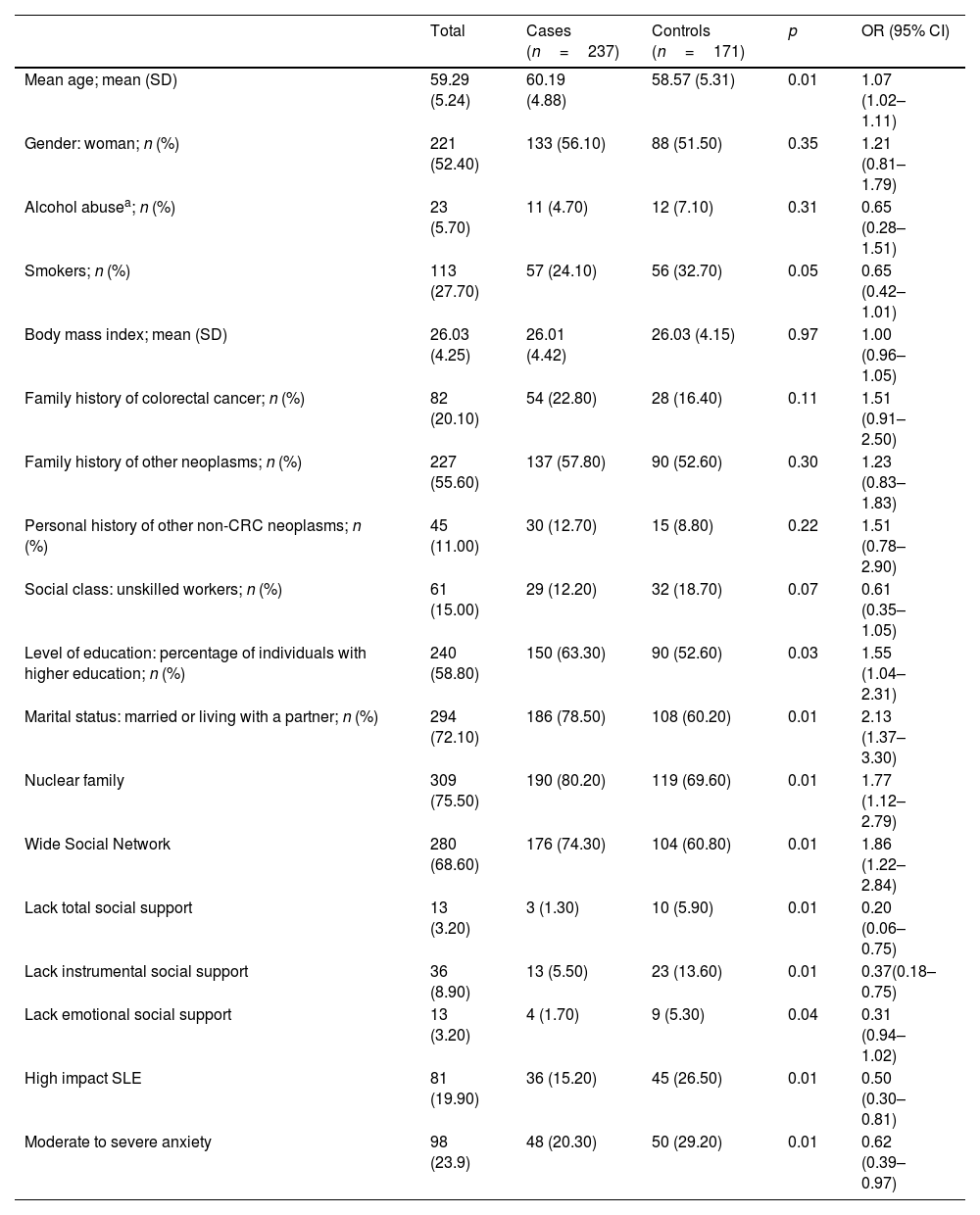
ResultsA total of 1017 individuals were invited to participate in the study. As shown in Fig. 1, 358 individuals could not be found; 128 did not want to participate; 80 were unable to attend the interviews; and 43 did not meet the criteria for inclusion. Out of 408 individuals included, 237 participated in the screening program (cases) and 171 did not participate (controls). No statistically significant differences were found between the individuals included/excluded with regard to age (59.51 vs. 59.12 years; p=0.18) and gender (223 vs. 309 women; p=0.28). Main characteristics of the sample are shown in Table 1.
Demographic, social and familial variables in colorectal cancer screening.
| Total | Cases (n=237) | Controls (n=171) | p | OR (95% CI) | |
|---|---|---|---|---|---|
| Mean age; mean (SD) | 59.29 (5.24) | 60.19 (4.88) | 58.57 (5.31) | 0.01 | 1.07 (1.02–1.11) |
| Gender: woman; n (%) | 221 (52.40) | 133 (56.10) | 88 (51.50) | 0.35 | 1.21 (0.81–1.79) |
| Alcohol abusea; n (%) | 23 (5.70) | 11 (4.70) | 12 (7.10) | 0.31 | 0.65 (0.28–1.51) |
| Smokers; n (%) | 113 (27.70) | 57 (24.10) | 56 (32.70) | 0.05 | 0.65 (0.42–1.01) |
| Body mass index; mean (SD) | 26.03 (4.25) | 26.01 (4.42) | 26.03 (4.15) | 0.97 | 1.00 (0.96–1.05) |
| Family history of colorectal cancer; n (%) | 82 (20.10) | 54 (22.80) | 28 (16.40) | 0.11 | 1.51 (0.91–2.50) |
| Family history of other neoplasms; n (%) | 227 (55.60) | 137 (57.80) | 90 (52.60) | 0.30 | 1.23 (0.83–1.83) |
| Personal history of other non-CRC neoplasms; n (%) | 45 (11.00) | 30 (12.70) | 15 (8.80) | 0.22 | 1.51 (0.78–2.90) |
| Social class: unskilled workers; n (%) | 61 (15.00) | 29 (12.20) | 32 (18.70) | 0.07 | 0.61 (0.35–1.05) |
| Level of education: percentage of individuals with higher education; n (%) | 240 (58.80) | 150 (63.30) | 90 (52.60) | 0.03 | 1.55 (1.04–2.31) |
| Marital status: married or living with a partner; n (%) | 294 (72.10) | 186 (78.50) | 108 (60.20) | 0.01 | 2.13 (1.37–3.30) |
| Nuclear family | 309 (75.50) | 190 (80.20) | 119 (69.60) | 0.01 | 1.77 (1.12–2.79) |
| Wide Social Network | 280 (68.60) | 176 (74.30) | 104 (60.80) | 0.01 | 1.86 (1.22–2.84) |
| Lack total social support | 13 (3.20) | 3 (1.30) | 10 (5.90) | 0.01 | 0.20 (0.06–0.75) |
| Lack instrumental social support | 36 (8.90) | 13 (5.50) | 23 (13.60) | 0.01 | 0.37(0.18–0.75) |
| Lack emotional social support | 13 (3.20) | 4 (1.70) | 9 (5.30) | 0.04 | 0.31 (0.94–1.02) |
| High impact SLE | 81 (19.90) | 36 (15.20) | 45 (26.50) | 0.01 | 0.50 (0.30–0.81) |
| Moderate to severe anxiety | 98 (23.9) | 48 (20.30) | 50 (29.20) | 0.01 | 0.62 (0.39–0.97) |
Case: participates in colorectal cancer screening. Control: does not participate in colorectal cancer screening. SLE: stressful life events.
A statistically significant association was detected between better adherence to CRC screening program and an older age (60.19±4.88 vs. 58.57±5.31 years; OR: 1.07, 95% CI: 1.02–1.11), having a stable partner (78.50% vs. 60.2%; OR: 2.13, 95% CI: 1.37–3.30), having a higher level of education (63.3% vs. 52.6%; OR: 1.55, 95% CI: 1.04–2.31) and belonging to a nuclear family (parents and children live together) instead of belonging to a non nuclear family (80.20% vs. 69.60%; OR: 1.77, 95% CI: 1.12–2.79). Worse adherence was related with suffering from moderate to severe anxiety (20.30% vs. 29.20%; OR: 0.62, 95% CI: 0.39–0.97) or experiencing high impact stressful life events (15.20% vs. 26.50%; OR: 0.50, 95% CI: 0.30–0.81). No differences were found between both groups with regard to gender, tobacco or alcohol use, body mass index, family or personal history of cancer, social class or other characteristics regarding quality of life, such as having problems with mobility or self-care, problems to carry out any physical activity or problems caused by pain.
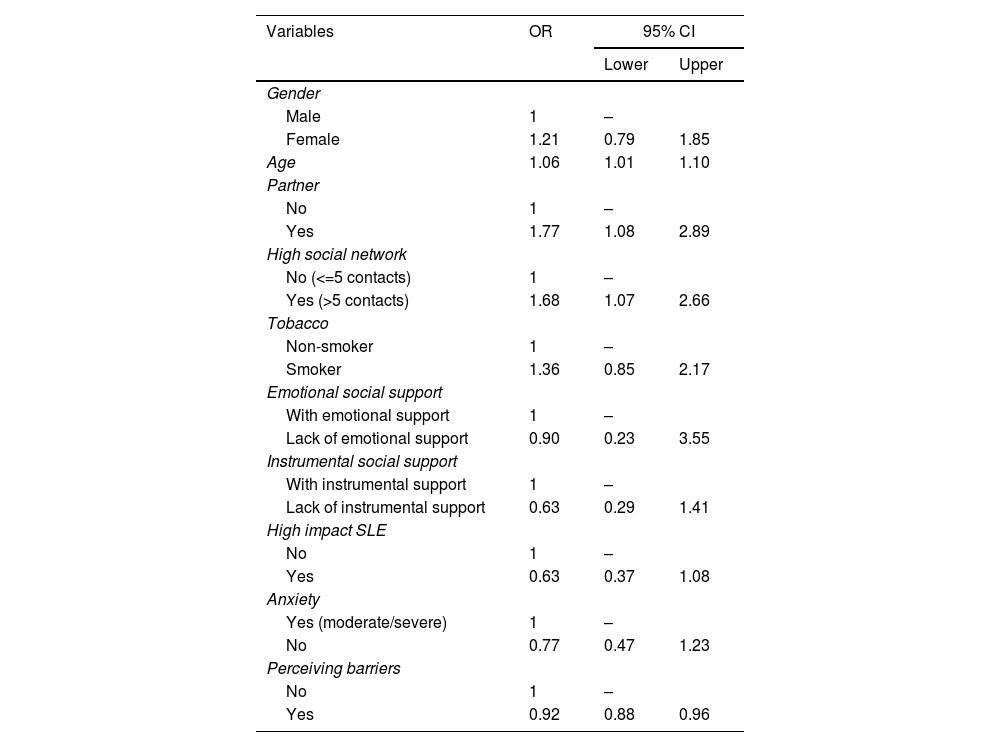
With regard to the relationship between the different dimensions of social support and adherence to CRC screening, statistical significances were shown in a wide social network (74.30% vs. 60.80%; OR: 1.86, 95% CI: 1.22–2.84), lack of global social support (1.30% vs. 5.90%; OR: 0.20, CI95%: 0.06–0.75) and lack of instrumental social support (5.50% vs. 13.60%; OR: 0.37, 95% CI: 0.18–0.75). We have not found significant differences between both groups with regard to lack of emotional social support (1.70% vs. 5.30%; OR: 0.31, 95% CI: 0.94–1.02), the lack of social interaction (4.20% vs. 5.80%; OR: 1.39, 95% CI: 0.59–3.26) or lack of affective social support (3.40% vs. 7.00%; OR: 2.08, 95% CI: 0.87–4.98). The multivariate logistic regression model (Table 2) shows that variables independently associated to adherence to a CRC screening were older age (OR: 1.06; 95% CI: 1.01–1.10), having a stable partner (OR: 1.77; 95% CI: 1.08–2.89), having a wide social network (OR: 1.68; 95% CI: 1.07–2.66) and objectifying barriers to participate in the CRC screening (OR: 0.92, 95% CI: 0.88–0.96). Experiencing high impact stressful life events maintains the trend to reduce the participation in CRC screening determined in the bivariate analysis, but remains in the verge of statistical significance (OR=0.63, 95% CI: 0.37–1.08). We have not found statistically significant differences in the rate of participation in CRC screening between patients experiencing SLE based on their SS; therefore, we have been unable to demonstrate in our sample the indirect or buffering effect described in the literature.
Logistic regression model for participation in colorectal screening with fecal occult blood test.
| Variables | OR | 95% CI | |
|---|---|---|---|
| Lower | Upper | ||
| Gender | |||
| Male | 1 | – | |
| Female | 1.21 | 0.79 | 1.85 |
| Age | 1.06 | 1.01 | 1.10 |
| Partner | |||
| No | 1 | – | |
| Yes | 1.77 | 1.08 | 2.89 |
| High social network | |||
| No (<=5 contacts) | 1 | – | |
| Yes (>5 contacts) | 1.68 | 1.07 | 2.66 |
| Tobacco | |||
| Non-smoker | 1 | – | |
| Smoker | 1.36 | 0.85 | 2.17 |
| Emotional social support | |||
| With emotional support | 1 | – | |
| Lack of emotional support | 0.90 | 0.23 | 3.55 |
| Instrumental social support | |||
| With instrumental support | 1 | – | |
| Lack of instrumental support | 0.63 | 0.29 | 1.41 |
| High impact SLE | |||
| No | 1 | – | |
| Yes | 0.63 | 0.37 | 1.08 |
| Anxiety | |||
| Yes (moderate/severe) | 1 | – | |
| No | 0.77 | 0.47 | 1.23 |
| Perceiving barriers | |||
| No | 1 | – | |
| Yes | 0.92 | 0.88 | 0.96 |
SLE: stressful life events.
Our study determines the association between the social network, age, having a stable partner, experiencing stressful life events and perceiving barriers to participate in colorectal cancer screening with fecal occult blood test, thus demonstrating the importance of social factors when engaging in preventive activities. This should be taken into account when designing future screening strategies and intervention studies in which primary care should play a leading role due to their deep knowledge of the patient and his or her environment.
Two hypotheses explain the impact of these psychosocial variables on human health. On the one hand, the direct effect hypothesis states that SS improves the physical and emotional wellbeing of the individuals directly impacting the immune and neuroendocrine response and/or through the adoption of healthy habits.5 On the other hand, the stress-buffering hypothesis holds that SS acts as a buffer between stress and illness, so that a higher SS would shield people from the negative effects of SLE.23
In a previous paper, we discussed the social and demographic characteristics and the impact of health beliefs on the adherence to a population screening program with FOBT.3 The data from our study determine that persons with a partner are 1.77 times more likely to participate in a CRC screening. These findings are consistent with the systematic reviews of Rogers et al. on African American population11 and Unanue-Arza et al. on American and European populations.12 There already exists previous evidence of the influence of marital status on participation in CRC screening through qualitative investigation studies.24 An ample cross-sectional study recently carried out in Denmark notes that unmarried individuals have a negative relationship in relation to participation in the screening; it also highlights the importance of agreement with the attitude of the spouse, so much so that married individuals whose spouse also takes part in the CRC screening are 5 times more likely to participate. This effect is similar in men and women.25 A recent study found that unmarried individuals have more advanced-stage diagnosis with respect to married individuals, who have better survival rates. The protective effect of marriage is greater in men than in women. Authors also point out that the COVID-19 pandemic stress could be increasing the participation of unmarried individuals in CRC screening.26
Our data establish a statistically significant relationship between individuals with more than 5 contacts in their social network and greater participation in CRC screening; on the contrary, persons with low perceived social support have lower participation rates. As early as 2006, Tessaro et al.,27 after analyzing data from focus groups, recommended strategies in social support to increase CRC and stressed the importance of the social network of the parishes in churchgoing population. This was latter attested by Rogers et al. 2017 in their systematic review in African American population11; there is also another important social net originating from the healthcare providers (family physicians and community nurses) as a source of social support which influences the behavior with regard to CRC screening. A recent publication about 319 black non-Hispanic males in Ohio/Minnesota/Utah reports a similar effect to that reported by our study with regard to low social support and lower CRC screening participation.26
With regard to functional social support subtypes, we have found an association between the lack of instrumental and emotional support and a lower CRC screening rate, although it loses its statistical significance in the multivariate analysis. Rogers et al. highlights not only the importance of the social network, but the type of support it transmits.11 Brittain et al. identify perceived family social support, measured with the same instrument we use, as the factor associated with CRC screening in African Americans.28 Dominic et al. identify lack of emotional support by the spouse and family members as a barrier to CRC screening in Pennsylvania Latinos.24 Jeihooni et al. likewise identify, in the city of Fasa (Iran) lack of perceived social support with a lower CRC screening rate.29
We have found that patients experiencing high impact SLE undergo fewer CRC screening. We have not found other studies analyzing this aspect in the literature. However, Azizi et al. using the same scale as we do, found that SLEs in the population of Fasa (Iran), are related to a risk of experiencing CRC with a gradient-dependent effect similar to classic epidemiological studies.30 According to this, there already exist scales of Predictive Models for CRC including SLEs and marital status among the quantifiable variables.31 A meta-analysis of 300 studies explains the physiopathology of this phenomenon, concluding that SLEs decrease humoral and cellular immunity and effects vary in accordance with the type of SLE. So, the death of the spouse would diminish the cytotoxicity of the natural killers; on the contrary, unemployment and disability would affect the proliferative response of the T-cells. By means of the stress hormones, SLEs may increase growth and extension of tumors by stimulating neovascularization, migration and cell invasion. We also know that the bowel is especially sensitive to the effects of stress. A good social support has been related to lower levels of angiogenic factors (IL-6 and VEGF) in cancer patients.32 Our study has not been able to demonstrate the indirect or buffering effects of SS on the SLEs described in the literature; this could be due to a problem in the sample size or to the fact that, in this case, stress caused by SLEs affects only the behavior in the preventive activity. Our findings could partly explain higher mortality in patients with CRC and SLE because they undergo fewer CRC screenings.
There are five types of interventions on SS: encouraging ties of the existing social network, developing new social networks, improving social support with community healthcare providers or “indigenous natural helpers”, acting on the capacities of the community or implementing combined or mixed interventions. With regard to social support interventions on CRC screening, we have 2 meta-analyses and 2 systematic revisions. Tsipa et al. analyze 102 studies involving 1.99 million participants and conclude that the most effective interventions are those combined and with a community profile, as they connect the participants with their social environment.14 Interventions are equally effective regardless of age, gender and family history of CRC. They are strengthened if healthcare providers are involved, reminders are sent, and health education is performed face to face, avoiding remote communication. They are more effective in countries without free health services. In the meta-analysis of 13 studies and 8090 individuals by Jieman Hu et al., the effectiveness of interventions with peer support (which contributes with “peer counseling”, “peer education” and “peer navigation”) improves CRC screening especially in ethnic minorities and is a cost-effective strategy.13 Mojica et al. analyze in their systematic review 44 studies in Latinos, confirming that peer support reduces barriers to CRC screening with strategies of one-to-one education.15 Kamala Adhikari et al. perform a systematic review of 12 studies with qualitative methodology, concluding that support from a cohesive healthcare team in primary care and social support from the families facilitate CRC screening. Multimodal interventions are more effective.16
Recent intervention studies show that social engagement with friends and family increase participation in CRC screening in Latinos and Iranian population with the same rural/urban effect.33,34 Studies with volunteer healthcare providers also show an increase in participation in CRC screening when the social network is enlarged and support is provided to Latino and African American populations.35 For individuals living in the Appalachians, recruitment of key players in the social network contributes to the improvement of CRC screening.36 Intervention studies on the internet take advantage of social networks and other mobile health technologies (mHealth) to increase cancer screenings with satisfactory results.37
We must point out as limitations in our study a potential selection bias due to untraceable and non-cooperating patients. We have no rural representation to see whether there are differences with urban population. Further studies will be necessary to extrapolate our results in populations with different social and demographic characteristics, as well as longitudinal and intervention studies to confirm the strength of the associations found.
As strengths of the study, we can say that all measurement instruments are validated in the literature; there are few European studies on urban population and mainly of upper social class. Nonetheless, the results found are in accordance with the literature; as far as we know, we have provided the first evidence of the influence of SLEs on CRC screening.
ConclusionWe can say that social and family variables influence participation in colorectal cancer screening with fecal occult blood test in Spanish medium risk individuals. Thus, we demonstrate that older age, having a stable partner, to have a wide social network, experiencing stressing events and perceiving barriers to screening are significantly related to adherence to CRC screening. This has to be taken into account when designing future strategies for preventive activities and intervention studies, where primary care professionals, who are specialized in the prevention of diseases, should play an essential role due to the SS that they are providing to the patients themselves and their deep knowledge of the socio-family situation of the patient.
Ethical considerationsThis study has been approved by the Comité Ético de Investigación de la Dirección General de Salud Pública y Centro Superior de Investigación en Salud Pública de Valencia (CEIDGSP-CSISP) [Research Ethics Committee of the General Directorate for Public Health and Higher Center for Public Health Research of Valencia], under registration number 20190301/04. The project was developed in accordance with the Declaration of Helsinki, the International Guidelines for Ethical Review of Epidemiological Studies, the European and Spanish regulations on biomedical research and the European (General Data Protection Regulation 2016/679, GDPR 2016) and Spanish (Organic Law 3/2018, of 5 December, on the Protection of Personal Data and Guarantee of Digital Rights; LOPDP-2018) regulations on the protection of personal data. The researchers signed a confidentiality agreement and specific measures were also taken to maintain the integrity and security of the data and to prevent the access of third parties to any identified or identifiable personal data. No paper or report derived from the study shall use or contain identified or identifiable data or images. All participants signed the informed consent.
Author contributionsConceptualization: MM, NG, JC; Methodology: CM, MJF, JC; Formal analysis: TS, JC, MM; Data curation: MM, YH, JG, AT; Writing – review and editing: MM, NG, MJF, JC, CM; Supervision: JC, CM.
FundingThis work received funding from the Spanish Society of Family and Community Medicine – semFYC – by being the winner of a grant for the completion of doctoral theses Isabel Fernández 2021. Likewise, the Official College of Physicians of Pontevedra financed the translation of the article into English.
Conflict of interestThe authors declare that the research was conducted in the absence of any commercial or financial relationships that could be construed as a potential conflict of interest.
To all my promotion colleagues, tutors, and especially my father for his unconditional support. To SEMFYC for financing this project with one of its grants.