
metricas
covid
Gastroenterología y Hepatología Fecal elastase-1 and 13C-mixed triglyceride breath test vs. coefficient of fat a...
Información de la revista
Vol. 48. Núm. 10.
(Diciembre 2025)
Compartir
Descargar PDF
Más opciones de artículo
Visitas
720
Vol. 48. Núm. 10.
(Diciembre 2025)
Original article
Fecal elastase-1 and 13C-mixed triglyceride breath test vs. coefficient of fat absorption to diagnose exocrine pancreatic insufficiency after pancreatic surgery
Elastasa fecal-1 y prueba de aliento con 13C-triglicéridos mixtos vs. coeficiente de absorción de grasa en el diagnóstico de insuficiencia pancreática exocrina después de cirugía pancreática
Visitas
720
Paula Sirera-Sireraa, Núria Lluísb, Fèlix Lluísc, Pedro Zapaterd,e,f, Pablo López-Guilléng, José M. Ramia-Ángelc, Rahma Amranih, Trinidad Castillo-Garcíah, José Andreu-Viserasg, Karina Cárdenas-Jaéng, Lucía Guilabertg, Sara Pérez-Brotonsg, Emma Martínez-Moneoi, Nerea Gendive-Martini, Iván González Hermosoa, Enrique de-Madariag,j,
Autor para correspondencia
emadaria@umh.es

Corresponding author.
, María José Ferria
a Department of Clinical Analysis, Dr. Balmis General University Hospital, ISABIAL, Alicante, Spain
b Department of Surgery, Hospital of the University of Pennsylvania, Philadelphia, PA, USA
c Department of Surgery, Dr. Balmis General University Hospital, ISABIAL, Alicante, Spain
d Department of Clinical Pharmacology, Dr. Balmis General University Hospital, ISABIAL, Alicante, Spain
e Centro de Investigación Biomédica en Red de Enfermedades Hepáticas y Digestivas (CIBEREHD), Madrid, Spain
f IDiBE, Miguel Hernandez University, Elche, Spain
g Department of Gastroenterology, Dr. Balmis General University Hospital, ISABIAL, Alicante, Spain
h Department of Endocrinology, Dr. Balmis General University Hospital, ISABIAL, Alicante, Spain
i Department of Gastroenterology, Cruces University Hospital, Barakaldo, Spain
j Department of Clinical Medicine, Faculty of Medicine, Miguel Hernandez University, Elche, Spain
Ver más
Este artículo ha recibido
Información del artículo
Resumen
Texto completo
Bibliografía
Descargar PDF
Estadísticas
Figuras (2)
Tablas (6)
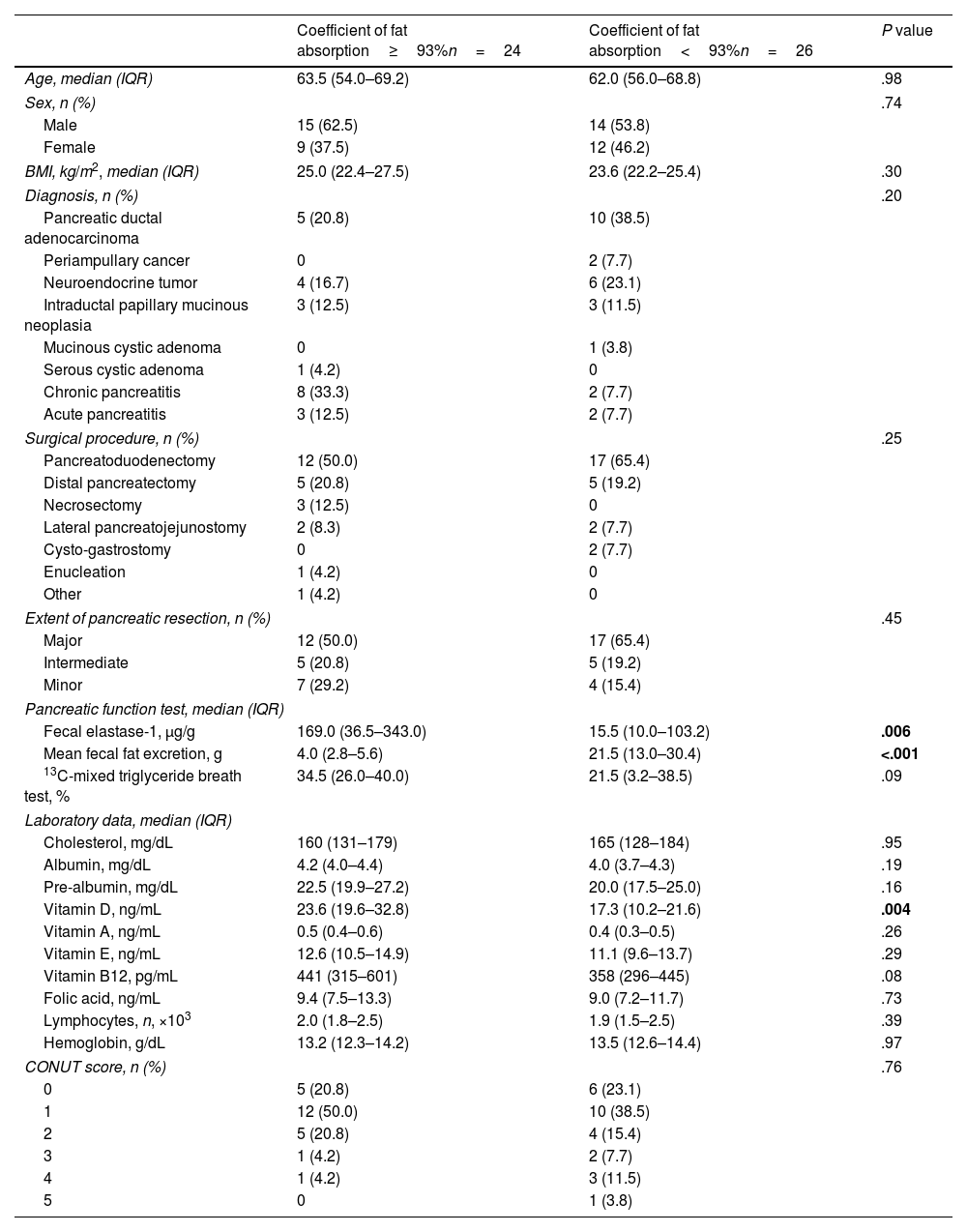
Table 1. Demographic and clinical characteristics of patients ranked by the malabsorption-defining coefficient of fat absorption.
Tablas
Table 2. Diagnostic accuracy of different cut-off points for fecal elastase-1, and 13C-mixed triglyceride breath test in the diagnosis of exocrine pancreatic insufficiency after pancreatic surgery.
Tablas
Table 3. Contingency table including patients diagnosed with exocrine pancreatic insufficiency according to coefficient of fat absorption<93%, fecal elastase-1 (<65.5μg/g, and 13C-mixed triglyceride breath test<22.5%.
Tablas
Table 4. Demographic and clinical characteristics of patients ranked by the fecal elastase-1 best cut-off point.
Tablas
Table 5. Characteristics of patients ranked by 13C-mixed triglyceride breath test best cut-off point.
Tablas
Table 6. Demographic and clinical characteristics of patients ranked by extent of pancreatic resection.
Tablas
Mostrar másMostrar menos
Abstract
Objective

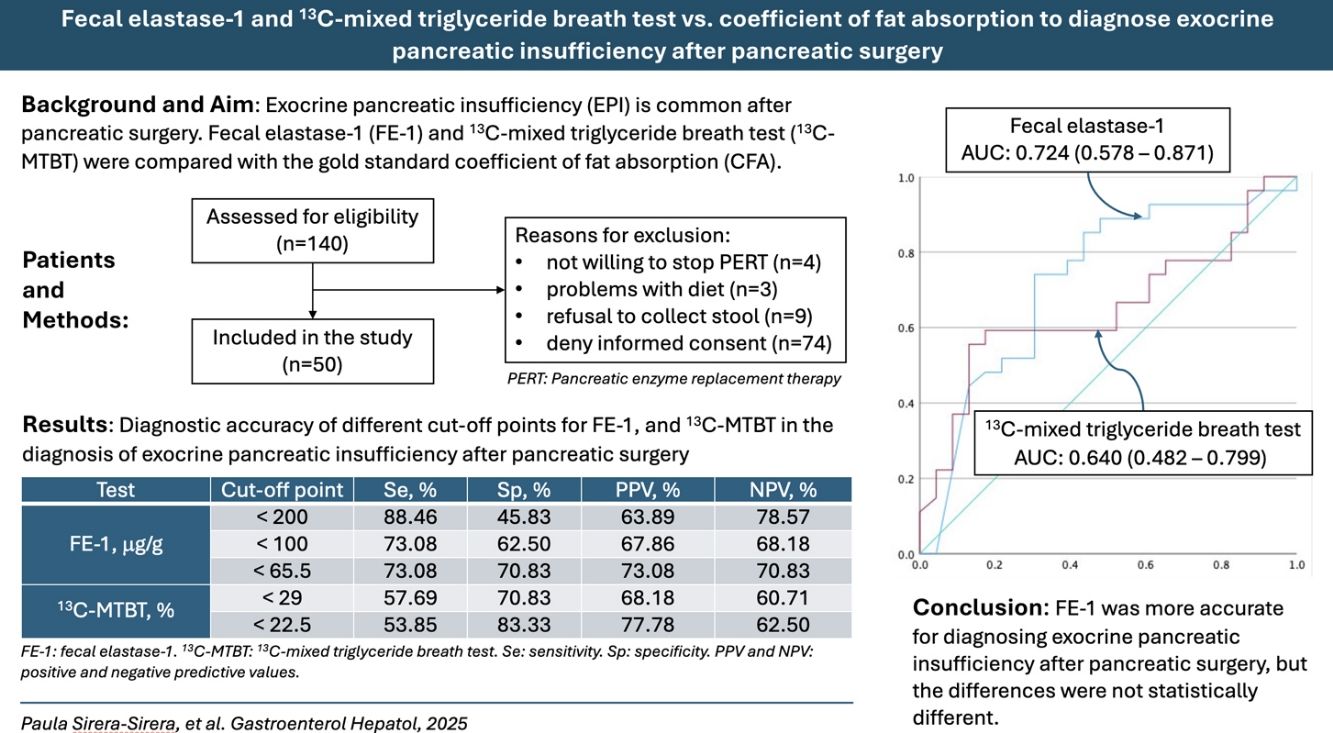
Exocrine pancreatic insufficiency (EPI) is common after pancreatic surgery. In patients with chronic pancreatitis, our previous results supported the use of fecal elastase-1 (FE-1) over the 13C-mixed triglyceride breath test (13C-MTBT) for the diagnosis of EPI. However, it is poorly established how the performance of these two tests compares to the diagnosis of EPI after pancreatic surgery.

Patients and methods

FE-1 and 13C-MTBT were compared with the gold standard coefficient of fat absorption (CFA). Area under ROC curve (AUC) and best cutoffs were used to assess presence of EPI. Patient characteristics were evaluated by extent of pancreatic resection.

Results

The AUC (95% confidence interval) was 0.724 (0.578–0.871) for FE-1 and 0.640 (0.482–0.799) for 13C-MTBT in the diagnosis of EPI. A pairwise comparison of the FE-1 and 13C-MTBT AUCs showed no statistically significant difference (P=.20). The best cut-off point was 65.5μg/g for FE-1 and 22.5% for 13C-MTBT. According to contingency analysis, both the FE-1 threshold of 65.5μg/g (P=.005) and the 13C-MTBT threshold of 22.5% (P=.015) showed statistical significance for diagnosing EPI.

Conclusion

FE-1 was more accurate for diagnosing EPI after pancreatic surgery, but the differences were not statistically different.

Keywords:
Pancreatic diseases/surgery*
Exocrine pancreatic insufficiency/diagnosis
Postoperative complications/diagnosis
Feces/chemistry
Malnutrition/diagnosis
Abbreviations:
13C-MTBT
AUC
BMI
CFA
ELISA
EPI
FE-1
IQR
PERT
Resumen
Objetivo

La insuficiencia pancreática exocrina (EPI) es común después de cirugía pancreática. En pacientes con pancreatitis crónica, nuestros datos favorecen el uso de elastasa fecal-1 (FE-1) sobre la prueba de aliento con 13C-triglicéridos mixtos (13C-MTBT). Sin embargo, es necesario comparar estas dos técnicas en el diagnóstico de EPI después de cirugía pancreática.

Pacientes y métodos

FE-1 y 13C-MTBT se compararon con el coeficiente de absorción de grasa (CFA). La detección de EPI se hizo mediante el área bajo la curva (AUC) ROC y los mejores puntos de corte. Las características de los pacientes se compararon en función de la amplitud de resección pancreática.

Resultados

El AUC (95% intervalo de confianza) fue 0,724 (0,578 – 0,871) para FE-1 y 0,640 (0,482 – 0,799) para 13C-MTBT en el diagnóstico de EPI. No hubo diferencia estadística (P=0,20) al comparar los AUC de FE-1 y 13C-MTBT. El mejor nivel de corte fue 65,5μg/g para FE-1 y 22,5% para 13C-MTBT. Mediante análisis de contingencia, tanto el umbral de 65,5μg/g para FE-1 (P=0,005) como el umbral de 22,5% para 13C-MTBT (P=0,015) mostraron diferencias significativas en el diagnóstico de EPI.

Conclusión

FE-1 fue más precisa que 13C-MTBT en el diagnóstico de EPI después de cirugía pancreática, pero estas diferencias no fueron estadísticamente significativas.


Palabras clave:
Enfermedades pancreáticas/cirugía*
Insuficiencia pancreática exocrina/diagnóstico
Complicaciones postoperatorias/diagnóstico
Heces/química
Malnutrición/diagnóstico
Resumen gráfico

Artículo

Opciones para acceder a los textos completos de la publicación Gastroenterología y Hepatología
Suscriptor
Suscriptor de la revista

Si ya tiene sus datos de acceso, clique aquí.

Si olvidó su clave de acceso puede recuperarla clicando aquí y seleccionando la opción "He olvidado mi contraseña".
Suscribirse
Suscribirse a:

Gastroenterología y Hepatología

Comprar
Comprar acceso al artículo

Comprando el artículo el PDF del mismo podrá ser descargado

Comprar ahora
Contactar
Teléfono para suscripciones e incidencias
De lunes a viernes de 9h a 18h (GMT+1) excepto los meses de julio y agosto que será de 9 a 15h
Llamadas desde España
932 415 960
Llamadas desde fuera de España
+34 932 415 960
E-mail
Opciones de artículo
Herramientas