









To present an overview to summarize the efficacy and safety of biologics for the treatment of Crohn's disease (CD).
MethodsWe gathered systematic reviews or meta-analyses on the efficacy and safety of biologic therapy for CD from the beginning to September 30, 2023, by searching the databases of the Chinese National Knowledge Infrastructure (CNKI), WanFang Data, China Science and Technology Journal Database, Web of Science, the Cochrane Library, PubMed, and Embase. Analysing reviews and extracting data, two researchers worked independently. Any discrepancies in the two researchers’ assessments of the review process were reevaluated, and the argument was settled by consulting to other researchers. The following details was taken out of the data: author, publication year, study type, number of included studies, country of study, sample size, risk bias tools, biologic therapy, and primary outcomes. Grades of Recommendation, Assessment, Development, and Evaluation (GRADE) and the AMSTAR-2, a critical appraisal tool for systematic reviews (2nd edition), were then utilized to assess the methodological quality and reporting quality of the evidence.
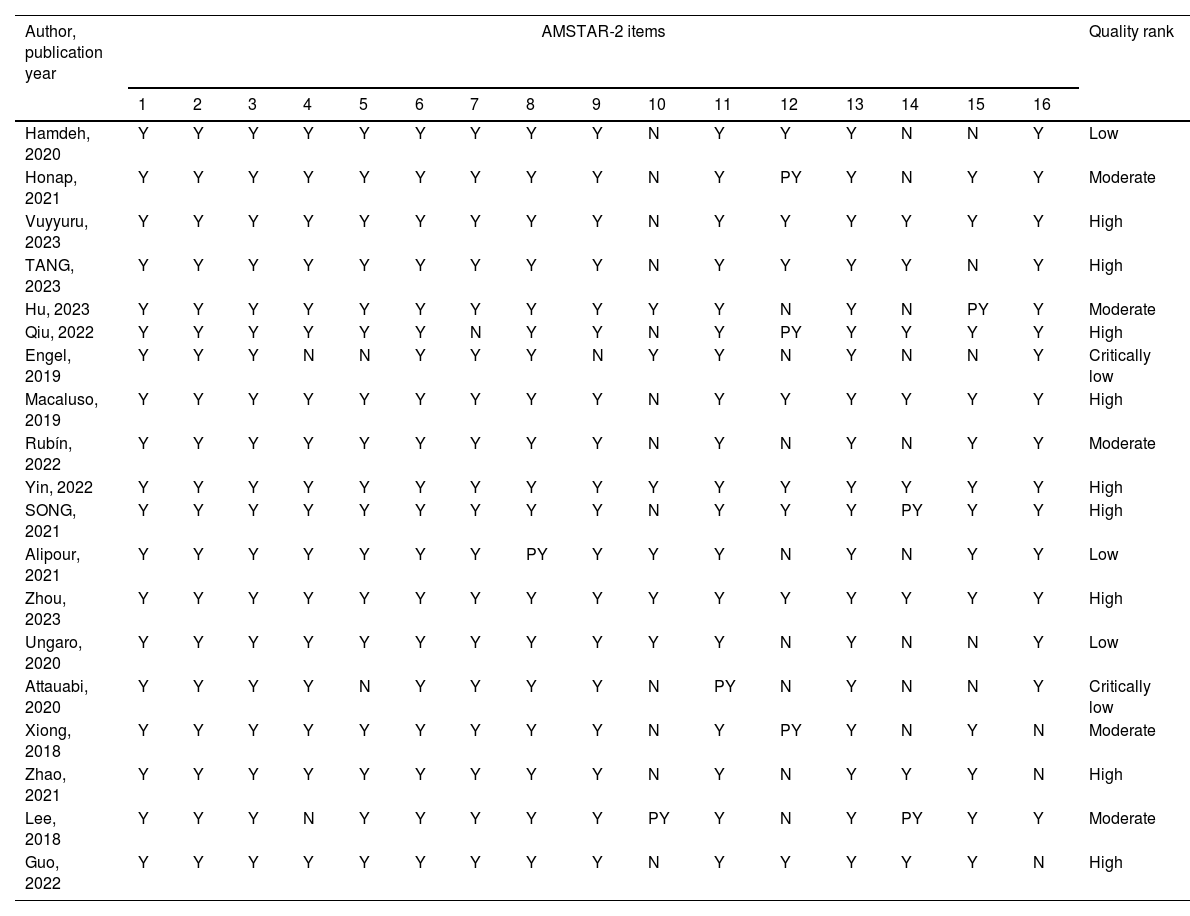
ResultsThere were 19 reviews in all. One systematic review, 5 meta-analyses, and 13 systematic reviews and meta-analyses were among the reviews that were included. Nine studies met the high quality, 5 met the moderate quality, 3 met the poor quality, and 2 met the critically low quality requirements of the AMSTAR-2 criteria.
ConclusionsThe analysis of the evidence finds biologic agents for CD are effective and safe. Overall, there was moderate to high quality biologic evidence for CD, but future head-to-head controlled studies are required to better inform the relative positioning of these drugs for the management of CD.
Ofrecer una visión general que sintetice la eficacia y la seguridad de los productos biológicos en el tratamiento de la enfermedad de Crohn (EC).
MétodosSe recopilaron revisiones sistemáticas y metaanálisis sobre la eficacia y la seguridad de la terapia biológica para la EC desde su inicio hasta el 30 de septiembre de 2023, mediante búsquedas en las bases de datos Chinese National Knowledge Infrastructure (CNKI), WanFang Data, China Science and Technology Journal Database, Web of Science, Cochrane Library, PubMed y Embase. Dos investigadores trabajaron independientemente analizando las revisiones y extrayendo los datos. Cualquier discrepancia en las evaluaciones del proceso de revisión fue reevaluada; además, se resolvieron los desacuerdos consultando a otros investigadores. Se eliminaron los siguientes detalles: autoría, año de publicación, tipo de estudio, número total de estudios incluidos, país del estudio, tamaño muestral, herramientas utilizadas para evaluar sesgos y resultados primarios relacionados con la terapia biológica. Posteriormente se aplicaron las metodologías Grading of Recommendations Assessment Development and Evaluation (GRADE) y AMSTAR-2 como herramientas críticas, con el fin de valorar tanto la calidad metodológica como la calidad informativa del conjunto estudiado.
ResultadosSe identificaron un total de 19 artículos. Dentro del grupo seleccionado se incluyeron una revisión sistemática completa, 5 metaanálisis y 13 combinaciones entre revisiones sistemáticas y metaanálisis. De estos estudios evaluados según criterios AMSTAR-2: 9 alcanzaron una calidad alta; 5 presentaron calidad moderada; mientras que 3 fueron considerados deficientes, y otros 2 mostraron requisitos críticamente bajos en cuanto a estándares cualitativos.
ConclusionesEl análisis de la evidencia muestra que los agentes biológicos son efectivos y seguros para tratar la EC. En términos generales existe evidencia científica clasificada entre moderada a alta respecto al uso terapéutico biológico en la EC, sin embargo, es imperativo realizar futuros estudios controlados cabeza a cabeza para mejorar el entendimiento sobre el posicionamiento relativo y el impacto clínico que estos fármacos tienen en el manejo integral de la enfermedad.